WPC (Wood Plastic Composite): Full Guide to Types, Uses, Price & Comparison with Plywood/MDF
Learn everything about WPC (Wood Plastic Composite)—types, uses, price range. Compare WPC boards vs plywood vs MDF for doors, furniture & exteriors.
Quick Decision Summary
WPC (Wood Plastic Composite) is the best waterproof board for bathroom doors, exterior applications, and high-moisture areas where plywood fails within months.
If you're in a hurry: WPC boards combine wood fibers with plastic polymers (typically 60-70% PVC or HDPE) to create a 100% waterproof, termite-proof panel that won't swell or warp. Unlike BWR or marine plywood that still absorbs some moisture, WPC is genuinely impervious to water—making it ideal for bathroom vanities, kitchen carcasses near sinks, outdoor furniture, and door frames in humid coastal cities. However, WPC costs 30-50% more than equivalent plywood, weighs significantly more, and doesn't hold screws as well for load-bearing applications.
- Choose WPC if: Your application involves direct water contact, outdoor exposure, bathroom doors/cabinets, or coastal environments with salt air
- Choose WPC if: Termite prevention is critical and fumigation isn't reliable in your area
- Avoid WPC if: You need strong screw-holding for heavy wardrobes with multiple hinges
- Avoid WPC if: Budget is tight and the application doesn't involve moisture exposure
- Avoid WPC if: You need to bend, shape, or route complex designs
Key takeaway: WPC is a specialist material for moisture-critical applications—not a universal plywood replacement, but unbeatable where water resistance matters most.
What WPC Actually Means: Composition, Construction, and Real-World Performance
WPC (Wood Plastic Composite) is an engineered panel made by combining wood flour or sawdust (typically 30-40%) with thermoplastic polymers like PVC, HDPE, or polypropylene (60-70%), along with additives for UV stability, color, and fire resistance. This creates a dense, homogeneous board that behaves like plastic on the outside but can be worked somewhat like wood.
The manufacturing process involves heating the wood-plastic mixture and extruding or molding it under high pressure. Unlike plywood's layered veneer construction or MDF's compressed fiber structure, WPC has a consistent composition throughout—meaning there's no core that can absorb water or delaminate. The plastic content forms a matrix that encapsulates the wood fibers completely, preventing moisture penetration at a cellular level.
Types of WPC Available in India
PVC-based WPC: Most common in India, uses polyvinyl chloride as the primary polymer. Offers excellent water resistance and dimensional stability. Slightly more rigid and brittle than HDPE variants. Available in densities from 650-800 kg/m³.
HDPE-based WPC: Uses high-density polyethylene, resulting in slightly better impact resistance and flexibility. More common in outdoor decking applications. Generally more expensive than PVC variants.
Foam-core WPC: Lighter weight with a cellular foam structure inside. Reduces weight by 20-30% while maintaining surface hardness. Better for large panels where weight is a concern.
Solid WPC: Denser, heavier construction without foam. Better screw-holding and structural strength. Preferred for door frames and applications requiring fasteners.
Common Misconceptions About WPC
Many buyers assume WPC is simply "better plywood" or "plastic plywood"—neither description is accurate. WPC performs differently than wood-based panels: it doesn't expand or contract with humidity changes, doesn't rot or support fungal growth, but also doesn't accept wood screws as reliably and can't be shaped with standard woodworking tools without specialized techniques. Understanding these differences is essential for correct application.
India-Specific Reality Check: Monsoons, Coastal Conditions, and Ground-Level Issues
WPC's water resistance makes it particularly valuable in India's challenging climate conditions. During monsoon months when relative humidity exceeds 85-90%, conventional plywood—even BWR grade—absorbs atmospheric moisture and swells. Coastal cities like Mumbai, Chennai, Kochi, and Visakhapatnam face additional challenges from salt-laden air that accelerates metal hardware corrosion and wood degradation.
Monsoon Performance: WPC vs Traditional Boards
In high-humidity zones (coastal areas, Kerala backwaters, Kolkata, Assam), WPC maintains dimensional stability that plywood cannot match. A bathroom door frame made from ordinary plywood in Chennai might swell and jam within two monsoon seasons. The same application in WPC will remain unchanged for 15-20 years. This isn't marketing—it's basic material science. The plastic matrix simply doesn't absorb water.
However, WPC does have thermal expansion characteristics. In areas with extreme temperature swings (Delhi's 45°C summers to 5°C winters), WPC panels can expand 2-3mm per meter. This matters for large installations—leave appropriate expansion gaps at edges.
Storage and Handling on Indian Sites
Unlike plywood, WPC doesn't require careful moisture protection during storage. This is actually a significant practical advantage on Indian construction sites where materials often sit exposed for weeks. However, WPC boards should be stored flat to prevent warping from uneven weight distribution. The boards are heavier than equivalent plywood—an 18mm WPC sheet weighs approximately 25-30 kg compared to 18-22 kg for plywood of the same size.
Contractor Practices and Pitfalls
Most Indian carpenters (mistris) are unfamiliar with WPC and treat it like plywood—leading to problems. Common mistakes include using wood screws instead of proper machine screws, not pre-drilling pilot holes, applying excessive pressure during cutting, and attempting to nail directly into the material. Always brief your carpenter specifically about WPC handling requirements before work begins.
Regional variations matter: WPC is more commonly used and better understood in metros like Bangalore, Mumbai, and Hyderabad. In tier-2 cities, finding carpenters with WPC experience may be difficult—factor in potential learning curve and supervision requirements.
WPC Types, Grades, and Thickness Options Available in India
WPC boards in India are available in several thickness options and grades, each suited to specific applications. Unlike plywood's IS 303/710/848 grading system, WPC doesn't have standardized BIS grades yet—quality varies significantly between manufacturers.
Standard Thickness Options
| Thickness | Primary Applications | Weight (per 8x4 sheet) | Typical Use Case |
|---|---|---|---|
| 5-6mm | Wall paneling, decorative applications | 12-15 kg | Bathroom wall cladding |
| 8-10mm | Cabinet backs, partition infills | 18-22 kg | Kitchen cabinet backs |
| 12mm | Cabinet carcasses, shutters | 24-28 kg | Bathroom vanity boxes |
| 17-18mm | Structural applications, doors | 30-38 kg | Door frames, main shutters |
| 19-25mm | Door frames, heavy-duty applications | 35-45 kg | External door frames |
Surface Finish Options
Plain WPC: Smooth surface ready for laminate or veneer application. Most versatile option.
Pre-laminated WPC: Factory-applied laminate finish in various colors and wood grains. Reduces on-site work but limits customization.
Textured/Embossed WPC: Surface texture mimicking wood grain. Often used for exterior cladding where natural appearance is desired.
PU/Lacquer-finished WPC: Factory-applied polyurethane or lacquer coating. Ready-to-install for certain applications.
Color Options
Unlike plywood which requires finishing, WPC comes in through-body colors—meaning the color extends throughout the material, not just on the surface. Common options include white, cream, grey, brown, and wood-tone colors. This is advantageous for edge-visible applications where laminate edge-banding isn't desired.
Price Range and Cost Drivers (2026 Market Conditions)
WPC board prices in India typically range from ₹85-180 per square foot depending on thickness, density, brand, and city. This makes WPC 30-60% more expensive than comparable BWR plywood but significantly cheaper than marine-grade plywood with similar moisture performance.
Thickness-Wise Price Ranges
| Thickness | Economy Brands (₹/sq ft) | Premium Brands (₹/sq ft) | Pre-laminated (₹/sq ft) |
|---|---|---|---|
| 8mm | 55-70 | 80-100 | 95-125 |
| 12mm | 75-95 | 105-130 | 125-160 |
| 18mm | 95-120 | 135-170 | 160-200 |
| 25mm | 130-160 | 180-220 | 210-260 |
Prices vary by city, quantity, and market conditions. Confirm with local suppliers.
What Drives WPC Pricing
Polymer quality: Virgin PVC vs recycled plastic significantly affects price and long-term performance. Premium brands use virgin polymers with UV stabilizers—essential for outdoor applications but adding 20-30% to cost.
Density: Higher density (750-850 kg/m³) WPC costs more but offers better screw-holding and structural performance than lower density (600-700 kg/m³) variants.
Wood fiber content: Higher wood content (above 40%) gives better workability but may compromise water resistance. Pure PVC boards cost more but offer superior moisture performance.
Surface finish: Pre-laminated or textured surfaces add ₹15-40 per square foot over plain boards.
City variations: Bangalore and Chennai typically have competitive WPC pricing due to proximity to manufacturers. Delhi, Kolkata, and smaller cities may see 10-20% higher prices due to logistics.
Budget Estimation for Common Applications
For a typical 100 sq ft bathroom renovation using 12mm WPC for vanity, cabinet, and door frame: expect material cost of ₹12,000-18,000 for boards plus ₹4,000-7,000 for hardware and finishing—total ₹16,000-25,000 before labor. Compare this to BWR plywood at ₹10,000-15,000 for the same application, but with likely replacement needed within 5-8 years in humid conditions.
Head-to-Head Comparison: WPC vs Plywood vs MDF vs HDHMR
Understanding when to use WPC versus alternatives requires comparing performance across multiple parameters. No single material wins everywhere—each has optimal use cases.
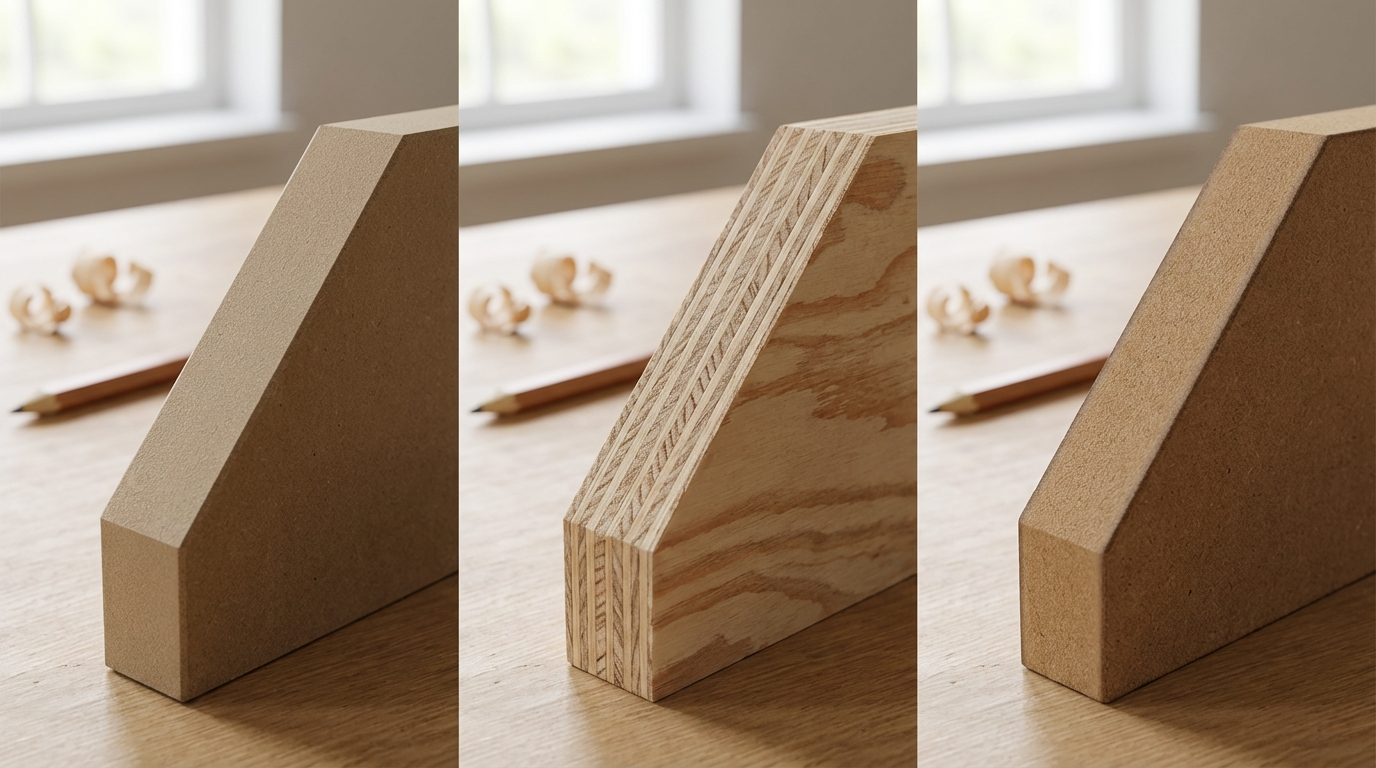
| Parameter | WPC | BWR Plywood | Marine Plywood | MDF | HDHMR |
|---|---|---|---|---|---|
| Water Resistance | 100% waterproof | Resistant, not waterproof | Highly resistant | Very poor | Moderate |
| Termite Resistance | 100% termite-proof | Treated, not immune | Treated, not immune | Poor | Moderate |
| Screw Holding | Moderate (needs pilot holes) | Excellent | Excellent | Poor | Good |
| Weight | Heavy (750-850 kg/m³) | Medium (550-650 kg/m³) | Medium (600-700 kg/m³) | Medium (700-800 kg/m³) | Heavy (850-950 kg/m³) |
| Machinability | Moderate | Excellent | Excellent | Excellent | Good |
| Cost (18mm, ₹/sq ft) | 95-170 | 55-85 | 90-140 | 35-55 | 55-80 |
| Lifespan (bathroom use) | 15-25 years | 5-10 years | 10-15 years | 2-4 years | 5-8 years |
| Best For | Wet areas, outdoors | General furniture | Kitchen carcasses | Dry interior panels | Modular furniture |
Decision Rules: When to Choose What
Choose WPC when: Application involves direct water contact (bathroom vanities, outdoor furniture, kitchen sink areas), termite risk is high and treatment unreliable, long-term waterproofing outweighs higher initial cost, coastal location with salt air exposure.
Choose BWR Plywood when: Strong screw-holding is essential (wardrobe carcasses with multiple hinges), budget is primary concern and moisture exposure is limited, carpenter expertise with plywood is readily available, complex joinery or routing is required.
Choose Marine Plywood when: Kitchen carcasses in non-direct-water areas, high-humidity zones without direct water contact, long lifespan needed with better workability than WPC.
Choose HDHMR when: Modular/factory-made furniture with CNC routing, budget-conscious applications with moderate moisture exposure, pre-laminated finish desired with consistent density.
For detailed plywood grade comparisons, our MR vs BWR plywood guide covers moisture-resistance differences comprehensively.
Applications: Where WPC Excels and Where It Falls Short
WPC's unique properties make it ideal for specific applications while being unsuitable for others. Understanding this distinction prevents costly mistakes.
Ideal Applications for WPC
Bathroom door frames: Perhaps the single best use case for WPC in Indian homes. Bathroom door frames face constant humidity, occasional direct water splash, and condensation. WPC frames remain dimensionally stable and rot-free for decades.
Bathroom vanities and cabinets: Vanity units under washbasins face regular water splashes. WPC carcasses eliminate the swelling and delamination problems common with plywood vanities in humid bathrooms.
Kitchen sink cabinets: The cabinet directly under kitchen sinks is vulnerable to water damage from pipe connections, spills, and condensation. WPC for this specific cabinet—even while using plywood elsewhere—is a smart hybrid approach.
Outdoor furniture and structures: Garden furniture, balcony seating, pergola components, and exterior cladding benefit from WPC's complete weather resistance.
Commercial applications: Restaurant kitchens, hospital furniture, laboratory counters, and other commercial spaces where washdown cleaning is routine.
Is WPC Good for Modular Kitchens?
WPC can be excellent for modular kitchen carcasses, particularly in humid coastal cities or homes without air conditioning. However, it's typically overkill (and overpriced) for the entire kitchen. A practical approach: use WPC for sink base units and areas near the dishwasher, BWR plywood for other base units, and HDHMR or MR plywood for wall units where moisture exposure is minimal. This hybrid approach optimizes cost while addressing actual moisture risks.
Where WPC Underperforms
Heavy wardrobes: Large wardrobes with multiple doors require excellent screw-holding at hinge points. WPC's moderate screw retention makes it less suitable—stripped screws in WPC are difficult to repair compared to plywood.
Beds and structural furniture: Furniture bearing significant weight loads benefits from plywood's superior fastening characteristics.
Intricate woodworking: Carved designs, complex routing, and detailed joinery work better with solid wood or quality plywood than with WPC's synthetic composition.
Budget-constrained dry applications: For wardrobes in air-conditioned bedrooms, paying WPC premiums provides no practical benefit over good BWR plywood.
Workmanship and Installation: Getting It Right
Proper WPC installation differs significantly from plywood work. Briefing your carpenter thoroughly prevents common failures and ensures the material performs as designed.
Cutting and Machining
WPC cuts cleanly with standard woodworking tools but requires slower feed rates than plywood. Use carbide-tipped blades—standard steel blades dull quickly against the plastic content. Support the panel fully during cutting to prevent edge chipping. For CNC routing, reduce spindle speed by 20-30% compared to MDF settings.
Fastening and Screw-Holding
Critical rule: Always pre-drill pilot holes for all screws in WPC. Unlike plywood where screws can be driven directly, WPC's composite structure splits under direct screw insertion. Use pilot holes 70-80% of screw shank diameter.
Use machine screws or confirmat screws rather than wood screws—the thread design grips WPC's structure better. For critical hinge points, insert brass or steel threaded inserts during assembly. This provides reliable screw anchorage for hardware that may need adjustment or replacement later.
In 18mm WPC, standard screws provide approximately 40-50 kg pullout resistance compared to 70-90 kg in equivalent plywood. Plan hardware placement and reinforcement accordingly.
Edge Treatment
WPC edges can be left exposed (the through-body color handles it), covered with PVC edge-banding, or finished with aluminum edge profiles. Unlike plywood or MDF where exposed edges look unfinished, WPC's color consistency allows visible edges in many applications.
For edge-banding, use PVC tape with hot-melt adhesive—the same as MDF practice. Ensure the banding machine temperature is appropriate; WPC's plastic content can soften if overheated during application.
Site Storage and Acclimatization
While WPC doesn't need moisture protection like plywood, proper storage prevents warping:
- Store sheets flat on a level surface, not leaning against walls
- Keep sheets out of direct sunlight before installation—thermal expansion can cause temporary bowing
- Allow boards to acclimatize to room temperature for 48 hours if brought from significantly different storage conditions
- Don't stack more than 10-15 sheets without intermediate supports
Carpenter Briefing Checklist
Before your carpenter begins WPC work, confirm understanding of:
- Mandatory pilot holes for all screws
- Slower cutting speed requirements
- No direct nailing—ever
- Proper screw types (machine screws, not wood screws)
- Expansion gap requirements (2-3mm for panels over 1 meter)
- Edge support during cutting to prevent chipping
Quality Checks: Evaluating WPC Without Lab Equipment
WPC quality varies significantly between manufacturers. These field checks help assess quality at the dealer before purchase and after delivery to your site.
Visual Inspection Points
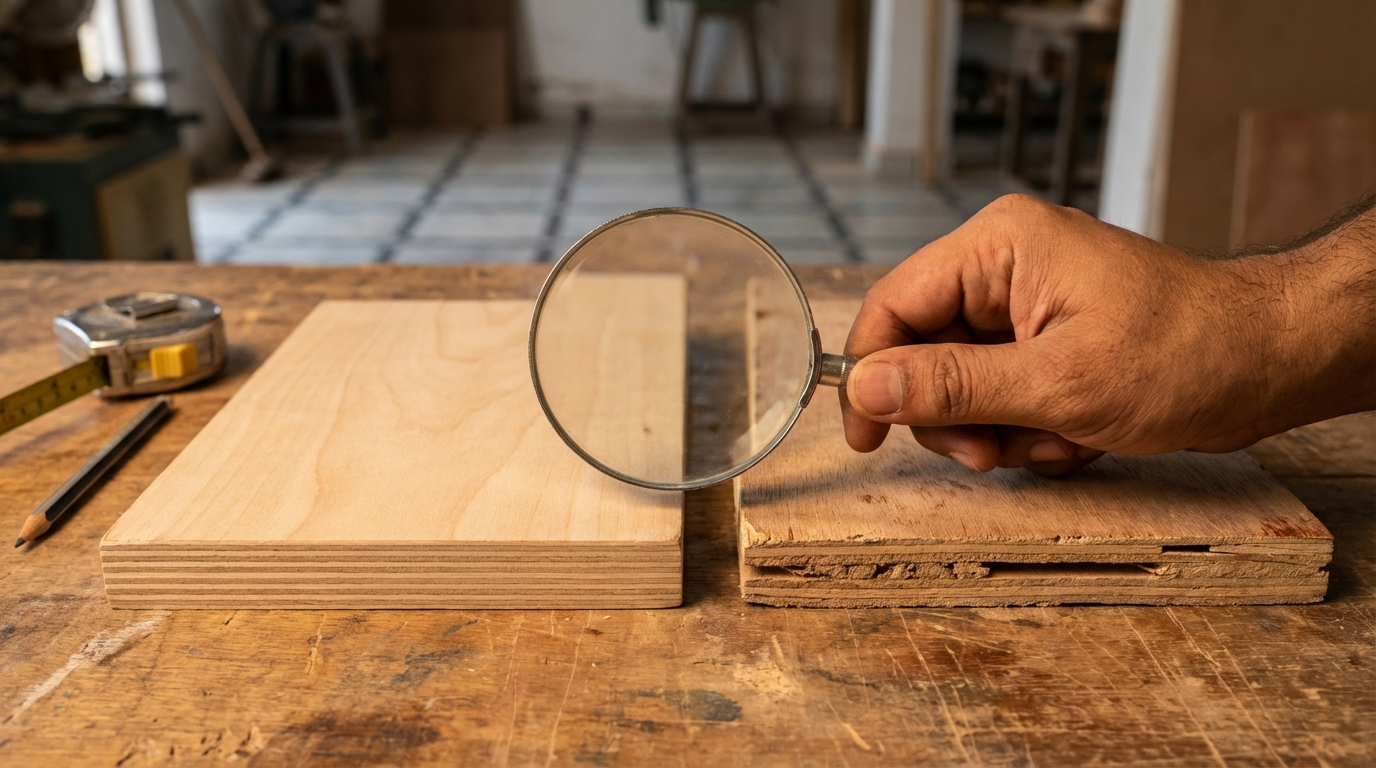
Surface consistency: Quality WPC has uniform color and texture across the sheet. Look for color variations, streaks, or patches indicating poor mixing or recycled material.
Edge examination: Cut edges should show homogeneous material throughout—no visible layers, voids, or color variations from surface to core.
Surface hardness: Press your fingernail firmly into the surface. Quality WPC shouldn't show permanent indentation from this simple test. Soft surfaces indicate low-density or poor-quality polymer.
Flatness: Place sheets on a flat surface and check for warping, bowing, or twisting. Some tolerance is acceptable (2-3mm over the sheet length), but significant deviation indicates manufacturing issues.
Simple Field Tests
Weight check: An 18mm 8x4 sheet of quality WPC weighs 30-38 kg. Significantly lighter boards (under 25 kg) may have excessive foam content or lower density—affecting screw-holding and durability.
Tap test: Knock on the board surface. Quality solid WPC produces a dense, dull sound. Hollow sounds indicate excessive foam content or internal voids.
Water drop test: Place water drops on the surface and cut edge. They should bead up and remain on the surface without absorption even after 30 minutes. Any absorption indicates compromised water resistance.
Flex test: For boards under 12mm thickness, gentle flexing should show uniform bending without cracking sounds or visible stress whitening.
Questions to Ask the Dealer
- What is the exact polymer composition (PVC, HDPE, or mixed)?
- What is the board density in kg/m³?
- Is the polymer virgin or recycled (recycled is acceptable but typically lower quality)?
- What is the fire rating/class?
- Is UV stabilizer included (essential for any exterior or sunlight-exposed application)?
- What warranty terms apply, and what do they actually cover?
Warning Signs to Walk Away From
- Strong chemical smell indicating volatile compounds or poor curing
- Surface bubbles, pits, or uneven texture
- Visible foreign particles embedded in the material
- Significant color variations between sheets from the same batch
- Boards stored improperly (exposed to sun, stacked without support)
- Dealer unable to provide basic specifications or manufacturer details
Common Buyer Mistakes and How to Avoid Them
These mistakes occur regularly with WPC purchases in India. Understanding them prevents wasted money and failed installations.
Mistake 1: Using WPC for Entire Wardrobes
What goes wrong: Hinge screws strip out after a few months of use, doors sag, and adjustments become impossible.
Why it happens: Buyers assume WPC's water resistance means it's universally superior, ignoring its moderate screw-holding characteristics.
How to avoid: Use BWR plywood for wardrobe carcasses and reserve WPC for bathroom applications or use threaded inserts at all hinge points.
Mistake 2: Not Specifying UV-Stabilized WPC for Exterior Use
What goes wrong: Outdoor WPC fades, becomes brittle, and degrades within 2-3 years.
Why it happens: Standard interior-grade WPC looks identical but lacks UV protection additives.
How to avoid: Explicitly confirm UV stabilization for any outdoor or sunlight-exposed application. Accept the 15-25% cost premium for proper outdoor-grade material.
Mistake 3: Allowing Direct Screw Insertion Without Pilot Holes
What goes wrong: Material splits around screws, hardware becomes loose, repairs are difficult.
Why it happens: Carpenters treat WPC like plywood, using familiar techniques inappropriately.
How to avoid: Brief carpenters specifically, provide pilot hole drill bits of appropriate size, and supervise initial fastening work.
Mistake 4: Ignoring Thermal Expansion in Large Installations
What goes wrong: Large WPC panels buckle or warp in summer heat, creating gaps in winter.
Why it happens: WPC expands 2-3mm per meter with temperature changes—ignored in tight-fit installations.
How to avoid: Leave 2-3mm expansion gaps at edges for panels over 1 meter. Use appropriate trim profiles that accommodate movement.
Mistake 5: Buying Lowest-Price WPC Without Quality Verification
What goes wrong: Cheap WPC with recycled or low-grade polymers degrades quickly, absorbs some moisture, or has poor screw-holding.
Why it happens: Significant price range in WPC market makes "bargain" options tempting.
How to avoid: Perform quality checks described earlier. Accept that quality WPC has a floor price—extreme discounts indicate compromised material.
Mistake 6: Using WPC for Structural Load-Bearing Applications
What goes wrong: Shelves sag, frames deflect under weight, joints fail.
Why it happens: WPC's structural properties are good but not equivalent to plywood for load-bearing.
How to avoid: Use WPC for non-structural components in high-moisture areas. For load-bearing elements, plywood with appropriate water protection remains superior.
Mistake 7: Expecting Wood-Like Appearance from Painted WPC
What goes wrong: Paint doesn't adhere well, surface texture doesn't match wood furniture, aesthetic expectations aren't met.
Why it happens: WPC's plastic content creates a different surface than wood-based panels.
How to avoid: For painted finishes, use appropriate plastic-compatible primers. For wood appearance, choose pre-laminated WPC with woodgrain finish rather than attempting on-site painting.
How Long Does WPC Last in Humid Indian Conditions?
Quality WPC boards installed correctly in appropriate applications can last 20-30 years in Indian conditions, significantly outlasting plywood alternatives in moisture-prone areas. In bathroom environments where BWR plywood typically shows swelling within 5-8 years, WPC remains dimensionally stable indefinitely.
Factors affecting WPC lifespan include:
- Polymer quality: Virgin PVC-based WPC outlasts recycled-polymer variants
- UV exposure: Non-UV-stabilized WPC degrades in 3-5 years with direct sunlight
- Installation quality: Proper fastening and expansion allowances prevent premature failure
- Hardware quality: Stainless steel hardware prevents rust staining and degradation around fasteners
For realistic planning, budget WPC replacements at 20-25 years for interior bathroom use, 15-20 years for exterior applications with proper UV protection, and 8-12 years for exterior use without UV stabilization.
Can WPC Be Used for Kitchen Cabinet Carcasses?
Yes, WPC works excellently for kitchen cabinet carcasses, particularly in Indian kitchens where steam, oil vapor, and occasional water splashes are common. The material resists moisture damage, doesn't support cockroach or pest infestations (due to absence of organic food source), and cleans easily—important advantages for kitchen hygiene.
However, consider these practical factors:
- WPC cabinets weigh 20-30% more than plywood equivalents—ensure wall mounting systems are appropriately rated
- Use proper threaded inserts at hinge points—standard cabinet doors need reliable screw-holding
- Pre-laminated WPC simplifies installation and eliminates on-site finishing in the kitchen environment
- For cost optimization, use WPC only for base units (especially sink cabinet) and wall units near the cooking zone; standard BWR plywood works well for other wall units
Our comprehensive kitchen cabinet material guide covers optimal material selection for different kitchen zones in detail.
Decision Framework: Material Selection by Application
Use this framework to make practical decisions based on your specific requirements rather than generic recommendations.
| Application | Primary Risk | Recommended Material | Reasoning |
|---|---|---|---|
| Bathroom door frame | Constant humidity, water splash | WPC (18-19mm) | 100% waterproof, no swelling |
| Bathroom vanity cabinet | Direct water contact | WPC (12-18mm) | Water-impervious, easy cleaning |
| Kitchen sink base cabinet | Pipe leaks, water splashes | WPC (18mm) | Waterproof for highest-risk area |
| Kitchen wall cabinets | Steam, grease | BWR Plywood (12mm) | Cost-effective, steam not as damaging as water |
| Bedroom wardrobe | Hinge stress, adjustments | BWR Plywood (18mm) | Better screw-holding for heavy doors |
| TV unit (living room) | None significant | MR Plywood/HDHMR | Dry application, cost-effective options work |
| Balcony furniture | Rain, sun exposure | UV-stabilized WPC | Weatherproof, low maintenance |
| External door frame | Rain, humidity, termites | WPC (25mm) | Weatherproof, termite-proof |
| Study table (AC room) | None significant | BWR Plywood/HDHMR | Cost-effective for controlled environment |
| Pooja unit | Oil, water from flowers | WPC (12-18mm) | Moisture resistance, easy cleaning |
Frequently Asked Questions About WPC Boards
What is the full form of WPC and what does it mean for furniture?
WPC stands for Wood Plastic Composite, a manufactured material combining wood flour or fibers (30-40%) with thermoplastic polymers like PVC or HDPE (60-70%). For furniture applications, this combination creates boards that behave somewhat like wood but offer complete waterproofing and termite resistance that natural wood-based materials cannot match. The plastic matrix encapsulates wood particles entirely, preventing water absorption at a cellular level. This makes WPC fundamentally different from moisture-resistant plywood, which still contains wood veneers capable of absorbing water over time. For Indian homes, WPC represents the most reliable waterproof substrate for furniture in bathrooms, kitchens, and outdoor areas where moisture exposure is unavoidable.
Is WPC stronger than plywood for making furniture?
WPC is not inherently stronger than quality plywood—strength depends on the specific property being measured. For compressive strength and moisture resistance, WPC outperforms plywood significantly. However, for tensile strength, screw-holding capacity, and resistance to concentrated loads at fastening points, quality BWR or marine plywood performs better than WPC. This matters practically for furniture like large wardrobes where door hinges experience repeated stress and must hold screws reliably over years of use. WPC's advantage lies in environmental resistance rather than pure structural strength. For furniture requiring multiple hardware attachments and adjustable components, plywood often remains the superior choice despite WPC's other benefits.
What thickness of WPC board should I use for bathroom doors?
For bathroom door shutters, 18mm WPC provides optimal balance between weight, rigidity, and cost. Thinner boards (12mm) can work for smaller bathroom doors but may flex slightly over large spans and feel less substantial. For door frames—the structural element holding the door—use 19-25mm WPC depending on door weight and frequency of use. Standard residential bathroom doors work well with 19mm frames, while heavy or commercial-grade doors benefit from 25mm frames. Always install 12mm WPC kick plates at the bottom 150-200mm of bathroom doors to protect against water splash accumulation where moisture contact is most frequent and damaging.
Can WPC boards be painted like regular plywood?
WPC can be painted, but the process differs significantly from plywood painting. Standard wood primers don't bond effectively to WPC's plastic-rich surface. Use plastic-compatible primers specifically designed for composite materials or PVC surfaces before applying finish coats. Alternatively, PU-based paints that bond chemically with plastic surfaces provide better adhesion than water-based latex paints. However, for most applications, pre-laminated WPC boards offer better appearance and durability than site-painted plain WPC. If painting is necessary, lightly sand the WPC surface with 180-grit sandpaper to improve mechanical adhesion, apply appropriate primer, and use quality exterior-grade paint for any moisture-exposed application.
How does WPC compare to HDHMR for kitchen cabinets?
WPC and HDHMR serve different optimal applications in kitchens. WPC offers superior water resistance—essentially 100% waterproof—making it ideal for sink base cabinets and areas with direct water exposure. HDHMR (High-Density High Moisture Resistant) provides good moisture tolerance at lower cost with better machinability for CNC routing and complex designs. For comprehensive kitchen builds, a hybrid approach optimizes both cost and performance: WPC for sink base cabinet and areas near dishwashers or water sources, HDHMR for other base cabinets, and standard moisture-resistant panels for wall units above cooking surfaces. This approach costs 15-20% less than all-WPC construction while addressing actual moisture risks appropriately.
Does WPC board need edge banding or can edges be left exposed?
Unlike plywood or MDF where exposed edges look unfinished and are structurally vulnerable, WPC's through-body color allows edges to remain visible without mandatory covering. The material is homogeneous throughout its thickness, so cut edges show the same color and composition as surfaces. However, edge-banding remains common for aesthetic consistency when WPC is used alongside other materials, to match specific color schemes, or to achieve a particular design intent. When edge-banding is applied, use PVC tape with hot-melt adhesive—the same technique used for MDF and HDHMR. Ensure application temperature is appropriate; excessive heat can soften WPC's surface during banding application.
Is WPC more expensive than marine plywood?
WPC pricing overlaps significantly with marine plywood in the ₹85-170 per square foot range for 18mm thickness. Standard WPC typically costs 5-15% less than premium marine plywood from reputed brands. However, pre-laminated WPC or high-density variants may exceed marine plywood prices. The cost comparison becomes more favorable for WPC when considering total installed cost and lifespan: WPC requires no waterproofing treatment, edge sealing, or periodic maintenance that marine plywood benefits from in wet applications. In bathroom environments, WPC's 20-25 year lifespan without degradation compared to marine plywood's 12-18 years (with proper care) makes the materials roughly equivalent in long-term value despite similar upfront costs.
Can carpenters work with WPC easily or does it need special training?
Most Indian carpenters can work with WPC after brief orientation, but treating it exactly like plywood causes problems. The critical differences involve fastening techniques: WPC requires pilot holes for all screws (mandatory, not optional), uses machine screws rather than wood screws for better grip, and benefits from threaded inserts at hinge points. Cutting uses standard tools but at slower feed rates. Carpenters experienced with PVC boards or laminate edges generally adapt quickly. For first-time WPC work, supervise initial cutting and fastening operations to ensure proper technique. The learning curve is modest—most carpenters become comfortable within a single project—but ignoring these differences results in stripped screws and loose hardware.
Is WPC suitable for making beds and heavy furniture?
WPC is generally not recommended as the primary material for beds and heavy furniture where significant weight loads and fastening requirements exist. The material's moderate screw-holding capacity becomes problematic for bed frames where joints experience repeated stress from user movement. Fasteners at critical connection points may loosen over time, requiring repair or reinforcement that's more difficult with WPC than plywood. For bed construction, BWR plywood remains the superior choice for structural components. If WPC is desired for specific design reasons (matching bathroom furniture, for example), use it only for headboards and decorative panels while constructing the structural frame from plywood with steel brackets at critical joints.
How do I verify WPC board quality at the dealer?
Quality verification involves both visual inspection and simple tests. Check surface uniformity—quality WPC has consistent color without streaks, spots, or variations. Examine cut edges for homogeneous composition without voids or layering. Press your fingernail firmly into the surface; it shouldn't leave permanent marks. Weigh a sheet if possible; 18mm WPC should weigh 30-38 kg per 8x4 sheet—significantly lighter boards indicate excessive foam or low-density material. Place water drops on the surface and any cut edge; they should bead up without absorption after 30 minutes. Ask the dealer for density specifications (should be 700-850 kg/m³ for quality boards), polymer type (PVC or HDPE), and whether UV stabilizers are included for your application.
Does WPC emit any harmful chemicals or odors?
Quality WPC from reputable manufacturers is stable and doesn't emit harmful chemicals under normal use conditions. Unlike certain composite boards that release formaldehyde, WPC's thermoplastic-based composition doesn't involve formaldehyde-based adhesives. New WPC may have mild plastic smell initially, which dissipates within 1-2 weeks of installation in ventilated spaces. However, low-quality WPC using recycled plastics of unknown origin may contain contaminants—another reason to purchase from established brands with quality certifications. Avoid installing WPC in completely unventilated spaces immediately after cutting, as machining does release some particulates. For indoor applications, ensure brief initial ventilation after installation before fully occupying the space.
Can WPC be used for exterior wall cladding in Indian weather?
Yes, WPC works excellently for exterior cladding, but only when specifically manufactured for outdoor use with UV stabilizers. Standard interior-grade WPC degrades rapidly in direct sunlight—fading, becoming brittle, and losing structural integrity within 3-5 years. Outdoor-grade WPC includes UV protection additives that maintain performance for 15-20 years in Indian conditions. Additionally, exterior applications require appropriate expansion gaps (3-4mm per meter) to accommodate thermal movement, stainless steel fasteners to prevent rust staining, and proper ventilation behind cladding panels to prevent heat buildup. The cost premium for outdoor-grade WPC (20-35% over interior grades) is essential—using interior WPC outdoors is a common and expensive mistake.
What is the difference between solid WPC and foam-core WPC?
Solid WPC has consistent density throughout its thickness, resulting in better screw-holding capacity, higher weight, and more structural strength. Foam-core WPC includes a cellular structure inside that reduces weight by 20-30% while maintaining surface hardness. For most furniture applications, solid WPC is preferred due to superior fastening characteristics. Foam-core WPC works better for large decorative panels, wall cladding, and applications where weight is a concern but structural fastening is minimal. When purchasing, confirm which type you're getting—they're not always clearly differentiated, and price differences should reflect the density variation. For door frames and cabinet carcasses requiring hardware attachment, always specify solid WPC.
How does WPC perform in extremely hot climates like Rajasthan?
WPC's thermal expansion characteristics require attention in extreme heat environments. In regions like Rajasthan where summer temperatures exceed 45°C, WPC panels can expand 3-4mm per meter—more than in temperate climates. This affects installation design: larger expansion gaps at edges, floating installation methods for large panels, and appropriate trim profiles that accommodate movement become essential. The material doesn't degrade in heat but dimensional changes can cause buckling if installations are too tight. Additionally, surface temperatures of dark-colored WPC in direct sun can become uncomfortably hot to touch—a consideration for exterior furniture or railings. Light-colored WPC performs better in extreme heat applications from both expansion and surface temperature perspectives.
Note: sainik710.com is an independent informational site and is not affiliated with any manufacturer.
Disclaimer: This content is provided for general informational purposes based on industry practices and publicly available information. Product specifications, standards, prices, and availability may vary by manufacturer, region, and time. Readers should independently verify details with manufacturers, dealers, or qualified professionals before making purchase or construction decisions.Want Plywood Suggestions?
Share a few details and a Sainik 710 specialist will suggest suitable brands and connect you to responsive dealers.