How to Choose Plywood: Complete Buying Guide with Quality Checks & Brand Comparison
Learn how to choose the right plywood—quality checks, grade selection & brand comparison. Complete buying guide to avoid counterfeit plywood in India.
Quick Answer: How to Choose the Right Plywood
To choose good plywood, match the grade to your application (MR for dry interiors, BWR for kitchens, BWP for wet areas), verify ISI certification, check edge layers for gaps, and do a simple tap test for hollow sounds before buying.
Short version: Forget brand loyalty for a minute. Your job is to figure out three things: where is this plywood going (dry, damp, or wet zone), what thickness do you need (usually 18mm for furniture carcass, 6mm for backs), and is the quality real or just good marketing? Most of my clients mess up the first question. They put MR grade behind the kitchen sink, then call me when it starts swelling in monsoon. Get the grade right, verify it with simple tests, and half your problems disappear.
This guide is right for you if:
- You're getting interiors done and the contractor keeps saying "acha ply hai" without specifics
- You've been burned before—furniture that swelled, laminate that peeled, wardrobes that started smelling musty after one monsoon
- You want to know the difference between genuine BWR and MR ply that's been dipped in dark colour to look like marine grade (yes, this happens)
- Budget matters but you don't want to pay twice for cheap ply that fails in 3 years
Skip this if:
- You're buying shuttering ply for construction formwork—different ball game altogether
- You're already working with a trusted interior designer who handles all material sourcing
Bottom line: The best plywood for Indian homes is BWR grade for kitchens and humid areas, MR grade for bedrooms and dry zones—always verify with ISI marking and your own visual checks.
What Plywood Actually Is (And Why Grades Matter)
Plywood is an engineered wood panel made by gluing together thin layers of wood veneer with their grains alternating at 90 degrees. This cross-grain construction gives plywood exceptional strength, stability, and resistance to warping compared to solid wood or other engineered boards like MDF or particle board.
Here's what most people get wrong. They think "plywood is plywood"—just buy a decent brand and you're fine. Actually, no. The type of adhesive used to bond these layers determines the plywood's water resistance grade and ultimately its suitable applications. That ₹50 difference per square foot between MR and BWR? It's the glue formula. And that glue formula is the difference between furniture that lasts 15 years versus furniture that starts delaminating in 3.
Most people think all branded plywood is equally good. Actually, even within a single brand, you'll find MR, BWR, and BWP variants that perform completely differently under moisture. The brand doesn't save you—the grade does.
The adjoining layers with their wood grains are rotated up to 90 degrees to one another in a process called cross-graining. This process lends superior strength to plywood and makes the product withstand splitting and shrinking. So when your carpenter says "ply better hai solid wood se," he's not wrong—structurally speaking, a well-made plywood sheet won't crack or warp the way teak or sheesham can. But only if it's well-made. That's the catch.
Is there a difference between 18mm and 19mm plywood?
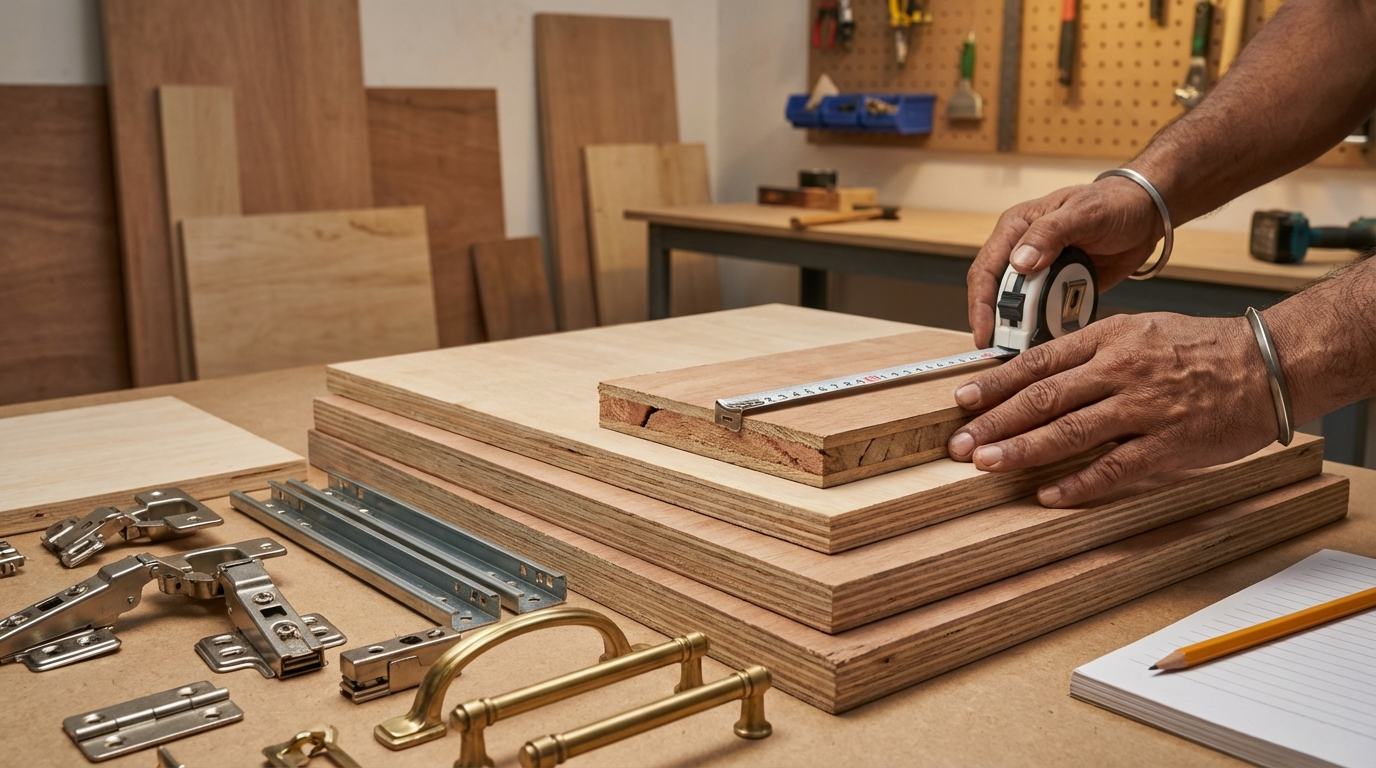
One persistent source of confusion in the Indian plywood market involves the 18mm and 19mm thickness designations. Technically, 19mm is the nominal thickness that accounts for sanding and calibration, while 18mm represents the actual measured thickness after finishing. Many dealers use these terms interchangeably, and different brands may label identical thicknesses differently. So don't overthink this one. When someone asks for 18mm, they mean the standard furniture-grade thickness. Just take a measuring tape to the dealer and verify—especially for modular kitchen work where CNC tolerances matter.
Why This Matters Specifically in Indian Homes
India isn't Europe or North America. Our humidity swings are brutal. In regions with normal humidity levels like North India (except monsoon months), MR grade performs reliably for 15-20 years when maintained properly. However, for coastal cities like Mumbai, Chennai, or Kolkata where humidity regularly exceeds 70%, even MR grade furniture benefits from proper finishing and ventilation.
I'll give you a real example. There was this builder in Thane—must have been 2022—who did an entire apartment in MR ply. Looked great in March. By September, the kitchen cabinets near the chimney were already showing edge swelling. The problem? He saved maybe ₹15,000 total by using MR instead of BWR in wet zones. The repair cost him ₹1.2 lakhs.
The key limitation of MR grade is its unsuitability for kitchens and bathrooms. Even in the dry zone of a bathroom, the steam and occasional splashes can weaken the adhesive bond over time. Many homeowners learn this lesson expensively when their MR grade kitchen cabinets start swelling and delaminating within 3-5 years.
Here's what I tell clients: think of Mumbai's July-August humidity—we hit 85-90% RH easily. Now think of Chennai during monsoon. Or Kolkata's year-round humidity. The Ghatkopar side in Mumbai gets more humid than Borivali, and nobody talks about this. Your ply choice has to account for YOUR specific location, not some generic "for homes" label.
Coastal Karnataka, the Konkan belt, humid Bengal—these aren't dry Rajasthan conditions. What works in Jodhpur won't work in Mangalore. Simple as that.
Types of Plywood Grades: What Each One Actually Does
There are three common types of plywood in India: MR, BWR, and BWP. Let me break this down without the marketing fluff.
MR Grade (Moisture Resistant)
MR grade plywood, commonly called commercial plywood in Indian markets, is the most widely used and affordable option for interior furniture. It uses urea formaldehyde (UF) adhesive that provides adequate resistance to indoor humidity but fails when exposed to direct water contact or prolonged dampness.
Best when: Bedroom wardrobes, TV units, study tables, bookshelves—basically any furniture that won't see water. My take: if you're in Delhi, Jaipur, or Bangalore (dry seasons at least), MR works fine for most bedrooms.
MR Grade is best for dry interiors like bedrooms and living rooms, and costs around ₹45-70 per square foot.
BWR Grade (Boiling Water Resistant)
BWR grade plywood represents the practical middle ground for most Indian homes. BWR grade offers superior moisture resistance compared to MR grade, making it essential for kitchens, bathrooms, and humid climate installations. However, BWR costs 40-70% more than equivalent MR grade plywood.
Best when: Kitchen cabinets (yes, ALL of them—not just under-sink), bathroom vanities, balcony-adjacent furniture, any coastal city installation. Honestly, if you're doing modular kitchen work anywhere in India, just go BWR and don't look back.
In 2026 Indian markets, BWR grade costs around ₹65-100 per square foot.
BWP/Marine Grade (Boiling Waterproof)
Marine Grade plywood is generally darker in color owing to the darker waterproof glue used in bonding. BWP/Marine is made with Phenol Bonded Resin and manufactured to be completely waterproof. Usually dark brown/dark chocolate in colour.
Best when: Actual boat building, outdoor furniture, bathroom interiors with direct water exposure. Unpopular opinion, but for most home applications, BWR is enough—you don't need to shell out for marine grade unless you're doing something genuinely outdoor or marine.
BWP/Marine grade costs approximately ₹90-150 per square foot in 2026.
| Grade | Adhesive Type | Water Resistance | Best Applications | 2026 Price Range (per sq ft) | My Take |
|---|---|---|---|---|---|
| MR (Commercial) | Urea Formaldehyde | Indoor humidity only | Bedrooms, living rooms, study | ₹45-70 | Fine for dry zones |
| BWR | Phenol Formaldehyde (modified) | Resists moisture and steam | Kitchens, bathrooms, humid areas | ₹65-100 | Default choice for most Indian homes |
| BWP/Marine | Phenol Bonded Resin | Completely waterproof | Outdoor, marine, extreme wet zones | ₹90-150 | Overkill for most interiors |
| Fire Retardant | Treated with FR chemicals | Varies | Commercial kitchens, public spaces | ₹100-180 | Specific applications only |
Price Reality Check: What to Actually Budget (2026 Market)
A standard plywood sheet in India comes in the 8x4 feet size, with thicknesses ranging from 6mm to 25mm. Prices typically range from ₹40 to ₹150 per square foot depending on grade, thickness, and brand—with commercial MR grade at the lower end and BWP/marine grade at the higher end.
Here's what actually affects your final bill:
Thickness: The choice between 12mm and 18mm alone can mean a 30-40% difference in material cost. Don't let anyone push you to 18mm everywhere. Use 18mm for carcasses and load-bearing panels. Use 12mm for shelves. Use 6mm for backs. That's how you save without compromising.
Core timber: Gurjan timber generally is reddish brown and darker in color than Eucalyptus, plus it has a granular texture while Eucalyptus has a much smoother finish. 90% of the plywood in the Indian market is sold under the name of Gurjan Plywood while only about 20% of them actually contain Gurjan Timber. So don't pay a premium for "Gurjan" unless you can actually verify it—which you can, by looking at the core colour and texture.
With raw material costs, logistics, and demand cycles constantly shifting, plywood pricing in India isn't static. Timber species like Gurjan, Eucalyptus, and Neem influence core pricing. With PAN-India distribution, local delivery costs can alter landed pricing.
Rough estimation approach: For a typical 3BHK in Mumbai, you're looking at roughly 25-35 sheets of 8x4 ply total (mixed thicknesses). At average BWR prices, that's ₹80,000-1,40,000 just for plywood material before labour, laminate, hardware, and fittings. Factor 10-15% wastage as well.
How much plywood do you need for a standard wardrobe?
A standard 6×7 feet three-door wardrobe typically requires 4-5 sheets of 8×4 feet 18mm plywood for the carcass and shutters, plus 1-2 sheets of 6mm plywood for back panels. The exact requirement depends on internal configuration like drawers, shelves, and hanging space along with cutting efficiency. A skilled carpenter achieves 85-90% material utilization; factor 10-15% wastage into your estimates.
MR vs BWR vs BWP: How to Actually Decide
Between you and me, most confusion happens because people overthink this. Let me simplify.
| Application | MR Grade | BWR Grade | BWP/Marine | My Recommendation |
|---|---|---|---|---|
| Bedroom wardrobe | ✓ Works fine | ✓ Better in coastal areas | Overkill | MR (dry cities), BWR (coastal) |
| Kitchen cabinets | ✗ Don't do it | ✓ Standard choice | ✓ If budget allows | BWR minimum |
| Under-sink cabinet | ✗ Will fail | ✓ Adequate | ✓ Best choice | BWR with good edge sealing |
| Bathroom vanity | ✗ Disaster waiting | ✓ Works | ✓ Ideal | BWR or BWP |
| Study table | ✓ Perfect | Unnecessary cost | Wasteful | MR |
| Outdoor furniture | ✗ No | ✗ No | ✓ Required | BWP only |
| False ceiling frame | ✓ Standard | Not needed | Not needed | MR |
| TV unit | ✓ Good | Optional | Overkill | MR (most cases) |
Choose MR when: Furniture goes in bedrooms, living areas, or any dry zone away from water sources. You're in a low-humidity city. Budget is tight and the space is genuinely dry.
Choose BWR when: Anything kitchen, anything bathroom-adjacent, any furniture in coastal cities like Mumbai or Chennai, any humid climate installation. This should be your default for 60-70% of home furniture if you're in the western coast or Bengal.
Choose BWP when: Actual outdoor use, actual marine applications, or you just want absolute peace of mind for wet-zone furniture and don't mind the premium.
Trade-off summary: You gain water resistance but lose budget headroom. Every step up from MR to BWR to BWP adds ₹20-50 per square foot. On a full kitchen, that could mean ₹15,000-30,000 extra. Worth it? For kitchens, absolutely yes. For a bedroom TV unit in Pune? Probably not.
How to Choose: A Step-by-Step Framework
Step 1: List every room and furniture piece. Seriously, make a list. Kitchen cabinets, wardrobe, TV unit, shoe rack, bathroom vanity—write it all down.
Step 2: Mark each as "dry zone," "damp zone," or "wet zone." Bedroom = dry. Kitchen = damp. Under-sink = wet. Bathroom = wet. Balcony-adjacent = damp at minimum. Most people underestimate the "damp zone"—anywhere steam or humidity can reach counts.
Step 3: Assign grades accordingly. Dry = MR okay. Damp/Wet = BWR minimum. Truly wet/outdoor = BWP only.
Step 4: Calculate sheet requirements per room. Ask your carpenter for a cutting estimate or use the rough guide: 4-5 sheets per wardrobe, 8-12 sheets per modular kitchen, 2-3 sheets per study unit.
Step 5: Set thickness by component. Carcass and load-bearing = 18mm. Shelves = 12mm (unless heavy books/equipment). Backs and internal dividers = 6mm. Don't let anyone sell you 18mm everywhere—that's wasteful.
Step 6: Verify before purchasing. ISI mark, tap test, edge inspection, weight check. More on this below.
| Your Situation | Recommendation | Why |
|---|---|---|
| First home, tight budget, dry climate city | MR for bedrooms, BWR only for kitchen | Maximum savings without compromising critical areas |
| Coastal city (Mumbai, Chennai, Kolkata) | BWR everywhere, BWP for bathroom | Humidity doesn't spare any zone |
| Rental property interior | MR mostly, BWR for kitchen | Balance durability vs investment |
| Premium home, no budget constraint | BWR everywhere, BWP for wet zones | Why compromise if you don't have to? |
| Modular kitchen only | BWR mandatory, no exceptions | Kitchen moisture is relentless |
Red flags to walk away from:
- Dealer refuses to cut a sample sheet for inspection
- No ISI marking visible on the sheet
- "Dark coloured" ply marketed as marine grade at BWR prices—likely fake
- Core layers show more than 2-3 visible gaps or overlaps
- Sheet feels unusually light for its claimed thickness
Common Mistakes People Make
Mistake #1: Using MR grade in kitchens
I've been saying this for years and people still do it. "But it's behind the chimney, not near water!" Steam is water, friends. Steam is water. The key limitation of MR grade is its unsuitability for kitchens and bathrooms. Even in the dry zone of a bathroom, the steam and occasional splashes can weaken the adhesive bond over time.
Mistake #2: Trusting the "Gurjan" label
90% of the plywood in the Indian market is sold under the name of Gurjan Plywood while only about 20% of them contain Gurjan Timber. Look at the core colour yourself. Gurjan is reddish-brown with granular texture. Eucalyptus is paler and smoother. Don't pay Gurjan prices for Eucalyptus ply.
Mistake #3: Skipping edge sealing
This one really frustrates me. Your carpenter finishes the job, the laminate looks great, everyone's happy. Six months later, the edges start swelling. Why? Proper edge sealing is as important as choosing the right grade. Unsealed edges absorb moisture like a sponge. Insist on PVC edge banding or at least laminate edge wrapping for all exposed sides.
Mistake #4: Not checking the core construction
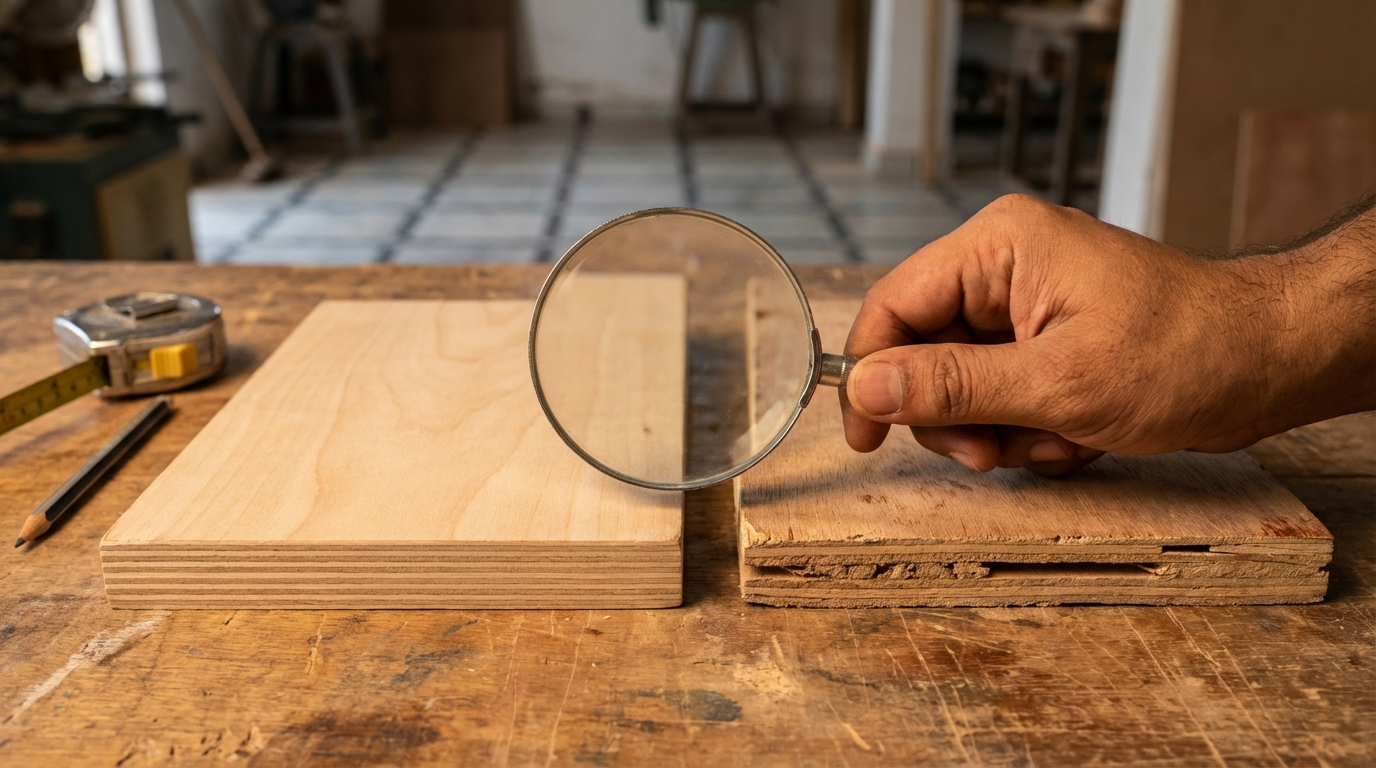
Surface can look perfect while the core has voids and gaps. Have the seller cut a piece from a sample sheet to see if the core lines visible on the outside are also congruent inside. There may be some core gaps and overlapping involved and that's okay since plywood in India is still largely a manual process but if there're more than 2-3 core gaps and overlappings, you should probably abort.
Mistake #5: Buying "marine grade" at suspiciously low prices
Now manufacturers all over India have devised a new way of fooling customers—they dip their MR ply in dark colour which gives it a look of BWP ply and then sell it at a much higher rate under the name of BWP Grade ply whereas it's not. If someone's selling BWP at BWR prices, be very suspicious.
Mistake #6: Same thickness everywhere
Understanding which thickness works for which application prevents both over-engineering (wasting money) and under-specification (structural failures). The choice between 12mm and 18mm alone can mean a 30-40% difference in material cost. Not everything needs 18mm. Think before you buy.
Mistake #7: Ignoring ISI certification
Generally, you notice some sign like ISI-303 or ISI-710 on plywood sheet when you purchase it. Those numbers are Indian standard guidelines number, which is given after the testing of plywood and assure the quality. IS:303 is for MR/BWR. IS:710 is for BWP/Marine. No marking? Walk away.
Mistake #8: Not measuring actual thickness
For practical purposes, when a carpenter specifies "18mm plywood for wardrobe carcass," they're referring to the standard furniture-grade thickness—whether the label reads 18mm or 19mm. Always verify by measuring a sample sheet at the dealer's shop, especially for modular kitchen work where CNC machining tolerances matter.
Mistake #9: Buying without asking about termite treatment
Termites can be a big problem for wood and plywood. Some types of plywood are treated with chemicals to resist termites, which makes them a better choice for long-lasting use, especially in places where termites are common. I've seen this happen when homeowners in ground-floor flats skip this check. By the time you notice termite damage, it's too late.
Quality Checks You Can Do Yourself
Checking plywood quality requires examining thickness consistency, core construction, surface finish, and water resistance before purchase. A reliable quality check involves visual inspection of edges for voids, the tap test for hollow sounds, moisture testing, and verifying BIS certification marks. These simple tests take minutes but save thousands in furniture replacement costs.
Visual Checks (5 things to look for)
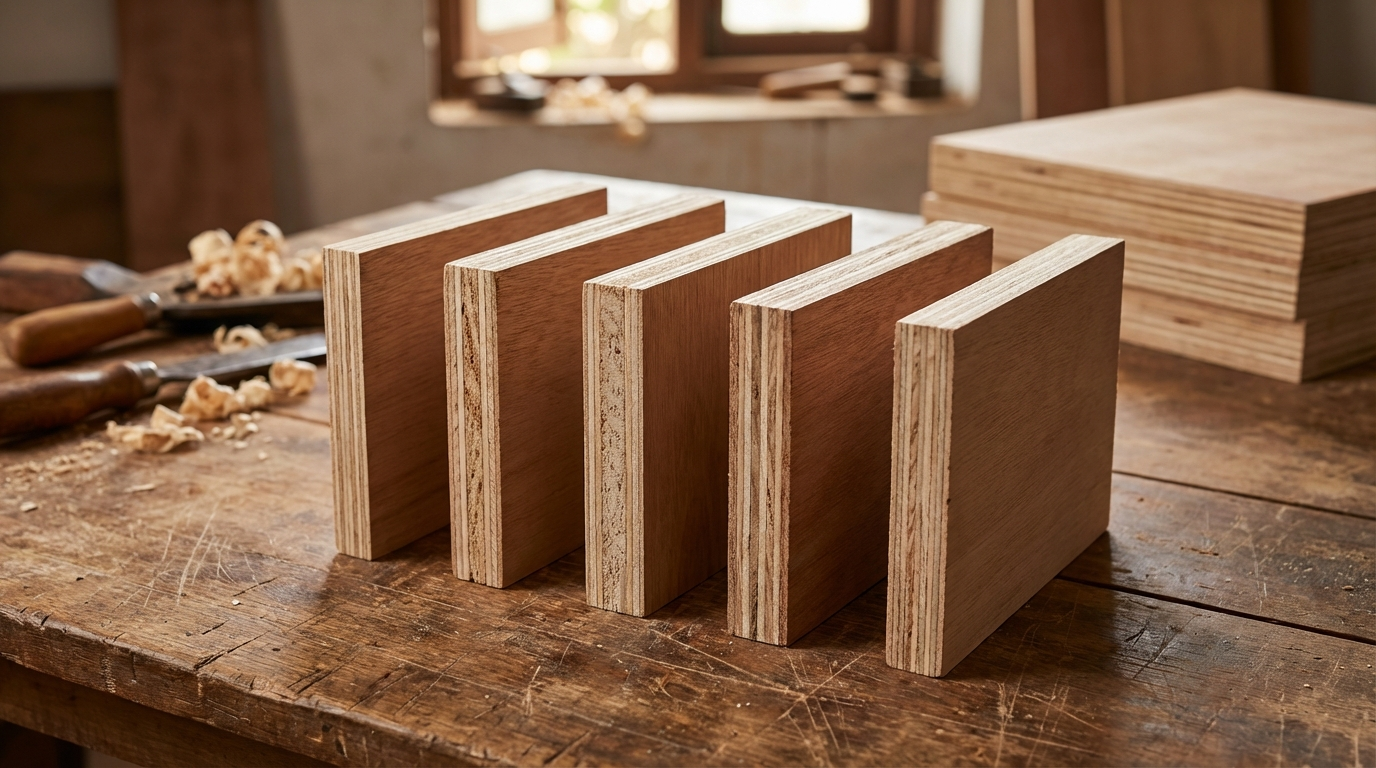
- Check the side profile of the ply and the edges. The layers on the side profile of plywood should be running straight. Since plywood is an engineered wood panel made by pressing layers of thin wood veneers together, it's the construction of these layers on top of each other which determines the quality of plywood. The core layers should be visible as straight lines without gaps/holes and much overlapping between layers.
- Look for smooth surfaces, uniform grain patterns, and minimal knots or imperfections.
- Check the edges to ensure there are no gaps or uneven layering, which could weaken the plywood.
- Always check that the plywood sheet has consistent thickness. Uneven sheets can lead to structural issues.
- Look for any warping—warping leads to deformations over time. Press the ply sheet on a flat surface to test for warping.
Questions to Ask the Dealer
- "Can you cut a sample piece so I can inspect the core?"—if they refuse, something's wrong
- "What's the actual weight of a full 8x4 sheet at 19mm?"—Higher the weight of the ply, the better its density, and therefore better its strength and performance. A normal full red core plywood of Eucalyptus timber make should weigh 39+ kgs for a 19mm 8×4 Plywood Sheet.
- "Is this IS:303 or IS:710 certified?"—force them to show you the marking on the sheet, not just claim it
- "What's the core timber—Gurjan, Eucalyptus, or poplar?"—then verify yourself by colour and texture
- "Has this been treated for termites and borers?"—especially important for ground floors and older buildings
Simple Field Tests
Tap Test: This test checks for uniform density and internal voids. Gently tap on different sections of the plywood with your knuckles or a small tool. A clear, resonant sound suggests the plywood has uniform density and no hollow spaces. A dull or hollow sound may indicate internal gaps or poor-quality bonding between layers.
Nail Test: If the layers split or crack when you drive a nail from the side into the ply, the ply would probably pose the risk of delamination and cracking at all nailing points which renders the furniture useless. To check this, drive a nail from the side into the ply. If the layers split or crack, you should probably look for a better ply. #14 1.5-inch nails should do the trick for this purpose.
Weight Check: A normal full red core plywood of Eucalyptus timber make should weigh 39+ kgs for a 19mm 8×4 Plywood Sheet. Alternate grade plywood made of alternate layers of Eucalyptus and Poplar timber should weigh around 32+ for a 19mm 8x4ft Plywood Sheet.
Water Drop Test: Place several drops of water on the plywood surface and observe behaviour over 30 minutes. Quality MR grade plywood shows minimal absorption—water beads on the surface rather than soaking in immediately. If water absorbs within minutes, leaving a dark patch, the plywood lacks adequate moisture resistance for any application involving humidity exposure. After 30 minutes, wipe the surface dry and check for swelling, discoloration, or surface texture changes. Quality plywood shows no visible effect from this brief exposure.
Here's a trick most dealers don't like: Take a sample and submerge it in boiling water for 72 hours or in a pressure cooker for 7 whistles. Cool down by submerging in normal temperature water. If the ply layers delaminate, it's not BWP Grade, and vice versa. Obviously you can't do this at the shop—ask for a sample piece, take it home, and test it yourself before placing a bulk order. If it fails, you've just saved lakhs.
Warning Signs (Walk Away If You See These)
- Core gaps visible even from the edge—more than 2-3 means reject
- Strong chemical smell, as this may indicate high formaldehyde content.
- Sheet feels unusually light for claimed thickness
- No ISI marking visible anywhere on the sheet
- Dealer gets defensive when asked for sample cuts
- Dark coloured MR ply being sold as BWP at premium prices—it's a known scam
Workmanship & Installation: What to Tell Your Carpenter
Thickness directly determines a plywood sheet's structural capability, weight, cost, and suitability for specific applications. In India, commercial plywood ranges from 4mm to 19mm, while waterproof grades extend to 25mm for heavy-duty requirements. Understanding which thickness works for which application prevents both over-engineering and under-specification.
Cutting Requirements
Always cut against the grain for maximum strength on load-bearing edges. Circular saws work better than jigsaws for clean edges. And for modular kitchen work with CNC machining, always verify thickness by measuring a sample sheet at the dealer's shop where CNC machining tolerances matter.
Why Edge Sealing Matters
I've seen carpenters skip edge banding to save time—they're paid per piece, not per hour. The problem is that unsealed edges absorb moisture over the first monsoon, and by December you'll see the laminate lifting at corners. Proper edge sealing is as important as choosing the right grade. Options: PVC edge banding (best), laminate edge wrapping (good), or at minimum paint/varnish on cut edges (acceptable for hidden areas only).
Fastener and Screw Guidance
For 18mm ply: 25-35mm screws typically. For 12mm ply: 18-25mm. Pre-drilling helps avoid splitting, especially near edges. For joining two panels, use right-angle brackets or cam locks—don't rely on screws alone for structural joints.
What to Tell Your Carpenter: Briefing Checklist
- "Use 18mm for carcass and 6mm for backs—don't switch"
- "All kitchen cabinets get BWR only—I've already bought it, don't substitute"
- "Edge band all exposed edges before fitting"
- "Pre-drill screw holes near edges"
- "Don't store sheets directly on floor—use supports underneath"
- "Let sheets acclimatize 2-3 days before cutting if stored in transit"
There was this job in Andheri in 2021. Mistri stored BWR sheets in the building basement during monsoon—directly on wet floor. Moisture wicked up through the edges overnight. Three sheets ruined before we even cut them. ₹12,000 gone. Storage matters.
How Long Does Plywood Last? Honest Durability Expectations
Here's what nobody wants to admit: plywood lifespan varies wildly based on grade, application, and—most importantly—how well it's maintained.
In regions with normal humidity levels like North India (except monsoon months), MR grade performs reliably for 15-20 years when maintained properly. That's for well-installed, properly sealed furniture in dry zones with decent ventilation.
In my experience, well-maintained BWR kitchen cabinets in Mumbai last about 12-15 years before showing significant wear. MR ply in the same location? Maybe 5-7 years before swelling becomes noticeable. That's the grade difference playing out.
What affects longevity:
- Grade match to application (biggest factor)
- Edge sealing quality
- Ventilation in the room/cabinet
- Local humidity levels
- Whether it was properly acclimatized before installation
- Laminate or veneer protection on surfaces
Signs of wear to watch for:
- Edge swelling (earliest warning sign)
- Laminate peeling at corners
- Musty smell inside wardrobes (moisture has gotten in)
- Visible warping or bowing
- Screw holes loosening (core degradation)
When to consider replacement: If edges are swelling beyond repair, if there's visible delamination between core layers, or if structural components like shelf supports are failing. Partial replacement is often possible—just the damaged panels, not the whole unit.
Can you use MR grade plywood in bathrooms?
Not worth it. The key limitation of MR grade is its unsuitability for kitchens and bathrooms. Even in the dry zone of a bathroom, the steam and occasional splashes can weaken the adhesive bond over time. Many homeowners learn this lesson expensively when their MR grade kitchen cabinets start swelling and delaminating within 3-5 years. Go BWR minimum. BWP if budget allows. Or consider alternatives like HDHMR for bathroom vanities—our HDHMR guide covers this extensively.
Alternatives Worth Considering
Plywood isn't always the answer. Sometimes you need something different.
HDHMR (High-Density High Moisture Resistant): For bathroom vanities and high-humidity applications where traditional plywood struggles. No grain direction, takes screws better at edges, and genuinely moisture resistant. Costs more, but sometimes makes sense. Our HDHMR versus plywood comparison covers this in detail.
Blockboard: If budget is tight, consider blockboard for large panels like wardrobe sides. It's lighter than equivalent plywood and cheaper, though not suitable for load-bearing shelves or kitchen work. For wardrobe carcasses where weight matters (moving, wall-mounting), blockboard saves money without major compromise.
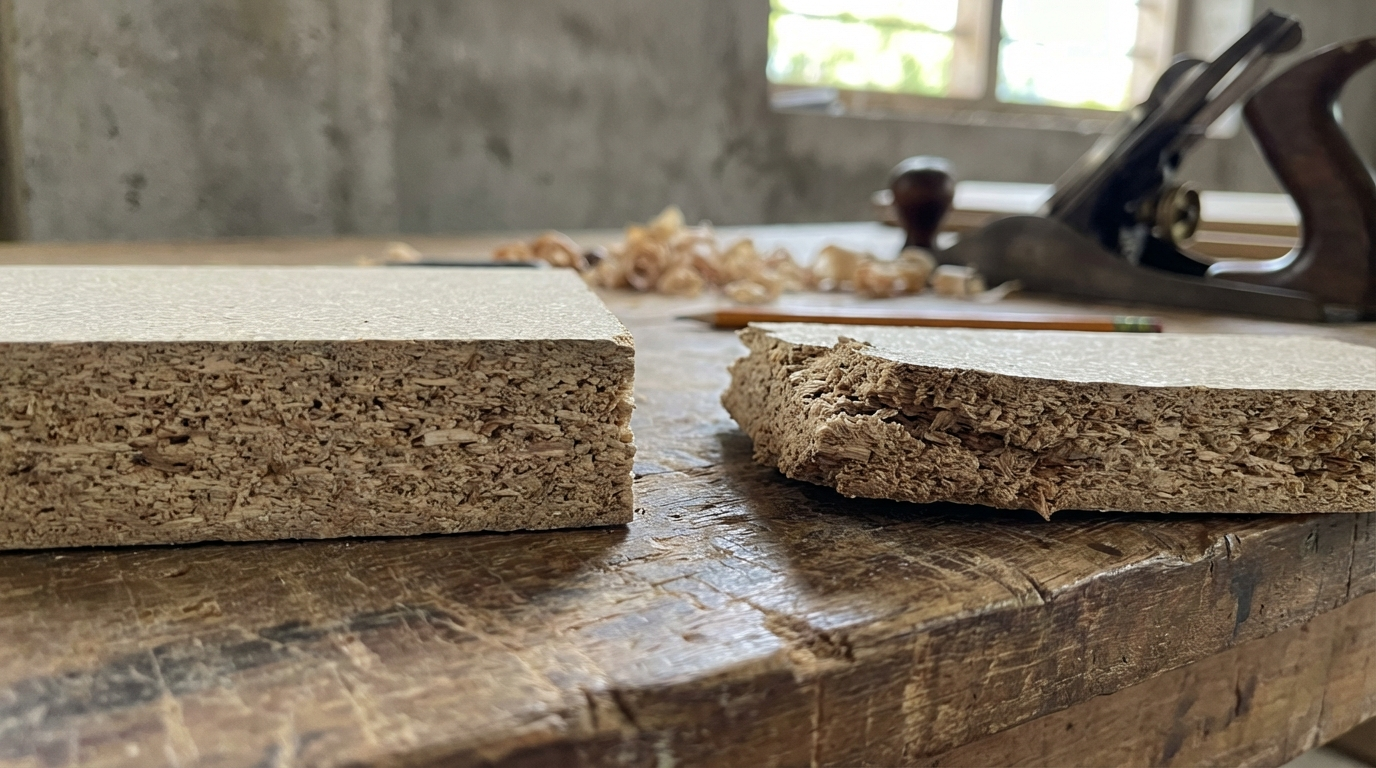
Particle Board/Pre-Laminated Particle Board (PLPB): For truly budget-constrained projects or rental-ready furniture. Won't last as long, doesn't handle moisture at all, but costs 40-50% less. If you need better moisture handling, look at our kitchen cabinet material comparison that covers HDHMR vs plywood vs particle board extensively.
If you're considering WPC door frames instead of traditional wooden frames, there's a separate door frame guide worth checking.
Frequently Asked Questions
What's the difference between BWR and BWP plywood?
Different grades of plywood vary in terms of water resistance, structural integrity, and finishing. BWR (Boiling Water Resistant) uses modified phenol formaldehyde adhesive and resists steam and occasional water contact—good for kitchens and humid zones. BWP (Boiling Waterproof), also called marine grade, uses phenol bonded resin and is completely waterproof—meant for outdoor use, boat building, and extreme wet conditions. For most Indian home interiors, BWR is sufficient. BWP is overkill unless you're doing genuinely outdoor or marine work. The price difference is ₹25-50 per square foot.
Is it true that all branded plywood is good quality?
Common belief: branded means reliable. Reality: a brand only guarantees consistency across their quality tiers, not that every product is premium. Even top brands sell MR, BWR, and commercial grades—each with different adhesives and quality levels. A branded MR ply will still fail in a wet zone. Always match grade to application, regardless of brand reputation.
How do I know if the plywood is genuinely ISI certified?
The Bureau of Indian Standards (BIS) certification, especially IS:303 and IS:710, is essential for confirming plywood quality. Look for the ISI mark stamped on the sheet itself—not just on packaging. IS 710 refers to the Bureau of Indian Standards specification for marine and boiling water resistant plywood. Plywood certified under IS 710 has been tested for resistance to boiling water, demonstrating that adhesive bonds withstand extreme moisture conditions without delamination. This certification indicates suitability for high-moisture applications including marine use, bathroom installations, kitchen cabinets, and exterior-adjacent applications.
Is it true that darker plywood is always marine grade?
Absolutely not. Manufacturers all over India have devised a new way of fooling customers—they dip their MR ply in dark colour which gives it a look of BWP ply and then sell it at a much higher rate under the name of BWP Grade ply whereas it's not. The only reliable test is the boiling water test. Don't trust colour alone.
What if I live in a coastal city like Chennai or Mumbai?
For coastal cities like Mumbai, Chennai, or Kolkata where humidity regularly exceeds 70%, even MR grade furniture benefits from proper finishing and ventilation. My recommendation: go BWR for everything in coastal cities. Yes, even bedrooms. The extra cost is insurance against humidity damage that compounds over years.
What thickness should I use for kitchen cabinets?
For cabinets, a thickness of 18mm is recommended for durability and strength. Use 18mm for the carcass and doors. Use 6mm for backs. Some people use 12mm for internal shelves to save cost—works fine for light loads, but go 18mm if you're storing heavy utensils or appliances.
Is it true that face veneer quality indicates core quality?
The face grain/look of plywood doesn't matter as they have absolutely no role to play in structural integrity, instead it's just pure aesthetics. However as a rule of thumb, good quality manufacturers use good quality Gurjan face veneers which deliver a high quality finish to the ply. However, on the off chance that the outside face finish is not up to the mark due to any reason, it doesn't mean the underlying plywood is also bad.
Can I do quality tests at home after buying?
Yes. Boiling water test is a simple test to determine how to check the quality of plywood, especially if one is purchasing BWR or marine plywood. Place a small piece of plywood into boiling water for 72 hours and evaluate its shape, structure, and strength. If there is no warping or delamination, it means the plywood quality is good. If it starts to delaminate, crack, or soften, the plywood quality is not fit for water-prone areas. Ask for sample pieces before bulk purchase and test them at home. Much better than discovering problems after installation.
What's the ideal moisture content for plywood?
Moisture content also determines the plywood quality. The plywood strength gets adversely affected and it becomes weak when the plywood is very dry (having low moisture content). On the other side, when the plywood is too moist, it's likely to decay and rot in the future. As per recommendation, the density of plywood should be around 800 Kg/m3 and moisture content should be not less than 5 percent and not more than 15 percent.
Is it true that calibrated plywood is worth the extra cost?
Factory-calibrated plywood costs more, but saves labour during fit-out. For modular kitchen work with CNC machines, yes—calibrated ply ensures consistent thickness and flat surfaces that CNC tolerances require. For traditional carpenter-made furniture, it's nice to have but not essential. Depends on your installation method.
What's the recommended density for good plywood?
As per recommendation, the density of plywood should be around 800 Kg/m3. Higher the weight of the ply, the better its density, and therefore better its strength and performance. Weigh the sheets at the dealer—anything significantly lighter than expected suggests lower density or voids in the core.
How do I check for termite resistance?
The ATBS (Anti-Termite Borer and Silverfish) mark ensures the plywood has been treated for termite resistance, a must for Indian homes. Look for this marking specifically. Ground-floor apartments, older buildings, and homes near gardens or water bodies are especially vulnerable. Termite damage is silent until it's catastrophic—better to pay for treated ply upfront.
Right, that's the gist of it. Your carpenter might have different opinions—worth hearing them out, they see failure patterns firsthand. But don't let anyone talk you into MR grade for your kitchen to save a few thousand rupees. That decision comes back to haunt you in 3-4 years, every single time.
Good luck with the project. And seriously—don't skip the edge banding.
Note: sainik710.com is an independent informational site and is not affiliated with any manufacturer.
Disclaimer: This content is provided for general informational purposes based on industry practices and publicly available information. Product specifications, standards, prices, and availability may vary by manufacturer, region, and time. Readers should independently verify details with manufacturers, dealers, or qualified professionals before making purchase or construction decisions.Want Plywood Suggestions?
Share a few details and a Sainik 710 specialist will suggest suitable brands and connect you to responsive dealers.