WPC Door Design & Price Guide: 40+ Designs, Colors & Comparison with Wooden Doors
Complete WPC door guide with 40+ designs, colors & price range. Compare WPC vs wooden doors—waterproof, termite-proof solution for Indian homes.
Quick Answer: What You Need to Know About WPC Doors
WPC doors are composite doors made from wood fibers and plastic polymers, offering complete waterproofing and termite resistance at prices ranging from ₹2,500 to ₹8,000 per door depending on thickness, design complexity, and brand.
Short version: If you're tired of bathroom doors swelling every monsoon or bedroom doors getting termite-eaten, WPC is your answer. It looks like wood, feels reasonably solid, costs somewhere between cheap PVC and expensive solid wood, and genuinely doesn't rot. For humid Indian conditions—especially in cities like Mumbai, Chennai, or Kolkata—it's become the practical default choice for moisture-prone areas.
This is right for you if:
- Your bathroom door has swollen shut at least once during monsoon
- You want something that looks like wood but won't need replacing every 5-7 years
- Budget is moderate—not rock-bottom cheap, but you're not spending ₹15,000 per door either
- Termites have been an issue in your building or area
Skip this if:
- You want the authentic weight and feel of real teak or sheesham—WPC feels lighter, almost hollow
- Your main entrance needs that premium solid wood impression for visitors
Bottom line: For bathrooms, kitchens, balconies, and utility areas in Indian homes, WPC doors have basically become the sensible standard—not exciting, but reliably practical.
What WPC Actually Means (And What It Doesn't)
WPC stands for Wood Plastic Composite—a material made by combining wood fibers (sawdust, wood flour) with thermoplastic polymers like PVC or polyethylene. The result is a board that machines like wood but resists water like plastic.
Here's what most people get wrong. They assume WPC is some kind of upgraded PVC. It's not. PVC doors are hollow, flexible, feel cheap when you knock on them. WPC is actually solid—or at least foam-filled solid—with genuine wood content. The wood fibers give it weight, rigidity, and that satisfying thud when you close it. The plastic component handles the waterproofing.
Most people think WPC is a recent invention. Actually, the technology has been around since the 1990s, mostly used for outdoor decking in Western countries. It came to India for doors maybe 10-12 years ago, but really took off in the last 5 years once people saw their "waterproof" wooden doors failing spectacularly during heavy monsoons.
The technical composition matters if you're comparing brands. Good WPC typically has 50-60% wood content and 40-50% plastic polymer. Higher wood content means better screw-holding and more natural feel. Higher plastic content means better water resistance but sometimes a cheaper feel. Some manufacturers add calcium carbonate as filler—that's fine in small quantities, but too much makes the board brittle. More on checking quality later.
Is WPC actually waterproof or just water-resistant?
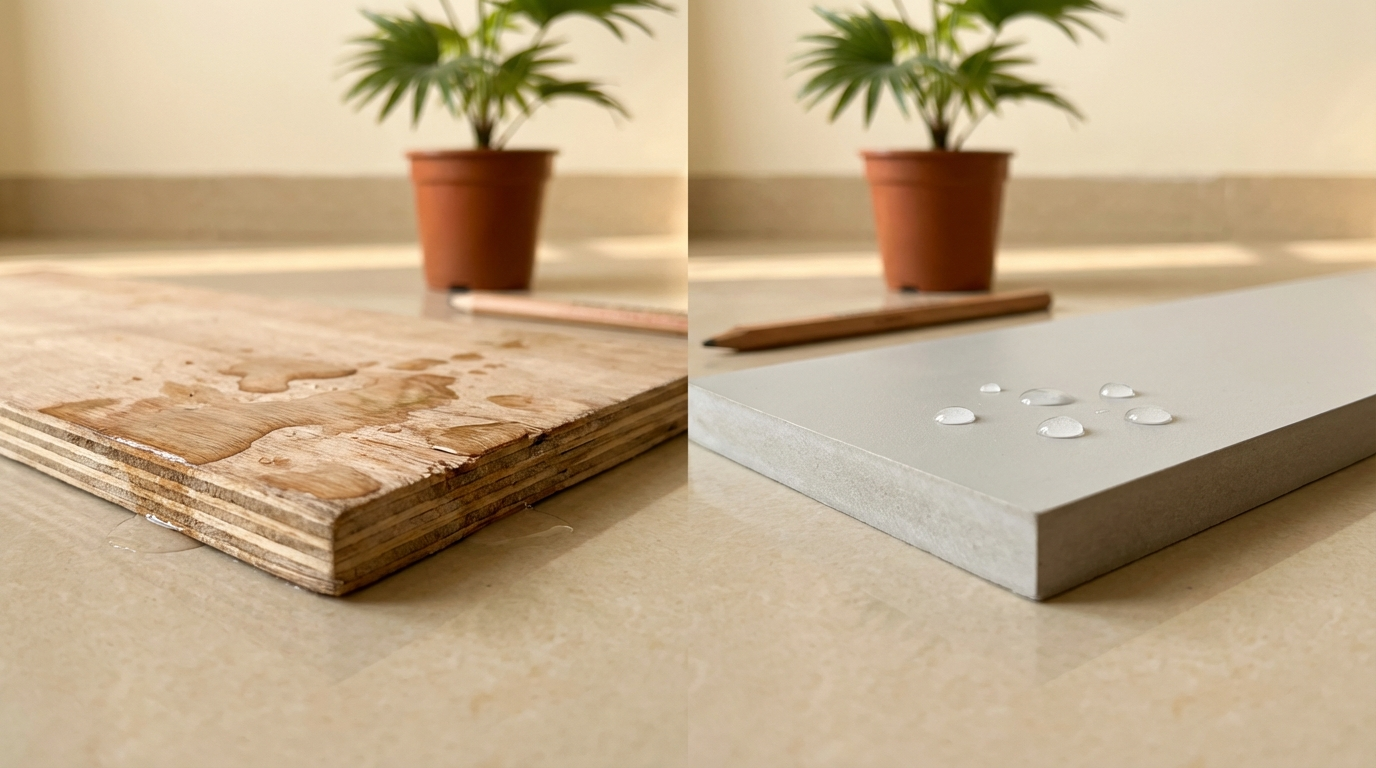
Technically, WPC is water-resistant rather than 100% waterproof—though for practical purposes in Indian bathrooms, the distinction barely matters. A WPC door can handle daily water splashes, humidity levels of 85-90%, and even direct water contact for short periods without swelling or warping. What it cannot handle is being submerged or having water pool against it for days. I've seen WPC doors in Mumbai chawl-style bathrooms that stay wet for hours daily, and they've held up fine for 8-9 years. That's more than you'll get from any wooden door in similar conditions.
Why This Matters So Much in Indian Homes
Let me be direct. Indian bathrooms are brutal environments for doors. Unlike Western bathrooms with exhaust fans running constantly, most Indian bathrooms have minimal ventilation, high humidity that lingers for hours after showers, and direct water splash near the door. Add monsoon humidity on top of that.
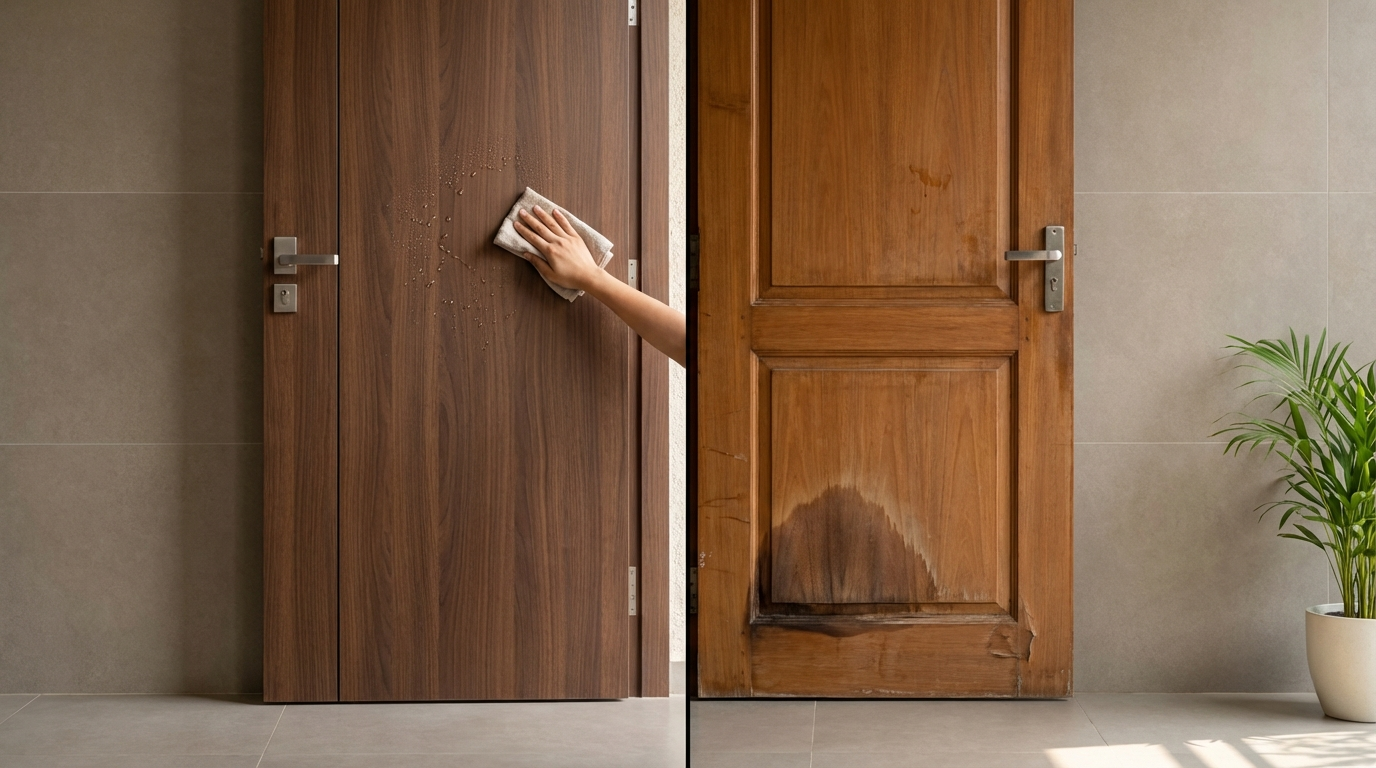
In places like Chennai or Mumbai, you're dealing with ambient humidity of 70-85% for five months straight. Your bathroom probably hits 90%+ humidity every morning. Wooden doors absorb this moisture, swell, then shrink when things dry out. Do this cycle a thousand times and the door warps, cracks, or stops closing properly. I've seen teak bathroom doors in Bandra flats that looked like they were trying to escape the frame—curved like a banana.
Kolkata has a slightly different problem—termites love the humidity there. Even treated wooden doors get attacked because the treatment wears off in 3-4 years. One housing society in Salt Lake I consulted for had to replace 60% of their internal doors within 8 years. All termite damage.
Coastal Karnataka, the Konkan belt, Kerala—same story. Even Bengaluru, which used to be relatively dry, now has unpredictable humidity patterns. The only places in India where wooden doors hold up reliably are the drier regions—Rajasthan, parts of Gujarat, interior Maharashtra.
The Ghatkopar side of Mumbai gets more humid than Borivali, and you can actually see this in door conditions across older buildings. It's that specific.
Types of WPC Doors: Understanding Your Options
Right, moving on to the actual product categories. WPC doors come in several configurations, and most dealers will confuse you by mixing up terminology. Let me sort this out.
By Core Construction
Solid WPC Doors: The entire door is WPC material, through and through. Heaviest option, best sound insulation, most expensive. Thickness usually 30-35mm. Best when you need acoustic privacy—think bedroom doors in apartments with thin walls.
Foam-Core WPC Doors: WPC skin with a foam-filled core. Lighter, cheaper, still waterproof. This is what 70% of the market actually buys. Thickness typically 25-30mm. Perfectly fine for bathrooms and utility areas. Honestly, for most homes, this is the sweet spot.
Hollow WPC Doors: WPC shell with honeycomb or hollow core. Cheapest option, lightest, least durable. I'd avoid these for anything except maybe a storeroom door that rarely gets used.
By Surface Finish
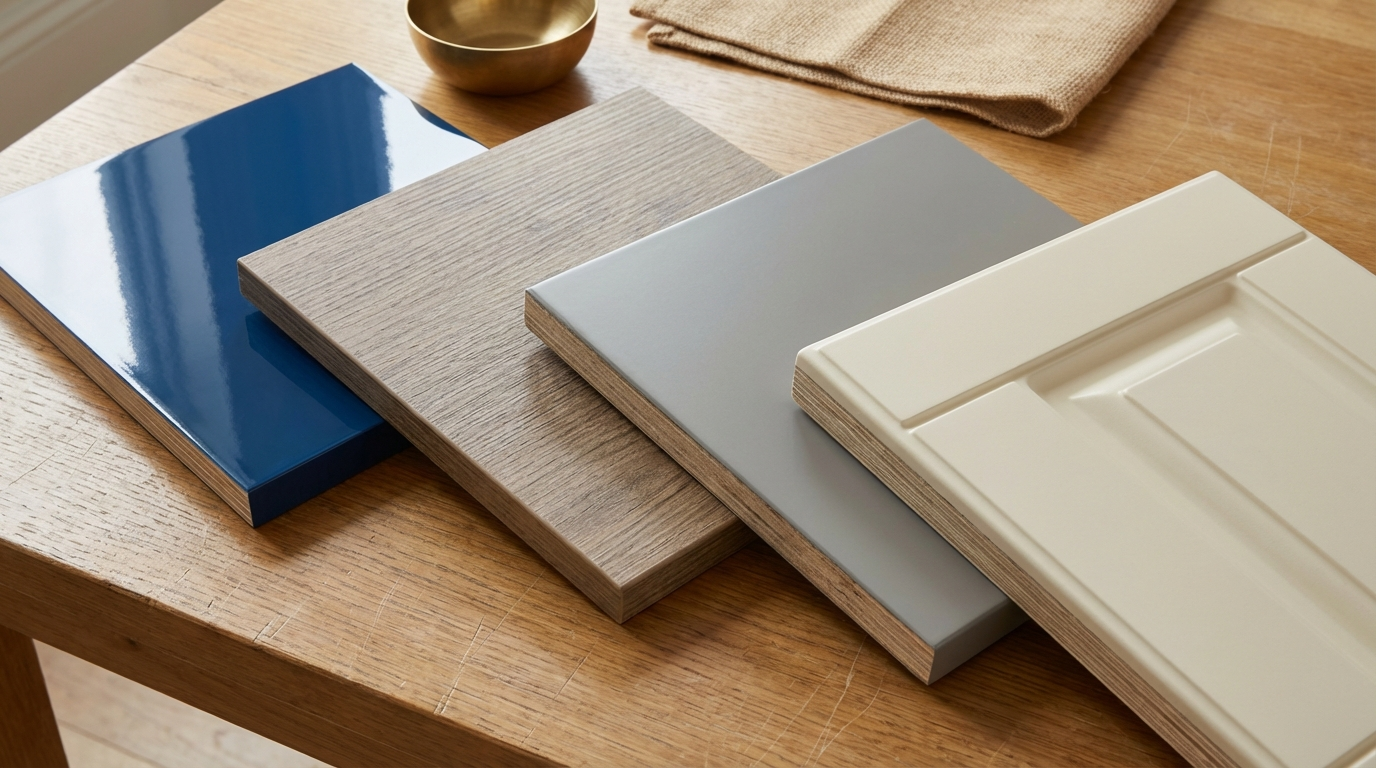
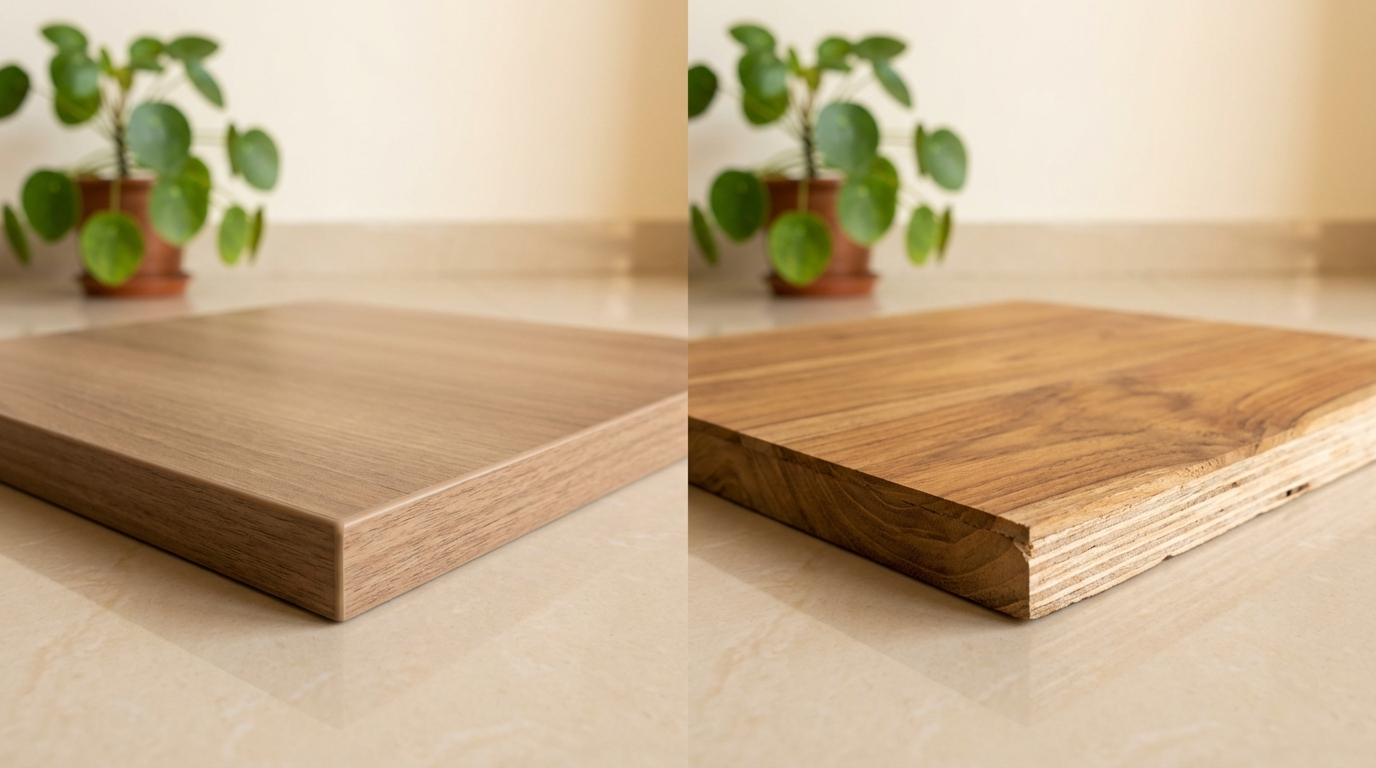
Wood-Grain Laminated: UV-printed wood texture on the surface. Most popular choice. Available in oak, walnut, teak, and about 20 other wood-look finishes. From two feet away, genuinely looks like wood.
Solid Colors: Plain white, grey, or colored finish. Common in modern interiors. White looks clean but shows every fingerprint and water stain—I'd suggest against white for bathrooms specifically.
Digital Printed: Custom designs, patterns, or even photographs printed on the door. More gimmicky than practical, but some people like it for kids' rooms.
| WPC Door Type | Typical Thickness | Weight (approx) | Best For | My Take |
|---|---|---|---|---|
| Solid Core | 30-35mm | 25-35 kg | Bedrooms, main internal doors | Worth the premium for bedrooms |
| Foam Core | 25-30mm | 18-25 kg | Bathrooms, kitchens, utility | Best value for most applications |
| Hollow Core | 25mm | 12-15 kg | Storerooms, closets | Skip unless budget is extremely tight |
| Wood-Grain Finish | Varies | Varies | Traditional interiors | Most versatile choice |
| Solid Color | Varies | Varies | Modern/minimal interiors | Avoid white for bathrooms |
40+ Design Options: What's Actually Available
Dealers love throwing around "40+ designs" or "100+ options"—and technically they're right. But here's what actually matters when you're standing in the shop.
Plain Panel Designs (10-12 variants): Single flat panel with different edge profiles. Clean, modern look. The oak and walnut finishes sell most. These work everywhere and don't go out of style.
Grooved Designs (8-10 variants): Vertical or horizontal grooves cut into the surface. Popular for bathrooms. The grooves are purely aesthetic but they do help hide minor scratches over time.
Panel-and-Rail Designs (6-8 variants): Traditional look with raised or recessed panels, mimicking classic wooden door construction. If your home has a colonial or vintage aesthetic, these fit well. More expensive because of the additional manufacturing steps.
Geometric Patterns (5-6 variants): Modern angular designs. Hit or miss depending on your overall interior style.
Glass Insert Options (4-5 variants): WPC frame with frosted or patterned glass in the center. Good for utility areas or pooja rooms where you want some light transmission.
Louvered Designs (3-4 variants): Slatted appearance for ventilation areas. Not actually ventilated in most cases—just the look.
Here's what I tell my clients: don't overthink the design. Pick a wood-grain finish that roughly matches your other furniture, choose between plain or grooved based on whether you want modern or slightly traditional, and move on. The design differences don't affect durability or functionality.
What colors work best for Indian homes?
If I'm being honest, stick to medium-toned wood finishes—natural oak, light walnut, or teak shades. Dark colors like mahogany or espresso look dramatic in showrooms but show dust instantly and make smaller Indian rooms feel cramped. Pure white is a maintenance nightmare in our dusty conditions. The light-to-medium wood grains hide dust, look reasonably premium, and match most Indian furniture which tends toward brown tones anyway. For bathroom doors specifically, go slightly darker than the rest of your doors—it hides water spots better.
Price Reality Check: 2026 Market Rates
Okay, let's talk money. This is where most online guides either give outdated numbers or suspiciously exact figures that don't match reality. I'll give you ranges based on what I've seen across Mumbai, Pune, and a bit of Chennai market this year.
Basic foam-core WPC doors (25mm): Expect ₹2,500-3,500 per door for standard 2.5x7 feet size. These are entry-level but perfectly functional. Good for rental properties or budget renovations.
Mid-range foam-core with better finish (25-30mm): ₹3,500-5,500 per door. Most of the branded products fall here. Plantex, Greenply, Century—you're in this range. This is what most homeowners end up buying.
Premium solid-core WPC (30-35mm): ₹5,500-8,000 per door. Better weight, better sound insulation, longer warranty typically. Worth it for bedroom doors in apartments.
Designer or custom-printed options: ₹6,000-12,000+. Honestly, I don't see the value here unless you have a very specific design requirement.
Here's what actually affects your final bill:
- Door frame is usually separate. WPC frames add ₹1,200-2,500 per door.
- Standard sizes are cheaper. Anything non-standard gets cut from larger sheets—you're paying for wastage.
- Glass inserts add ₹500-1,500 depending on glass type.
- GST is 18%. Make sure quoted prices include this.
- Installation/fitting by the carpenter: ₹300-600 per door depending on complexity and your city.
A builder in Andheri told me last year that his total cost for WPC bathroom doors including frame and installation worked out to roughly ₹5,500-6,500 per door. That's a reasonable benchmark for decent quality with professional fitting.
WPC vs Wooden Doors: The Honest Comparison
This is what everyone actually wants to know. Let me break it down without the marketing spin.
| Parameter | WPC Doors | Wooden Doors (Solid) | Wooden Doors (Flush) | My Preference |
|---|---|---|---|---|
| Water Resistance | Excellent—won't swell | Poor without treatment | Poor to moderate | WPC, no contest |
| Termite Resistance | 100% immune | Requires treatment | Requires treatment | WPC |
| Premium Feel | Good, not great | Excellent | Moderate | Wood for main entrance |
| Weight/Solidity | Lighter than solid wood | Heavy, substantial | Light | Depends on application |
| Price (per door) | ₹3,000-8,000 | ₹12,000-35,000+ | ₹3,500-7,000 | WPC for bathrooms, wood for showcase |
| Lifespan | 10-15 years | 20-30 years if maintained | 5-10 years | Depends on maintenance commitment |
| Maintenance | Almost zero | Regular polishing, treatment | Moderate | WPC if you're lazy about maintenance |
| Sound Insulation | Moderate | Good to excellent | Poor | Solid wood for bedrooms |
| Environmental | Uses recycled materials | Requires tree cutting | Uses less wood | WPC slightly better |
Choose WPC when: The location is moisture-prone (bathrooms, kitchens, balconies), you don't want maintenance hassles, termites are a concern in your area, or budget is moderate.
Choose wooden doors when: It's your main entrance and first impressions matter, you want that authentic solid feel for bedrooms, you're in a dry climate where moisture isn't an issue, or the home has a traditional aesthetic that demands real wood.
The trade-off is clear: you gain complete peace of mind about moisture and termites but lose that premium weight and authentic character. For me, the sweet spot is WPC for all bathrooms and utility areas, decent flush doors or WPC for bedrooms, and real wood only for the main entrance if budget allows.
Why do carpenters sometimes resist WPC doors?
I've heard this complaint from many homeowners. Here's what actually happens. Carpenters are paid per piece, not per hour, and WPC doors require different handling than wood. The cutting creates fine plastic dust that irritates some workers. The screwing technique is different—you can't just hammer nails in like you would with wood. Some older carpenters genuinely haven't worked with the material and are uncomfortable admitting it. If your carpenter resists, either find one who's worked with WPC before, or let him watch a YouTube tutorial—there are plenty in Hindi now. The installation isn't harder, just different.
How to Choose: Your Decision Framework
Let me give you a practical approach rather than vague advice.
Step 1: List out every door in your home. Main entrance, bedrooms (how many?), bathrooms, kitchen, utility, pooja room, balcony if applicable.
Step 2: Categorize by moisture exposure. High moisture = bathrooms, kitchen near sink, utility. Medium = other areas.
Step 3: Apply this simple rule—WPC for all high-moisture areas, no exceptions. For medium moisture, decide based on budget and aesthetic preference.
Step 4: For each WPC door, pick your core type. Bathrooms can use foam-core. Bedrooms benefit from solid-core if sound privacy matters.
Step 5: Measure carefully. Standard sizes are 2.5x7 feet, 2.75x7 feet, or 3x7 feet. Anything else is custom.
| Location | My Recommendation | Why |
|---|---|---|
| Master bathroom | Foam-core WPC, wood-grain finish | Constant moisture exposure, doesn't need premium feel |
| Common bathroom | Foam-core WPC, darker shade | Higher traffic, darker color hides water marks |
| Kitchen entry | Foam-core WPC or solid-core | Oil vapor and humidity from cooking |
| Bedrooms | Solid-core WPC or good flush wooden | Sound privacy matters, moderate moisture |
| Main entrance (internal) | Solid-core WPC or solid wood | First impression, needs weight and feel |
| Pooja room | WPC with glass insert | Light transmission, diya smoke is acidic |
| Balcony door | WPC essential | Direct rain exposure during monsoon |
| Utility/store | Basic WPC, hollow-core acceptable | Just needs to function |
Exception: If you're in a genuinely dry climate—Jaipur, Jodhpur, interior Gujarat—wooden doors are fine even for bathrooms, assuming you have decent exhaust ventilation.
Red flags to walk away from:
- Dealer can't specify wood-to-plastic ratio in the WPC
- No warranty offered, or warranty has bizarre exclusions
- Price is 40%+ below market average—something's wrong with quality
- Thickness seems inconsistent when you check multiple doors from same batch
- Surface finish peels when you scratch with fingernail
Common Mistakes People Make with WPC Doors
Buying based on price alone. The ₹2,000 door that seems like a steal? It's probably hollow-core with excessive filler content. It'll dent easily and the laminate might peel within two years. I've seen this happen too often in budget renovations.
Ignoring the door frame. People spend time choosing the perfect door and then let the contractor use whatever cheap frame he has lying around. Your WPC door is only as good as its frame. If the frame warps or rots, the door stops closing properly. Use WPC frames with WPC doors—it's not that much extra.
White doors for bathrooms. This one really frustrates me. I see it recommended online constantly. White WPC looks stunning in showroom lighting. In an actual Indian bathroom? Water spots, soap residue, and dust are visible within days. You'll be wiping it constantly. Just go with a medium wood-tone and save yourself the annoyance.
Not checking thickness consistency. Some low-quality manufacturers have poor quality control. The door might be 25mm in the center but 23mm at the edges. This creates fitting problems. Always run your hand along the edges to feel for variations.
Assuming all WPC is the same. There's a massive quality variation in this market. The wood-to-plastic ratio matters. The type of plastic matters (virgin vs recycled). The density matters. Don't assume brand A equals brand B just because both say "WPC."
Skipping edge sealing for cut edges. If your door needs trimming for fit, the cut edge exposes the core material. While WPC is water-resistant, the exposed core is slightly more vulnerable. A simple edge band or sealant takes five minutes and costs nothing but adds years to lifespan. Most carpenters skip this unless you specifically ask.
Using wrong hardware. WPC holds screws well, but you can't use wood screws meant for solid timber. You need machine screws or specifically designed WPC screws. Using wrong screws strips the hole quickly.
Not accounting for thermal expansion. WPC expands and contracts slightly with temperature changes. This isn't as dramatic as wood's moisture movement, but if you install with zero clearance in summer, the door might bind in winter or vice versa. Leave 3-4mm gap around edges.
Buying without warranty. Reputable brands offer 5-year warranties minimum. Some offer 10 years. If a dealer says "no warranty needed, it's guaranteed"—walk away. In my experience, warranty isn't just about replacement; it indicates the manufacturer's confidence in their product.
Quality Checks You Can Do Yourself
Don't just trust the dealer's word. Here's what to actually look for when you're at the shop.
Visual checks:
- Surface should be completely smooth—no bubbles, no ripples, no discoloration patches
- Laminate edges should be perfectly adhered—try to lift the corner with your fingernail
- Color should be consistent across the entire door—hold it at angle to check
- No visible warping—lay the door flat and check if all four corners touch the ground
- Edges should be crisp and clean, not rough or uneven
- Weight should feel substantial for the size—too light indicates hollow or high-filler core
Questions to ask the dealer:
- "What's the wood-to-plastic ratio in this product?" (Good answer: 50-60% wood, 40-50% plastic)
- "Is this virgin polymer or recycled?" (Virgin is better but costlier; recycled is fine if from reputable manufacturer)
- "What's the density rating?" (Should be 550-650 kg/m³ for standard, higher for premium)
- "Can I see the warranty terms in writing before I buy?"
- "Will you replace if the laminate peels within warranty period?"
Simple field tests:
- Tap test: Knock on the door with your knuckles. Solid-core has a dull, dense thud. Hollow-core sounds... hollow. Foam-core is somewhere between—slight resonance but not obviously hollow.
- Weight check: Lift one end of the door. A good 25mm foam-core 2.5x7 door should feel like 18-22 kg. If it feels significantly lighter, be suspicious.
- Edge inspection: Look at the edge if you can see the core. It should be uniform, not have visible voids or inconsistent texture.
- Flex test: Place door across two supports at the ends and press gently in center. There should be minimal flex. Excessive bending indicates weak core.
- Scratch test: Run your fingernail firmly across the surface. Good laminate shouldn't scratch or show marks from this.
Here's a trick most dealers don't like—ask to see a door from the back of the storage, not the showroom display. Display pieces are cherry-picked. Stock pieces show actual quality consistency.
Installation and Workmanship Notes
A good WPC door badly installed is worse than an average door properly installed. Here's what matters.
Cutting requirements: WPC cuts well with standard wood-cutting tools, but generates fine dust. Circular saw with carbide-tipped blade works best. Tell your carpenter to cut slowly—rushing creates rough edges and may chip the laminate.
Edge sealing matters: Any cut edge should be sealed. PVC edge band works fine. Some people use silicone sealant for bathroom doors. Either option is fine—just don't leave edges raw.
Screw guidance: Pre-drill holes slightly smaller than screw diameter. 4mm pilot hole for 5mm screws typically. Don't drive screws too tight—WPC doesn't grip as aggressively as solid wood, and overtightening strips the hole. Use screws specifically designed for WPC or composite materials if available.
What to tell your carpenter—print this list for him:
- Cut slowly, don't force the blade through
- Pre-drill all screw holes
- Don't overtighten hardware—just snug
- Seal any cut edges with edge band or sealant
- Leave 3-4mm clearance around door edges for expansion
- Don't plane WPC like wood—it doesn't respond the same way
Storage notes: Store WPC doors flat, not leaning against a wall. Leaning can cause slight warping over time before installation. Keep away from direct sunlight during storage—some cheaper laminates fade even before installation.
I've seen carpenters skip the edge sealing and then blame the WPC when moisture issues appear three years later. Happened to a flat in Powai last monsoon—they'd done a bathroom renovation in 2022, carpenter didn't seal the trimmed bottom edge, and by 2025 the bottom 2 inches were deteriorating. Easy to prevent, frustrating to fix after the fact.
How long do WPC doors really last?
In my experience, well-maintained WPC doors last about 10-15 years in bathroom conditions, potentially longer in drier areas. "Well-maintained" is key—though maintenance is minimal. Wipe down occasionally, don't let water pool against the base for extended periods, keep hinges oiled. I've seen WPC doors from early installations (around 2015) still working fine in Mumbai apartments. The surface dulls slightly over 8-10 years, but functionality remains. What typically fails first isn't the WPC itself but the hinges and handles.
Durability Reality: What to Expect Over Time
Let me be honest about the lifecycle because marketing materials won't tell you this.
Years 1-5: Door should perform like new if quality is decent. No swelling, no warping, no termite damage. This is the honeymoon period.
Years 5-10: Slight fading of surface finish, especially if door gets direct sunlight. Hardware might need tightening or replacement. Some minor scratches from daily use become visible. Functionality remains perfect.
Years 10-15: Noticeable surface wear in high-contact areas. Laminate may start showing micro-cracks if lower quality. This is when you start considering whether to live with it or replace for aesthetic reasons. The door still works fine.
Beyond 15 years: You're on borrowed time. Some last 20 years, some start showing real wear at 12. Depends heavily on original quality and usage intensity.
What affects longevity:
- Quality of original product (obviously)
- Whether edges were properly sealed during installation
- Ventilation in the room—better ventilation means less humidity stress
- Direct sunlight exposure—causes faster fading
- Quality of hardware used—cheap hinges fail before the door does
Signs it's time to replace:
- Laminate peeling at edges
- Visible swelling despite WPC's resistance (indicates core damage)
- Hardware no longer holds—screw holes stripped out
- Surface discoloration that cleaning doesn't fix
- Door no longer closes properly despite frame being intact
Alternatives Worth Considering
If budget is tight, consider UPVC doors for bathrooms. They're cheaper than WPC (₹1,500-2,500 range), fully waterproof, and perfectly adequate for utility applications. They don't feel as solid and won't impress anyone, but they function. Our door frame guide has more details on UPVC options.
If you need better aesthetics, laminated plywood doors with good edge banding work for bedrooms and non-wet areas. Not for bathrooms though—plywood and humidity don't mix. The HDHMR guide on this site covers moisture-resistant alternatives for furniture applications.
If you want traditional looks with modern performance, some companies now make solid wood doors with WPC frames. You get the wood appearance and feel for the door panel, with WPC handling the frame where moisture exposure is highest. Interesting hybrid approach, though pricier.
For sliding doors or barn-style doors that are currently trendy, WPC works but needs proper track systems. The door frame material guide discusses sliding door considerations in detail.
Frequently Asked Questions
Can I paint WPC doors a different color?
Yes, but it requires specific preparation. The laminate surface doesn't accept regular paint well—you need to sand lightly to create adhesion, then use primer specifically designed for plastic/laminate surfaces, then acrylic paint. Honestly, it's easier to just buy the color you want initially. Painting voids most warranties too.
Is it true that WPC doors are fire-resistant?
Partially true. WPC has better fire resistance than solid wood—it doesn't catch fire as easily and doesn't support flame spread. But it's not fireproof. The plastic content will eventually burn and release fumes. Don't rely on WPC as a fire barrier. It's better than wood, worse than metal or fire-rated doors.
What if I live in a coastal city like Goa or Kochi?
WPC is actually ideal for coastal areas. Salt air accelerates wood deterioration and metal rusting, but doesn't affect WPC. The high humidity is handled well. I'd say coastal areas are where WPC makes the most sense—you'll get full lifespan value there compared to alternatives that struggle with the conditions.
Do WPC doors dent easily?
More easily than solid wood, less easily than hollow PVC. A solid hit with something heavy will leave a mark, especially on foam-core varieties. Kids banging toys against the door daily will eventually show. But normal daily use doesn't cause denting. If dent-resistance is crucial (say, high-traffic commercial settings), opt for solid-core WPC.
Is it true that WPC expands a lot in heat?
The expansion exists but is minimal compared to what people fear. Temperature changes cause maybe 1-2mm movement in a standard door size—much less than wood's moisture-related movement. As long as you leave proper clearance during installation (3-4mm around edges), you'll never notice it.
Can termites ever attack WPC doors?
No. There's zero organic food in WPC that termites can digest. The wood fibers are encapsulated in plastic, making them inaccessible. I've never seen or heard of termite damage on WPC in 10+ years of the product being in Indian markets. This is perhaps its biggest genuine advantage.
What thickness should I choose for bathroom doors?
25mm foam-core is perfectly adequate for bathroom doors. Going to 30mm or solid-core is unnecessary for that application—you're paying for sound insulation that doesn't matter in a bathroom. Save the premium thickness for bedroom doors where acoustic privacy has value.
Is it true that WPC doors are eco-friendly?
Reasonably true. WPC uses wood waste that would otherwise be discarded, and the plastic component is often recycled. No new trees are cut specifically for WPC production. However, the plastic content means it's not biodegradable. It's a better choice than virgin wood from forests, a worse choice than materials that fully biodegrade. Environmental claims should be taken with moderate skepticism.
What if my bathroom doesn't have an exhaust fan?
WPC is your best option in that scenario. Without exhaust ventilation, humidity after bathing lingers for hours. Wooden doors will swell in such conditions within 2-3 monsoon seasons. WPC handles it fine. I'd also suggest keeping the bathroom door slightly open after use to let moisture escape—helps everything in the room last longer.
Can I use WPC doors as my main entrance door?
I wouldn't recommend it for external main entrance doors exposed to direct weather. WPC handles humidity well but constant UV exposure and direct rain beating causes faster degradation than indoor conditions. For internal main entrance doors (like apartment entrance doors in corridors), WPC works fine. For external entrances, consider fiber-reinforced or proper exterior-grade options.
How do I clean water stains from WPC doors?
Mild soap solution and soft cloth for regular cleaning. For stubborn water spots or soap residue buildup, white vinegar diluted with water works well—spray, let sit for 5 minutes, wipe clean. Don't use abrasive scrubbers or harsh chemicals. The laminate surface scratches and some chemicals can cause discoloration.
Is it true that WPC doors always look fake up close?
Quality varies enormously here. Cheap WPC with basic UV printing does look plasticky up close—the wood grain pattern repeats obviously, the texture feels flat. Better brands use textured laminate that mimics wood grain feel, not just appearance. From 6 inches away, yes, you can usually tell. From 3 feet away, good WPC is indistinguishable from wood laminate furniture. It's the same visual technology used on most "wooden" furniture today.
Final Thought
Look, WPC doors aren't exciting or glamorous. Nobody's ever going to walk into your home and exclaim about your fantastic bathroom door. But that's kind of the point—they just work, year after year, without drama. In Indian conditions where humidity destroys wood and termites are a constant threat, that reliability is worth a lot. Get decent quality from a brand that offers warranty, make sure your carpenter seals any cut edges, and you're sorted for the next decade. Don't overthink it.
Disclaimer: This content is provided for general informational purposes based on industry practices and publicly available information. Product specifications, standards, prices, and availability may vary by manufacturer, region, and time. Readers should independently verify details with manufacturers, dealers, or qualified professionals before making purchase or construction decisions.Want Plywood Suggestions?
Share a few details and a Sainik 710 specialist will suggest suitable brands and connect you to responsive dealers.