Laminate vs Veneer vs Sunmica: Differences, Price & Which to Choose for Furniture
Clear comparison of laminate vs veneer vs sunmica—differences, durability, price & best uses. Find the right finish for your furniture in Indian homes.
Quick Answer: Which One Should You Actually Pick?
Laminate is a synthetic sheet finish made of resin-bonded paper, Sunmica is just laminate called by its old brand name (like calling all photocopies "Xerox"), and veneer is real wood sliced thin and pasted onto furniture. Sunmica, also known as laminate, is a commonly used material in interior design and furniture—it's used equivalently with laminates in India. Veneer is a thin layer of natural wood sliced directly from real timber logs, bonded onto plywood, MDF, or blockboard to give furniture the rich look of solid wood.
Short version: If your budget is tight and you need durability—kitchen, kids' wardrobe, daily-use furniture—go with laminate (Sunmica). If you want that premium wood-grain look for your living room showcase or bedroom furniture and you're okay with maintenance, veneer is worth the extra money. Most Indian homes in 2026 are using laminate everywhere except statement pieces. That's the sensible approach.
This is right for you if:
- You want scratch-resistant, low-maintenance surfaces that handle the chaos of Indian households—kids, cooking, humidity
- Budget matters and you need to cover large surface areas without breaking the bank
- You're looking for the natural elegance of wood grain without the hassle of solid wood prices and maintenance issues that come with it during monsoon season
- Statement pieces—veneer adds a certain warmth that printed laminate simply can't replicate no matter how expensive
Skip this if:
- You're set on PU paint or acrylic finishes—those are a completely different category and deserve their own research
- Your carpenter is insisting on one specific option without explaining why (that's usually commission talking)
Bottom line: Laminates work brilliantly in high-use areas while veneers bring warmth and elegance where aesthetics matter—many Indian homes today use laminates in kitchens and wardrobes, and veneers in living room or bedroom furniture.
What This Actually Means: Definitions Without the Jargon
Laminate is a man-made decorative surface created by pressing layers of paper soaked in resin under high heat and pressure, then bonding it to plywood, MDF, or particleboard. Laminate is a synthetic material made by layering paper or fabric soaked in resin and then bonding it to a substrate like MDF or particleboard. It gives your furniture a finished look with patterns that can imitate wood, stone, marble—basically anything.
Sunmica—and I get asked this constantly—is just laminate. That's it. Laminates are commonly called Sun Mica in India. Sunmica was one of the first laminate brands in India decades ago, and the name stuck. Like how we say "Xerox" for any photocopy. Dealers who tell you Sunmica is "different and better" than laminate are either confused or hoping you are.
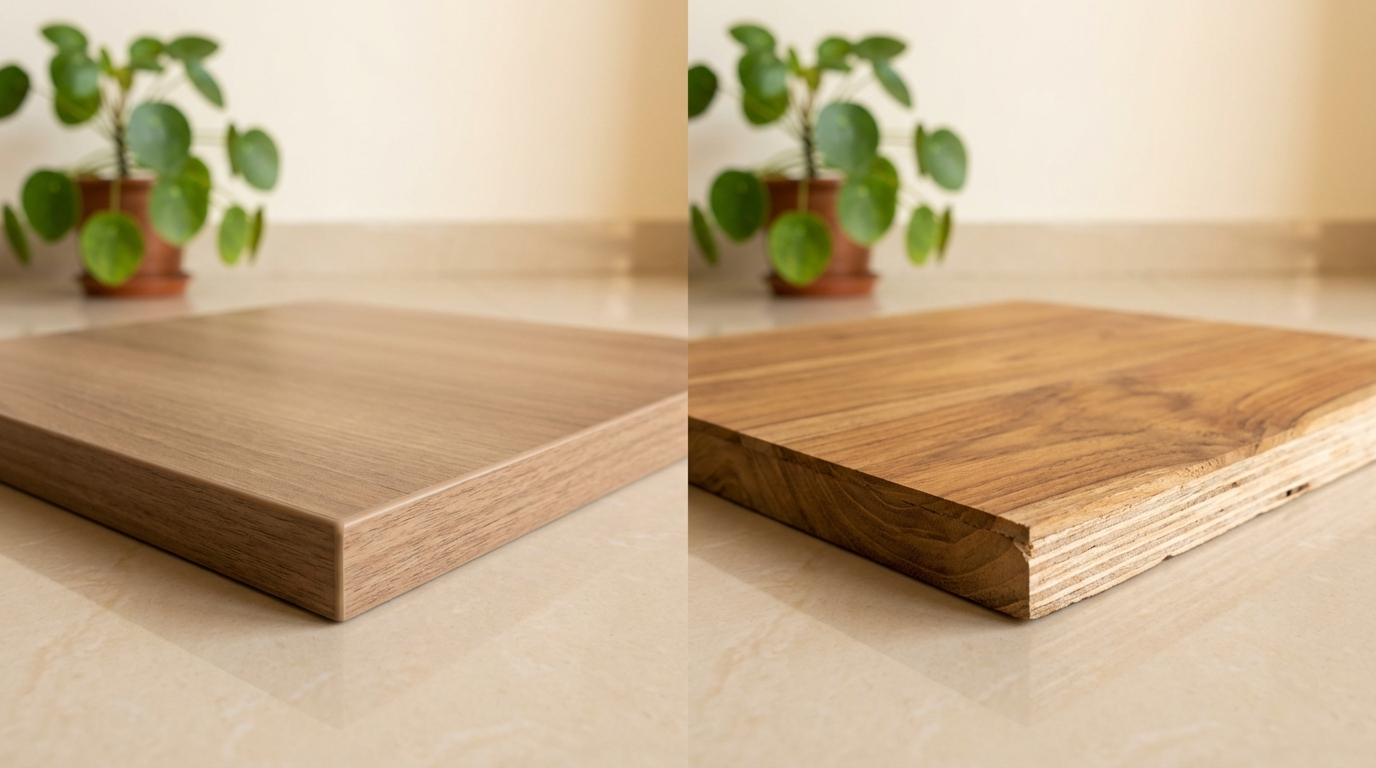
Veneer is actual wood, sliced paper-thin (usually 0.5mm to 4mm) from real timber logs and glued onto a substrate. Wood veneer is made from real wood—thin slices fixed on plywood or MDF boards. It gives a natural, rich look.
Most people think veneer is just laminate with a wood print. Actually, veneer IS real wood—you can feel the grain, see natural variations, and it develops character over time. Laminate, no matter how expensive, is printed. Run your fingers over both blindfolded. You'll know instantly.
Here's another common confusion: "decorative laminate" vs "decorative veneer." Both are decorative surfaces. But one is synthetic (laminate), one is natural (veneer). The word "decorative" just means they're meant for visible surfaces, not structural use. Your carpenter knows this; your dealer might be less clear about it.
Why This Matters in Indian Homes
From what we've seen, wood veneer is not the easiest to manage in Indian homes. And honestly, I've been saying this for years. Mumbai in July-August sees humidity hit 85-90% easily. Chennai stays humid year-round. Kolkata during monsoon is brutal. These conditions matter.
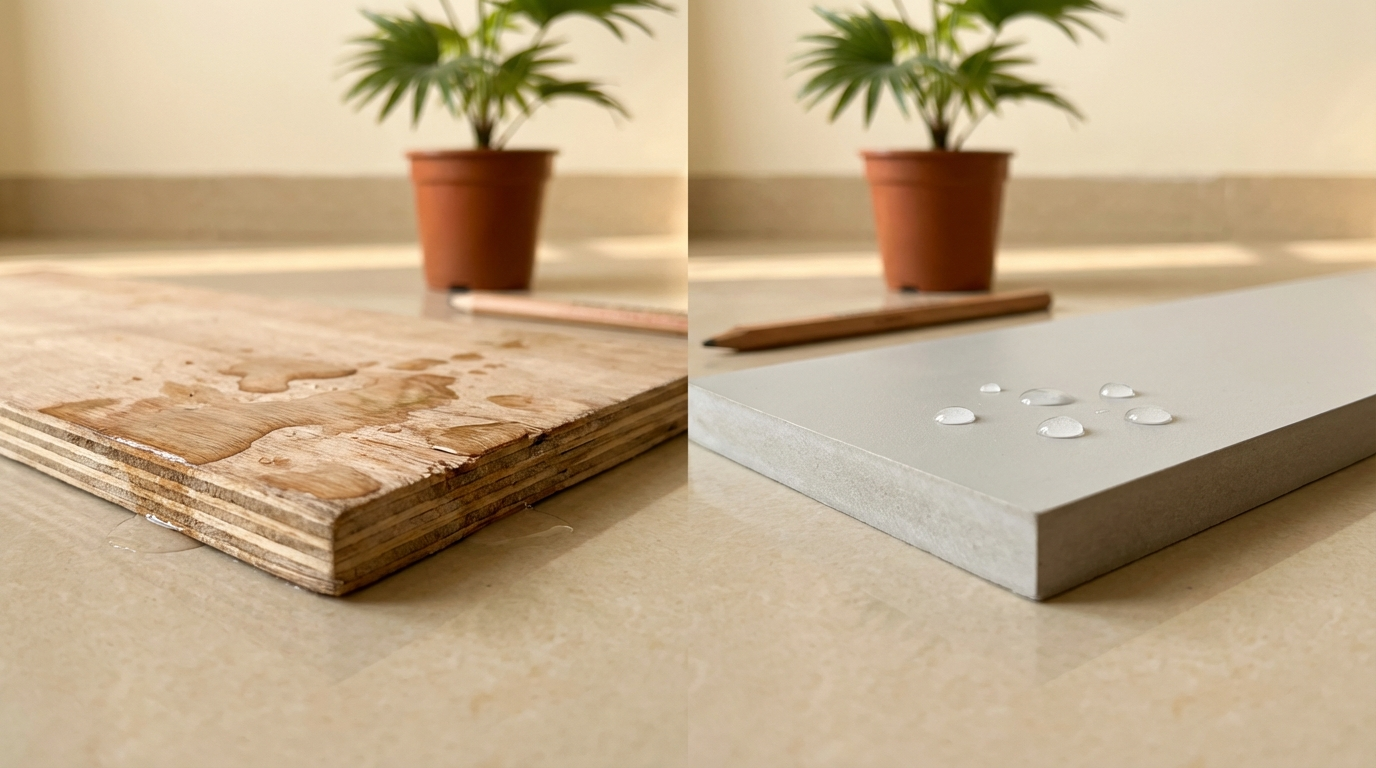
If you spill water, clean it roughly, or place veneer in a humid room, it can swell or fade. It scratches easily. Rough use, kids playing, or even daily cleaning can leave marks. That's the reality. The Ghatkopar side of Mumbai gets more humid than Borivali—I've seen veneer panels warp differently in flats just 15 kilometers apart.
In coastal cities like Chennai, Kochi, or the Konkan belt, moisture penetrates everything. Laminates are scratch-resistant and moisture-resistant but cannot be repaired once damaged. Veneer requires regular care and protection from water. For kitchens especially—where steam, oil splatters, and spills are daily events—laminate just makes more sense.
But here's where it gets interesting. In Bengaluru, Hyderabad, or drier parts of Rajasthan? Veneer holds up much better. Lower humidity means less swelling risk. A client in Jubilee Hills, Hyderabad had veneer wardrobes for seven years with just annual polishing. Same product in Bandra would have needed attention every monsoon.
PVC sunmica sheets are increasingly preferred in Indian homes, particularly in Gujarat where humidity and temperature variations are common. That's an interesting trend—PVC-based laminates for areas that see both heat and moisture.
Can you use veneer in bathrooms?
Short answer: no. Well, technically you can, but you'll regret it within two monsoons. Kitchens, wardrobes, bathroom vanities—laminates are the sensible choice. Even marine-grade veneer with PU coating struggles in bathrooms. The constant moisture cycle—steam from hot showers, wet towels, splashing water—breaks down any finish eventually. Stick to laminates or acrylic for bathroom vanities. I've seen too many expensive veneer vanities turn into warped, discolored messes within 18 months.
Types, Grades, and Options: Breaking It Down
Laminate Types
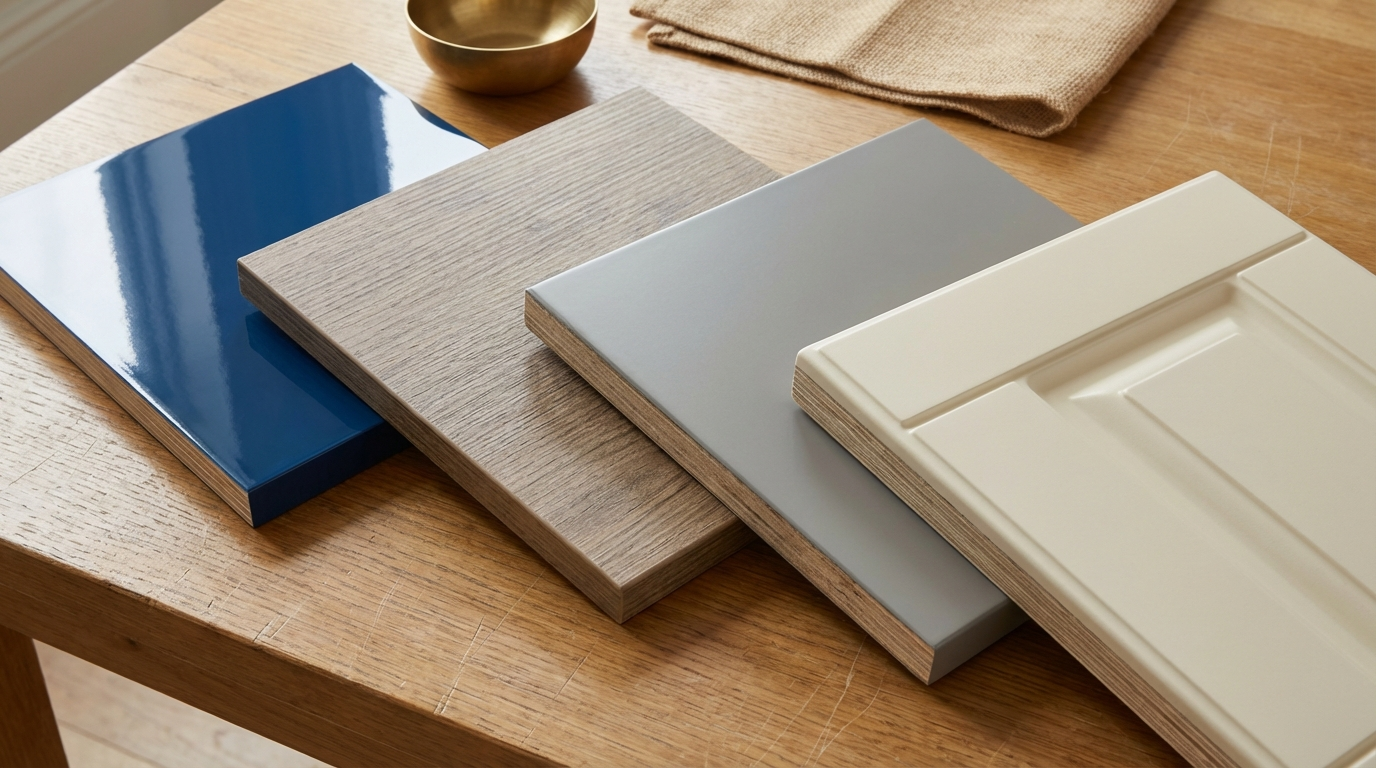
Laminates are available in very different types such as matte-finish, textured, gloss-finish, metallic, and more. High Pressure Laminate (HPL) is made by pressing thin layers of Kraft paper and resins together—available in 1MM, 0.8MM and 0.72MM thicknesses.
Here's my take on each:
HPL (High Pressure Laminate) – 1mm thick: This is what I recommend for horizontal surfaces—kitchen counters, tabletops, anything that takes abuse. The extra thickness matters for impact resistance. Costs more, lasts longer. Worth it.
LPL (Low Pressure Laminate) – 0.6-0.8mm: Fine for wardrobe shutters and vertical surfaces. Not ideal for kitchens or anywhere with direct heat. Cheaper, and for wardrobes, it honestly works fine. Why pay more for vertical surfaces that don't take much beating?
Finishes matter: Glossy laminates are slowly being replaced by super-matt, anti-fingerprint finishes that look elegant and stay cleaner in daily use. I agree with this trend. High-gloss looks amazing in showrooms but shows every fingerprint and scratch in real homes. Matte or textured is more practical.
Veneer Types
Veneers have varieties of classification such as natural wood & composite veneer, backed & un-backed veneer faces, pre-finished veneer, etc.
Natural Veneer: Sliced directly from real timber—teak, oak, walnut, rosewood. Each sheet is unique. Beautiful but expensive. More number of shades cannot be expected from veneer since it's a natural material—shades are limited.
Reconstituted/Engineered Veneer: Wood is dyed and restructured to create uniform patterns. Looks consistent across large installations. Honestly, for most homes, this is the practical choice if you want veneer look without premium teak prices.
Pre-finished Veneer: Comes with protective coating already applied. Saves time and polish costs during installation. Worth the premium if your carpenter isn't great with finishing work.
Comparison Table: Quick Reference
| Parameter | Laminate (Sunmica) | Veneer |
|---|---|---|
| Material | Synthetic (resin-bonded paper) | Real wood slices |
| Thickness | 0.6mm to 1.5mm typically | 0.5mm to 4mm |
| Look/Feel | Consistent, printed patterns | Natural grain, each piece unique |
| Durability | Excellent scratch/stain resistance | Moderate—scratches show easily |
| Water Resistance | Good | Poor without proper sealing |
| Repairability | Cannot be repaired | Can be sanded and refinished |
| Maintenance | Wipe clean, almost nothing else | Regular polishing needed |
| Best for | Kitchens, wardrobes, high-use areas | Living rooms, bedrooms, statement pieces |
Price Reality Check (2026 Market)
Alright, let's talk numbers. Not exact prices—those change monthly—but the ranges you should expect.
Latest cost of sunmica sheet is ₹30-200/sq ft. That's a massive range, I know. Here's how to make sense of it:
Budget laminate (₹30-50/sq ft): Local brands, basic finishes, 0.7-0.8mm thick. Fine for rental properties or temporary use. Don't expect miracles.
Mid-range laminate (₹50-100/sq ft): Recognized brands, decent finishes, 0.8-1mm thick. This is where most homeowners should be shopping. Good balance of cost and quality.
Premium laminate (₹100-230/sq ft): Greenlam, Royale Touche premium ranges cost ₹80-230/sq ft with superior quality and glossy finishes. Worth it for high-visibility areas if budget allows.
Veneer pricing: The price of veneer sheets lies between Rs 50-Rs 150 per sq ft in India. It varies according to the finish, application, brand, and durability. But add polishing costs on top—that's another ₹25-50/sq ft depending on finish quality. So all-in, veneer runs roughly ₹75-200/sq ft after finishing.
What actually affects your final bill:
- Brand premium—national brands cost 30-50% more than local
- Finish type—textured and synchronized finishes cost more
- Sheet utilization—irregular furniture shapes mean more wastage
- Labor—veneer needs skilled application and finishing, laminate doesn't
Quick example: A standard 6-door wardrobe needs roughly 120-140 sq ft of finish material. At mid-range laminate (₹70/sq ft), that's ₹8,400-9,800 just for laminate. Same wardrobe in decent veneer with polishing? ₹15,000-22,000. Double the cost for aesthetics. Whether that's worth it depends entirely on where the wardrobe sits.
Direct Comparison: When to Choose What
| Factor | Laminate Wins When... | Veneer Wins When... |
|---|---|---|
| Budget | Tight budget, large area to cover | Money isn't the main constraint |
| Location | Kitchen, kids' rooms, rentals | Master bedroom, living room showcase |
| Climate | Humid coastal cities | Dry inland areas |
| Usage | Daily heavy use, kids, staff | Careful handling, adult-only spaces |
| Look | You want consistency across pieces | You want that natural, unique character |
| Maintenance | You want zero effort | You're okay with annual polishing |
| Long-term | Planning to redo in 8-10 years | Want furniture that ages gracefully |
Trade-off summary: If you're looking for authenticity, luxury, and the natural beauty of real wood, veneer is the way to go. However, if you want durability, affordability, and low-maintenance surfaces, laminate is a practical and versatile option. You gain durability with laminate but lose that organic warmth. You gain character with veneer but lose convenience.
My preference: For 80% of furniture in most Indian homes, laminate makes more sense. Use veneer strategically—the TV unit, the bed headboard, that one showcase in the drawing room. Mixing both isn't cheating; it's smart. This way, you get the best of both worlds—practicality and beauty.
Is veneer actually worth the extra cost?
Depends on where you're using it. For your kitchen cabinets? Absolutely not—you'll spend twice as much and deal with maintenance headaches. For a living room console that guests actually notice? Yes, the difference in feel and appearance justifies the premium. A veneer wardrobe would exude a more luxurious feel than a laminate wardrobe. That luxury feel comes from depth and warmth that printed laminate simply cannot replicate. But put that same veneer in your utility area, and you've wasted money on something nobody appreciates.
How to Choose: A Decision Framework
Step 1: List your furniture pieces and where they go. Kitchen cabinets, wardrobes, TV unit, study table—write it all down.
Step 2: Mark each piece as "high-use" or "display." High-use means daily touching, opening, possible spills. Display means people look at it more than use it.
Step 3: Check your city's humidity. Mumbai, Chennai, Kolkata, Kochi—default to laminate for most things. Bangalore, Pune, Hyderabad—you have more flexibility with veneer.
Step 4: Set your finish budget at roughly 15-20% of total furniture cost. If you're spending ₹5 lakh on a 2BHK's woodwork, you've got maybe ₹75,000-1 lakh for finishes. Allocate accordingly.
Step 5: Decide on hero pieces. Which 2-3 furniture items do you want to really stand out? Those get veneer if budget allows. Everything else gets quality laminate.
| Your Situation | My Recommendation | Why |
|---|---|---|
| First home, tight budget | Laminate everywhere | Focus resources on core furniture quality, upgrade finishes later if needed |
| Rental property | Budget laminate | Tenants won't maintain veneer; laminate survives rough use |
| Mumbai apartment, mid-budget | Laminate + veneer TV unit | Humidity makes veneer risky everywhere else |
| Bangalore villa, good budget | Laminate in wet areas, veneer in living/bedroom | Climate allows veneer to thrive; use strategically |
| Premium home, unlimited budget | Veneer with PU coating everywhere except kitchen | Maintenance isn't an issue; go for aesthetic excellence |
Red flags to walk away from:
- Dealers pushing one option heavily without asking about your usage or location
- "Premium Sunmica" sold at veneer prices—it's still laminate
- Veneer being recommended for kitchen shutters without discussing maintenance
- Extremely cheap veneer (under ₹40/sq ft)—that's likely paper-thin composite, not real veneer
Common Mistakes People Make
Mistake 1: Treating Sunmica as a separate category from laminate. This one really frustrates me. I've had clients come in saying "I want Sunmica, not laminate"—and when I explain they're the same thing, they look at me like I'm trying to trick them. Sunmica is usually used equivalently with laminates in India. Some dealers exploit this confusion to charge premium prices for regular laminate. Don't fall for it.
Mistake 2: Using veneer in kitchens to save money. I've seen this happen when architects design on paper without considering Indian cooking. There was this builder in Andheri—must have been 2021—who insisted on using veneer for modular kitchen shutters because it "looked more premium." Called me eleven months later. The finish near the stove had bubbled, edges had started lifting, and the polished surface looked tired already. Complete disaster. Had to replace everything with laminate.
Mistake 3: Going all-glossy because showrooms look great. High-gloss laminate photographs beautifully. But try keeping it smudge-free with kids running around, domestic help cleaning daily, and Mumbai humidity making everything slightly sticky. Matte or textured finishes hide fingerprints and minor scratches much better.
Mistake 4: Buying the cheapest laminate available. Budget laminate from unknown brands might be 40% cheaper, but it fades faster, chips at edges sooner, and the printed pattern looks obviously fake. The difference between ₹35/sq ft and ₹70/sq ft laminate is visible for years. This isn't where you save money.
Mistake 5: Assuming veneer needs no maintenance. Veneer has to be polished frequently to retain the look. If you're not willing to polish annually (or hire someone to do it), stick with laminate. I've seen beautiful teak veneer wardrobes turn dull and scratched within three years because owners thought "it's wood, it'll age naturally." It doesn't age naturally indoors—it just looks neglected.
Mistake 6: Matching laminate across different pieces bought months apart. Even the same code from the same brand can show slight shade variations between production batches. If your TV unit and your bookshelf need to match perfectly, buy all sheets together. Learned this the hard way on a project in Powai—client noticed the shade difference immediately after installation.
Mistake 7: Ignoring edge banding. Premium laminates adhere more effectively and reduce issues like bubbling or edge lifting. But even the best laminate fails if edges aren't banded properly. Exposed edges absorb moisture, leading to swelling. Insist on matching edge bands, and don't let your carpenter skip this step because it's "tedious."
Quality Checks You Can Do Yourself
Visual Inspection
- Hold the laminate sheet at an angle under light—look for print defects, color inconsistencies, or surface irregularities
- Check all four edges for chips or damage from handling
- Verify the pattern/color matches the sample you approved (take photos)
- For veneer: examine grain direction—it should flow consistently across pieces meant to be side-by-side
- Look at the back of laminate sheets—grainy brown backing is normal; peeling or bubbling isn't
Questions to Ask Your Dealer
- "Is this HPL or LPL?"—if they can't answer clearly, find another dealer
- "What's the warranty period?"—reputable brands offer 5-7 years on laminate
- "Can I see the ISI marking?"—look for IS 2046 on laminate, IS 1003 on veneer plywood
- "Do you have matching edge bands for this?"—if no, you'll end up with mismatched edges
- "What finish is this exactly?"—get specific: matte, satin, suede, gloss, textured
Simple Field Tests
Tap test: Tap the laminate with your knuckle. Quality HPL sounds solid, almost like plastic. Thin or cheap laminate sounds hollow.
Flex test: Gently bend the laminate sheet (don't crease it). Quality laminate flexes slightly without cracking. Brittle, cheap laminate cracks at slight flex.
Scratch test: Run your fingernail firmly across a sample. Good laminate shouldn't show a mark. If your nail leaves a visible scratch, the wear layer is too thin.
Veneer grain check: Wipe the veneer with a damp cloth. Real wood veneer shows grain that goes deeper than the surface—you can feel it. Paper-printed "veneer look" shows only surface printing.
Warning Signs
- Dealer refusing to show you full sheets—they might be hiding defects
- No brand marking anywhere on the sheet—could be repackaged seconds
- Price significantly below market rate—there's always a reason
- Veneer that looks perfectly uniform with no grain variation—likely reconstituted or printed
- Laminate backing that's already separating or feels moist
Here's a trick most dealers don't like: ask to see their stock, not just samples. Samples are always perfect. Stock might show batch variations, handling damage, or storage issues. If they resist, that tells you something.
Workmanship & Installation: What to Tell Your Carpenter
Good material badly installed is worse than budget material installed well. I've seen ₹150/sq ft laminate peel within a year because of poor application.
Cutting Requirements
Laminate needs to be cut face-up with a fine-tooth blade or scoring knife. Face-down cutting chips the decorative surface. If your carpenter uses a regular saw without adjusting, expect rough edges. For veneer, cutting with grain prevents splitting.
Why Edge Sealing Matters
Premium laminates adhere more effectively to calibrated plywood, reducing issues like bubbling or edge lifting. Exposed plywood or MDF edges absorb moisture. First monsoon, you'll see swelling. By December, the laminate starts lifting at corners. I've seen this happen in at least thirty kitchens across Mumbai and Thane. Insist on matching edge bands—2mm PVC is standard, 1mm for curves. Don't accept paper tape as a substitute.
Adhesive Selection
For laminate: synthetic rubber-based contact adhesive (Fevicol SH or equivalent) works for most applications. For high-moisture areas, use marine-grade adhesive. For veneer: hot press application is ideal, but hand rolling with PVA adhesive works for small jobs. Don't let them use regular white glue—it doesn't bond properly.
What to Tell Your Carpenter: 5-Point Briefing
- "Use matching edge bands on all exposed edges—I'll check before polish."
- "Let the laminate/veneer acclimatize in the room for 24-48 hours before application."
- "Cut with the decorative face up, not down."
- "Apply adhesive to both surfaces—substrate AND laminate backing."
- "Press from center outward to remove air bubbles, then roll firmly."
I've seen carpenters skip the acclimatization step and then blame the material when it buckles a week later. Material expands and contracts with temperature and humidity. If you apply it straight from a godown that's different temperature than your home, it'll move after installation. That 24-hour wait matters.
How Long It Lasts: Durability Reality
High-quality veneer, when properly polished and maintained, can last for many years. Laminates are scratch-resistant and moisture-resistant but cannot be repaired once damaged.
Laminate lifespan: Quality branded laminate on well-made furniture lasts 12-15 years easily with normal use. Kitchen cabinets—maybe 8-10 years because of heat and moisture stress. After that, you're not throwing away the furniture—just the finish fades, edges might lift, and patterns look dated. Replacement is just new laminate on the same carcass.
Veneer lifespan: Well-maintained veneer can last 20+ years—it actually improves with proper aging. But "well-maintained" means annual polishing, immediate cleaning of spills, protection from direct sunlight, and keeping humidity controlled. In Indian homes with domestic help who clean with wet mops? Probably 8-12 years realistically before you need major refinishing.
Signs of wear to watch for:
- Laminate: edge lifting starting, color fading near windows, surface scratches accumulating, pattern looking dated
- Veneer: dullness despite cleaning, water stains that won't polish out, cracks along grain, lifting at corners
When to consider replacement: If laminate is lifting at more than 20% of edges, or if veneer needs third re-polishing in five years, you've probably hit the practical lifespan. Throwing good money at restoration doesn't make sense at that point.
How long does laminate really last?
Here's what I tell my clients: expect 10-15 years from quality laminate in living spaces, 7-10 years in kitchens. But these are with normal use. If you have kids banging doors, heavy cooking daily, and Mumbai humidity—subtract 20-30%. If it's a guest bedroom that's barely used? Add 30%. Environment and usage matter more than brand claims. I've seen premium laminate fail in 5 years in beachfront flats and budget laminate last 12 years in well-ventilated Pune homes.
Alternatives Worth Considering
Laminate and veneer aren't your only options. Here are others worth knowing about:
Acrylic finish: High-gloss, modern look that's genuinely fingerprint resistant (unlike glossy laminate). Costs 2-3x more than premium laminate but maintenance is almost nothing. Popular for modern kitchens and wardrobes. Our kitchen cabinet material comparison covers this extensively if you want details.
PU (Polyurethane) paint: Gives furniture a lacquered, solid-color look. No grain pattern—just smooth color. Great for contemporary designs. Requires professional application; DIY will show streaks. Roughly same cost as mid-range laminate but labor-intensive.
HDHMR with laminate: HDHMR (High Density High Moisture Resistance) boards handle humidity better than regular MDF. If you're doing a Mumbai kitchen, HDHMR core with laminate finish is worth the 20-25% premium over regular MDF. Our HDHMR guide covers this in more detail.
If budget is genuinely tight, consider melamine paper finish—it's basically very thin laminate, costs half as much, but don't expect it to last more than 4-5 years. Fine for rental properties or temporary furniture.
Why do carpenters prefer laminate over veneer?
Honestly? Laminate is easier. Way easier. Application is forgiving—small mistakes don't show as much. Laminate is low-maintenance and easy to clean, making it suitable for heavy-use areas. With veneer, grain matching matters, finishing requires skill, and one water spill during installation can ruin a sheet. Carpenters also finish laminate jobs faster—same job might take 40% more time with veneer because of polishing steps. More profit per hour with laminate. Some genuinely believe laminate is better for Indian conditions; others just prefer the easier route. Ask your carpenter directly why they're recommending one over the other. Their answer tells you a lot.
FAQs
Is Sunmica and laminate the same thing?
Yes. Sunmica is just a brand name that became generic in India—like Xerox for photocopies. Sunmica, also known as laminate, is a commonly used material in interior design and furniture widely used in Indian households for its design, durability, and smooth appearance. Any dealer telling you otherwise is either misinformed or hoping you are. Don't pay a "Sunmica premium" for regular laminate.
What thickness of laminate should I use for kitchens?
1mm HPL minimum for kitchen cabinets—horizontal surfaces especially. Laminates are offered in various thicknesses, typically 1mm, to suit different applications. Thinner 0.7-0.8mm works for wardrobe shutters where there's less abuse, but kitchens need that extra durability. The heat and moisture resistance of thicker HPL justifies the higher cost. For kitchen countertops, consider postformed laminate (bent around edges) for seamless water protection.
Can veneer be repaired if scratched?
Veneers can be polished again and again over the years, refreshing their look and making them last a long time if maintained properly. Light scratches can be sanded out during regular polishing. Deep scratches or water damage are harder—might need localized patching by skilled craftsmen. This repairability is actually veneer's biggest advantage over laminate. Laminate scratches are permanent; you live with them or replace the whole sheet.
Is it true that veneer looks more premium than laminate?
Veneer exudes a luxurious, high-end feel that's hard to replicate with synthetic materials. Laminate can replicate the look of wood, but it's ultimately a printed design that doesn't offer the same depth or authenticity. Yes, this is true—to a point. Quality veneer has depth and warmth that even ₹200/sq ft laminate can't match. But here's the catch: poorly finished veneer looks worse than good laminate. The premium look requires skilled polishing. If your carpenter isn't experienced with veneer, you might end up with uneven sheen and visible brush marks that defeat the whole purpose.
What if I live in a coastal city like Chennai or Mumbai—should I avoid veneer entirely?
Not entirely, but be strategic. Use laminate for kitchens, wardrobes, and high-moisture areas. For living rooms with AC running regularly, veneer is fine—controlled humidity protects it. The problem is non-AC rooms, areas near windows that stay open during monsoon, or any furniture in servant quarters/utility areas. I've had clients in Bandra and Neelankarai (Chennai) use veneer successfully in air-conditioned bedrooms while using laminate everywhere else. The AC does the humidity control work.
Is it true that laminate can't be repaired at all?
Laminate lasts well but cannot be repaired. Minor edge lifting can sometimes be reglued if caught early. But surface scratches, chips, or burn marks? Permanent. You can buy laminate repair kits that fill small chips with colored wax—it helps, but the repair is always visible up close. For major damage, the affected panel needs complete re-lamination. This is laminate's main drawback compared to veneer.
How much does veneer polishing cost annually?
Depends on your city and the area to be polished. Rough estimate: ₹15-30 per sq ft for basic polish renewal, ₹40-60 per sq ft if you need complete sanding and re-finishing. A standard bedroom with veneer wardrobe and bed headboard might run ₹4,000-8,000 for annual touch-up, or ₹12,000-18,000 for full refinishing every 3-4 years. Factor this into your long-term budget when choosing veneer. Many people forget this recurring cost.
Can I install laminate myself or do I need a carpenter?
Technically possible; practically not recommended. Laminate application looks simple but requires even adhesive application, proper alignment (you get one shot—misalignment is permanent), and proper pressing to avoid air bubbles. Professional-looking DIY laminate work needs a rolling pin, proper contact adhesive, and frankly more patience than most homeowners have. For one small project, maybe. For an entire room's furniture? Get a carpenter who's done it before. The money you save isn't worth visible bubbles and peeling edges.
What's the difference between 0.8mm and 1mm laminate in actual use?
More than you'd think. That 0.2mm difference affects impact resistance significantly. Drop something heavy on 0.8mm laminate—higher chance of chipping. 1mm takes more abuse before showing damage. The difference is most visible on horizontal surfaces: countertops, tabletops, cabinet tops. For vertical surfaces like wardrobe shutters, 0.8mm is honestly fine—they don't take direct impacts. Save money on verticals, spend on horizontals.
Are fire-resistant laminates worth the extra cost?
Sunmica is preferred due to its fire retardance, water resistance, and low-maintenance qualities. Fire-resistant laminate won't completely prevent fire, but it delays spread and doesn't produce toxic fumes as quickly. Worth it near stovetops, in commercial kitchens, or if building codes require it. For regular wardrobes in bedrooms? Probably overkill. The premium is about 30-40% over standard laminate.
How do I know if a dealer is selling genuine branded laminate?
Check the back of the sheet for ISI markings and brand stamps—every sheet should have them. Ask for the purchase invoice from distributor (dealers buy from authorized distributors who maintain records). Reputable brands like Greenlam, Century, and others have dealer verification on their websites—enter the dealer's name and check. If a dealer hesitates to show you any of this, find another dealer. The branded laminate market has its share of dupes and seconds sold as originals.
Is it true that sunmica sheets fade quickly in sunlight?
High-quality printing and protective layers prevent fading, even in sunlit rooms. Quality laminate with UV-resistant coating holds up well. Budget laminate without UV protection fades noticeably within 2-3 years if near windows. If your furniture faces windows that get direct afternoon sun, specifically ask for UV-resistant variants. They cost maybe 10-15% more but make a visible difference over time. Dark colors show fading more obviously than light ones.
Note: sainik710.com is an independent informational site and is not affiliated with any manufacturer.
That's the gist of it. If you're still confused between the three—remember, Sunmica IS laminate, so you're really only choosing between laminate and veneer. Pick laminate for practicality, veneer for beauty, and use both strategically for the best results. Your carpenter might push back if you mix finishes in the same room, but trust me—it works when done right. And seriously, don't skip the edge banding.
Disclaimer: This content is provided for general informational purposes based on industry practices and publicly available information. Product specifications, standards, prices, and availability may vary by manufacturer, region, and time. Readers should independently verify details with manufacturers, dealers, or qualified professionals before making purchase or construction decisions.Want Plywood Suggestions?
Share a few details and a Sainik 710 specialist will suggest suitable brands and connect you to responsive dealers.