Window Design Ideas: 30+ Modern Wooden, Aluminium & UPVC Window Styles for Indian Homes
Get 30+ window designs for home—wooden, aluminium & UPVC styles. Size guide, material comparison & ventilation tips for modern Indian homes.
Window Design: The Quick Answer You're Looking For
Window design is the selection of frame material, opening style, size, and placement that determines how much light, air, and visual appeal your home gets. "Window definitions are considered quite crucial to the aesthetic appeal and functions of a house."
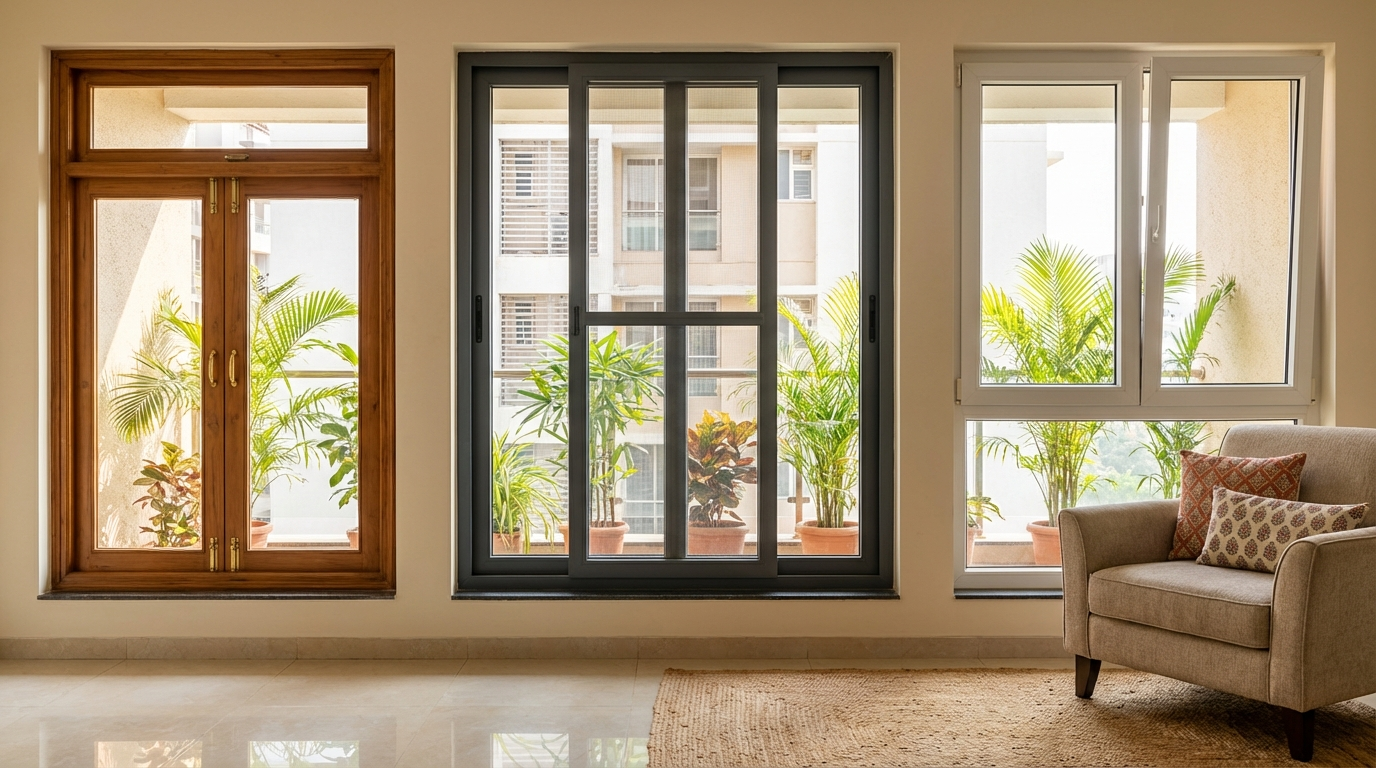
Short version: For most Indian homes in 2026, your decision comes down to three materials—wooden (for warmth and traditional look), aluminium (for strength and slim profiles), or UPVC (for insulation and budget-friendliness). "Aluminium, uPVC, and eco-friendly materials will gain popularity due to their insulation properties and durability." The style you pick—sliding, casement, bay, or fixed—depends on your room size, ventilation needs, and honestly, how much you want to spend.
This is right for you if:
- You're building a new home or doing a full renovation and want to get the windows right the first time
- Your current windows are 15+ years old, rattling in the monsoons, and letting in way too much dust—been there myself in a Chembur flat
- You're confused between UPVC and aluminium (welcome to the club, most homeowners are)
- You want better ventilation without compromising security
Skip this if:
- You're just looking for curtain or grille ideas—that's a different conversation altogether
- Your windows are fine and you're only here because someone told you UPVC is "the future"
Bottom line: The best window design for Indian homes combines the right material for your climate, an opening style that suits your space, and sizing that balances light with privacy—get these three things right and you've solved 90% of the problem.
What Window Design Actually Means
Window design is the complete specification of your window—frame material, glass type, opening mechanism, dimensions, and how it integrates with your wall structure. It's not just about how the window looks (though that matters) but how it performs over 15-20 years in Indian conditions.
Most people think window design means picking a pretty grill pattern or choosing between white and wood-finish frames. Actually, it's about matching your material choice to your local climate, selecting an opening style that suits the room's function, and sizing correctly for both ventilation and structural integrity. "In 2025, window frame design trends have changed to something that incorporates performance and style at the same time. Homeowners are now choosing designs that not only complement their interior themes but also stand strong against weather and time."
Here's what I keep telling my clients: a window is essentially a controlled hole in your wall. That sounds crude, but think about it. You're cutting through your structural wall to let light and air in while keeping rain, dust, noise, and intruders out. Get it wrong, and you'll feel the consequences every monsoon when water seeps in, every summer when heat makes the room unbearable, and every winter (yes, even in Mumbai) when you're wondering why the room feels drafty.
"It is always advisable to choose frame materials based on your region's weather conditions. For example, in North India, aluminium or uPVC frames are ideal for efficiently balancing summer heat and winter cold."
Why This Matters in Indian Homes
Indian homes face climate challenges that most global window guides don't even mention. I'm talking about 85-90% humidity during Mumbai's monsoons, 45°C summers in Delhi and Ahmedabad, salt-laden coastal air in Chennai and Kochi, and heavy dust throughout the Indo-Gangetic plains.
"As South India grapples with intensifying summer heatwaves and the persistent roar of urban traffic, a significant shift is occurring in how homes are built. Homeowners and developers across Bengaluru, Chennai, Hyderabad, and Kochi are moving away from traditional timber frames toward advanced window types for heat and sound insulation."
In places like Chennai or Mumbai, you'll notice wooden windows warping if they're not properly treated—and even then, they need re-polishing every 2-3 years. I remember a flat in Andheri where the client insisted on Burma teak windows because his father had them. Beautiful windows. By the third monsoon, three of them wouldn't close properly. "Wooden windows offer natural beauty and warmth but are prone to weathering over time. They require regular treatment, painting, or sealing to prevent rot, warping, and insect damage. With proper care, wood can last long, but maintenance is more demanding compared to uPVC or aluminium."
Coastal areas like Goa, Mumbai's western suburbs, and Kerala have additional problems. "These windows may not be very suitable for coastal areas as aluminium has a tendency to corrode and discolour due to oxidation in the presence of salt-laden air." Standard aluminium can start showing corrosion within 5-6 years in these zones unless you go for marine-grade or properly coated options.
Then there's noise. If you're in Bengaluru's tech corridors or Hyderabad's HITEC City area, "Double Glazed Units (DGU) reduce noise by 30–40 dB, essential for urban IT corridors in Bengaluru and Hyderabad." That's the difference between hearing every auto-rickshaw horn and actually sleeping at night.
Is UPVC Actually Worth the Extra Cost Over Standard Aluminium?
"When doing uPVC vs aluminium windows comparison, uPVC windows are known for excellent insulation. They don't conduct heat or cold, which makes them ideal for places with extreme summers or winters. You'll often feel a noticeable difference in room temperature if you switch from metal to uPVC." If you're running ACs for 6+ months a year, UPVC can reduce your electricity bills noticeably—maybe 10-15% on cooling costs depending on how many windows you have. For a 2BHK in Pune or Bengaluru where you only use AC 3-4 months, the payback period stretches longer. In humid coastal cities, UPVC's resistance to corrosion becomes the bigger advantage. "UPVC windows are even suitable for coastal areas (unlike its counterpart, aluminium, which may corrode or discolour)."
Window Types and Opening Styles: The Complete Breakdown
The opening style you choose affects ventilation, cleaning ease, security, and even furniture placement. "Some of the most common window designs include sliding windows, casement windows, bay windows, and tilt-and-turn windows. These types are practicable, aesthetically pleasing, and fit well with almost all buildings."
Let me break down the main types with my honest take on each:
Sliding Windows – "Sliding windows continue to be the best among the most trending window designs for flats. It saves more floor space and is easy to operate. It has no inward or outward opening and is great for compact areas." Honestly, sliding windows have become the default for apartments because they work. "Sliding windows are perfect for small areas because they do not require extra space to open and close. They also seem fashionable and trendy."
Casement Windows – These open outward like a door, hinged on one side. "Casement windows and louvred windows are the best for fresh air supply. Their designs allow easy entrance of fresh air into the house." Great for catching cross-breezes. The downside? They need clearance outside, so not ideal if you have a narrow balcony or your window opens onto a corridor.
Bay Windows – "A corner window gives your home an architectural outlook. It joins two walls with glass, which increases brightness and visibility. It helps to create a panoramic view and enhances ventilation. It adds a luxury feel to your home." Beautiful but expensive, and you need structural support.
Tilt-and-Turn Windows – These can tilt inward from the top for ventilation or swing open completely like a casement. "These windows are designed to open outward from the top and allow for air to circulate even during rain." Very practical for bedrooms where you want some air at night without fully opening the window. Getting more popular in high-rises.
Fixed Windows – "Fixed Windows – Do not open, designed for aesthetics and natural light." Use these where you want views but don't need ventilation—like a staircase landing or above your front door.
Folding/Bi-fold Windows – "Among all modern window solutions, folding windows have emerged as a favorite for architects, interior designers, and homeowners who want to combine style with practicality." These fold accordion-style to create a completely open space between indoor and outdoor. Stunning for connecting living rooms to balconies or gardens.
| Window Type | Best For | Ventilation | Space Required | Price Range | My Take |
|---|---|---|---|---|---|
| Sliding (2-track) | Apartments, bedrooms, living rooms | 50% opening | Minimal—no swing space needed | ₹350-700/sq ft (UPVC) | Default choice for most situations |
| Sliding (3-track with mesh) | Ground floors, mosquito-prone areas | 33% opening | Minimal | ₹450-850/sq ft | Worth it if you hate mosquitoes |
| Casement | Bungalows, row houses with space outside | 100% opening | Needs external clearance | ₹500-900/sq ft | Best ventilation but needs space |
| Tilt-and-Turn | Bedrooms, high-rises | Adjustable—partial to full | Inward clearance needed | ₹600-1200/sq ft | Underrated, especially for bedrooms |
| Bay Window | Living rooms with views | Depends on configuration | Projects outward—structural support needed | ₹1500-3500/sq ft | Beautiful but expensive |
| Fixed | Stairwells, above doors, aesthetic panels | None | None | ₹300-500/sq ft | Use strategically for light |
| Bi-fold/Folding | Living-balcony connections, gardens | 100% opening | Full panel folding space | ₹1800-3000/sq ft | Showstopper for entertaining spaces |
Frame Materials: Wooden, Aluminium & UPVC Compared
This is where most homeowners get stuck. Let me give you the honest comparison after dealing with all three materials across hundreds of projects.
Wooden Windows: The Traditional Choice
"Wooden window frames offer a classic and timeless look, excellent insulation properties, and the ability to be customized with various stains and finishes. They also provide natural thermal insulation and can be repainted or refinished as needed."
"Sal Wood – Strong, resistant to decay, and widely used for frames. Sheesham (Indian Rosewood) – Hard, termite-resistant, and aesthetically appealing. Mahogany – Durable, rich in color, and cost-effective for interiors. Pine Wood – Affordable and lightweight, but less durable for exterior use."
"The cost range of the wooden window estimates Rs 120/sq. feet- Rs2,800/sq. feet." That's a huge range because wood quality varies massively—cheap mango wood at one end, premium Burma teak at the other.
My honest take: If you want that traditional aesthetic and don't mind yearly maintenance, quality teak wooden windows are still unmatched for looks. But factor in the ongoing costs. "Different types of woods have different maintenance needs. Softer woods, such as pine, may need to be repainted and sealed more often to prevent damage, while harder woods like teak and sheesham require less maintenance because they are naturally resistant to moisture and insects."
Aluminium Windows: The Strength Advantage
"Aluminium windows are prized for their durability and ability to withstand harsh weather conditions, making them suitable for various climates across India."
"Aluminium windows and doors are known for their strength and rigidity. They are extremely durable, especially for large panels and commercial spaces. However, aluminium can conduct heat and cold, which may affect indoor insulation unless thermal breaks are added."
"It is estimated that aluminium windows have a share of over 50% in India, while UPVC windows may hold around 15-18% of the market." There's a reason for this dominance—aluminium works.
"Aluminium sections are thinner than uPVC and have a higher ratio of glass." This is actually a big deal if you want those slim, modern frames that maximize your view.
"In conducive conditions (away from salty air or spray or with suitable protective paint), the lifespan of aluminium windows is more than 45 years." That's if you're away from the coast. Coastal areas are a different story.
UPVC Windows: The Insulation Winner
"uPVC windows and doors are highly durable and resistant to environmental factors such as moisture, corrosion, and UV exposure. They do not warp, rot, or rust, making them ideal for a wide range of climates. High-quality uPVC frames maintain their shape and performance for decades with minimal maintenance."
"In general, uPVC windows are more budget-friendly in India. Depending on the design and brand, they usually cost between ₹400–₹900 per sq. ft., including installation."
"Aluminium windows tend to be pricier. Standard versions start from ₹700–₹1,200 per sq. ft., while high-end thermally broken frames can go up to ₹2,000 or more."
"This one's important, especially in cities with traffic noise, barking dogs, or construction sounds. uPVC windows tend to do a better job at keeping out noise."
How Long Do Different Window Materials Really Last?
Here's the honest lifespan expectation based on what I've seen in the field:
Wooden windows: 20-40 years with proper maintenance. "Wood windows are a popular choice for homes because they are durable and timeless. They are stronger compared to materials like vinyl and can last a long time if taken care of properly." But "proper maintenance" means re-polishing every 2-3 years, checking for termites annually, and immediate repairs if you notice any swelling or cracks.
Aluminium windows: "The lifespan of aluminium windows is more than 45 years" in good conditions. I've seen 30-year-old aluminium windows in Pune still working fine. But coastal or heavily industrial areas—expect 15-25 years before major maintenance kicks in.
UPVC windows: "UPVC windows are more vulnerable to UV rays from the sun, which causes them to become brittle and yellow over time. This issue worsens if the supplier reduces TiO2 content in the material, which is hard to identify in new windows." Good quality UPVC with proper stabilizers: 25-35 years. Cheap UPVC from unknown brands: you might see yellowing and brittleness in 8-10 years.
Price Reality Check (2026 Market)
Let me give you realistic price expectations for the Indian market:
| Material | Budget Range (per sq ft) | Mid-Range (per sq ft) | Premium (per sq ft) | What You Get at Each Level |
|---|---|---|---|---|
| Wooden (Sal/Pine) | ₹120-350 | ₹400-800 | ₹1200-2800 (Teak) | Budget: basic frames, needs frequent maintenance. Premium: solid teak, beautiful grain, longer life |
| Aluminium (Standard) | ₹350-500 | ₹550-850 | ₹900-1400 | Budget: basic profiles. Premium: thicker profiles, better hardware, more color options |
| Aluminium (System/Thermal Break) | ₹1000-1500 | ₹1600-2200 | ₹2300-3500 | Budget: basic thermal break. Premium: European-style systems, excellent insulation |
| UPVC | ₹350-500 | ₹550-800 | ₹850-1200 | Budget: thin profiles. Premium: multi-chamber profiles, better glass, branded hardware |
What actually affects your final bill:
- Glass type—plain glass vs toughened vs double-glazed can double your cost
- Hardware quality—cheap handles and hinges save money upfront but fail within 3-5 years
- Size and complexity—bay windows and arched shapes cost 40-60% more than simple rectangles
- Installation—proper waterproofing and sealing adds ₹50-100 per sq ft but prevents water seepage for years
- Location—Mumbai and Delhi prices run 15-20% higher than Tier-2 cities
For a typical 2BHK apartment with 8-10 windows, expect to spend:
- Basic aluminium: ₹80,000-1,20,000
- Good quality UPVC: ₹1,20,000-1,80,000
- Premium aluminium with thermal break: ₹1,80,000-2,50,000
Direct Comparison: The Decision Table
| Parameter | Wooden | Aluminium (Standard) | Aluminium (Thermal Break) | UPVC | My Preference |
|---|---|---|---|---|---|
| Upfront Cost | Medium-High (₹400-2800/sq ft) | Low-Medium (₹350-850/sq ft) | High (₹1000-2500/sq ft) | Low-Medium (₹350-900/sq ft) | UPVC or Standard Alu for budget |
| Thermal Insulation | Good (natural insulator) | Poor (conducts heat) | Excellent | Excellent | UPVC or Thermal Break Alu |
| Sound Insulation | Good | Average | Very Good (with DGU) | Very Good | UPVC with double glazing |
| Maintenance | High—annual polishing, termite checks | Low—occasional cleaning | Very Low | Very Low | UPVC or Aluminium |
| Durability | 20-40 years (depends on care) | 35-45+ years | 40-50+ years | 25-35 years | Aluminium for longevity |
| Coastal Suitability | Poor (warping, termites) | Poor (corrosion risk) | Good (with marine coating) | Excellent | UPVC for coast |
| Slim Profile/Modern Look | No | Good | Excellent | No (bulkier frames) | Aluminium for aesthetics |
| Color Options | Any (paintable) | Wide range (powder coated) | Wide range | Limited (mostly white/wood finish) | Alu or Wood for variety |
| Eco-Friendliness | Renewable if sourced responsibly | 100% recyclable | 100% recyclable | Recyclable but plastic-based | Wood or Aluminium |
Choose wooden when: Traditional aesthetic is non-negotiable, you have budget for quality teak, you don't mind ongoing maintenance, and you're not in a humid/coastal area.
Choose standard aluminium when: Budget is moderate, you want low maintenance, slim frames matter, and you're not in a coastal area or extreme climate.
Choose thermal break aluminium when: You want the best of both worlds—modern aesthetics plus excellent insulation—and can afford the premium.
Choose UPVC when: Insulation and noise reduction are priorities, you're in a coastal area, you want zero maintenance, or you're on a tighter budget but still want quality.
How to Choose: A Step-by-Step Decision Framework
Step 1: Identify your climate zone. Coastal and humid (Mumbai, Chennai, Kochi, Goa)? UPVC is safest. Extreme temperatures (Delhi, Ahmedabad, Nagpur)? Insulation matters—UPVC or thermal break aluminium. Mild weather (Bengaluru, Pune)? Any material works, so choose based on other factors.
Step 2: Define your priorities. Is it aesthetics? Modern look = aluminium. Traditional = wood. Is it budget? UPVC or standard aluminium. Is it low maintenance? UPVC or aluminium—never wood if you hate annual polishing.
Step 3: Measure your openings. Larger windows (over 5 feet width) need stronger frames. Aluminium handles larger spans better than UPVC. "UPVC gets its structural strength through a steel reinforcement inside the window profile. The bigger the steel section, the stronger the window, but this results in bulkier windows that reduce the amount of light entering the space."
Step 4: Think about glass requirements. Want double glazing for noise/heat? Factor that into cost. Some suppliers include basic glass in quotes, others don't—always clarify.
Step 5: Get at least 3 quotes. I cannot stress this enough. Prices vary 30-40% between suppliers for similar quality.
| Your Situation | Recommendation | Why |
|---|---|---|
| Mumbai/Chennai apartment, moderate budget | UPVC sliding windows | Humidity resistance, noise reduction, no corrosion |
| Delhi bungalow, premium budget | Thermal break aluminium with double glazing | Best insulation for extreme summers and winters |
| Bengaluru villa, want modern aesthetics | System aluminium with slim profiles | Mild climate allows flexibility, sleek look |
| Traditional Kerala home | Quality teak wooden windows | Matches architectural style, budget for maintenance |
| Goa beach property | UPVC—absolutely non-negotiable | Salt air destroys aluminium and wood |
| Tight budget, Tier-2 city | Standard aluminium or budget UPVC | Best value for money, readily available |
| High-rise apartment, traffic noise issue | UPVC with acoustic double glazing | Maximum sound reduction |
Red flags to walk away from:
- Supplier won't provide material specifications in writing
- Price is 40%+ below market rate—there's always a catch
- No warranty or vague warranty terms ("one year manufacturing defects only")
- Pushy about immediate payment before installation
- Can't show you completed projects in your area
Common Mistakes People Make
1. Choosing material based only on price. I've seen this so many times. Client picks the cheapest UPVC quote, and within 3 years the frames are yellowing and the handles are loose. "UPVC windows are more vulnerable to UV rays from the sun, which causes them to become brittle and yellow over time. This issue worsens if the supplier reduces TiO2 content in the material, which is hard to identify in new windows." The difference between good and bad UPVC isn't visible when you buy—it shows up years later.
2. Ignoring glass quality. Everyone obsesses over frame material and forgets that glass is 70-80% of your window surface. Cheap glass scratches easily, doesn't insulate well, and can even have visible distortions. Always ask about glass thickness and brand.
3. Wrong window style for the room. This one really frustrates me. I see people installing casement windows in rooms where furniture will block them from opening fully. Or sliding windows in rooms that desperately need maximum ventilation. Think about how you'll actually use the space.
4. Forgetting about hardware. The handles, hinges, and locking mechanisms matter as much as the frame. Bad hardware means windows that jam, rattle, or become security risks. "The hardware in aluminium upvc windows is generally more corrosion-resistant, and the metal-to-metal lock fixing makes them more secure. Additionally, aluminium windows are easier to operate due to larger rollers, and features like door closures or child safety catches can be easily added."
5. Not planning for mosquito mesh. Standard 2-track sliding windows give you 50% opening. If you want mesh AND full opening, you need 3-track systems. "2.5-Track Windows An upgrade over two-track windows, these feature an additional track that allows for the installation of a mosquito mesh, offering enhanced ventilation and protection from insects."
6. Choosing aluminium for coastal properties. "These windows are not very suitable for the coastal areas as aluminium has a tendency to corrode and discolour due to the oxidation in the presence of salty air." I've seen this happen within 4-5 years in Versova and Juhu areas. The corrosion isn't just ugly—it weakens the structure.
7. Skipping waterproofing during installation. A 2022 project in Powai taught me this the hard way. Perfect windows, terrible installation—water seeped in during the first heavy rains. Cost twice as much to fix as doing it right initially.
8. Not considering future cleaning access. Fixed windows on upper floors of high-rises look great until you realize you can't clean them properly from inside. Think about how you'll maintain each window 5-10 years from now.
9. Matching frame color to current trends. That trendy dark bronze finish might look dated in 10 years. Classic white, wood-finish, or matte black tend to age better.
Quality Checks You Can Do Yourself
Visual checks (at the dealer/showroom):
- Look at cut profile sections—internal chambers should be clearly visible in UPVC, wall thickness should be even
- Check corner joints—they should be welded seamlessly in UPVC, mechanically joined with no gaps in aluminium
- Powder coating on aluminium should be completely uniform—run your finger over it, no rough patches
- Glass edges should be polished, not rough or chipped
- Hardware should operate smoothly—open and close mechanisms 10+ times to check
- Ask to see the raw profiles before fabrication if possible
Questions to ask the dealer:
- "What's the profile wall thickness?" (For UPVC, quality brands are 2.8-3mm; budget ones are 2-2.4mm)
- "Who manufactures the hardware?" (Branded hardware like Hettich, Ozone, or Roto = good sign)
- "What glass brand and thickness are you using?"
- "What's included in the installation—waterproofing, removal of old windows, finishing?"
- "Can I visit a site where you installed windows 3-4 years ago?"
Simple field tests:
- Weight test: Quality aluminium profiles feel substantial, not flimsy. Pick up a sample—it shouldn't feel like a soda can.
- Tap test: Tap the UPVC profile. Solid thunk = good. Hollow, cheap sound = thin walls.
- Flex test: Try to flex a profile sample slightly. Good profiles are rigid. If it bends easily, walk away.
- Edge inspection: Cut edges should be clean and precise. Rough cuts indicate poor fabrication.
- Hardware test: Move the handle through its full range multiple times. Smooth action or grinding/resistance?
Here's a trick most dealers don't like: Ask for the ISI certification number or batch markings on the profile. Quality profiles have permanent stamps or markings showing the manufacturer and batch. If there's no marking, you don't know what you're actually buying.
Warning signs:
- Dealer avoids showing you profile cross-sections
- No samples available—everything is "in the factory"
- Price is dramatically lower than competitors but they claim same quality
- Installation "team" is just two guys with no formal training
- Warranty documents are vague or non-existent
- They can't name their profile supplier or hardware brand
Workmanship & Installation: What to Insist On
Even the best windows fail if installed badly. I've seen premium ₹2000/sq ft windows leak because the installer saved ₹50 on sealant.
Critical installation requirements:
Opening preparation: The wall opening should be clean, level, and properly sized. Gaps between frame and wall should be 10-15mm on each side—not more, not less. Too tight and you can't seal properly. Too loose and you're relying too much on foam.
Waterproofing (non-negotiable): External silicone sealant on all joints. Proper flashing or drip mould at the top to direct water away. Sill should slope slightly outward (5-10 degrees) so water doesn't pool.
Shimming and alignment: Frames must be perfectly plumb (vertical) and level (horizontal). Wooden or plastic shims every 300-400mm. Never just pump expanding foam and hope for the best.
Fixing: Frame anchors or screws should go into solid masonry—not just into plaster. For concrete walls, proper plugs are essential. Minimum 4 fixing points per frame side, more for larger windows.
What to tell your installer/contractor (6-point briefing):
- "I want to see the waterproofing sealant brand before you use it—no local unbranded stuff"
- "Check level and plumb at every stage—I'll verify before you proceed"
- "Use proper wall plugs and screws, not just nails or weak rawl plugs"
- "Clean all glass and tracks before handover—I'm not paying for cleaning"
- "Leave no exposed foam—trim and seal properly"
- "Test every window opens and closes smoothly—I'll check each one"
Storage and acclimatization: If windows arrive before installation, store them upright (not flat), covered but ventilated, away from direct sun. UPVC especially can warp if left in hot sun.
I've seen installers skip the waterproofing step on upper floors because "rain doesn't hit there directly." Wrong. Wind-driven rain absolutely hits 10th floor windows, sometimes harder than ground floor. A builder in Kandivali discovered this during Cyclone Tauktae—water ingress in multiple flats because installers got lazy.
Why Do Carpenters Prefer Aluminium Over UPVC?
Honestly? It's partly about familiarity. "Wood has long been a preferred option for residential windows, but its share is declining due to high costs and the difficulty in finding skilled carpenters." Most carpenters learned their trade on metal and wood. UPVC requires specialized welding machines and trained fabricators—different skill set entirely. Aluminium is easier to repair on-site if something's wrong. UPVC repairs often mean replacing entire sections. Also, aluminium suppliers have been around longer, so relationships and margins are established. That said, your carpenter's preference shouldn't override what's right for your situation.
Size Guidelines for Indian Homes
Here's what works for typical Indian rooms:
Bedrooms (10x12 or 12x14 feet): Minimum two windows if possible for cross-ventilation. Size: 4x4 feet or 5x4 feet each. Sill height: 900mm-1000mm from floor.
Living rooms: Go bigger—6x4 feet or larger if wall allows. Consider combining fixed + openable panels. "This design is considered the best among the modern apartment window styles as it features tall and full-length windows that instantly transform any room's look and feel. It lets in maximum sunlight and creates a premium and open look. It makes small rooms look bigger, reduces the need for artificial lighting, and offers wide outdoor views."
Kitchens: Ventilation is priority. 3x3 feet minimum above the counter or 4x3 feet. Consider awning-style or top-opening tilt-turn so you can keep them open during light rain.
Bathrooms: Small but essential—2x2 feet or 2x3 feet. Higher placement for privacy (sill at 1500mm). Ventilator style or frosted glass with openable section.
Ventilation rule of thumb: Total openable window area should be at least 8-10% of floor area for adequate air circulation. More in humid coastal cities.
Alternatives Worth Considering
WPC (Wood Plastic Composite) Frames: These are gaining popularity as an alternative to solid wood. Better moisture resistance than wood, similar look, lower maintenance. Not as strong as aluminium for large spans, but good for standard residential sizes. Our WPC door frame guide covers the material in detail if you're considering this for doors as well.
Steel Windows: Still common in commercial buildings and some traditional homes. "Steel has been popular because of its lower initial cost, but it is also seeing a decline due to quality and maintenance issues." Rust is the killer—unless you're religious about repainting every 2-3 years, steel windows eventually corrode.
Composite Windows (Aluminium-clad Wood): Wood interior for warmth, aluminium exterior for weather protection. Excellent but expensive—mostly seen in premium projects. Worth considering if budget allows and you want that wood aesthetic without the maintenance headache.
If you're doing a full interiors project and also choosing plywood for furniture, the material compatibility matters. Our BWR plywood guide covers moisture-resistant options that work well with UPVC and aluminium window installations where humidity is a concern.
FAQs
Is it true that UPVC windows turn yellow after a few years?
Partly true, but it depends entirely on quality. "UPVC windows are more vulnerable to UV rays from the sun, which causes them to become brittle and yellow over time. This issue worsens if the supplier reduces TiO2 content in the material." Good brands add UV stabilizers (titanium dioxide or TiO2) that prevent yellowing. The problem is you can't test this yourself—cheap manufacturers cut costs by reducing stabilizer content. Solution: buy from established brands with 10+ year warranties specifically covering discoloration. Ask for their warranty terms in writing.
What if I live in a coastal city like Mumbai or Chennai—which material should I pick?
"UPVC windows are even suitable for coastal areas (unlike its counterpart, aluminium, which may corrode or discolour)." UPVC is the safest choice for areas within 2-3 km of the sea. If you really want aluminium's slim profile, look for marine-grade powder coating or anodized finishes, but expect to pay 20-30% more. Standard aluminium will definitely show corrosion—I've seen windows in Versova with visible pitting within 5 years.
Can aluminium windows be as good as UPVC for insulation?
Yes, but only with thermal break technology. "Aluminium windows, by nature, conduct heat. So, unless they come with a thermal break (a special insulating layer between the inside and outside frame), they may let in more heat or cold. Good brands do offer thermal break options, but they'll cost more." Standard aluminium without thermal break is a poor insulator—you'll feel the frame getting hot in summer and cold in winter. Thermal break aluminium performs on par with UPVC but costs significantly more.
Is it true that bigger windows mean weaker structural walls?
Not automatically, but there are limits. Any opening over 4 feet wide typically needs a lintel (supporting beam) above it. Very large openings—8 feet or more—require structural engineer input. Window size should be planned during the construction phase, not as an afterthought. Cutting new large openings in existing load-bearing walls is risky and expensive.
How often do wooden windows really need maintenance?
"Wooden windows, by contrast, demand ongoing maintenance. Paint or varnish needs to be reapplied periodically to protect the wood from moisture and UV damage. Without maintenance, wooden frames can deteriorate quickly." For Mumbai's climate, expect to re-polish or re-varnish every 2-3 years. In drier cities like Pune or Bengaluru, you might stretch it to 3-4 years. Ignore maintenance and you'll see cracks, swelling during monsoons, and eventually termite damage.
What's the difference between standard aluminium and "system aluminium" windows?
"The modern Aluminium windows are known as 'System Windows' which are tested for safety in extreme weather conditions." Standard aluminium uses locally fabricated profiles—quality varies wildly. System aluminium uses engineered, pre-designed profiles from established manufacturers with consistent quality, better hardware integration, and often thermal breaks. System windows cost 2-3x more but perform significantly better.
Is it true that folding windows are just a trend and not practical?
Depends on the application. "Folding windows align perfectly with these needs. They combine high-end design with everyday functionality, making them a smart investment for the future. For homeowners who want spaces that adapt to modern lifestyles while retaining elegance, folding windows are no longer just a trend — they are becoming the new standard." For connecting living rooms to balconies or gardens, folding windows are fantastic—they completely open up a wall. But they're expensive, need regular maintenance (more moving parts), and make no sense for bedrooms or small windows.
Should I choose double glazing for all windows or only some?
Not all windows need it. Prioritize double glazing for: west-facing windows (afternoon heat), bedrooms facing main roads (noise), and rooms where you run AC heavily. For internal-facing windows or protected balcony-side windows, single glazing is usually sufficient. "Solar Control Glass can reflect up to 70% of solar heat, which can help lower AC bills." That's worth it for heat-exposed windows.
What's the minimum window size for bedroom ventilation as per building codes?
Most municipal codes require openable window area to be at least 8-10% of floor area. For a 12x10 feet bedroom (120 sq ft), that's roughly 10-12 sq ft of openable windows—equivalent to one 4x3 feet window or two smaller ones. However, codes vary by city, so confirm with your local architect or municipal office.
Is it true that UPVC windows can't be repaired, only replaced?
Mostly true for frame damage—UPVC can't be welded or patched on-site like aluminium. Minor issues like hardware replacement, glass replacement, or gasket changes are possible. But if the frame itself cracks or warps, replacement is usually the only option. This is one area where aluminium has an advantage—a skilled fabricator can often repair aluminium frames on-site.
Can I use wooden windows in my bathroom?
Not recommended. Even with waterproof finishes, the constant humidity in bathrooms causes wood to swell and eventually rot. UPVC or aluminium is the better choice for bathrooms. "They require regular treatment, painting, or sealing to prevent rot, warping, and insect damage." In a bathroom environment, you'd need to re-seal monthly—not practical.
What if my builder is pushing a specific window brand—should I trust their recommendation?
Be cautious. Builders often have arrangements with specific suppliers—not always based on quality but on margins. Get independent quotes from 2-3 other suppliers. Compare specifications, not just prices. Check if the builder's recommended brand has a good market reputation. Ask for warranty terms. If the builder won't let you choose your own windows, at least verify the proposed brand's profile thickness, hardware quality, and warranty coverage.
Right, that covers most of what you need to know about window design for Indian homes. The material choice will depend on your specific situation—no universal answer works for everyone. But if you take away one thing from this guide: buy quality over cheap, plan your sizes during construction (not after), and never skip the waterproofing during installation. The windows you install today will be with you for 20-30 years. Worth doing right.
Disclaimer: This content is provided for general informational purposes based on industry practices and publicly available information. Product specifications, standards, prices, and availability may vary by manufacturer, region, and time. Readers should independently verify details with manufacturers, dealers, or qualified professionals before making purchase or construction decisions.Want Plywood Suggestions?
Share a few details and a Sainik 710 specialist will suggest suitable brands and connect you to responsive dealers.