Sliding Door Wardrobe Design: 35+ Modern Ideas with Track, Handle & Mirror Options
Explore 35+ sliding door wardrobe designs—track systems, handle options & mirror integration. Space-saving solutions & material guide for modern bedrooms.
Quick Answer: Sliding Door Wardrobes Save Space and Look Modern—But the Track System Makes or Breaks It
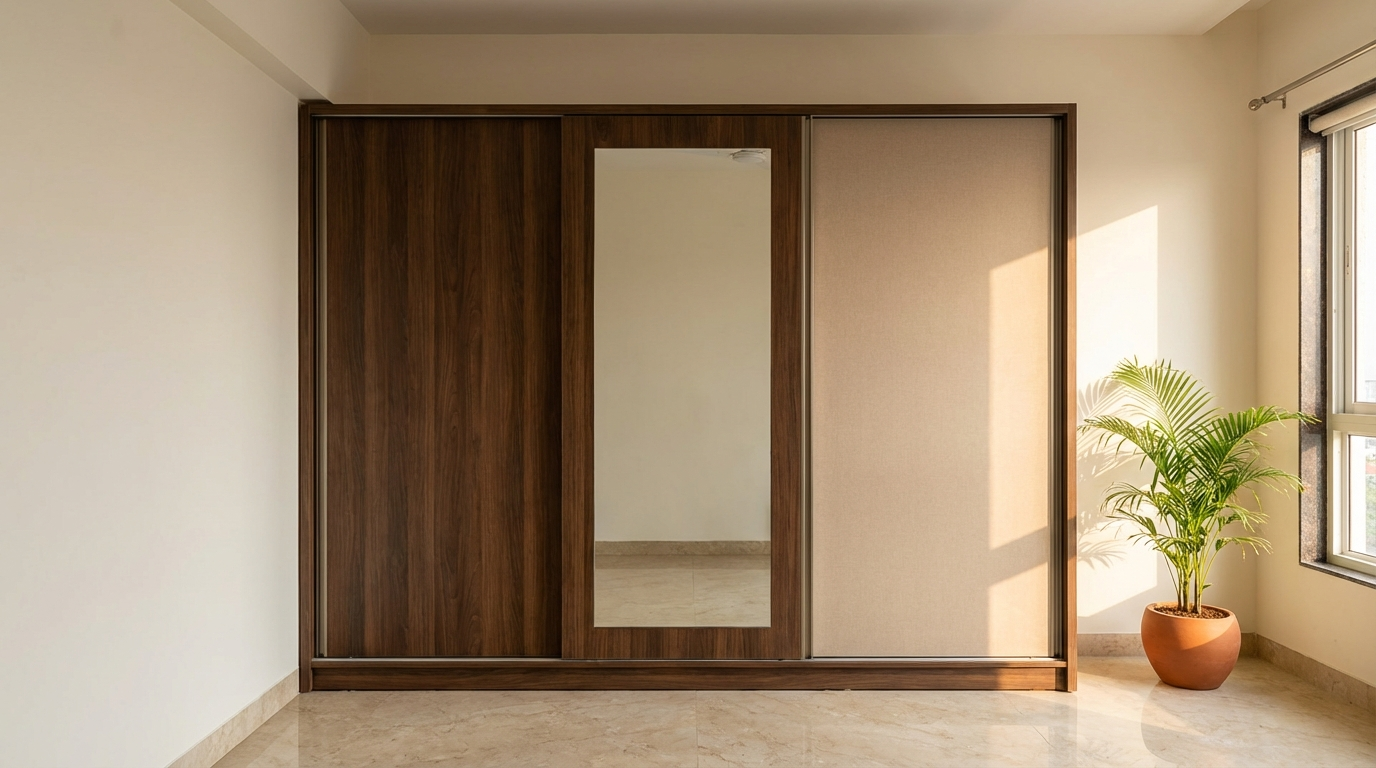
A sliding door wardrobe uses horizontal tracks instead of hinges, letting doors glide sideways rather than swinging outward—saving roughly 2-3 feet of clearance space in your bedroom.
Short version: Sliding wardrobes work brilliantly in compact Indian bedrooms where swing doors would crash into beds or block walkways. The magic is in three components: the track system (top-hung vs bottom-rolling), the handle design (or lack of one), and whether you integrate mirrors. Get the track system wrong, and you'll be fighting sticky doors within two monsoons. Get it right, and the wardrobe practically services itself for 12-15 years.
This is right for you if:
- Your bedroom is under 150 square feet and every inch matters
- The wardrobe sits at the foot of your bed or along a narrow passage where swing doors would be impractical
- You want a sleek, contemporary look
- You're okay with accessing only half the wardrobe at a time (this catches people off-guard)
Skip this if:
- You need to see everything inside simultaneously—maybe for daily outfit planning where you like comparing options
- You're on an extremely tight budget, because decent sliding hardware adds ₹3,000-8,000 to your costs compared to hinged
Bottom line: Sliding wardrobes aren't just about looks—they're a spatial compromise that works beautifully when you understand the trade-offs and invest in quality track systems.
What Sliding Door Wardrobes Actually Mean in Practice
A sliding door wardrobe is a storage unit where doors move horizontally along tracks rather than swinging on hinges. The doors typically overlap partially, meaning you can only access one section at a time—usually 50-60% of the interior depending on door configuration.
Most people think sliding wardrobes are purely an aesthetic choice. Actually, they're an engineering response to space constraints. The mechanism involves either top-hung systems (where doors suspend from an upper track) or bottom-rolling systems (where wheels run along a floor track). This distinction matters more than most design magazines admit.
Here's what happens inside: each door panel—usually made from 18mm plywood or MDF with laminate or veneer finish—sits on rollers or hangs from carriers. When you push, the door glides along the track until a stopper prevents it from falling off. Quality systems include soft-close dampers that slow the door in the last few centimeters. Cheap systems... well, they bang shut and eventually jump off the track. I've replaced hardware on wardrobes barely two years old because the original track couldn't handle daily use.
The frame construction typically uses aluminum profiles or matching wood/MDF frames. Aluminum profiles have become popular because they're moisture-resistant and allow slimmer sight lines. But wooden frames painted to match the shutter give a more integrated look if that's your preference.
Why This Matters Specifically in Indian Homes
Indian bedrooms are getting smaller. That 10x12 master bedroom in your new Thane flat? Try fitting a queen bed, two side tables, and a 6-foot-wide wardrobe with swing doors. You'd need to stand on the bed to open it fully.
Then there's humidity. In Chennai, Mumbai, or Kolkata, you're dealing with 75-90% relative humidity for four months straight. This warps wooden tracks, rusts cheap metal hardware, and swells MDF shutters until they scrape against each other. I've seen perfectly good-looking wardrobes in Kochi become nearly unopenable by their third monsoon—all because someone saved ₹2,000 on the track system.
Coastal cities face salt air corrosion too. A builder in Panaji showed me a wardrobe where the aluminum tracks had white oxidation patches within 18 months. The solution? Marine-grade or anodized aluminum, which costs more but doesn't pit and corrode.
In drier cities like Pune, Bangalore, or Ahmedabad, you get more flexibility with materials. MDF shutters hold up better, wooden frames don't warp as dramatically, and even mid-range hardware lasts longer. But even there, I'd recommend moisture-resistant MDF for the shutter panels—not regular MDF.
One thing nobody talks about: dust. Indian homes accumulate dust faster than European or American ones. Bottom-rolling track systems collect dust in the channel, making doors stick over time. Top-hung systems handle this better because the track is at eye level where you'll actually clean it.
Do sliding wardrobes work well in humid coastal cities?
They do, but only with the right materials. You need marine-grade plywood (BWP grade, IS 303 standard) for the carcass, moisture-resistant MDF or high-pressure laminates for shutters, and anodized aluminum profiles for the track system. Avoid regular MDF entirely—it swells like bread in water. Top-hung systems outperform bottom-rolling in coastal areas because salt and moisture collect in floor channels. Expect to pay 20-30% more for coastal-appropriate materials, but you'll avoid the ₹50,000+ replacement headache in three years.
Track Systems: The Part Nobody Explains Properly
The track is everything. Seriously. You can have gorgeous Italian laminate on the shutters, but if the track system fails, the whole wardrobe becomes furniture-shaped frustration.
Top-Hung Systems: The door hangs from a rail at the top, with a small guide channel at the bottom that keeps it from swinging inward. This is my preference for most installations. Why? Fewer dust issues, smoother operation over time, and if something goes wrong, you can usually adjust or replace components without dismantling the wardrobe. The weight limit is lower than bottom-rolling—usually max 40-50 kg per door panel—so you can't go crazy with thick glass or heavy mirror panels.
Bottom-Rolling Systems: The door sits on wheeled carriages that roll along a floor-mounted track. Can handle heavier doors (60-80 kg per panel), which matters if you want thick framed mirrors or solid wood shutters. But that floor track? It becomes a dust magnet. And if a roller fails, the door either jams or derails completely. I've seen this happen at a client's home during a party. Not ideal.
Concealed vs Exposed Tracks: Concealed tracks hide within the frame—cleaner look, but harder to maintain. Exposed tracks are visible at top and bottom—easier to clean and repair, but some people find them less elegant.
| Feature | Top-Hung System | Bottom-Rolling System |
|---|---|---|
| Weight capacity per door | 40-50 kg typical | 60-80 kg, some go higher |
| Dust accumulation | Low—track is at height | High—floor track collects everything |
| Coastal suitability | Better | Moderate |
| Maintenance difficulty | Easier—accessible track | Harder—need to lift door off |
| Smooth operation over years | More consistent | Degrades faster with dust/debris |
| Cost | ₹150-300 per running foot for decent quality | ₹100-250 per running foot |
| Glass/mirror compatibility | Limited by weight | Better for heavy panels |
| My preference | Yes, for most bedrooms | Only for heavy door requirements |
Handle Options: More Than Aesthetics
Handles on sliding doors aren't just about looks—they affect how you interact with the wardrobe daily. Get this wrong and you'll be annoyed every morning.
Recessed/Flush Handles: Cut into the door edge so they sit flush with the surface. Clean contemporary look, nothing to catch clothes on, but you need adequate grip depth (at least 25mm) or your fingers slip. Popular choice for modern minimalist bedrooms.
Profile Handles: Aluminum or steel strips that run the full height of the door. You can grip anywhere along the edge. My personal favorite for heavy doors because the leverage is better. Some call it the "European style" though that's mostly marketing.
Handle-Less (Push-Touch or Groove): A groove cut into one edge lets you push/pull without visible hardware. Looks incredible—very high-end. But grooves collect dust, and the mechanism (if using push-to-open systems) adds cost and potential failure points. Not recommended for humid climates.
Surface-Mounted Handles: Traditional handles screwed onto the door surface. Cheapest option, most variety in designs, but they protrude and can catch on things. Fine for budget projects.
If I'm being honest, the profile handle offers the best balance. It's sturdy, doesn't accumulate dust like grooves, provides good grip, and looks modern without being fussy.
What handle style works best for children's bedrooms?
Profile handles or large recessed grips. Kids don't have the finger strength for shallow flush handles, and they'll struggle with push-to-open mechanisms. Avoid small knob handles—children tend to yank sideways instead of straight out, which damages the hardware. Profile handles let them grab anywhere and slide easily. Also consider soft-close mechanisms so doors don't slam on little fingers. One family in Andheri had me retrofit soft-close after their six-year-old got his finger caught. Could have been avoided with proper planning.
Mirror Integration: Options and Reality Checks
Mirrors on sliding wardrobes do two things beautifully: they eliminate the need for a separate dressing mirror, and they make rooms feel larger by bouncing light around. But mirror adds weight, cost, and potential issues.
Full-Panel Mirror: The entire door is mirrored. Maximum visual impact, but heavy—a 8x2.5 foot panel with 4mm mirror weighs about 25-30 kg. You need robust tracks (usually bottom-rolling) and expect slight flexing over time as the door carrier bearings wear.
Half-and-Half: Mirror on top or bottom half, laminate or veneer on the other. Reduces weight while still giving you a functional mirror. This is what I recommend for most clients—practical without overloading the hardware.
Mirror Strips: Narrow vertical or horizontal mirror bands integrated into a laminate door. Decorative more than functional—you can't really see your full reflection. But it adds visual interest.
Back-Painted Glass: Not technically mirror, but similar effect. Glossy, reflective, modern. Lighter than mirror, available in colors. Doesn't give true reflection though.
Now here's what most designers won't mention: mirrors on bedroom wardrobes face the bed in most Indian layouts. Vastu considerations aside, a lot of people find this uncomfortable—waking up and seeing movement in your peripheral vision is unsettling. Consider which wall the wardrobe will occupy and whether mirror positioning will bother you.
Also: mirror doors show every fingerprint, water splash, and dust particle. If you're not up for regular cleaning, consider limiting mirror to one panel or skipping it entirely.
Price Reality Check: What Budget Gets You What
Here's what actually affects your final bill—it's not just square footage.
Carcass Material: The internal structure (shelves, sides, back). Commercial plywood runs ₹60-90 per sq ft finished; BWP plywood ₹90-130; HDHMR ₹70-100; MDF ₹50-75. For the wardrobe body in most bedrooms, commercial plywood works fine. In bathrooms or very humid areas, BWP or HDHMR.
Shutter Material: Laminate on MDF is the budget option—₹250-450 per sq ft of shutter area. Laminate on plywood adds ₹50-80 more. PU finish (polyurethane paint) runs ₹500-700. Acrylic high-gloss hits ₹600-900. Veneer with polish starts around ₹550 and goes way up depending on the wood species.
Track Hardware: Basic Indian-made tracks: ₹80-150 per running foot. Mid-range branded (Hettich, Ebco): ₹150-350. Premium soft-close systems: ₹300-600. This isn't where you should cut corners—cheap tracks cause the most complaints.
Mirror: If you're adding mirror, expect ₹150-250 per sq ft including installation, depending on thickness (4mm vs 5mm) and edge treatment.
Rough Estimate for a 7-foot wide x 7-foot tall sliding wardrobe:
- Budget version (MDF, basic laminate, economy hardware): ₹55,000-70,000
- Mid-range (plywood carcass, decent laminate, Hettich hardware): ₹85,000-1,20,000
- Premium (BWP ply, acrylic/PU finish, soft-close everything, partial mirror): ₹1,40,000-2,00,000
These are estimates for metro cities in 2024-25. Actual quotes vary based on design complexity, fittings (drawers add ₹2,000-4,000 each), and local labor rates. Our wardrobe plywood guide covers material selection in more detail if you want to dig deeper.
35+ Design Ideas Organized by Style
Rather than just throwing images at you, let me organize these by what might actually suit your home.
Minimalist/Contemporary (For Modern Apartments)
Clean lines, no visible handles, matte or subtle textures. Think white, grey, beige, or muted wood-tones. Handle-less designs with push-open or groove handles. Works best in well-lit rooms because dark handle-less wardrobes can look like blank walls. Perfect for Scandinavian-inspired interiors or those going for the "less is more" aesthetic.
Shutter options: matte laminate (Frosty White, Cashmere, Irish Cream are popular shades), anti-fingerprint laminates, or matte PU paint.
Warm Wood Finishes (For Traditional Homes)
Wood-grain laminates or actual veneer create warmth. Walnut, oak, teak, and ash patterns remain popular. These hide fingerprints better than solid colors and age gracefully with scratches looking less obvious. Good choice if your flooring or bed frame has wood tones you want to complement.
Shutter options: synchronised wood-grain laminates (where the texture matches the print), natural veneers with matte or semi-gloss finish.
High-Gloss Statement (For Dramatic Bedrooms)
Reflective, almost mirror-like laminates or acrylic panels. Makes rooms feel larger but shows every smudge. Pure white gloss is common; champagne, grey, and even black gloss for bolder tastes. These photograph beautifully but require commitment to maintenance.
Shutter options: high-gloss acrylic, PU gloss paint, glass-finish laminates.
Mixed Material (Contemporary Fusion)
Combine two or three textures: maybe a wood-tone center panel with white sides, or mirror on one door with laminate on others. Breaks visual monotony in large wardrobes. I've seen combinations that work beautifully—grey matte laminate with vertical walnut strips—and some that look confused. The key is no more than two contrasting elements per wardrobe.
With Mirror Integration
Full mirror, half mirror, mirror strips, or frameless mirror panels in aluminum frames. The half-and-half approach (mirror on one panel, solid on others) balances function without making the room feel like a dance studio. Corner placements where mirror faces a window bounce natural light effectively.
Colored/Bold Statements
Teal, navy, olive green, dusty rose—if you're going bold on the wardrobe, keep the rest of the room relatively neutral. I've seen stunning teal wardrobes in otherwise beige rooms. Also seen disastrous burgundy wardrobes in already-busy bedrooms. Commit to the color or don't.
With Loft Integration
Extending the wardrobe to ceiling height with a sliding loft section. Adds 20-30% more storage for seasonal items. The loft typically has separate (smaller) sliding doors. Important: these need to match perfectly in finish, otherwise the junction looks awkward. The kitchen cabinet material comparison discusses HDHMR and MDF performance for loft sections where weight load matters less.
Corner Configurations
L-shaped sliding wardrobes where two units meet at a corner. Tricky to get right because the corner junction eats into storage space. Some designers use a corner unit with rotating shelves; others accept the dead corner and maximize the straight sections. If you're going this route, work with someone who's done corners before.
Walk-in Closet Sliders
Using sliding doors to close off a walk-in wardrobe area. Often uses glass panels (frosted or tinted) to maintain visual openness while hiding the clutter. This is more of an entrance door than a wardrobe door, so track systems need to handle larger spans—usually 4-8 feet per panel.
How to Choose: A Decision Framework
So many options. Here's how to narrow down.
Step 1: Measure Your Space and Clearance
Literally—grab a tape measure. Note the width available for the wardrobe, depth of the room where doors would swing (if considering hinged), and ceiling height if you want loft integration. If swing door clearance is tight (under 3 feet between wardrobe and bed/wall), sliding makes more sense.
Step 2: Assess Your Climate
Coastal or very humid city? Budget for marine-grade materials and top-hung tracks. Dry inland city? More material flexibility, can consider bottom-rolling.
Step 3: Decide on Mirror
Want full-length mirror? Need dressing area? Or is there already a mirror elsewhere? Remember: mirrors add cost, weight, and maintenance. If you have a separate dressing area, maybe skip it.
Step 4: Set Handle Preference
Minimalist handle-less, practical profile, or budget surface-mount? Kids in the house? Go for profile handles.
Step 5: Choose Your Finish Based on Maintenance Tolerance
High-gloss = high maintenance. Matte and textured = forgiving. Wood-grain = hides wear. Be honest about whether you'll wipe down doors regularly.
Step 6: Fix Budget Before Meeting Vendors
Know your range. Vendors will always upsell. If you walk in saying "best quality, no budget limit," you'll walk out with a ₹3 lakh quote for a simple wardrobe.
| Your Situation | Recommendation | Why |
|---|---|---|
| Compact bedroom, bed close to wardrobe | 2-door sliding with profile handles | Space efficiency, easy operation |
| Master bedroom, full wall available | 3-4 door sliding with partial mirror | Maximizes storage, adds mirror function |
| Coastal city (Mumbai, Chennai, Kochi) | Top-hung system, BWP ply, anodized aluminum | Humidity and corrosion resistance |
| Children's bedroom | Sturdy profile handles, soft-close, matte laminate | Safety, hides fingerprints |
| Rental property / temporary | Budget MDF with basic hardware | Cost-effective for non-permanent situation |
| Want heavy mirror panels | Bottom-rolling system | Higher weight capacity |
| Minimal maintenance person | Textured wood-grain laminate, top-hung | Hides dust and fingerprints, less track cleaning |
Red flags to walk away from:
- Vendor can't specify which track brand/type they'll use
- Quote doesn't separate carcass, shutter, and hardware costs
- Only offers "standard" track without options
- Dismisses your humidity concerns
- Can't show you a sample of the actual track mechanism
Common Mistakes People Make
1. Choosing based on showroom models without asking about track systems.
The shutters look gorgeous in the display. Nobody asks what's holding them up. Then six months later, the doors scrape and stick.
2. Going for the cheapest track "because it's hidden anyway."
This one really frustrates me. A Bandra client—young couple, first home, tight budget—saved ₹4,000 on hardware. Two years later, both doors had jumped off the bottom track twice, the rollers were worn smooth, and they ended up spending ₹12,000 on complete track replacement including labour. You don't save money on hidden components that work hard every day.
3. Full mirror on a wardrobe facing the bed.
Some people love it. Many regret it. Try living with a temporary standing mirror in that position for a week before committing.
4. Ignoring the overlap issue.
Sliding doors overlap, meaning you can never see the full interior at once. Plan your internal organization knowing you'll only see half at a time. Keep frequently used items in one section.
5. Not planning internal layout before finalizing door configuration.
A 3-door wardrobe divides storage differently than a 2-door. If your hanging section spans the center of a 2-door wardrobe, both doors will always block part of it. Work out internals first.
6. Using regular MDF in bathrooms or attached dressing areas.
Just don't.
7. Assuming all soft-close systems are equal.
Budget soft-close slows the door only at the very end, still allowing a noticeable thump. Good systems slow it through the last 6-8 inches—genuinely silent. I've seen this happen with a modular furniture company in Pune where their "soft-close" was barely softer than no mechanism at all.
8. Forgetting the floor track protrusion.
Bottom-rolling tracks create a raised channel on your floor—typically 10-15mm. Not a big deal, but if you're using area rugs or have elderly family members, it's a tripping consideration.
9. Matching wardrobe finish exactly to flooring.
Paradoxically, identical finishes often look mismatched because lighting hits vertical and horizontal surfaces differently. A shade lighter or darker, or a complementary (not matching) tone, usually looks more intentional.
Quality Checks You Can Do Yourself
Visual Checks:
- Track alignment—hold a straight edge against it, look for bends or warps
- Roller/carrier quality—metal beats plastic, ball bearings beat plain bushings
- Edge banding on shutters—should be seamless, no visible glue lines
- Panel flatness—sight along the shutter surface for waves or bulges
- Finish consistency—no patchy areas, uniform color across all panels
- Hardware brand markings—good hardware is usually branded (Hettich, Ebco, Hafele)
Questions to Ask Your Vendor:
- "What's the weight rating of this track system?" (They should know without checking)
- "Is this top-hung or bottom-rolling?" (Make sure it's what you want)
- "What happens if I need to adjust or replace the track in five years—is it a standard size or proprietary?"
- "Can you show me the actual track profile you'll install, not just a catalogue image?"
- "What warranty covers the hardware specifically—not just the shutter material?"
Simple Tests:
- Slide the door back and forth ten times—consistent smoothness? Any grinding sound?
- Push the door off-center—does it derail or stay in track?
- Let go mid-slide—does it drift or stay put? (Slight drift is normal, major drift indicates imbalance)
- Check for vertical play—can you wiggle the door in/out? Shouldn't have more than 1-2mm play
Here's a trick most dealers don't like: Ask to see a door removed from the track. It reveals the actual roller/carrier mechanism and whether it's metal or plastic, branded or generic. Quality systems have metal carriages with sealed ball bearings. Budget systems have plastic wheels that wear flat.
Warning Signs:
- Plastic rollers on doors expected to last 10+ years
- Track thickness under 1.5mm (flimsy, will bend)
- Visible rust or oxidation on display models
- Shutter edges that feel rough or show exposed core material
- Doors that require effort to start moving (should glide with gentle push)
- Carrier mechanisms with exposed (non-sealed) bearings
Workmanship and Installation Notes
Even the best materials fail with poor installation. Here's what to tell your carpenter or contractor.
Track Mounting:
Top tracks must be dead level. A 2mm deviation across 6 feet means doors will drift to one end. Use a spirit level, not eyeballing. The mounting surface (ceiling, soffit, or wardrobe top panel) must be sturdy enough to bear suspended door weight plus operational forces.
For Bottom Tracks:
Floor must be level and clean. Any debris under the track creates bumps. The track channel should be flush with—or slightly proud of—surrounding flooring, not recessed where dust collects faster.
Shutter Sizing:
Doors need precise overlap. Too little overlap and there's a visible gap between doors. Too much and they scrape each other. Standard overlap is 30-40mm per door edge. Measure twice, cut once—clichéd but true.
Edge Banding:
All exposed shutter edges should have edge banding—usually 1mm or 2mm PVC or ABS tape matching the laminate. This seals the MDF/plywood core against moisture. I've seen carpenters skip edge banding on the top edge "because nobody sees it." Wrong. Moisture enters from anywhere.
There was this wardrobe in a Goregaon high-rise—beautiful Italian laminate, great design, but the installer left the bottom edge of the shutter unsealed. By the third monsoon, that edge had swelled enough that the door dragged on the floor track. Whole bottom section had to be trimmed and re-edged. Totally avoidable.
Hardware Adjustment:
Most track systems have height-adjustment screws on the carriers. After installation, doors should be adjusted so they hang parallel and level. This is fine-tuning that makes the difference between "okay" and "smooth as butter."
What to Tell Your Carpenter:
- Level check the track before mounting—not after
- Edge-band ALL exposed edges including top and bottom
- Don't over-tighten track screws—strips the holes
- Allow 24 hours after installation before heavy use, to let the structure settle
- Clean the track channel before first operation
- Check and adjust door heights as final step
Why do carpenters sometimes prefer hinged doors over sliding?
Hinged wardrobes are more forgiving. Small measurement errors get absorbed by hinge adjustment. Sliding systems demand precision—if the track isn't level or the doors aren't sized perfectly, problems show immediately. There's also less hardware expertise required. Many carpenters learned on hinged systems and find sliding hardware unfamiliar. Not all will admit this—they'll say hinged is "stronger" or "traditional." In my experience, the reluctance is often skill-related. A good carpenter who's installed fifty sliding wardrobes will have no preference against them.
Durability: How Long They Actually Last
A well-made sliding wardrobe with quality hardware should last 12-15 years without major issues. The shutters may last longer—20 years isn't unusual for good plywood with quality laminate. What fails first is usually the hardware.
What Affects Longevity:
- Track quality—cheap tracks fail in 3-5 years; good tracks last 15+
- Usage intensity—daily use wears components faster than guest room wardrobes
- Climate—humidity accelerates wear on metal and swelling on wood/MDF
- Maintenance—occasional track cleaning and lubrication extends life significantly
- Weight on doors—overloaded doors (from heavy mirrors or thick glass) strain bearings
In my experience, well-maintained wardrobes with Hettich or similar branded hardware last about 12-15 years before needing roller replacement. The track itself may never need replacing if it's aluminum and properly installed.
Signs of Wear to Watch For:
- Doors that stick, scrape, or require force to move
- Visible wear patterns on floor track
- Grinding or squeaking sounds
- Doors that don't stay put when released
- Increasing gap between door and frame
When to Consider Replacement:
If you're replacing rollers for the second time, consider upgrading the entire track system. If shutters are warped, delaminating, or water-damaged, replacement is usually more cost-effective than repair.
Alternatives Worth Considering
Hinged/Swing Door Wardrobes:
If space isn't constrained, hinged doors give full access to the interior simultaneously. No overlapping door issue. Better for small wardrobes (under 4 feet wide) where sliding hardware cost doesn't justify itself. The door frame material guide discusses swing door construction in more depth.
Bi-Fold Doors:
Doors fold outward in two sections, requiring less clearance than full swing doors but more than sliding. Useful for wardrobes in corners where sliding isn't practical. Less common in India—finding good bi-fold hardware takes effort.
Open Wardrobes (No Doors):
Trending in some contemporary homes. Just shelves and rails, maybe fabric curtains. Cheapest option, but dust accumulation is significant in Indian conditions. Works better in air-conditioned, low-dust environments.
If budget is tight, a well-made hinged wardrobe with standard hinges will outlast a sliding wardrobe with bottom-tier hardware. Better to have quality construction with simpler mechanism than fancy sliding doors on cheap tracks.
Frequently Asked Questions
How much space do I need around a sliding wardrobe compared to a hinged one?
Sliding wardrobes need virtually zero clearance in front—just enough space to stand and reach inside (about 60-70cm comfortable). Hinged wardrobes need clearance equal to the door width plus standing space—typically 90-120cm. In tight bedrooms, this difference is significant. However, sliding doors are slightly deeper (by 5-7cm) because of the track mechanism, so you lose a bit of room depth instead of floor clearance.
Is it true that sliding doors break down faster than hinged doors?
Not inherently. Cheap sliding hardware breaks down faster than quality hinges—that's where this belief comes from. With branded track systems (Hettich, Hafele, Ebco) and proper maintenance, sliding mechanisms last as long as hinges. The failure point in hinged doors is usually the hinge screw holes loosening; in sliding doors, it's roller wear. Both are repairable. What matters is component quality, not the mechanism type.
Can I retrofit existing hinged wardrobes with sliding doors?
Technically possible but often not worth the hassle. You'd need to remove existing doors and hinges, modify the frame to accept track mounting, and ensure the opening dimensions work for sliding panels (which overlap, unlike hinged doors that meet at center). Labor cost often approaches building new. I'd suggest retrofitting only if the carcass is excellent quality and the doors are the only problem.
What if I live in a city like Chennai or Mumbai—will sliding mechanisms rust?
Standard steel components will rust; aluminum won't but may oxidize (white powdery coating). In coastal cities, insist on anodized aluminum profiles or stainless steel rollers. Avoid bare steel tracks even if cheaper. Also consider top-hung systems—floor tracks in humid areas collect moisture and corrode faster. Every monsoon season, wipe down tracks and apply a light silicone lubricant.
Is it true that sliding wardrobes waste storage space?
Partially true. The track mechanism sits inside the wardrobe depth, consuming about 5-7cm that would otherwise be storage. Also, the internal layout must account for door overlap—items at the center of a 2-door wardrobe may be blocked by either door. But sliding wardrobes can extend wall-to-wall more easily than hinged ones (no door-swing space needed), often recovering more space than they lose to tracks. Net effect depends on room layout.
How do I maintain sliding wardrobe tracks?
Monthly: Vacuum or wipe floor tracks to remove dust and debris. Quarterly: Apply silicone-based lubricant to rollers and track surfaces—avoid oil-based lubricants which attract dust. Annually: Check for loose screws, adjust door height if needed, and inspect rollers for wear. That's really it. Maybe ten minutes every few months. Most people do none of this and wonder why doors stick.
What's the maximum door width for sliding wardrobes?
Standard tracks handle panels up to 100-120cm wide and 240-270cm tall. Beyond that, panels become unwieldy heavy and require industrial-grade hardware. For a 6-foot (180cm) wide wardrobe, two 90cm doors work well. For an 8-foot wardrobe, you'd typically use three doors. Very wide walls (10+ feet) may need four doors or separate wardrobe units.
Can sliding wardrobes have drawers and pull-outs inside?
Absolutely. Internal drawers, pull-out trouser hangers, rotating shoe racks, jewelry trays—all the accessories available for hinged wardrobes work in sliding ones too. Just ensure the accessory dimensions fit within the accessible area when doors are open. Deep pull-outs may collide with partially closed doors if not planned carefully.
Is it true that mirror sliding doors are heavier and more problematic?
Heavier, yes—a full-panel mirror adds 15-25kg compared to a laminate shutter. More problematic? Only if the track system isn't rated for the weight. Bottom-rolling systems handle mirror weight better than top-hung. Also use safety-backed mirror (film on the back prevents shattering into shards). With appropriate hardware, mirror doors work perfectly fine. The problems arise when people use top-hung systems rated for 40kg doors with 60kg mirror panels.
Should I choose a 2-door or 3-door configuration?
Depends on wardrobe width and how you use it. 2-door: simpler mechanism, wider door panels, suitable for wardrobes under 180cm. 3-door: better for wider wardrobes, each panel is lighter, allows more internal layout flexibility. In a 3-door setup, you can typically access 2/3 of the interior at once (opening two adjacent doors) versus only half in a 2-door. I generally recommend 3-door for wardrobes over 6 feet wide.
What if the track gets damaged after a few years?
Good news: tracks are usually replaceable without rebuilding the entire wardrobe. Standard track profiles are widely available—another reason to avoid proprietary systems. A carpenter can remove doors, replace the track, and reinstall in a day. Cost depends on track type but typically ₹4,000-10,000 including labor for a standard 6-foot wardrobe. This is why asking about track standardization matters during purchase.
How much do soft-close mechanisms add to the cost?
Basic soft-close dampers: ₹300-600 per door. Quality soft-close integrated into the carrier: ₹800-1,500 per door. For a typical 2-door wardrobe, you're looking at ₹1,200-3,000 total. Worth it in my opinion—eliminates slamming noise, reduces hardware wear, and adds a premium feel. If choosing, prioritize soft-close on the primary opening side (the door you'll open most often).
Final Thought
Sliding wardrobes solve a real problem in Indian bedrooms—where space is tight and every inch counts. But they're not magic. The track system, handle choice, and material selection determine whether you get fifteen years of smooth operation or five years of frustration. Spend the extra ₹3,000-5,000 on quality hardware. You'll forget you spent it, but you'll notice daily if you didn't.
Note: sainik710.com is an independent informational site and is not affiliated with any manufacturer.
Disclaimer: This content is provided for general informational purposes based on industry practices and publicly available information. Product specifications, standards, prices, and availability may vary by manufacturer, region, and time. Readers should independently verify details with manufacturers, dealers, or qualified professionals before making purchase or construction decisions.Want Plywood Suggestions?
Share a few details and a Sainik 710 specialist will suggest suitable brands and connect you to responsive dealers.