Wardrobe Design for Bedroom: 50+ Modern Ideas with Storage, Materials & Size Guide
Explore 50+ wardrobe designs for bedroom—sliding, hinged, walk-in options. Get size guide, storage tips & best plywood thickness for lasting wardrobes.
Quick Decision Summary
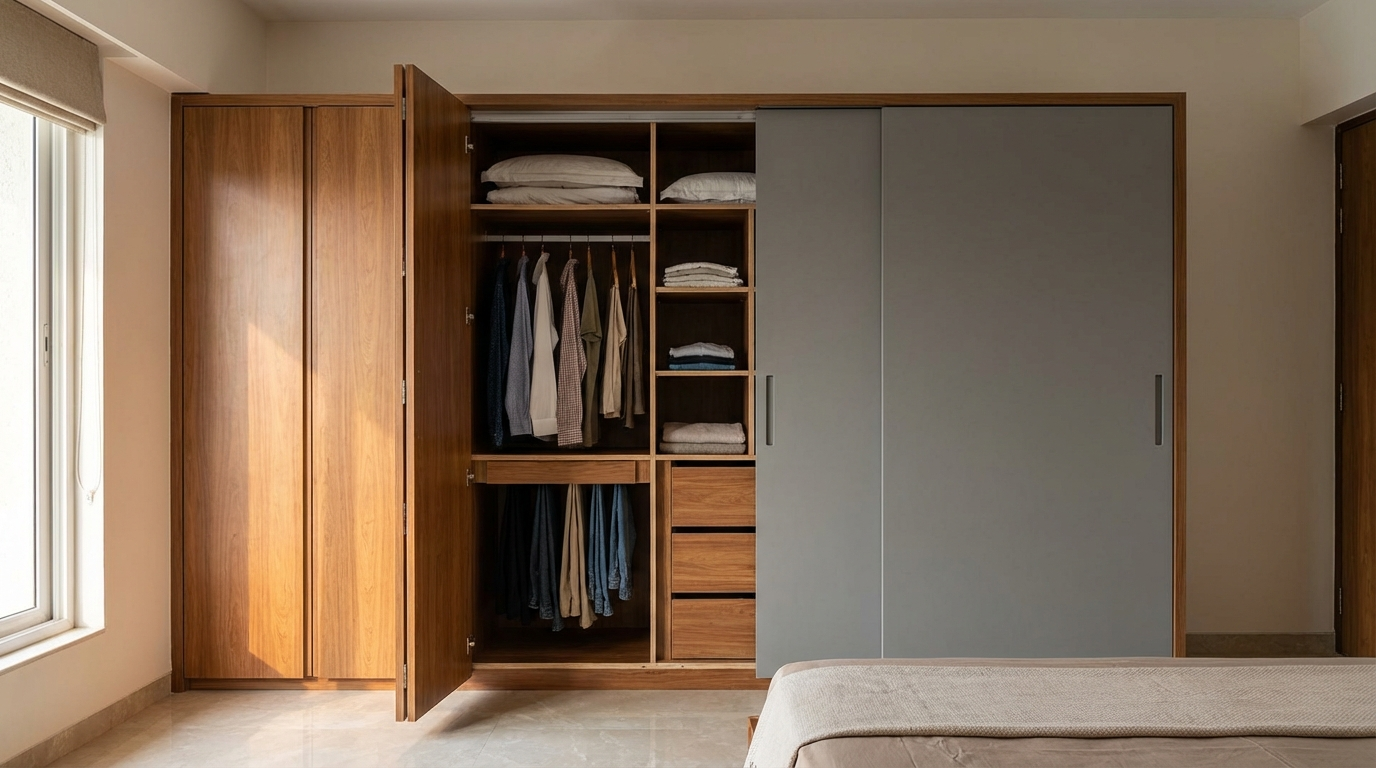
The best wardrobe design for Indian bedrooms combines 18mm BWR-grade plywood for the carcass, sliding doors for space efficiency, and internal partitions customised to your clothing mix.
If you're in a hurry: For most Indian bedrooms, a wall-to-wall sliding wardrobe with 18mm BWR plywood carcass, 12mm back panel, and laminate finish offers the best balance of durability, cost, and aesthetics. Standard depth of 22-24 inches works for hanging garments. Include dedicated sections for sarees, suits, and folded Indian wear. Budget approximately ₹1,200-1,800 per square foot for mid-range quality with soft-close hardware.
- Choose sliding wardrobes if: Your bedroom is under 150 sq ft, you need mirror integration, or door swing clearance is limited
- Choose hinged wardrobes if: You want full-width access simultaneously, prefer traditional hardware, or have ample clearance space
- Choose walk-in wardrobes if: You have 70+ sq ft dedicated area and extensive clothing storage needs
- Avoid open wardrobes if: You live in dusty areas, coastal zones, or high-humidity regions without climate control
Key takeaway: Material grade matters more than design style—a simple wardrobe in BWR plywood outlasts an elaborate design in commercial-grade board.
What Wardrobe Design Actually Involves: Beyond Aesthetics
Wardrobe design for bedrooms is the systematic planning of storage furniture that accounts for available space, clothing types, access patterns, material durability, and budget constraints. A good wardrobe design balances visual appeal with practical functionality—how easily you can access, organize, and maintain your belongings over 10-15 years of daily use.
The technical breakdown involves three core decisions: structural configuration (sliding, hinged, walk-in, or modular), material selection (plywood grade, thickness, and finish), and internal layout (hanging sections, shelves, drawers, and accessories). Each decision cascades into cost, durability, and maintenance requirements.
Why Indian Wardrobes Need Different Planning
Indian wardrobes face unique challenges that Western designs don't address. Sarees need 18-22 inch deep drawers or dedicated hanging systems. Heavy lehengas and sherwanis require reinforced rods. The monsoon humidity cycle (40% winter to 85%+ monsoon) stresses joints and causes swelling in inferior materials. Most Indian bedrooms also serve as dressing areas, requiring integrated mirrors and lighting that Western walk-in closets handle separately.
Common misconceptions include believing that thicker plywood always means better quality (grade matters more than thickness), that modular wardrobes are automatically superior to carpenter-made ones (depends entirely on material quality and workmanship), and that MDF is always inferior to plywood (HDHMR actually outperforms low-grade plywood in many applications).
India-Specific Reality Check: Moisture, Termites, and Workmanship
Indian bedroom wardrobes face environmental stresses that vary dramatically by region, making material selection and construction methods critical rather than cosmetic decisions. Understanding these factors prevents premature wardrobe failure that typically occurs 3-5 years into use.
Monsoon and Coastal Risk Factors
During monsoon months, indoor humidity in cities like Mumbai, Chennai, Kolkata, and Kochi regularly exceeds 80%. This moisture penetrates through exposed plywood edges, causing gradual swelling that manifests as sticky drawers, misaligned doors, and eventually delamination. Coastal cities add salt-air corrosion that attacks metal hardware and accelerates wood degradation. The solution isn't just BWR-grade plywood—it's proper edge banding, sealed backs, and adequate wall clearance (minimum 1 inch from exterior walls).
Northern cities like Delhi, Jaipur, and Chandigarh face the opposite extreme: severe dryness in summer causing wood shrinkage, joint gaps, and veneer cracking. Here, the concern shifts from moisture resistance to dimensional stability, making calibrated plywood with consistent core density more important than waterproofing grades.
Termite Prevention Reality
Termite damage in wardrobes typically originates from floor contact or wall transmission rather than direct infestation. Ground-floor apartments and independent houses face higher risk. Prevention involves raised plinths (4-6 inch gap from floor), wall clearance, and avoiding hollow spaces where termites can build mud tubes undetected. Anti-termite treatment during construction helps, but isn't a substitute for proper design that allows inspection access.
Common Contractor Practices to Watch
Many carpenters (mistris) use commercial MR-grade plywood even when BWR is specified, pocketing the price difference. They may skip edge sealing on non-visible surfaces, use thin 6mm backs instead of 12mm, and substitute lower hardware quality. Always verify material grade stamps before cutting begins, not after installation when returns become impossible.
50+ Modern Wardrobe Design Ideas with Practical Material Choices
Design ideas become useful only when paired with material specifications that ensure the design actually works in Indian conditions. Below are practical design concepts organized by style and space constraints, each with recommended material combinations.
Sliding Door Wardrobe Designs (15 Ideas)
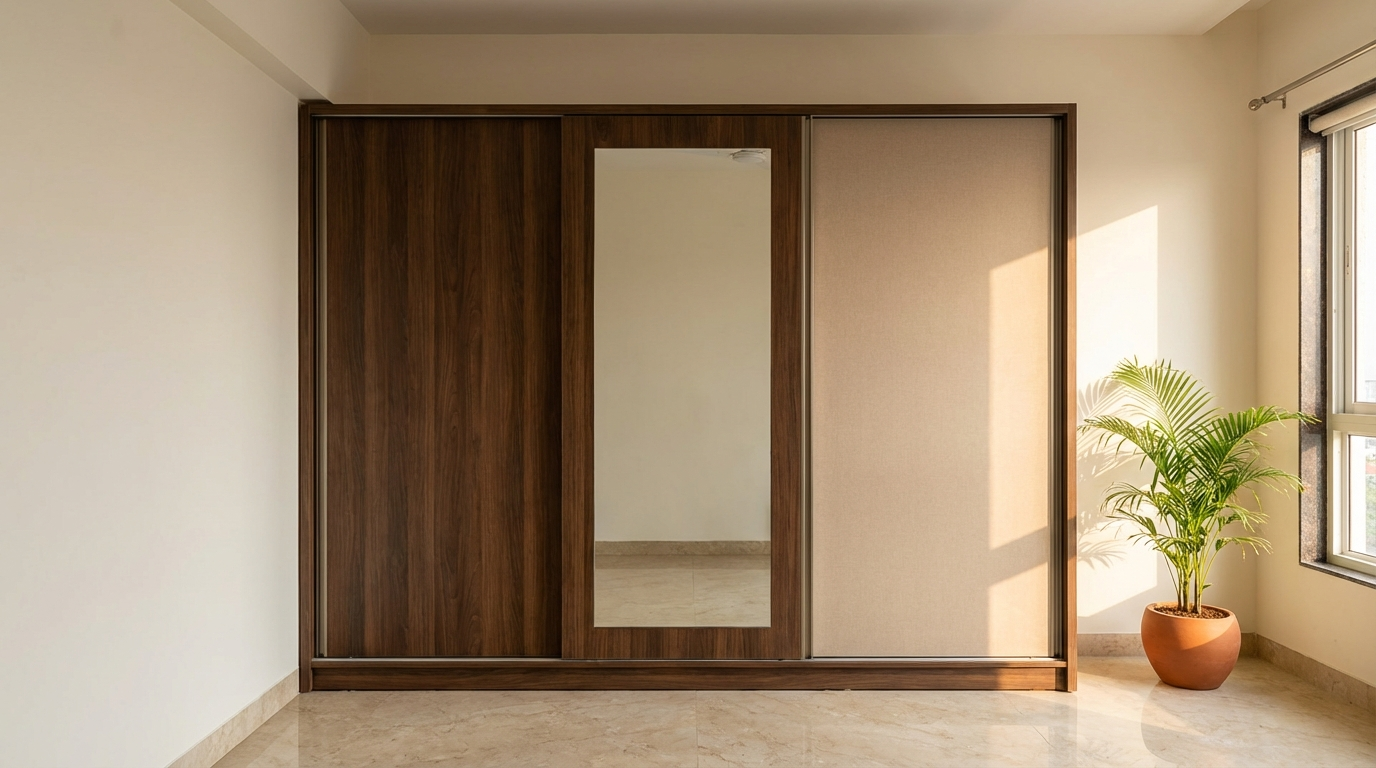
- Full-wall mirror sliding wardrobe: 18mm BWR carcass, aluminium frame sliding system, 4mm mirror panels. Best for bedrooms under 120 sq ft where door swing space is unavailable. Depth: 22 inches minimum.
- Two-tone laminate slider: Matte and glossy laminate combination on 18mm shutters. Creates visual interest without mirror maintenance. Works in 8-10 feet wall spans.
- Profile shutter sliding wardrobe: Membrane or PU finish with routed patterns. Requires 25mm MDF shutters for clean routing. Higher maintenance in dusty environments.
- Frosted glass panel slider: Aluminium frame with frosted glass inserts. Allows visibility while hiding clutter. Not recommended for homes with young children.
- Handleless push-open slider: Track-mounted system with push-to-slide mechanism. Requires precision installation—specify experienced fabricators only.
- Floor-to-ceiling sliding wardrobe: Maximizes vertical storage. Requires ceiling-mounted tracks for stability. Loft sections accessible via step stool.
- Sliding wardrobe with integrated TV unit: Central open section with TV mount, flanked by sliding storage. Requires 12-14 feet minimum wall length.
- Wooden finish sliding wardrobe: Wood-grain laminate or veneer finish. Natural oak, walnut, and teak finishes popular. Veneer requires more maintenance than laminate.
- Combination sliding and fixed panels: Central fixed mirror with sliding storage sections on sides. Balances access and aesthetics.
- Soft-close sliding system: Premium track systems with damped closing. Adds ₹3,000-5,000 per door but extends hardware life significantly.
- Backlit sliding wardrobe: LED strips behind frosted panels. Requires electrical planning before installation. Creates ambient lighting.
- Industrial metal-frame slider: Black metal frames with laminate or glass panels. Works in contemporary and loft-style interiors.
- Curved corner sliding wardrobe: Custom curved track for L-shaped rooms. Significantly higher cost but maximizes awkward corners.
- Minimalist white sliding wardrobe: All-white matte finish with concealed handles. Shows dust easily—requires regular cleaning.
- Sliding wardrobe with open display: End sections open for displaying items. Adds visual lightness but requires regular dusting.
Hinged Door Wardrobe Designs (15 Ideas)
- Classic six-door hinged wardrobe: 18mm BWR plywood with laminate finish. Each door maximum 24 inches wide for hinge durability. Requires 4+ feet clearance in front.
- Shaker-style hinged wardrobe: Routed shaker profiles on MDF shutters. Paint or membrane finish. Traditional look that works in transitional interiors.
- Glass-insert hinged doors: Clear or frosted glass panels within wooden frames. Requires 25mm frames for structural integrity.
- Full-mirror hinged wardrobe: Mirror mounted on 18mm backing. Heavier than standard doors—requires three hinges per door instead of two.
- Louvered hinged doors: Ventilated design ideal for non-air-conditioned bedrooms. Allows air circulation but collects dust in slots.
- Two-tone hinged wardrobe: Different colors for upper loft and lower sections. Creates visual break and height illusion.
- Hinged wardrobe with external drawers: Lower section has drawers outside shutter line. Easy access for daily items without opening full wardrobe.
- Fluted panel hinged doors: Vertical fluting routed into MDF. Current trend in premium interiors. Requires careful dust management.
- Handleless hinged wardrobe: J-profile or push-to-open mechanisms. Clean aesthetics but requires quality hardware for durability.
- Arched top hinged wardrobe: Decorative arched panels above rectangular doors. Custom fabrication required—adds 15-20% to cost.
- Colonial-style hinged wardrobe: Raised panel doors with brass hardware. Works in traditional and heritage-style homes.
- Hinged wardrobe with open center: Closed storage on sides, open shelving in center. Good for displaying collectibles or books.
- Bi-fold hinged wardrobe: Doors fold in half when opening. Requires less clearance than standard hinged—good for narrow rooms.
- Painted hinged wardrobe: MDF shutters with spray-paint or duco finish. Premium finish requiring 5-7 coats for durability.
- Fabric-insert hinged doors: Padded fabric panels within wooden frames. Adds texture and sound dampening. Requires professional upholstery.
Walk-In Wardrobe Designs (10 Ideas)
- L-shaped walk-in wardrobe: Storage on two adjacent walls with 3-foot minimum aisle. Needs 70+ sq ft minimum area.
- U-shaped walk-in: Three walls of storage with island center. Luxury option requiring 100+ sq ft dedicated space.
- Linear walk-in: Single wall of storage with dressing mirror opposite. Works in narrow spaces 4 feet wide minimum.
- Walk-in with island: Central island for accessories and folded items. Requires 10x10 feet minimum space.
- Glass-enclosed walk-in: Visible from bedroom through glass partition. Luxury aesthetic requiring meticulous organization.
- Walk-in with vanity integration: Dressing table and makeup storage within wardrobe space. Requires good lighting design.
- Open-shelf walk-in: No shutters—all open display. Only works in dust-controlled, air-conditioned environments.
- Modular walk-in system: Pre-fabricated components that can be reconfigured. Easier installation but less customization.
- Walk-in with seating: Ottoman or bench seating within wardrobe space. Requires 12+ feet length for comfortable movement.
- Climate-controlled walk-in: Separate AC unit for wardrobe space. Essential for expensive fabric collections in humid zones.
Compact and Space-Saving Designs (10+ Ideas)
- Corner wardrobe: Maximizes dead corner space with L-shaped or curved front. Requires carousel or pull-out accessories for access.
- Under-bed wardrobe integration: Platform bed with wardrobe drawers underneath. Works in studio apartments.
- Wall-mounted floating wardrobe: No floor contact, creates visual space. Limited to lighter loads—not for heavy storage.
- Wardrobe with murphy bed: Fold-down bed integrated with wardrobe. Space-saving for guest rooms.
- Alcove wardrobe: Built into wall recess for flush finish. Requires structural assessment before modification.
- Wardrobe behind headboard: Walk-through storage behind bed wall. Creates dressing area without dedicated room.
- Narrow depth wardrobe: 18-inch depth with front-facing hangers instead of perpendicular. Works in tight spaces.
- Modular cube wardrobe: Stackable cubes that grow with needs. Flexible but less durable than fixed construction.
- Wardrobe partition: Freestanding wardrobe dividing room zones. Two-sided access in studio or shared bedrooms.
- Over-door wardrobe extension: Storage above bedroom entry door. Utilizes typically wasted space.
Size Guide: Standard Wardrobe Dimensions for Indian Bedrooms
Standard wardrobe dimensions in India balance storage efficiency with room functionality, following guidelines that account for Indian clothing dimensions, bedroom sizes, and anthropometric requirements. Getting dimensions wrong leads to wasted space, accessibility issues, or oversized furniture that dominates the room.
Height Specifications
| Wardrobe Section | Recommended Height | Purpose |
|---|---|---|
| Full wardrobe | 7-8 feet (84-96 inches) | Standard ceiling clearance |
| Long hanging section | 48-54 inches | Sarees, dresses, sherwanis, long kurtas |
| Short hanging section | 36-40 inches | Shirts, kurtis, folded trousers |
| Loft section | 18-24 inches | Seasonal storage, luggage |
| Drawer height | 6-8 inches internal | Undergarments, accessories |
| Shelf spacing | 12-15 inches | Folded clothes, sweaters |
Width Planning by Bedroom Size
| Bedroom Size | Recommended Wardrobe Width | Door Configuration |
|---|---|---|
| Under 100 sq ft | 4-5 feet | 2-door sliding or bi-fold |
| 100-150 sq ft | 6-8 feet | 3-door sliding or hinged |
| 150-200 sq ft | 8-10 feet | 4-door configuration |
| Over 200 sq ft | 10-14 feet or walk-in | Multiple sections or walk-in |
Depth Requirements
Standard wardrobe depth is 22-24 inches (550-600mm), accommodating standard hangers (17-18 inches wide) with clearance for door mechanism. Sliding wardrobes need 2 inches extra for track systems, making internal depth 22 inches with 24-inch external depth. For narrow rooms, 18-inch depth wardrobes work with front-facing hangers (perpendicular to normal orientation) but reduce hanging capacity by approximately 40%.
What Plywood Thickness Works for Different Wardrobe Sections?
Plywood thickness in wardrobes isn't uniform—different sections face different loads and stress patterns, requiring appropriate thickness selection for durability without unnecessary cost increase.
| Wardrobe Component | Recommended Thickness | Grade Requirement | Reason |
|---|---|---|---|
| Side panels (carcass) | 18mm | BWR minimum | Structural load-bearing |
| Top and bottom | 18mm | BWR minimum | Structural integrity |
| Internal shelves | 18mm or 15mm | MR acceptable for interiors | Load bearing for stacked clothes |
| Back panel | 12mm (ideal) or 6mm (budget) | MR acceptable | Dust protection and rigidity |
| Drawer components | 12mm sides, 6mm bottom | MR acceptable | Weight reduction |
| Shutter/doors | 18mm for laminate, 25mm for routing | MR for shutters | Prevents warping |
| Drawer fronts | 18mm | MR acceptable | Hardware mounting strength |
For detailed plywood grade comparisons, our BWR vs BWP plywood comparison guide covers moisture resistance specifications in depth.
Material Selection: Plywood, MDF, and Board Options
Material choice determines wardrobe longevity more than any design element. In Indian conditions, selecting the wrong material grade leads to failures within 3-5 years, while appropriate materials easily last 15-20 years with basic maintenance.
Plywood Grades for Wardrobes
BWR (Boiling Water Resistant) grade plywood is the standard recommendation for wardrobe carcasses in most Indian cities. It handles the humidity fluctuations between monsoon and dry seasons without significant dimensional changes. MR (Moisture Resistant) grade can be used for internal components that don't face humidity directly, but isn't advisable for exterior-facing surfaces or ground-floor installations.
BWP (Boiling Water Proof) or Marine grade is necessary only for wardrobes against external walls in coastal cities, ground-floor installations in flood-prone areas, or bathroom-adjacent wardrobes. The cost premium of 30-40% over BWR isn't justified for standard bedroom use in most locations.
MDF and HDHMR Options
HDHMR (High-Density High Moisture Resistant) boards have become viable alternatives to plywood for wardrobe shutters, offering superior screw-holding in hinge zones and consistent density that prevents uneven finishing. For routed or membrane-finish shutters, HDHMR typically outperforms plywood due to its uniform surface.
Standard MDF works for shutters in air-conditioned bedrooms but swells irreversibly when exposed to sustained humidity—not recommended for non-AC bedrooms in coastal or eastern India.
Is Particle Board Acceptable for Wardrobes?
Particle board is commonly used in factory-produced modular wardrobes to reduce costs. While acceptable for temporary furniture or rental properties, it has significantly lower screw-holding capacity (screws loosen within 2-3 years of normal use), no moisture tolerance (irreversible swelling from even brief humidity exposure), and poor edge durability. Our guide on particle board vs plywood details these limitations for readers considering budget options.
Internal Storage Configuration: What Goes Where
Internal wardrobe layout should mirror actual usage patterns rather than generic configurations. The typical Indian wardrobe needs to accommodate sarees, suits, western wear, ethnic wear, and seasonal items—a mix most international designs don't address.
Configuration for Different Clothing Types
| Clothing Type | Storage Solution | Space Required | Notes |
|---|---|---|---|
| Sarees | Deep drawers or saree rods | 18-22 inch depth, 8 inch height per drawer | Horizontal storage prevents crushing |
| Suits/Blazers | Long hanging with shoulder support | 40-44 inches height, 24 inches depth | Wide hangers essential |
| Sherwanis/Lehengas | Extra-long hanging section | 54-60 inches height | Consider protective covers |
| Daily kurtas/shirts | Short hanging section | 36-40 inches height | Double-rod system doubles capacity |
| Trousers | Trouser hangers or folded on shelves | 28-30 inches for hanging | Pull-out trouser racks work well |
| Sweaters/woolens | Shelves with dividers | 12-15 inch shelf spacing | Never hang—stretches knitwear |
| Undergarments | Shallow drawers with dividers | 4-6 inch drawer height | Compartmentalized organizers help |
| Accessories (ties, belts, scarves) | Dedicated pull-out or hooks | Varies by accessory | Visible storage prevents forgotten items |
| Seasonal items | Loft or upper sections | 18-24 inches height | Vacuum bags save space |
Recommended Internal Accessories
- Soft-close drawer channels: Add ₹150-300 per drawer but prevent slamming damage and noise
- Pull-out trouser rack: Holds 8-12 trousers in 18 inches width, better visibility than folding
- Pull-out mirror: Space-efficient alternative to door-mounted mirrors
- LED interior lighting: Essential for walk-ins, helpful for deep wardrobes. Motion-sensor options prevent forgetting to switch off
- Tie and belt organizer: Rotating or pull-out options maximize small spaces
- Safe compartment: Concealed sections for valuables—requires 12mm plywood minimum for security
Common Buyer Mistakes and How to Avoid Them
Wardrobe purchases and fabrication involve multiple decision points where mistakes prove costly—either immediately or after a few years of use when failure modes manifest.
Mistake 1: Choosing Design Before Measuring
What goes wrong: Selected design doesn't fit available space, requires modifications that compromise aesthetics or functionality.
Why it happens: Buyers select designs from catalogues or social media without verifying dimensional compatibility.
How to avoid: Measure exact wall dimensions, ceiling height, and clearances before design selection. Account for architectural elements like beams, electrical points, and AC placement.
Mistake 2: Underspecifying Material Grade
What goes wrong: Delamination, swelling, and termite damage within 3-5 years.
Why it happens: Contractors suggest lower grades to reduce quotes or pocket the difference.
How to avoid: Specify BWR grade explicitly in writing. Verify ISI marks (IS 303 for BWR) before cutting. Take photos of ply bundles showing stamps.
Mistake 3: Ignoring Edge Sealing
What goes wrong: Moisture penetration from exposed edges causes swelling, especially at floor contact and back panel interfaces.
Why it happens: Edge banding on non-visible surfaces is skipped to save time and cost.
How to avoid: Insist on edge banding or paint sealing on ALL edges, including shelf undersides and back panel perimeters. This is critical in humid zones.
Mistake 4: Wrong Hardware Selection
What goes wrong: Hinges fail, drawer channels jam, sliding tracks misalign within 2-3 years.
Why it happens: Generic local hardware substituted for specified branded hardware.
How to avoid: Specify hardware brands explicitly. Inspect hardware packaging before installation. Quality hinges cost ₹80-150 per piece—significant savings on generic aren't worth the failure risk.
Mistake 5: Incorrect Internal Layout
What goes wrong: Wardrobe doesn't accommodate actual clothing mix—too much hanging space, not enough shelves, or wrong dimensions for sarees/suits.
Why it happens: Standard internal configurations used without customization to user needs.
How to avoid: Inventory your clothes before design. Count sarees, suits, and hanging items. Specify exact internal configuration rather than accepting standard layouts.
Mistake 6: Neglecting Ventilation
What goes wrong: Musty odors, mildew growth on clothes, moisture accumulation inside wardrobe.
Why it happens: Fully sealed wardrobes without any ventilation provision.
How to avoid: Include ventilation grilles or small gaps. Use louvered doors or leave 2-3 inch gap between wardrobe back and wall. Critical for non-AC bedrooms.
Mistake 7: Overloading Sliding Tracks
What goes wrong: Sliding doors derail, tracks bend, difficult operation within 1-2 years.
Why it happens: Heavy mirror panels or thick doors on standard-grade tracks.
How to avoid: Match track capacity to door weight. Mirror doors need heavy-duty tracks rated for 40+ kg per panel. Ceiling-mounted tracks handle weight better than floor-mounted.
Cost Framework: Wardrobe Price Ranges for 2026
Wardrobe costs in India vary significantly based on material grade, hardware quality, finish type, and city-specific labor rates. The ranges below provide estimation frameworks rather than fixed prices, which require actual quotations based on specific designs.
Per Square Foot Price Ranges
| Quality Tier | Price Range (per sq ft) | Material Specification | Hardware Level |
|---|---|---|---|
| Budget | ₹700-1,000 | Commercial plywood, MR grade, basic laminate | Local hardware |
| Mid-range | ₹1,200-1,800 | BWR plywood, standard laminate, 12mm back | Branded hardware |
| Premium | ₹2,000-3,000 | BWR/BWP calibrated ply, high-end laminate/acrylic | European hardware |
| Luxury | ₹3,500+ | Premium boards, veneer/lacquer finish | Premium soft-close systems |
Cost Drivers That Increase Price
- Calibrated plywood: 15-25% premium over non-calibrated, but ensures consistent finish
- Soft-close hardware: Adds ₹300-500 per hinge, ₹500-800 per drawer channel
- Glass or mirror integration: ₹150-400 per sq ft depending on type
- Profile/routed shutters: 20-35% premium over flat laminate
- Internal accessories: Pull-outs, organizers add ₹2,000-8,000 per unit
- LED lighting integration: ₹1,500-5,000 depending on complexity
How to Estimate Your Wardrobe Cost
Calculate wardrobe area in square feet (width × height). A standard 8 feet wide × 7 feet tall wardrobe equals 56 square feet. At ₹1,500/sq ft mid-range rate, base cost equals ₹84,000. Add 15-20% for internal accessories, and 10% for installation and finishing. Total estimate: approximately ₹1,05,000-1,10,000 for this configuration.
Workmanship and Installation Guidelines
Even premium materials fail with poor workmanship. Understanding installation requirements helps you brief carpenters correctly and verify work quality during execution.
Before Installation
- Wall surface must be dry and level. Moisture content above 12% causes wardrobe back to absorb moisture—wait for walls to cure if newly plastered.
- Electrical points for LED lighting must be completed before wardrobe installation.
- Mark exact wardrobe boundaries with masking tape, verify dimensions match design.
- Store plywood horizontally in the room for 48-72 hours to acclimatize to room humidity.
During Installation
- All cuts should use clean blades—chipped edges indicate dull blades that compromise joint strength.
- Edge band all exposed edges immediately after cutting, before assembly.
- Pre-drill all screw holes to prevent core damage—direct screwing splits plywood.
- Use appropriate screws: minimum 1.5-inch screws for carcass assembly, 1-inch for back panels.
- Verify level and plumb at each stage—correction after assembly is difficult.
- Back panel must be inset, not surface-mounted, for moisture protection.
Hinge Zone Requirements
Hinge attachment points face the highest stress in wardrobes. For 18mm panels, hinges need minimum 35mm cup holes at precisely 22mm from door edge. Use three hinges per door for panels over 1200mm height. Reinforcement blocks behind hinge mounting improve longevity, especially for heavy mirror doors.
Carpenter Briefing Checklist
- Provide written specification of plywood grade, thickness for each component
- Specify hardware brand and model numbers
- Agree on edge treatment for all surfaces including non-visible ones
- Define internal layout with dimensions, not just verbal description
- Establish inspection points: after cutting, after carcass assembly, before shutter installation
- Clarify who provides consumables (screws, adhesive, edge tape)
Quality Checks You Can Do Without Lab Equipment
Professional testing for plywood grade verification requires laboratory facilities, but several practical checks help identify quality issues before and during wardrobe fabrication.
Before Purchase Checks
- Visual grade stamp: Look for IS 303 (BWR) or IS 710 (BWP) stamps with manufacturer details. Missing stamps indicate ungraded product.
- Core inspection: Check edge of ply bundle for void-free cores. Gaps in inner layers indicate poor quality that affects screw holding.
- Weight comparison: Among same-size sheets, heavier typically indicates better core density. Unusually light sheets suggest voids or inferior wood species.
- Surface inspection: Check for patches, repairs, or uneven veneer. While face repairs are normal, excessive patching indicates lower grade.
- Flexibility test: Quality plywood has consistent flexibility. Stiff spots indicate core defects or glue failures.
After Cutting Checks
- Core uniformity: Cut edges should show uniform layers without gaps, overlaps, or varying thickness.
- Edge integrity: Clean cuts without splintering indicate good blade condition and proper plywood quality.
- Smell test: Strong chemical odor from fresh cuts may indicate excess formaldehyde—request emission-certified products if concerned.
Questions to Ask Dealers
- Request manufacturer's test certificate showing BWR/BWP compliance
- Ask about warranty terms—reputable brands offer 7-15 year warranties
- Inquire about exchange policy for defective sheets discovered after cutting
- Verify if price includes delivery to floor or only building gate
Sliding vs Hinged vs Walk-In: Decision Framework
Choosing between wardrobe door types involves balancing space constraints, budget, access preferences, and maintenance willingness. Use this framework to match your specific situation to the appropriate option.
| Factor | Sliding Wardrobe | Hinged Wardrobe | Walk-In Wardrobe |
|---|---|---|---|
| Space efficiency | Best for compact rooms | Needs 3-4 ft clearance | Requires dedicated 70+ sq ft |
| Access width | 50% at a time | 100% simultaneously | 100% with walking space |
| Hardware cost | Higher (quality tracks essential) | Moderate | Varies by configuration |
| Maintenance | Track cleaning needed | Hinge adjustment occasional | Depends on design |
| Mirror integration | Easy, common design | Adds door weight | Separate standing mirrors |
| Budget range | Mid to high | Low to high | High to luxury |
| Ideal bedroom size | Under 150 sq ft | 150+ sq ft | 250+ sq ft with dedicated area |
| Best for | Space-constrained bedrooms, modern aesthetics | Traditional preference, full access need | Luxury homes, large clothing collections |
Decision Rules by Situation
- Choose sliding if: Bed is within 4 feet of wardrobe wall, room under 150 sq ft, want integrated mirror, prefer modern aesthetics
- Choose hinged if: Adequate clearance space available, want to see entire wardrobe contents at once, prefer traditional hardware, budget is constrained
- Choose walk-in if: Dedicated space of 70+ sq ft available, extensive clothing collection, desire dressing room experience, budget permits luxury option
How Long Do Wardrobes Last in Indian Conditions?
Wardrobe longevity in India depends primarily on material grade, construction quality, and maintenance practices. With appropriate materials and workmanship, wardrobes should function well for 15-20 years, with finish requiring refresh around year 10-12.
Expected Lifespan by Material
| Material Type | Expected Lifespan | Common Failure Mode | Maintenance Required |
|---|---|---|---|
| BWR plywood carcass | 15-20 years | Edge delamination in humid zones | Annual inspection, edge resealing if damaged |
| BWP plywood carcass | 20+ years | Hardware failure before material | Hardware replacement at 8-10 years |
| HDHMR shutters | 12-15 years | Edge chipping, hinge zone wear | Handle with care, avoid impact |
| Standard MDF shutters | 8-12 years (AC environment) | Swelling if humidity exposed | Keep dry, refinish at 6-8 years |
| Particle board | 4-6 years | Screw loosening, edge deterioration | Frequent hardware tightening |
| Laminate finish | 10-15 years | Edge lifting, surface scratches | Careful cleaning, edge regluing |
Signs That Indicate Wardrobe Needs Attention
- Doors not closing flush—indicates hinge wear or warping
- Drawers sticking—humidity swelling or channel wear
- Visible edge separation—moisture penetration beginning
- Musty smell—inadequate ventilation or moisture accumulation
- Hardware wobble—screws losing grip, may indicate core degradation
Frequently Asked Questions
What is the best plywood thickness for bedroom wardrobes?
For bedroom wardrobes, 18mm BWR-grade plywood is the standard recommendation for carcass construction (sides, top, bottom, and shelves). This thickness provides adequate screw-holding capacity for hinge mounting and structural rigidity for daily use. Back panels can use 12mm for quality builds or 6mm for budget constraints. Shutters typically use 18mm for laminate finishes, while routed or membrane designs may require 25mm MDF for clean detailing. Using 12mm for shelves is possible but limits load capacity—stick with 18mm for heavy storage sections.
Is MDF better than plywood for wardrobe shutters?
MDF and plywood serve different purposes in wardrobe construction. Plain MDF offers a smoother surface ideal for paint or membrane finishes and superior routing for profile doors, but swells irreversibly in humidity. Plywood handles moisture better and has higher screw-holding strength but shows grain through thin finishes. For wardrobe shutters specifically, HDHMR (High-Density High Moisture Resistant) board offers a compromise—better moisture handling than standard MDF with the smooth surface needed for quality finishes. In non-AC bedrooms in humid zones, plywood shutters with laminate finish remain the safest choice.
How much does a modular wardrobe cost compared to carpenter-made?
Modular wardrobes from branded companies typically cost 20-40% more than carpenter-made equivalents using similar materials. However, direct cost comparison is misleading. Modular units offer factory precision, consistent quality, faster installation, and warranty coverage. Carpenter-made wardrobes allow greater customization, can use superior material grades than factory-standard specifications, and permit adjustments during installation. For mid-range budgets, a well-supervised carpenter using quality materials often delivers better value. For luxury budgets or those prioritizing convenience, modular systems with their factory-finished aesthetics may justify the premium.
Can I use particle board for wardrobes to save money?
Particle board can be used for wardrobes but comes with significant compromises that limit its recommendation to temporary setups, rental properties, or extremely tight budgets. The material has poor screw-holding capacity—hinges and handles loosen within 2-3 years of normal use. It swells irreversibly when exposed to humidity, even briefly. Edge durability is low despite edge banding. If budget constraints force particle board selection, use it only for internal shelves (not carcass), install metal reinforcement for all hardware mounting, ensure aggressive edge sealing, and accept a 5-7 year functional lifespan rather than the 15-20 years expected from plywood.
What wardrobe depth is needed for hanging Indian clothes?
Standard wardrobe depth of 22-24 inches (550-600mm) accommodates most Indian and Western clothing on standard hangers. This depth allows hangers to hang perpendicular to the back wall with door clearance. For sarees stored on rods or hangers (rather than drawers), this depth works well. Heavy lehengas and sherwanis may benefit from slightly deeper configurations or front-facing arrangement. If space constrains depth to 18 inches, clothes must hang parallel to the back wall (front-facing), reducing total hanging capacity by approximately 40% but remaining functional for lighter garments.
How do I prevent termites in wooden wardrobes?
Termite prevention in wardrobes involves design, material selection, and maintenance rather than relying solely on chemical treatment. Design wardrobes with 4-6 inch raised plinths from floor level to eliminate direct ground contact. Maintain 1-2 inch gap between wardrobe back and wall to prevent moisture bridging and allow inspection. Seal all edges to eliminate entry points. Use BWR or BWP grade plywood that includes boric treatment in manufacturing. For ground-floor installations, request anti-termite chemical treatment of the wall and floor area before installation. Annual inspection of plinth areas and wall-contact zones allows early detection before damage spreads.
Are sliding wardrobes more expensive than hinged wardrobes?
Sliding wardrobes typically cost 15-25% more than equivalent hinged wardrobes due to track system costs and additional precision required in installation. Quality sliding mechanisms (essential for longevity) cost ₹3,000-8,000 per door depending on brand and weight capacity, while quality hinges cost ₹150-300 per piece. Sliding wardrobes also require perfectly level installation—any floor or ceiling unevenness requires adjustment that adds labor cost. However, sliding designs save floor space, integrate mirrors more elegantly, and suit modern aesthetics better, making the premium worthwhile for space-constrained or contemporary bedrooms.
What is the minimum size for a walk-in wardrobe?
A functional walk-in wardrobe requires minimum 70 square feet of floor area, typically configured as 7 feet by 10 feet. This accommodates single-wall or L-shaped storage with 3-feet minimum aisle width for comfortable movement and access. Smaller walk-ins feel cramped and may function better as standard wardrobes. For U-shaped configurations with storage on three walls, 100+ square feet is necessary. Walk-ins with central islands (for accessories, folding surface) need 120+ square feet. Beyond space, walk-ins require dedicated lighting, ventilation (preferably climate control in humid zones), and ideally natural light or high-quality artificial lighting for outfit selection.
How often should wardrobe hardware be replaced?
Quality wardrobe hardware typically requires replacement after 8-12 years of regular use, though this varies significantly by hardware quality and use intensity. Soft-close hinges and drawer channels may need replacement sooner (6-8 years) as their damping mechanisms wear. Signs indicating hardware replacement need include: doors not closing flush, visible hinge play or wobble, drawer channels requiring force to operate, sliding doors jumping tracks. Budget hardware may fail within 3-5 years—quality hardware costs more initially but reduces replacement frequency and prevents the door sagging that damages carcass screw holes, extending overall wardrobe life.
Can wardrobes be placed against external walls?
Wardrobes can be placed against external walls but require additional precautions in Indian conditions. External walls transmit outdoor humidity and temperature extremes. In coastal cities and humid zones, moisture seeping through walls causes wardrobe back panel damage and interior mold. Mitigation measures include: maintaining 2-inch gap between wardrobe and external wall, using BWP-grade plywood for back panel (not just carcass), waterproofing the wall surface before wardrobe installation, and ensuring room has adequate ventilation. North-facing external walls are preferable to west-facing ones that receive afternoon sun and associated thermal stress.
Is laminate or veneer better for wardrobe finish?
Laminate and veneer serve different aesthetic preferences and maintenance tolerances. Laminate is a synthetic material bonded to substrate—highly durable, easy to clean, resistant to scratches and moisture, available in endless patterns including realistic wood grains, but obviously artificial to trained eyes. Veneer is actual wood sliced thin and applied to substrate—natural appearance with unique grain patterns, but requires careful maintenance, shows scratches easily, and can fade or degrade in humidity. For most Indian bedrooms, laminate offers better value through durability and lower maintenance. Veneer suits those prioritizing natural aesthetics and willing to invest in careful upkeep and climate control.
What lighting works best inside wardrobes?
LED strip lighting is the most practical wardrobe lighting solution, offering low heat output (prevents fabric damage), energy efficiency, and flexible installation. Install strips at the top front edge of each section, angled inward to illuminate contents without glare. Motion-sensor activation prevents forgetting to switch off and adds convenience. Color temperature of 4000-5000K (neutral white) provides accurate color perception for outfit selection—warmer tones distort clothing colors. For walk-in wardrobes, combine ambient ceiling lighting with task lighting inside specific zones. Battery-operated puck lights serve as budget alternatives but require regular battery changes.
How do I maximize storage in a small bedroom wardrobe?
Maximizing storage in compact wardrobes requires vertical optimization and smart internal configuration. Extend wardrobe to ceiling height with upper loft for seasonal items. Use double-hanging rods in sections for shirts and folded trousers—doubles capacity versus single rod. Incorporate pull-out trouser racks and tie organizers that utilize narrow spaces. Install drawer dividers for small items rather than dedicated drawers. Use door-back organizers for accessories and frequently-used items. Consider vertical pull-out units for shoes. Most importantly, audit your actual clothing before design—many wardrobes waste space on generic configurations that don't match owner's specific storage needs.
Are handleless wardrobes practical for daily use?
Handleless wardrobes using push-to-open mechanisms or J-profile edges offer clean aesthetics but require quality hardware for practical daily use. Budget push-to-open systems fail within 2-3 years of regular use. Quality systems from European hardware brands cost significantly more but function reliably for 8-10 years. J-profile (groove cut into door edge for finger grip) is more reliable mechanically but requires careful cleaning as the groove collects dust. Handleless designs also show fingerprints more prominently, especially on high-gloss or acrylic finishes. For families with children or elderly members who may struggle with push mechanisms, traditional handles remain more practical despite less contemporary appearance.
Final Considerations for Your Wardrobe Project
A well-designed bedroom wardrobe balances immediate aesthetics with long-term functionality—the design that photographs beautifully must also survive a decade of monsoons, daily use, and the inevitable accumulation of more clothes than originally planned for. Prioritize material grade over design complexity when budget requires trade-offs. Invest in quality hardware that won't require replacement when the rest of the wardrobe remains sound. Customize internal layout to your actual clothing mix rather than accepting generic configurations.
Whether you choose sliding doors for a compact bedroom, traditional hinged shutters for a spacious master suite, or commit to a walk-in wardrobe as a lifestyle investment, the principles remain consistent: specify materials correctly, verify quality before cutting, ensure proper edge treatment, and match hardware to load requirements. The wardrobe that serves you well for fifteen years is built on these fundamentals, regardless of which trending finish or handle style you select for its visible surfaces.
Disclaimer: This content is provided for general informational purposes based on industry practices and publicly available information. Product specifications, standards, prices, and availability may vary by manufacturer, region, and time. Readers should independently verify details with manufacturers, dealers, or qualified professionals before making purchase or construction decisions.Want Plywood Suggestions?
Share a few details and a Sainik 710 specialist will suggest suitable brands and connect you to responsive dealers.