U-Shaped Kitchen Design: 25+ Modern Layouts for Large & Medium Indian Kitchens
Discover 25+ U-shaped kitchen designs for large Indian homes. Maximum storage layouts, appliance placement & material guide for premium modular kitchens.
U-Shaped Kitchen Design: Quick Answer
A U-shaped kitchen design wraps cabinets and countertops along three walls, creating the most storage-efficient layout for medium to large Indian kitchens—typically those with at least 100 square feet of floor space.
Short version: If your kitchen has three usable walls and enough room to move around comfortably, U-shaped layouts give you roughly 30-40% more storage than L-shaped alternatives. You get countertop space on all sides, the cooking triangle stays tight, and everything from your pressure cooker to your masala dabba has a dedicated spot. The catch? You need minimum 8-10 feet on two parallel walls to avoid that cramped feeling.
This is right for you if:
- Your kitchen is 100+ square feet with three available walls
- You cook daily and need serious storage for Indian kitchenware—those big steel containers, heavy kadais, and multiple tawas take space
- Multiple people use the kitchen simultaneously
- You're renovating a builder flat where the original galley layout never made sense for actual Indian cooking
Skip this if:
- Your kitchen is smaller than 80 square feet—you'll feel boxed in
- You want an open-plan kitchen that flows into the living area without barriers
Bottom line: U-shaped is the workhorse layout for serious home cooks who prioritize function over Instagram aesthetics.
What U-Shaped Kitchen Design Actually Means
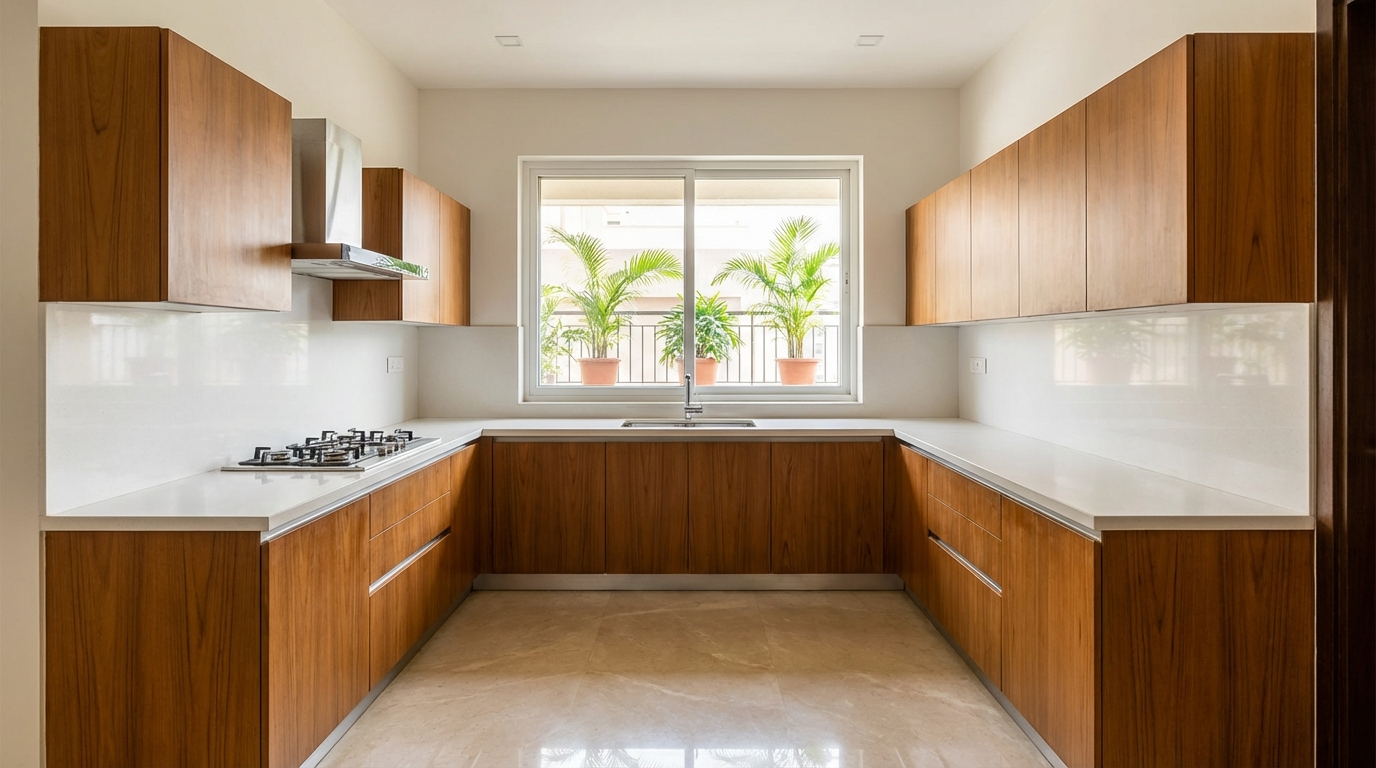
A U-shaped kitchen is a three-wall layout where base cabinets, wall units, and countertops form a continuous U pattern with one open end for entry. This configuration naturally creates a cooking triangle—connecting your stove, sink, and refrigerator—with everything within arm's reach.
Now here's where most people get confused. They think U-shaped automatically means cramped or old-fashioned. Actually, it's the opposite when you have adequate space. The layout originated in professional kitchens because chefs needed efficiency—spin around once and you've accessed prep area, cooking zone, and storage without walking five steps.
Most people think you need a massive kitchen for U-shape. Actually, medium-sized kitchens of 100-150 square feet work perfectly—sometimes even better than larger spaces because the three walls create natural work zones without wasted walking distance.
The technical term you'll hear designers use is "continuous work surface." What this means practically is that you can slide a hot pan from stove to adjacent counter, then to the sink, without lifting or carrying. For Indian cooking—where you might have three things going simultaneously—this matters more than most Western kitchen guides acknowledge. We're not making one-pot pasta here. We're tempering dal, frying puris, and keeping sabzi warm all at once.
Why U-Shaped Layouts Work Differently in Indian Homes
The humidity factor is the first thing that hits me whenever I consult on kitchen projects in coastal cities. Mumbai kitchens deal with 75-90% relative humidity for four to five months straight. Chennai isn't much better. Kolkata during monsoon is brutal. This changes everything about material selection for your U-shaped kitchen.
In places like Mumbai or Mangalore, you'll notice that cabinets without proper edge banding start swelling at the corners within two monsoons. I've seen it happen repeatedly—beautiful modular kitchens worth ₹4-5 lakhs looking sad within 18 months because someone used MR-grade ply where they needed BWR, or skipped the silicone seal around the sink cutout.
The oil and steam situation in Indian kitchens is another thing most design guides ignore. We don't just sauté vegetables. We do tadka. We deep fry. We pressure cook. All that steam and oil splatter settles on every surface. Your U-shaped design needs to account for a chimney with adequate suction—at least 1200 cubic meters per hour for a gas hob—and surfaces that can handle actual cleaning, not just aesthetic wiping.
Quick detour: if you're in a dry climate city like Jaipur or Ahmedabad, you have different concerns. Dust infiltration becomes the primary issue rather than humidity. Your cabinet interiors will collect fine dust through gaps, so soft-close hinges with proper sealing become more important than waterproof ratings.
Is U-shaped really better than L-shaped for Indian cooking?
For actual Indian cooking with multiple burners going, yes. The U-shape keeps your cooking zone, prep zone, and washing zone distinctly separated while remaining connected. In an L-shaped kitchen, you're constantly crossing paths with anyone else in the space. The U-shape lets one person handle the stove side while another preps vegetables on the opposite counter. Both can access the sink without collision. If you cook elaborate meals with lots of chopping, grinding, and simultaneous dishes, the extra counter surface isn't luxury—it's necessity.
U-Shaped Kitchen Layout Types: What Actually Works
Here's where it gets interesting. Not all U-shaped kitchens function the same way. The layout variation depends on where your entry is, where your window falls, and how much floor space you're working with.
Standard Three-Wall U: Entry at the open end, counters on left, back, and right. This is best when you have a window on the back wall—the sink goes there for natural light during dishwashing. Most builder flats in Bangalore and Pune default to this configuration.
Peninsula U-Shape: Third arm extends into the room as a half-wall rather than against a full wall. Works brilliantly if you want visual connection to the dining area without a full open kitchen. My take: this is underrated for families who want to keep an eye on kids in the adjacent room while cooking.
U-Shape with Island: Only viable if you have 180+ square feet. The island sits in the middle—can function as breakfast counter or extra prep surface. Honestly, I see this done wrong more often than right in Indian homes. People add islands in kitchens too small, and then complain they can't open the dishwasher fully.
Compact U-Shape: For kitchens between 80-100 square feet. Narrower counters (500mm depth instead of 600mm) and single-door overhead cabinets instead of double. Feels tight but maximizes what you have.
| Layout Type | Minimum Space Needed | Best For | Avoid If | My Take |
|---|---|---|---|---|
| Standard Three-Wall | 100 sq ft, 8ft parallel walls | Most families, daily cooking | You want open-plan feel | The reliable workhorse—can't go wrong |
| Peninsula U-Shape | 120 sq ft | Semi-open layouts, families with kids | Space is tight | Underused option that deserves more attention |
| U-Shape with Island | 180+ sq ft | Large kitchens, entertainment-focused homes | Kitchen under 150 sq ft | Impressive but often overkill |
| Compact U-Shape | 80 sq ft | Apartments, tight spaces | Multiple cooks use kitchen | Better than L-shape for same space |
Material Selection for U-Shaped Kitchen Cabinets
Right, this is where I see the most expensive mistakes happen. The cabinet carcass material matters more than the shutter finish—but people spend 80% of their mental energy choosing between acrylic and laminate while ignoring what's holding the whole thing together.
For U-shaped kitchens specifically, you're dealing with three walls of cabinetry. That's a lot of material. Cutting corners on the carcass to afford fancy shutters is backwards thinking.
BWR Plywood (Boiling Water Resistant): My default recommendation for the base unit carcass—everything below the counter. Use 18mm thickness minimum. For sink units, go BWP (Boiling Water Proof) if budget allows, because that area sees actual water damage, not just humidity.
HDHMR: High-Density High Moisture Resistant boards work well for wall units and tall units where direct water contact is unlikely. Cheaper than plywood, more consistent density. But—and here's the catch—screw holding in HDHMR is weaker than plywood. If your mistri over-tightens hinges during installation, the screw holes can strip.
Marine Plywood: For the sink base cabinet specifically, especially in coastal cities. Is it worth the 40-50% premium over BWR? In Chennai or Mumbai, probably yes. In Jaipur, probably not.
Our modular kitchen material guide goes deeper into these comparisons with specific brand recommendations.
What thickness works best for U-shaped kitchen cabinets?
For carcass: 18mm throughout, no exceptions. I've seen contractors suggest 16mm to save money—don't do it. The countertop load on a U-shaped kitchen is significant because you have three runs of base cabinets supporting stone or quartz. 16mm will bow over time. For shutters: 18mm if solid, 16mm if hollow-core with adequate internal structure. Back panels: 8mm is fine for wall units, use 12mm for base units that might see moisture splashing from the floor during mopping.
Budget Reality for U-Shaped Modular Kitchens (2026 Market)
Here's what actually affects your final bill—and most quotes you get will be confusing on purpose.
The base calculation for any modular kitchen is done per-square-foot of cabinet surface area—not kitchen floor area. A U-shaped kitchen in a 100 sq ft space might have 80-100 sq ft of cabinetry when you add up all base units and wall units. Multiply that by the rate.
Entry Level: ₹1,200-1,600 per sq ft gets you commercial-grade particle board carcass, laminate shutters, basic hardware. Functional but won't last beyond 5-7 years with heavy use.
Mid-Range: ₹1,800-2,500 per sq ft for BWR plywood carcass, decent laminate or membrane shutters, Hettich or Ebco hardware. This is what I recommend for most families. Will last 12-15 years with proper care.
Premium: ₹3,000-4,500 per sq ft for marine or BWP plywood carcass, acrylic or PU-finish shutters, Blum hardware with soft-close everything. Overkill for most people, but worth it if you're building forever-home.
So a typical mid-range U-shaped kitchen in a 100 sq ft space runs ₹1.8-2.5 lakhs for cabinetry alone. Add countertop (₹350-800 per sq ft for quartz), chimney (₹15,000-40,000), and accessories (₹20,000-50,000). Final bill: ₹2.5-4 lakhs for a complete kitchen.
The kitchen cabinet price guide has more detailed breakdowns by city.
U-Shaped vs L-Shaped vs Parallel: Direct Comparison
Most people are deciding between these three layouts. Here's the honest breakdown.
| Parameter | U-Shaped | L-Shaped | Parallel (Galley) |
|---|---|---|---|
| Minimum space | 100 sq ft | 60 sq ft | 70 sq ft (6ft width) |
| Storage capacity | Highest—three full walls | Moderate | High for narrow spaces |
| Counter space | Maximum continuous surface | Corner creates dead zone | Two separate surfaces |
| Work triangle efficiency | Excellent | Good | Depends on width |
| Multiple cooks | Best—separated zones | One person blocks path | Difficult—linear path |
| Natural light | Limited—three walls occupied | Better—two walls free | Can have window at end |
| Cost (similar finishes) | Highest | 20-25% less | 15-20% less |
| My preference | For serious cooking families | For open-plan living preference | For narrow spaces only |
Choose U-shaped when: You have the space, multiple people cook, storage is priority, you're doing elaborate Indian cooking daily.
Choose L-shaped when: You want open feel, kitchen connects to living area, space is 60-100 sq ft, single person cooks mostly.
Trade-off summary: You gain storage and counter space with U-shape but lose the open feel and natural light that L-shape provides. If your kitchen has only one window, U-shape will feel more enclosed.
How to Plan Your U-Shaped Kitchen: Step by Step
Step 1: Measure your actual space—wall to wall, floor to ceiling, window positions, door swing direction. Don't trust builder drawings. They're often off by 2-3 inches, which matters when fitting modular cabinets.
Step 2: Identify your utilities. Where does the gas line enter? Where's the water inlet for sink? Where does the drain exit? Moving plumbing and gas lines costs ₹8,000-15,000 and requires building approval in many societies.
Step 3: Decide on the work triangle. Standard rule: stove, sink, and fridge should form a triangle with sides between 4-9 feet each. In U-shaped kitchens, the sink usually goes on the back wall (longest run), stove on one side, fridge on the other.
Step 4: Plan storage zones. Adjacent to stove: cooking utensils, spices, oils. Adjacent to sink: cleaning supplies, waste bin, dishwashing stuff. Adjacent to fridge: dry goods, packaged items. This isn't arbitrary—it maps to actual cooking workflow.
Step 5: Account for clearances. Between parallel counters: minimum 4 feet for comfortable movement, 5 feet if multiple people cook. Cabinet door swing shouldn't block walkway. Dishwasher door should open without hitting island or opposite counter.
Step 6: Get at least three quotes. And here's something most guides won't tell you—show each vendor the previous quote. They'll suddenly find room to negotiate.
| Situation | Recommendation | Why |
|---|---|---|
| Kitchen is exactly 100 sq ft | Standard U-shape without island | Island will crowd the space |
| Only one small window | Consider peninsula instead of closed U | Preserves some visual openness |
| Two people cook regularly | Ensure 5ft clearance between parallel counters | Prevents constant collision |
| Heavy Indian cooking daily | Stove on wall away from entry door | Oil splatter contained, chimney more effective |
| Budget is tight | Prioritize base units over wall units | Base units used more, see more wear |
Red flags to walk away from: Vendor can't show sample carcass material. Quote doesn't specify hardware brand. Installation team is subcontracted with no oversight. No warranty in writing. Unusually low per-sq-ft rate—something's compromised.
Design Ideas: What Actually Looks Good (And Lasts)
Let me be honest—half the "U-shaped kitchen ideas" you see on Pinterest and Instagram are styled for photoshoots, not daily cooking. Those all-white kitchens with open shelving? Beautiful. But open shelving in an Indian kitchen collects oil film and dust within weeks. Not practical.
What works for Indian homes:
Two-tone approach. Darker shades for base cabinets (they see more wear, stains, scuffs), lighter shades for wall units. This isn't just aesthetic—it's practical. Walnut or dark grey bases with white or cream uppers is a combination I've recommended dozens of times. It hides the inevitable oil stains on lower cabinets while keeping the eye-level area bright.
Handleless for wall units, handles for base units. The handleless look is clean, but on base cabinets you'll have greasy fingers after cooking—handles give you grip without smudging the shutter surface.
Glass shutters for one or two wall cabinets only. Full glass shutter kitchens look great in magazines. In real life, you need to keep those cabinets perfectly organized because everything is visible. One or two glass units for your nice crockery—rest should be solid shutters.
Dado tiles or acrylic back-painted glass behind the cooking zone. Not just for looks—it's for cleaning. A tiled or glass backsplash wipes clean. Laminate finish wall gets damaged by constant cleaning.
Can you have an island in a U-shaped kitchen?
Only if your kitchen exceeds 150 square feet, ideally 180+. Here's why: between the U-shaped counter and the island, you need at least 42-48 inches of walkway on all sides. An island also needs to be functional—just a block of counter in the middle serves no real purpose unless it has a cooktop, sink, or storage underneath. Adding utility connections to a central island raises cost significantly. Most Indian apartments don't have kitchen sizes that justify islands. If yours does, consider a movable island or butcher block instead—gives flexibility without permanent commitment.
Common Mistakes People Make with U-Shaped Kitchens
1. Ignoring the entry clearance. The open end of your U needs at least 3 feet of clearance from the adjacent counters. I've seen kitchens where you literally can't open the fridge door fully because it hits the opposite counter. Measure twice.
2. Putting the stove right at the entry. This one really frustrates me. The stove should be away from foot traffic. If you place it near the entry, anyone walking in gets a blast of heat and oil splatter. Plus it's a safety hazard—hot pan handles sticking out into the walkway.
3. Skipping the corner optimization. Two corners in a U-shaped kitchen. Both will be dead zones unless you use corner solutions—carousel units, magic corners, or at minimum, swing-out shelves. Leaving corners as regular cabinets means you'll be crawling in to reach stuff at the back.
4. Matching all three walls identically. Some variation helps. The cooking wall can be slightly different—maybe a darker backsplash, hood integrated differently. Breaks the visual monotony.
5. Underestimating electrical requirements. A U-shaped kitchen needs more outlets than L-shaped—you've got three counter runs to service. Plan for: one outlet every 4 feet of counter, separate 15-amp circuits for heavy appliances (microwave, OTG, mixer grinder), dedicated lines for fridge and dishwasher.
6. Forgetting under-cabinet lighting. With wall units on three sides, your counters will be shadowed. LED strips under wall cabinets aren't luxury—they're functional necessity.
7. Wrong countertop overhang. Standard overhang is 1-1.5 inches beyond the cabinet face. Some people request flush countertops for aesthetic reasons. Don't. The overhang prevents water and crumbs from dripping directly onto cabinet faces.
8. Not planning for ventilation. Three walls of cabinets with limited openings traps heat and cooking odors. The chimney sizing becomes critical—undersized chimneys in U-shaped kitchens are a recipe for greasy walls. A contractor in Navi Mumbai showed me photos last year—client saved ₹8,000 on chimney, spent ₹45,000 repainting after 18 months because grease film covered everything.
Quality Checks Before Signing Off on Your Kitchen
Visual checks:
- Cabinet faces aligned—run your eye along the shutter fronts, no cabinet should protrude or recess noticeably
- Consistent gap between shutters—should be 2-3mm throughout, not varying
- Edge banding complete on all exposed plywood edges—check inside cabinets, not just fronts
- No visible screw heads on exterior surfaces
- Soft-close actually working on all hinges and drawer slides—not just some
- Silicone seal visible around sink cutout—should be continuous, not patchy
Questions to ask your vendor:
- "Can I see the warranty document for hardware specifically?"—general kitchen warranty often excludes hardware
- "What's the carcass material ISI certification?"—BWR is IS 303, BWP is IS 710
- "Who handles service calls after installation—your team or third party?"
- "What happens if a shutter color fades or discolors within warranty?"
Simple tests:
Tap test: knock on cabinet panels—hollow sound means particle board or lower density material, denser thud indicates plywood or HDHMR.
Drawer full-extension test: pull drawers all the way out—should glide smoothly and stay in place when fully open, not droop.
Shutter alignment test: close shutters and look at the gap lines—should be parallel, not tapering.
Here's a trick most dealers don't like: ask for offcut pieces of the carcass material used in your kitchen. Soak it in water overnight. BWR should show minimal swelling. This tells you more than any certificate.
Installation and Workmanship Notes
What to tell your carpenter or installation team—a brief checklist:
1. All plywood edges must be edge-banded with PVC or ABS tape, including edges hidden inside cabinets. Don't skip internal edges just because they're not visible.
2. Use stainless steel screws for sink base unit—regular screws will rust within two years.
3. Cabinet backs should be pinned and glued, not just nailed. Nails alone work loose over time with repeated door slamming.
4. Counter cutout for sink should have silicone seal applied to the raw edge before sink installation—not after. Once the sink is placed, you can't seal the cutout edge properly.
5. Leave 10mm gap between cabinet back and wall—allows air circulation and prevents moisture trapping.
6. All base units should sit on 4-inch legs, not directly on floor. Makes cleaning possible and protects against floor moisture.
I've seen carpenters skip the edge banding on internal surfaces and then argue it doesn't matter because nobody sees it. Wrong. Moisture enters through unsealed edges—visible or not. A kitchen I consulted on in Powai last monsoon had swollen cabinet bottoms inside the sink unit. Edge banding looked perfect from outside. Inside? Raw edges. The board absorbed moisture from under-sink humidity for eight months before visible damage appeared.
How Long Will a U-Shaped Kitchen Last?
Honest answer: depends more on materials and usage than layout.
With BWR plywood carcass, quality hardware (Hettich, Blum, Hafele), and proper maintenance: 15-20 years before major refurbishment needed.
With particle board or MDF carcass, budget hardware: 5-8 years before problems appear.
What affects longevity most:
- Sink area maintenance—wipe down daily, fix any leak immediately
- Chimney usage—running the chimney reduces grease accumulation on cabinet surfaces
- Hardware quality—soft-close mechanisms reduce impact stress on hinges and panels
- Cleaning products—avoid harsh chemicals on laminate surfaces
In my experience, well-maintained mid-range kitchens last about 12-15 years before you start wanting to update them—usually because design trends change, not because the kitchen fails.
Signs of wear to watch for: shutter laminate lifting at edges, hinges getting loose despite adjustment, drawer slides losing smooth motion, discoloration around stove area.
Alternatives Worth Considering
If U-shaped isn't quite right for your situation:
G-shaped kitchen: Like U-shape but with a fourth partial wall or peninsula. Works if you have 150+ sq ft and want breakfast bar seating. Adds maybe 15% more storage than U-shape.
L-shaped with tall unit: If budget is tight, consider L-shape but add a floor-to-ceiling tall unit on the third wall. Gets you the pantry storage without full U-shaped cost.
Open L-shape with island: If you need better interaction with living space, L-shape plus island might work better than enclosed U-shape. Different feel but comparable function.
The kitchen layout comparison guide covers all options with space requirements.
FAQs
What is the minimum size for a U-shaped kitchen?
The absolute minimum is around 80 square feet with at least 7 feet on the parallel walls. But comfortable U-shaped cooking needs 100+ square feet and 8-10 feet parallel walls. Below that, you'll feel cramped, and the passage between counters becomes too narrow for two people. I've seen functional U-shaped kitchens in 90 sq ft spaces, but the homeowners compromised on counter depth—500mm instead of standard 600mm.
Is it true that U-shaped kitchens are outdated?
Common belief: U-shaped is an old-fashioned layout. Reality: it's seeing a resurgence specifically because it prioritizes function over aesthetics. The open-kitchen trend peaked around 2018-2020. Now I'm getting more requests for closed or semi-closed kitchens again—people realized that Indian cooking smells in the living room gets old fast. U-shape keeps cooking contained while maximizing utility.
What if I live in a coastal city like Chennai—any special considerations?
Absolutely. Chennai, Mumbai, Kochi, Mangalore—anywhere humidity exceeds 80% for extended periods—you need BWP grade plywood (not just BWR) for at least the sink base unit. Use marine-grade ply for any cabinet within 2 feet of the sink. Specify stainless steel hinges, not zinc-plated—they'll rust. Budget 15-20% more than standard because coastal-appropriate materials cost more. Also consider soft-close drawer slides as standard—they prevent moisture from slamming into cabinet structures.
Is it true that U-shaped kitchens are more expensive than L-shaped?
Yes, typically 25-35% more expensive for similar finishes because you have one more full wall of cabinetry. But the cost-per-storage-space calculation favors U-shape—you're paying more but getting proportionally more storage. If your priority is maximum function per rupee, U-shape delivers better than L-shape despite higher total cost.
How do I handle the corner dead zones in a U-shaped kitchen?
Two corners means two potential dead spaces. Options: magic corner units (pull-out systems that swing out and extend), carousel units (rotating shelves), or simple swing-out shelves on the cabinet doors. The magic corner costs roughly ₹8,000-15,000 per corner but recovers nearly 90% of corner space. Without any solution, you lose about 4-6 square feet of storage—that's real money in a modular kitchen.
Can U-shaped kitchens have windows?
Yes, but placement matters. The back wall (longest run) typically has the window—put your sink there for natural light during dishwashing. If your window is on one of the shorter side walls, that's where you reduce wall-unit height or skip wall units entirely to preserve light and ventilation. Don't block windows with full-height wall units just to maximize storage—you'll regret the dark, stuffy result.
What's the ideal countertop material for U-shaped Indian kitchens?
Quartz is my default recommendation—non-porous, handles heat reasonably well, doesn't need sealing. Granite works but requires periodic sealing in humid climates. Avoid marble (stains from turmeric, lemon juice) and solid surface (scratches easily with Indian cooking wear). For budget options, compact HPL works but has lower heat resistance—always use trivets under hot vessels.
Is it true that modular kitchens last only 10 years?
That's true for budget installations with particle board and cheap hardware. Mid-range and premium U-shaped kitchens using BWR plywood and quality hardware (Hettich, Blum) last 15-20 years easily. The "10-year lifespan" reputation comes from early modular kitchens built in the 2005-2010 period when material quality was inconsistent. Today's better-engineered systems last longer if maintained properly.
How do I prevent oil stains on my U-shaped kitchen cabinets?
Three things: chimney running whenever cooking (not just during deep frying), backsplash extending at least 24 inches on either side of the stove, and choosing matte or textured finishes over high-gloss for cabinets near the cooking zone. Glossy surfaces show every oil fingerprint. Also, wipe cabinet faces near the stove weekly with mild degreaser—don't let buildup accumulate.
What if my existing kitchen is L-shaped—can it be converted to U-shaped?
Depends on available wall space and utility locations. Adding a third run of cabinets is straightforward if the wall exists. The complications are plumbing (if you want sink on new side) and electrical (additional outlets needed). Budget roughly ₹80,000-1,50,000 for conversion in addition to new cabinet cost, depending on how much utility work is needed. A good contractor can assess feasibility during site visit.
Should I choose modular or carpenter-made for U-shaped kitchen?
For U-shaped layouts specifically, modular has advantages: factory precision matters more when you have three walls that need to align. Carpenter-made can work but requires very skilled execution for clean corners. Modular also offers better hardware integration—factory-fitted hinges are more precise than site-installed. If budget is tight, hybrid approach works: carpenter-made carcass with modular shutters and hardware.
How many electrical outlets do I need in a U-shaped kitchen?
More than you think. My formula: one outlet every 4 feet of counter space, plus dedicated circuits for fridge, microwave, and dishwasher. A 100 sq ft U-shaped kitchen needs roughly 8-10 outlets minimum. Put them 6-8 inches above counter level, not at counter height where water and debris can enter. Also plan for at least two outlets on the island if you're adding one—under-counter outlets accessible without bending are convenient.
Oh, one more thing—if you're comparing quotes from different vendors, make sure they're specifying the same hardware brand. The price difference between a Hettich soft-close hinge and a generic Chinese alternative is about ₹80-100 per hinge. Multiply that across 25-30 hinges in a U-shaped kitchen, and the "cheaper" quote might actually have compromised where it matters most.
That's the gist. Your designer or contractor might push alternatives—worth hearing them out, especially if they've done similar kitchens in your building or area. They know the quirks that generic guides don't cover.
Disclaimer: This content is provided for general informational purposes based on industry practices and publicly available information. Product specifications, standards, prices, and availability may vary by manufacturer, region, and time. Readers should independently verify details with manufacturers, dealers, or qualified professionals before making purchase or construction decisions.Want Plywood Suggestions?
Share a few details and a Sainik 710 specialist will suggest suitable brands and connect you to responsive dealers.