TV Cabinet Design for Living Room: 40+ Modern, Wooden & Floating Designs with Storage
Get 40+ TV cabinet designs for living room—modern, wooden & floating styles. Storage solutions, size guide & material options for stylish TV stands.
TV Cabinet Design for Living Room: What Actually Works in 2026
Note: sainik710.com is an independent informational site and is not affiliated with any manufacturer.
A TV cabinet is a storage unit designed to hold your television, media equipment, and accessories while serving as the visual anchor of your living room. Short version: The best TV cabinet for most Indian homes in 2026 is a floating or wall-mounted unit with concealed storage, built from 18mm BWR-grade plywood with laminate finish. This handles our humid climate, hides cables, looks modern, and lasts 12-15 years with proper edge banding. If you're tight on space—which most of us are—a 4-5 feet wide floating unit at 42-48 inches from the floor hits the sweet spot.
This is right for you if:
- You want a modern look without the bulky entertainment centers from 2010
- Your living room is under 300 sq ft and you need every inch of floor space back—floating units are non-negotiable here
- You're dealing with Mumbai, Chennai, or Kolkata humidity and need something that won't swell up in monsoon
- You actually have things to store: set-top box, gaming console, router, that collection of remotes nobody uses
Skip this if:
- You're renting for less than 2 years—modular ready-made units make more sense
- Your wall can't handle load-bearing mounts (older buildings, hollow blocks)
Bottom line: A well-designed TV unit isn't just about looks—it's about cable management, humidity resistance, and not driving yourself crazy with dust collection.
What "TV Cabinet Design" Actually Means in 2026
TV cabinet design refers to the style, material, construction, and storage configuration of furniture built to accommodate televisions and media equipment. In the dynamic world of home interior design, the TV unit has moved far beyond a simple stand—it has evolved into the central focal point of the modern living room, a statement piece that perfectly blends technology, style, and essential storage.
Most people think a TV cabinet is just a stand for your TV. Actually, it's the one piece of furniture that has to do three completely different jobs simultaneously. It needs to support weight (modern TVs aren't heavy, but add a soundbar, decorative items, and suddenly you're at 25-30 kg). It needs to hide ugliness (cables, that router with blinking lights, the stabilizer). And it needs to look like you have taste.
The TV stand isn't out of style—it just grew up. The trends for 2026 focus on solving problems: hiding cables, saving space, and looking good doing it. The old entertainment centers with glass doors and that weird spotlighting inside? Gone. Good riddance, honestly.
Here's what's changed: In 2026, the trend shifts toward "Media Walls"—these are sleeker, lower-profile designs that give you storage without the bulk. Think of them as a curated part of the wall rather than a heavy box sitting against it.
Why This Matters Specifically in Indian Homes
I've been saying this for fifteen years and I'll keep saying it: what works in a Pinterest board from Scandinavia doesn't work in a 2BHK in Thane. Our conditions are different. Very different.
Humidity in Mumbai during July-August hits 85-90% relative humidity. Chennai stays at 70-80% almost year-round. Kolkata gets both—humidity AND the occasional flooding. Meanwhile, someone in Jaipur or Ahmedabad is dealing with 40°C dry heat that can crack certain materials.
What does this mean for your TV cabinet?
BWP-grade sheets are designed for consistently damp or high-humidity zones—they retain their shape and finish even with prolonged exposure to water. If you're in a coastal city or any area where your walls feel damp during monsoon, this isn't optional—it's essential. I've seen MDF TV units in Andheri literally swell and the laminate peel within two monsoons. The homeowner thought I was exaggerating until he called me back in November.
The Ghatkopar side of Mumbai gets more humid than Borivali—I know this because I've replaced furniture in both areas. Chennai's OMR stretch, Salt Lake in Kolkata, the Konkan belt—these are all zones where material choice matters more than design trends.
In drier zones like Rajasthan or parts of Karnataka, you have more flexibility. MDF works fine there. But even then, edge sealing is non-negotiable.
What thickness works best for TV cabinets?
Standard TV units in India typically use 18mm thickness plywood. This gives you the structural integrity to handle wall-mounting and the weight of equipment. For shelves inside the cabinet that span more than 600mm, I'd push for 18mm—don't let your carpenter convince you that 12mm is "enough." It'll sag within a year with books or equipment on it. For the back panel, 6mm is standard, but 9mm if you're running cables through it and need some rigidity.
Types of TV Cabinet Designs: What Actually Looks Good (And Lasts)
Let me break down what's working in 2026 and what's just marketing.
Floating/Wall-Mounted TV Units
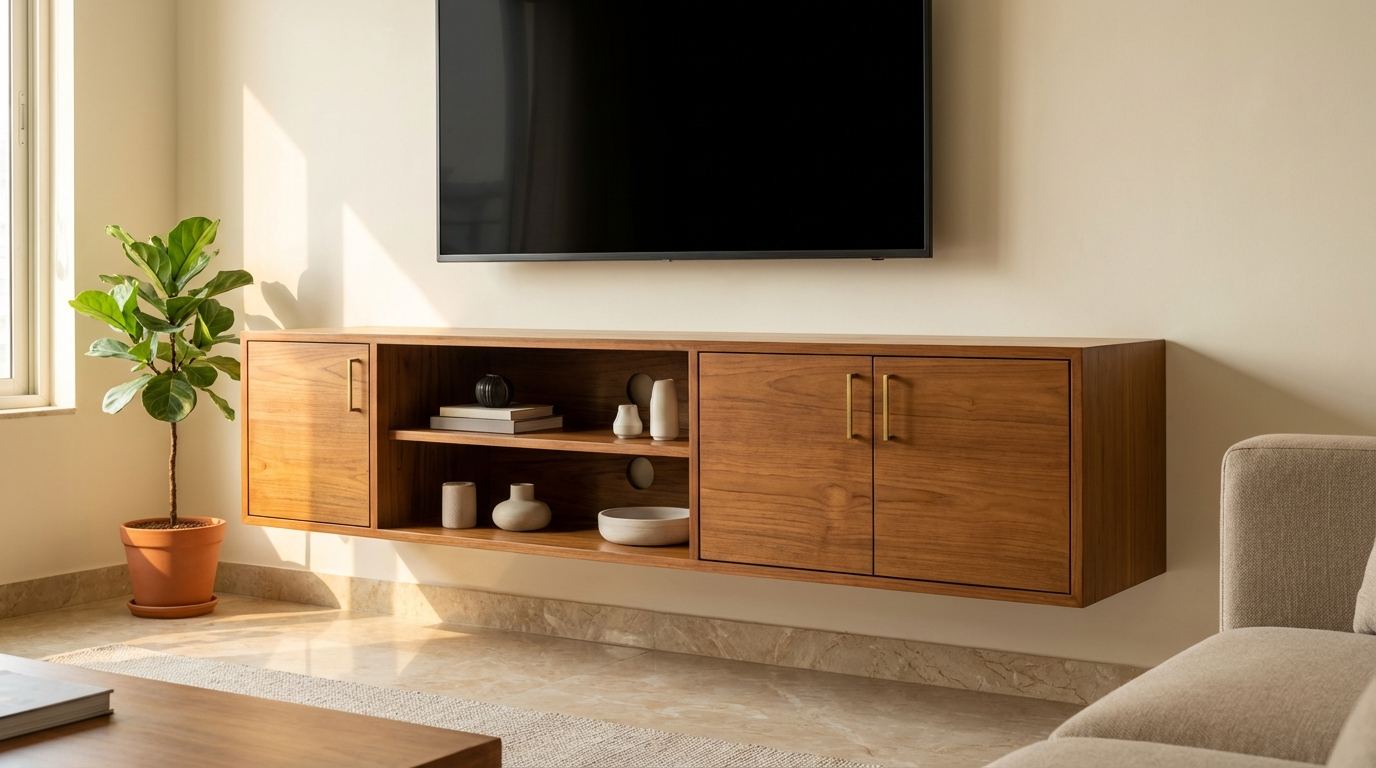
Floating TV units are a popular choice for modern homes—these units are mounted on the wall, giving the illusion that they are floating in the air. This design creates a sleek and uncluttered look, making it ideal for small spaces.
My take: This is what 7 out of 10 clients are asking for now. It makes cleaning easy, makes rooms look bigger, and forces you to deal with cable management properly (because exposed cables look terrible). The catch? Your wall needs to handle the load. Old buildings with hollow blocks or poorly cured concrete? I'd get a structural check first.
Floor-Standing TV Units (Low Profile)
The traditional TV stand, but evolved. Minimalism continues to dominate interior design, and TV consoles are no exception. Clean lines, smooth surfaces, and neutral colour palettes define this trend. Many minimalist TV stands integrate hidden storage, keeping cables and other electronics out of sight.
Honestly, this works better if you have a ground-floor flat or prefer not to drill into walls. Also better for renters—you can take it with you.
TV Units with Back Panels
TV units with marble panels offer unmatched luxury to the background. When paired with an LED-grooved backdrop, they elevate the viewing experience effortlessly. A combination of marble and lighting creates the illusion of a spacious room.
These are statement pieces. Not for everyone's budget, but if you have a 14-foot living room wall to work with, a full-height back panel with the TV mounted in the middle looks stunning. The cost jumps significantly though—expect 40-60% more than a basic floating unit.
Corner TV Units
Usually triangular or wedge-shaped, these TV stands help homeowners save floor space and maximize viewing angles. Corner TV units typically provide storage options like cabinets and shelving, supporting an uncluttered or minimalist look.
Underrated option for odd-shaped living rooms. I've used these in L-shaped halls where no straight wall made sense for a TV.
Modular/Expandable Units
Adaptability is key in today's home decor trends. Modular TV cabinets offer customisable layouts, allowing homeowners to rearrange and expand their setups based on their needs. Some models include interchangeable shelving and adjustable storage compartments.
| Type | Best For | Space Needed | Typical Cost Range | My Recommendation |
|---|---|---|---|---|
| Floating Unit (Basic) | Small apartments, renters, modern aesthetics | 4-6 ft wall width | ₹15,000-35,000 | Best value for most people |
| Floating with Back Panel | Larger living rooms, statement piece | 8-12 ft wall width, floor to ceiling | ₹45,000-1,50,000 | Worth it if budget allows |
| Floor-Standing (Low Profile) | Ground floors, easy mobility, rental homes | 5-7 ft width | ₹12,000-40,000 | Good for traditional setups |
| Corner Unit | Odd room shapes, L-shaped halls | Corner space | ₹18,000-45,000 | Underutilized, actually clever |
| Full Entertainment Wall | Home theaters, large homes | 12+ ft wall | ₹80,000-3,00,000+ | Overkill for most |
Material Breakdown: What Your TV Unit Should Actually Be Made Of
A TV unit is the centerpiece of your living room—it's where aesthetics meet function. With the rise of wall-mounted designs, floating cabinets, hidden wires, and LED grooves, the choice of material becomes a core decision in both design and durability.
Plywood (BWR/BWP Grade)
Plywood is an engineered board made by gluing together multiple thin layers (veneers) of wood—each layer is oriented perpendicular to the next, giving plywood superior strength, dimensional stability, and load-bearing capacity.
Plywood is the right pick for Indian kitchens where haldi, water, and steam are regular guests. Especially Marine plywood can handle monsoons and leak-prone areas really well, without swelling-off.
For TV units, BWR (Boiling Water Resistant) grade is usually sufficient. BWP (Boiling Water Proof) is better, but you're paying 20-30% more and most living rooms don't need that level of protection.
MDF (Medium Density Fibreboard)
MDF offers a super-smooth surface—perfect for PU paint, acrylic, or matte finishes. Great for modern minimalist looks. Ideal for TV units with grooves, 3D carving, or laser-cut detailing.
But here's the problem: MDF is lighter than plywood because plywood's layered wood construction makes it heavier and denser. That sounds good until you realize lighter also means weaker screw holding. Floating MDF units need more support brackets.
HDHMR (High Density High Moisture Resistant)
Choose HDHMR when you need MDF-like finish with added moisture resistance and strength. This is the middle ground. Better than regular MDF in humidity, smoother than plywood for painted finishes. Use HDHMR for areas where MDF is risky but plywood is not required—it's the best surface for laminates, PU paint, acrylic, CNC grooves, fluting, and decorative routing.
Is MDF actually worth the extra cost savings?
MDF is generally cheaper than plywood of the same thickness and grade because MDF is made from recycled wood fibres, while plywood uses whole wood veneers. The price difference can be significant for thicker boards.
Between you and me: if you're doing a painted finish TV unit with CNC patterns and you live in Bangalore or Pune (moderate humidity), MDF is fine. If you're in Mumbai, Chennai, or Kolkata? Choose plywood for structural strength and wet areas. Don't let budget override climate reality.
| Factor | Plywood (BWR/BWP) | MDF | HDHMR |
|---|---|---|---|
| Moisture Resistance | Excellent (especially BWP) | Poor—swells in humidity | Good, much better than MDF |
| Screw Holding | Excellent | Weak—screws loosen over time | Better than MDF |
| Surface Smoothness | Moderate—needs finishing | Excellent—perfect for paint | Very good |
| CNC/Carving | Difficult due to grain | Excellent | Very good |
| Weight | Heavier | Lighter | Medium |
| Cost (approx) | ₹85-140/sq ft (18mm) | ₹45-65/sq ft (18mm) | ₹70-95/sq ft (18mm) |
| Best For | Humid cities, load-bearing | Dry climates, painted finishes | Balanced performance |
Price Reality Check (2026 Market)
Look, I can't give you exact numbers because prices change every quarter and vary by city. But I can give you ballpark ranges so you know if your quote is reasonable or if someone's trying to take you for a ride.
Basic floating TV unit (4-5 ft, plywood with laminate): Expect ₹18,000-35,000 in tier-1 cities. Add ₹3,000-5,000 if you want PU paint finish instead of laminate.
Full wall unit with back panel (8-10 ft width): ₹55,000-1,20,000 depending on complexity. LED lighting integration adds another ₹8,000-15,000.
Modular/ready-made units from furniture stores: ₹12,000-50,000. These are usually MDF or particle board. Fine for dry climates and temporary setups.
Here's what actually affects your final bill:
- Material grade: BWP plywood costs 25-30% more than BWR. Worth it for coastal cities.
- Hardware quality: Soft-close hinges, heavy-duty drawer channels—these can add ₹3,000-8,000 to a project but last 3-4x longer than basic hardware.
- Finish type: Laminate is cheapest. PU paint adds 30-40%. Veneer with clear lacquer adds 50-60%.
- Cable management integration: Built-in channels and access points add ₹2,000-5,000 but save endless frustration later.
- Carpenter vs modular company: Carpenters are 20-40% cheaper but quality varies wildly. Modular companies offer consistency but charge for the brand.
How to Choose the Right TV Cabinet Design
Step 1: Measure your wall and TV first. A good rule of thumb would be to measure the size of your TV diagonally. Once you've done that, add an extra margin of 10 cm all around for the perfect TV unit size. Your TV cabinet should be wider than your TV by at least 10-15 cm on each side.
Step 2: Decide on mounting height. In Indian homes, the ideal height to mount a TV is 42 to 48 inches from the floor to the TV's center, matching typical eye level when seated. For bedrooms, it can be slightly higher.
Step 3: List what you're storing. Set-top box, gaming console, router, speakers, decorative items—count everything. Then add 20% buffer because you'll acquire more stuff. Assess your media equipment inventory, including gaming consoles, sound systems, and peripheral devices, to ensure adequate compartmentalisation within your cabinet design.
Step 4: Check your wall type. Solid brick or RCC? Great for floating units. Hollow blocks or older construction? Floor-standing might be safer, or consult a contractor about reinforcement.
Step 5: Consider cable paths. Look for cabinets with cable channels, dedicated wire management compartments, and strategically placed access points that facilitate connection while maintaining a clean, uncluttered appearance.
| Your Situation | Recommended Type | Why |
|---|---|---|
| 2BHK, small living room (<250 sq ft) | Simple floating unit, 4-5 ft | Maximizes floor space, easy cleaning |
| Large living room (400+ sq ft) | Full wall unit with back panel | Creates focal point, uses proportions well |
| Rental apartment | Floor-standing modular unit | Take it with you, no wall damage |
| Coastal city (Mumbai, Chennai) | Floating, BWP plywood, laminate | Moisture protection essential |
| L-shaped or odd room | Corner unit or angled installation | Works with room shape |
| Home theater setup | Full entertainment wall with AV slots | Integrates equipment properly |
Red flags to walk away from:
- Carpenter says "12mm is enough for everything"—it isn't
- No mention of edge banding in the quote
- Using commercial MR grade ply in humid cities
- Hardware that feels flimsy when you test the sample
- "We'll figure out cables later"—no, figure them out now
Common Mistakes People Make with TV Cabinet Design
1. Ignoring cable management completely. This one really frustrates me. People spend ₹50,000 on a beautiful TV unit and then have cables dangling everywhere like a server room from 1998. Plan cable channels from day one. Wire cutouts at the back, access holes, conduit runs—all of this should be in the design.
2. Going too wide without center support. If your unit is longer than 1.2 meters, you need a center support or vertical divider. Otherwise, shelves sag over time. I've seen this happen in at least twenty homes—gorgeous unit, drooping shelf, because the designer didn't account for load over span.
3. Choosing MDF in coastal cities. Already covered this, but it bears repeating. There was this architect in Andheri—must have been 2022—who insisted on MDF for a client's TV unit because it was "international standard." The client called me fourteen months later when the bottom panel had swelled so much the drawers wouldn't close. Complete replacement.
4. Mounting height based on standing, not sitting. You watch TV sitting down. The center of the TV should be at eye level when seated. I keep seeing units mounted too high because people test the viewing angle while standing in front of the wall.
5. Skipping edge banding. "We'll save ₹2,000 and paint the edges." No. Unsealed edges absorb moisture, delaminate, and start peeling. Quality laminates can last 10-15 years with proper care—but only if edges are sealed.
6. Forgetting ventilation for equipment. Set-top boxes and gaming consoles generate heat. If you're putting them inside closed cabinets, add ventilation slots or they'll overheat and die early. A ₹50 mesh grill saves you ₹5,000 in equipment replacement.
7. Over-designing with too many materials. Mixing wood veneer with glass with metal with LED strips with textured laminate—it becomes chaotic. Pick 2-3 elements max and commit.
8. Not thinking about access for future changes. You'll upgrade your TV. You'll change your set-top box. Design for removable panels or easy access. Permanently fixed backs are a nightmare to service later.
Quality Checks You Can Do Yourself
Visual checks before accepting material:
- Check for core gaps in plywood edges—gaps mean poor quality layering
- Look for delamination at corners—any peeling is a reject
- Laminate should have uniform color and no bubbles
- Edge banding should be flush, not raised or crooked
- Run your hand along surfaces—any roughness means poor finishing
Questions to ask your dealer/carpenter:
- "What grade plywood is this—BWR or BWP?" (If they hesitate, they don't know)
- "Is this ISI-marked?" (Should be for any quality board)
- "What hardware brand are you using?" (Generic hardware fails first)
- "How thick is the laminate?" (Standard laminate thickness is typically around 1mm to 1.5mm, which is suitable for most applications—for additional strength, you can opt for thicker laminates, especially if the TV unit is used for heavy storage.)
Simple field tests:
- Tap test: Tap the board—solid sound is good, hollow/papery sound means poor core
- Weight check: Plywood should feel substantial. Unusually light boards are suspicious.
- Edge inspection: Look at the core layers—even layers mean quality, uneven gaps mean recycled/inferior material
- Flex test: For 18mm board, minimal flex when you push the center. Too much flex means thin core or inferior material.
Here's a trick most dealers don't like: Ask to see the full board before they cut. Check all four edges and both faces. Once it's cut, you can't complain about issues that were "hidden."
Workmanship & Installation: What to Tell Your Carpenter
Most carpenters are good at cutting and joining. Where they typically cut corners (pun intended) is in finishing and installation precision.
Brief your carpenter on these points:
- All exposed edges get 2mm PVC edge banding, properly heat-sealed—no exceptions
- Drilling for wall mounting: use 8mm or 10mm anchors minimum, not those tiny plastic ones
- Level check at every stage—floating units look terrible if they're even 2mm off
- Pre-plan cable holes before assembly, not after
- Soft-close hinges for any doors—₹200 per hinge is worth the quiet operation
- Leave 5mm gap at the back for air circulation
For floating units specifically, wall-mounted TVs need BWR/BWP plywood with steel brackets. Don't let anyone use wooden cleat alone—steel L-brackets or French cleats are stronger and adjustable.
There was this carpenter in Powai who skipped edge banding on the back panel because "nobody sees it anyway." First monsoon, that back panel absorbed moisture, expanded, and pushed the whole unit off the wall. The homeowner was lucky it didn't damage the TV when it came crashing down. Edge banding on ALL exposed edges—visible or not.
Can you use the same TV unit for 10+ years?
With proper material choice and maintenance, yes. Quality laminates can last 10-15 years with proper care. The carcass (plywood body) can last 15-20 years if it's good quality BWR/BWP grade with proper sealing. What usually fails first is hardware—hinges, drawer channels, handles. Buy good hardware upfront and you'll save on replacement hassle later.
How Long It Lasts / Durability Reality
Honest expectations:
- BWP plywood TV unit with laminate: 12-18 years in humid climates, 15-20 years in dry climates
- BWR plywood: 10-15 years with proper care
- HDHMR: 8-12 years in moderate humidity
- Regular MDF: 4-7 years in humid areas (much longer in dry climates)
- Ready-made particle board units: 3-5 years typically
What affects longevity:
- Maintenance: Weekly dusting, immediate spill cleanup
- Climate: Coastal humidity ages furniture 30-40% faster
- Usage: How often you open/close doors and drawers
- Hardware quality: Cheap hinges fail in 2-3 years; good ones last 15+
Signs of wear to watch for: laminate peeling at edges (reseal immediately), drawer channels sticking (may need replacement), hinges loosening (tighten screws or replace), any swelling or warping (usually moisture damage—address the source first).
Alternatives Worth Considering
If budget is tight, consider multi-functional units in your bedroom that can act as a TV unit, study/work desk, bookshelf, and display unit, all at the same time. These combo units cost more upfront but save on buying separate furniture.
If you want better moisture resistance without the plywood cost, WPC/PVC boards work for extreme moisture areas. I've started recommending these for bathroom-adjacent walls or ground floor flats in flood-prone areas. Our WPC door frame guide covers this material in more detail.
For renters who need portability: look at metal-framed TV stands with wooden tops. They're lightweight, disassemble easily, and survive moves better than all-wood units. The industrial look works well in modern apartments too.
If you're doing a full living room renovation, our wardrobe plywood guide has overlapping material recommendations, and the kitchen cabinet material comparison covers HDHMR vs plywood extensively.
Frequently Asked Questions
Is it true that floating TV units damage walls over time?
Not if installed properly. The damage happens when you use inadequate anchors or mount on walls that can't handle the load. RCC or solid brick walls with proper 8-10mm expansion anchors can handle 100+ kg easily—more than any TV unit will ever weigh. The issue is usually people using those tiny 5mm plastic anchors meant for picture frames. Get proper heavy-duty anchors, have the installer drill test holes to confirm wall type, and you're fine for decades.
What's the best material for a TV unit in Mumbai?
BWR-grade plywood minimum, BWP-grade if your flat is on lower floors or your building has moisture issues. Marine plywood can handle monsoons and leak-prone areas really well, without swelling-off. Skip regular MDF entirely—the humidity will ruin it within 2-3 monsoons. HDHMR is an acceptable middle ground if you want painted finishes.
How high should a TV be mounted for comfortable viewing?
In Indian homes, the ideal height to mount a TV is 42 to 48 inches from the floor to the TV's center, matching typical eye level when seated. For bedrooms, it can be slightly higher. If your sofa is lower or higher than standard, adjust accordingly—the center of the TV should be at your seated eye level.
Is it true that LED backlighting behind TV units is just for show?
LED strip lights enhance the visual appeal and create a theatre-like ambiance. In Indian homes, warm or cool white LEDs behind the panel or under floating units work well. But beyond aesthetics, bias lighting (light behind the TV) actually reduces eye strain during evening viewing by reducing contrast between the bright screen and dark surroundings. So it's functional, not just decorative.
What if I live in a rented apartment and can't drill walls?
Go for floor-standing TV units. Many modern low-profile designs look almost as sleek as floating units. You can also explore units with adjustable feet that work on uneven floors. Some newer designs even use tension poles (floor-to-ceiling) that don't require any drilling—though these work better for lighter setups.
Can I use the same TV unit from my bedroom in the living room?
Size-wise, bedroom units are typically 3-4 feet while living rooms need 5-7 feet minimum. The proportions will look off. You can repurpose bedroom units in guest rooms or kids' rooms, but for your main living area, invest in something appropriately sized.
Is it true that carpenters prefer MDF because it's easier to work with?
Partially true. MDF is easy to cut and shape—whether you need detailed CNC work in the wall panel or need an intricate back panel, MDF delivers with clean edges and precise detailing. Plywood with its grain patterns doesn't cut as cleanly. But "easier for the carpenter" shouldn't override "better for your climate." A good carpenter can work with both—don't let convenience dictate material choice.
How do I hide all those ugly cables?
In Indian homes, modular units with set-top box trays, wire cutouts, and closed drawers help maintain aesthetics. Plan cable runs before construction—have your carpenter create channels at the back of the unit. If it's already built, cable raceways (those plastic channels) painted to match your wall are the easiest retrofit. Some people also run cables through the wall itself, but that requires planning during construction.
Is it true that veneer finish is always better than laminate?
Not always. Veneer gives a more natural wood look and can be refinished/polished if scratched. But it's 40-60% more expensive and needs more maintenance. Laminate is more durable for daily use, easier to clean, and comes in many realistic wood finishes now. For TV units (which get touched less than kitchen cabinets), either works—it's more about your budget and aesthetic preference.
What's the ideal depth for a TV cabinet with storage?
12-14 inches is standard for most applications. That's deep enough for set-top boxes, routers, and gaming consoles without protruding too far into the room. If you're storing larger equipment or books, go up to 16-18 inches. Anything deeper than 18 inches becomes a credenza and starts looking out of proportion for just a TV unit.
How much storage is actually necessary in a TV unit?
Most people overestimate. Unless you have a massive DVD collection (increasingly rare) or multiple gaming consoles, you need: 1-2 slots for set-top box and router, 1-2 drawers for remotes and miscellaneous items, maybe one cabinet for board games or photo albums. The rest should be open or semi-open for displaying items. Too much closed storage makes the unit look heavy and dated. Mix open and closed storage to balance display and utility without adding bulk.
Can I combine a TV unit with a bookshelf or display unit?
Yes, combining a bookshelf or showcase with your TV unit is a smart and space-efficient idea, especially in Indian living rooms. Use vertical open shelves on one or both sides for books, artefacts, or photos. Modular designs help balance display and utility. This works particularly well in living rooms that don't have separate wall space for both items.
That's the Gist
Most of this comes down to: use the right material for your climate, get good hardware, and don't skip edge banding. The design trends will change every few years, but a well-made unit lasts through multiple trends. Your carpenter might have different opinions on some of this—worth hearing them out, especially the experienced local ones who know your area's humidity patterns. Good luck with the project.
Disclaimer: This content is provided for general informational purposes based on industry practices and publicly available information. Product specifications, standards, prices, and availability may vary by manufacturer, region, and time. Readers should independently verify details with manufacturers, dealers, or qualified professionals before making purchase or construction decisions.Want Plywood Suggestions?
Share a few details and a Sainik 710 specialist will suggest suitable brands and connect you to responsive dealers.