Temple Door Design: 20+ Traditional & Modern Pooja Room Door Ideas with Vastu Tips
Get 20+ temple door designs for pooja room—traditional & modern styles. Vastu-compliant options, wood types & carving ideas for sacred spaces at home.
Quick Answer: Best Temple Door Designs for Indian Homes
The best temple door design for your pooja room depends on available space, budget, and whether you prioritize traditional aesthetics or modern minimalism—but solid teak or sheesham double doors with light carving work remain the most versatile choice for most Indian homes.
Short version: Pooja room doors typically fall into three categories—traditional carved wooden doors (best for dedicated rooms), glass-panel doors with wooden frames (great for apartments where you want visibility), and sliding or folding doors (essential when space is tight). Vastu recommends two-door designs opening outward, wood as the primary material, and placement in the northeast corner. Budget anywhere from ₹8,000 for basic engineered wood doors to ₹60,000+ for hand-carved solid wood masterpieces.
This guide is right for you if:
- You're designing a new pooja room or renovating an existing one
- You want to understand which wood types actually work for mandir doors and which are marketing nonsense
- You've seen beautiful temple doors online but have no clue what they cost or how to get them made locally
- Vastu compliance matters to your family
Skip this if:
- You're looking for ready-made door catalogs with prices—this is about understanding options, not shopping
- Your pooja "room" is a wall shelf (no door needed)
Bottom line: A well-designed temple door transforms a prayer corner into a sacred space, but don't overspend on elaborate carvings if you're just going to paint over them in five years.
What Temple Door Design Actually Means
A temple door design refers to the specific style, material, carving pattern, and hardware configuration used for pooja room entrances—distinct from regular interior doors because of their spiritual significance and often unique construction requirements. These doors range from simple single-panel shutters to elaborate double-door systems with brass fittings, traditional motifs, and integrated bells.
Most people think expensive carved doors automatically look better. Actually, an ill-proportioned heavily carved door can overwhelm a small pooja room and look cluttered rather than divine. I've walked into homes where someone spent ₹45,000 on intricate Rajasthani-style doors for a 4x3 foot pooja nook. The effect? Suffocating. Meanwhile, a ₹12,000 clean-lined teak door with minimal border carving in another flat looked absolutely stunning because the proportions were right.
The technical aspects worth understanding: temple doors typically use thicker panels (25-32mm versus 18-19mm for standard room doors), require better quality hinges to handle ornamental weight, and often incorporate jaali (lattice) work, glass panels, or decorative metalwork. The frame-to-door ratio matters more here than anywhere else—too thin a frame on heavy carved doors leads to sagging within two monsoons.
Why Pooja Room Door Design Matters in Indian Homes
Here's what actually happens in Indian conditions. The door you install in Mumbai's 85% humidity behaves completely differently than one in Jaipur's dry climate. Wood expands, contracts, and warps based on moisture content—and your pooja room door opens and closes multiple times daily, often by elderly family members who aren't gentle with hardware.
In places like Chennai or Mumbai, you'll notice solid wood doors swelling during July-September, sometimes refusing to close properly. I've seen this happen in at least twenty homes. The devotee struggles with a stuck door every morning during their most peaceful time of day. Frustrating doesn't begin to describe it.
Coastal Karnataka and the Konkan belt present the worst conditions—salt-laden air plus humidity is murder on iron hardware and certain wood species. Kolkata has similar issues. Move to Ahmedabad or Pune, and sudden temperature swings cause different problems: cracking along grain lines, joint separation, and finish degradation.
The spiritual dimension matters too. According to most Vastu practitioners, the pooja room door creates a threshold between the material world and sacred space. A squeaky, jammed, or visually unappealing door disrupts the mental transition that prayer requires. Whether you believe in Vastu or not, there's something to the idea that a beautiful, smoothly functioning temple door sets the right mood.
Does wood type really affect how long temple doors last?
Absolutely, and more than most people realize. Teak (sagwan) remains the gold standard because its natural oils resist moisture and termites—a well-made teak temple door can last 40-50 years with basic maintenance. Sheesham (Indian rosewood) comes close but needs more attention in humid climates. Pine and rubber wood? I wouldn't recommend them for temple doors regardless of budget constraints. They don't hold carving detail well, warp faster, and frankly don't have the gravitas a sacred space deserves. The money you save gets eaten up in repairs and replacements within a decade.
Types of Temple Door Designs: Complete Breakdown
Let me walk you through the major categories. This isn't exhaustive—carpenters across India create countless regional variations—but it covers what 90% of homeowners actually choose.
Traditional Carved Wooden Doors
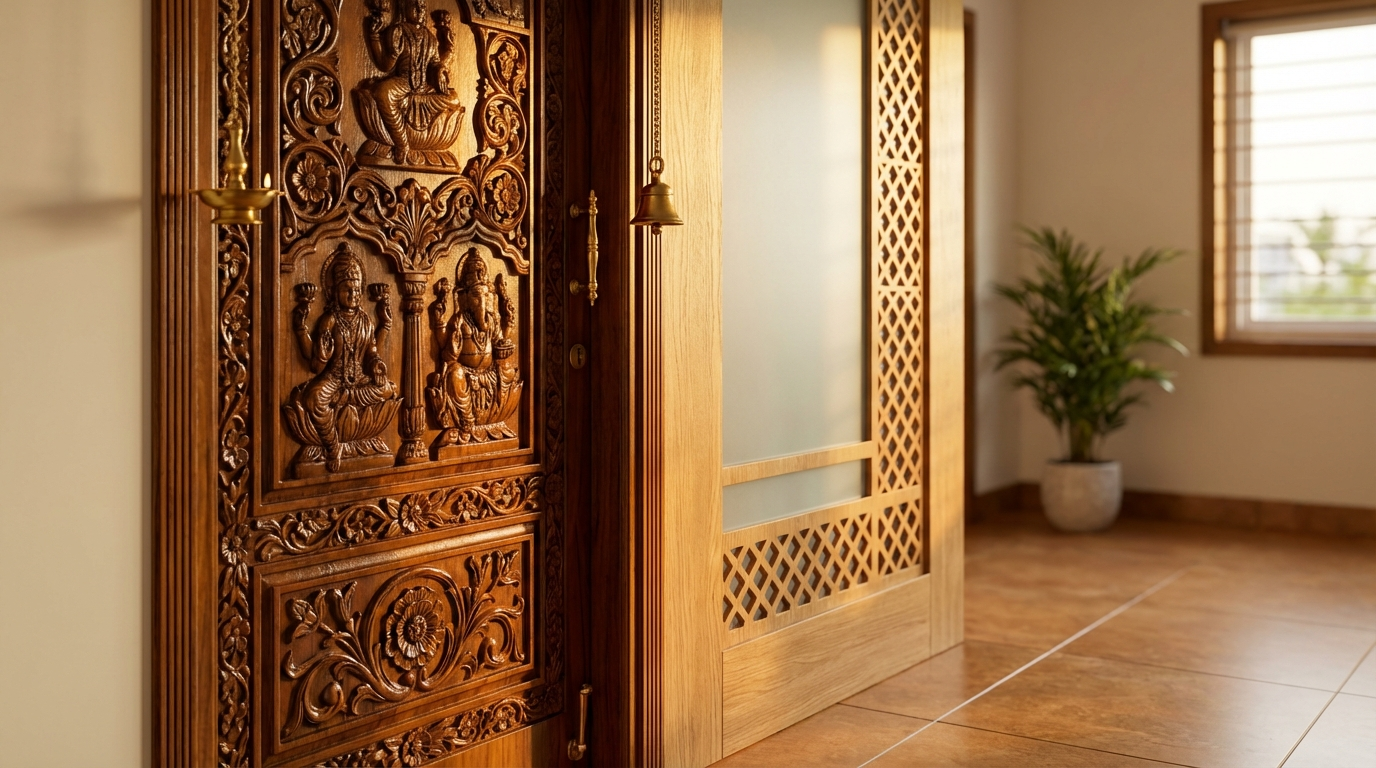
The classic choice. Solid wood panels with hand-carved or CNC-machined religious motifs: elephants, lotus flowers, temple gopuram patterns, Om symbols, bells, diyas. South Indian homes often feature detailed deity carvings—Ganesha is overwhelmingly popular. These doors work best when you have a dedicated pooja room of at least 5x5 feet and want a heritage aesthetic.
My take: Beautiful when done right, but the quality variation is enormous. I've seen "hand-carved" doors that were actually machine-cut with minimal finishing, selling at hand-carved prices. Always ask to see the back of carving panels—hand work shows tool marks and slight irregularities that machine work doesn't.
Glass and Wood Combination Doors
These have become incredibly popular in modern apartments. Wooden frames with frosted, etched, or stained glass panels allow light transmission while maintaining privacy. The glass can feature laser-cut religious symbols, traditional jaali patterns, or simple geometric designs.
Best when you want the pooja room visible as a design element in your living space, or when the room itself has no windows and needs borrowed light.
Jaali Pattern Doors
Intricate lattice work—originally designed to allow air circulation in pre-AC India—creates beautiful light-and-shadow patterns. Modern jaali doors use MDF or engineered wood for the lattice portion with solid wood frames. Traditional ones are entirely hand-cut from solid wood, which costs significantly more.
Sliding and Folding Doors
The practical choice for space-constrained homes. Sliding doors need wall track space but don't eat into floor area. Folding (accordion-style) doors work when even sliding isn't possible. Honestly, these aren't my favorite aesthetically, but in a 2BHK where the pooja room is essentially a large closet converted for purpose, they're sometimes the only option.
Metal-Accent Doors
Brass-clad doors, copper sheet overlays, or doors with decorative metal fittings have a distinct temple-like grandeur. Common in traditional homes across Gujarat and Rajasthan. Maintenance is higher—metals tarnish and need regular polishing—but the effect is undeniably striking.
| Door Type | Best For | Space Needed | Budget Range | Maintenance Level | My Recommendation |
|---|---|---|---|---|---|
| Traditional Carved | Dedicated large pooja rooms, heritage homes | Minimum 5x5 ft room | ₹20,000-80,000+ | Medium | Worth it if room size supports it |
| Glass + Wood | Apartments, modern interiors, low-light rooms | Any size | ₹12,000-35,000 | Low (just glass cleaning) | Best all-rounder for apartments |
| Jaali Pattern | Medium rooms, those wanting traditional look without heavy carving | Medium rooms work best | ₹15,000-45,000 | Medium (dust accumulates) | Beautiful but cleaning is tedious |
| Sliding/Folding | Space-constrained apartments, alcove conversions | Minimal | ₹8,000-25,000 | Track needs attention | Functional, not ideal aesthetically |
| Metal-Accent | Grand homes, traditional aesthetics, making statement | Larger rooms | ₹30,000-1,00,000+ | High (polishing required) | Gorgeous but committed maintenance |
Vastu Guidelines for Pooja Room Doors
I'll be honest—I'm not a Vastu expert, and I've seen clients get overly stressed about minor details. But here are the commonly accepted guidelines that most practitioners agree on:
Direction: The pooja room door should ideally face east or north. Northeast is considered most auspicious. If your home layout forces a south-facing door, some Vastu consultants suggest keeping the door closed when not in use.
Two-shutter doors preferred: Double doors that open outward (toward you as you stand outside) are considered more auspicious than single doors. The opening-outward part matters more than having two shutters, though.
Wood over metal: Vastu generally favors wooden doors over full-metal ones for pooja rooms. Metal accents and hardware are fine.
Avoid black: Black-colored doors or dark finishes are considered inauspicious for sacred spaces. Warm wood tones, white, and off-white are preferred.
Threshold (chaukhat) matters: A complete wooden threshold is recommended rather than a flush floor-level door.
Now, here's my practical take. If following Vastu precisely means installing a door that doesn't fit your space or budget, prioritize functionality. A well-made, properly hung door that brings you joy every time you open it serves the spiritual purpose better than a technically "Vastu-compliant" door that sticks, squeaks, or looks wrong for your home.
Price Reality Check: Temple Door Costs in 2026
Expect prices to vary wildly based on wood species, carving complexity, size, and your city. Here's what actually drives your final cost:
Wood species: This is the biggest factor. Burma teak costs roughly 2-3x what plantation teak costs. Sheesham falls in between. Mango wood and engineered options sit at the budget end.
Carving depth and coverage: A simple border carving might add ₹3,000-5,000 to a door's cost. Full-panel hand carving with religious figures? Could add ₹15,000-40,000 or more depending on intricacy.
Size: Standard 6'6" x 2'6" doors are cheapest. Taller or wider doors, especially double-door configurations, scale up in price non-linearly.
Hardware: Basic hinges and handles run ₹500-1,500. Decorative brass hardware with bells, ornate handles, and specialty fittings can add ₹3,000-15,000.
Rough budgeting framework:
- Basic engineered wood single door, minimal design: ₹6,000-12,000
- Solid sheesham or plantation teak, moderate carving: ₹18,000-35,000
- Premium teak double doors with detailed carving: ₹45,000-80,000
- Heritage-style brass-clad or heavily carved masterpieces: ₹80,000-2,00,000+
Here's what actually affects your final bill beyond the door itself: frame construction (often sold separately), finishing (polish type matters), installation, and whether you need any structural modifications to the doorway opening.
Traditional vs Modern Temple Door Designs: Direct Comparison
This question comes up constantly. I tell clients to think about their entire home's design language before deciding.
| Parameter | Traditional Design | Modern Design | My Take |
|---|---|---|---|
| Visual impact | Ornate, makes a statement | Subtle, integrates with interiors | Both work—depends on your space |
| Carving style | Religious figures, temple motifs, elaborate borders | Geometric patterns, minimal lines, laser-cut symbols | Modern carving ages better with trends |
| Material flexibility | Primarily solid wood | Glass, veneer, MDF combinations common | Modern offers more options |
| Maintenance | Higher—intricate carvings trap dust | Lower—smooth surfaces clean easily | Consider who cleans your home |
| Cost range | Generally higher | More budget-friendly options exist | Traditional has wider price spread |
| Resale appeal | Subjective—not everyone loves ornate | Broader appeal | Modern safer if selling within 10 years |
| Customization | Requires skilled carvers, longer lead time | CNC options make it faster and cheaper | Modern is more accessible |
| Best suits | Villa, large flat, heritage-style interiors | Apartments, contemporary homes | — |
Choose traditional when: You have space for the doors to breathe visually, your family values heritage aesthetics, you're willing to invest in quality craftsmanship, and you don't plan major interior style changes.
Choose modern when: You're in an apartment with mixed design elements, you prefer easier maintenance, budget is a constraint, or you like the clean look and want the pooja room to blend rather than dominate.
Is CNC carving actually as good as hand carving?
Depends on what you mean by "good." For precision and consistency, CNC wins hands down. Every lotus petal identical, every curve exactly as designed. For depth, character, and that unmistakable handmade warmth? Traditional hand carving has qualities machines can't replicate. The best approach for most budgets is CNC-cut design with hand-finished detailing—gives you precision where it matters and artisan touch where it shows. Pure hand carving is increasingly rare and expensive; if you find a skilled karegar (craftsman), it's worth the premium for the center panel at minimum.
How to Choose the Right Temple Door Design
Step 1: Measure your doorway opening precisely. Width, height, and critically—depth available for the frame. I've seen people fall in love with 4-inch frame designs when they only have 3 inches of wall depth. Disaster.
Step 2: Assess your space honestly. A grand double door needs room to be appreciated. In a cramped corner, it looks forced.
Step 3: Consider your daily use pattern. Will elderly parents be opening this door at 5 AM? Heavy brass-clad doors might not be practical. Is the pooja room near the kitchen? Glass panels show oil splatter.
Step 4: Set a realistic budget before you start browsing Pinterest. It's easy to fall in love with ₹70,000 doors when your actual budget is ₹20,000.
Step 5: Check what's available locally versus what needs custom ordering. Custom work means longer wait times and usually higher costs—but sometimes it's the only way to get exactly what you want.
Decision Framework:
| Your Situation | Recommended Door Type | Why |
|---|---|---|
| Large dedicated room, traditional home | Carved double doors in solid wood | Space supports grandeur, matches home style |
| Modern 3BHK apartment | Glass and wood combination | Blends with contemporary interiors, lets in light |
| Converted closet/alcove | Sliding or bi-fold doors | No swing space available |
| Tight budget but want impact | Simple solid wood with brass accents | Hardware makes affordable doors look premium |
| Humid coastal location | Teak with minimal carving | Reduces moisture trapping, easier maintenance |
Red flags to walk away from:
- Carpenter who can't show you previous temple door work
- Significantly lower prices than market range (usually means inferior wood or hollow core construction)
- No clarity on wood species being used
- Unwillingness to discuss warranty or rework policy
Common Mistakes People Make with Temple Doors
Oversizing for the space. The most common error. That elaborate 7-foot double door looks majestic in the showroom, overwhelming in your 6x6 pooja room. Leave breathing space.
Ignoring the frame. People obsess over door panel design and cheap out on the frame. The frame is what holds everything together, takes the hinge weight, and provides the finished look. A beautiful door on a flimsy frame defeats the purpose.
Choosing based on photos alone. This one really frustrates me. Someone sees a Pinterest image of a stunning Chettinad-style door, orders something "like that" without understanding the context. That door was photographed in a mansion with 12-foot ceilings and antique furniture. In your flat? Totally different effect.
Neglecting hardware till last minute. I've seen this happen repeatedly. The door is installed, beautiful, and then someone runs to the local hardware shop and slaps on chrome handles because the brass ones weren't ready. The mismatch ruins everything.
No provision for bell clearance. If you want traditional bells on your door, they need swing space. I watched a carpenter install a lovely door with decorative bells that couldn't ring because they hit the frame edge. Had to rehang the whole thing.
Wrong finish for the climate. Melamine finish in coastal humid areas peels faster than you'd believe. Polyurethane holds up better. NC lacquer looks premium but needs reapplication. Match finish to your climate.
Skipping the threshold. A temple door without a proper threshold looks incomplete and—if you care about Vastu—is considered inauspicious. Don't save ₹2,000 and regret it.
Installing before room is painted. Paint drips on carved woodwork are nearly impossible to clean properly. The door should go in last, after all wet work is complete.
Quality Checks You Can Do Yourself
Visual inspection:
- Check grain consistency—genuine solid wood shows natural variation, not perfectly uniform patterns
- Look at joints closely—gaps shouldn't be visible
- Examine carving depth—should be consistent across the panel
- Verify both sides of the door—back shouldn't look drastically inferior
- Check edges for proper sealing
Questions to ask your carpenter or supplier:
- "What wood species is the core? What about the carving panel?"
- "Is this kiln-dried wood?" (Properly dried wood warps less)
- "What's the panel thickness after finishing?"
- "What hardware weight can this frame support?"
- "What's included in the price—frame, threshold, installation?"
Simple tests:
- Tap test: Solid wood sounds... solid. Hollow core sounds hollow. Tap in multiple spots.
- Weight check: Solid wood doors are heavy. If a "solid teak" door feels light, question what you're actually getting.
- Flex test: Press the panel center firmly. It shouldn't flex noticeably on a solid door.
- Edge inspection: Look for proper sealing and consistent thickness throughout.
Here's a trick most dealers don't like: ask to see an offcut from your actual door. The cross-section reveals everything about core construction that surface inspection can't.
Getting the Installation Right
The best door poorly installed is worse than an average door well installed. I keep saying this.
Frame installation is critical. It must be perfectly plumb and level. Even 2-3mm variance will cause the door to swing open or closed on its own, or bind against the frame. Use a spirit level. Insist on it.
Hinge placement matters more for heavy carved doors. Standard doors use two hinges. Heavy temple doors need three—sometimes four. The middle hinge carries most of the carved panel's weight and prevents sagging.
Use appropriate screws. For solid wood frames into masonry: 3-inch screws minimum, with wall plugs. For hinges: brass screws look better and don't rust, but steel is stronger. Match screw gauge to hinge hole size.
What to tell your carpenter—essential briefing checklist:
- The door must open fully without hitting walls or furniture
- I want to see level check before frame is fixed
- All screw heads must be countersunk
- Hardware installation after final polish, not before
- Leave 3-4mm clearance gap at bottom—this isn't a bathroom door
- Clean up all sawdust from site daily—pooja room should stay clean during work
I've seen carpenters skip the acclimatization step and install doors straight from transport. This is asking for trouble. Wood needs to adjust to your home's humidity for at least 3-5 days before installation. Just stand it upright in the room where it'll be installed.
Quick detour: if your pooja room has plywood paneling on walls, our plywood grades guide explains which grades work for interior paneling. Worth checking to ensure your door doesn't look stunning against substandard walls.
How Long Do Temple Doors Actually Last?
In my experience, well-maintained solid teak temple doors last 30-50 years easily. Sheesham, maybe 20-35 years. Engineered options, realistically 10-15 years before they start looking tired.
What affects longevity:
- Daily use intensity—doors opened five times daily versus fifty times
- Climate—humid conditions accelerate everything
- Direct sunlight exposure—UV degrades finishes
- Maintenance discipline—occasional oiling, touch-up polish
- Original quality—cheap wood just doesn't last regardless of care
Signs of wear to watch:
- Finish dulling or yellowing
- Carving detail becoming less defined (accumulated polish buildup)
- Gaps appearing in joints
- Hinges loosening despite tightening
- Wood checking (small surface cracks)
When to consider replacement:
If the door still functions but looks dated, refinishing often makes more sense than replacement. Complete replacement is warranted when structural integrity is compromised—warping beyond adjustment, termite damage, or joint failure that repair can't fix.
Alternatives Worth Considering
WPC (Wood-Plastic Composite) doors: If budget is genuinely tight and you're in a termite-prone or extremely humid location, WPC is worth considering. Won't give you the warmth of real wood, but zero termite worries and moisture resistance. Our WPC material guide has more details on what to expect.
Veneer-on-core construction: Premium veneer (like teak veneer on engineered core) costs much less than solid teak while looking almost identical. The catch: you can't do deep carving on veneer—only surface etching or applied mouldings. Good middle ground for modern designs.
Brass or copper cladding on basic wood: If you want that traditional metal-sheathed look, you can clad a simpler wooden door rather than investing in solid premium wood throughout. The metal becomes the visual element; the wood is just structural.
For those considering built-in pooja units rather than room doors, our modular furniture guide covers how BWP plywood works for such applications.
Can I install a temple door myself?
Honestly, I wouldn't recommend it unless you've done door installations before. Temple doors are often heavier than standard doors, require precise alignment for proper aesthetics and function, and mistakes are visible and costly. The installation cost—usually ₹1,500-3,000—is money well spent. What you can do yourself: basic maintenance, hardware tightening, cleaning, and touch-up polishing. Leave the installation to someone with experience.
Frequently Asked Questions
What's the ideal size for a pooja room door?
Standard interior door size works for most pooja rooms—6'6" to 7' height, 2'6" to 3' width for single doors, 4' to 5' for double doors. The real question is proportion: the door should be roughly 70-80% of wall width it's set in. A door that fills the entire wall looks cramped. One that's too narrow looks lost. Measure your wall width and work backward.
Is it true that pooja room doors must always open outward?
This is a Vastu recommendation, not a structural requirement. The reasoning is that opening outward symbolically invites positive energy from the sacred space into your home. Practically, outward-opening doors need clearance in the hallway or adjacent room. If your layout genuinely can't accommodate outward opening, an inward-opening door doesn't doom your prayers. Focus on what's functional.
What if I live in Chennai—do I need special treatment for humidity?
Chennai's coastal humidity is tough on wood. Stick to teak—it handles moisture better than any alternative. Avoid elaborate deep carvings that trap moisture. Choose polyurethane finish over NC lacquer. Most importantly: ensure proper ventilation inside the pooja room. A ceiling exhaust fan or even keeping the door partially open during humid months helps. The door is only part of the moisture management equation.
How do I clean carved temple doors without damaging details?
Soft brush first to remove loose dust from crevices—a clean paintbrush works well. Then slightly damp (not wet) microfiber cloth for surface wiping. Never spray water or cleaning solution directly on carved wood. For stubborn buildup in carving grooves, use a soft toothbrush. Oil polish maybe once every 6-12 months depending on climate—more isn't better; it attracts dust.
Is teak actually worth the price premium over sheesham?
For temple doors specifically? Yes, in most Indian conditions. Teak's natural oil content resists moisture and insects without chemical treatment. Sheesham is beautiful and durable but needs more care in humid climates. The price difference—teak costs maybe 30-50% more—is reasonable insurance for something you want lasting decades. That said, if you're in a dry climate like Rajasthan or Madhya Pradesh interior, sheesham performs excellently.
Can bells be added to any door design?
Technically yes, but they work best with certain styles. Jaali patterns naturally accommodate bells within the lattice. Solid carved doors need a horizontal crossbar or decorative hanging strip added for bells. Glass doors—possible but looks awkward usually. Plan for bells from the design stage; retrofitting often looks like an afterthought.
Is it true that black-colored doors are bad for pooja rooms?
Per Vastu, yes—black and very dark finishes are considered inauspicious for sacred spaces. Whether you follow this is personal. From a pure design perspective, dark doors in small pooja rooms do make the space feel smaller and heavier. Natural wood tones, whites, and light colors visually expand the space and feel more serene.
What's the minimum budget for a decent temple door?
If "decent" means solid construction that won't embarrass you—realistically ₹10,000-12,000 for a single door in engineered wood with simple design, including basic hardware and installation. Below this, quality compromises become very visible. For solid wood with any meaningful carving, start your mental budget at ₹18,000-20,000 minimum.
How do I find skilled craftsmen for traditional carved doors?
This has become harder as the craft declines. Traditional furniture markets in each city usually have a few specialists—Kirti Nagar in Delhi, Jogeshwari furniture market in Mumbai, Banjara Hills in Hyderabad. Ask to see previous temple door work specifically—general carpentry skill doesn't transfer automatically. Word-of-mouth through recent temple door buyers in your community is often the most reliable route. Interior designers who've done traditional homes can also recommend.
Should I match the temple door style with other doors in my home?
Not necessarily—and often deliberately not. The pooja room is meant to feel distinct, a transition into sacred space. A carved wooden temple door in a home with modern flush doors is perfectly fine; the contrast is part of the design intent. What should match: overall quality level and finish type. A cheap-looking temple door in a home with premium finishes everywhere else creates the wrong kind of contrast.
What if my existing doorway is an odd size?
Custom sizing is standard for temple doors anyway—unlike mass-produced doors, these are typically made to order. Odd sizes don't cost significantly more unless extremely unusual dimensions are involved. What matters is communicating measurements accurately and having the carpenter verify in person before fabrication begins. "Measure twice, cut once" applies literally here.
How far in advance should I order a custom temple door?
Basic designs: 2-3 weeks. Moderate carving with standard wood: 4-6 weeks. Elaborate traditional carving or rare wood species: 8-12 weeks, sometimes longer. Festival season (before Diwali especially) adds delays as craftsmen are overloaded. If you have a specific deadline—griha pravesh, festival—order at least 30% earlier than the craftsman suggests. They're optimistic by nature.
Final Thought
Your temple door is probably one piece of woodwork in your home that carries meaning beyond function. Take time choosing. Visit actual doors in homes or showrooms rather than just browsing online images—photos never capture scale and presence accurately. And don't let perfect be the enemy of good. A well-made simple door serves divinity better than an elaborate door poorly executed. Oh, and whatever you install—make sure the hinges don't squeak. Nothing breaks the morning prayer mood like a squeaky door announcing your arrival.
Disclaimer: This content is provided for general informational purposes based on industry practices and publicly available information. Product specifications, standards, prices, and availability may vary by manufacturer, region, and time. Readers should independently verify details with manufacturers, dealers, or qualified professionals before making purchase or construction decisions.Want Plywood Suggestions?
Share a few details and a Sainik 710 specialist will suggest suitable brands and connect you to responsive dealers.