Sunmica Sheet Guide: Types, Designs, Price & Application for Kitchen, Wardrobe & Furniture
Complete sunmica guide—types (HPL, decorative), designs, price & application tips. Best sunmica for kitchen, wardrobe & furniture with brand comparison.
The Quick Answer on Sunmica Sheets
Sunmica is a decorative laminate sheet made from layers of resin-impregnated kraft paper, pressed under heat to create a durable, scratch-resistant surface for furniture, kitchens, and wardrobes. That's it—nothing more complicated.
Short version: Sunmica laminate is a popular brand of laminate in India—it's a decorative laminate sheet generally used as an overlay over wooden furniture. Made from a blend of paper and plastic, brown paper and decorative paper soaked in phenolic and melamine resins are hard-pressed together to form a stiff laminate sheet. The name became so common that people now use "sunmica" to refer to any laminate, like how we say "Xerox" for photocopies. Most sheets come in 8x4 feet size, thickness ranging from 0.6mm to 1.5mm.
This is right for you if:
- You want affordable surface finishing for plywood furniture without spending on veneer or solid wood
- Your kitchen, wardrobe, or furniture needs protection from scratches, stains, and daily wear—basically any home with kids or heavy usage
- You prefer low-maintenance surfaces that can be wiped clean with a damp cloth
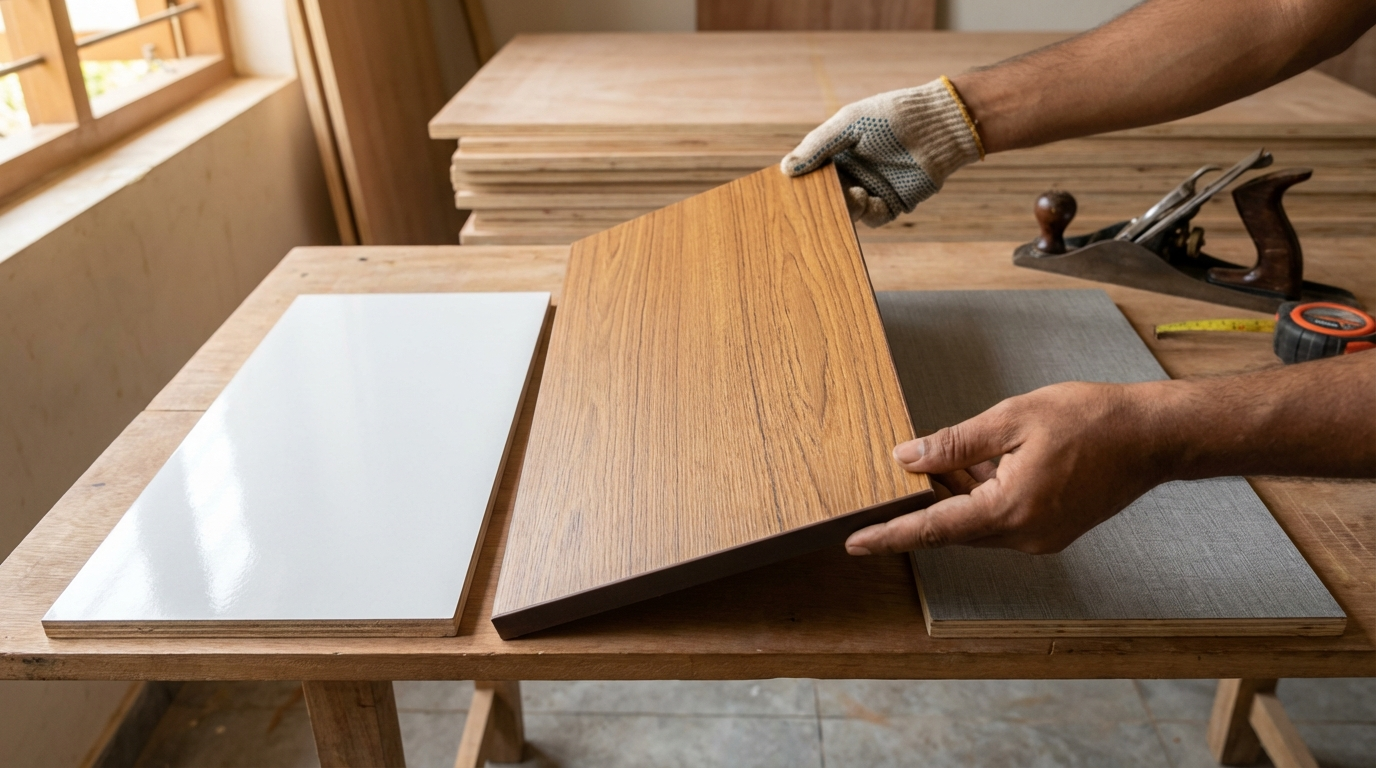
- Design variety matters to you—wood grains, solid colours, abstract patterns, metallic finishes
Skip this if:
- You need an extremely high-end finish where veneer or acrylic would be more appropriate
- The application involves constant water exposure (like inside showers)—laminates handle moisture, not continuous soaking
Bottom line: For 90% of Indian homes, sunmica/laminate is the most practical, cost-effective surface solution—just choose the right thickness and type for your specific application.
What Sunmica Actually Means (And Why Everyone Gets It Wrong)
Sunmica is one of the popular brands of laminates, while "laminates" is a broader term for multilayer composite material bonded together. Sunmica originally belonged to Bombay Burmah Trading Corporation Limited, but AICA Laminates India Pvt Ltd later took over ownership. Sunmica became so popular that people started using the term 'sunmica' to talk about laminates in general, no matter the company.
Most people think sunmica and laminate are two different things. Actually, they're the same. Sunmica is a popular brand of laminates—so popular that contractors and vendors refer to laminates in general as sunmica or mica. But it's no different than going to a copying centre and asking for your papers to be xerox-ed, when in fact you should be asking for photocopies.
Here's what happens inside a laminate sheet: At 1mm thickness, sometimes even lesser, laminates are hard and brittle sheets. If you did a cross-section of a laminate sheet, you'd basically see that it's made up of three sheets—there's the base layer, which is non-decorative and is the surface on which carpenters apply their adhesive. Then comes the core layer for strength. Finally, the decorative top layer that gives you all those beautiful designs and colours.
The manufacturing involves soaking these paper layers in resins, then pressing them together under heat and pressure. Once the three layers are treated, they are pressed together—thus giving them the identifier of either Low Pressure Laminate (LPL) or High Pressure Laminate (HPL). This distinction matters. HPL is stronger, more durable. LPL is cheaper but not as robust.
Why This Matters in Indian Homes Specifically
I've been in this business long enough to know that what works in Delhi doesn't always work in Chennai. And what survives in Jaipur might fail completely in Mumbai during monsoon.
Here's the thing about Indian climate conditions—humidity levels in coastal cities like Mumbai, Chennai, and Kolkata regularly hit 80-90% during monsoon months. That's brutal for any wood-based material. The good news? Sunmica doesn't require polish and regular maintenance, sunmica doesn't get damaged with water and other basic forms of liquid. Sunmica laminate is highly durable and long-lasting—it has a high power to tolerate high temperature or low temperature and resists scratches, scrape, stain, peel, moistness, dent and such type of other problems.
In places like Chennai or Mumbai, you'll notice plain plywood edges start swelling within the first monsoon if left unprotected. I've seen this happen dozens of times. A good laminate overlay, properly applied with sealed edges, creates a barrier against that moisture. Not waterproof—let me be clear about that—but water-resistant enough for everyday kitchen splashes and bathroom humidity.
The Ghatkopar side of Mumbai gets more humid than say Borivali, and if you're in Thane or Navi Mumbai near the creek areas, moisture management becomes even more critical. Same story in Kolkata's Salt Lake area versus the drier zones. Bengaluru and Hyderabad are relatively kinder—less humidity to worry about. And places like Jaipur, Ahmedabad? Dry heat is the enemy there, and laminates handle that pretty well actually.
Can You Use Sunmica in Bathrooms?
Yes, but with conditions. Sunmica is water-resistant, making it suitable for bathrooms, but proper installation is essential. Use it on vanity cabinets, not inside shower cubicles. Make sure all edges are properly sealed—this is where most bathroom failures happen. The laminate surface itself resists water fine; it's the exposed edges and poorly bonded areas that let moisture creep into the substrate below.
I had a client in Powai—must have been around 2021—who used regular 0.8mm laminate on a bathroom vanity without edge banding. Within eight months, the base had started bubbling. Complete replacement job. ₹40,000 down the drain (pun intended). The lesson? Bathroom applications need 1mm minimum thickness, waterproof adhesive, and mandatory edge sealing.
Types of Sunmica/Laminates: The Complete Breakdown
Right, here's where it gets useful. Not all laminates are created equal, and picking the wrong type is a common mistake.
HPL vs LPL: Which One Do You Actually Need?
Laminates can be categorized into two main types: high-pressure laminates (HPL) and low-pressure laminates (LPL). High-pressure laminates consist of multiple layers of kraft paper impregnated with resins, and they undergo a more rigorous manufacturing process involving higher pressure and temperature. HPL laminates are thicker and more durable, making them suitable for heavy-duty applications such as countertops and flooring.
Low-pressure laminates (LPL), on the other hand, are commonly used for furniture surfaces. These laminates are created by pressing together layers of paper or fabric with a resin overlay. While not as robust as HPL laminates, LPL laminates are more budget-friendly and offer a wide range of design options.
My take: If budget is tight and you're doing bedroom wardrobes or low-traffic furniture, LPL is fine. But for kitchens? Always HPL. The extra cost pays for itself within two years of heavy use.
| Type | Best For | Durability | Price Range | My Recommendation |
|---|---|---|---|---|
| HPL (High-Pressure Laminate) | Kitchen countertops, heavy-use furniture, commercial spaces | Excellent—handles heat, scratches, impacts well | ₹80-230/sq ft | Go-to choice for kitchens and offices |
| LPL (Low-Pressure Laminate) | Wardrobes, bedroom furniture, low-traffic areas | Good for normal residential use | ₹30-60/sq ft | Fine for bedrooms, not kitchens |
| Compact Laminate | Toilet partitions, outdoor furniture, heavy commercial | Exceptional—self-supporting, doesn't need substrate | ₹200+/sq ft | Overkill for most homes |
| Post-formed Laminate | Curved edges, countertop lips | Good | Varies | Great for seamless countertops |
| Digital/Printed Laminate | Custom designs, statement pieces | Same as base type | Premium pricing | Nice for accent walls or unique designs |
| Acrylic Laminate | High-gloss modern kitchens, showrooms | Scratch-prone surface, but gorgeous look | ₹150-300/sq ft | Beautiful but needs careful use |
What Thickness Works Best for Different Applications?
Thickness isn't just a number. It directly affects durability, how well designs show up, and how the laminate handles wear.
Thin laminates are typically 0.8mm—these laminates are utilised as decorative elements as well as applications that require flexibility and ease of cutting. Standard laminate thicknesses range from 0.8mm to 1mm and are often used for furniture. They strike a nice mix between price and durability.
Thinner laminates, like 0.6-0.8mm, are lightweight and flexible, suitable for vertical applications like wall coverings or wardrobe panels. They might not withstand prolonged usage well. For high-impact areas like workstations and kitchen countertops, thicker laminates (1.0–1.25mm) are preferable because they provide superior impact resistance. Thick laminates in kitchens are more durable over time since they can tolerate heat, moisture, and normal wear.
Here's what I tell my clients:
- 0.6-0.72mm (Liner): Only for inside of wardrobes and cabinet interiors—cheap, does the job, not meant for external surfaces
- 0.8mm: Bedroom furniture, study tables, low-traffic areas. 0.8mm laminates work well on vertical surfaces like wall panels or cabinet doors—thinner, lightweight, and less costly. They are better suited for low-wear or domestic applications.
- 1mm: A 1mm laminate is suitable for most residential applications, providing a balance of durability and affordability. It's often a popular choice for common areas in homes.
- 1.25-1.5mm: 1mm–1.5mm is ideal for countertops and high-traffic areas. 1.2mm–1.5mm is strong, heat-resistant for heavy-use kitchens.
1mm laminates have more colours, textures, and varieties than 0.8mm laminates. 3D laminates are only offered in 1mm thickness, with 0.8mm being unavailable. So if you want textured or 3D designs, you'll need to go 1mm minimum.
Sunmica Price Reality Check (2026 Market)
Let's talk money. Because I see people getting overcharged all the time, and I also see people buying the cheapest option and regretting it within a year.
Latest cost of sunmica sheet is ₹30-200/sq ft depending on brand, thickness, finish, and design. That's a huge range, I know. Here's how to make sense of it:
Price of laminates varies significantly. CenturyPly variants range around Rs. 32-60/sq ft. Greenlam Anti-fingerprint and premium ranges go Rs. 80-230/sq ft. Royale Touch PU laminate sheets are known for their glossy and elegant finishes—they are premium quality and offer durability and resistance to fading.
What actually affects your final bill:
- Thickness: Thicker = more expensive. A 1mm sheet costs roughly 20-30% more than 0.8mm of the same design
- Finish type: A glossy laminate finish may cost more than a matte one. Textured finishes are typically premium-priced
- Brand reputation: Greenlam, Merino, Century command premium pricing. Local brands are cheaper but quality varies wildly
- Design complexity: Wood grains, marble patterns, digital prints—all cost more than solid colours
- Special properties: Anti-bacterial, fire-resistant, anti-fingerprint variants add 15-40% to base price
Budget estimation for common uses:
- Standard 8x4 sheet (0.8mm, economy brand): ₹400-600 per sheet
- Standard 8x4 sheet (1mm, reputed brand): ₹800-1,500 per sheet
- Premium HPL (1mm, top brands): ₹1,500-3,500 per sheet
- Full kitchen cabinets (moderate quality): Expect ₹35-50 per sq ft for laminate alone, plus labour and substrate
And honestly? The ₹200-400 extra per sheet for a reputed brand versus unknown local brand is worth it. I've seen too many cheap laminates peel at edges, fade in sunlight, and scratch at the slightest contact.
HPL vs Regular Sunmica: Direct Comparison
People get confused about this. So let me lay it out clearly.
High-pressure laminates (HPL) use multiple kraft paper layers and resin pressed at high temperatures for durability, while low-pressure laminates (LPL) are less robust but more economical. Laminates—particularly high-pressure laminates (HPL)—are significantly more durable than standard sunmica. HPL can withstand high levels of stress, making it suitable for industrial use, office furniture, and other demanding environments. Laminates can also be engineered with additional properties such as impact resistance, UV protection, and moisture resistance.
| Parameter | Standard Sunmica/LPL | HPL (High Pressure Laminate) | My Preference |
|---|---|---|---|
| Manufacturing Pressure | Lower—around 300-500 PSI | Higher—1000+ PSI | HPL for heavy-use areas |
| Typical Thickness | 0.6-0.8mm | 0.8-1.5mm+ | Depends on application |
| Scratch Resistance | Moderate | Excellent | HPL clearly |
| Heat Resistance | Can handle warm objects | Designed for countertops near stoves | HPL for kitchens |
| Impact Resistance | Fair | Good to excellent | HPL |
| Price | ₹30-60/sq ft | ₹80-230/sq ft | LPL for budget wardrobes |
| Best Application | Wardrobes, bedroom furniture | Kitchen cabinets, countertops, commercial | Match to use case |
| Design Variety | Good | Extensive | Both have options now |
Choose Standard Sunmica when: Budget is tight, application is low-traffic (bedroom wardrobes, guest room furniture), and you don't need special properties.
Choose HPL when: Kitchen use, commercial spaces, areas with heavy daily wear, or when you need anti-bacterial/fire-resistant properties.
Trade-off summary: You gain significant durability and special features with HPL, but you lose on initial cost. Purchasing thicker laminates (1.0mm to 1.25mm) offers long-term value due to their greater resilience to moisture and wear in high-impact areas like kitchens or commercial furniture. The math usually works out in HPL's favour over a 5-7 year period.
How to Choose the Right Sunmica: A Decision Framework
Step 1: Identify the exact application—kitchen cabinet exteriors? Wardrobe shutters? Countertops? Bathroom vanity? Each has different requirements.
Step 2: Check humidity conditions. Mumbai kitchen near window? You need moisture-resistant HPL, 1mm minimum. Jaipur bedroom? 0.8mm standard is fine.
Step 3: Consider traffic and wear. Kids in the house? Pets? Heavy kitchen use? Go thicker, go HPL, consider scratch-resistant variants.
Step 4: Set your budget per square foot, then pick the best quality within that range. Don't compromise on thickness to save ₹5-10 per sq ft—you'll regret it.
Step 5: Match finish to maintenance reality. High-gloss looks stunning in showrooms but shows every fingerprint and scratch. Matte and textured finishes are more forgiving for actual living.
| Situation | Recommendation | Why |
|---|---|---|
| Kitchen cabinets (exterior) | HPL, 1mm, matte/textured finish | Handles grease, heat, daily wear; hides fingerprints |
| Kitchen countertop | HPL 1.25mm+ or compact laminate | Needs maximum heat and impact resistance |
| Bedroom wardrobe | Standard 0.8-1mm, any finish you like | Lower wear, can prioritize aesthetics |
| Children's room furniture | HPL 1mm, scratch-resistant, solid colours or patterns | Kids are rough on furniture; solid colours hide marks better |
| Bathroom vanity | HPL 1mm minimum, waterproof adhesive, sealed edges | Moisture is the enemy—no shortcuts here |
| Living room TV unit | 1mm with premium finish (wood grain, matte) | Visible piece, needs to look good but also be practical |
| Office workstation | HPL 1mm, anti-fingerprint if possible | Heavy daily use, visible mess |
Red flags to walk away from:
- Dealer can't tell you the exact thickness or type (HPL/LPL)
- No brand name visible on sheet backing
- Price seems too good to be true (it probably is)
- Uneven thickness when you check edges
- Strong chemical smell that doesn't fade—indicates poor quality resins
Common Mistakes People Make With Sunmica
1. Using 0.8mm for kitchen cabinets to save money. Don't. The ₹100-200 you save per sheet costs you ₹10,000+ in replacement within 3-4 years. I've seen this happen so many times.
2. Ignoring edge banding entirely. This drives me crazy. The laminate surface might be perfect, but if edges aren't sealed, moisture creeps in from the sides. Especially in humid cities. Always—always—insist on proper edge banding. Your mistri might resist because it adds time, but push for it.
3. Picking high-gloss for the entire kitchen. Look, I understand the appeal. Showroom kitchens look gorgeous in high-gloss. But in an actual Indian kitchen with daily cooking, oil splatter, and multiple people using it? Fingerprints and grease marks everywhere. Every. Single. Day. Matte or textured finishes are far more practical for heavy-use areas.
4. Not checking laminate sheets for warping before purchase. There was this builder in Thane who bought 50 sheets at once without inspecting them. Twelve were warped. The dealer refused full returns. Always check at least a few sheets from each batch—lay them flat, look for any bowing or curves.
5. Storing laminates improperly at site. Laminates should be stored flat, in a dry place, away from direct sunlight and moisture. I've seen stacks left standing vertically against walls—they warp. Left in direct sun—colour fading before installation. Left in areas where rainwater can reach? Complete disaster.
6. Using the same laminate everywhere regardless of conditions. Your bedroom wardrobe and kitchen sink cabinet face completely different conditions. Treating them the same is asking for trouble.
7. Trusting the carpenter to choose the laminate. With all respect to skilled carpenters—and many are genuinely talented—they often pick based on what's available at their usual dealer or what gives them the best margins. You should choose the laminate yourself, or at minimum verify what's being used matches what was quoted.
8. Forgetting about the substrate. The best laminate in the world won't help if it's applied over poor quality plywood. I've been saying this for years—the laminate is only as good as what's underneath. Use BWR or BWP grade plywood for moisture-prone areas. Commercial grade won't cut it in kitchens.
9. Not asking for a physical sample before committing. Screen colours lie. Always get a physical sample and see it in your actual space lighting. What looks great in a showroom's bright lights might look completely different in your kitchen with its smaller windows.
Quality Checks You Can Do Yourself
Visual checks—5 things to look for:
- Uniform colour across the sheet—no splotches or uneven patches
- Consistent texture—run your hand across the surface, feel for irregularities
- Clean edges without chips or damage
- Back surface should have consistent colour (brown for most brands) without bare patches
- Brand name and specifications printed on the back
Questions to ask your dealer:
- "What's the exact thickness—0.8mm or 1mm?" (Don't accept vague answers)
- "Is this HPL or LPL?"
- "What's the warranty period from the manufacturer?"
- "Do you have the technical specification sheet for this product?"
- "Which adhesive do you recommend for this specific laminate?"
Simple field tests:
- Flex test: Take a small sample and try to bend it. A good quality laminate will be flexible and resist snapping. Also, check for a uniform finish and consistent thickness across the sheet. If it snaps easily, it's poor quality
- Tap test: Tap the surface with your knuckle—good laminates produce a solid, consistent sound. Hollow or uneven sounds indicate quality issues
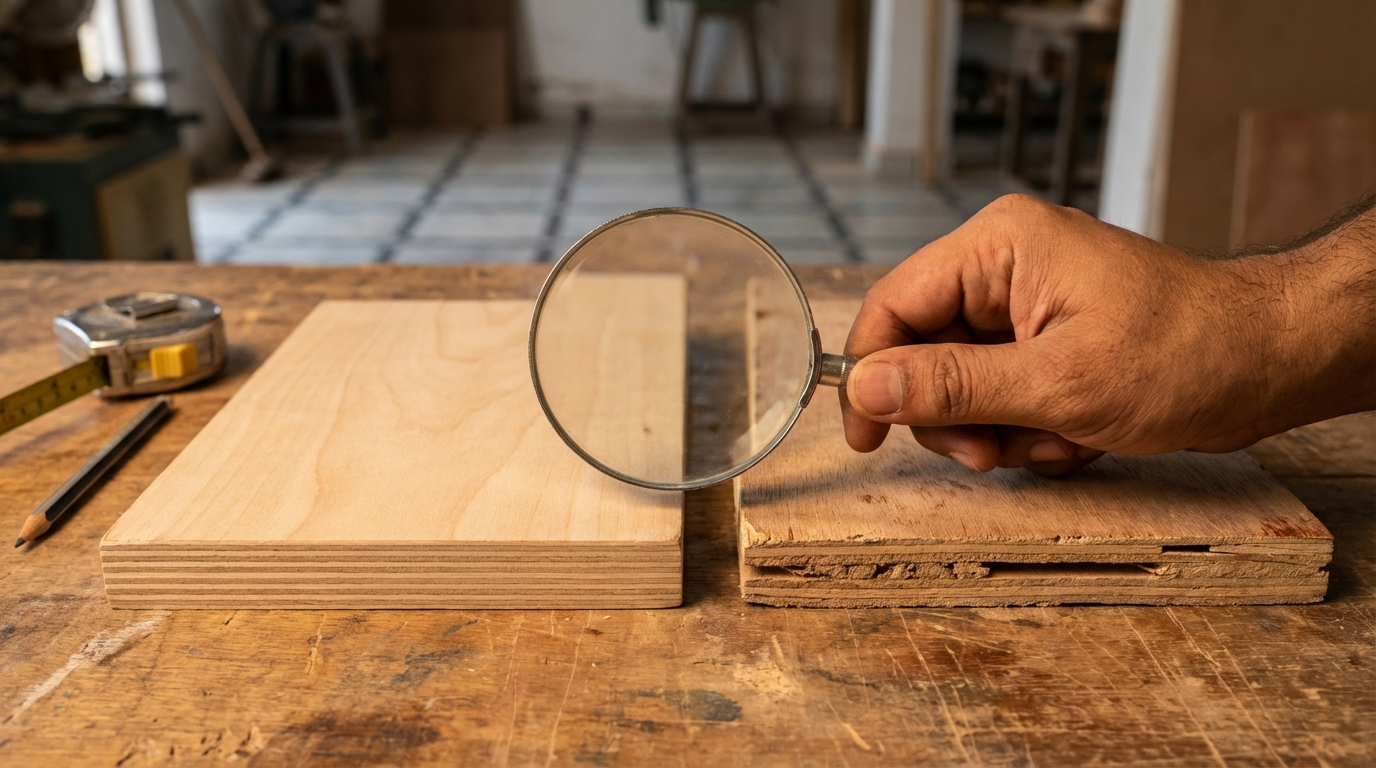
- Edge inspection: Look at the edge cross-section—you should see distinct layers pressed tightly together, no air gaps or delamination
- Weight check: Within the same thickness category, heavier sheets generally indicate denser, better quality material
Warning signs—6 red flags:
- Dealer refuses to provide samples
- No clear branding on the product
- Price is significantly below market average for claimed brand
- Sheets in the stack have inconsistent colours
- Strong chemical odour that's unusual
- Dealer is vague about specifications or warranty
Here's a trick most dealers don't like—ask to see the purchase invoice from their supplier. Genuine branded stock will have proper documentation. If they hesitate or make excuses, walk away.
Workmanship & Installation: What Actually Matters
The best laminate poorly installed is worse than a mediocre laminate installed correctly. I've seen this proven again and again.
Cutting requirements: Laminates should be cut with a fine-toothed blade on the decorative side facing up to prevent chipping. Your carpenter should know this, but many use whatever blade is handy. Result? Chipped edges that can't be hidden even with edge banding.
Edge sealing matters more than you think: Edge banding is applied as a strip around the edge of a surface. It is available in many colors and finishes and is durable. Options include matching laminate strips, PVC edge bands, or ABS edge bands. For kitchens and bathrooms, PVC or ABS is better because they're more moisture-resistant than paper-backed laminate strips.
Adhesive choice: Use contact adhesives specifically designed for laminates. SR (synthetic rubber) adhesive works for most applications. For high-moisture areas, use waterproof or water-resistant grades. Never let the carpenter use regular fevicol—it doesn't bond laminates properly.
What to tell your carpenter—a 6-point briefing:
- Specify exact thickness required for each area (don't leave it to their discretion)
- Insist on edge banding for all visible edges, especially in kitchen and bathroom
- Ask them to use laminate-specific adhesive, not general purpose
- Request that they check each sheet for warping before cutting
- Remind them to cut with decorative side facing up
- Ask them to leave a small expansion gap at edges—laminates can expand/contract slightly
Storage and acclimatization: Laminates should ideally be stored at the installation site for 48-72 hours before application. This allows them to adjust to the local humidity and temperature. Keep them flat, not standing on edge.
There was this project in Andheri last year where the carpenter cut and applied laminates the same day they arrived at site—in peak monsoon. Within a month, bubbling and edge lifting everywhere. Had to redo significant portions. The cost of haste was about ₹60,000 in rework. Don't make that mistake.
How Long Does Sunmica Really Last?
Honest answer? It depends on quality, application, and maintenance. Warranty from some manufacturers goes up to 10 years. But that warranty has conditions.
In my experience, well-maintained HPL laminate on kitchen cabinets lasts about 8-12 years before you'll want to replace it—not because it failed, but because designs change and you want a fresh look. Standard laminate on bedroom wardrobes? 10-15 years easily if you're not too rough with it.
What affects longevity:
- Quality of substrate underneath: Plywood deterioration takes the laminate down with it
- Moisture exposure: More exposure = shorter life, especially if edges aren't sealed
- Heat exposure: Placing hot pans directly on laminate countertops damages them over time
- Maintenance habits: Harsh chemicals, abrasive scrubbers, and neglected spills all reduce lifespan
- Quality of initial installation: Poor bonding leads to peeling and bubbling
Signs of wear to watch for:
- Edge lifting or peeling—usually starts at corners
- Bubbling on the surface—indicates moisture damage underneath
- Fading or discolouration, especially near windows
- Scratches that expose the brown kraft paper layer
- Delamination—layers separating
When to consider replacement: When damage affects functionality (water seeping in) or appearance becomes unacceptable. Small chips at edges can often be repaired with matching edge bands. But widespread bubbling or delamination usually means the substrate has issues too, and you might need more than just a laminate change.
Top Laminate Brands Worth Considering
GreenLam Laminates from GreenPly Industries Ltd. has a strong presence in the decorative laminates market in India as well. Other notable brands include Merino Laminates, Century, Sundek, Asis and Durian.
Greenlam Industries is among the world's top three largest laminate manufacturers and suppliers in India, offering a large range of surface décor items that includes decorative/digital laminate sheets, compact boards, wall cladding solutions.
Royale Touche was founded in 1978 and since then are known for their innovative products. They provide more than 1,000+ options of laminates to suit every preference and interior décor theme. Right from high-gloss laminates to matte and textured finishes, they bring aesthetics together with functionality. Their laminates consist of high-tech features like antibacterial surfaces and fire resistance.
Merino is a globally respected brand that offers a vast and sophisticated portfolio of surface solutions. As a top contender for the best mica brand in India, Merino is a go-to choice for homeowners seeking premium quality, exquisite designs, and innovative features.
One of the three divisions of Century Plyboards (India) Ltd, Century Laminates is famous for its decorative laminates. Century laminates come with excellent strength and resilience. They are good for areas with heavy usage.
My honest take: For premium applications where budget isn't the primary constraint, Greenlam and Merino are hard to beat. Century offers good value at mid-range pricing. Royale Touche has excellent design variety. For budget-conscious projects, there are good regional brands—just verify quality carefully before committing.
Alternatives Worth Considering
Veneer: Real wood veneer gives an authentic wood look that laminate can't fully match. Costs more, needs more maintenance, but the aesthetic is genuinely different. If budget allows and you want a warm, natural wood feel—especially for living room furniture—veneer is worth considering. Our wood veneer guide covers this in detail.
Acrylic finish: For those who prefer glossy, mirror-like finish, acrylic is a great choice. It's stunning in modern kitchens and wardrobes. But it scratches easier than laminate, and scratches are very visible on that glossy surface. Best for display areas or adult-only homes where surfaces get gentle treatment.
Pre-laminated boards: These are particle boards or MDF that come factory-laminated. Cheaper than getting plywood + separate laminate applied. Works fine for simple wardrobes and low-stress furniture. But you can't customise designs, and quality varies. The HDHMR guide we've put together covers engineered boards in more detail.
If budget is tight, consider using premium laminate only on visible surfaces (cabinet fronts, countertop) and economy laminate for interiors and backs. Smart allocation often works better than uniform mediocrity throughout.
FAQs About Sunmica Sheets
Is it true that sunmica and laminate are completely different materials?
No, this is a common misconception. Sunmica is one of the popular brands of laminates, while laminates is a broader term for the multilayer composite material bonded together. Think of it like Xerox and photocopies—Sunmica was such a dominant brand in India that its name became synonymous with all decorative laminates. When your dealer or carpenter says "sunmica," they usually mean any decorative laminate, regardless of actual brand.
What if I live in a coastal city like Chennai or Mumbai—do I need special laminates?
You don't necessarily need "special" laminates, but you do need to make smarter choices. Go with HPL rather than LPL for any moisture-prone area. Stick to 1mm minimum thickness. Absolutely insist on proper edge sealing—this is where most failures in humid cities happen. Consider laminates with specific moisture-resistant properties. And don't skip the substrate quality—use BWP grade plywood in coastal areas, especially for kitchen cabinets near sinks.
Is HPL actually worth the extra cost over regular sunmica?
The durability of laminates can vary depending on the quality of the materials used. High-pressure laminates (HPL) tend to be more durable and suitable for high-traffic areas, while low-pressure laminates (LPL) may be less durable. For kitchens, countertops, and any heavy-use furniture—yes, HPL is absolutely worth the extra cost. The additional ₹30-60 per sq ft pays for itself within 3-4 years through better wear resistance. For bedroom wardrobes and low-traffic furniture, standard laminate is often sufficient.
How do I match laminate with the rest of my interior design?
Start with the dominant colours and materials in your space. Wood-grain laminates pair well with neutral walls. Solid colour laminates can either complement or contrast with flooring and walls. If you have laminated your cabinets in a striking color, use a lighter tone for the countertop and dado area. Because laminated kitchen surfaces are more likely to get filthy and are used frequently, choose a darker solid color for your base units. Always get physical samples and view them in your actual space lighting before deciding.
Is it true that glossy laminates are harder to maintain?
Yes, this is accurate. Darker laminates or those with a different texture will require a little more care to keep their beauty. High-gloss surfaces show every fingerprint, water spot, and minor scratch. They need regular wiping to look presentable. Matte and textured finishes are much more forgiving for everyday use. I generally recommend glossy only for accent pieces or surfaces that don't get heavy daily use.
Can I apply new laminate over old laminate without removing it?
Technically possible, but I don't recommend it for most cases. The surface needs to be roughened for proper adhesive bonding, and you're adding thickness that might affect door alignment and hardware. The better approach is to remove old laminate, prepare the substrate properly, then apply new laminate. It's more work but gives better, longer-lasting results.
How do anti-bacterial laminates work, and are they worth it?
Antibacterial laminates are manufactured using antimicrobial agents that are commonly used in many cosmetics. Some ranges are completely US-EPA approved, which makes them ideal for laboratories, chemistry labs, hospitals, and other spaces prone to microbial growth. For typical home use, they're nice to have but not essential. If someone in your family has compromised immunity, or if you're designing for healthcare settings, then they're worth the premium.
What's the difference between compact laminate and regular HPL?
The primary distinction between standard laminate sheets and compact laminate sheets is their thickness. Regular laminates have a maximum thickness of 1.5mm, making them significantly thinner. Conversely, compact laminates have a maximum thickness of 30mm. Since regular laminate sheets are thin, they are usually attached to a substrate material foundation. Compact laminates are robust enough to support themselves—it is not necessary to adhere them to wood or other surfaces. Compact laminates are used for toilet partitions, outdoor furniture, and heavy commercial applications. Overkill for most residential use.
Is it true that laminates emit harmful chemicals?
Low-quality laminates with poor manufacturing can off-gas formaldehyde, which is a health concern. Reputed manufacturers hold sustainability certifications including FSC®, PEFC™, ISO 14001, and products are certified with CE, UL, NSF, Greenguard and other standards. Stick to brands with proper certifications and you'll be fine. If a laminate has a strong chemical smell that persists after installation, that's a red flag—it shouldn't.
Do I need different laminates for vertical surfaces vs horizontal surfaces?
Thinner laminates, like 0.6-0.8mm, are lightweight and flexible, suitable for vertical applications like wall coverings or wardrobe panels. For high-impact areas like workstations and kitchen countertops, thicker laminates (1.0–1.25mm) are preferable because they provide superior impact resistance. Horizontal surfaces face more wear—things are placed on them, dragged across them, hot items rest on them. Vertical cabinet doors can get away with thinner laminates. Countertops need the thicker, more durable stuff.
How should I clean and maintain laminate surfaces?
Dust off dirt regularly. Wipe off spills immediately. Keep your laminates away from harsh chemicals. Use mild soaps to clean the laminates. Avoid placing hot stuff directly on top of the laminates; use coasters instead. Never use abrasive scrubbers—they scratch the surface. A soft cloth with mild detergent is usually all you need.
Can laminates be repaired if damaged?
Minor scratches on matte finishes can sometimes be hidden with coloured wax sticks made for laminates. Small chips at edges can be covered with matching edge bands. But deep scratches that expose the brown kraft paper layer, or bubbling from moisture damage—these typically require panel replacement. Prevention (proper installation, edge sealing, reasonable care) is much cheaper than cure.
Finding the Right Balance
Between you and me, most homeowners overthink design and underthink quality. They spend hours choosing between walnut-brown-dark and walnut-brown-medium but don't bother checking if the laminate is HPL or LPL. Don't be that person.
Focus on getting the thickness and type right for each application. Match your expectations to your budget realistically—you can't get Greenlam quality at local-brand pricing. And please, for the love of everything, don't skip the edge banding in kitchens and bathrooms.
That's the gist of it. If you're still confused about anything specific, our kitchen cabinet material comparison and wardrobe plywood guides go deeper into substrate selection—worth checking if you're planning a full project. Good luck with your work. And remember what I always say: the laminate is only as good as what's underneath it and how well it's applied.
Note: sainik710.com is an independent informational site and is not affiliated with any manufacturer.
Disclaimer: This content is provided for general informational purposes based on industry practices and publicly available information. Product specifications, standards, prices, and availability may vary by manufacturer, region, and time. Readers should independently verify details with manufacturers, dealers, or qualified professionals before making purchase or construction decisions.Want Plywood Suggestions?
Share a few details and a Sainik 710 specialist will suggest suitable brands and connect you to responsive dealers.