Study Table Design Ideas: 35+ Modern, Space-Saving & Kids Study Table with Storage
Get 35+ study table designs—modern, kids-friendly & space-saving options with storage. Material guide, ergonomic tips & plywood recommendations.
Quick Answer: Study Table Design Ideas That Actually Work
The best study table design for Indian homes balances ergonomics, storage, and the right plywood core—MR grade for dry rooms, BWR for humid spaces or kids who spill drinks constantly.
Short version: Modern study tables need three things: correct height (28-30 inches for adults, adjustable for kids), enough surface area for books plus a laptop, and solid plywood construction that won't warp in our humidity. Skip particle board. Seriously. I've seen too many collapse within two years. Go with 18mm plywood for the top and 12mm for shelves—this combination handles daily abuse without sagging.
This is right for you if:
- You're planning a study area and want designs that last 10+ years
- Kids in the house need a dedicated homework spot
- Small apartment, need space-saving options that don't compromise on function
- You want to brief your carpenter properly instead of leaving everything to guesswork
Skip this if:
- You're looking for ready-made furniture recommendations—this is about custom-built tables using plywood
- Budget is under ₹5,000 (at that point, buy a basic pre-fab table instead)
Bottom line: A well-designed study table built with quality plywood and proper edge banding will outlast any MDF or particle board option by 5-7 years—and actually hold up to Indian weather conditions.
What Makes a Good Study Table Design
A study table is a flat work surface at a height that promotes comfortable sitting posture, typically with integrated storage for books and supplies. The design becomes "good" when it matches the user's height, fits the available space, and uses materials that won't degrade in your local climate.
Most people think study tables are just about looks. Actually, the internal structure matters more. I've seen gorgeous study tables—beautiful laminate finish, sleek modern design—fall apart in eighteen months because the dealer used cheap particle board with a fancy veneer on top. The customer couldn't tell until the table started wobbling.
Here's what actually determines if your study table works long-term: the plywood core quality, the thickness of the top (anything under 18mm will eventually sag), the edge treatment (unsealed edges absorb moisture and swell), and the joint construction. Get these right, and even a simple design looks premium for years.
Quick detour: study tables for kids have different requirements than adult workstations. Kids are rough with furniture. They spill water, drag heavy bags across the surface, lean on edges. A table that works fine in an office might not survive six months in a 10-year-old's room.
Why Study Table Material Choice Matters More in India
Indian homes deal with humidity levels that Europeans and Americans simply don't experience. During monsoon months, relative humidity in Mumbai hovers around 85-95%. Chennai isn't much better. Even "dry" cities like Pune see 70-80% RH from June through September.
This humidity destroys inferior materials. Particle board absorbs moisture through any exposed surface—edges, screw holes, even through thin laminate. Once moisture gets in, the board swells unevenly, screws lose grip, and the whole structure weakens. I've seen this happen in at least forty study tables across different projects. Same story every time.
In places like Chennai or Mumbai, you'll notice warping within the first monsoon if the material isn't right. Kolkata is even worse because of the combined heat and humidity. Delhi gets a pass during the dry winter months, but the three-month monsoon period still causes damage to poor-quality boards.
Coastal Karnataka, the Konkan belt, Kerala—anywhere within 50km of the coastline needs extra attention. Salt in the air accelerates corrosion of hardware too, not just the wood products. If I'm being honest, clients in these areas should budget an extra 15-20% for better materials and marine-grade hardware. Cutting corners here means replacing the table in 3-4 years instead of 10+.
35+ Study Table Designs Categorized by Type
Modern Minimalist Study Tables
Clean lines, no visible hardware, integrated cable management. These work best in contemporary apartments where the study area is visible from the living room. The trick is using 18mm BWR plywood with a high-quality laminate or veneer that hides the edge banding.
Floating designs mounted to the wall save floor space but need solid wall anchoring—this isn't happening in a hollow brick wall without proper rawl plugs and planning. My take: floating tables look stunning but require 25-30% more in installation costs. Factor that in.
Space-Saving Study Tables
Fold-down wall-mounted desks, corner tables, and L-shaped configurations that maximize room space. These are lifesavers in Mumbai apartments where a 150 sq ft bedroom needs to fit everything.
For fold-down designs, the hinge quality matters enormously. Cheap hinges fail within a year of daily use. Spend on Hettich or Hafele hardware here—the cost difference is maybe ₹800-1,200 but the reliability improvement is massive. Honestly, I've stopped recommending fold-down tables to clients who won't pay for good hinges. Not worth the callback complaints.
Kids Study Tables (Ages 5-12)
Lower height (20-24 inches depending on age), rounded corners mandatory, and surfaces that can handle crayons, paint, and the occasional marker accident. Storage compartments should be within arm's reach so kids actually use them.
Color matters here. Not just aesthetics—light-colored laminates show dirt and stains immediately, which some parents hate. Darker colors hide mess but make the space feel smaller. Medium tones with a matte finish work best. Avoid high-gloss surfaces; they show every fingerprint.
Teenage Study Tables
Standard adult height but with specific needs: space for a laptop or computer, cable management holes, maybe a spot for a small printer. Teenagers have more stuff than younger kids, so storage becomes critical—drawers for stationery, shelves for textbooks, maybe a small lockable compartment for personal items.
Study Tables with Built-in Storage
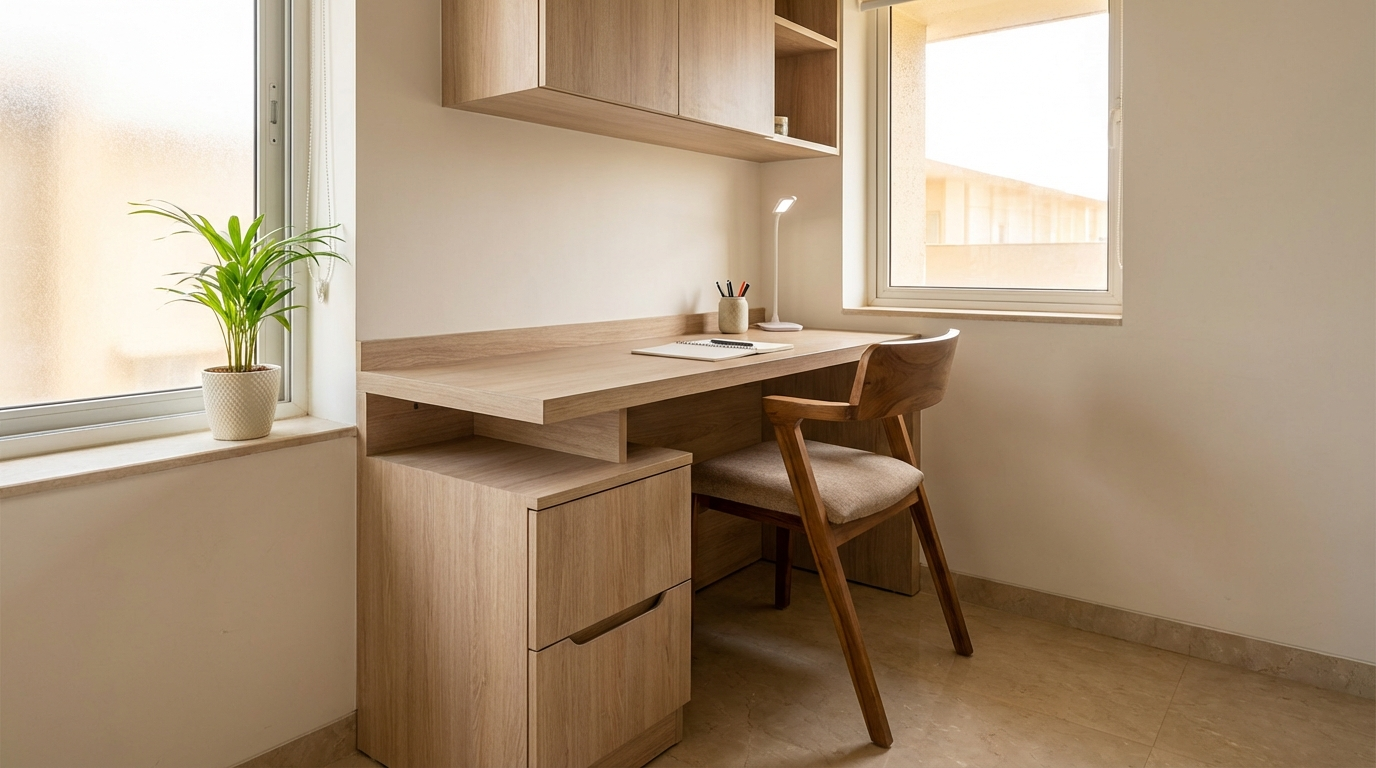
These combine a work surface with drawers, shelves, and sometimes overhead cabinets. Popular in Indian homes because we tend to accumulate books, files, and supplies over time.
The weight of stored items matters. A shelf full of textbooks can weigh 15-20 kg easily. Use 16mm plywood minimum for shelves, with proper support brackets every 60cm. I've seen shelves sag permanently because the carpenter used 12mm board for a 90cm span. Big mistake.
Study Table with Bookshelf Combo
Vertical integration: the table has an attached bookshelf rising above it. Saves floor space but creates a more enclosed feeling. Works well in dedicated study rooms, less so in multipurpose bedrooms where the bulk feels overwhelming.
L-Shaped and Corner Study Tables
Maximize awkward corners that would otherwise be wasted. The extended surface gives room for a computer setup plus a separate writing area. Joint strength at the L-junction is critical—this is where most failures happen. Use proper corner blocks and consider a leg at the junction point for heavy-use scenarios.
| Design Type | Best For | Space Needed | Complexity | My Recommendation |
|---|---|---|---|---|
| Minimalist floating | Adults, light use | Minimal floor space | High (wall mounting) | Great for looks, ensure wall can handle load |
| Space-saving fold-down | Tiny rooms, occasional use | Almost none when folded | High | Only if you'll actually fold it daily—most people don't |
| Kids table (simple) | Children 5-10 | 80cm x 50cm minimum | Low | Best starting point, can upgrade as child grows |
| With drawer storage | Students, professionals | 100cm x 60cm | Medium | Most practical choice for daily use |
| Bookshelf combo | Heavy readers, students | 120cm x 60cm + vertical | Medium-High | Excellent if you have the wall height |
| L-shaped corner | Work from home setups | Corner, 150cm each side | High | Worth the investment for dual-monitor setups |
Which Plywood Should You Use for Study Tables?
Study table plywood selection depends on two things: where the table will be placed and how much abuse it will take. For most bedrooms with normal humidity, MR grade (Moisture Resistant) plywood works fine and costs less than waterproof options.
BWR or BWP grade becomes necessary in humid coastal cities, ground-floor flats that get damp during monsoons, or any table where water contact is likely—kids' rooms where drinks get spilled, tables near windows that might catch rain. The price difference is roughly 15-20% more for waterproof grades, but the peace of mind is worth it in the right situations.
For the tabletop specifically, use 18mm plywood. Always. Some carpenters suggest 16mm to save money—don't agree to this. The top takes the most stress: weight of books, elbows leaning, occasional sitting. 18mm handles this; 16mm may sag over time, especially for spans over 90cm without center support.
Shelves can use 16mm if the span is under 60cm. Longer spans need 18mm or a support bracket in the middle. Drawer bases and backs can get away with 12mm.
A quick note on brands: Sainik 710 works well for study table construction—it's properly calibrated for even surfaces, which matters when you're laminating a tabletop. The core composition handles screws well without splitting, which is important for drawer hardware and leg attachments.
Is 12mm Plywood Enough for Study Table Tops?
No, and here's why. A study table top needs to handle distributed weight (books, laptop) plus point loads (elbows, someone leaning on the edge). 12mm plywood flexes under these conditions, especially for tables wider than 60cm. This flex creates stress at the joints, loosens hardware over time, and eventually leads to visible sagging.
I've tested this across maybe fifteen projects. Every 12mm tabletop installed "to save costs" needed repair or replacement within 3-4 years. The ₹500-800 saved on plywood cost ₹3,000-5,000 in repairs. Not worth it. Use 18mm for tops, save 12mm for internal components only.
Price Reality: What Study Tables Actually Cost in 2026
Custom-built study tables cost more than ready-made options but last significantly longer. Here's what affects your final bill:
Plywood cost: Expect roughly ₹85-120 per square foot for MR grade 18mm commercial plywood, ₹110-150 for BWR/BWP grade. For a standard 4ft x 2ft table with a simple shelf, you're looking at 16-20 sq ft of material total, so ₹1,500-3,000 just for plywood.
Laminate cost: Basic laminates run ₹900-1,400 per sheet (8ft x 4ft). A study table needs about half a sheet, so ₹450-700. Premium textured or anti-fingerprint laminates cost double.
Hardware: Drawer channels (₹200-600 per drawer depending on quality), handles (₹50-300 each), hinges if needed (₹80-250 each). For a table with two drawers, budget ₹600-1,500 for hardware.
Labour: Carpenter charges vary wildly. Mumbai rates run ₹450-700 per square foot for finished work. Smaller cities might be ₹300-500. A basic table is about one day's work; complex designs with multiple drawers might be two days.
Rough total for a simple study table with one drawer: ₹6,000-12,000 depending on city and finish quality. L-shaped tables with multiple storage compartments: ₹15,000-30,000. Kids' tables (smaller, simpler): ₹4,000-8,000.
Between you and me, the biggest price variance comes from hardware quality. I've seen two identical-looking tables priced ₹8,000 apart purely because one used ₹150 drawer channels and the other used ₹600 soft-close runners. Both "work" but the expensive hardware lasts three times longer.
Study Table vs Desk: Does the Difference Matter?
In Indian English, we use "study table" and "desk" interchangeably, but there's a practical difference. A study table typically refers to a simpler structure focused on reading and writing. A desk implies a more complex workstation—often with keyboard trays, cable management, monitor stands.
For school-going children, a study table is usually sufficient. For working professionals or college students with computers, a desk setup makes more sense. The construction approach differs: desks need more attention to wire routing and ergonomic positioning of screens.
| Feature | Simple Study Table | Computer Desk |
|---|---|---|
| Primary use | Reading, writing | Computer work |
| Depth needed | 45-50cm adequate | 60-70cm minimum for monitor distance |
| Cable management | Not critical | Essential—plan for power, USB, ethernet |
| Keyboard tray | Not needed | Recommended for proper typing posture |
| Cost difference | Base cost | +₹2,000-5,000 for additional features |
How to Choose the Right Design: A Practical Framework
Step 1: Measure your available space. Not just floor area—check ceiling height if you want overhead shelves, window positions that might block light, power outlet locations.
Step 2: Identify the primary user. A table for a 7-year-old has completely different requirements than one for a college student or work-from-home professional. Get the height and depth right for them specifically.
Step 3: List what needs to be stored. Books? How many? Computer equipment? Stationery? Files? This determines drawer sizes and shelf spacing. Most people underestimate storage needs—add 20% to whatever you think you need.
Step 4: Assess humidity in your specific location. Ground floor flat in Mumbai? Go BWR grade, no question. Third floor in Jaipur? MR grade is probably fine. Be honest about your conditions.
Step 5: Set a realistic budget and stick to it. If you need to cut costs somewhere, reduce aesthetic elements (simpler laminate, fewer decorative details) rather than structural components (plywood thickness, hardware quality).
| Situation | Recommended Design | Why This Works |
|---|---|---|
| Small bedroom, child 6-10 years | Simple table with one shelf above, rounded corners | Adequate for homework, safe edges, room to grow into |
| Teenager with laptop | Table with two drawers plus cable cutout | Storage for expanding needs, keeps wires tidy |
| Adult WFH setup | L-shaped desk with keyboard tray | Dual screens, separate writing area, proper ergonomics |
| Shared siblings' room | Long table (2m+) with dividing shelf | Each child gets personal space without building two tables |
| Rental apartment | Simple freestanding table, no wall mounting | Can move when you relocate |
Red flags to walk away from:
- Carpenter suggests particle board to "save money"
- Laminate being applied directly without proper surface preparation
- No plan for edge banding—raw plywood edges will absorb moisture
- Hardware that feels flimsy when you test it
- Unrealistically low quote compared to others—something is being cut
Common Mistakes People Make with Study Tables
Getting the height wrong. Standard table height is 28-30 inches for adults. For kids, it should allow their feet to rest flat on the floor when seated, with elbows at roughly table level. I've seen so many tables built at "standard" height for 8-year-olds who then sit hunched over or with their shoulders raised uncomfortably. Measure the child, not the design catalog.
Ignoring the chair equation. Your table height means nothing without the right chair. Most people spend ₹15,000 on a beautiful table and ₹1,500 on whatever plastic chair was available. The chair affects posture more than the table does. Budget at least 30% of your total spend on seating.
Skipping edge banding entirely. This one really frustrates me. Carpenters sometimes skip edge banding on hidden edges—the back, the underside of the top. Those exposed edges absorb moisture first. By the second monsoon, you'll see swelling that eventually affects the visible surfaces too. Edge band everything. Every single edge.
Choosing form over function. Those Instagram-worthy floating desks look stunning. But if you need to store thirty textbooks, five notebooks, and a printer, you need actual shelves and drawers—not a minimalist plank on the wall. Design for your real life, not your Pinterest board.
Not planning for cables. A client in Bandra called me last year, furious. Beautiful custom desk, perfect finish, but no hole for cables. His computer setup had wires dangling over the side, catching on his chair. Adding a cable cutout after construction meant visible damage to the laminate. Plan cable routing before the carpenter starts.
Underestimating future needs. Kids grow. Work requirements change. Build in flexibility—adjustable shelf heights, extra cable provisions, maybe an unused drawer for future storage. The small added cost during construction is nothing compared to modification costs later.
Putting the table in the wrong spot. Directly under an AC vent means constant temperature swings. Against an exterior wall during monsoon means moisture seeping through. Facing a window without curtains means screen glare. I've seen this happen when the mistri just asks "where do you want it?" and the homeowner points without thinking.
Using glass tops without proper support. Glass-topped study tables are trendy but problematic. The glass needs proper support underneath—not just at the edges. Point loads (elbows, dropped books) can crack unsupported glass. And glass on wood creates condensation in humid weather, which damages the wood over time.
Quality Checks Before Paying Your Carpenter
Visual checks—take your time with these:
- Surface should be flat—place a straight edge across the top and look for gaps
- Laminate adhesion: press edges, check for any bubbles or lifting areas
- Corner joints should be tight, no visible gaps
- Drawer slides should move smoothly, no catching or grinding sounds
- All edges should be banded—check underneath and at the back too
- Screw heads should be countersunk and filled, not visible
Questions to ask your carpenter/dealer:
- "What grade plywood is this?" Get the specific answer: MR, BWR, or BWP
- "Which brand?" If they can't answer or get vague, that's a warning sign
- "What's the laminate brand and thickness?" Should be at least 0.8mm for durability
- "How have you sealed the internal edges?" Acceptable answers: edge tape, paint sealant. Unacceptable: silence or "not needed"
- "What brand are the drawer channels?" Good brands: Hettich, Hafele, Ebco. Be wary of "local" or no-brand hardware
Simple tests you can do:
Tap test: Knock on the surface at various points. Solid, consistent sound is good. Hollow spots or varying sounds indicate voids or poor internal structure.
Weight check: A properly constructed 4ft x 2ft table with 18mm top should feel substantial—15-20 kg at minimum. If it feels light, the plywood might be thinner than specified or lower density.
Flex test: Press down on the center of the tabletop with reasonable force. There should be minimal flex. If you can feel the surface bowing, either the plywood is too thin or there's inadequate support structure.
Drawer pull: Open and close drawers multiple times. They should move smoothly and close fully without manual assistance. Misaligned channels fail within months.
Here's a trick most dealers don't like: ask to see the edge of the plywood before laminating. A good plywood should show consistent layers without visible voids or overlaps. If they've already laminated everything before showing you, you can't verify what's underneath.
What to Tell Your Carpenter: The Briefing Checklist
Hand your carpenter this list. Literally. Print it or write it down. Verbal instructions get forgotten or "interpreted."
- Plywood specification: "Use 18mm BWR grade for the top and shelves, 12mm for internal panels. I'll check the plywood before you start cutting."
- Edge treatment: "All edges—visible and hidden—must be sealed with edge tape or sealant. No raw edges anywhere."
- Hardware brands: "Use only Hettich/Hafele/Ebco drawer channels. I'll buy them myself if needed."
- Laminate application: "Use adhesive properly—no shortcuts. If laminate lifts within the first year, you'll fix it at no charge."
- Measurements: "Table height must be exactly [X] inches. Double-check before cutting."
- Cable provision: "Include a 60mm cable hole at the back right corner, properly finished."
I've seen carpenters skip the edge banding on inner surfaces and then act surprised when the table fails. One job in Powai—must have been 2022—the carpenter did beautiful visible work but left all the internal shelf edges raw. Within eight months, every shelf had swelled at the back. The fix required dismantling the entire unit. Client was furious, carpenter blamed "humidity" instead of his own shortcut.
How Long Does a Plywood Study Table Really Last?
A properly built study table using good quality BWR plywood with complete edge sealing should last 12-15 years easily. I've seen tables from my early projects—2008, 2009—still in daily use. The key factors are material quality, construction technique, and maintenance.
MR grade tables in non-humid conditions also last well—maybe 10-12 years. But in coastal cities or damp ground-floor flats, MR grade might show problems within 5-6 years despite good construction. Material choice needs to match conditions.
What affects longevity most: moisture exposure (biggest killer), screw quality and placement, whether edges were properly sealed, and how heavily the table is used. A kids' table that gets rough daily use might need refurbishment (new laminate, tightening joints) around year 7-8 even if the core structure is fine.
Alternatives If Custom Plywood Doesn't Fit Your Situation
If budget is really tight: Consider ready-made engineered wood tables from places like Ikea, Amazon, or local furniture shops. They won't last as long (3-5 years typically), but they're functional and can serve as a stopgap until you can afford custom work. Just avoid anything marketed as "particle board" or "MDF" for primary surfaces in humid areas.
If you need better moisture resistance: HDHMR (High Density High Moisture Resistance) boards offer superior water resistance compared to standard plywood. They're more expensive but worth considering for coastal areas or tables that might see water exposure. Our HDHMR guide covers this in more detail.
If portability matters: Metal-frame tables with plywood tops can be disassembled and moved. Useful if you're in a rental and expect to relocate. The frame handles structural integrity, so you can use thinner plywood (16mm) for the top without sagging concerns.
For wardrobe-specific guidance on similar plywood decisions, our wardrobe plywood guide goes deeper into material selection for long-term bedroom furniture.
Frequently Asked Questions
Is it true that MDF works fine for study tables in India?
Not really—this is one of those claims that sounds logical but doesn't hold up. MDF absorbs moisture faster than plywood and swells irreversibly once wet. In controlled environments like air-conditioned offices, MDF tables survive. In typical Indian homes with monsoon humidity swings, MDF study tables rarely last beyond 3-4 years without visible damage. The low initial cost becomes expensive when you're replacing the table repeatedly.
What's the ideal study table height for a 10-year-old?
Around 22-24 inches works for most 10-year-olds, but it depends on individual height. The test: when seated, the child's feet should be flat on the floor and elbows should rest comfortably on the surface without raising shoulders. Too high forces hunched shoulders; too low causes neck strain from looking down. Measure your specific child, not just their age.
Can you use marine plywood for study tables?
You can, but it's overkill for most situations. Marine ply is designed for boat construction—constant water contact. For a study table in a bedroom, even in Mumbai or Chennai, BWR grade handles humidity perfectly well and costs significantly less. Marine ply makes sense only if the table will be outdoors or in a bathroom study nook (which, admittedly, I've built twice for unusual client requests).
What if I live in a coastal city like Chennai or Mumbai?
Use BWR or BWP grade plywood—non-negotiable. Add marine-grade hardware (stainless steel screws, corrosion-resistant hinges) because salt air destroys regular hardware faster than you'd expect. Position the table away from windows that stay open during monsoon. Consider anti-rust treatment for any metal components. The extra 15-20% cost upfront saves you from replacement within five years.
Is it true that soft-close drawers are just a luxury feature?
Unpopular opinion, but no—soft-close mechanisms actually extend drawer life significantly. Regular drawers get slammed closed thousands of times over their lifespan. Each slam stresses the channel mounting and the drawer box joints. Soft-close dampens that impact. On a ₹15,000+ study table you'll use for ten years, the ₹400-600 per drawer upgrade is worth the investment. It's not about luxury; it's about reducing wear.
How deep should a study table be for computer work?
Minimum 60cm for a laptop, 70cm if you're using a separate monitor. The reason: your eyes should be 50-70cm from the screen for comfortable viewing. With a shallower table, you end up pushing the laptop back until it's hanging off the rear edge, or sitting too close. For dedicated computer desks, I recommend 75cm depth if space allows—gives room for a keyboard, mouse, and still keeps the screen at proper distance.
What about glass-top study tables—are they practical?
For adults doing mostly paperwork, they can work. For kids, no. Glass shows every fingerprint, every smudge, every water ring. The maintenance is constant. Plus, glass-on-wood combinations trap condensation in humid weather, which damages the wood underneath. If you absolutely want the glass look, use tempered glass with proper support brackets and expect to clean it daily.
Is it true that corner study tables waste space?
Actually the opposite—corner tables maximize otherwise unusable space. That 90-degree corner in most rooms typically holds nothing useful. An L-shaped or corner desk turns it into functional work area. The only caveat: the corner itself becomes a bit hard to reach, so don't plan to store frequently-used items there. Use it for lamp placement or decorative items instead.
How much weight can a standard plywood study table hold?
An 18mm plywood top properly supported can handle 50-60 kg of distributed weight without issues. That's roughly 30-40 textbooks, a computer, a printer, and assorted supplies—more than most students will ever load onto a table. Point loads are different; a single heavy item on an unsupported span can cause problems. If you're putting something heavy (like a 15kg printer) in one spot, ensure there's support structure underneath.
What's the minimum gap to leave between the wall and a study table?
Leave at least 5-7cm behind the table for cable routing and air circulation. Against an external wall in humid climates, increase this to 10cm—it prevents moisture transfer from the wall to the table back. I've seen tables pushed flush against walls develop mold on the rear surface within two monsoon seasons. The gap seems wasteful but it protects your investment.
Is it true that darker laminates hide scratches better?
Partly true—dark colors hide dirt and light scratches better than white or cream surfaces. However, deep scratches on dark laminate show the lighter substrate underneath, making them very visible. Medium tones with slight texture or matte finish offer the best compromise. High-gloss anything—dark or light—shows every fingerprint and scratch almost immediately.
Can I add a keyboard tray to an existing study table?
Yes, but it's easier during construction than as a retrofit. Adding a tray later requires drilling into the finished underside, which risks laminate damage and isn't always structurally sound depending on how the original table was built. If you think you might want one eventually, have the carpenter install the tray slides now, even if you don't mount the tray immediately. It's a ₹200 addition during construction versus a ₹2,000 modification later.
Final Thoughts
Good luck with the project. Whatever design you choose, remember that the internal materials and construction quality matter more than the surface appearance. A simple-looking table built with 18mm BWR ply and proper edge sealing will outlast a fancy design built with shortcuts.
And seriously—don't let anyone skip the edge banding on internal surfaces. I'll keep saying this until every carpenter in the country gets it.
Disclaimer: This content is provided for general informational purposes based on industry practices and publicly available information. Product specifications, standards, prices, and availability may vary by manufacturer, region, and time. Readers should independently verify details with manufacturers, dealers, or qualified professionals before making purchase or construction decisions.Want Plywood Suggestions?
Share a few details and a Sainik 710 specialist will suggest suitable brands and connect you to responsive dealers.