Study Room Design Ideas: 30+ Modern Home Study & Library Designs for Productivity
Explore 30+ study room designs—modern home study, library & reading room interiors. Get furniture tips, lighting guide & productivity-boosting layouts.
What Makes a Study Room Actually Work for You
A productive study room design is one that reduces distractions, provides proper lighting, uses ergonomic furniture, and creates a dedicated space where your brain shifts into focus mode. That's it. No fancy jargon needed.
Short version: The best study room designs balance three things—good light (natural plus task lighting), a proper desk-chair setup that doesn't wreck your back, and smart storage that keeps clutter away from your work surface. In Indian homes, this often means carving out a corner of a bedroom or creating a nook near a window. A well-designed study room should give you privacy to work without interruptions, organised furniture, and decorated in a way that improves productivity.
This is right for you if:
- You're setting up a dedicated workspace for WFH or kids' studies
- You've been working from the dining table and your neck is screaming at you—time to fix that properly
- You want a home library corner that's actually usable, not just decorative
- Your current study setup is basically a laptop on a bed (we've all been there)
Skip this if:
- You only need occasional workspace—a fold-out desk might be enough
Bottom line: Even 40-50 square feet, done right, can give you a study room that beats most cluttered "office spaces" I've seen in 3BHKs across Mumbai.
What a Proper Study Room Actually Means
A study room is a dedicated space designed for focused mental work—reading, writing, working on a computer, or studying for exams. It differs from a general living area because everything in it should support concentration and reduce distractions.
Most people think a study room is just a desk and chair in a corner. Actually, the room's orientation (window placement), lighting layers, acoustic control, and even wall colors play significant roles in how well you can focus. Most Indian kids study in cluttered and messy rooms which throws aesthetics out the window, and this clutter not just demoralises but also makes them unable to focus properly.
Here's what separates a study room from just "a desk somewhere":
- Dedicated purpose—you sit there to work, not scroll through Instagram
- Proper furniture proportions—desk height matches chair height matches your body
- Storage within arm's reach for materials you need frequently
- Isolation from household traffic patterns (no one walking through your workspace constantly)
A home library, by the way, is slightly different—a private collection of books and reading materials that home members keep, often customised to family preferences. But most Indian homes blend the two: study-cum-library, which works fine if done thoughtfully.
Why Study Room Design Matters More in Indian Homes
Buyers in 2026 are choosing homes that enhance daily living, emotional well-being, and long-term value. Study rooms are no longer "nice to have"—they're essential.
The Indian context adds specific challenges. In Mumbai or Chennai, humidity during July-September hovers around 75-90% RH. This affects everything—your books, your wooden furniture, even your electronics. In coastal cities, you'll notice MR-grade plywood warping within 2-3 years if the room isn't ventilated properly. In places like Hyderabad or Bengaluru, the dry climate is easier on furniture but dust accumulation becomes the bigger enemy.
Apartment layouts also create constraints. A typical 2BHK rarely has a spare room, so the study becomes a corner of the master bedroom or a converted balcony. "Foldaway study pods, modular partitions, sliding panels" are increasingly commonplace—the idea is to maximise productivity while avoiding visual clutter. This multipurpose approach works, but only if you plan storage and lighting correctly.
In cities like Kolkata or Ahmedabad, power cuts are still common enough that you need to think about natural light positioning. A desk facing a north-facing window is ideal—consistent light without harsh afternoon glare.
How Does Climate Affect Your Study Room Material Choices?
This is one of those things that most online guides skip, but it matters a lot in practice. In humid climates like coastal Maharashtra or Bengal, you absolutely need BWP or marine-grade plywood for any built-in furniture—bookshelves, desks, cabinets. MR-grade will work in Delhi or Jaipur where humidity stays below 60% most of the year.
For bookshelves specifically, moisture resistance is the primary concern with wooden furniture, especially bookcases, as their susceptibility to moisture can damage books over time.
Climate also affects your seating choice. Leather chairs that feel luxurious in air-conditioned Gurgaon offices become sticky nightmares during a Kolkata summer. A mesh study chair can offer better breathability, which is useful in warm climates. If I'm being honest, I'd recommend mesh-back chairs for any Indian city that doesn't have AC running 12 months a year.
Types of Study Room Designs That Actually Work
Right, let's break this down into practical categories. I've seen all of these executed well—and badly—across client projects.
| Design Type | Best For | Space Needed | Typical Cost Range | My Take |
|---|---|---|---|---|
| Dedicated Study Room | Serious WFH, students preparing for competitive exams | 80-120 sq ft minimum | ₹1.5-4 lakh (furniture + interiors) | Ideal if you have the space. Worth the investment. |
| Bedroom Study Corner | Most Indian apartments, kids' rooms | 30-50 sq ft | ₹40,000-1.2 lakh | The practical choice for 2BHKs. Design carefully or it feels cramped. |
| Converted Balcony Study | Natural light lovers, small flats | Whatever your balcony gives you | ₹60,000-1.5 lakh (includes weather protection) | Brilliant when done right, disaster when not weatherproofed properly |
| Living Room Library Wall | Book collectors, families who read together | One full wall | ₹80,000-2.5 lakh | Makes a statement. Can double as TV unit storage. |
| Fold-Out/Murphy Study | Extreme space constraints, occasional use | Almost none when closed | ₹35,000-90,000 | Great for guest rooms. Don't expect to use it daily. |
| Under-Stair Study Nook | Duplex apartments, row houses | Depends on staircase | ₹50,000-1.2 lakh | Underutilised space. Lighting is the challenge. |
Honestly, the "bedroom study corner" is what 70% of Indian families end up with. That's fine. Window seats have gone from Pinterest trend to legitimate architectural feature in modern homes, providing space for relaxed reading while letting in natural light. If you have a bedroom window, building a window seat with storage underneath plus a small desk nearby—that's a solid setup.
Is a Separate Study Room Actually Worth the Cost?
Depends on who's using it and how often. If you're working from home 40+ hours a week or have a kid in Class 10-12, yes—dedicate a proper room if possible. The productivity difference is real. I've seen people struggle for months with a dining table setup, then move to a proper study and finish the same work in half the time.
But if it's occasional use, don't waste a bedroom on it. Better to have a well-designed corner that you can mentally "switch on" when needed. The guiding principle of 2026 is simple: choose what feels good, functions well and reflects your everyday rituals. Trends may come and go, but a home that understands you never goes out of style.
The Furniture Reality: What You Actually Need
Let me be direct. You need three things: a proper desk, a proper chair, and adequate storage. Everything else is optional.
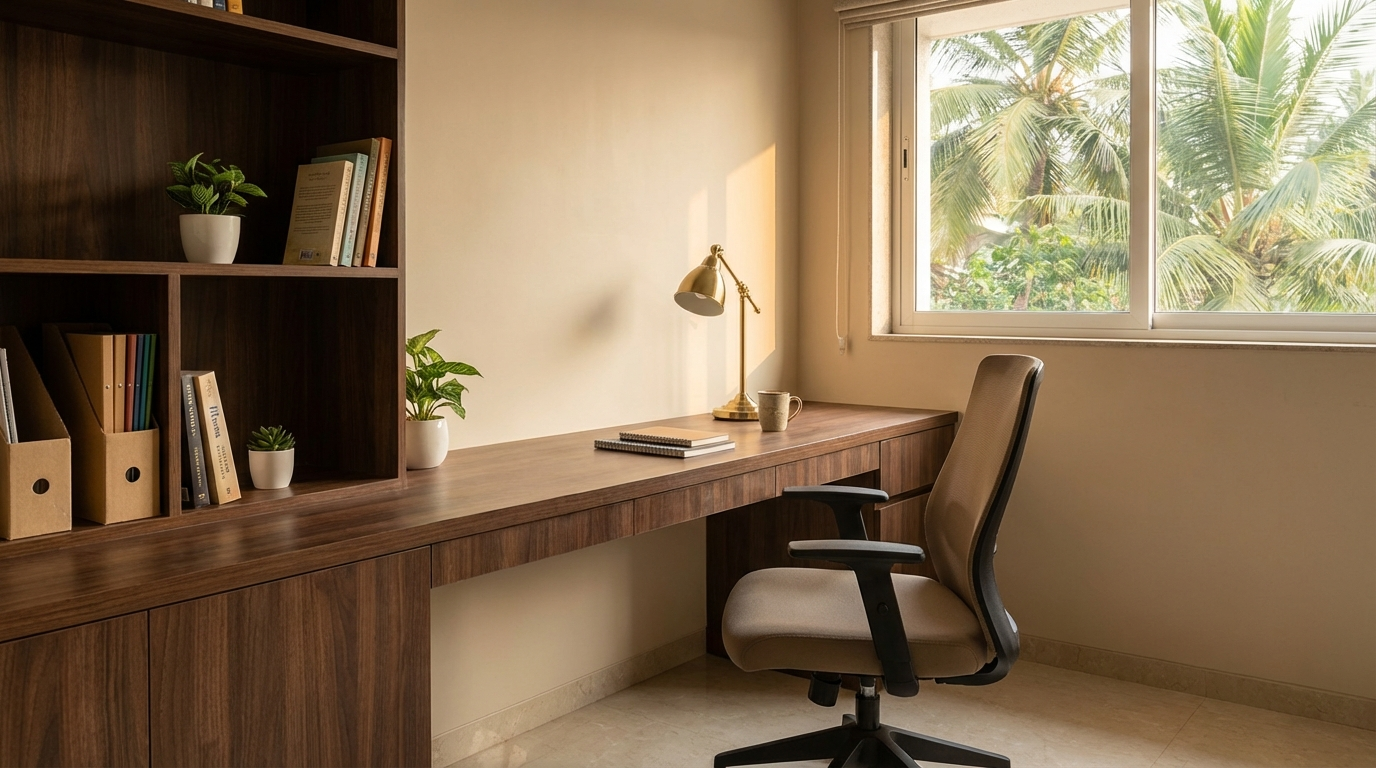
The Desk: Standard desk height is 28-30 inches. For computer work, you want depth of at least 24 inches—laptops are fine with 20 inches, but if you ever add a monitor, you'll need that space. Width depends on your room, but 48 inches gives you room for a laptop plus papers plus a cup of chai.
The Chair: The best office chair should support your body in ideal sitting position—thighs parallel to floor with feet planted, forearms at desk level, spine upright with natural curve and no slouching. Skip the "executive" chairs with thick padding—they feel good initially but collapse over time. A comfortable and ergonomic study chair with adjustable height, lumbar support, and cushioned seat ensures comfort during long hours of study.
The Shelving: This is where material choice matters. For bookshelves, aim for plywood between 3/4 inch (18mm) and 1 inch thick to ensure strength, especially for holding books. Hardwood plywood like oak or birch offers durability and resistance to warping. Typically, 3/4-inch plywood is recommended for most bookcase shelves, as it offers a good balance of strength and rigidity.
And here's something most guides won't tell you: for spans longer than 30-32 inches, you need either a center support or thicker shelving. No question the shelves will bow at longer spans. If the customer wants them that long, then you need to build the shelves thicker by laminating two layers. Don't normally build shelves longer than 36" without stiffeners. I've seen so many bookshelves sag after a couple of years because the carpenter used 12mm ply across a 4-foot span. Books are heavy.
Lighting: The Part Everyone Gets Wrong
This drives me crazy. People spend lakhs on furniture and then put in one tubelight. Lighting in studies and home offices should promote focus and productivity while minimizing eye strain. Arrange diffuse background lighting to prevent harsh glare on screens. Task lighting can be provided using desk lamps, with between 400 and 500 lux for task lighting on desks.
You need three layers:
- Ambient light—the general room lighting, ideally diffused (not direct tubes glaring at you)
- Task light—a desk lamp positioned to illuminate your work surface without creating shadows
- Natural light—position your desk perpendicular to the window, not facing it directly (reduces glare and screen reflections)
The ideal lighting for a study room should be bright, cool-toned (4000-6500K color temperature), and free from glare or harsh shadows. Studies show that cooler light temperatures improve cognitive performance and reduce fatigue.
Numbers to remember: Office work surfaces require illumination of at least 500 lux to enhance productivity by minimizing eye fatigue. For reading corners specifically, approximately 400 lux prevents eye strain during extended reading sessions. Your typical bedroom ceiling light gives maybe 150-200 lux on the desk surface. That's why you need task lighting.
For school libraries and reading rooms, 200 lux fixtures work for book shelves while 500 lux fixtures are optimal for workstations or reading rooms.
How to Choose the Right Setup: A Decision Framework
Step 1: Measure your available space. Be precise—down to inches. Include window positions, door swing clearances, and electrical outlet locations.
Step 2: Identify the primary user(s). A school-age child needs different proportions than an adult. Shared study spaces need more storage and possibly acoustic separation.
Step 3: Determine daily usage hours. Under 2 hours? Basic setup is fine. Over 4 hours? Invest in proper ergonomics.
Step 4: Check your climate zone and plan materials accordingly.
Step 5: Budget realistically—furniture, lighting, electrician, carpenter, finishing. Most people budget 20% less than needed.
| Situation | Recommendation | Why |
|---|---|---|
| Student, Class 8-12, dedicated study | L-shaped desk + ergonomic chair + wall-mounted shelves | Needs space for books AND laptop/tablet. Growing kids need adjustable chairs. |
| WFH professional, 6+ hours daily | Proper desk (28-30" height) + high-quality ergonomic chair + monitor arm | Your spine will thank you. False economy to skimp here. |
| Part-time WFH, space constraint | Wall-mounted fold-down desk + stackable chair | Disappears when not needed. Just ensure good task lighting when working. |
| Book collector, reading focus | Reading chair + floor lamp + full-wall library unit | The desk becomes secondary. Invest in comfortable seating and proper book storage. |
| Shared space, multiple users | Long desk (60"+) with partition + individual task lights + assigned storage | Personal zones within shared space. Cable management is critical. |
Red flags to walk away from:
- Carpenter who says "12mm ply is fine for bookshelves across any span"—it isn't
- Furniture that doesn't let you adjust seat height
- Study setups that put you facing a window (glare nightmare)
- Built-ins with no access to electrical outlets behind them
Common Mistakes I See All the Time
1. Desk too deep for the space. Then the chair can't push back properly and you're constantly bumping into things. Measure first.
2. Relying entirely on ceiling lights. Already covered this. Get a proper desk lamp. LED, adjustable neck, 500-600 lumens. Budget ₹1,500-3,000.
3. Chair that "looks nice." A ₹3,000 "designer" chair with no lumbar support will destroy your back within 6 months of daily use. I've seen it happen dozens of times. An ergonomic office chair is designed to promote better posture and reduce strain on back, neck, and shoulders, with adjustable settings such as lumbar support, armrests, and seat height.
4. Shelves without proper thickness. This one really frustrates me—carpenters default to 12mm ply because it's cheaper, and within two years your bookshelf looks like a sad smile. Plywood is popular for DIY bookshelves due to strength and affordability—the industry standard for bookshelves is 3/4-inch plywood.
5. Ignoring cable management. Extension cords snaking across your desk, tangled cables behind furniture—it looks bad and creates tripping hazards. Plan your outlets.
6. Placing the desk against a solid wall with no view. Sounds minor, but staring at a wall all day is depressing. Even a small window or some artwork helps. Research collected insights on 'Skychology'—the science of looking up to the sky—showing it improves focus, reduces eye strain, and boosts serotonin levels while prompting imaginative and creative thinking.
7. Skipping edge banding on plywood. Skipping steps like sanding, priming, or edge banding can result in furniture that looks unfinished and wears out quickly. Those exposed plywood edges absorb moisture and look terrible. Edge banding costs almost nothing—insist on it.
8. No dedicated power strip with surge protection. Your laptop, monitor, lamp, phone charger, maybe a printer—all need power. Plan for it.
Quality Checks Before You Accept the Furniture
Visual checks:
- Run your hand along all edges—should be smooth, no splinters
- Check laminate adhesion at corners—lift an edge slightly to see if it's properly bonded
- Look for uniform color/grain if using veneer
- Inspect drawer slides—should move smoothly, no wobble
- Check alignment of doors and drawers—gaps should be even
Questions to ask your carpenter/vendor:
- "What grade and thickness ply did you use?" (Should be 18mm BWR minimum for desks, shelves)
- "What's the warranty on the laminate?"
- "Are these full-extension drawer slides?" (Cheaper ones only come out 75%)
- "How is the back panel attached?" (Stapled is weak, screwed is better)
Simple field tests:
- Tap test—hollow sound on ply means air gaps in core
- Wobble test—press down on desk corners, shouldn't flex more than 2-3mm
- Weight check—good quality 18mm ply is noticeably heavier than cheap stuff
- Edge inspection—look at the cross-section of ply at any visible edge
Here's a trick most dealers don't like: carry a small magnet. If they've used staples instead of screws for back panels, the magnet will find them all.
Getting the Installation Right
If you're getting custom furniture made, here's what to tell your carpenter:
- Desk height: 28-30 inches (standard). If user is shorter/taller, adjust accordingly.
- Use 18mm BWR ply minimum for desk top and shelves. 12mm only for back panels and partitions.
- Edge band all exposed edges—pre-glued veneer tape works fine.
- Leave 4-6 inch gap between wall and desk for cable routing.
- Position electrical outlet access before building anything.
- For bookshelves over 30" wide, add a center support or use 25mm ply.
I've seen carpenters skip the edge banding and then—surprise—six months later the edges are swelling from humidity. Especially in Mumbai, Chennai, Kolkata. The moisture gets into the core through exposed edges. ₹500 worth of edge tape saves you ₹15,000 in repairs later.
Acclimatization note: If you're getting plywood delivered during monsoon, let it sit in the room (stacked flat, supported at multiple points) for 3-4 days before cutting. This lets it adjust to the room's humidity level and reduces warping after installation.
How Long Will This Furniture Actually Last?
In my experience, well-maintained study furniture made with proper materials lasts 12-15 years easily. Some of my earliest projects from 2008-2010 are still functioning fine.
What affects longevity:
- Material quality (BWR > MR grade in humid areas)
- Laminate vs veneer vs paint finish (laminate is most durable)
- Hardware quality—hinges, drawer slides, handles
- Usage patterns—kids are harder on furniture than adults
- Climate control—AC extends furniture life significantly
Signs of wear to watch for:
- Laminate peeling at edges
- Shelves developing visible bow/sag
- Drawer slides becoming sticky or loose
- Screw holes becoming loose (the threads in ply have worn out)
When to consider replacement: If the core structure is swelling (humidity damage), repairs become false economy. Better to replace.
Alternatives Worth Considering
If budget is tight, pre-made modular furniture from places like IKEA, Urban Ladder, or Pepperfry can work. Quality varies, but for entry-level study setups, they're decent. Just check the materials—a lot of "particle board" furniture won't last in humid Indian climates.
If you need better durability, HDHMR boards are worth looking at for painted finishes. They hold screws better than MDF and resist moisture better too. Our HDHMR vs plywood guide covers this in more detail.
For a kids' study room, consider furniture that can grow with them—adjustable desk heights, chair heights, modular storage that can be reconfigured as needs change.
FAQs on Study Room Design
What's the minimum space needed for a functional study room?
Around 40-50 square feet can work for a single-person study setup—that's roughly 6x7 feet. You'll fit a desk, chair, and some wall-mounted storage. Below that, you're really looking at a "study corner" rather than a room. For shared study spaces or home offices with video calls, aim for at least 80 square feet to avoid feeling cramped.
Is it true that north-facing windows are best for study rooms?
Yes, in India (Northern Hemisphere). North-facing windows provide consistent, diffused light throughout the day without direct sun glare. East-facing is second-best—good morning light, but you'll need blinds by afternoon if west-exposed. South-facing gets harsh light for most of the day. This matters more than most people think—I've repositioned desks in projects just for better window orientation and clients notice the difference immediately.
What if I live in a coastal city like Chennai or Mumbai—does that change material recommendations?
Absolutely. In coastal cities with 80%+ humidity for 4-5 months yearly, standard MR-grade plywood deteriorates faster. Use BWR or marine-grade ply for all furniture. Consider laminate finishes over veneer (less moisture absorption). With moisture-resistant plywood, the worry of moisture damage diminishes significantly—water-resistant properties protect books and furniture from damage caused by dampness. Also crucial: ensure your room has cross-ventilation or dehumidification, especially if you're storing books.
How much should I budget for a proper study room setup in 2026?
For custom-made furniture (desk, chair, bookshelves, storage) in decent materials with good finishing, expect ₹80,000-1.5 lakh for a single-person setup. Add another ₹20,000-40,000 for proper lighting, electrical work, and finishing touches. Ready-made modular furniture can bring this down to ₹40,000-70,000, but quality and customization options are limited.
Is it true that warm colors are better for study rooms than cool colors?
It depends on the room's purpose. For focused, analytical work—studying for exams, coding, financial work—cooler tones (light blues, greens, grays) help maintain alertness. For creative work or reading, warmer tones can feel more comfortable. Tone-on-tone colour schemes with different tones of the same colour bring depth and calmness to rooms. Avoid anything too stimulating—bright reds or oranges can be distracting.
What chair features are absolutely non-negotiable for long study hours?
Three things: adjustable height (so your feet rest flat on floor), lumbar support (built-in curve that supports your lower back), and a seat pan deep enough that your knees don't hang over the edge. Everything else—armrests, headrest, rocking mechanism—is nice to have but these three are essential. Office chairs with adjustable height suit people of different heights. The chair should be adjusted so that one looks directly at the monitor when working at a computer.
Can I use MDF instead of plywood for bookshelves?
You can, but with significant limitations. MDF is smooth, easy to paint, and inexpensive, but it's not as strong as plywood and can sag under heavy weight. MDF is fine for short spans (under 24 inches) with light loads. For actual bookshelves with textbooks or hardcovers, plywood is the better choice. Also, MDF swells badly when exposed to moisture—not ideal for humid Indian climates.
How do I make a small study space feel less cramped?
Light colors on walls (obviously), but more importantly: vertical storage instead of horizontal, wall-mounted shelves instead of floor-standing units, a desk with legs rather than solid panels (visual lightness), and good lighting. Mirrors can help if placed opposite a window. Keep the desk surface clutter-free—visual clutter makes small spaces feel smaller.
Is it better to have the study room near the bedroom or living area?
Near the bedroom generally works better—it's quieter, you can work late without disturbing others, and morning routines flow more naturally. Living area studies tend to get more foot traffic and interruptions. Exception: if you're a parent supervising kids' homework, being near the living area lets you multitask.
What about standing desks—are they worth it for Indian homes?
They can be, but most people overestimate how much they'll actually stand. The research suggests alternating between sitting and standing, maybe 20-30 minutes standing every hour or two. If you're seriously considering one, start with a desk converter (sits on your existing desk) before investing in a full electric standing desk. They're expensive (₹25,000-60,000 for decent quality) and heavy—make sure you'll actually use it.
Do I really need a bookshelf if I mostly read on Kindle or iPad?
Depends on your life stage. Students absolutely need physical book storage—textbooks, notebooks, reference materials. For adults who've gone mostly digital, a small bookshelf for favourite physical books plus storage for files, documents, and office supplies is usually enough. Don't build floor-to-ceiling shelving if you're not a book collector—you'll end up storing random junk on them.
Final Word
Look, study room design isn't rocket science. Good light, comfortable seating, proper surface height, organized storage. Get these right and you've got 80% of the benefit. The remaining 20%—aesthetic choices, colour schemes, decorative elements—those are personal preferences.
Don't overthink it, but don't underspend on the chair. That's probably the single most important piece of advice I can give. Your back has to last longer than any furniture.
Oh, and if your carpenter pushes back on using 18mm ply or proper edge banding—find a different carpenter. Trust me on this one.
Disclaimer: This content is provided for general informational purposes based on industry practices and publicly available information. Product specifications, standards, prices, and availability may vary by manufacturer, region, and time. Readers should independently verify details with manufacturers, dealers, or qualified professionals before making purchase or construction decisions.Want Plywood Suggestions?
Share a few details and a Sainik 710 specialist will suggest suitable brands and connect you to responsive dealers.