Staircase Design Ideas: 25+ Modern Wooden, Steel & Space-Saving Designs for Indian Homes
Explore 25+ staircase designs—wooden, steel & space-saving styles. Railing options, safety tips & material guide for beautiful Indian homes.
The Short Answer: Picking the Right Staircase for Your Indian Home
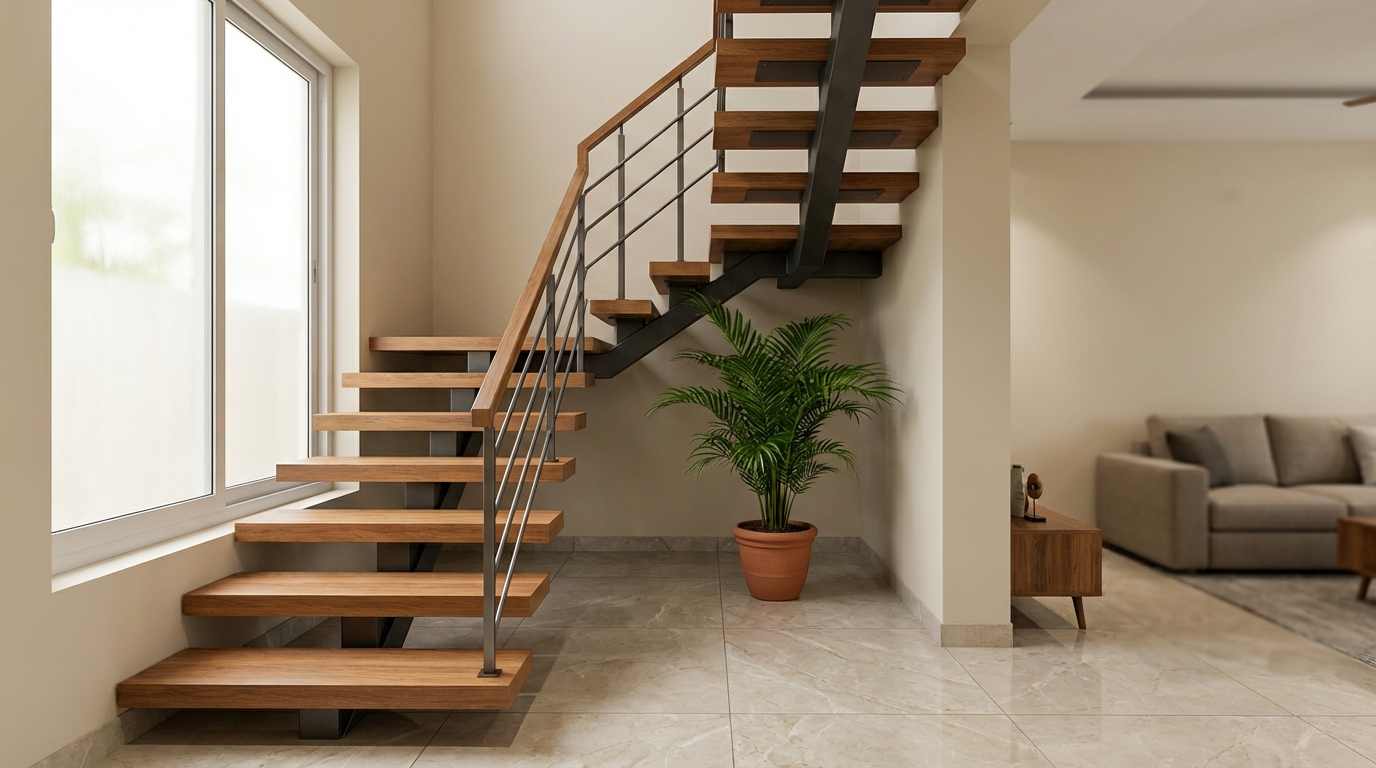
A staircase is essentially the backbone of any multi-level home—it connects spaces while making a design statement that visitors notice the moment they walk in. Short version: for most Indian homes in 2026, a combination of MS (mild steel) frame with wooden treads hits the sweet spot between durability, aesthetics, and cost. If space is tight, spiral or L-shaped designs work best; if you're in a humid coastal city, lean heavily toward steel with proper rust treatment.
This guide is right for you if:
- You're building or renovating a duplex, villa, or independent house
- You've got a small flat and need space-saving staircase solutions that don't feel cramped—maybe for a loft bedroom or terrace access
- You're confused between wood, steel, and glass options and want someone to cut through the marketing fluff
- Budget is a real concern and you need to know where to spend and where to save
Skip this if: You're looking at commercial buildings with fire escape requirements—that's a whole different ballgame with NBC regulations.
Bottom line: Your staircase should last 25-30 years minimum, so don't cheap out on the structure—save money on finishes if needed, but get the core right.
Note: sainik710.com is an independent informational site and is not affiliated with any manufacturer.
What Staircase Design Actually Means (Beyond Just Steps)
Staircases are the connectors of spaces—they bring different levels together, forming a continuity in your home's interiors. But here's what most people don't realize: the staircase you choose affects everything from how light travels through your home to how much storage space you can squeeze out of the area underneath.
Most people think staircase design is just about picking between straight or spiral. Actually, it's about understanding four key factors: the structural system (what holds it up), the tread material (what you walk on), the railing system (safety and aesthetics), and the space configuration (how it fits your floor plan).
In modern Indian homes, the staircase is now seen as a visual centerpiece, a way to improve lighting flow, a functional element that can add storage, and a structure that contributes to the overall interior theme. Back in 2018, I worked on this duplex in Bandra where the architect insisted on a floating glass staircase. Beautiful, yes. Practical for a family with two kids under five? Nightmare. We ended up adding safety rails six months later.
Is a floating staircase actually worth the extra cost?
Floating stairs generally cost 15 to 40% more than standard RCC stairs, depending on the material. Are they worth it? Depends entirely on your situation. If you have an open-plan living area where the staircase is the focal point, yes—the visual impact is undeniable. A floating staircase needs strong structural support and usually requires an engineer to evaluate load capacity, not just a carpenter. But if your staircase is tucked in a corner or you have elderly family members at home, stick to conventional designs. The safety concerns with open risers and minimal railings aren't worth the aesthetic payoff.
Why Staircase Design Matters Specifically in Indian Homes
Here's where the generic international advice falls flat. Indian homes deal with conditions that European or American design guides simply don't address.
Mumbai and Chennai see humidity hitting 85-90% during monsoons. This moisture wreaks havoc on untreated wood—I've seen teak treads warp within 18 months in a Versova flat because nobody bothered with proper sealing. The Kolkata side gets similar issues plus the termite problem is genuinely worse there. Meanwhile, places like Jaipur or Ahmedabad deal with extreme temperature swings—40°C summers to 8°C winter mornings—which causes expansion and contraction issues in both wood and metal.
Kota stone or granite slabs stay firm with natural grip, keeping stairs safe and perfect for Indian weather. This is why you see so much granite and Kota stone in older Indian homes. Our grandparents knew what they were doing. The material handled everything thrown at it.
Coastal Karnataka, the Konkan belt, and humid Bengal need extra attention to rust prevention if you're going with steel. A simple powder coating isn't enough—you need proper galvanization plus coating. I've seen railings in Panaji start rusting within 8 months because the fabricator cut corners.
If you have toddlers, steep stairs are not a good solution. Small space spiral stairs designs are also not ideal if you have young toddlers. This is critical. I keep seeing Pinterest-worthy spiral staircases in Indian homes where grandparents and kids live together. Terrible idea. One slip on a tight spiral with narrow treads, and you're looking at a hospital visit.
Types of Staircases: What Actually Works Where
Staircase design encompasses a broad spectrum of styles tailored to diverse architectural preferences and spatial considerations. Modern staircase design integrates elements like steel, glass and wood, creating visually striking indoor and outdoor structures.
Honestly, all the fancy names—cantilever, floating, helical—they're mostly marketing terms. What matters is matching the design to your actual space and needs.
| Staircase Type | Best For | Space Needed | Relative Cost | My Take |
|---|---|---|---|---|
| Straight Run | Large homes, simple circulation | Needs long wall (minimum 3m horizontal space) | ₹₹ | Boring but bulletproof. Most practical choice. |
| L-Shaped | Corner spaces, medium-sized homes | Can fit in 2.5m x 2.5m corner | ₹₹ | Goes up, stops midway, then turns. Gives a short rest while climbing. It looks neat and feels simple to use every day. |
| U-Shaped | Duplexes, larger independent houses | Needs dedicated stairwell | ₹₹₹ | Two sets of stairs meeting at a landing. Feels wide and steady. The design feels safe. |
| Spiral | Tight corners, lofts, terrace access | As little as 1.5m diameter | ₹₹₹ | Most efficient option for smaller homes, though they may not be the easiest to climb. Not for daily heavy use. |
| Floating/Cantilever | Modern villas, statement pieces | Needs strong wall for mounting | ₹₹₹₹ | Looks incredible. Requires structural engineer. Not for homes with kids or elderly. |
| Winder | Very tight spaces | Minimal, triangular treads at turns | ₹₹ | Functional but awkward. Avoid at top of stairs per building codes. |
Why do carpenters prefer MS steel frames over pure wood?
Metal is considered a more durable material. Steel is resistant to most threats that plague wood, like rot and decay from moisture absorption. Plus, steel stair components will not warp or twist as a result of exposure to extreme temperatures or rapid freeze-thaw cycles.
But there's a practical reason too. A skilled mistri can fabricate an MS frame in his workshop and install it in two days. Wood requires on-site cutting, precise joinery, and much more skill. The margin for error with steel is higher—you can weld, grind, adjust. With wood, one wrong cut and you've wasted expensive timber. Most fabricators I work with quote steel frames at 30-40% less labor cost compared to full wooden construction.
Material Breakdown: Wood, Steel, Glass, and Combinations
Floating stairs, glass railings, and staircase-cum-storage units are trending. Curved designs and sustainable materials like wood and marble are also in demand. Wood, marble, glass, steel, and concrete are the most popular.
Wooden Staircases
Wood staircases are about the texture, warm shades, uniqueness of the texture, and the safety of the occupants themselves. This material is environmentally friendly and clean. However, the characteristics will directly depend on the species of wood that you choose.
For Indian conditions, stick to teak, Burma teak, or sheesham for treads—these are naturally resistant to moisture and pests. Mango wood looks nice but swells badly in humidity. I've seen people use rubberwood to save costs, and it works fine for railings, but for treads that take daily foot traffic? Not recommended.
For tread material, engineered wood with a teak veneer top is a smart middle ground. Solid 40mm teak slabs cost roughly ₹1,500-2,500 per sq ft depending on quality; engineered alternatives run ₹800-1,200 and perform almost as well if sealed properly.
Steel Staircases
Steel is the sturdiest material that can be used for building staircases. Steel stairs have high tensile strength, meaning they are resistant to breaking under tension. Galvanizing steel to resist corrosion increases its durability. Steel is almost five times stronger than concrete.
Steel stairs are usually less expensive than other staircases. Steel is a very economical metal to manufacture. Reduced labor expenses result in a lower price. It also requires less time to construct than other staircases.
MS (mild steel) frames with powder coating work for most interior applications. For outdoor or coastal areas, go with SS304 stainless steel—yes, it's expensive, but it won't rust. I had a client in Goa who insisted on powder-coated MS for his exterior staircase. Called me 14 months later—the salt air had eaten through the coating. Complete re-fabrication. ₹2.5 lakhs down the drain.
Glass Elements
Glass imparts a sense of openness and modernity. It allows light to pass through, creating a visually spacious environment. Glass stairs are often used in combination with steel or wood for a sleek appearance.
Tempered glass railings (10-12mm thick) are safe and look stunning. Glass treads? Proceed with extreme caution. They require specialized laminated safety glass (minimum 18mm) and proper anti-slip treatment. Cost goes through the roof, and one crack means replacement—no repairs possible.
Price Reality Check (2026 Market)
In India, the cost of a concrete staircase varies from ₹500 to ₹1,500 per square foot depending on the design and specific needs.
Here's what actually affects your final bill:
| Staircase Type | Price Range (per running foot) | What's Included | Watch Out For |
|---|---|---|---|
| RCC Concrete (basic) | ₹4,000-7,000 | Structure + basic tile finish | Hidden steel reinforcement costs |
| MS Steel Frame + Wooden Treads | ₹6,000-12,000 | Powder-coated frame, solid wood treads | Wood species makes huge difference |
| Full Wooden | ₹10,000-25,000 | Wooden stringers + treads + railings | Quality of joinery, wood treatment |
| Floating/Cantilever | ₹15,000-35,000 | Hidden steel supports, engineered design | Structural engineering fees extra |
| Spiral (Steel + Wood) | ₹8,000-18,000 | Central pole, radiating treads | Diameter affects usability |
| Glass Railings (add-on) | ₹3,500-6,000 per running meter | Tempered glass, SS fittings | Cleaning maintenance ongoing cost |
For a typical ground-to-first-floor staircase in an Indian home (say, 15 steps with landing), expect to budget ₹80,000-2,00,000 for a decent MS frame with wooden treads, or ₹1,50,000-4,00,000 for a full-wood design with quality railings. These are 2026 metro city rates—smaller towns run 20-30% lower.
Wooden vs Steel: The Direct Comparison
Wooden staircases have long been cherished for their classic, warm, and inviting appeal. Wood exudes timeless elegance. Wood can be easily customized to match your specific design preferences. Well-maintained wood staircases can last for generations.
Metal staircases offer a minimalist, industrial, or futuristic appearance. Metals like steel and aluminum are resistant to wear and generally require less maintenance than wood. Metal staircases are exceptionally strong and can support heavy loads.
| Parameter | Wooden | MS Steel | My Preference |
|---|---|---|---|
| Durability | 15-30 years with maintenance | 30-50 years with proper coating | Steel |
| Humidity Resistance | Requires sealing; can warp | Can rust without treatment | Treated steel edges out |
| Termite Risk | High without treatment | None | Steel, obviously |
| Aesthetics | Warm, traditional | Modern, industrial | Depends on home style |
| Noise | Absorbs noise better than metal. Less noise when walking. | Can be noisy; needs proper mounting | Wood |
| Repair Ease | Easy to sand, refinish | Harder to fix; may need re-fabrication | Wood |
| Installation Time | Longer; requires skilled joinery | May be built in a factory then sent to site for quick installation | Steel |
| Fire Safety | Combustible | Needs fireproofing; poorly fireproofed steel may cause fires when heated | Neither perfect |
Choose wood when: You want warmth and traditional aesthetics, you have dry climate conditions, noise is a concern (bedrooms nearby), or budget is flexible for quality timber.
Choose steel when: You're in humid/coastal areas, termite risk is high in your locality, you want modern industrial looks, or you're optimizing for low maintenance.
The trade-off: You gain durability and lower maintenance with steel but lose the warmth and acoustic comfort of wood. Honestly, the best solution for most Indian homes? MS frame for structure with wooden treads on top. Best of both worlds.
How to Choose: A Decision Framework
Step 1: Measure your available space honestly. Not the space you wish you had—the actual space. A spiral staircase needs minimum 1.5m diameter to be usable; below 1.2m and you're building a decorative nightmare. Straight runs need roughly 10cm horizontal depth per 18cm rise, plus landing space.
Step 2: List who uses the stairs daily. Kids under 5? Elderly parents? Someone with mobility issues? This single factor should eliminate 50% of your design options right away.
Step 3: Consider your climate zone and building location. Coastal Mumbai is different from dry Pune, even though they're 150km apart. Ground floor to first floor in a villa versus internal loft access—different requirements.
Step 4: Set a realistic budget. The staircase should be about 3-6% of your total interiors budget. Going below 3% usually means compromising on safety; above 8% and you're probably over-engineering.
| Your Situation | Recommendation | Why |
|---|---|---|
| Small flat, loft access needed | Spiral or ship ladder | Space efficiency matters most |
| Duplex apartment, modern aesthetic | Floating stairs with glass railings | Visual impact without structural constraints |
| Independent house, joint family | L-shaped or U-shaped with solid railings | Safety for all age groups |
| Coastal city, humid climate | SS steel frame with treated wood or stone treads | Rust and moisture resistance |
| Budget-conscious, practical needs | RCC with granite/Kota finish | Proven durability, lowest maintenance |
| Statement staircase, large villa | Helical or split staircase with mixed materials | Design centerpiece opportunity |
Red flags to walk away from: Any fabricator who quotes without visiting your site. Anyone who says "waterproof" about wood without explaining the treatment. Spiral designs quoted with diameter under 1.2m. Glass treads from anyone who can't show you their certification for safety glass. Quotes that don't include railing costs separately—that's usually where they pad margins.
Common Mistakes People Make
1. Choosing style over substance. That Instagram-worthy floating staircase looks amazing. Until your 70-year-old mother visits and can't navigate it safely. I've had to retrofit railings on three "statement" staircases in the last two years alone. Design for your actual life, not photoshoots.
2. Ignoring the landing. Codes require a minimum landing width equal to staircase width, but more is always better. A cramped landing at a turn makes every trip upstairs feel rushed and risky.
3. Skimping on railings. If you have kids, the elderly, or pets at home, you must install a steady railing for safety. This one really frustrates me. People spend ₹3 lakhs on a staircase and then argue about ₹15,000 for proper railings. Railings influence safety, maintenance, cost and overall visual impact. The railing is what saves you when you slip at 2 AM going to get water.
4. Wrong tread dimensions. The minimum width of treads without nosing shall be 25 cm for an internal staircase for residential high-rise buildings. In the case of other buildings, the minimum tread shall be 30 cm. The maximum height of riser shall be 19 cm in the case of residential high-rise buildings. I see carpenters making risers at 20cm+ to save material. Big mistake. It makes the stairs uncomfortable and potentially dangerous, especially for anyone with knee issues.
5. Underestimating structural needs. A floating staircase usually requires an engineer to evaluate load capacity, not just a carpenter. Your carpenter might be excellent at woodwork, but staircase engineering is different. Get a structural engineer's input, especially for floating or cantilever designs.
6. Forgetting about lighting. Lighting under each tread or along the railing is one of the most practical trends for 2026. Stairs are one of the most common places for slips, especially at night. Built-in LED strip lighting isn't expensive—maybe ₹8,000-15,000 for a full flight—but retrofitting later is a mess.
7. No edge treatment on wooden treads. The edges of wooden treads take maximum abuse. Without proper edge banding or nosing treatment, they start showing wear within 6 months. I've seen this happen when people opt for unfinished edges to save ₹2,000. Then they're looking at full refinishing within a year.
8. Installing before plaster/paint is done. This sounds obvious, but I've seen it happen more times than I can count. Wooden stairs installed, then painters splash paint everywhere, construction debris scratches finishes. Get your timing right—stairs should be one of the last things installed, with proper protection covers during final construction phases.
Quality Checks You Can Do Yourself
Visual checks before accepting delivery:
- Wood grain should be consistent across treads; mixed grain directions indicate low-quality lumber
- Steel welds should be smooth, not lumpy or with visible porosity
- Powder coating should be uniform—check undersides where lazy fabricators skip coverage
- Glass should have chamfered edges, not sharp cuts
- Pre-finished wood should have consistent stain penetration—patchy areas mean poor prep
- Check for warping by placing treads on a flat surface; any rocking means rejection
Questions to ask your fabricator:
- "What gauge steel are you using for the frame?" (For MS, 16-gauge minimum for stringers, 18-gauge for balusters)
- "What's the thickness of the powder coating?" (50-70 microns for interior, 80+ microns for exterior)
- "Is this kiln-dried wood and what's the moisture content?" (Should be under 12% for interior use)
- "Can I see your previous installations that are 5+ years old?"
- "What warranty are you offering on the structure versus the finish?"
Simple field tests:
- Tap test for wood: Solid wood sounds dull and heavy; hollow or composite sounds sharper
- Weight check: Lift a tread sample. Proper 40mm teak should feel substantial. If it feels light, question the wood species
- Flex test for steel: Press on the center of a stringer. Quality 16-gauge should have minimal flex over 1m span
- Magnet test: SS304 stainless is weakly magnetic; if the magnet sticks strongly, it's probably mild steel being sold as SS
Here's a trick most dealers don't like: Ask for offcuts to take home. A genuine supplier won't mind. Then get them tested at a local timber merchant or even a hardware store. They can quickly tell you if that "Burma teak" is actually local plantation teak or something else entirely.
Workmanship & Installation: What to Tell Your Carpenter
Briefing checklist for your mistri:
- All steel joints must be welded, not just bolted—welding provides stronger connections
- Wooden treads should be fixed with countersunk screws from below, not visible fasteners on top
- Leave a 2-3mm expansion gap between wooden treads and any wall surfaces
- Railing posts should be anchored to the structure, not just to treads—minimum 10mm anchor bolts into concrete or 8mm into steel frame
- Apply wood treatment (termite and moisture protection) before installation, including hidden surfaces
- Primer must be applied to all steel surfaces before powder coating, including inside hollow sections
Wooden stairs may require resealing or varnishing periodically to maintain their finish and guard against scratches or water damage. Metal stairs need less frequent attention. A wipe-down with soapy water is often enough to keep metal floating stairs looking new.
Edge sealing matters. The edge of wooden treads is where moisture enters first. PU sealant on all exposed edges, including undersides. Metal is less likely to suffer from issues related to pests, such as termites, which can be a concern with wood in certain climates. But wood edges are vulnerable points even in non-termite areas.
Acclimatization: If you're bringing in wooden treads, let them sit in your home for at least 48-72 hours before installation. Wood adjusts to local humidity—installing immediately after delivery (especially if it came from a different climate zone) is asking for warping problems later.
I've seen carpenters skip the under-tread treatment and then claim ignorance when rot sets in from below. Specifically tell them: every surface gets sealed, even the ones nobody sees. It takes an extra day but saves years of headaches.
How Long It Lasts: Durability Reality
Honest lifespan expectations:
- RCC concrete: 40-50+ years for structure; finish depends on cladding
- MS steel (properly treated): 30-40 years for structure; powder coating needs touch-up every 10-15 years
- SS304 stainless: 50+ years if not exposed to chlorine/salt constantly
- Quality hardwood (teak, sheesham): 25-40 years with refinishing every 7-10 years
- Softwood or lower-quality timber: 10-15 years before structural concerns arise
Durability for wooden staircases is lower than metal. Wood is easily damaged by moisture or high humidity. Extreme temperature fluctuations can stress the material. Wood must be treated to make it pest resistant.
What affects longevity most: consistent maintenance, avoiding water exposure at joints, proper ventilation around the staircase area, and catching small issues before they become big ones.
Signs of wear to watch for:
- Creaking that develops suddenly (indicates loose connections)
- Visible movement when stepping on treads (structural concern)
- Rust bubbles under powder coating (coating failure starting)
- Wood darkening near edges (moisture penetration)
- Wobbly railings (anchor failure)
When to consider replacement: If more than 30% of treads need repair, if structural elements show corrosion beyond surface level, or if the design no longer meets your family's mobility needs. Sometimes a staircase that was fine for 15 years becomes problematic when an elderly parent moves in.
Alternatives Worth Considering
If budget is tight: RCC stairs with Kota stone or granite cladding. Not glamorous, but incredibly durable and cost-effective. A full flight can be done for ₹40,000-70,000 in most cities. Our granite vs marble comparison guide covers the pros and cons of different stone options.
If you need better moisture resistance: Consider WPC (wood-plastic composite) treads on steel frames. They're not as warm-looking as real wood but handle humidity much better. The WPC board guide on the site explains the material in detail.
If space is extremely limited: Alternating tread stairs (also called ship ladders) take up half the floor space of conventional stairs. Not comfortable for daily use, but acceptable for loft or terrace access. Spiral designs work too, but need minimum 1.3m diameter to be practical.
Many modern staircases are teamed with buttressed storage parts or shelves below. They can be used for books, ornaments or to hide belongings. Under-stair storage is criminally underutilized. A decent carpenter can turn that dead space into ₹50,000 worth of storage value. The under-stair utilization guide covers this topic specifically.
Railing Options: Safety Meets Style
Instead of plain vertical metal bars, homeowners are now choosing glass balustrades with hidden clamps, laser-cut metal designs, cable railings, wooden handrails with elegant curves, and mixed materials like wood + metal, or glass + steel.
What thickness works best for glass railings?
For balustrade panels, 10mm tempered glass is the minimum—12mm is better for anything over 1m height. For stair railings specifically, I recommend 12mm tempered or 10+10mm laminated. The laminated option costs more but if it breaks, the pieces stay together instead of scattering.
Mounting systems matter as much as glass thickness. Spigot mounts (point fixtures) need 12mm minimum; channel mounts can work with 10mm. Don't let fabricators convince you that 8mm is adequate for stair railings—it's not.
Cable railings: Worth it?
Stainless steel cable railings look clean and modern. But they have downsides: cables can loosen over time and need periodic tensioning (annually in most cases), they're not suitable for homes with young children (climbable), and they're harder to clean in dusty Indian conditions. If you like the look, go for it—just know the maintenance commitment.
Safety Considerations for Indian Homes
All buildings with a height of 15M or more shall have a minimum of two staircases according to the National Building Code. These staircases should be of enclosed type, and at least one shall be on the external wall of the building.
For residential homes, the key safety points:
- Railing height: Minimum 900mm from tread surface to top of railing; 1000mm is better if you have tall family members
- Baluster spacing: Maximum 100mm gap between vertical balusters—a child's head shouldn't fit through
- Handrail graspability: Graspability allows a user to hold the handrail with a firm and steady grip, maintaining balance. This is key especially during a stumble or fall. Round or oval profiles between 35-50mm diameter work best
- Non-slip surfaces: The step surface should have good grip to avoid slips. For wood, use polyurethane with grit additive; for stone, choose flamed or honed finish over polished
- Tread uniformity: All risers in a flight should be the same height (±5mm tolerance maximum). Uneven risers cause trips.
Use slip-resistant steps, sturdy handrails, and good lighting. Add stair gates for kids and gentle risers for seniors.
FAQs
Is it true that wooden staircases creak no matter what?
Mostly myth with a kernel of truth. Properly constructed wooden staircases with kiln-dried timber, adequate fixing, and expansion gaps will be silent for years. Creaking usually means the wood wasn't properly dried before installation, fixings have loosened, or wood has absorbed moisture and is rubbing against other surfaces. For wooden staircases, installation means exact cuts and joints that align perfectly to prevent creaks or movement. If your carpenter takes shortcuts, yes, you'll get creaking. But quality construction shouldn't creak for at least 10-15 years.
Can you use a spiral staircase as the main staircase in a home?
Technically yes, legally yes in most residential applications, practically—I'd advise against it. The spiral design efficiently saves space and allows you to control entry and exit points. Such modern spiral staircase design is ideal for urban living areas that have less space. But carrying furniture upstairs? Nightmare. Elderly family members? Difficult. Emergency evacuation? Problematic. Use spirals for secondary access—loft bedrooms, terrace, home office—not as your only way between floors.
What if I live in a coastal city like Mumbai or Chennai—does that change my options?
Significantly. Salt air accelerates corrosion on regular steel at roughly 3-4 times the normal rate. Go with SS304 stainless for any exposed metal components, or at minimum hot-dip galvanized MS with premium powder coating. For wood, moisture-resistant species are essential—teak is your best bet, but even teak needs marine-grade sealant in coastal conditions. If your floating staircase will face the elements outdoors, metal is typically the more durable choice—but it must be the right metal with the right treatment.
Is it true that glass staircases are unsafe?
Not if properly specified. The glass used in proper stair construction is tempered safety glass, the same stuff used in car windshields—it's designed to break into small, relatively harmless pieces if it ever does shatter. Utilizing a glass balustrade imparts a sense of transparency and modernity. The clear panels allow light to flow through the space. The real risks are: slipping on glass treads (solvable with anti-slip treatments or textured glass), privacy concerns, and the psychological discomfort some people feel walking on transparent surfaces. If these don't bother you and budget allows, glass is perfectly safe.
How much storage space can I actually get under my staircase?
For a standard straight-run staircase (floor to first floor, ~15 steps), you typically have 2.5-3.5 cubic meters of space underneath. That's enough for a small study nook, a powder room, substantial book storage, or even a mini bar area. L-shaped and U-shaped stairs offer more usable space because the area under the landing is tall enough to stand in. Many modern staircases are teamed with storage parts or shelves below. They can be used for books, ornaments or to hide belongings. This approach is practical and still looks beautiful.
Is it true that steel staircases are cold in winter?
Bare steel, yes. But nobody builds staircases with bare steel treads in homes. Wood-clad treads on steel frames are the norm, and wood is naturally warm underfoot. Wood is warm and comfortable to feel. It is more welcoming compared to metal. If you're going with stone treads on steel, yes, they'll feel cold in Shimla winters. For most of India, this isn't a significant concern.
What's the minimum width for a comfortable staircase?
Single staircase may be accepted for buildings where floor area does not exceed 300 sq m and height does not exceed 24 m. Code minimums are around 750mm for very tight spaces, but 900mm should be your practical minimum for a single-user staircase. For comfortable two-person passing, 1100mm is ideal. If you're carrying furniture regularly or have mobility concerns, 1200mm makes life much easier. The extra width costs maybe 15-20% more but improves daily usability dramatically.
How often do wooden staircases need refinishing?
Compare steel to timber, which needs regular sanding and re-application of chemical treatments over time. For high-quality polyurethane finish on teak in moderate-traffic homes, expect to refinish every 8-12 years. High-traffic situations (rental properties, homes with multiple children, shoes worn indoors) might need it every 5-7 years. The good news: refinishing is straightforward—sand, clean, reapply finish. Much easier than dealing with rusted steel or cracked concrete.
Is it true that floating staircases are structurally dangerous?
Only if poorly designed or built. Floating stairs create a visually striking illusion by seemingly defying gravity. Suspended from the wall or supported by minimalistic structures, they offer an open and airy ambiance. Properly engineered floating stairs can handle 350-400kg per tread—far more than any normal residential use requires. The key is "properly engineered." This means structural calculations, quality steel work, and professional installation. A carpenter eyeballing it without engineering? That's when problems happen.
What's the best material for outdoor staircases?
Wood stairs are a potentially less expensive option for residential stairs in homes. But for outdoor? I'd say the opposite. Steel is resistant to rot and decay from moisture absorption. Steel stair components will not warp or twist from extreme temperatures or rapid freeze-thaw cycles. For outdoor applications, galvanized steel with stone or WPC treads is your safest bet. If you insist on wood, use teak with marine-grade finish and expect significant ongoing maintenance.
Can I convert my RCC staircase to a modern design without demolishing it?
Partially, yes. You can clad existing concrete treads with wood, stone, or tiles. You can add new railings (glass, cable, or metal). You can add LED lighting underneath or along the sides. What you can't easily change: the footprint, the number of steps, or the rise/run dimensions. If your existing staircase has awkward proportions, cladding won't fix that—it might even make it worse by reducing tread depth. An experienced interior designer can assess whether cladding makes sense for your specific situation.
Do I need an architect or can a carpenter handle staircase design?
For a standard L-shaped or straight staircase in a normal home, an experienced carpenter-contractor can handle it with standard dimensions. For floating stairs, cantilever designs, or anything that needs to bear significant loads without visible support, get a structural engineer involved—not optional. A floating staircase usually requires an engineer to evaluate load capacity, not just a carpenter. The consultation fee (typically ₹5,000-15,000) is nothing compared to the cost of structural failure or retrofitting.
Right, that covers most of what you need to know. Your contractor might have opinions that differ from mine—that's fine, hear them out. Local conditions, specific site constraints, and available craftsmen all affect what makes sense for your particular project. The fundamentals don't change though: get the structure right, prioritize safety over looks, and plan for maintenance from day one. Good luck with the build.
Disclaimer: This content is provided for general informational purposes based on industry practices and publicly available information. Product specifications, standards, prices, and availability may vary by manufacturer, region, and time. Readers should independently verify details with manufacturers, dealers, or qualified professionals before making purchase or construction decisions.Want Plywood Suggestions?
Share a few details and a Sainik 710 specialist will suggest suitable brands and connect you to responsive dealers.