Sofa Set Design Ideas: 40+ Modern, L-Shaped & Wooden Sofa Designs for Living Room
Get 40+ sofa set designs for living room—L-shaped, wooden & modern styles. Material guide, size chart & price range for comfortable Indian homes.
Quick Answer: Finding the Right Sofa Set Design for Your Living Room
The best sofa set design for Indian living rooms depends on three factors—room size, family habits, and climate conditions in your city. Short version: L-shaped sofas work brilliantly for spaces above 150 square feet where you need to seat 5-6 people regularly. Wooden sofa sets handle humidity better in coastal cities, while fully upholstered modern designs suit climate-controlled apartments in drier regions. Your ₹25,000 can get you a decent fabric 3+1+1 set, but expect to spend ₹60,000-1,20,000 for quality wooden frames with good cushioning.
This guide is right for you if:
- You're setting up a new home or replacing worn-out furniture
- Your living room is anywhere between 100 to 400 square feet
- You've walked through furniture showrooms feeling completely overwhelmed by options—modern, traditional, L-shaped, wooden, recliner, sectional—and left without buying anything
- Budget matters, but you also don't want something falling apart in 3 years
Skip this if:
- You're looking for imported luxury brands—that's a different conversation entirely
- You need commercial seating for offices or lobbies
Bottom line: Match your sofa frame material to your city's humidity, pick a shape that leaves 3 feet of walking space around it, and never compromise on the cushion foam density—everything else is personal taste.
What Sofa Set Design Actually Means Today
A sofa set design encompasses the frame construction, upholstery material, seating configuration, and overall aesthetic style that determines how the furniture looks, feels, and lasts in your home. In Indian homes, this typically means choosing between wooden frame sets (3+1+1 configurations), L-shaped sectionals, modular arrangements, or fully upholstered modern styles.
Most people think sofa design is mainly about looks. Actually, 70% of your satisfaction comes from what you can't see—frame quality, foam density, and joint construction. That gorgeous velvet sofa in the showroom? Might look tired in 18 months if the internal support is cheap ply and low-density foam.
Here's how I break down sofa design when consulting:
Frame construction: This is your foundation. Solid hardwood frames (teak, sheesham, sal) last 15-20 years. Engineered wood frames give you 8-12 years if maintained well. Metal frames—usually steel or aluminium—work great for contemporary styles but feel different when you sit.
Suspension system: What's under those cushions? Sinuous springs (S-springs) are standard in decent sofas. Eight-way hand-tied springs cost more but provide better support. Webbing alone? That's budget territory—expect sagging within 2-3 years.
Cushion fill: High-resilience (HR) foam with 32-40 kg/m³ density is what you want for seats. Anything below 28 density will compress permanently within a year. Some premium options use pocket springs inside the cushion—fantastic for heavier users.
Upholstery: Fabric, leatherette, genuine leather, or exposed wood with minimal cushioning. Each has trade-offs I'll cover in detail below.
Why This Matters Specifically in Indian Homes
I've been advising families on furniture choices for almost two decades now, and here's what I've observed: sofa problems in India are different from what you'd read in American or European guides. Our challenges are humidity, dust, and family usage patterns that Western furniture isn't designed for.
In Mumbai, humidity stays between 70-85% for nearly six months. That's brutal on certain materials. I've seen leatherette sofas in Andheri flats where the surface started peeling within two years—not because the material was bad, but because the backing absorbed moisture and separated. Genuine leather handles this better, but only if the room has decent ventilation or AC usage.
Chennai brings a different problem. The combination of humidity AND salt air near the coast accelerates corrosion on metal frame components. A friend in Besant Nagar bought an Italian-style metal frame sofa—looked stunning. The chrome started pitting within 18 months. She'd have been better off with a wooden frame, honestly.
Bengaluru and Pune get somewhat easier conditions. Lower humidity means you have more material options. But the dust is relentless in these cities during summer. Textured fabrics trap dust like crazy, requiring professional cleaning every 6-8 months.
Then there's how Indian families actually use sofas. We don't just sit—we lounge, kids jump, relatives visit for weeks, food gets eaten on the sofa during cricket matches. This isn't a design magazine photo shoot. Your sofa needs to handle real life.
Does the city you live in really affect which sofa material to choose?
Absolutely, and I wish more showroom salespeople would mention this. In coastal cities like Mumbai, Chennai, Kolkata, or Kochi where relative humidity consistently exceeds 75%, wooden frames with removable, washable fabric covers work best. Fully upholstered sofas trap moisture inside, leading to musty smells and potential mould in the foam. If you're in a drier city like Jaipur, Ahmedabad, or interior Maharashtra, you have much more flexibility—leatherette and fixed upholstery hold up well. Air-conditioned homes change the equation somewhat, but remember, not every room runs AC 24/7.
Types of Sofa Set Designs: What Actually Works
Let me break down the main categories you'll encounter. I'm going to be honest about each one—what the salespeople say versus what actually happens in homes.
Traditional Wooden Sofa Sets (3+1+1 Configuration)
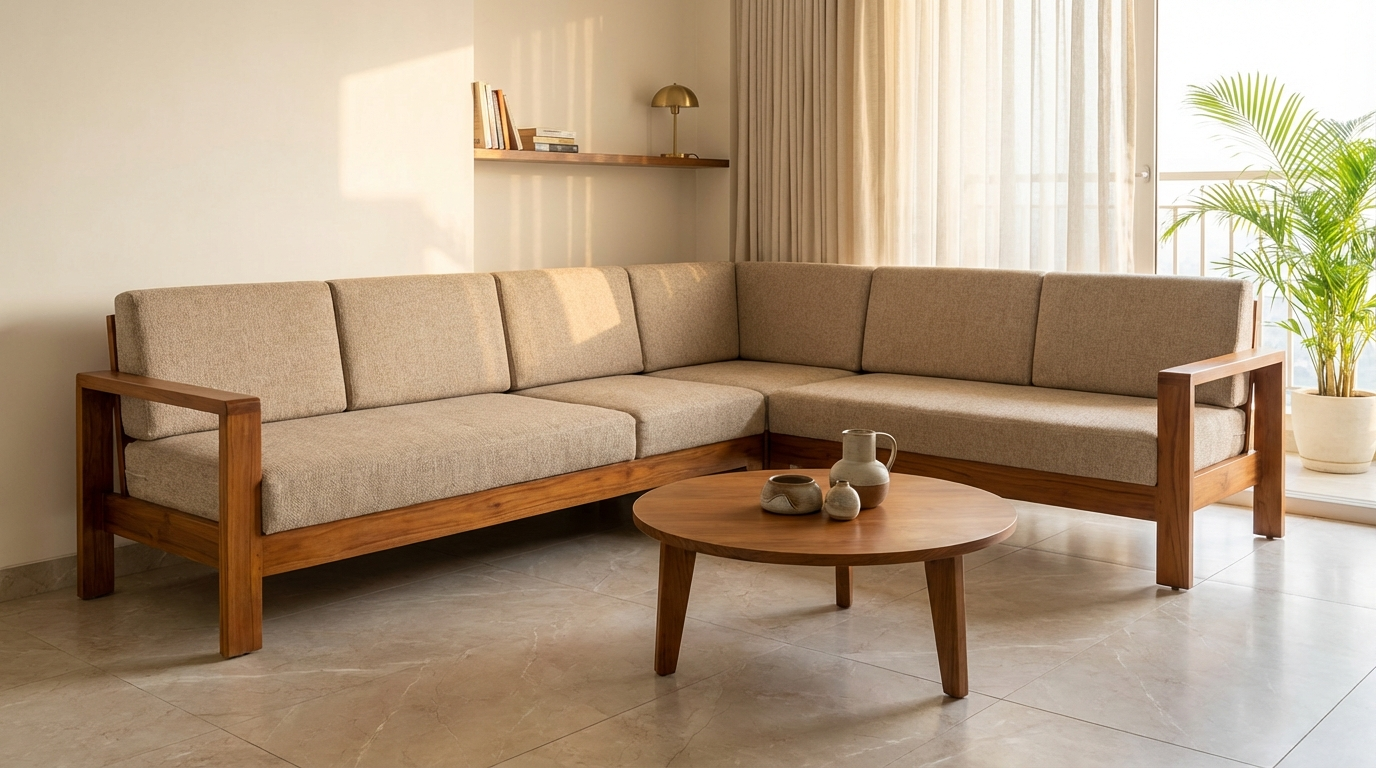
The classic Indian choice. A three-seater plus two single-seaters, usually with exposed wooden frames and removable cushions. Teak and sheesham are the preferred woods.
Best when: You want longevity (15+ years), live in a humid climate, or prefer the flexibility of replacing cushion covers without buying new furniture.
The downsides? Traditional designs can look dated in modern apartments. And good hardwood isn't cheap anymore—expect ₹80,000-2,00,000 for quality teak sets. The Rajwadi or Victorian-style carved sets look impressive but become dust magnets.
A client in Thane went with sheesham a few years back. Smart choice—the wood has handled four monsoons without any issues. She gets the cushion covers professionally cleaned annually and the set still looks presentable.
L-Shaped Sectional Sofas
These have exploded in popularity over the last decade. Makes sense—they maximize seating in a corner configuration and look contemporary.
Best when: Your room is at least 150 square feet, you regularly host 5-6 people, or you want that lounge-style seating for movie nights.
Here's what most guides won't tell you: L-shaped sofas are tricky to move. If you're renting and might relocate, think twice. That monster isn't fitting through narrow building staircases. I've seen families abandon sofas during moves because disassembly wasn't possible.
Also measure your doors before buying. Sounds obvious, but at least once a year I hear about someone whose sectional couldn't enter their flat. The delivery guys stood there helplessly while the customer panicked.
Modern Fully Upholstered Sofas
Clean lines, no visible frame, often with metal legs. Very popular in urban apartments going for that Instagram-worthy look.
Best when: You have AC in the living room, low-dust environment, and appreciate minimalist aesthetics.
My honest take? These look fantastic for about 3-4 years. After that, the fabric shows wear patterns where people sit regularly, and you can't just replace covers like with traditional sets. Reupholstering costs ₹15,000-30,000 depending on the fabric.
Recliner Sofa Sets
Either manual or motorized mechanisms that let you kick back. Heaven for watching TV.
Best when: Someone in the family has back issues, you prioritize comfort over aesthetics, or your living room is primarily a home theater.
The mechanism is the weak point. Budget recliners from unknown brands—I've seen the lever break within 2 years. Motorized ones need accessible power outlets and eventually the motor gives out. Stick with known brands if you're going this route. Durian, Urban Ladder, and a few others have decent after-sales service for mechanism repairs.
Sofa Cum Beds
Convertible designs that transform from seating to sleeping surface. Useful for small apartments or when guests visit.
Best when: You genuinely need occasional guest sleeping space and can't dedicate a room for it.
Let me be direct: most sofa cum beds are mediocre at both functions. The seating feels harder than regular sofas (to support sleeping), and the bed surface is never as comfortable as an actual mattress. The mechanism adds complexity that can fail. If you're buying one, test the conversion mechanism repeatedly in the showroom—pull it out and push it back at least five times. Any resistance or grinding sounds? Walk away.
| Sofa Type | Best Room Size | Typical Price Range | Humidity Tolerance | Longevity | My Take |
|---|---|---|---|---|---|
| Wooden 3+1+1 | 120-200 sq ft | ₹50,000-2,00,000 | Excellent | 15-20 years | Best all-rounder for Indian conditions |
| L-Shaped Sectional | 180-400 sq ft | ₹45,000-1,50,000 | Moderate | 8-12 years | Great for large families, difficult to move |
| Modern Upholstered | 100-250 sq ft | ₹30,000-90,000 | Poor to moderate | 6-10 years | Looks great initially, shows wear faster |
| Recliner Set | 150-300 sq ft | ₹60,000-2,50,000 | Moderate | 10-15 years (mechanism may need repair) | Worth it only if comfort is top priority |
| Sofa Cum Bed | 100-180 sq ft | ₹20,000-70,000 | Varies | 5-8 years | Compromise solution—only if you truly need dual function |
Material Deep Dive: What's Actually Inside Your Sofa
This is where showrooms gloss over details. Let me get specific.
Frame Materials
Solid hardwood (Teak, Sheesham, Sal): The gold standard. Teak resists moisture and termites naturally—no treatment needed. Sheesham (Indian Rosewood) is slightly less durable but beautiful grain. Sal is cheaper but very strong. Look for kiln-dried wood—air-dried tends to warp in AC environments.
Engineered wood (Plywood, MDF, Particle Board): Hidden frames are often plywood now—not necessarily bad if it's BWR grade. Our marine plywood and BWR plywood guide covers what grades mean. Particle board frames? Avoid completely. I've seen them crumble at joints within 3 years.
Metal frames: Powder-coated steel or aluminium. Works well in dry climates. In coastal areas, ensure it's marine-grade or properly sealed. Welding joints are the weak points—check for complete coverage.
Upholstery Materials
Cotton/Linen blends: Breathable, comfortable, affordable. But stains easily and fades with sunlight. Good choice if you're okay with covers needing replacement every 3-4 years.
Polyester/Microfiber: More stain-resistant, holds color better. Less breathable—can feel sticky in humid weather without AC. The better option for homes with kids or pets.
Leatherette (PU/PVC): Looks like leather at lower cost. PU is softer and more breathable than PVC. Both struggle in high humidity—the surface can peel or crack. Works fine in air-conditioned rooms.
Genuine leather: Ages beautifully, very durable if maintained. Needs conditioning every 6-12 months. The upfront cost is high (₹1,00,000+), but per-year cost over 15-20 years actually makes sense.
Velvet: Luxurious look and feel. Nightmare to maintain. Traps dust, shows watermarks, requires professional cleaning. I'd only recommend this for formal living rooms that see light use.
Is genuine leather worth the extra cost over leatherette?
If you're keeping the sofa for 10+ years and your living room has climate control, yes. Genuine leather develops a patina that actually looks better with age, while leatherette starts deteriorating around year 5-6. The math works out roughly like this: a ₃0,000 leatherette sofa replaced twice over 15 years costs ₹60,000 plus hassle. A ₹1,00,000 leather sofa maintained properly lasts the same period with just annual conditioning (₹500-1,000 per year). The initial investment is higher, but lifetime cost is comparable. In humid cities without consistent AC, though, skip leather entirely—it'll get mouldy.
Price Reality Check: What Budgets Actually Get You in 2026
I'm not going to give you exact prices because they vary by city and dealer. But here's the honest picture of what different budget ranges typically deliver.
₹20,000-40,000: Entry level. Particle board or thin plywood frames, low-density foam (under 28 kg/m³), basic fabric. Fine for rental apartments or guest rooms you're not sitting in daily. Don't expect more than 4-5 years.
₹40,000-80,000: Mid-range. Plywood frames (hopefully BWR grade), decent 32-density foam, better fabric choices. This is where most urban families land. Quality varies wildly—some ₹60,000 sofas outperform ₹80,000 ones. Brand reputation matters here.
₹80,000-1,50,000: Upper mid-range. Solid wood frames become possible at the lower end. Better suspension systems (S-springs at minimum). HR foam with 36+ density. Reputable brands like Godrej Interio, Urban Ladder, Durian operate here. Expect 10-12 years of good service.
₹1,50,000-3,00,000: Premium domestic. Hardwood frames, eight-way hand-tied springs in some models, high-density foam, quality upholstery. This is where I tell clients to aim if budget permits—the per-year cost over the sofa's lifetime is actually reasonable.
₹3,00,000+: Luxury and imported. At this level you're paying for brand, design exclusivity, and premium materials. Whether that's worth it depends entirely on your priorities. Functionally, you're not getting dramatically more than the ₹1,50,000-2,50,000 range.
What actually affects your final bill:
- Wood type—teak costs 40-60% more than sheesham
- Cushion density—each 4kg/m³ increase adds roughly 8-12% to cushion cost
- Mechanism complexity—recliners add ₹15,000-40,000 over static equivalents
- Brand markup—can be 20-35% for identical construction quality
- City—Mumbai and Delhi showrooms price 10-15% higher than tier-2 cities
- Customization—non-standard sizes or fabrics add 15-25%
Choosing the Right Design: A Decision Framework
I've developed this framework over years of consultations. Works for most situations.
Step 1: Measure ruthlessly. Not just room size—measure doorways, staircases, elevator dimensions. The most beautiful sofa is useless if it can't enter your home. Leave minimum 3 feet walking space around the sofa. Sounds like a lot until you see how cramped rooms feel otherwise.
Step 2: Count actual users. Who sits on this sofa daily? A couple needs different seating than a joint family. Include regular visitors—if parents visit monthly and stay a week, that affects the calculation.
Step 3: Identify the primary activity. TV watching favors recliners and deep seats. Conversations need sofas where people face each other. Formal sitting rooms get away with firmer, less deep seating.
Step 4: Assess your climate honestly. Don't buy based on what you wish your living conditions were. No AC? Plan for humidity. Dusty area? Pick cleanable fabrics.
Step 5: Set the budget with buffer. Whatever you think you'll spend, add 15-20% for cushions, throws, and accessories. Also budget for delivery—some sellers don't include assembly.
| Your Situation | Recommended Style | Why This Works |
|---|---|---|
| Small apartment (under 120 sq ft living room), just married couple | Compact 3-seater or loveseat + accent chair | Maintains flexibility, easier to move if you relocate |
| Medium room (150-200 sq ft), family of 4 | Traditional 3+1+1 wooden set | Seats everyone, cushions replaceable, handles Indian humidity |
| Large living room (250+ sq ft), frequent entertaining | L-shaped sectional + accent seating | Maximizes seating capacity, creates conversation zones |
| Home theater focused room | Recliner set (motorized if budget permits) | Viewing comfort is priority, worth the mechanism investment |
| Studio apartment, need guest sleeping | Quality sofa cum bed from known brand | Dual function necessary, invest in better mechanism |
| Coastal city, no AC | Teak frame with removable cotton covers | Only combination that truly handles 80%+ humidity long-term |
| Parents' home, elderly users | Firm seating with proper armrests, standard height (17-18 inches) | Easy to sit and stand, armrests provide support |
Exception: If you're renting and might move within 2-3 years, always choose modular or easily transportable options over fixed L-shaped units, regardless of room size.
Red flags to walk away from:
- Showroom won't let you remove cushions to inspect frame
- "Special discount" only valid today (oldest trick in furniture sales)
- No warranty on frame or mechanism
- Delivery timeline is vague—"2-4 weeks" without specific date
- Can't provide material specifications in writing
Common Mistakes People Make (And How to Avoid Them)
Mistake 1: Buying for looks without sitting. Spend at least 10 minutes actually sitting on the floor model. Sit in different positions. Lie down if the showroom allows. That Instagram-perfect sofa might be uncomfortable for daily use.
Mistake 2: Ignoring seat depth. Standard seat depth is 20-22 inches. Deep seats (24+ inches) look great but shorter people can't sit back comfortably—their feet dangle. I've seen a family in Malad buy a gorgeous deep-seated sectional. The grandmother hated it because she couldn't sit properly. Ended up adding cushions behind her back permanently, which looked odd.
Mistake 3: Forgetting about doorways. This one really frustrates me because it's so avoidable. Measure every doorway and turn the sofa will navigate. Include elevator dimensions if applicable. That 8-foot sectional doesn't bend.
Mistake 4: Choosing light colors with kids or pets. I know, the beige linen looks sophisticated. It won't in 6 months with children around. Darker colors and patterned fabrics hide everyday wear much better.
Mistake 5: Skipping the warranty discussion. Frame should have 5+ year warranty. Mechanism warranty matters for recliners. Get it in writing before paying. Verbal assurances mean nothing when the spring breaks.
Mistake 6: Buying from photos alone. Online shopping works for many things. Sofas? You really need to experience the firmness, fabric texture, and build quality in person. Order online only if returns are genuinely free and easy—most furniture returns are nightmares.
Mistake 7: Matching everything exactly. Your sofa doesn't need to match your curtains and rug perfectly. Complementary colors work better than identical shades. Over-matching looks dated quickly.
Mistake 8: Ignoring cushion replacement costs. That cheap sofa becomes expensive when cushions need replacing in 3 years. Ask about cushion prices upfront. Some brands charge absurd amounts for replacements.
Mistake 9: Not checking assembly requirements. Some sofas arrive in pieces requiring assembly. Do you have tools? Will the delivery team assemble? Is there extra charge? Clarify everything before purchase.
Quality Checks You Can Do Yourself
Most buyers feel helpless in furniture showrooms. You're not—here's how to assess quality without being an expert.
Visual Checks
- Sit on the sofa and look underneath—exposed staples, unfinished wood, or visible particle board are bad signs
- Check seam alignment on upholstery—uneven seams indicate sloppy construction
- Look at the legs closely—are they solidly attached or wobbly?
- Examine where arm meets back—weak construction shows stress here first
- Check cushion zippers—do they open smoothly? Can you inspect the foam inside?
- For wooden frames, look at joint construction—dowels or mortise-and-tenon joints beat screws alone
Questions to Ask the Dealer
- "What's the frame made of exactly?" If they can't answer specifically, that's concerning.
- "What density is the seat foam?" Below 32 kg/m³ means faster compression.
- "What's the suspension system?" S-springs or better for quality pieces.
- "Can I see a sample of the wood or frame construction?" Reputable dealers often have cutaway samples.
- "What's included in the warranty, specifically?" Get frame, mechanism, and upholstery terms separately.
Simple Field Tests
Corner lift test: Lift one corner of the sofa about 6 inches. A well-constructed sofa feels solid. If the frame twists visibly or creaks loudly, the structure is weak.
Cushion press test: Press your palm firmly into the seat cushion and release. Good foam springs back within 2-3 seconds. Slow recovery or permanent impression means low-quality foam.
Frame tap test: Tap the frame (where exposed) with your knuckle. Solid wood sounds dense and dull. Hollow sound suggests thin plywood or particle board.
Sit-bounce test: Sit down somewhat forcefully, then bounce slightly. Excessive noise, visible flex, or instability indicates poor frame and suspension.
Here's a trick most dealers don't like: ask to see the same model that's been on display for months. The floor model reveals how the sofa ages—compression patterns, fabric wear, loose joints. A sofa that looks shabby after showroom use won't fare better in your home.
Placement and Arrangement Tips
Buying the right sofa is half the battle. Placing it correctly matters just as much.
The focal point rule: Your sofa should face the room's natural focal point—usually the TV, a window with a view, or a fireplace. Not the entrance door. Sitting with your back completely to the door feels psychologically uncomfortable for most people.
The conversation distance: If you have multiple seating pieces, keep them 4-8 feet apart for comfortable conversation. Beyond 10 feet, people have to raise their voices. Feels like sitting in different rooms.
The traffic flow: Major walking paths shouldn't require navigating around the sofa. If people constantly squeeze past, the placement is wrong. This seems obvious until you see how many living rooms violate it.
Wall distance: Don't push the sofa flush against the wall—leave 3-6 inches. Air circulation prevents moisture buildup behind the cushions, especially important during monsoon. Also makes vacuuming possible.
Light exposure: Avoid placing fabric sofas in direct sunlight from windows. The UV exposure fades colors dramatically, sometimes within a single summer. If unavoidable, use curtains during peak sun hours.
Our furniture arrangement guide goes deeper on room-specific layouts if you need more detail.
Why do designers recommend floating the sofa away from walls?
Beyond the moisture issue I mentioned, floating the sofa creates defined zones in open-plan spaces. The sofa back becomes a visual divider between living and dining areas without needing a physical wall. In smaller rooms, it actually makes the space feel larger because you're not just lining furniture around the perimeter. The downside is you need enough room to walk behind the sofa—if that's not possible, against the wall is fine.
How Long Different Sofa Types Actually Last
Everyone wants their furniture to last forever. Here's the reality based on what I've observed over the years.
Solid hardwood frame (teak/sheesham) + quality cushions: 15-20 years for the frame. You'll likely replace cushions twice in that period (every 6-8 years), but the bones stay solid.
Plywood frame + decent foam: 10-12 years if you maintain it. The plywood handles humidity reasonably well if it's BWR grade. Regular rotation of cushions extends life.
Fully upholstered with hidden frame: 8-10 years typically. The frame itself might last longer, but the upholstery becomes the limiting factor. Professional reupholstering can extend life another 5-6 years.
Recliner mechanisms: Manual mechanisms last 12-15 years usually. Motorized ones, more like 8-10 years before motor issues start. The chair itself might be fine; it's the mechanism that gives out.
Sofa cum beds: Honestly? 5-8 years of regular use. The conversion mechanism adds stress points that wear out. I've seen well-maintained ones go 10 years, but that's not common.
What shortens lifespan: Humidity without ventilation (number one killer in coastal cities), direct sunlight on fabric, jumping/bouncing use, inadequate support under cushions, never rotating or flipping cushions, placing near heat sources.
Signs it's time to replace: Frame creaks when you sit, visible sagging even with new cushions, springs poking through padding, unstable wobbling, mechanism grinding or sticking, mould smell that won't go away.
Alternatives Worth Considering
If traditional sofa sets don't fit your situation, these options might work better.
Floor seating with bolsters: Not just for ethnic-themed rooms anymore. Modern floor seating arrangements work well for casual spaces, home theaters, or rooms where flexibility matters. Significantly cheaper, easier to store, and you can mix cushion sizes for different gatherings. Won't work for everyone—harder for older people to get up from floor level.
Modular cube seating: Individual cube or ottoman-style units that can be rearranged as needed. Works brilliantly for studio apartments and rentals. Each piece is light and portable. Quality varies dramatically—look for good foam density and sturdy internal frames even in these smaller pieces.
Futons and daybeds: If you're single or a couple in a small space, a quality futon provides seating and occasional sleeping without the mechanism complexity of sofa cum beds. Japanese-style futons with cotton batting need more maintenance but breathe better than foam versions.
If budget is really tight, consider secondhand hardwood sets. A well-made teak sofa from 30 years ago, with new cushions, often outperforms a cheap new sofa. Our furniture restoration basics guide touches on what to look for in older pieces.
FAQs
What's the ideal sofa seat height for Indian homes?
Most comfortable range is 16-18 inches from floor to seat top. At 16 inches, shorter individuals (under 5'4") can sit with feet flat. At 18 inches, taller people don't feel like they're squatting. If your household includes elderly members, aim for 17-18 inches—lower seating makes standing up difficult. If you're buying online without testing, 17 inches works for most families.
Is it true that fabric sofas are always better than leatherette in Indian climates?
Not always—it depends on your specific situation. Fabric breathes better and handles humidity without the peeling issues leatherette faces. But in air-conditioned homes with low dust, quality leatherette (PU, not PVC) works fine and is easier to wipe clean. In coastal Mumbai without AC? Fabric wins. In a sealed, climate-controlled Gurgaon apartment? Leatherette is perfectly acceptable. The blanket "fabric is better" advice ignores individual conditions.
How much space should I leave around an L-shaped sofa?
Minimum 3 feet on the open sides for walking. The corner where the L meets can go closer to walls—2 feet is usually fine there. Also consider door swing areas and any furniture that needs access (like a bookshelf). A common mistake is calculating space when the room is empty and forgetting that other furniture exists.
What if I live in a coastal city like Chennai—what sofa frame material is safest?
Solid teak is your best bet. It naturally resists moisture and doesn't need chemical treatment that might fail over time. Second choice would be sal wood. Avoid metal frames unless they're marine-grade stainless or aluminium with proper sealing—even then I'd hesitate. Plywood frames can work if they're BWP (boiling water proof) grade and the sofa allows air circulation (not fully enclosed bases). Skip particle board entirely in coastal conditions.
Is it true that foam density numbers are just marketing?
No—density actually matters, though it's not the only factor. A 32 kg/m³ foam will hold shape noticeably longer than a 24 kg/m³ foam under similar use. But density alone doesn't tell you about comfort—that's where ILD (Indentation Load Deflection) comes in, which measures firmness. A high-density but high-ILD foam will be firm. High-density with lower ILD will be plush but still supportive. For seat cushions, I recommend 32+ density with medium ILD. For back cushions, slightly lower density is acceptable.
Can I use outdoor furniture indoors as a sofa alternative?
You can, but comfort suffers. Outdoor furniture is designed to drain water and resist weather—materials are typically harder and less plush. However, for covered balconies converted to living spaces, or truly humid conditions where nothing else survives, weather-resistant outdoor seating with added cushions can work. Just don't expect the lounging comfort of proper indoor sofas.
How often should sofa cushions be rotated or flipped?
Flip and rotate monthly for even wear. If your cushions are single-sided (many modern designs are), at least rotate their positions—swap left and right, exchange seat cushions with back cushions if they're interchangeable. This seems like overkill until you see how quickly permanent compression patterns develop in unrotated cushions.
What's the advantage of eight-way hand-tied springs over S-springs?
Eight-way hand-tied springs connect at eight points per coil, creating a unified support system that flexes together. When you sit, the entire surface responds, not just the area directly under you. This provides more even support and typically lasts longer. S-springs (sinuous springs) are the zig-zag wire type—adequate for most uses but each section operates somewhat independently. For heavy daily use or heavier users, eight-way is worth the premium. For average use, S-springs are fine.
Is it true that online sofa prices are always lower than showroom prices?
Sometimes yes, sometimes no. Online sellers save on showroom costs but pay for shipping (heavy furniture is expensive to deliver). What you lose online is the ability to test comfort and inspect quality. I've seen people save ₹15,000 buying online only to spend ₹20,000 trying to return an uncomfortable sofa. My recommendation: visit showrooms to identify what you like, then check if the same brand/model is cheaper online. Don't buy a completely unknown brand online just because it's cheaper.
How do I know if a wooden sofa frame is solid wood versus veneer over plywood?
Check the underside and any unfinished areas. Solid wood shows consistent grain throughout—you can see the same pattern on ends and surfaces. Veneer has a thin attractive layer over substrate that looks different when viewed from angles. Also, solid wood frames are heavier. The tap test helps—solid wood sounds dense and dull, while veneer over plywood sounds slightly hollow. When in doubt, ask directly and get the answer in writing with your invoice.
What's a reasonable delivery time for custom sofas in India?
Stock items should ship within 2 weeks. Custom orders (non-standard fabrics, sizes, configurations) typically take 4-6 weeks from confirmed order. Anything beyond 8 weeks suggests either poor inventory management or genuine supply issues. Get specific dates in writing. If the dealer is vague about delivery ("around one month"), push for a commitment. Reputable brands provide tracking once items ship.
Can sofa cushions be restuffed instead of replaced?
Yes, and it's often more economical. Most metro cities have foam suppliers who can cut custom pieces to your cushion cover dimensions. You'll need to specify the foam density—bring the old foam if possible so they can match or recommend an upgrade. Restuffing typically costs 40-60% of new cushion prices. The cover fabric is often fine even when foam is compressed; no need to discard both. Some furniture stores also offer restuffing services, though they charge more than local foam shops.
Right, that covers most of what you need to know. Your specific situation will have nuances I can't predict—room dimensions, family composition, climate quirks of your neighborhood. Use this as a framework, not a rulebook. And please—sit on the sofa for 10 minutes before buying. Your back will thank you for years.
Disclaimer: This content is provided for general informational purposes based on industry practices and publicly available information. Product specifications, standards, prices, and availability may vary by manufacturer, region, and time. Readers should independently verify details with manufacturers, dealers, or qualified professionals before making purchase or construction decisions.Want Plywood Suggestions?
Share a few details and a Sainik 710 specialist will suggest suitable brands and connect you to responsive dealers.