Bar Unit Design for Home: 25+ Modern Mini Bar & Liquor Cabinet Ideas
Get 25+ bar unit designs for home—mini bar, liquor cabinet & counter ideas. Space-saving options, material guide & lighting tips for stylish home bars.
The Quick Answer: Home Bar Design Basics
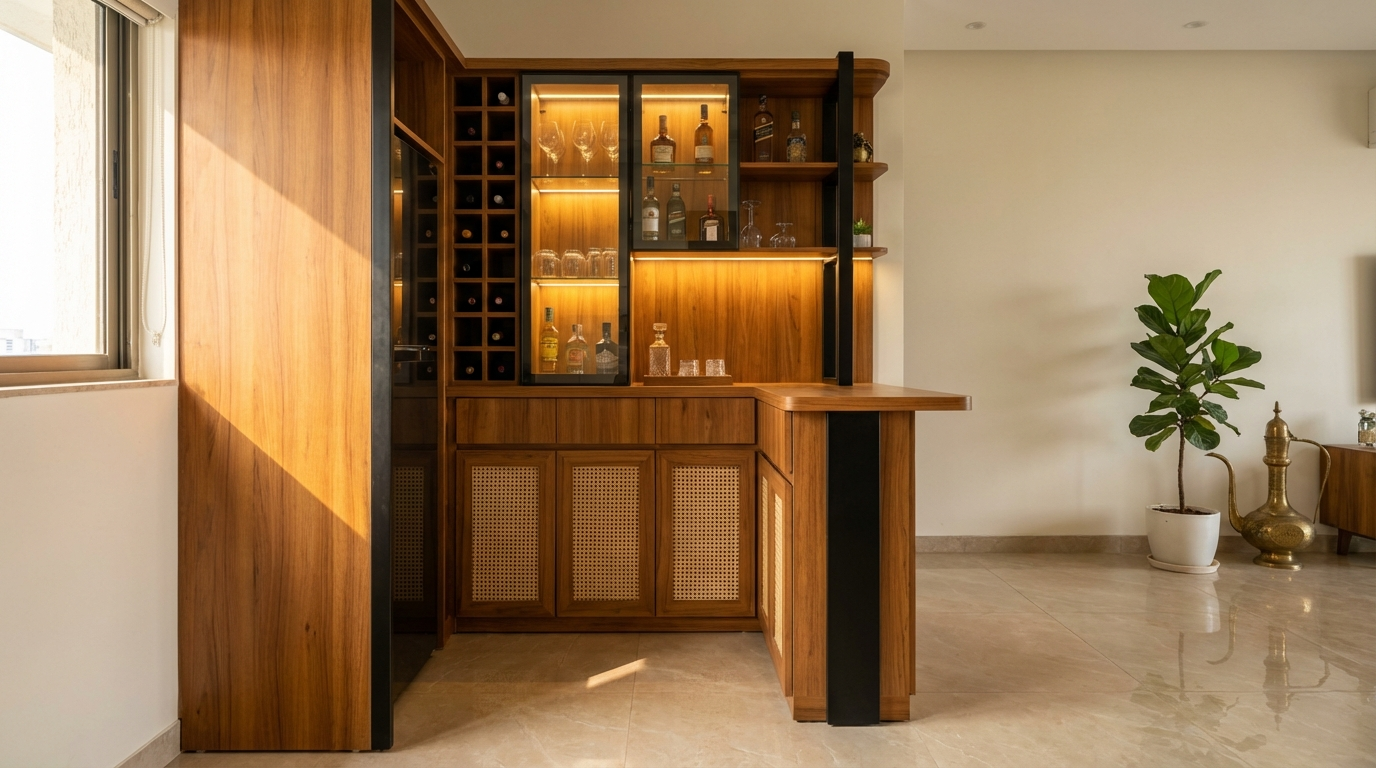
A home bar unit is a dedicated furniture piece or built-in installation designed to store, display, and serve beverages—from whiskeys and wines to mixers and glassware. Short version: The best bar unit design for Indian homes balances style with practicality. You need moisture-resistant materials (BWP or BWR plywood, not plain MR grade), proper ventilation inside cabinets to prevent that musty smell during monsoons, LED lighting that doesn't overheat your bottles, and enough counter space to actually mix a drink without knocking things over. Most people over-design the look and under-plan the function.
This is right for you if:
- You entertain guests regularly and want a dedicated space that looks impressive
- You're tired of keeping bottles scattered across kitchen shelves and want everything organized—glassware, bar tools, the works—in one place
- You have at least 3-4 feet of wall space or a corner that's currently wasted
- Your budget allows for ₹25,000 to ₹2,00,000 depending on size and finish
Skip this if:
- You only have the occasional drink and a basic bar cart would do just fine
- You're renting and can't make any permanent modifications
Bottom line: A well-designed home bar isn't about showing off expensive bottles—it's about creating a functional space that makes hosting effortless and keeps everything within arm's reach.
What a Home Bar Unit Actually Means
A home bar unit is a furniture piece or built-in cabinet system specifically designed to store liquor bottles, wine, glassware, and bar accessories while providing a countertop surface for drink preparation. It can range from a simple standalone cabinet to an elaborate L-shaped counter with overhead shelving, integrated lighting, and even a small sink.
Most people think a bar unit is just about displaying bottles. Actually, it's a working station. You need storage that's accessible (not stuffed behind other things), counter space that can handle spills, and lighting that lets you see what you're pouring without blinding your guests. A convertible bar is an innovative solution for those who need their room to do double duty. These designs often incorporate pull-out or fold-down elements, allowing you to transform a typical feature, like a bookshelf or a desk, into a fully functional bar. It's the ultimate space-saver in urban apartments and smaller homes.
The technical side involves more than most realize. You're looking at shelving depths of 10-12 inches minimum for standard bottles (deeper for wine storage), counter heights between 40-42 inches if you want bar stools, and proper weight-bearing capacity—a fully stocked bar is surprisingly heavy. The thickness of the plywood plays a significant role in structural integrity. For cabinet frames, doors, and shelves, 3/4″ plywood is the best option. That's roughly 18-19mm in our terms.
Why This Matters Specifically in Indian Homes
Here's where things get interesting for us. The real challenge, however, comes during the monsoon season. Excessive humidity, dampness, and moisture make it difficult to preserve both equipment and ingredients at their best. Cabinets may swell or warp, bottles may lose their labels, and condensation can dull the clarity of glassware.
In Mumbai, Chennai, and Kolkata—basically anywhere coastal—you're dealing with humidity that regularly hits 80-90% during July through September. I've seen bar cabinets in Marine Drive flats where the veneer started peeling within two monsoons because someone used commercial-grade ply instead of BWR. In Bengaluru or Pune, it's slightly better—maybe 60-70% RH on average—but the fluctuations between seasons still cause problems.
Humidity during the monsoon season can severely affect cabinets in a home bar. Excess moisture causes wooden shelves to swell, metal racks to rust, and labels on bottles to peel. Installing a small dehumidifier or using silica gel packs can help regulate moisture levels. Proper airflow through windows or exhaust fans also prevents dampness from building up.
The Ghatkopar side of Mumbai gets more humid than Borivali—I don't know why, but I've noticed it across multiple projects. Coastal Karnataka is brutal. Dry Rajasthan, on the other hand, you can get away with less moisture protection, but then you're dealing with dust infiltration instead. Different problems, different solutions.
Does plywood type really matter for a bar unit?
Absolutely, and more than most people realize. Cabinet makers may use solid wood or plywood, which holds up quite well even when exposed to some moisture. But many cabinets today are made of engineered wood that is laminated, such as particle board or medium-density fiberwood (MDF). These kinds are not very water-resistant and absorb moisture quickly. When they do, their laminates can peel off, causing them to disintegrate on the inside. For any bar unit in Indian conditions, BWR or BWP grade plywood is not optional—it's essential. MR grade will fail you within 3-4 years in a humid city. Particle board? Don't even think about it. The countertop especially needs water resistance because spills happen. Every single time someone mixes a drink, there's condensation, drips, the works.
Types of Home Bar Designs: Finding Your Style
Right, let me break down what actually works. As urban living spaces become smaller, compact home bars that maximise functionality in limited areas are trending. Compact bars, corner units, and hidden bars that blend seamlessly with the surrounding furniture are becoming must-haves. These designs ensure that even the cosiest spaces can have a touch of luxury.
1. Wall-Mounted Bar Unit (Best for: 2BHK apartments, minimal floor space)
This is what I recommend most often for Mumbai flats. You mount the entire unit on the wall—shelving, a fold-down counter, maybe a small cabinet below. Takes zero floor space. The counter folds up when not in use. Works beautifully in living rooms where you can't sacrifice square footage.
2. Corner Bar Cabinet (Best for: Using dead space, budget-conscious builds)
Don't overlook that empty corner. A dedicated corner bar can be a surprisingly efficient use of space. Use custom cabinetry or a triangular-shaped unit to fit the nook perfectly. This transforms an awkward, unused area into a charming and functional feature of your interior design. I've seen this work brilliantly in dining room corners. You get about 4-5 square feet of functional space from an area that was previously just collecting dust.
3. Full Counter Bar with Stools (Best for: Dedicated entertaining, larger homes)
This is the classic setup—an L-shaped or straight counter at 42-inch height, 2-4 bar stools, back bar shelving for bottles, under-counter storage for glasses and mixers. Needs at least 8-10 feet of linear space when you factor in walking room. Not for everyone, but if you have the space and entertain frequently, nothing beats it.
4. Liquor Cabinet/Bar Armoire (Best for: Renters, flexibility)
A standalone piece of furniture you can take with you when you move. Doors close to hide everything—useful if you have kids or just prefer a cleaner look when not entertaining. Primary Material: Sheesham Wood | Secondary Material: Solid MDF/12 MM Plywood Used For Seat Base Depending On Availability. Many good ones use solid wood for the frame with ply internals.
5. Under-Staircase Bar (Best for: Duplex/triplex homes, utilizing otherwise wasted space)
This Manhattan townhouse was updated by designer Cliff Fong, after a rainstorm damaged the original space. It proves that not all bars need to be the centerpiece of the room—this one is tucked away under the stairs leading to the library and clad in Brazilian rosewood. The space under stairs is often awkward for storage but perfect for a bar. You naturally get varying heights—use the taller sections for bottle display, shorter areas for glasses and accessories.
| Bar Type | Space Needed | Typical Cost Range | Best Material | My Take |
|---|---|---|---|---|
| Wall-Mounted | 4-6 ft wall width | ₹35,000-₹80,000 | BWR Ply + Laminate | Best value for apartments |
| Corner Unit | 3x3 ft corner minimum | ₹25,000-₹60,000 | BWR Ply | Underrated option, works well |
| Full Counter Bar | 8-12 ft linear + circulation | ₹1,00,000-₹3,00,000+ | BWP Ply + Stone counter | Go big or use a different style |
| Liquor Cabinet | 3-4 ft floor space | ₹40,000-₹1,50,000 | Solid wood or good ply | Great if you move often |
| Under-Staircase | Depends on stairs | ₹50,000-₹1,20,000 | BWR Ply custom-fitted | Brilliant use of wasted space |
Price Reality Check (2026 Market)
Here's what actually affects your final bill—and most people get this wrong.
The material is usually only 30-40% of the total cost. Labour, hardware (hinges, handles, drawer slides), finishes, countertop material, and lighting make up the rest. A basic wall-mounted bar unit using 18mm BWR plywood with laminate finish, simple LED strip, and standard hardware runs roughly ₹1,800-2,200 per square foot of external surface area.
Expect to pay roughly:
- ₹25,000-₹45,000 for a compact corner unit or simple wall cabinet (no counter)
- ₹50,000-₹90,000 for a mid-sized wall unit with fold-down counter and LED lighting
- ₹1,00,000-₹1,80,000 for a proper L-shaped counter bar with back shelving
- ₹2,00,000+ for elaborate designs with stone counters, glass shelving, and premium finishes
Cost drivers explained:
- Countertop material: Granite adds ₹400-800/sq ft, quartz ₹800-1500/sq ft, Corian-type solid surface ₹1200-2000/sq ft
- Glass shelving vs ply: Tempered glass shelves for bottle display add ₹300-500 per shelf depending on thickness
- Hardware quality: Soft-close hinges and premium drawer slides can add ₹3,000-8,000 to the total
- Lighting: Basic LED strip ₹1,500-3,000; proper backlit shelving system ₹8,000-15,000
Budget estimation approach: measure your wall space in square feet, multiply by ₹2,000 for basic finish or ₹3,000-3,500 for premium, then add countertop separately.
Is expensive hardware worth it for a bar unit?
Honestly? Yes, but not everywhere. Soft-close hinges on cabinet doors—absolutely worth it. The number of times I've seen regular hinges fail on bar cabinets because people open and close them while holding drinks... it adds up. Drawer slides for your accessories drawer—get the good stuff, maybe ₹800-1,200 per pair instead of ₹200-300 cheap ones. They'll last 10+ years versus 2-3 years. But premium decorative handles? That's personal preference. The ₹50 handle works just as well as the ₹500 one functionally—it's purely aesthetic.
Material Comparison: What Actually Works
MDF (including moisture-rated MDF) is mainly a finishing and machining material, while cabinet-grade plywood is mainly a structural and moisture-tolerant material. For most cabinet builds, plywood wins for boxes and long shelves, and MDF wins where a dead-smooth painted surface matters.
| Material | Moisture Resistance | Screw Holding | Paint Finish | Weight | Cost | Indian Climate Suitability | My Preference |
|---|---|---|---|---|---|---|---|
| BWP Plywood (Marine) | Excellent | Very Good | Needs primer | Medium | ₹140-180/sq ft | Best choice | ★★★★★ |
| BWR Plywood | Good | Very Good | Needs primer | Medium | ₹100-140/sq ft | Good for most cities | ★★★★☆ |
| MR Plywood | Poor | Good | Needs primer | Medium | ₹70-100/sq ft | Only dry regions | ★★☆☆☆ |
| HDHMR | Very Good | Good (pre-drill) | Excellent | Heavy | ₹80-110/sq ft | Good but heavy | ★★★☆☆ |
| MDF (standard) | Very Poor | Poor | Excellent | Heavy | ₹50-70/sq ft | Avoid | ★☆☆☆☆ |
| Particle Board | Terrible | Poor | Okay with laminate | Medium | ₹35-50/sq ft | Never use | ☆☆☆☆☆ |
Cabinet boxes: choose plywood most of the time. Painted doors and panels: MDF is often the cleanest finish. Long shelves / spans: plywood performs better with less sag. Wet zones (sink base, bath vanities): plywood is the safer default.
Trade-off summary: With MDF you gain a smoother paint finish but lose moisture resistance and screw-holding strength. With plywood you gain structural integrity and durability but lose that perfectly smooth surface for painted finishes. For bar units specifically—where spills happen and humidity is a concern—plywood wins almost every time.
How to Choose: Decision Framework
Step 1: Measure your available space precisely. Not just width and height—check for electrical outlets, light switches, air conditioning vents that might interfere.
Step 2: Decide if you want it visible or hidden when not in use. This determines whether you go open shelving (looks great but needs constant organizing) or cabinet-style (cleaner but less impressive when closed).
Step 3: Count your bottles and glassware. Seriously. Most people underestimate by 40-50%. Add 30% extra capacity for growth.
Step 4: Consider who'll be using it. Bar stools mean 42-inch counter height. Standing only? 36-38 inches works. Sitting at a regular chair height (like a dining setup)? That's around 30 inches.
Step 5: Factor in your city's climate. Mumbai, Chennai, Kolkata—go BWP. Bengaluru, Pune, Hyderabad—BWR is usually fine. Delhi, Jaipur, dry northern cities—you might get away with MR but I'd still recommend BWR for the counter area.
| Your Situation | Recommendation | Why |
|---|---|---|
| Small apartment, limited budget | Wall-mounted fold-down unit | Saves floor space, can be closed when not entertaining |
| Dead corner in living/dining room | Corner bar cabinet | Utilizes wasted space, surprisingly good storage |
| Large home, frequent entertaining | Full counter bar with back shelving | Maximum function, creates focal point |
| Rental property | Standalone liquor cabinet or bar cart | Portable, no permanent installation |
| Want to hide the bar from kids | Cabinet with doors + lock | Safety, discretion |
| Duplex with under-stair space | Custom under-staircase bar | Uses otherwise unusable space beautifully |
Red flags to walk away from:
- Contractor insisting on particle board "because it's the same thing"—it's not
- No provision for ventilation in closed cabinets
- Countertop edge that's not sealed or banded properly
- LED lighting positioned where bottles will block it completely
- Shelf spans over 36 inches without center support (they'll sag)
Lighting: What Makes or Breaks the Look
Lighting is one of the most important aspects of designing a bar, whether it's a home setup or a commercial establishment. The right mix of ambient, task, and accent lighting creates a stylish and functional space. From modern pendant lights to LED strip lighting and outdoor bar lighting ideas, there are endless ways to enhance your bar's ambiance and efficiency.
Let me be honest—this is where most DIY bar builds fall flat. People either skip lighting entirely or install one bright tube light that kills the vibe.
What actually works:
Backlit shelving: Backlit shelving is an elegant way to showcase your drink collection while adding sophistication to your home bar. By placing LED lights behind the shelves, your bottles and glasses will glow, adding visual interest. This method not only highlights your liquor selection but also contributes a soft, warm light that helps create an inviting atmosphere.
Under-counter strips: LED strip lights are a sleek and modern way to add illumination directly beneath your shelves. Installed along the underside of the shelf, this method works well for showcasing bottles, books, or decorative pieces. If you've chosen wood shelves, a benefit of this style of lighting is that a small channel can be cut into the shelving itself, where the LED light strip can be tucked away and less visible. For narrow shelves, place the strip near the front edge for brighter visibility, or near the rear for a more subtle, backlit effect.
Color temperature matters: Warm-toned lighting between 2700K–3000K creates a relaxing and intimate ambiance, perfect for a home bar setting. Don't use cool white (5000K+) unless you want your bar to feel like a hospital. Warm white makes everything—especially the amber tones of whiskey—look gorgeous.
Can you add lighting to an existing bar unit?
Yes, and it's often easier than building it in from the start. Adhesive LED strips are available everywhere now, run on 12V, and can be powered by a simple adapter. The trick is hiding the strip itself so you only see the glow, not the LEDs. Use aluminum channels with diffusers (available at most electrical shops for ₹200-400 per meter) for a cleaner look. Route the wires along the back or sides of the unit. Hide unsightly fixtures - Conceal wires, drivers, and hardware in clever ways to maintain aesthetics. Include controls - Dimming, automation, and central control systems enable easy lighting adjustments.
Common Mistakes People Make
1. Using the wrong plywood grade. This one really frustrates me. I keep seeing this nonsense where people use MR grade for bar units "because it's cheaper" and then wonder why things start swelling in monsoon. The price difference between MR and BWR is maybe ₹30-40 per square foot. Over an entire bar unit, that's ₹3,000-5,000 extra. And you're risking the entire ₹50,000-1,00,000 project to save that much?
2. Shelves that are too shallow. Standard whiskey bottles need at least 4 inches depth. Wine bottles lying down need 4.5 inches. If you want bottles standing at an angle (which looks great), you need 5-6 inches minimum. Most people design for 3 inches and then wonder why bottles keep falling.
3. No counter overhang. The counter should extend at least 10-12 inches beyond the base cabinet if you want to sit at bar stools. Otherwise your knees hit the cabinet. I've seen this mistake in maybe 6 out of 10 home bars I've visited.
4. Ignoring ventilation in closed cabinets. When designing cabinets for laundry or bathroom settings, consider adding ventilation slats or vents. This encourages better air circulation inside the cabinetry, reducing moisture retention and preventing mold growth. Same applies to bar cabinets. Those bottles generate micro amounts of condensation. Without ventilation, you'll get that musty smell.
5. LED placement that bottles block. If your LED strip is behind the bottles and your bottles are opaque (most are), you get zero backlighting effect. The light needs to come from below the shelf or from the sides for clear bottles, or from dedicated spots between bottles.
6. Forgetting the glass storage location. You need glasses within arm's reach of the counter, preferably at eye level or slightly below. Not in a bottom cabinet where you have to bend every time someone wants a drink. There was this builder in Andheri—must have been 2021—who put all the glassware storage at floor level. Beautiful bar otherwise, but completely impractical.
7. Skipping edge banding. High humidity can cause wood cabinets to swell by 3-5%, leading to gaps and alignment issues. Proper edge banding protects the integrity of the cabinetry and guarantees its overall appearance, ensuring a polished look. Exposed plywood edges are moisture entry points. Every single edge needs banding—PVC, ABS, or veneer.
8. Counter material that stains. Marble looks amazing but stains from acidic cocktails (lime juice, etc.). White Corian shows every ring mark. Go for darker quartz or granite with proper sealing, or accept that lighter materials will show wear.
9. Not planning for a sink drain. If you want a wet bar with a small sink (highly recommended if you entertain often), you need to plan the plumbing before construction, not after. Retrofitting drainage is expensive and messy.
Quality Checks You Can Do Yourself
Visual checks before accepting delivery:
- Check the ply edge—you should see distinct layers, not just wood dust compressed together (that's particle board being passed off as plywood)
- Look for consistent layer thickness in the cross-section
- Surface should be smooth with no bubbles or rough patches in the veneer
- No warping—lay the sheet on a flat surface and check for rocking
- ISI mark for BWR/BWP grade should be visible and match what you ordered
Questions to ask your dealer:
- "Can I see the test certificate for this batch?" (Legitimate dealers have them)
- "What's the core composition—hardwood or poplar?" (Hardwood is better)
- "Is this calibrated thickness or nominal?" (Calibrated means precise; nominal can vary)
- "What's the formaldehyde emission class?" (E1 or E0 is what you want)
Simple field tests:
- Tap test: Good plywood gives a solid, resonant sound. Hollow sounds indicate voids in the core
- Weight check: Lift one corner—18mm BWR should feel substantial, around 35-40 kg for a full 8x4 sheet
- Edge inspection: Run your finger along cut edges—should feel smooth and solid, not crumbly
- Flex test: A sheet shouldn't flex more than an inch or two when supported at both ends
Here's a trick most dealers don't like: Bring a small spray bottle with water. Spray a few drops on a cut edge and wait 2-3 minutes. BWR and BWP grade should show minimal absorption. MR grade will start darkening and swelling at the edge almost immediately.
What to Tell Your Carpenter: The Briefing Checklist
1. Specify material clearly: "18mm BWR plywood for carcass and shelves, 12mm for back panel. Not MR, not commercial. I'll check the ISI stamp before you cut."
2. Edge banding requirement: "All exposed edges need 1mm PVC edge banding. I don't want to see raw plywood anywhere visible."
3. Screw guidance: For 18mm ply, use minimum 1.25-inch screws for joints. Pre-drill pilot holes—no exceptions. Hinges get proper hinge screws, not random ones from the toolbox.
4. Shelf support: "Any shelf span over 30 inches needs a center support or rail underneath. Fully loaded bottle shelves are heavy—I've seen 15mm ply shelves sag within a year without support."
5. LED channel routing: "Cut a 10mm x 10mm groove along the underside of each display shelf, 2 inches from the front edge, for the LED strip. Don't wait until assembly to figure this out."
6. Ventilation: "The closed cabinet section needs either ventilation slits cut into the back panel or small drilled holes—at least 4-6 of them."
I've seen carpenters skip the pre-drilling and then the plywood splits six months later when the screws work loose. Happened to a bar unit in Powai back in 2019—the whole shelf came crashing down because the mistri wanted to save 10 minutes. ₹25,000 in broken bottles and a damaged countertop.
Why do carpenters prefer MDF over plywood for painted finishes?
MDF shines when the finish is paint. If you want a dead-smooth shaker door without wood grain telegraphing through the paint, MDF is hard to beat. It machines cleanly for profiles, and it stays consistent across panels. For panels that are painted and not living in a wet zone, MDF gives you the cleanest surface. So if you want a painted bar unit, you can use MDF for the door fronts (which don't get wet) while using plywood for the carcass and shelves (which do). That's the compromise position. But make sure the MDF edges are sealed exceptionally well—that's where moisture enters.
How Long Does a Home Bar Unit Last?
Honest lifespan expectations depend entirely on two things: material choice and maintenance.
With BWP plywood and proper edge sealing: 15-20 years easy. The hardware will give out before the structure does. Marine-grade plywood is an excellent choice for areas with fluctuating humidity. Marine-grade plywood cabinets can resist moisture for up to 50 years, making them perfect for high-humidity environments. That's optimistic for our conditions, but 15-20 years is realistic.
With BWR plywood: 10-15 years in humid cities, longer in drier climates. You might see some edge swelling after 8-10 years in coastal areas.
With MR plywood: 5-7 years in humid cities before problems start showing. Maybe 10 in dry regions.
What affects longevity:
- Spill cleanup habits—wipe up immediately vs letting it sit
- Edge banding quality and completeness
- Ventilation in closed cabinets
- Air conditioning usage (reduces humidity fluctuations)
- How often you use the bar (ironically, regular use with good maintenance extends life compared to neglected units)
Signs of wear to watch for:
- Edge banding peeling or lifting—address immediately
- Sticky or warping doors—indicates moisture absorption
- Soft spots when you press the surface
- Hardware loosening repeatedly (sign the ply is degrading around screw holes)
- Musty smell that doesn't go away—fungus has started inside
When to consider replacement: If the carcass itself has started swelling or showing soft spots, replacement is usually more economical than repair. Surface damage (laminate peeling, scratches) can often be fixed with refinishing.
Alternatives Worth Considering
If budget is tight: Consider a good-quality bar cart instead of a built-in unit. You can get solid wood carts with bottle storage for ₹8,000-25,000 that look great and are completely mobile. Not as impressive as a proper bar, but functional and budget-friendly.
If you need better moisture resistance: Look at HDHMR (High-Density High Moisture Resistance) board. It's heavier than plywood and doesn't hold screws as well at edges, but it's uniform, takes paint beautifully, and handles moisture better than standard MDF. Our HDHMR vs plywood guide covers this in more detail.
If space is extremely limited: A console-style unit that doubles as a side table when closed might work better than forcing a dedicated bar into a cramped corner. Sometimes the best design decision is not building something that doesn't fit.
For the countertop specifically, if stone is too expensive, consider good-quality acrylic solid surface or even well-sealed butcher block. Both are more forgiving than budget granite when it comes to installation and maintenance.
FAQs
What is the ideal counter height for a home bar with stools?
The standard bar height is 40-42 inches (about 105-110 cm) from the floor, which pairs with bar stools that have a 28-30 inch seat height. If you want a more casual setup where regular dining chairs work, go for counter height at 36 inches instead. The key measurement most people forget is the overhang—you need at least 10-12 inches of counter extending beyond the base cabinet for comfortable knee room.
Is it true that you need a wet bar with plumbing for a proper home bar?
Common belief: A real bar needs a sink. Reality: Most home bars work perfectly fine without plumbing. A small ice bucket and a pitcher of water for rinsing tools is often enough. That said, if you entertain more than twice a month and your bar is far from the kitchen, a small sink (even a bar-sized 12x12 inch one) makes life significantly easier. Just plan the plumbing during construction, not after—retrofitting is expensive.
What if I live in a coastal city like Chennai—will any plywood work?
Taking steps to maintain proper relative humidity year-round will keep your cabinetry more stable. We recommend 30% to 55% relative humidity. Air conditioning helps, as it removes some humidity from the air. In Chennai, Mumbai, Kolkata, or anywhere coastal, use only BWP (marine-grade) plywood for bar units. BWR might survive if you have air conditioning running most of the time, but why take the risk? The price difference is maybe ₹40-50 per square foot. Also, keep silica gel packets inside closed cabinets and ensure good ventilation.
How much space do I need for a functional home bar?
Minimum for a wall-mounted unit: 4 feet width, 2 feet depth (when open). For a proper counter bar with one stool: 6 feet width, 4 feet depth including standing room. For two stools: 8 feet width. For three or more stools: 10+ feet. These are functional minimums—more space always helps, especially for circulation when multiple people are gathered around.
Is it true that LED lights can damage liquor bottles from heat?
LED lights produce minimal heat compared to halogen or incandescent bulbs, so they won't damage your bottles. However, if you're storing wine (especially good wine), even LED light over extended periods can affect it. For wine storage specifically, keep bottles in closed cabinets or use UV-filtered glass shelving. Spirits are much more forgiving—the LED backlighting won't affect whiskey or vodka quality at all.
Can I convert an existing bookshelf into a bar unit?
Yes, but with modifications. Check the shelf depth (needs minimum 4-5 inches for bottles), verify it can handle the weight (bottles are heavy—a fully stocked shelf might weigh 30-40 kg), and add a waterproof liner or countertop material where you'll be mixing drinks. The biggest limitation is usually shelf depth—bookshelves designed for paperbacks are too shallow for most bottles.
What's the best countertop material for home bars?
Quartz is my top recommendation—non-porous, doesn't stain from citrus or alcohol, virtually maintenance-free. Granite works well too but needs periodic sealing. Marble looks gorgeous but will show etching from acidic drinks (lime juice is the main culprit). Solid surface (Corian-type) is good but scratches more easily. Laminate is budget-friendly but shows wear at the edges over time and doesn't handle hot objects well.
Is it true that vertical bottle storage is bad for spirits?
For spirits (whiskey, vodka, gin, rum), vertical storage is actually preferred. The high alcohol content can degrade the cork over time if stored horizontally. Wine with natural corks should be stored horizontally to keep the cork moist. For wine with screw caps, orientation doesn't matter. Most home bars store spirits vertically and wine horizontally—plan your shelving accordingly.
How do I prevent my bar cabinet from smelling musty during monsoons?
Fungus often thrives on wooden cabinets, walls, and hidden corners in humid conditions. Left unchecked, it spreads quickly and damages both furniture and stored items. Regular inspection is essential, with early cleaning using a mild disinfectant or vinegar solution. Lining shelves with washable mats or newspapers absorbs moisture and prevents fungal patches from forming. Avoid overcrowding storage areas to ensure proper ventilation. Natural sunlight exposure, even for a short period, helps reduce fungal growth. Additionally, keep silica gel packets (the ones that come in shoe boxes work fine—save them!) inside closed cabinets and replace them every month during monsoon season.
What's the minimum lighting setup I need for a home bar?
At the very least: one LED strip under your primary display shelf (so bottles are backlit) and one focused light source over the counter area so you can see what you're mixing. Total investment for basic LED strips and a simple pendant or track light: ₹3,000-6,000. This makes a massive difference compared to relying on room lighting alone.
Should I include a small fridge in my bar design?
If you have the space and budget, absolutely. A bar fridge (usually 50-100 liters) holds mixers, garnishes, beer, white wine, and pre-chilled glasses. They run ₹10,000-25,000 for decent ones. Just factor in the electrical outlet placement during design and ensure there's enough ventilation around the fridge—they generate heat from the back and need clearance.
Is it true that glass shelves are stronger than they look?
Tempered glass at 10-12mm thickness can hold significant weight—we're talking 15-20 kg per shelf easily when properly supported at both ends. The key is bracket placement and quality. But glass shelves need more frequent cleaning (every fingerprint shows) and will shatter if hit hard with something (though tempered glass breaks into small granules, not sharp shards). For heavy bottle collections, I still prefer solid wood or ply shelving with backlighting from strips mounted underneath.
That's the practical overview. One last thing—whatever design you choose, make sure there's at least one spot within easy reach for your most-used bottle. Nothing kills the hosting vibe faster than having to dig through a cabinet every time someone asks for a refill.
Note: sainik710.com is an independent informational site and is not affiliated with any manufacturer.
Disclaimer: This content is provided for general informational purposes based on industry practices and publicly available information. Product specifications, standards, prices, and availability may vary by manufacturer, region, and time. Readers should independently verify details with manufacturers, dealers, or qualified professionals before making purchase or construction decisions.Want Plywood Suggestions?
Share a few details and a Sainik 710 specialist will suggest suitable brands and connect you to responsive dealers.