Simple Pop Design: 25+ Modern False Ceiling Ideas for Hall, Bedroom & Living Room
Get 25+ simple POP design ideas for hall, bedroom & living room. Modern false ceiling patterns, lighting integration & cost guide for Indian homes.
Quick Decision Summary
Simple POP design for false ceilings offers the best balance of affordability, design flexibility, and clean aesthetics for Indian homes.
If you're in a hurry: Plaster of Paris (POP) remains India's most popular false ceiling material due to its low cost (₹50–120 per sq ft installed), seamless finish, and ability to create both simple and elaborate designs. For halls and living rooms, opt for peripheral or tray designs with cove lighting. Bedrooms work well with minimal single-layer POP with concealed lights. Avoid POP in bathrooms or areas with direct water exposure—use gypsum board or PVC there instead.
- Choose POP if: You want design flexibility, seamless joints, budget-friendly installation, and plan to work with skilled local labour
- Choose POP if: Your ceiling height is adequate (9+ feet) and you want customized curves, patterns, or layered designs
- Avoid POP if: Your area has extreme humidity, you lack access to skilled POP workers, or you need moisture-resistant ceilings for bathrooms
- Avoid POP if: You're on a very tight timeline—POP requires curing time unlike pre-finished panels
Key takeaway: Simple POP designs deliver maximum visual impact at minimum cost when executed by experienced craftsmen in appropriate spaces.
What POP False Ceiling Actually Means
POP false ceiling refers to a secondary ceiling constructed below the original structural ceiling using Plaster of Paris—a white powder made from gypite that forms a paste when mixed with water and hardens into a smooth, paintable surface. This suspended ceiling system creates an air gap that improves thermal insulation, hides electrical wiring and AC ducts, and allows integration of recessed lighting.
The "simple" in simple POP design typically indicates straightforward geometric patterns—rectangles, borders, single-layer trays, or basic plus-minus designs—rather than elaborate floral or ornate motifs. These designs suit modern Indian interiors and require less skilled labour while delivering clean, contemporary aesthetics.
Technical Construction Breakdown
A standard POP false ceiling consists of a metal framework (GI channels and sections) suspended from the main ceiling using clamps and threaded rods. This framework supports metal lath or chicken wire mesh onto which the POP paste is applied in layers. Skilled workers build up the thickness gradually, typically achieving 8–12mm final thickness for flat sections and 15–25mm for mouldings and drops.
The curing process takes 24–72 hours depending on humidity and temperature. After curing, the surface is sanded, primed with white cement putty, and finished with emulsion paint. This labour-intensive process is why POP installations are priced significantly lower than pre-fabricated alternatives but require more time and craftsmanship.
Common Misconceptions Cleared
Many homeowners confuse POP with gypsum board (drywall). While both create false ceilings, gypsum boards are factory-made panels screwed onto frameworks, requiring jointing compound at seams. POP is applied wet and dries to a completely seamless surface—its biggest advantage for visible areas like living rooms. However, gypsum boards offer better moisture resistance and faster installation, making them preferable for commercial spaces and humid zones.
India-Specific Reality Check: Monsoon, Humidity, and Site Conditions
Indian climate conditions significantly impact POP false ceiling performance and should influence both design choices and installation timing. Understanding regional variations helps avoid costly repairs and premature ceiling damage.
Monsoon and Coastal Considerations
POP absorbs moisture readily, making it vulnerable during monsoon season (June–September) across most of India. In coastal cities like Mumbai, Chennai, and Kolkata, ambient humidity of 75–90% can delay curing and cause surface dampness if the ceiling isn't properly ventilated. Coastal areas also face salt-laden air that can cause metal framework corrosion if inferior quality GI sections are used.
In humid eastern regions (Bengal, Assam, Odisha), POP false ceilings require better waterproofing of the structural ceiling above. Any roof leakage directly damages POP, causing bubbling, peeling, and eventual collapse. Ensure your contractor applies bituminous waterproofing to the main ceiling before installing POP, especially in top-floor apartments and independent houses.
Regional Installation Timing
In North India (Delhi NCR, Punjab, Rajasthan), the dry winter months (October–February) offer ideal installation conditions. Avoid monsoon installation in Tier-2 cities where climate-controlled conditions are harder to maintain. In South India, post-monsoon (October–January) provides the best window, though modern dehumidified interiors allow year-round installation in apartments.
Site Storage and Workmanship Realities
On Indian construction sites, POP bags are often stored improperly—exposed to rain splash or ground moisture. Insist that your contractor stores POP powder in elevated, covered areas. Pre-wetted POP (even partially) loses binding strength and creates weak ceilings prone to cracking.
Skilled POP workers (called "POP mistris" or ceiling contractors) are increasingly scarce in metros as the construction industry shifts toward pre-fabricated solutions. In cities like Bangalore and Hyderabad, expect higher labour charges (₹40–60 per sq ft just for labour) compared to Tier-2 cities where traditional POP work remains common.
25+ Simple POP Design Ideas by Room Type
These design recommendations balance aesthetics with practical material choices, installation complexity, and budget considerations specific to Indian homes.
Simple POP Designs for Hall and Living Room (10 Ideas)
Living rooms and halls typically have the highest ceilings and largest footprints, making them ideal for statement false ceiling designs. Here are proven designs that work in Indian contexts:
- Peripheral Border Design: A 12–18 inch wide POP border around the room perimeter with cove lighting—simple, elegant, and suits ceilings as low as 9 feet. Best for 150–300 sq ft halls.
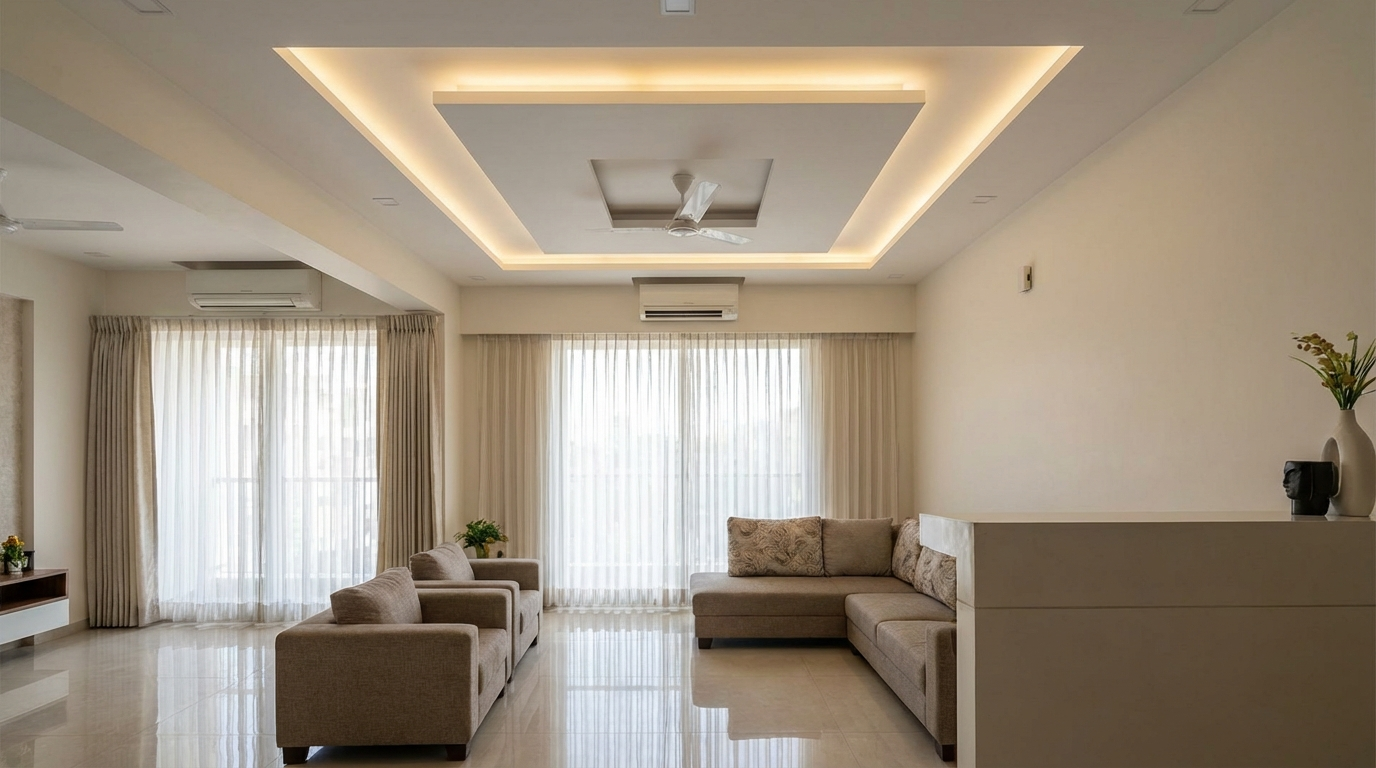
- Rectangular Tray Ceiling: A central recessed rectangle (12–18 inch drop) with the fan mounted in the center and LED strip lighting along edges. Works beautifully in 12×15 ft living rooms.
- Plus-Minus Pattern: Alternating raised and recessed rectangular sections creating visual depth without excessive drop. Ideal for modern apartments with 9.5–10 ft ceilings.
- L-Shaped Corner Drop: A dropped POP section in one corner (typically above the TV unit or sofa) defining functional zones. Requires minimal POP work and costs less.
- Double-Layer Border: Two concentric rectangular borders at different heights with separate lighting channels—adds luxury without complexity.
- Coffered Grid Pattern: Square or rectangular grid with recessed panels—suits large halls (400+ sq ft) with high ceilings. More labour-intensive but visually striking.
- Central Medallion Design: A circular or oval POP feature in the center for chandelier mounting, with simple peripheral border. Classic for traditional Indian homes.
- Geometric Step Pattern: Stepped rectangular layers creating a pyramid effect—dramatic but requires 10+ ft ceiling height for proper proportion.
- Minimal Floating Ceiling: A flat POP panel suspended with visible gap around edges, backlit with LED strips. Ultra-modern aesthetic for contemporary interiors.
- Linear Channel Design: Parallel POP channels (6–10 inch wide) running across the ceiling with integrated linear LED lights. Excellent for narrow or elongated living rooms.
Simple POP Designs for Bedroom (8 Ideas)
Bedrooms benefit from softer, less dramatic ceiling designs that promote relaxation. Ceiling height is often lower (8.5–9.5 ft), requiring designs that don't overwhelm the space:
- Single-Layer Peripheral: A simple 10–12 inch border with warm white cove lighting—creates ambient atmosphere without reducing ceiling height significantly.
- Headboard Accent Ceiling: A POP drop only above the bed headboard area (typically 4×8 ft section) with integrated reading lights. Cost-effective and focused.
- Curved Corner Design: Softened corner transitions with curved POP mouldings—less angular, more calming for bedroom spaces.
- Inverted Tray: Instead of a dropped center, create a raised central portion with recessed edges—adds height perception to compact bedrooms.
- Circular Central Feature: A round or oval POP element for fan/light fixture mounting, keeping the rest of the ceiling flat. Works in 120–180 sq ft bedrooms.
- Half-Wall Extension: POP ceiling that extends partially down one wall behind the bed—creates a cohesive headboard-ceiling feature.
- Minimalist Single Drop: One clean rectangular drop on one side of the room (window or AC side) for concealing wiring. Functional simplicity.
- Soft Wave Pattern: Gentle curved POP undulations across a portion of the ceiling—requires skilled craftsmanship but delivers unique results.
Simple POP Designs for Kitchen and Dining (7 Ideas)
Kitchen false ceilings must accommodate exhaust ducts, recessed lights, and potentially higher humidity from cooking. Dining areas benefit from designs that frame the dining table as a focal point:
- Rectangular Highlight Over Dining Table: A dropped POP section directly above the dining area with pendant light provision—defines the dining zone in open plans.
- Kitchen Work-Zone Ceiling: A simple POP border around the kitchen perimeter with multiple recessed downlights for task lighting over counters.
- Integrated Exhaust Channel: POP boxing that conceals the chimney exhaust duct while providing a clean linear element across the kitchen ceiling.
- Island Ceiling Feature: For kitchens with islands, a corresponding POP drop above the island with pendant lights creates visual anchor.
- Combined Kitchen-Dining Ceiling: A flowing POP design that starts from kitchen and extends to dining, maintaining visual continuity in open layouts.
- Simple Flat POP with Downlights: For compact kitchens, a flat POP ceiling with strategically placed 6W/9W LED downlights—practical and clean.
- Soffit Concealment Design: POP boxing around ceiling edges to hide beams and utility lines, with integrated lighting below.
For kitchen cabinet and interior material guidance, our kitchen plywood selection guide provides detailed specifications.
POP vs Gypsum vs PVC: Which False Ceiling Material for Which Room?
Choosing the right false ceiling material depends on room function, humidity exposure, budget, and aesthetic preferences. This comparison helps you make informed decisions for different spaces in your home.
| Parameter | POP (Plaster of Paris) | Gypsum Board | PVC Panels |
|---|---|---|---|
| Cost (Installed) | ₹50–120/sq ft | ₹70–150/sq ft | ₹40–90/sq ft |
| Moisture Resistance | Low—absorbs moisture | Medium (moisture-resistant variants available) | High—fully waterproof |
| Finish Quality | Seamless, excellent | Good but visible joints possible | Visible panel lines, moderate |
| Design Flexibility | Very high—any shape/curve possible | Moderate—limited to flat/angular | Low—straight lines only |
| Installation Time | 3–7 days (including curing) | 1–3 days | 1–2 days |
| Skill Required | High—expert POP workers needed | Medium—carpenters can install | Low—DIY possible |
| Repair Ease | Easy—patch and repaint | Moderate—panel replacement | Easy—panel swap |
| Lifespan | 15–25 years (proper maintenance) | 20–30 years | 10–15 years |
| Best For | Living rooms, bedrooms, halls | Commercial, humid areas | Bathrooms, balconies, budget projects |
Is POP Good for Indian Kitchens?
POP can work in kitchens but requires careful consideration. The area above the cooking zone experiences heat and moisture from steam, which can degrade POP over time. For best results, restrict POP to dining-adjacent areas and use moisture-resistant gypsum or PVC above the cooktop. If you proceed with full POP in the kitchen, ensure excellent exhaust ventilation and apply oil-based paint rather than emulsion for easier cleaning.
Can POP Be Used in Bathrooms?
POP is not recommended for bathrooms. The high humidity (often 80–95% during and after bathing) causes POP to absorb moisture, leading to bubbling, peeling, and potential fungal growth. Use moisture-grade gypsum board or PVC panels for bathroom false ceilings. If you want a seamless look similar to POP, opt for cement-based plastering systems designed for wet areas.
Price Range and Cost Drivers for POP False Ceilings (2026 Market)
POP false ceiling costs vary significantly based on design complexity, location, material quality, and contractor expertise. Understanding these cost factors helps you budget accurately and negotiate effectively.
Base Cost Breakdown
A basic POP false ceiling in 2026 typically costs between ₹50–120 per square foot, fully installed and painted. This range breaks down as:
- Simple flat ceiling or basic border: ₹50–70/sq ft
- Single-layer tray or peripheral design: ₹70–90/sq ft
- Double-layer or plus-minus patterns: ₹85–110/sq ft
- Complex curves, coffered, or multi-layer designs: ₹100–150/sq ft
Key Cost Factors Explained
Design Complexity: Every additional layer, curve, or drop increases labour hours. A simple border design might take 2 days for a 200 sq ft room; a coffered pattern could take 5–7 days with the same team.
Ceiling Height: Higher ceilings (11+ ft) require scaffolding and more working time, adding 10–15% to costs. Very high ceilings (15+ ft in duplexes) may add 20–30%.
City Location: Metro cities (Mumbai, Delhi NCR, Bangalore) command 20–40% higher labour rates than Tier-2 cities. Skilled POP workers in Mumbai charge ₹600–900/day compared to ₹350–500/day in cities like Indore or Jaipur.
Material Quality: Premium-grade POP powder, galvanized steel framework (vs. mild steel), and quality primers/paints add 15–25% to material costs but improve durability significantly.
Lighting Integration: Cove lighting channels, recessed light housings, and electrical work add ₹50–150/running foot depending on complexity.
Budget Estimation Example
For a 180 sq ft living room with a rectangular tray design and cove lighting:
- Base POP work: 180 sq ft × ₹85 = ₹15,300
- Cove lighting channel: ~50 running ft × ₹80 = ₹4,000
- LED strip lights: ~50 ft × ₹60 = ₹3,000
- Painting (two coats): 180 sq ft × ₹12 = ₹2,160
- Total estimate: ₹24,460 (round to ₹25,000–28,000 including contingencies)
For complete interior budgeting including wardrobes and storage, see our wardrobe material selection guide.
How to Choose: 5-Step Decision Framework for POP False Ceiling
This systematic approach helps you finalize POP false ceiling design, contractor, and specifications without common regrets.
Step 1: Assess Your Ceiling and Room
Measure your existing ceiling height accurately. Subtract 6–10 inches for the false ceiling drop to determine final room height. For comfortable proportions:
- Minimum 8 ft final height for bedrooms (allowing 6-inch drop from 8.5 ft ceiling)
- Minimum 8.5 ft final height for living rooms (allowing 10-inch drop from 9.5 ft ceiling)
- If your ceiling is below 9 ft, opt for minimal peripheral designs rather than full false ceilings
Step 2: Check for Moisture and Structural Issues
Before any POP work, inspect the main ceiling for:
- Water stains or dampness (indicates active leakage—fix first)
- Cracks or hollow areas (may need structural repair)
- Previous coating peeling (surface preparation needed)
Step 3: Define Lighting Requirements
Map out your lighting needs before finalizing design. Consider:
- Number and position of recessed downlights
- Cove lighting locations for ambient illumination
- Ceiling fan placement (requires reinforced mounting)
- Chandelier or pendant provisions (need strong mounting blocks)
Step 4: Select Design Complexity Based on Budget and Timeline
| If Your Priority Is... | Choose This Design Type | Expect This Timeline |
|---|---|---|
| Lowest cost | Simple peripheral border | 2–3 days |
| Modern aesthetics | Rectangular tray with cove lighting | 3–4 days |
| Statement ceiling | Multi-layer or coffered design | 5–7 days |
| Fastest completion | Pre-fabricated gypsum (not POP) | 1–2 days |
Step 5: Vet Your Contractor Thoroughly
Before hiring:
- Request photos of 3–5 recent projects (similar to your design complexity)
- Visit one ongoing or recently completed site if possible
- Confirm material specifications in writing (GI section gauge, POP brand)
- Agree on curing time and painting timeline before starting
- Establish payment milestones (50% advance, 40% on completion, 10% after painting)
Common Buyer Mistakes in POP False Ceiling Projects
Avoiding these documented mistakes can save you significant repair costs and disappointment with your false ceiling investment.
Mistake 1: Ignoring Ceiling Height Limitations
What goes wrong: Installing elaborate multi-layer designs in 8.5–9 ft ceiling rooms, creating claustrophobic spaces with final heights below 8 ft.
Why it happens: Homeowners focus on design images without measuring actual drop requirements.
How to avoid: Always calculate final ceiling height. For rooms below 9 ft, stick to minimal peripheral designs with maximum 6-inch drop.
Mistake 2: Proceeding Without Fixing Roof Leakage
What goes wrong: POP ceiling bubbles, peels, or collapses within 1–2 years due to underlying moisture seepage.
Why it happens: Contractors don't inspect (or ignore) existing moisture issues; homeowners want to proceed quickly.
How to avoid: Demand a moisture check before starting. Apply waterproofing to the structural ceiling if there's any history of leakage.
Mistake 3: Hiring Based on Lowest Quote Only
What goes wrong: Poor finish quality, substandard materials (thin GI sections, low-grade POP), and callbacks for cracks within months.
Why it happens: Significant price variation (sometimes 40–50% between quotes) tempts buyers toward the cheapest option.
How to avoid: Get 3–4 quotes, understand specification differences, and choose mid-range quotes from contractors with verifiable portfolios.
Mistake 4: Not Planning Electrical Layout Before POP Work
What goes wrong: Inadequate provisions for future lights, fans, or AC; cutting into finished ceiling later causes damage and unsightly repairs.
Why it happens: Electrical planning is deferred; POP work starts without coordination with electrician.
How to avoid: Complete electrical layout marking before POP framework begins. Install conduits and mounting blocks during construction.
Mistake 5: Rushing the Curing Process
What goes wrong: Painting applied before complete curing causes paint peeling, bubbling, and uneven finish within weeks.
Why it happens: Project timelines are tight; painters arrive before POP is fully dry.
How to avoid: Allow minimum 48–72 hours curing in dry weather, longer during monsoon. Test by touching—the surface should feel completely dry and cool.
Mistake 6: Skipping Primer/Putty Application
What goes wrong: Paint doesn't adhere properly, surface looks patchy, minor cracks become visible quickly.
Why it happens: Cost-cutting or unskilled painters skip the preparation steps.
How to avoid: Insist on white cement putty application followed by primer before emulsion paint. This adds cost but dramatically improves finish and durability.
Mistake 7: Not Reinforcing Fan/Heavy Fixture Mounting Points
What goes wrong: Ceiling fans or heavy chandeliers cause sagging, cracking, or dangerous detachment over time.
Why it happens: Mounting is done directly to POP without proper anchoring to the structural ceiling above.
How to avoid: Install wooden or metal mounting blocks anchored to the main ceiling before POP application. Heavy fixtures should hang from the structural ceiling, not the false ceiling.
Workmanship and Installation Tips for Quality POP Ceilings
Quality POP false ceiling depends heavily on craftsmanship. These practical guidelines help you supervise work effectively and catch issues early.
Framework Quality Checks
Before POP application begins, inspect the metal framework:
- GI Section Quality: Look for galvanized (silver-colored) sections, not painted black mild steel which rusts quickly
- Spacing: Main channels should be 3–4 ft apart; furring channels at 1.5–2 ft intervals
- Level: Use a long spirit level or laser level to verify the framework is perfectly horizontal
- Suspension: Check that hanging rods are securely anchored to the structural ceiling, not just plastered in
POP Application Standards
During application, monitor these quality markers:
- Mixing: POP should be mixed to smooth paste consistency, without lumps or excessive water
- Layering: Multiple thin layers (2–3 coats) are stronger than one thick application
- Mesh Coverage: Ensure metal lath or chicken mesh is completely embedded in POP with no exposed wire
- Joint Treatment: Corners and joints need extra attention and reinforcement tape in high-stress areas
What Thickness of POP Is Best for False Ceilings?
For standard residential false ceilings, POP thickness should be 8–12mm for flat surfaces. Mouldings, drops, and decorative elements can range from 15–25mm. Thickness below 8mm is structurally weak and prone to cracking. Excessive thickness (above 20mm on flat areas) adds unnecessary weight and increases cracking risk from shrinkage during curing.
Post-Installation and Painting Sequence
- Curing: Allow 48–72 hours minimum (longer in humid conditions)
- Sanding: Light sanding to remove any rough spots or drips
- Putty: Apply white cement putty to fill minor imperfections (1–2 coats)
- Primer: Apply PVA or acrylic primer for paint adhesion
- Painting: Two coats of acrylic emulsion paint for durability
Site Storage and Material Handling
Proper material storage is critical but often neglected on Indian sites:
- Store POP bags elevated off the ground on wooden pallets
- Keep away from rain exposure and high humidity areas
- Use within 2–3 months of manufacture for best results
- GI sections should be stored flat, not leaning, to prevent bending
Quality Checks Without Lab Tests: Field Inspection Guide
You don't need laboratory equipment to assess POP false ceiling quality. These practical checks help homeowners evaluate work at every stage.
Before Work Begins: Material Inspection
- POP Powder Test: Take a small amount in your palm, add water—it should form smooth paste without lumps. Grainy texture indicates old or moisture-damaged POP
- GI Section Check: Scratch the surface slightly—silver galvanized coating should be visible, not rust or black paint
- Check Manufacturing Date: POP bags should show production date within the last 2–3 months
During Installation: Visual Monitoring
- Framework Alignment: Stand at different corners and sight along the framework—any waviness or dipping indicates leveling issues
- Suspension Security: Gently tug hanging rods to verify secure anchoring
- Mesh Coverage: No wire should be visible after first POP coat
After Completion: Quality Assessment
- Tap Test: Gently tap across the surface with knuckles—consistent solid sound indicates proper adhesion. Hollow sounds suggest air pockets or delamination
- Visual Scan: Use a flashlight at an angle across the surface—this reveals waves, bumps, or uneven areas invisible under normal lighting
- Corner Inspection: Check all corners and edges for clean, sharp lines. Rounded or uneven corners indicate poor craftsmanship
- Touch Test: After painting, the surface should feel uniformly smooth without grainy or rough patches
Questions to Ask Your Contractor
- What gauge GI sections will you use? (Answer should be 0.45–0.55mm for residential)
- Which brand of POP will you use? (Established brands include Shree, JK, Birla)
- How many days will you allow for curing before painting?
- What's your warranty period for cracking or peeling? (Reasonable contractors offer 1–2 years)
- Will you apply putty and primer, or is that separate?
Lighting Integration: Making POP Ceilings Functional
False ceilings become truly valuable when they integrate lighting effectively. Proper planning of lighting makes the difference between a decorative ceiling and a functional one.
Types of Lighting for POP Ceilings
Cove Lighting: LED strip lights concealed in recessed channels that bounce light off the ceiling, creating soft ambient illumination. Best for living rooms and bedrooms. Use warm white (2700–3000K) for residential spaces.
Recessed Downlights: 6W, 9W, or 12W LED fixtures mounted flush with the ceiling surface. Plan 1 downlight per 25–30 sq ft of floor area for general illumination. Use 4000K (neutral white) for kitchens and work areas.
Pendant/Chandelier Provisions: Heavy fixtures need anchoring to the structural ceiling with mounting blocks built into the POP during construction. Plan these locations before framework installation.
Profile Lights: Linear LED fixtures that create architectural lines across the ceiling. Increasingly popular in modern Indian interiors for their clean, contemporary look.
How Long Do LED Lights Last in False Ceilings?
Quality LED strips and fixtures last 25,000–50,000 hours, translating to 10–15 years of typical residential use (6–8 hours daily). However, LED drivers (the electronic components powering the LEDs) typically fail before the LEDs themselves, lasting 5–8 years. Plan for accessible driver locations during installation to simplify future replacements. Avoid sealing drivers inside POP—they generate heat and need ventilation.
Common Lighting Mistakes to Avoid
- Placing cove lighting too close to the wall—maintain 4–6 inch gap from vertical surfaces
- Using cool white (6000K+) LEDs in living spaces—creates harsh, clinical atmosphere
- Insufficient provision for future additions—always run spare conduits during installation
- Non-dimmable lights everywhere—use dimmable options in bedrooms and living areas for flexibility
For complete home lighting planning including modular areas, our interior lighting guide covers specifications in detail.
Maintenance and Long-Term Care for POP False Ceilings
With proper maintenance, POP false ceilings last 15–25 years. Neglect leads to premature deterioration, staining, and costly repairs.
Regular Maintenance Schedule
Monthly: Light dusting with dry microfiber cloth or soft brush. Avoid wet cleaning as POP absorbs moisture.
Quarterly: Inspect for hairline cracks, especially at corners and around fixture mounts. Small cracks are normal settling; widening cracks indicate structural issues.
Annually: Check for any yellowing or staining (may indicate moisture seepage from above). Inspect pendant mounts and fan mounts for stability.
Every 3–5 Years: Repaint with fresh acrylic emulsion to maintain appearance. This is also the opportunity to repair minor cracks with wall putty before repainting.
Dealing with Common Problems
Hairline Cracks: Fill with acrylic crack filler or wall putty, sand smooth, and repaint. Persistent cracking in the same area indicates framework movement—investigate cause.
Water Stains: First fix the source of water (roof leak, pipe seepage). Once dry, apply stain-blocking primer before repainting. Persistent moisture will cause ongoing problems.
Sagging: Minor sagging near fixtures indicates inadequate support. Major sagging requires professional inspection—may need section replacement or framework reinforcement.
Yellowing: Often caused by smoke exposure (kitchen-adjacent ceilings) or moisture. Clean with mild detergent solution (test in inconspicuous area first), then repaint with fresh emulsion.
FAQs About Simple POP Design False Ceilings
What is the cost of simple POP false ceiling per square foot in India?
Simple POP false ceiling costs range from ₹50–120 per square foot in India, depending on design complexity, location, and contractor expertise. A basic peripheral border design costs ₹50–70 per sq ft, while multi-layer tray designs with cove lighting range from ₹85–110 per sq ft. Metro cities like Mumbai and Delhi NCR command 20–40% higher rates than Tier-2 cities. This price typically includes material, labour, and basic finishing but excludes painting, which adds ₹10–15 per sq ft for quality acrylic emulsion with primer and putty.
How much does POP false ceiling drop from the main ceiling?
Standard POP false ceiling drops 6–10 inches from the main structural ceiling. Simple peripheral designs need only 4–6 inches, while elaborate tray or coffered designs may require 8–12 inches. The framework itself occupies 3–4 inches, with additional drop for design depth and lighting channels. For rooms with 9 ft ceiling height, a 6-inch drop is recommended to maintain comfortable final height of 8.5 ft. Rooms with higher ceilings (10+ ft) can accommodate more dramatic drops without feeling cramped.
Is POP false ceiling better than gypsum board?
POP and gypsum board each have advantages depending on application. POP offers seamless finish without visible joints, unlimited design flexibility for curves and custom shapes, lower cost, and easier repairs. Gypsum board provides faster installation, better moisture resistance (especially moisture-grade variants), consistent factory quality, and fire resistance. For living rooms and bedrooms where seamless aesthetics matter, POP is often preferred. For commercial spaces, humid areas, or when timeline is critical, gypsum board works better. Many contractors now use hybrid approaches—gypsum for flat areas and POP for decorative elements.
How long does POP false ceiling last?
Well-constructed POP false ceilings last 15–25 years with proper maintenance. Longevity depends on installation quality (framework, curing time, finishing), environmental conditions (humidity, temperature fluctuations), and maintenance practices. In dry climates like Rajasthan and Gujarat, POP ceilings can exceed 25 years. In humid coastal areas like Mumbai or Chennai, expect 12–18 years before significant repairs are needed. Regular repainting every 3–5 years, prompt crack repairs, and preventing moisture ingress from above are key to maximizing lifespan.
Can POP false ceiling be installed in apartments with low ceilings?
POP false ceiling can be installed in apartments with 8.5–9 ft ceiling heights using minimal designs. Opt for simple peripheral borders with 4–6 inch drop, maintaining final ceiling height of 8–8.5 ft. Avoid multi-layer designs, deep trays, or elaborate patterns that require 8+ inch drops. For extremely low ceilings (below 8.5 ft), consider alternative approaches like painted ceiling designs with mounted track lights, or partial false ceilings covering only specific zones rather than the entire room. The key is maintaining at least 8 ft final height for comfortable livability.
Is POP false ceiling safe? Does it fall?
Properly installed POP false ceiling is safe and poses minimal falling risk. Falls occur due to poor framework installation (inadequate anchoring to structural ceiling), water damage weakening the POP, or overloading with heavy fixtures not properly supported. Quality installations use GI sections anchored with expansion fasteners or concrete screws, multiple suspension points per square meter, and proper load distribution for fans and lights. Hiring experienced contractors, using quality materials, and maintaining the ceiling (especially preventing moisture damage) virtually eliminates falling risk.
What is plus-minus POP design?
Plus-minus POP design refers to a pattern of alternating raised (plus) and recessed (minus) rectangular sections creating three-dimensional visual interest on the ceiling. Typically, rectangular boxes of varying sizes are constructed at two different heights—some projecting down (plus) and some recessed up (minus). This design adds depth and shadow play without requiring elaborate curves or expensive materials. Plus-minus designs are popular in Indian living rooms and halls because they offer visual sophistication at moderate cost, work with standard ceiling heights, and complement both modern and traditional interiors.
How to remove POP false ceiling for repairs?
Removing POP false ceiling for repairs requires careful process. For localized repairs (pipe access, electrical work), cut a rectangular section using a sharp knife or small saw, preserving clean edges for patching. For complete removal, chip away POP from edges working toward center, then dismantle the metal framework. POP generates significant dust—use drop cloths to protect furnishings and flooring, wear dust masks, and work in small sections. After repairs, reinstall framework and apply fresh POP. Matching old and new POP seamlessly requires skilled craftsmanship; plan to repaint the entire ceiling for uniform appearance.
Which paint is best for POP false ceiling?
Acrylic emulsion paint is the best choice for POP false ceilings due to its durability, washability, and resistance to yellowing. Premium brands offer ceiling-specific emulsions with higher coverage and better adhesion. Use matte or low-sheen finishes rather than glossy paints—matte hides minor surface imperfections while glossy finishes highlight every flaw. Apply primer coat before painting for better adhesion and uniform finish. For kitchen-adjacent ceilings exposed to smoke and grease, consider semi-gloss or satin finish for easier cleaning. White remains the most popular ceiling color, but light pastels and off-white shades work well in bedrooms.
How to clean POP false ceiling without damaging it?
Clean POP false ceilings using dry methods only, as POP absorbs water and can be damaged by wet cleaning. Use a soft dry cloth, microfiber duster, or vacuum with brush attachment for regular dust removal. For stubborn stains, try a slightly damp (not wet) cloth with mild soap, immediately followed by dry cloth—test in an inconspicuous area first. Never spray water directly onto POP surfaces. For smoke stains or yellowing, repainting is often easier and more effective than cleaning. Cobwebs in corners can be removed with soft brush or vacuum hose. Clean regularly (monthly) to prevent dust accumulation that's harder to remove later.
Is POP false ceiling fireproof?
POP itself is fire-resistant—Plaster of Paris doesn't burn and actually releases water vapor when heated, providing some fire resistance. However, POP false ceilings are not classified as fireproof because the metal framework can conduct heat, and any wooden components or electrical wiring within the ceiling space present fire risks. For improved fire safety, use fire-resistant electrical conduits, avoid overloading circuits powering ceiling fixtures, and ensure proper heat dissipation from recessed lights. In commercial applications requiring fire ratings, gypsum board with specific fire certifications is preferred over POP.
Can I install POP false ceiling myself (DIY)?
DIY installation of POP false ceiling is not recommended for homeowners without construction experience. Unlike some home improvement projects, POP work requires specialized skills—accurate framework leveling, proper POP mixing and application technique, smooth finishing, and safe electrical integration. Poor DIY attempts result in uneven surfaces, visible framework lines, cracking, and potentially unsafe installations. The cost savings from DIY are minimal compared to professional installation, while the quality difference is significant. If budget is the primary concern, consider simpler alternatives like PVC panels (genuinely DIY-friendly) or negotiate with contractors for basic designs within your budget.
What is the difference between POP and gypsum false ceiling finish quality?
POP produces a completely seamless finish as it's applied wet and cures as a single continuous surface—joints and connections are invisible. Gypsum board produces visible seams at panel joints that require taping and jointing compound; skilled finishing reduces but doesn't eliminate these lines. For large continuous ceilings or where seamless aesthetics are priority (formal living rooms, master bedrooms), POP provides superior visual quality. For areas where slight joint visibility is acceptable or will be masked by lighting/design features, gypsum board's faster installation and better moisture resistance may outweigh the finish difference.
How to choose between simple and elaborate POP designs?
Choose simple POP designs (peripheral borders, basic trays) when ceiling height is limited (below 10 ft), budget is constrained, room size is compact, modern minimalist interiors are desired, or skilled POP craftsmen are unavailable locally. Choose elaborate designs (multi-layer, coffered, curved) when ceiling height exceeds 10 ft, budget allows higher per-sq-ft costs, room is large enough to appreciate complexity (200+ sq ft), traditional or luxurious aesthetics are desired, and experienced craftsmen are accessible. Remember that simple designs executed excellently always look better than elaborate designs executed poorly.
Final Thoughts: Making Your POP False Ceiling Decision
Simple POP design remains one of the most practical choices for Indian homes seeking elegant false ceilings without excessive costs. The key to success lies not in choosing the most elaborate design, but in matching design complexity to your space dimensions, selecting competent craftsmen, and maintaining the ceiling properly over time.
Before finalizing your design, spend time in spaces with similar false ceilings—friends' homes, showrooms, hotel lobbies—to understand how different designs feel in real spaces, not just photos. Discuss lighting integration early in the planning process, as this determines much of the ceiling's functional value. And remember that in Indian climate conditions, moisture management above the ceiling is just as important as the design below it.
Whether you choose a minimalist peripheral design for a compact bedroom or an elaborate coffered pattern for a spacious hall, the principles remain the same: quality materials, skilled installation, adequate curing time, and proper finishing. These fundamentals, combined with designs suited to your space and style, will deliver a POP false ceiling that enhances your home for years to come.
For guidance on other interior materials including plywood grades for furniture and cabinet construction, explore our detailed material selection guides covering Indian market options and specifications.
Disclaimer: This content is provided for general informational purposes based on industry practices and publicly available information. Product specifications, standards, prices, and availability may vary by manufacturer, region, and time. Readers should independently verify details with manufacturers, dealers, or qualified professionals before making purchase or construction decisions.Want Plywood Suggestions?
Share a few details and a Sainik 710 specialist will suggest suitable brands and connect you to responsive dealers.