Shoe Rack Design Ideas: 30+ Modern, Wall-Mounted & Cabinet Styles for Indian Homes
Get 30+ shoe rack designs—wall-mounted, cabinet & open styles. Space-saving solutions, material guide & size options for organized Indian entryways.
The Quick Answer on Shoe Rack Designs
A shoe rack is a dedicated storage unit—wall-mounted, freestanding, or cabinet-style—that keeps your footwear organized while fitting your home's layout and climate needs.
Short version: If you're short on time, here's the deal. Wall-mounted shoe racks free up valuable floor space and keep your entrance clean by placing shoes at a convenient height. For Indian homes dealing with monsoon humidity and limited entryways, go for ventilated cabinet designs in 12-16mm plywood with louver doors—these hide the mess while letting your shoes breathe. Open tiered racks work fine in dry cities like Jaipur or Ahmedabad, but Mumbai and Chennai folks, you need closed options with proper air circulation.
This is right for you if:
- You're tired of shoes scattered at your doorstep and want a clean entryway
- Your shoe rack needs to prevent dirt from being tracked inside while letting wet shoes dry properly
- You have a joint family with 15-20+ pairs of footwear across sizes—from dadaji's chappals to kids' school shoes
- Your carpenter is asking for design input and you have no clue what to tell him
Skip this if:
- You're looking for those ₹500 plastic stackable racks from Amazon—this guide focuses on built-in and semi-permanent solutions
- You want exact prices (market fluctuates too much, I'll give you ranges instead)
Bottom line: The best shoe rack design for most Indian homes is a wall-mounted cabinet with flip-down compartments and louver ventilation—it hides shoes, saves floor space, and handles our humidity.
What a Shoe Rack Actually Means for Your Home
A shoe rack is a furniture piece or built-in storage unit which keeps pairs of shoes together and organized, commonly found in an entry foyer, vestibule, or closet. Simple enough, right? But here's where most people go wrong.
Most people think any random shelf near the door counts as a shoe rack. Actually, a proper shoe rack considers three things: capacity (how many pairs), accessibility (can you grab shoes without bending awkwardly), and ventilation (especially critical in our climate). A shoe rack brings convenience of finding footwear instantly, without worrying about dust, dirt, and disorganization—like every Indian, we put off our shoes before entering our home, and with a shoe cabinet in your entryway, you can maintain a clean space.
The technical bit if you're curious: shelf depth should match shoe length—most shoe racks range from 12 to 18 inches deep, with 12-15 inches sufficient for sneakers, flats, and sandals, while 18 inches is recommended for boots and high-heeled shoes. I see so many custom-built racks where the carpenter made shelves too shallow, and shoes stick out looking messy. Or too deep, wasting precious entryway space. Get this dimension wrong, everything else falls apart.
Why This Matters in Indian Homes
Here's the thing about shoe storage in India. We have specific challenges that Western designs don't address.
First, the humidity factor. A well-designed wooden shoe rack absorbs excess moisture, making it less likely to cause water damage—rainwater sticking to soles fosters bacteria and encourages mildew, so placing wet shoes on a rack facilitates them to dry out safely. In Mumbai during July-August, humidity can hit 85-90%. In Chennai, it stays consistently high year-round. The Kolkata side during monsoons is brutal. I've seen beautiful teak shoe cabinets develop fungus within one rainy season because they had no ventilation—just solid doors trapping all that moisture inside.
Proper ventilation is essential to keep shoes fresh and odor-free—when designing or choosing a shoe cabinet, look for options with slatted doors or sides to allow air to circulate freely. This isn't optional in coastal cities. I had a client in Bandra who insisted on a sleek, fully enclosed shoe cabinet because it looked premium. By October, the smell was unbearable. We had to retrofit louvers.
Inland cities like Pune, Bengaluru, and Ahmedabad have it easier—humidity stays manageable most of the year, so you can get away with semi-open designs. But even there, monsoon months need attention.
Second, our entryways are typically smaller than Western homes. A 3x3 foot foyer is common in flats. You can't put a massive shoe cabinet there. One of the many advantages of a shoe rack mounted on the wall is that it frees up valuable floor space. Wall-mounted flip-down designs work brilliantly here—shoes stay hidden, floor stays clear.
Types of Shoe Rack Designs: The Complete Breakdown
Is an open shoe rack actually practical for Indian homes?
Depends on where you live and your dust tolerance. Open shelf racks offer the best access without doors—you can view your entire collection and choose what you need for the day. But in Gurgaon or Delhi during October-November, the dust will coat your shoes within days. Chennai's coastal humidity makes open racks problematic too—shoes stay perpetually damp.
Open tiered racks work best in: air-conditioned rooms, walk-in closets, or dry inland cities. If your shoe rack sits in a balcony-adjacent entryway facing the road, closed is the only sensible option. I've had arguments with interior designers over this—some want the "airy modern look" without understanding practical maintenance.
Wall-Mounted Shoe Racks
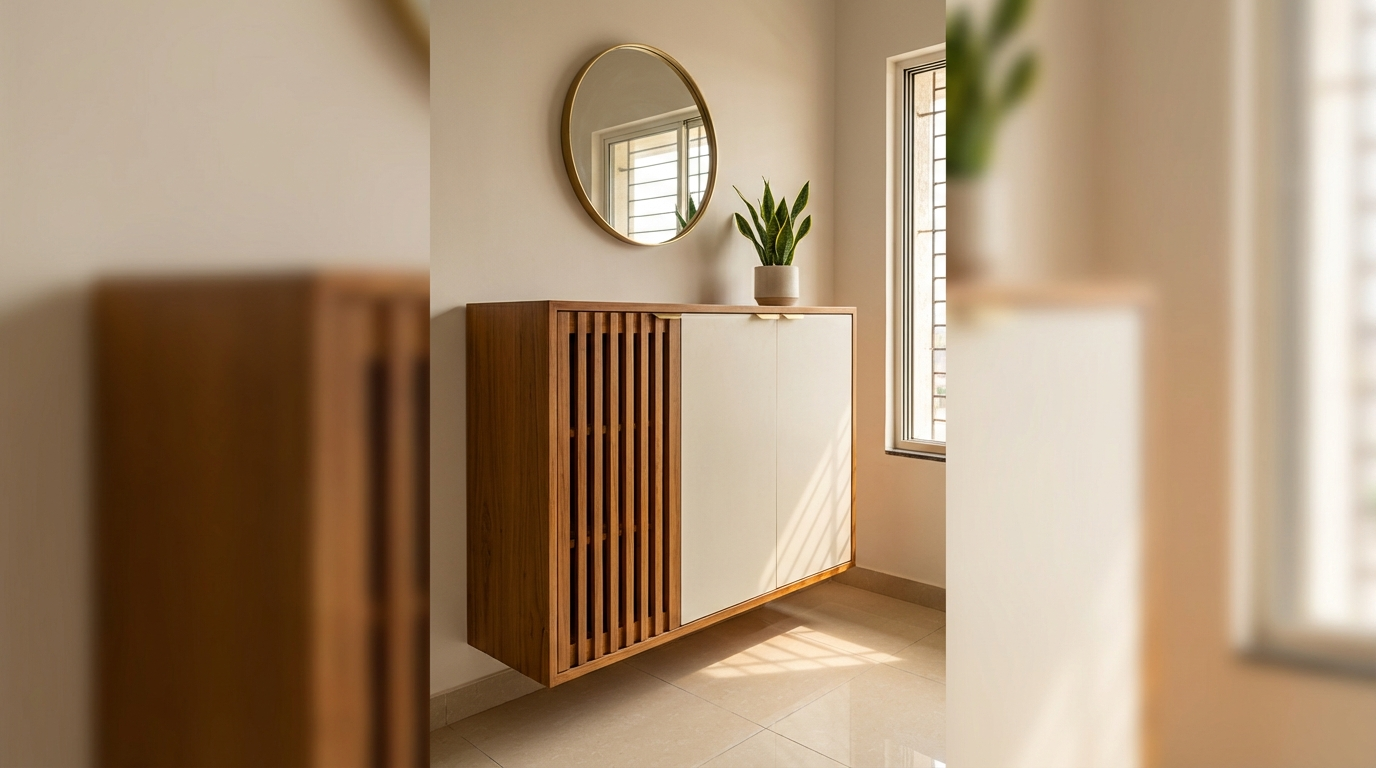
A wall-mounted plywood shoe rack is a space-efficient storage solution for smaller apartments or narrow hallways—keeping shoes off the floor is great for cleaning and for an organized look. These are my personal favorite for urban Indian flats.
The flip-down style is brilliant. Essentially a series of tilting compartments mounted at waist height. You flip it open, place shoes, flip it shut. Wall mounted shoe racks have air louvers for ventilation to keep shoes smelling fresh—despite being closed, the cabinet has ventilation holes that keep odors and humidity at bay.
For material, wall-mounted shoe organizers can be made from a single sheet of 19mm plywood, with adjustable shelves to suit changing needs. I typically recommend 16mm for lighter designs—18mm only if you're mounting a heavy cabinet that'll hold 20+ pairs.
Cabinet-Style Shoe Racks
Cabinet shoe racks are enclosed units that help keep shoes out of sight, providing a neat appearance—they can have doors that swing open or a sliding mechanism, and are a great way to keep your home organized.
These work best for large families with extensive shoe collections. My recommendation: go for adjustable shelves inside. Kids' shoe sizes change every year, and you'll want to reorganize spacing as your collection evolves. Look for shoe cabinets with multiple compartments and adjustable shelves to accommodate different shoe sizes and styles.
The louver door style is specifically good for our climate. Those angled slats allow airflow while hiding contents. Solid doors look cleaner but trap moisture—bad idea in Mumbai or any coastal area.
Shoe Rack with Bench/Seating
The shoe rack with seat is not only stylish but overall elevates the look of your room. Beyond aesthetics, it's genuinely practical. Elderly family members, pregnant women, anyone with back issues—sitting while putting on shoes makes life easier.
Standard dimensions for a shoe storage bench are around 37 inches wide, 14 inches deep, and 19 inches tall. Below the seat, you get open cubbies or closed compartments. Some designs have a cushioned top. If you're getting one custom-made, ensure the seat height is comfortable—too low and getting up becomes difficult, especially for older folks.
Corner and Rotating Designs
Lazy Susans and rotating racks enhance accessibility in small spaces. Corner shoe racks utilize that awkward 90-degree space near doors that usually stays wasted. Rotating designs let you access shoes from multiple angles.
Honestly? I've seen rotating racks fail more often than succeed. The mechanism needs quality bearings, and Indian dust gets into everything. Three years in, it starts jamming. Go for fixed corner units instead—less flashy, more reliable.
Comparison Table: Shoe Rack Types
| Type | Best For | Capacity | Ventilation | Space Needed | My Take |
|---|---|---|---|---|---|
| Open Tiered Rack | Walk-in closets, dry climates | 10-30 pairs | Excellent | Floor space required | Good budget option but collects dust |
| Wall-Mounted Flip | Small entryways, apartments | 8-16 pairs | Good with louvers | Minimal | My favorite for urban flats |
| Full Cabinet | Large families, formal entryways | 20-40+ pairs | Depends on door style | Significant | Worth it if you have space |
| Bench Style | Mudrooms, homes with elderly | 6-12 pairs | Usually open | Moderate | Practical but limited capacity |
| Corner Unit | Utilizing dead corners | 8-15 pairs | Variable | Uses corner space | Underrated option |
| Pull-out Drawer | Built-in wardrobes | 6-10 pairs per drawer | Poor (needs ventilation holes) | Inside existing furniture | Good for occasional-wear shoes |
Price Reality Check (2026 Market)
Alright, let me give you the honest picture on costs. Prices vary significantly based on material, finish, and where you're buying.
For ready-made options from furniture stores, expect to pay roughly:
- Basic metal tiered rack (3-4 shelves): ₹1,500-3,000
- Engineered wood cabinet (small): ₹5,000-12,000
- Solid wood cabinet (medium): ₹12,000-25,000
- Premium designs with bench: ₹18,000-40,000+
Custom-built by carpenter using plywood:
- Wall-mounted flip-down (3-door): ₹8,000-15,000 including hardware and laminate
- Full cabinet with louvers: ₹15,000-30,000 depending on size
- Built-in unit with seating: ₹25,000-45,000
The thickness of plywood makes a difference when creating a strong and sturdy shoe rack—if shelves carry multiple shoes, 16mm or 19mm plywood works best to withstand daily weights without sagging. Don't let your carpenter convince you that 12mm is "enough"—for anything wider than 18 inches between supports, it will sag over time.
Here's what actually affects your final bill:
- Hardware quality: Good hinges (Hettich, Ebco) add ₹800-1,500 but last years. Cheap hinges fail within months.
- Finish type: Laminate is ₹15-25 per sq ft cheaper than veneer, and honestly more practical for shoe storage—easier to wipe clean
- Depth: Going from 12" to 18" depth adds 30-40% to material cost
- Special features: Soft-close mechanisms, internal lighting, rotating shelves—each adds ₹2,000-5,000
Wall-Mounted vs. Floor-Standing: The Honest Comparison
| Parameter | Wall-Mounted | Floor-Standing | My Preference |
|---|---|---|---|
| Space efficiency | Excellent—floor stays clear | Takes floor area | Wall-mounted for small entryways |
| Installation | Needs sturdy wall, proper anchors | Just place and use | Depends on wall quality |
| Capacity | Limited by wall space | Can be much larger | Floor-standing for big families |
| Accessibility | At comfortable height | May need bending for lower shelves | Wall-mounted wins |
| Cleaning underneath | Easy—nothing on floor | Needs moving or lifting | Wall-mounted, hands down |
| Stability | Depends on mounting | Can tip if tall and narrow | Both need attention |
| Flexibility | Permanent placement | Can relocate | Floor-standing if renting |
| Cost | Usually lower for same capacity | Varies widely | Similar overall |
Choose wall-mounted when: Your entryway is under 4x4 feet, you hate seeing shoes at ground level, or you have young kids/pets who'll knock over freestanding units.
Choose floor-standing when: You're in a rented flat and can't drill walls, your family has 25+ pairs to store, or you want the flexibility to move it later.
The trade-off: Wall-mounted gives you cleaner floors but limits capacity. Floor-standing offers more storage but eats into your circulation space. Indian consumers often favor shoe racks placed in west/southwest orientations according to Vastu, so consider this for placement.
How to Choose: The Decision Framework
Step 1: Count your shoes
Seriously. Go count them. Most people underestimate by 30-40%. Include chappals, sports shoes, formal shoes, occasional wear—everything. Add 20% buffer for future purchases.
Step 2: Measure your space
Not just width and height. Check door swing clearance. Measure the wall depth if it's recessed. Note any switches, electrical boards, or water pipes that limit placement.
Step 3: Consider climate and placement
Is this going near an exterior door that stays open? Near a window that leaks during rain? In a semi-outdoor balcony space? Each scenario needs different ventilation levels.
Step 4: Match to family needs
Small kids can't reach wall-mounted racks above 3 feet. Elderly members struggle with pull-out drawers. Think about who uses this daily.
Step 5: Set realistic budget
Factor in hardware, handles, and installation—not just the cabinet cost.
Decision Matrix
| Your Situation | Recommendation | Why |
|---|---|---|
| 2BHK apartment, small family (3-4 members) | Wall-mounted flip cabinet, 3 doors | Saves space, sufficient capacity |
| Large flat, joint family (8+ members) | Floor-standing cabinet with bench | Need 30+ pair capacity, seating helpful |
| Ground floor flat, monsoon-prone city | Raised cabinet with louvers | Keeps shoes off wet floor, allows drying |
| Walk-in closet with space | Built-in shelving system | Maximizes storage, integrates with wardrobe |
| Rented accommodation | Freestanding rack or bench | Can take it when you move |
| Minimalist aesthetic requirement | Hidden pull-out in console | Shoes completely concealed |
Red flags to walk away from:
- Carpenter suggesting particle board for shoe rack—it cannot handle moisture
- Designs with no ventilation holes in closed cabinets
- Extremely thin (less than 12mm) shelves spanning more than 45cm
- Ready-made units with plastic hinges—they'll crack within months
- Any "waterproof" claim for basic MDF or plywood without proper treatment
Common Mistakes People Make
1. Ignoring ventilation entirely
This one really frustrates me. Without adequate air circulation, your shoes can become musty and unpleasant to wear. I've seen expensive Italian leather shoes ruined inside beautiful cabinets because nobody thought about airflow. If your cabinet doesn't have louvers or ventilation holes, you're essentially creating a humidity chamber.
2. Underestimating capacity needs
That designer 8-pair cabinet looks elegant in the showroom. Then you get home and realize your family has 24 pairs. Now shoes overflow onto the floor, defeating the purpose entirely. Count your shoes first. Always.
3. Choosing style over substance
Glass-front shoe cabinets look fancy but show every speck of dust and dirt. High-gloss finishes show fingerprints. Elaborate carved designs collect grime. For shoe storage, practical beats pretty every time.
4. Wrong shelf spacing
Standard spacing between shelves is typically 12-18 inches—12 inches is sufficient for flats, while boots and high heels need 18 inches. I've seen racks where all shelves are equally spaced at 15cm—great for flats, useless for boots. Get adjustable shelves or plan heights based on what you actually own.
5. Forgetting about weight
Plywood is versatile, inexpensive and strong. But 8mm plywood shelving will sag if you load it with 6-8 heavy shoes. If shelves are carrying multiple shoes, 16mm or 19mm plywood works best to withstand daily weights without sagging or breaking.
6. Placing in direct sunlight
That sunny spot near the window seems logical for drying shoes. But UV exposure fades leather and cracks rubber soles over time. Indirect light and air circulation is what you want.
7. Skipping the drip tray
During monsoons, wet shoes drip water. Without a tray or removable mat at the bottom, that water damages the rack base. Simple ₹200 solution that people overlook.
8. Going too tall without anchoring
Tall narrow shoe cabinets (above 4 feet) become top-heavy when loaded. Built for durability and family safety, shoe storage cabinets should include anti-tipping devices to securely attach to the wall, especially in homes with children and pets. I've seen one topple over on a toddler in Powai—thankfully minor injuries, but completely preventable.
9. Not accounting for seasonal shoes
Your everyday rack doesn't need to hold wedding heels and winter boots. Store occasional-wear footwear elsewhere and size your primary rack for daily-use shoes only.
Quality Checks You Can Do Yourself
Visual Inspection
- Check laminate edges—peeling at corners indicates poor workmanship
- Look for even gaps around doors and drawers—uneven gaps mean misalignment
- Examine hinges: branded hardware (Hettich, Hafele, Ebco) has visible markings
- Look inside for rough edges that could catch on shoe fabric
- Verify ventilation holes aren't just decorative—they should go through
- Check if shelves are truly removable/adjustable as claimed
Questions to Ask Your Dealer or Carpenter
- "What's the core material—plywood, MDF, or particle board?"
- "What thickness are the shelves and sides?"
- "Which brand of hardware—hinges, slides—are you using?"
- "How are the joints made—just glue, or proper screws?"
- "What's the warranty, and what does it actually cover?"
Simple Field Tests
- Weight test: Press down firmly on shelves—any flex is concerning
- Door test: Open and close doors 10 times. Should be smooth throughout.
- Knock test: Solid plywood sounds dull, hollow particle board sounds...hollow
- Edge check: Run your finger along all edges—no roughness or splinters
- Stability test: Gently push from the side. Shouldn't wobble excessively.
Warning Signs
- Extremely low prices—likely particle board disguised as plywood
- Refusal to show inside of cabinet or back panel
- Generic "imported hardware" claims without brand names
- Visible glue residue at joints
- Different finish inside vs. outside (cost-cutting)
- No ventilation in closed designs—they don't understand the climate
Here's a trick most dealers don't like: ask to see the invoice for raw materials. A genuine vendor can show you plywood and hardware purchase receipts. Those who buy in bulk have nothing to hide.
Workmanship and Installation Guide
Material Selection
For plywood shoe racks, I recommend BWR (boiling water resistant) grade for areas near exterior doors or in humid cities. MR grade is fine for interior closets in drier climates. Avoid commercial grade entirely—too much moisture exposure in shoe storage.
Plywood is durable and smooth-finished, which is why homeowners today are turning to plywood shoe rack solutions. Our HDHMR vs plywood guide covers the material comparison in more detail if you want to go deeper.
Edge Treatment
Use a soft cloth to dust the surface, and a damp cloth to remove spills immediately—spills can stain or develop watermarks. But the real protection starts during construction. All exposed plywood edges need edge banding or proper laminate wrapping. Unsealed edges absorb moisture, swell, and eventually delaminate.
For DIY builds, iron-on edge banding is affordable and effective. Your carpenter should be doing this automatically—if they skip it, that's a red flag about their overall quality standards.
Mounting Wall Units
If possible, attach the rack to a wall stud—mark its location, hold the rack in place and make sure it's plumb, drill countersunk pilot holes near the top, bottom, and middle, then drive screws through the back and into the stud.
In Indian construction, walls are usually brick or concrete, not stud-based. You'll need proper wall plugs and anchors. For heavy shoe cabinets (15+ kg when loaded), use 8mm or 10mm rawl plugs with appropriate screws. Don't trust the flimsy plastic plugs that come with some ready-made units.
What to Tell Your Carpenter: Briefing Checklist
- Specify exact outer dimensions based on your space measurement
- Mention plywood grade and thickness—don't leave it to their discretion
- Request branded hardware by name (Hettich soft-close, for example)
- Insist on ventilation—louvers or holes of specific diameter
- Ask for edge banding on all exposed surfaces
- Request a removable base tray or moisture-resistant bottom
I've seen carpenters skip ventilation because "it's extra work." Had a client in Thane whose carpenter assured him the solid doors would be fine. Eleven months later, fungus on leather shoes, terrible smell, complete cabinet replacement needed. The ₹800 saved on louver work cost ₹18,000 in replacement.
How Long Does a Shoe Rack Actually Last?
Honest answer: it depends heavily on material, construction quality, and maintenance.
Solid wood (sheesham, teak): 15-25+ years with proper care. Worth the investment if budget allows.
Good plywood (BWR, 16mm+): 8-15 years. Most practical choice for custom builds.
MDF with laminate: 5-8 years. Okay for dry locations, fails faster in humid areas.
Particle board: 2-4 years, maybe less with moisture exposure. Avoid.
Metal racks: 10-15 years, but prone to rust in coastal cities without proper coating.
What affects longevity:
- Overcrowded shelves restrict airflow and lock in moisture—properly spaced cabinets facilitate better drying and more convenient access.
- Screws and fasteners need to be checked for tightness periodically so the shoe rack stays stable.
- Using silica gel sachets, bamboo charcoal, or desiccant balls within the rack helps regulate humidity and inhibit mildew—especially useful with wooden racks.
Signs it's time to replace:
- Shelves sagging even without weight
- Persistent musty smell despite cleaning
- Visible swelling or bubbling in laminate
- Hinges failing repeatedly even after replacement
- Structural wobble that tightening doesn't fix
Alternatives Worth Considering
If budget is tight: Metal tiered racks with fabric covers. Not glamorous, but functional. Look for powder-coated steel to resist rust. The fabric cover keeps dust out while allowing airflow. Runs ₹1,500-3,000 for a 4-5 tier unit.
If you need better durability: HDHMR boards are gaining popularity for shoe cabinets—more moisture-resistant than regular MDF, takes screws better. Our HDHMR guide on sainik710.com covers this material extensively. Costs 15-20% more than standard plywood but handles humidity better.
If you're going premium: Bamboo shoe racks emphasize durability and eco-friendliness, while industrial-style metal racks dominate for sleek modern appeal. Bamboo handles moisture naturally and looks distinctive. Just ensure it's properly treated for Indian conditions.
Built-in option: Integrating shoe storage into a console or false wall near your entrance. Completely hidden, very clean look. Higher cost but transforms your entryway. The wardrobe material guide has relevant information about built-in construction approaches.
FAQs
Is it true that closed shoe cabinets always smell bad?
Common belief. Reality: it's not about closed vs. open—it's about ventilation. Proper ventilation is crucial to keep shoes fresh and odor-free—look for shoe cabinets with slatted doors or sides and ventilation holes to optimize air circulation. A closed cabinet with louver doors and ventilation holes performs better than an open rack in a stagnant corner. The smell comes from trapped moisture, not just being enclosed. Add silica gel packets inside, rotate your shoes, and ensure those ventilation features actually allow airflow—not just decorative cuts that don't go through.
What's the ideal depth for a shoe rack in Indian homes?
Standard shoe shelves have a depth of 12-15 inches, suitable for regular shoes like flats, sneakers, and sandals, while 18 inches is better for bulkier footwear. For most Indian households, 12-13 inches handles 80% of footwear. Only go deeper if you have multiple people with size 10+ shoes or need to store boots. Remember, every extra inch of depth eats into your entryway passage space—in typical 3x4 foot foyers, those inches matter.
Can I use the same shoe rack design for Mumbai and Delhi?
I'd suggest modifications. Mumbai's humidity (70-90% during monsoons) demands proper ventilation and moisture-resistant materials—BWR plywood, louvers, raised base to avoid water contact. Delhi's main issue is dust, not humidity—you can use MR grade plywood, but you need covers or doors to keep dust out. Same basic design can work if you adjust the ventilation strategy: open with covers for Delhi, closed with louvers for Mumbai.
What if I live in a coastal city like Chennai or Kochi?
Take humidity seriously. Positioning a rack in a closed, non-ventilated space can trap moist air, hindering shoes from drying completely—such an environment fosters bacterial multiplication and should be avoided during monsoon. Go for marine-grade or BWR plywood minimum. Consider stainless steel or aluminum hardware instead of regular MS—regular steel rusts within a year in coastal humidity. Louver doors are practically mandatory, not optional. And check the back panel—that often gets neglected but absorbs moisture from walls.
Is it true that wall-mounted shoe racks damage walls?
Only if installed poorly. Proper installation with correct anchors distributes weight appropriately. The damage happens when people use inadequate wall plugs for heavy loads, or mount on weak plaster without hitting brick/concrete. Get someone who understands your wall construction. For hollow walls or soft plaster, use toggle bolts instead of regular rawl plugs. And never mount on freshly constructed walls—wait at least 2-3 months for complete curing.
How many pairs can a standard wall-mounted flip-down rack hold?
A 2-door shoe rack can hold 2 pairs of boots or shoes per drawer, or 4-5 pairs of flat sandals per drawer—overall capacity ranges from 4 to 8 pairs depending on shoe sizes and types. A typical 3-door wall-mounted unit handles 12-18 pairs comfortably for a small family. But capacity claims are always optimistic—they assume perfectly organized, similar-sized footwear. Real families with kids' shoes, sports shoes, and formal wear together? Reduce manufacturer claims by 25-30%.
Should I get a shoe rack with a mirror?
Practical for dressing near the entrance, but consider placement carefully. Full-length mirrors make small foyers feel larger. However, mirrors add weight (requiring stronger mounting) and break if the door slams against them. If you're placing this near an exterior door that might swing forcefully in wind, skip the mirror or add a buffer. Also, mirrors show every smudge—be prepared for frequent cleaning.
Is particle board acceptable if it's "laminated" for moisture protection?
No. I keep seeing this nonsense online and it drives me crazy. Laminate only protects the surface it covers. Every screw hole, every cut edge, every hinge mounting point exposes the core—and particle board cores absorb moisture like sponge. Within 2 monsoon seasons, you'll see swelling at joints and edges. The laminate might look fine while the structure underneath crumbles. For shoe storage specifically, particle board is a poor choice regardless of surface treatment.
What height should a shoe rack be for elderly family members?
For someone who can't bend easily, the usable range is roughly 45cm to 120cm from floor level. Below that requires bending, above that requires reaching up. A wall-mounted cabinet at waist height works well. If using floor-standing units, skip the bottom shelf for elderly use—they can store seldom-used shoes there while daily footwear stays at accessible heights. Wearing shoes in an awkward standing position seems like a task—to ease this, a shoe rack with bench combines seating with storage for easily putting on or taking off shoes.
How do I prevent white fungus on shoes in the cabinet?
Focusing on dust prevention without ventilation allows mold to breed—leather shoes develop mold much faster without proper ventilation, leading to irreparable damage. Prevention steps: ensure ventilation holes or louvers, use silica gel or bamboo charcoal sachets (replace every 2-3 months), don't store wet shoes directly, and air out the cabinet periodically. If fungus appears, remove all shoes, clean with diluted vinegar solution, dry completely in sunlight, and improve ventilation before putting shoes back.
Is it true that rotating shoe racks are better for large collections?
Some rotating racks can store 50 pairs and allow easy access with 180-degree rotating function—the shelves can easily slot in and be removed for cleaning. Sounds impressive. In practice? The mechanism adds complexity and cost. Bearings fail over time, especially with Indian dust levels. Great concept, unreliable execution in most price ranges. Unless you're spending on premium imported units, I'd suggest two regular cabinets over one rotating unit. You get more reliable storage and easier maintenance.
What should the gap between shelves be for storing boots?
If you're storing knee-high boots, the shelf spacing should be about 24 inches—this allows boots to stand upright without being squished, which is essential to maintain their shape. Standard 6-inch shelf gaps work for flats but crush boots. Either get adjustable shelves, or dedicate a separate tall section for boots. Some people use boot shapers or pool noodles inside to maintain shape—but adequate height is non-negotiable for leather boots that cost serious money.
Final Word
Pick a design that matches your real shoe count (not optimistic estimates), suits your climate, and fits your actual entryway dimensions. Ventilation isn't optional in most Indian cities—insist on louvers or holes in any closed design. And if your carpenter tries to use 12mm ply for shelves wider than 40cm, find a different carpenter.
Good luck with the project. And seriously—count your shoes before you commit to any size.
Disclaimer: This content is provided for general informational purposes based on industry practices and publicly available information. Product specifications, standards, prices, and availability may vary by manufacturer, region, and time. Readers should independently verify details with manufacturers, dealers, or qualified professionals before making purchase or construction decisions.Want Plywood Suggestions?
Share a few details and a Sainik 710 specialist will suggest suitable brands and connect you to responsive dealers.