PVC Board & Sheet Guide: Types, Uses, Thickness & Price for Bathroom, Kitchen & Ceiling
Complete PVC board & sheet guide—types, uses for bathroom, kitchen & ceiling. Get thickness options, price range & comparison with plywood for interiors.
PVC Board: What It Is and Whether You Actually Need It
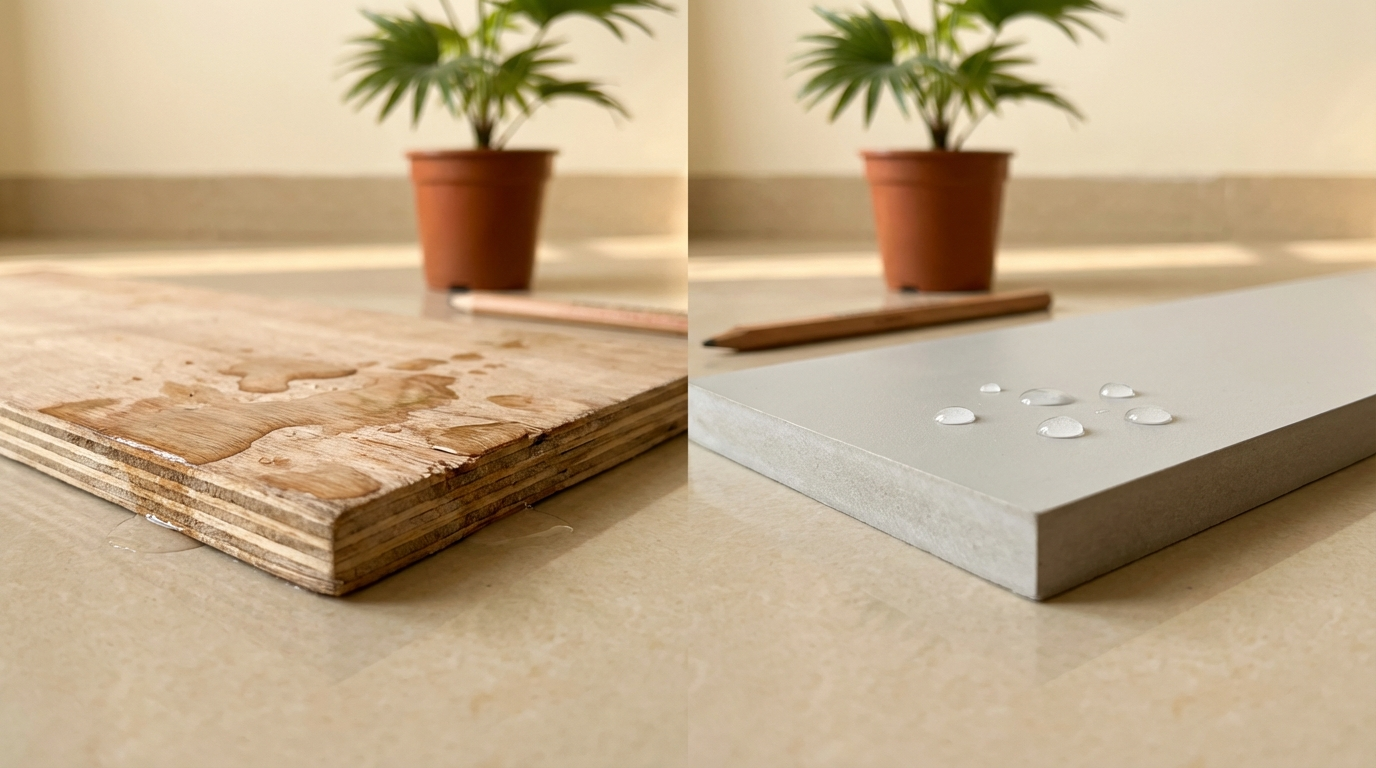
PVC board is a synthetic sheet made from polyvinyl chloride—basically a rigid plastic panel that's waterproof, termite-proof, and doesn't need the maintenance headache of wood-based materials. Short version: In interior design, PVC foam boards are used for wall cladding, partition design, false ceilings, and decorative panels. Their moisture resistance makes them suitable for use in damp areas like bathrooms and kitchens.
This is right for you if:
- PVC boards are plastic-based panels that are lightweight, waterproof, and termite-proof.
- You're doing bathroom vanities or under-sink cabinets where water exposure is daily
- PVC is low maintenance, waterproof, and termite proof, making it perfect for damp spaces like bathrooms or under-sink storage.
- You want quick installation without waiting for polishing and finishing work
Skip this if:
- PVC may sag under heavy loads—so heavy-duty wardrobes are better done with plywood
- You want a premium wood-grain look that doesn't feel plastic-y
Bottom line: PVC boards shine in moisture-prone areas but can't fully replace plywood for structural furniture—use the right material for the right spot.
Note: sainik710.com is an independent informational site and is not affiliated with any manufacturer.
What PVC Board Actually Means (Cut the Jargon)
PVC foam board, also known as expanded PVC foam board, is a lightweight, rigid material that is less dense than traditional PVC. It retains many of the same properties as typical PVC, such as an excellent strength-to-weight ratio, good flame retardancy, and excellent chemical resistance. In plain Hindi-English—it's lakdi ka plastic substitute that won't rot, swell, or get eaten by termites.
Most people think PVC board and PVC foam board are the same thing. Actually, they're different. PVC board and PVC foam board are two distinct types of PVC-based materials, each with its unique properties and applications. PVC board, also known as PVC rigid board or PVC sheet, is a dense and rigid PVC-based material. The foam version is lighter, cheaper, and what you'll mostly find in interior applications.
PVC foam board is a lightweight and soft PVC-based material made by foaming PVC resin. Usually manufactured in sheet or panel form, PVC foam board features a foam structure throughout its interior. Known for its excellent insulation, soundproofing, and shock-absorbing properties, it finds widespread use as an insulation material in building construction.
Here's something most dealers won't clarify upfront: solid PVC boards are denser, more expensive, and better for heavy-duty work. Solid PVC boards. Foam PVC boards (lighter and cheaper). If someone's quoting you very cheap rates, they're probably talking about foam boards. Not necessarily bad—just know what you're getting.
Why PVC Boards Matter for Indian Homes Specifically
Right, here's where it gets interesting. Indian homes—especially in coastal cities like Mumbai, Chennai, Kolkata, and Kochi—face humidity levels that European or American building materials simply aren't designed for. We're talking 75-90% relative humidity during monsoon. That kind of moisture destroys regular plywood from the inside out.
From scorching pressure cookers to monsoon dampness, your furniture has to withstand everything. That's why many homeowners today employ a mix: plywood boards for the skeleton and the heavier parts, and PVC sheeting for the smaller parts such as under-sink units.
I remember a flat in Powai—must have been 2022—where the owner had used regular MR grade plywood for the entire kitchen. Beautiful work, expensive too. By the second monsoon, the base cabinets near the sink were swelling. The mistri had to replace everything. If he'd used PVC for just the lower section, the whole problem could've been avoided.
Steam generated from the cooking process, splashes from water, and humidity were the troubles that would slowly tear the plywood. PVC Foam Boards, on the other hand, remain terrestrial and unaffected in humid conditions, not absorbing any water.
In places like Chennai's OMR stretch or Mumbai's Chembur-Ghatkopar belt, the combination of sea breeze and monsoon humidity is brutal on wood products. Perfect for bathrooms or rental kitchens where low-maintenance and water resistance matter more than aesthetics. PVC handles this naturally without special treatments.
Can You Actually Use PVC Boards in Bathrooms?
Yes, PVC foam boards are water-resistant, making them an excellent choice for damp areas like kitchens and bathrooms. Their moisture resistance also ensures durability and long-lasting performance. That said, "water-resistant" doesn't mean you can submerge them. For bathroom vanities, wall panels, and ceiling applications—absolutely yes. For the floor or constantly wet surfaces? Look at other options.
If I'm being honest, I've seen PVC bathroom vanities last 10-12 years in Mumbai flats without any issues. The key is proper installation—edge sealing, silicone at joints, and keeping the back panel slightly raised from the wall to allow air circulation.
Types of PVC Boards: Which One Do You Actually Need?
There are 3 types of PVC foam board: pvc celuka board, pvc free foam board and pvc co-extruded board. They differ in appearance, size and performance. We can choose them according to the purpose.
PVC Free Foam Board
PVC free foam board is also called PVC sign board because of its wide use in the advertising industry. It has a fine matt surface, which has good adhesion to ink and adhesive, so it is conducive to printing, spray coating, and laminating. When used as a billboard or sign, it can be used both indoors and outdoors. In addition, as a rigid foam board, PVC free foam board has the advantages of light weight, large size and low price compared with solid plastic boards of the same size.
My take: Good for signage, display boards, and light decorative panels. Not for furniture.
PVC Celuka Board
PVC celuka board has a very smooth surface, high hardness, and is not easy to be scratched. In addition, its waterproof, mildew-proof and termite-proof properties make it commonly used in making cabinets in kitchen and bathroom, furniture, etc. And PVC foam board is free of formaldehyde and can be self-extinguishing from fire.
The high-density grade, often referred to as PVC Celuka foam board, features a denser core and a smooth, hard outer surface. This grade is known for its durability and strength, making it a suitable choice for more heavy-duty applications. High-density boards have a stronger resistance to impact and wear, making them ideal for furniture construction, building panels, and both interior and exterior cladding. It offers greater rigidity and dimensional stability.
Honestly, this is the one I recommend for most home interior work. The harder surface holds screws better and doesn't dent as easily.
PVC Co-Extruded Board
The co-extrusion process is an upgraded version of the common extrusion process. It allows the sheet to be made from a combination of three layers: two rigid layers of PVC and a middle layer of foam PVC. Due to its rigid layer, PVC co-extruded foam sheet has a harder and smoother surface than PVC celuka foam sheet.
Premium option. Costs more but gives you that extra surface hardness. Worth considering for high-traffic areas like kitchen cabinet doors.
| Type | Best For | Surface Quality | Screw Holding | Price Range |
|---|---|---|---|---|
| Free Foam | Signage, displays, light panels | Matte, good for printing | Moderate | ₹22-40/sq ft |
| Celuka | Cabinets, furniture, vanities | Smooth, scratch-resistant | Good | ₹40-80/sq ft |
| Co-Extruded | Premium furniture, high-wear areas | Hardest, most durable | Excellent | ₹70-120/sq ft |
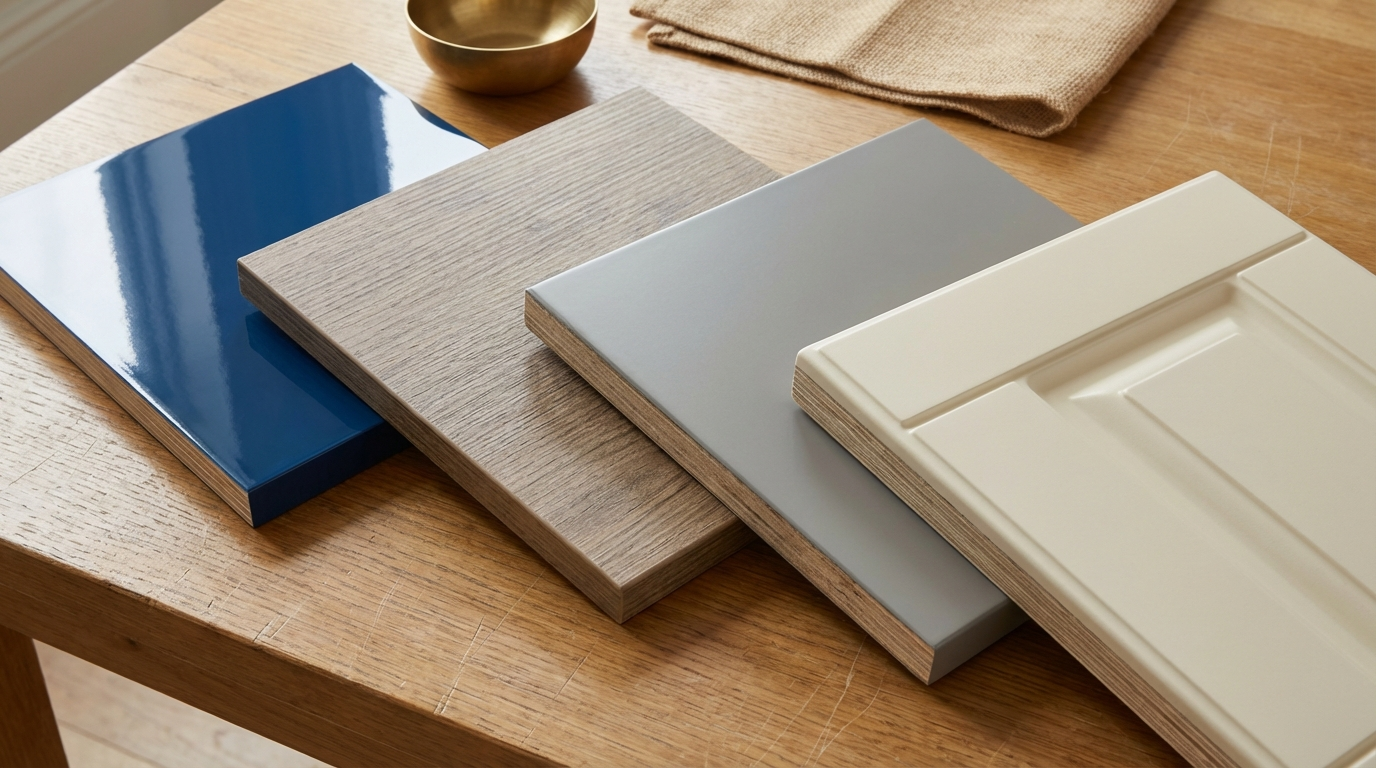
| Laminated | Ready-finish decorative work | Pre-finished patterns | Good | ₹100-180/sq ft |
PVC Board Thickness: What Actually Works
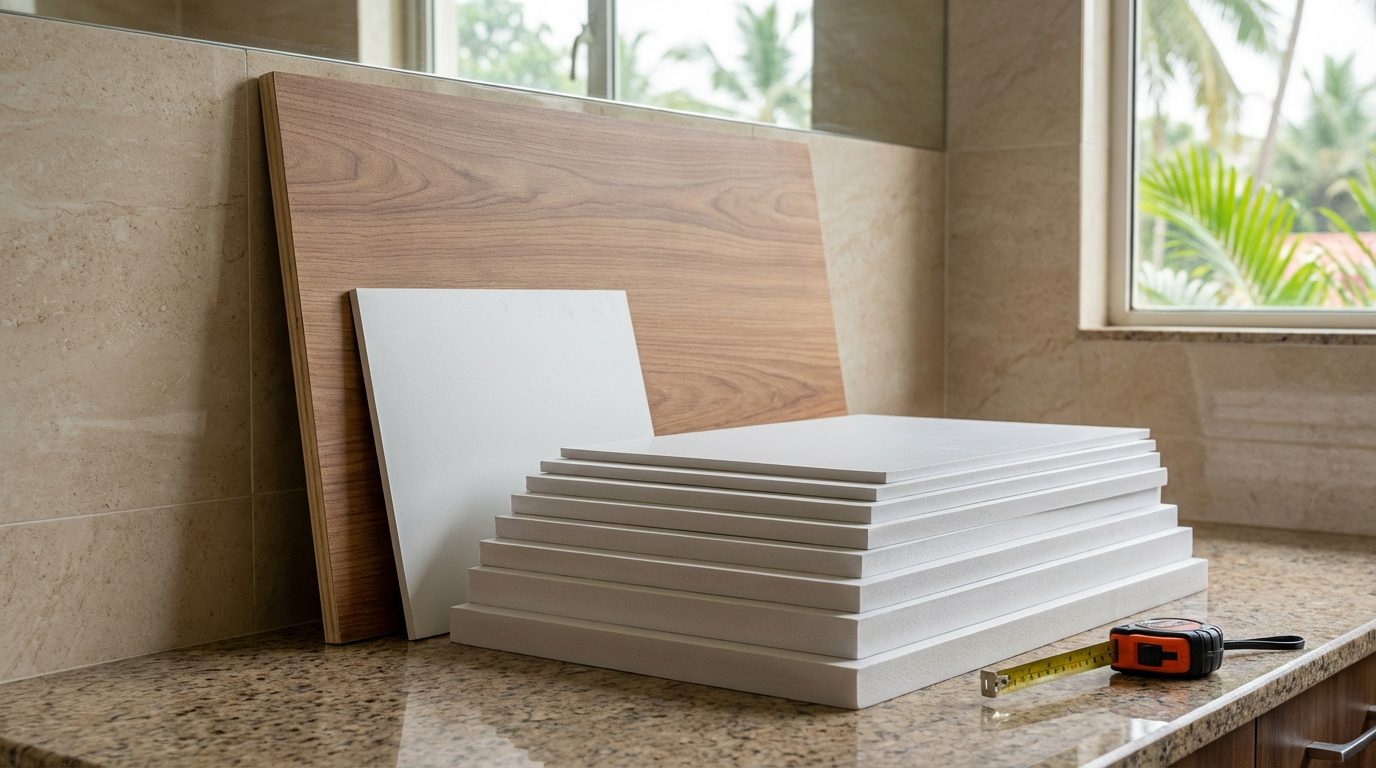
PVC foam board can do the thickness ranges from 1mm to 25mm. With smooth surface, the boards can be used for professional printing. But that doesn't mean you should use 3mm for everything just because it's cheaper.
Here's my thickness guide based on actual projects:
- 3-5mm: Wall cladding, decorative panels, backsplashes. Nothing structural.
- 8-10mm: False ceiling panels, partition panels, light furniture backs.
- 12-15mm: Cabinet doors, shelf boards, wardrobe sides where load is moderate.
- 18-20mm: Base cabinets, bathroom vanity tops, anywhere you need serious rigidity.
A quick note—I've seen people use 8mm for kitchen cabinet boxes to save money. Big mistake. The box needs to support utensils, mixer grinders, pressure cookers. Use 15-18mm minimum for box construction, then you can go 12mm for the doors if budget is tight.
What Thickness Works Best for Kitchen Cabinets?
The most popular and essential use of PVC foam board is in kitchen cabinets and bathroom vanities, thanks to its excellent waterproof and moisture-resistant properties. These features make PVC foam board ideal for areas exposed to humidity and moisture, ensuring long-lasting durability and reliability in these key applications.
For modular kitchen cabinets: 15-18mm for cabinet boxes, 12-15mm for doors, 8-10mm for the back panel. The shutters (doors) can be thinner because they're not load-bearing—they just need to look good and stay flat.
Price Reality Check (2026 Market Rates)
Look, I'm not going to give you exact prices because they change every quarter and vary city to city. But here's the rough picture:
Price Range: Rs. 25-165/sq ft. That's a wide range, I know. The variation depends on thickness, density, brand, and whether it's foam or celuka type.
The price range for PVC sheets varies based on thickness, colour, and finish, with an average cost starting from ₹50 to ₹150 per square foot.
Expect to pay roughly:
- Basic 5mm foam board: ₹22-35 per sq ft
- Standard 12mm celuka: ₹45-65 per sq ft
- Premium 18mm high-density: ₹70-100 per sq ft
- Laminated/pre-finished: ₹100-180 per sq ft depending on laminate quality
Here's what actually affects your final bill:
- Density—higher density costs more but holds screws better
- Brand premium—branded boards cost 15-25% more than unbranded
- City—Mumbai and Bangalore rates are typically higher than Ahmedabad or Surat where manufacturing happens
- Quantity—bulk orders (10+ sheets) get better rates
One thing I tell my clients: don't chase the cheapest board. The difference between a ₹30/sq ft board and a ₹50/sq ft board might be ₹4,000-5,000 on your entire kitchen project—but the quality difference shows up in screw holding, surface finish, and longevity. Not worth the risk.
PVC Board vs Plywood: The Real Comparison
Both PVC boards and plywood have their strengths and ideal use cases. When selecting a material, it's essential to consider the specific needs of your project. If structural strength and load-bearing capacity are key, plywood is the best choice. However, if you need a lightweight, waterproof material, PVC board is more suitable.
| Parameter | PVC Board | Plywood (BWP Grade) | My Preference |
|---|---|---|---|
| Water Resistance | 100% waterproof | Water-resistant, not waterproof | PVC for wet areas |
| Termite Resistance | Completely termite-proof | Needs treatment | PVC wins |
| Load Bearing | Moderate—can sag | Excellent | Plywood for heavy loads |
| Screw Holding | Good (celuka), moderate (foam) | Excellent | Plywood for hardware-heavy work |
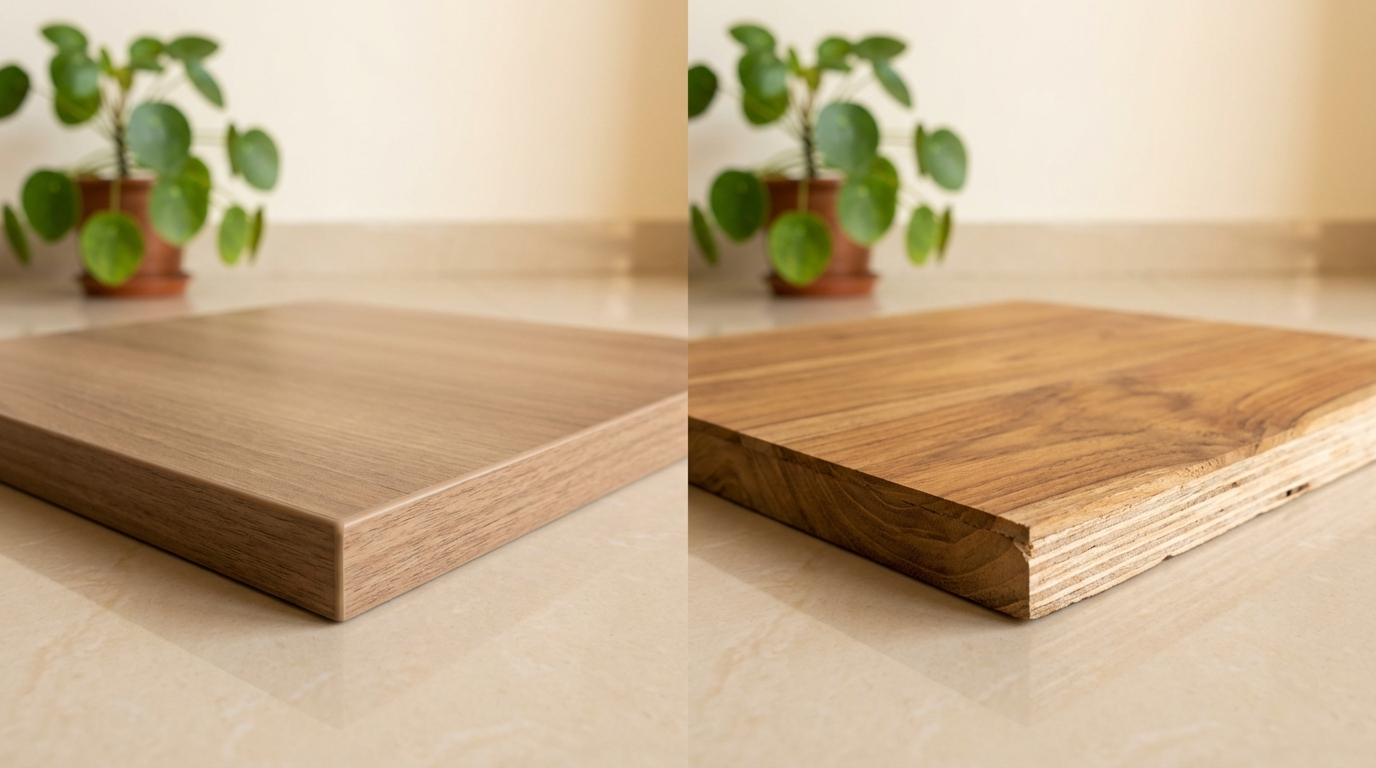
| Look & Feel | Plastic-y unless laminated | Natural wood aesthetic | Plywood for premium look |
| Maintenance | Wipe clean, zero maintenance | Needs periodic care | PVC for convenience |
| Price | ₹25-150/sq ft | ₹100-400/sq ft | Depends on grade |
| Lifespan | 15-25 years if maintained | 20-30+ years for BWP | Both good if installed right |
Particularly for heavy duty applications, plywood is considered more resilient and robust. It is ideal for wall cabinets and load bearing furniture since it is composed of layers of wood veneer and has good screw retention. In contrast, PVC is low maintenance, waterproof, and termite proof, making it perfect for damp spaces like bathrooms or under-sink storage. PVC is usually less expensive, but it can have a plasticky appearance, while plywood provides a more upscale wood-like finish.
Choose PVC when: Bathrooms, under-sink areas, rental properties where low maintenance matters, budget is tight
Choose plywood when: Heavy wardrobes, bedroom furniture, areas where you want premium wood finishes, load-bearing shelves
Trade-off summary: You gain waterproofing and zero maintenance with PVC but lose the structural strength and natural aesthetics of plywood.
Is PVC Actually Worth the Cost Savings?
Between you and me, PVC doesn't always save money. Yes, the material cost is lower for basic grades. But in contrast to certain plywood alternatives, PVC Foam Board tends to be slightly higher priced initially. Plywood's veneer must be maintained regularly, or may have to be replaced if attacked by moisture or termites. Thus, PVC Foam Board is durable and maintenance-free. It saves money in the future.
The savings come from reduced finishing work—no polish, no laminate application, no edge sealing in most cases. Labor costs drop. And zero maintenance for 10-15 years means no repair bills.
How to Choose the Right PVC Board: Decision Framework
Step 1: Identify your use case clearly
Bathroom vanity? Kitchen cabinet? False ceiling? Wall cladding? Each needs different thickness, density, and finish. Don't buy a general-purpose board hoping it'll work everywhere.
Step 2: Check the density
Our PVC boards are made from a harmonious mix of PVC and Calcium Carbonate, giving you a high screw holding capacity and no brittleness. Ask the dealer for the density specification. For furniture, you want minimum 0.45-0.55 density. Lower density is fine for signage but won't hold hardware properly.
Step 3: Match thickness to application
Refer to the thickness guide above. When in doubt, go one step thicker. The extra ₹5-10 per sq ft is worth the peace of mind.
Step 4: Decide on finish
Plain white needs laminating or painting. Pre-laminated costs more but saves finishing work. Colored boards are available but limited in options.
Step 5: Check for certifications
100% waterproof, 100% termite-proof, and free from heavy metals like Lead, Mercury and Cadmium. It contains Virgin PVC to avoid any brittleness, is fire retardant and self-extinguishing. Ask if the board is lead-free—this matters for long-term health, especially in kitchens.
| Situation | Recommendation | Why |
|---|---|---|
| Bathroom vanity in Mumbai/Chennai | 18mm Celuka, white | Maximum water resistance, structural rigidity for basin support |
| Modular kitchen base units | 15-18mm Celuka or Co-extruded | Handles humidity, supports heavy utensils |
| Kitchen wall cabinets | 12mm Celuka | Lighter weight, not load-bearing like base |
| False ceiling | 5-8mm Free Foam | Just needs to stay flat, no structural requirement |
| Rental flat quick renovation | 10-12mm Laminated PVC | No finishing work, fast installation |
| Premium bedroom wardrobe | Skip PVC—use plywood | Better aesthetics, screw retention for heavy loads |
Red flags to walk away from:
- Dealer can't tell you the density specification
- Price is significantly below market range (could be recycled material)
- Board surface has visible bubbles or uneven texture
- Strong chemical smell—indicates poor quality additives
- No brand name or manufacturing details on the sheet
Common Mistakes People Make with PVC Boards
1. Using foam board for furniture construction
Free foam boards are meant for signage and displays. For furniture, you need celuka or co-extruded. I've seen carpenters use whatever's available—and within a year, the cabinet doors warp because they can't handle the hardware stress.
2. Not pre-drilling for screws
PVC isn't wood. You can't just drive a screw in directly. Pre-drill slightly undersized holes or the board might crack. The ADD ON COLLECTION PVC Boards can be sawed, drilled, bent and fabricated using ordinary carpentry tools. But "can be drilled" doesn't mean you should skip the pilot hole.
3. Skipping edge treatment
This one really frustrates me. PVC edges look unfinished if left raw. Use matching edge bands or at minimum, sand the edges smooth. Some carpenters think because it's plastic, nothing needs doing. Wrong.
4. Buying without checking density
A 12mm board at 0.35 density is useless for furniture. Same 12mm at 0.55 density is excellent. The thickness tells you nothing without the density. Always ask.
5. Using the wrong adhesive
Standard wood glue doesn't bond PVC properly. You need PVC-specific adhesive or industrial-grade solutions. I've seen laminate peeling off within months because someone used Fevicol SH thinking it'll work the same way. It doesn't.
6. Ignoring expansion gaps
PVC expands slightly with temperature changes. In hot climates—say Rajkot or Nagpur where summers hit 45°C—tight-fit installations buckle. Leave 2-3mm gaps at edges.
7. Direct sunlight exposure without UV protection
Outdoor-grade PVC foam board is specifically formulated to endure harsh environmental conditions. It is designed to resist UV rays, weathering, and moisture, which makes it perfect for long-term outdoor use. Its enhanced durability allows it to maintain its structural integrity even after prolonged exposure to sunlight and rain. Standard indoor-grade boards fade and become brittle with sun exposure. If your application gets direct sunlight, specify outdoor-grade.
8. Thinking PVC replaces plywood everywhere
Not as strong as plywood – may sag under heavy loads. For heavy wardrobes, load-bearing shelves, or tall cabinets, plywood is still the better choice. PVC is a complement, not a complete replacement.
9. Ordering exact sizes without wastage allowance
Standard sheets come in 8x4 feet typically. If you're getting custom cutting, account for 5-8% wastage. Every project I've seen that ordered "exact" quantities ran short by the end.
10. Storing improperly before installation
Sheets stacked flat, in shade, away from direct heat. I've seen sheets stored against a hot wall develop a permanent curve that no amount of clamping fixes.
Quality Checks You Can Do Yourself
Visual checks—what to look for:
- Surface should be uniformly smooth, no bubbles or pits
- Edges should be clean-cut, not chipped or cracked
- Color should be consistent across the sheet—patches indicate recycled material
- Both faces should have similar finish quality
- No visible warping when sheet is laid flat
- Thickness should be uniform—check at multiple points with a vernier if possible
Questions to ask your dealer:
- "What's the density of this board?" (Should be able to tell you without checking)
- "Is this lead-free?" (For kitchen applications especially)
- "Is it virgin PVC or recycled?" (Recycled is cheaper but less consistent)
- "What thickness tolerance does this have?" (Good boards are ±0.3mm)
- "Can you show me the test certificate?" (Branded boards have these)
Simple field tests:
- Tap test: Knock on the board—consistent sound across the surface indicates uniform density. Hollow or varied sounds mean air pockets.
- Weight check: A 12mm celuka 8x4 sheet should weigh roughly 18-22 kg. Much lighter means low density.
- Edge inspection: Look at a cut edge. You should see fine, uniform foam cells. Large irregular bubbles indicate poor manufacturing.
- Flex test: Hold an offcut and try to bend it gently. Good celuka resists bending. Cheap foam bends easily.
- Scratch test: Run your fingernail across the surface. Celuka shouldn't mark easily. If it does, density is too low.
Here's a trick most dealers don't like—ask for a small offcut and try driving a screw into it. Good quality board grips the screw. Low density board lets the screw pull out with minimal force.
Workmanship & Installation: What to Tell Your Carpenter
PVC foam panels will need less maintenance compared to wood, can be pre-formed into custom sizes, and are easily installed—all saving on labor costs and time. But easy to install doesn't mean install carelessly.
Cutting requirements:
PVC cuts cleanly with standard wood-cutting blades—circular saw, jigsaw, even hand saw works for small pieces. Can be readily nailed, drilled, pasted, sawed, or processed in any other way. Use fine-tooth blades for cleaner edges. Speed should be moderate—too fast and you'll melt the material, too slow and it'll chip.
Edge sealing:
For visible edges, use PVC edge band (1mm or 2mm) with contact adhesive or heat-activated bonding. Raw PVC edges don't absorb moisture but look unfinished. Edge banding makes a huge difference to the final look.
Screw guidance:
- Pre-drill all holes—undersized by 1mm compared to screw thread
- Use wood screws with coarse threads, not machine screws
- For 12mm board, use screws no longer than 20mm
- For 18mm board, screws up to 30mm work fine
- Don't over-tighten—PVC strips easily if you force it
What to tell your carpenter—the briefing checklist:
- Pre-drill every screw hole. No exceptions.
- Leave 2-3mm expansion gap at edges near walls
- Apply edge band to all visible edges before assembly
- Don't force pieces together—file or sand to fit
- Use PVC adhesive for joints, not wood glue
- Wipe adhesive overflow immediately—it shows through laminate
Storage notes:
Keep sheets flat, not leaning. Store in shade—direct sunlight warps the material. If sheets need acclimatization (especially in humid areas), unpack and let them sit 24-48 hours before cutting.
I've seen carpenters skip the edge banding on bathroom vanities thinking "no one sees the back." But moisture enters through unfinished edges. Six months later, the laminate starts lifting. Twenty minutes of edge banding would've prevented it. Frustrating to watch.
Why Do Carpenters Sometimes Prefer Plywood Over PVC?
Honest answer: familiarity. Most carpenters—especially the older mistriis—grew up working with wood. PVC handles differently. Prior to installation, PVC requires no polishing. In contrast, plywood needs to be polished in order to have a finished appearance following installation and completion of all tasks.
Also, Plywood's alternating grain structure makes it exceptionally strong and stable. It's ideal for structural applications where strength is a priority, such as in walls, roofing, and flooring. For heavy-duty work, carpenters trust what they know works.
The best carpenters I work with use both—plywood for structure, PVC for moisture-prone sections. Mixed construction gives you the best of both worlds.
How Long Does PVC Board Actually Last?
Due to the structure of its component molecules, PVC foam boards are highly strong which ensures that they don't undergo any deformation. The boards can survive for as long as 4 decades without any damage.
Four decades is the theoretical maximum under ideal conditions. In my experience, well-maintained PVC furniture in Indian homes realistically lasts 15-25 years before showing significant wear. That's still excellent—comparable to good quality plywood.
What affects longevity:
- Quality of original material (density, virgin vs recycled)
- Installation quality (edge sealing, proper hardware)
- Usage patterns (kitchen cabinets see more wear than bedroom furniture)
- Climate (extreme heat accelerates degradation)
- Sun exposure (UV breaks down PVC over time)
Signs of wear to watch for:
- Surface yellowing (especially white boards)
- Edge chipping or cracking
- Laminate peeling at corners
- Hardware loosening from stripped screw holes
- Visible sagging on long horizontal spans
When to consider replacement:
Surface yellowing is mostly cosmetic—you can live with it. But if screw holes are stripping or the board is sagging, it's time. Usually happens around the 15-year mark for kitchen cabinets, longer for bedroom furniture.
Alternatives Worth Considering
If PVC doesn't fit your needs exactly, here are other options:
HDHMR (High-Density High Moisture Resistance Board)
Denser than regular MDF, handles moisture better. Good for kitchen cabinets where you want a smoother finish than PVC offers. Our HDHMR guide covers this in more detail.
WPC (Wood Plastic Composite)
WPC (Wood Plastic Composite) PVC boards combine wood fibres with PVC, creating a material that mimics wood's appearance and offers enhanced strength and durability. They are heavier and denser than PVC foam boards, making them suitable for structural applications. Better for door frames and areas needing wood-like aesthetics with moisture resistance. There's a separate door frame guide worth checking if you're considering WPC frames.
Marine Plywood
If budget allows and you want the natural wood feel, BWP grade marine plywood with proper lamination handles moisture well. Costs more but looks better. MR grade (moisture-resistant) is adequate for wardrobes; BWP/BWR grade (boiling water-proof) is ideal for kitchens.
If budget is tight, consider using PVC only for the most moisture-exposed areas (under-sink, bathroom) and regular MR plywood with laminate for the rest. Mixed approach often makes the most sense.
FAQs About PVC Boards
Is it true that PVC boards release harmful chemicals?
Fire-Retardant & Self-Extinguishing – Meets fire safety standards. Eco-Friendly & Non-Toxic – Recyclable and free from harmful substances. Quality PVC boards from reputable manufacturers are lead-free and don't off-gas under normal conditions. The concern comes from very cheap boards using recycled PVC with unknown additives. Always buy from known brands or ask for test certificates. I've been using PVC in my own kitchen for 8 years—no issues whatsoever.
Can PVC board be painted?
Easily shaped and painted: PVC can be given any shape to suit your requirements. It can be cut for the furniture of your house or can be made into wall panels for exterior use. Also, it can be painted with any type of paint which lasts for years and gives the look and feel as if it is new! Yes, but you need proper primer for plastic surfaces. Standard wood primers won't adhere properly. Use acrylic or PVC-specific primers, then topcoat with enamel or latex paint.
What if I live in a coastal city like Mumbai or Chennai—does PVC hold up?
Actually, PVC handles coastal conditions better than plywood because salt air causes wood to deteriorate faster. PVC foam board is resistant to chemical abrasion and features low water absorption. This makes it perfect for both indoor and outdoor applications. Coastal humidity is high year-round—PVC's zero moisture absorption means no swelling, no warping, no termite worries that plague wood products in these areas.
Is it true that PVC cracks in extreme heat?
Standard PVC can become brittle with prolonged sun exposure. But for indoor furniture, this isn't an issue—your cabinets aren't sitting in direct sunlight. For outdoor applications, outdoor-grade PVC foam board is specifically formulated to endure harsh environmental conditions. It is designed to resist UV rays, weathering, and moisture. If your kitchen window gets direct afternoon sun on a specific cabinet, specify UV-resistant grade for that section.
How does PVC compare to particle board for furniture?
PVC beats particle board in every way except cost. Particle board absorbs water like a sponge and disintegrates, while PVC is fully waterproof. For wet areas, particle board is simply not an option regardless of how cheap it is. For dry areas like bedroom storage, particle board works if budget is very tight, but PVC lasts longer and requires less care.
Can I use regular wood screws with PVC board?
Yes, but pre-drill first. Coarse-thread wood screws work best. Don't use fine-thread machine screws—they won't grip the foam core properly. And don't over-tighten. Simple fabrication utilizing standard instruments such as blades, saws, hammers, and drills. The material is forgiving but not indestructible.
Is it true that PVC furniture looks cheap?
May look plasticky if not finished well. Prone to scratches and dents. Honestly, this depends on the finish. Raw white PVC does look industrial. But laminated PVC with good quality films can look indistinguishable from laminated plywood. The "cheap look" usually comes from poor finishing, not the material itself. Invest in decent laminate and proper edge banding.
What's the maximum span for PVC shelves without sagging?
For 18mm celuka board holding moderate weight (books, clothes), keep spans under 60-70cm without intermediate support. For heavy items like kitchen appliances, reduce to 45-50cm or add a center support. PVC doesn't have the span strength of plywood—this is one area where it genuinely falls short.
Is it true that carpenters charge more for PVC work?
Some do, some don't. PVC actually requires less finishing work—no polish, no laminate pasting in some cases. But if the carpenter is unfamiliar with it, they might quote higher to account for the learning curve. Experienced modular kitchen installers work with PVC regularly and don't charge extra.
Can PVC boards be recycled at end of life?
PVC foam board is eco-friendly and fully recyclable, offering a sustainable solution across industries. Yes, though finding recycling facilities in smaller Indian cities can be challenging. Major cities have plastic recyclers who accept PVC. It's better than wood which typically ends up as scrap or burned.
What if my dealer only has unbranded PVC boards—should I still buy?
Unbranded doesn't automatically mean bad quality, but it's riskier. Without brand backing, you have no recourse if quality is poor. If buying unbranded, do the physical tests—check density, tap for uniformity, inspect edges carefully. And buy one sheet first to test before ordering full quantity. I've seen decent unbranded boards from Gujarat manufacturers, but I've also seen absolute garbage sold at similar prices.
Is PVC board fire-safe for kitchens?
Fire resistance: PVC foam boards are self-extinguishing, making them a safer choice for interior applications. Sometimes fire-resistant additives are added to the core material during the manufacturing process. In case, PVC foam boards catch fire, they tend to melt down rather than combust, slowing the spread of fire. PVC doesn't catch fire easily and self-extinguishes when flame is removed. It's safer than wood in fire situations. However, when burning, it releases chlorine gas which is toxic. Keep extinguishers accessible in any kitchen regardless of material used.
A Final Word on Making This Work
So look, PVC isn't a magic material that solves every problem. It has specific strengths—waterproofing, termite resistance, low maintenance—and specific weaknesses—lower load capacity, plastic feel, limited span lengths.
The smart approach is using PVC where it makes sense: bathroom vanities, under-sink cabinets, false ceilings, wet-area wall cladding. For the rest of your home—bedroom wardrobes, heavy-duty shelving, premium furniture—plywood still makes more sense.
The wardrobe plywood guide goes deeper into choosing the right plywood grades if you're doing mixed construction. And the kitchen cabinet material comparison covers HDHMR vs plywood vs PVC specifically for modular kitchens.
Your carpenter might have different opinions based on their experience—worth hearing them out. But go into the conversation knowing what you want and why. Good luck with the project.
Disclaimer: This content is provided for general informational purposes based on industry practices and publicly available information. Product specifications, standards, prices, and availability may vary by manufacturer, region, and time. Readers should independently verify details with manufacturers, dealers, or qualified professionals before making purchase or construction decisions.
Want Plywood Suggestions?
Share a few details and a Sainik 710 specialist will suggest suitable brands and connect you to responsive dealers.