Plywood vs Solid Wood: Which is Better for Furniture, Doors & Interiors in India
Detailed comparison of plywood vs solid wood—durability, cost, moisture resistance & best uses. Find what works better for furniture & doors in India.
Quick Answer: Plywood or Solid Wood—What Actually Works Better?
Plywood is better for most furniture, doors, and interior applications in Indian homes because it handles humidity swings without warping, costs significantly less, and gives carpenters more flexibility—while solid wood makes sense only for statement pieces where you want that natural grain character and don't mind the premium price or maintenance demands.
Short version: If you're building wardrobes, kitchen cabinets, beds, or any furniture that needs to survive Indian monsoons without drama, plywood wins hands down. Solid wood looks gorgeous and lasts generations, but it's expensive, temperamental in our climate, and increasingly hard to source in genuine quality. For 90% of what people actually build in their homes, good-quality BWR or BWP plywood with the right finish does the job better.
This is right for you if:
- You're furnishing a new flat and need reliable, cost-effective materials
- Your home experiences humidity above 70% for several months—basically anywhere coastal or during monsoon season across most of India
- You want modular furniture that can be disassembled if you move
- Budget matters, and you'd rather spend on better finishing than on raw material bragging rights
Skip this if:
- You're specifically after heirloom furniture pieces—a teak dining table passed down generations, for instance
- You have unlimited budget and access to verified, plantation-sourced hardwood
Bottom line: For practical Indian homes, plywood makes more sense—solid wood is a luxury choice, not always a better one.
What This Actually Means
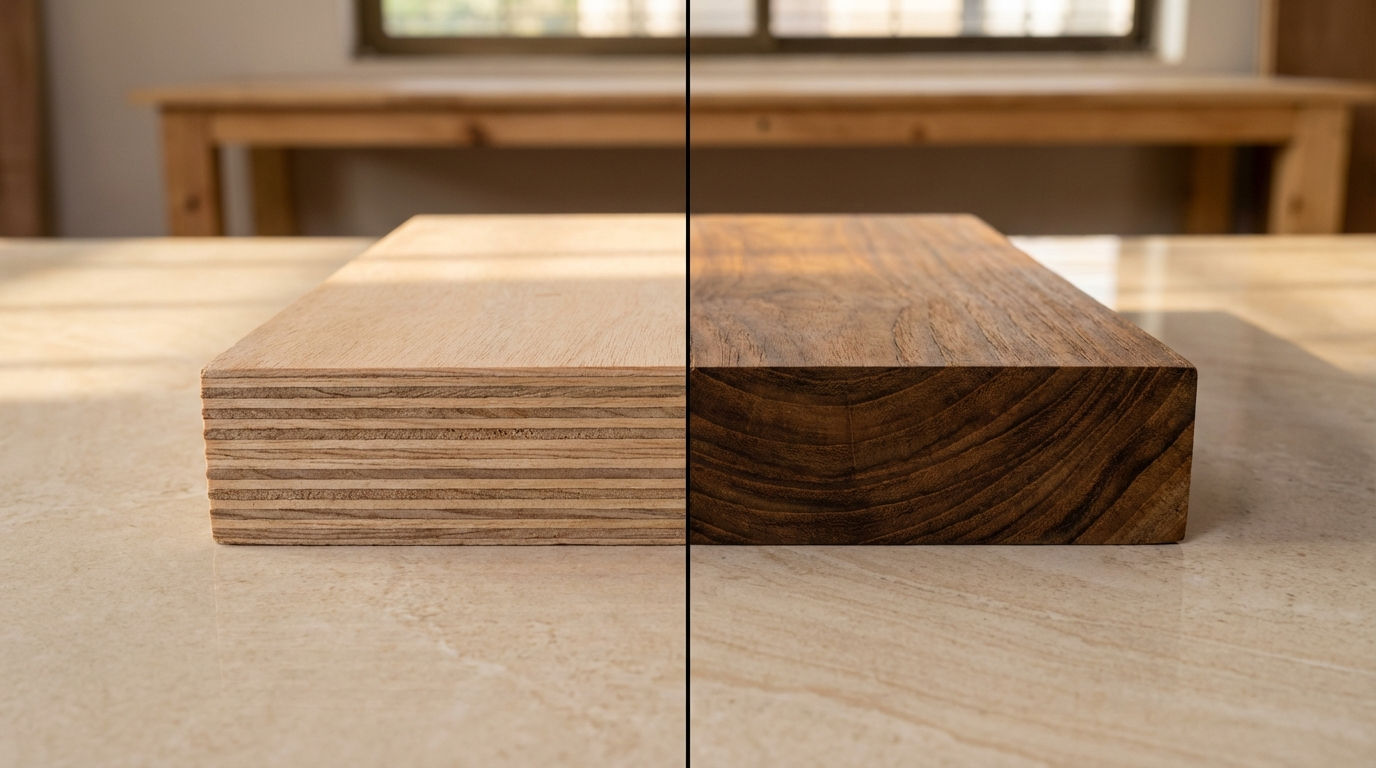
Plywood is an engineered wood product made by gluing thin layers (called veneers or plies) together with their grain directions alternating at 90 degrees, creating dimensional stability that natural timber simply cannot match. Solid wood refers to lumber cut directly from tree trunks—teak, sheesham, sal, mango—with the natural grain running straight through.
Most people think solid wood is automatically superior because it's "natural" and "pure." Actually, that's marketing nostalgia from when our grandparents had access to old-growth forests and carpenters who understood wood movement intimately. Today's solid wood furniture often uses younger plantation timber that hasn't developed the density of traditional hardwood. And worse—in our climate, even good solid wood expands, contracts, cracks, and warps unless it's been kiln-dried properly and maintained religiously.
Here's what most guides won't tell you: the solid wood being sold in many Indian markets isn't what your grandfather used. It's often partially seasoned, sometimes mixed with inferior species, and rarely kiln-dried to the 8-12% moisture content needed for stability. Meanwhile, plywood from a decent brand—Sainik 710, for example—comes manufactured under controlled conditions with consistent quality.
The cross-grain construction of plywood means it resists warping, doesn't split when you drive screws near edges, and handles the stress of being cut into specific shapes without cracking. Solid wood's long grain gives it tremendous strength along the grain direction, but it's weak across the grain and moves seasonally as humidity changes.
Why This Matters in Indian Homes
India's climate is brutal on wood. Not in the dramatic, obvious ways—but in slow, steady damage that shows up months or years later.
In places like Chennai or Mumbai, humidity regularly hits 80-90% during monsoon months. Even inland cities like Pune or Bangalore see 70-80% humidity from June through September. This moisture gets absorbed by wood, causing expansion. Then during dry winter months—especially in North India—humidity drops to 30-40%, and wood contracts. This seasonal cycle, repeated year after year, is what causes solid wood furniture to develop cracks, joints to loosen, and doors to stick or gap.
Coastal Karnataka, the Konkan belt, Kerala, Bengal—these regions stay humid practically year-round. I've seen beautiful teak wardrobes in a Goa apartment develop drawer problems within two years because nobody accounted for the 85% humidity baseline. The wood swelled, drawers stopped sliding smoothly, and eventually the whole unit needed refitting.
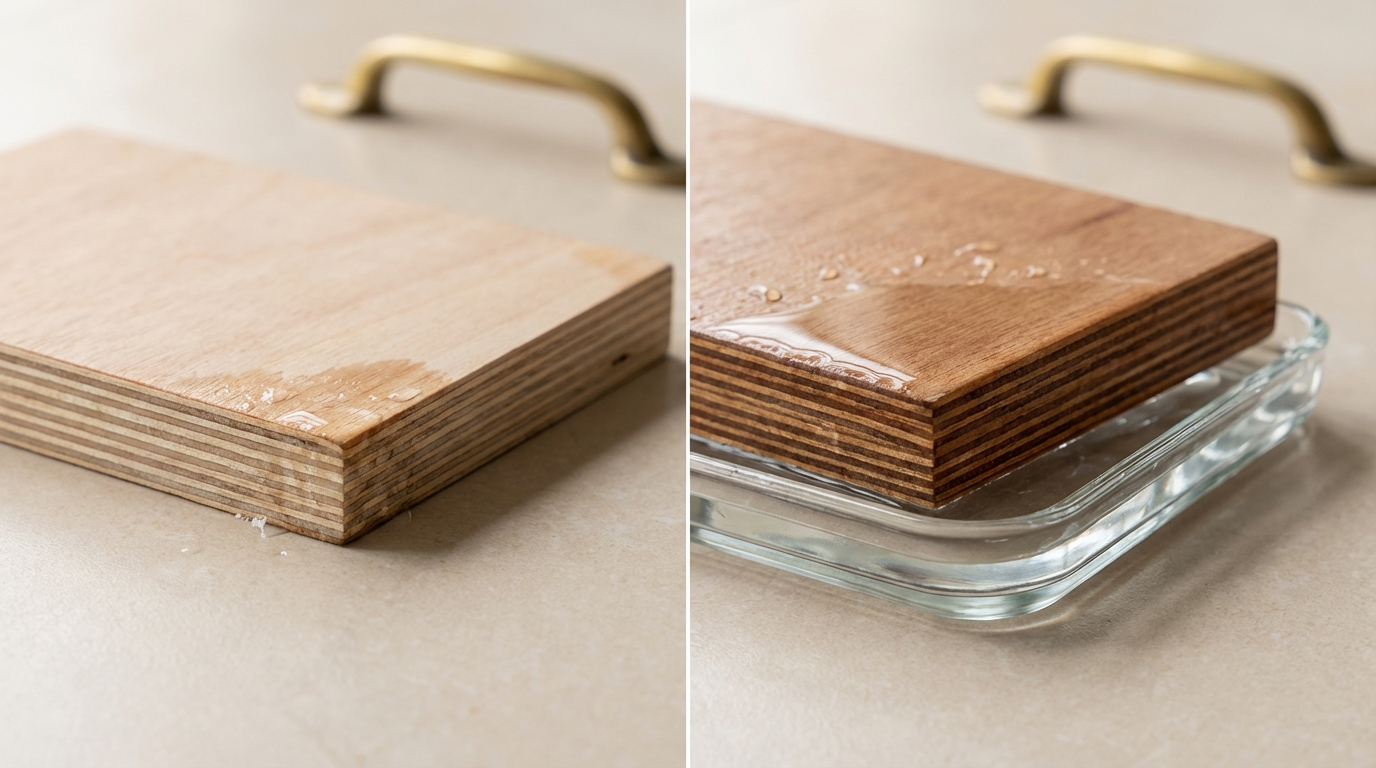
Plywood handles this better because the cross-laminated construction cancels out most of the expansion and contraction forces. Each layer pulls against the adjacent layer, keeping the board dimensionally stable. A BWR grade plywood board in Mumbai might swell 1-2% in monsoon versus 5-8% for solid wood of equivalent thickness.
Now, Delhi and Rajasthan have the opposite problem—extremely dry conditions that can crack solid wood as it loses moisture too quickly. Plywood still performs better here because the glue lines prevent the kind of deep checking that solid wood develops.
Does solid wood actually last longer than plywood?
It depends heavily on maintenance and conditions. A well-made teak piece can last 50-100 years, no question—but that assumes proper kiln-drying, good joinery, regular oiling, and climate-controlled storage. In practice, I've seen plywood furniture from the 1990s still holding up fine in Mumbai apartments while solid wood pieces from the same era have needed multiple repairs. The "solid wood lasts forever" claim comes from an era of old-growth timber and traditional craftsmanship that barely exists anymore. Today's reality is more nuanced. Plywood from a reputable brand, properly edge-sealed and finished, realistically gives you 15-25 years of good service with minimal fuss.
Types and Grades: Breaking Down Your Options
Let me walk through what you'll actually encounter in the market.
Plywood Categories
MR (Moisture Resistant): The entry-level option. Uses urea-formaldehyde glue that handles some humidity but not prolonged moisture exposure. Best for dry interior applications—bedroom furniture, living room shelving, study tables. Honestly, even for these uses, I'd bump up to BWR if budget allows.
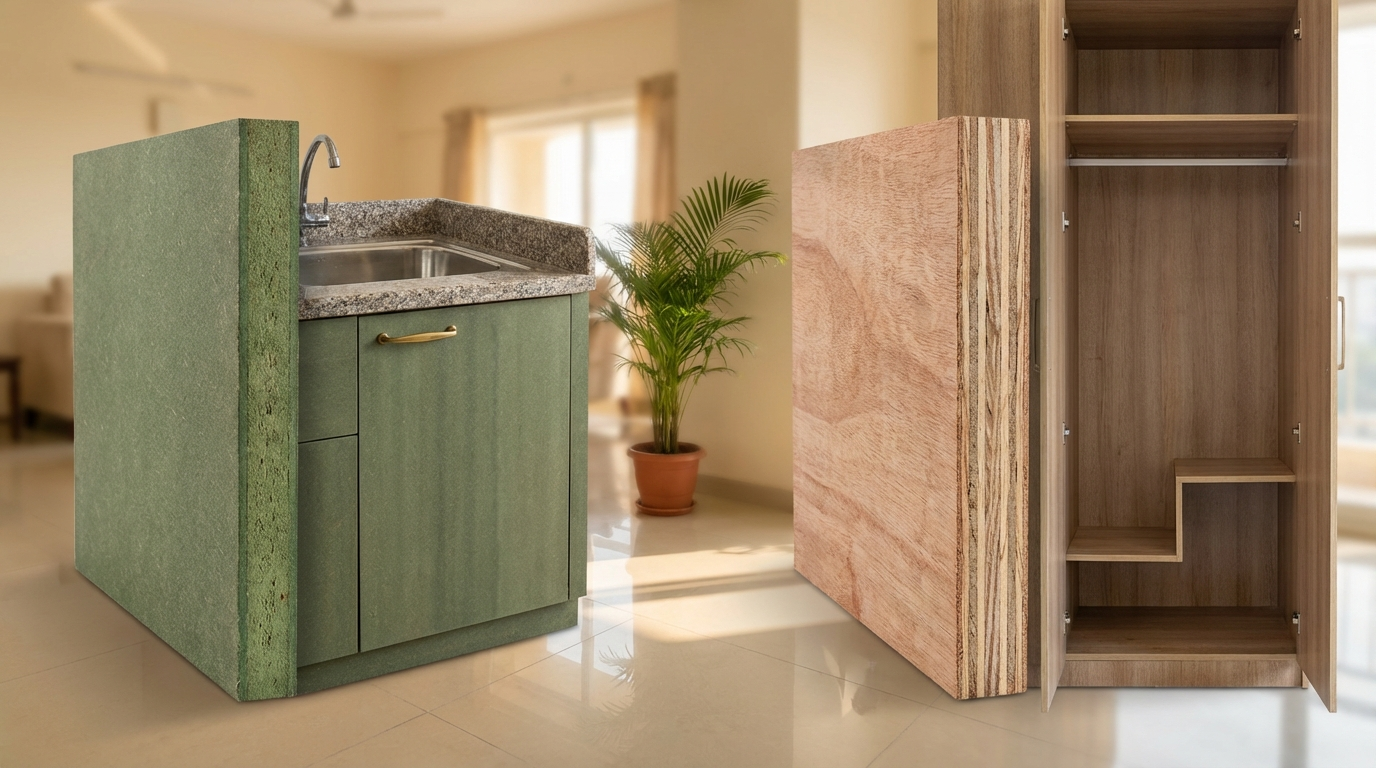
BWR (Boiling Water Resistant): The workhorse grade. Uses phenol-formaldehyde glue that survives high humidity without delaminating. This is what you want for most home furniture across India. Kitchen cabinets except the sink area, wardrobes, TV units—BWR handles it.
BWP (Boiling Water Proof) / Marine Grade: The premium option. Designed to handle direct water contact. Costs 30-50% more than BWR but essential for bathroom vanities, kitchen sink cabinets, outdoor applications, or if you're in coastal areas where everything stays damp. Sainik 710 from CenturyPly falls in this category—it's calibrated, marine-grade stuff that's genuinely waterproof.
My take: For most people, BWR grade is the sweet spot. Only go BWP where you have actual water exposure risk.
Solid Wood Categories
Teak (Sagwan): The gold standard. Natural oils make it termite and water resistant. Dense, durable, ages beautifully. But genuine teak costs ₹3,000-6,000 per cubic foot and up. Lots of "teak" in the market is actually inferior species or plantation teak that lacks the density of forest teak.
Sheesham (Indian Rosewood): Beautiful grain, decent durability. More affordable than teak. But prone to cracking in very dry or very humid conditions. I've seen plenty of sheesham dining tables develop hairline cracks within 3-4 years.
Sal: Extremely hard and strong. Good for doors and heavy structural use. But it's difficult to work with and not as attractive for furniture.
Mango: Budget-friendly, relatively stable. Okay for painted furniture. But not in the same league as teak or sheesham for durability.
| Parameter | Plywood (BWR/BWP) | Solid Wood (Teak/Sheesham) |
|---|---|---|
| Moisture handling | Excellent—engineered for stability | Variable—depends on species and seasoning |
| Dimensional stability | High—minimal seasonal movement | Low to medium—expands and contracts noticeably |
| Weight | Moderate—easier to handle and install | Heavy—especially teak and sal |
| Natural appearance | Uniform surface—needs veneer or laminate for aesthetics | Unique grain patterns, natural beauty |
| Termite resistance | Treated options available | Teak excellent; others need treatment |
| Screw holding | Excellent near edges | Risk of splitting near edges |
| Repairability | Sections can be replaced | Can be sanded and refinished multiple times |
| Carbon footprint | Lower—uses less raw timber per board | Higher—one tree yields less usable material |
Price Reality Check (2026 Market)
Here's what actually affects your final bill—and it's not just the raw material cost.
For plywood, expect to pay roughly:
- MR grade: ₹55-90 per sq ft (19mm thickness)
- BWR grade: ₹85-140 per sq ft (19mm thickness)
- BWP/Marine grade: ₹120-200 per sq ft (19mm thickness)
Branded products like Sainik 710 sit at the higher end of BWP pricing but deliver consistency that cheaper alternatives often can't match.
For solid wood, you're looking at a completely different scale:
- Mango wood: ₹800-1,500 per cubic foot
- Sheesham: ₹1,500-2,500 per cubic foot
- Teak (plantation): ₹3,000-5,000 per cubic foot
- Teak (mature/premium): ₹5,000-8,000+ per cubic foot
But here's what people miss: solid wood generates more wastage during furniture making. A carpenter working with plywood wastes maybe 5-8% of the material. With solid wood, expect 15-25% wastage from cutting around knots, sapwood, and defects. So that ₹3,000 per cubic foot teak actually costs you closer to ₹3,600-3,750 in effective material cost.
And then there's labor. Working with solid wood takes longer—more careful cutting, more complex joinery, more time spent matching grain patterns. A solid wood wardrobe might take 40-50% longer to build than an equivalent plywood one.
Quick math: A 6x4 feet wardrobe in BWR plywood might cost ₹25,000-40,000 complete with labor and laminate finish. The same wardrobe in sheesham could run ₹70,000-1,20,000. In teak? You're looking at ₹1,50,000 and up.
Is solid wood actually worth the extra cost?
Depends what you're buying it for. If it's a dining table that will be the centerpiece of family gatherings for decades, where the patina of age adds character, where you'll maintain it properly with occasional oiling and won't expose it to AC blasting directly on it—then yes, solid wood makes sense. It's an heirloom investment. But for wardrobes, kitchen cabinets, TV units, kids' study tables, bathroom vanities? Not really. These are functional items where plywood with a good laminate or veneer finish gives you 90% of the utility at 30-40% of the cost. The money you save can go toward better hardware, better finishing, or honestly just staying in budget.
Direct Comparison: Making the Choice Clear
| Factor | Plywood | Solid Wood | My Take |
|---|---|---|---|
| Initial cost | ₹70-180 per sq ft | ₹250-600+ per sq ft (converted) | Plywood wins for budget-conscious |
| Monsoon performance | Stable with BWR/BWP | Swells, doors stick, joints loosen | Plywood, especially coastal areas |
| Look and feel | Uniform—needs laminate/veneer | Natural grain, unique character | Solid wood if aesthetics paramount |
| Lifespan potential | 15-25 years typical | 30-80 years with maintenance | Solid wood for heirlooms only |
| Maintenance demand | Low—occasional cleaning | High—regular oiling, careful cleaning | Plywood for low-fuss living |
| Termite risk | Treated options available | Depends on species | Treated plywood safer bet |
| Modular flexibility | Excellent—knock-down fittings work well | Limited—traditional joinery preferred | Plywood for modern modular furniture |
| Resale value | Minimal—furniture, not antique | Genuine teak holds value | Solid wood if investment angle matters |
Choose plywood when: Building modular furniture, working within budget, living in humid regions, wanting uniformity in finish, planning furniture for kids' rooms or rental properties.
Choose solid wood when: Creating statement dining tables or beds, wanting heirloom pieces, having access to verified quality timber, willing to invest in maintenance, living in controlled-climate environments.
The trade-off: You gain natural beauty and potential longevity with solid wood but lose moisture stability, budget flexibility, and ease of construction.
How to Choose: A Decision Framework
Step 1: Figure out where this furniture will live. Bathroom, kitchen near sink, or anywhere that'll see water splashes? BWP plywood, no question. Bedroom, living room, study? BWR plywood works fine, or solid wood if you really want it.
Step 2: Consider your climate honestly. Mumbai, Chennai, Kolkata, coastal Karnataka, Kerala—default to plywood unless you have a specific reason for solid wood. Dry climates like Rajasthan or winter-heavy areas like Delhi can handle solid wood better, but plywood still performs more consistently.
Step 3: What's your actual budget? If the furniture cost feels like a stretch, plywood lets you get better finishing within the same budget. Skimping on solid wood quality is worse than using good plywood.
Step 4: How long will you keep this furniture? Renting and likely to move in 3-5 years? Plywood makes sense—it's easier to disassemble and transport. Own the home and planning to stay 15+ years? Now solid wood becomes a consideration.
Step 5: Evaluate your maintenance temperament honestly. Will you actually oil that teak table twice a year? Will you wipe up water spills immediately? If the answer is "probably not," stick with plywood.
| Your Situation | Recommendation | Why |
|---|---|---|
| Furnishing first home on budget | BWR plywood with laminate | Best value, consistent quality, replaceable later if tastes change |
| Kitchen cabinets | BWR for main carcass, BWP near sink | Moisture handling is critical; solid wood not recommended |
| Bathroom vanity | BWP plywood only | Direct water exposure; solid wood will fail |
| Main bedroom wardrobe | BWR plywood with veneer finish | Large surface area makes solid wood prohibitively expensive |
| Statement dining table | Solid wood (teak/sheesham) | Centerpiece item worth the investment if budget allows |
| Kids' room furniture | MR or BWR plywood with laminate | Will be abused, outgrown, or replaced; don't overspend |
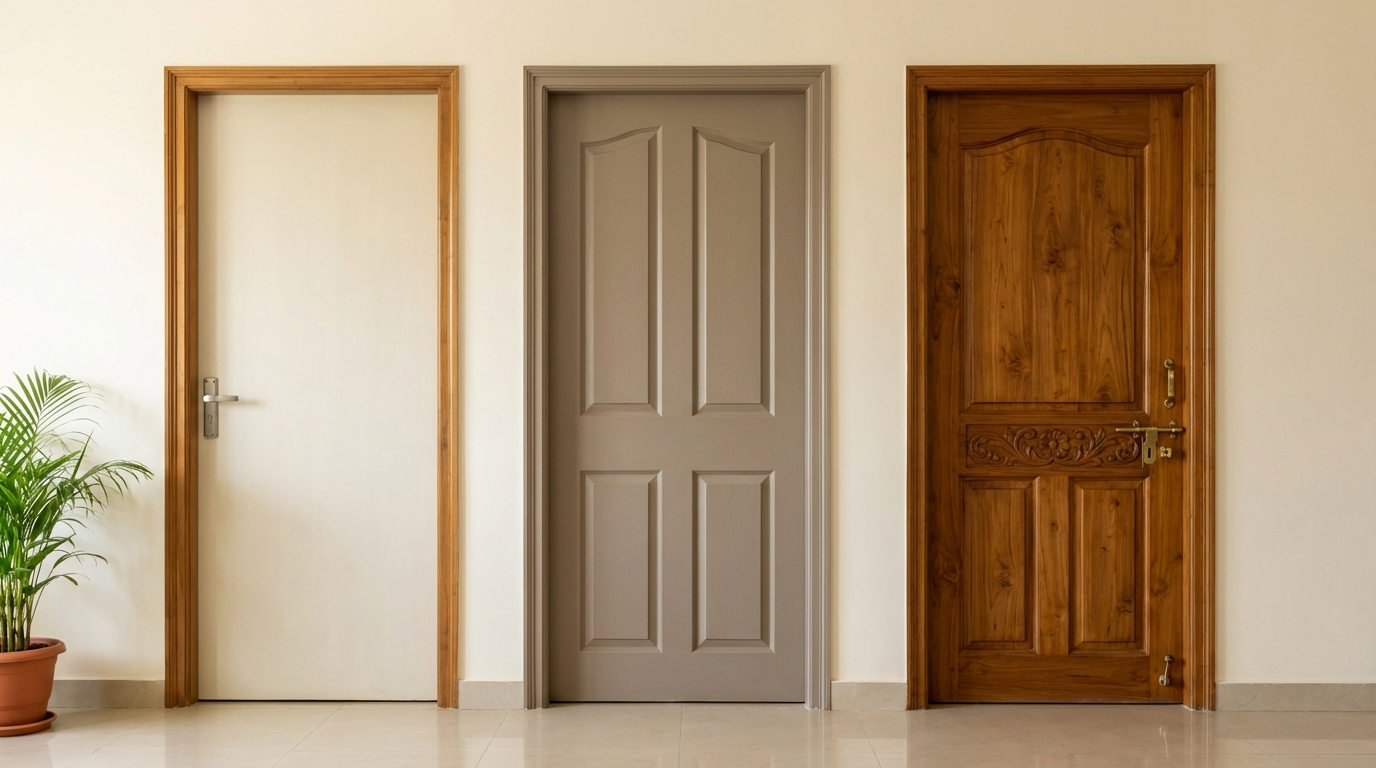
| Main door | Solid wood or flush door with solid frame | Security and aesthetics matter here |
| Internal doors | Flush doors (plywood core) | More stable, lighter, more cost-effective |
| Living room TV unit | BWR plywood | Large spans where solid wood would warp |
Red flags to walk away from:
- Solid wood sold without species name or source information
- Prices that seem too good—premium teak at sheesham prices means something's wrong
- Wood that feels damp or has visible moisture on cut ends
- Plywood with gaps or voids visible from the edge
- Any dealer who gets defensive when you ask questions about grade or certification
Common Mistakes People Make
1. Assuming solid wood is automatically better. It's not. Not for every application. A BWP plywood kitchen cabinet will outlast a sheesham one in any Mumbai apartment. Match material to use case.
2. Buying unnamed "teak" from random dealers. This one really frustrates me. I've tested wood from street-side dealers claiming to sell teak—half the time it's not teak at all. Some lighter wood species stained to look similar. If you can't verify the source, you're gambling with serious money.
3. Using MR grade plywood in humid areas. A contractor in Thane did this for a client's wardrobe back panel—figured nobody would see it anyway. Within two monsoons, the back was bubbling and delaminating. Had to replace the whole thing. The few hundred rupees saved on better grade cost ₹15,000 in repairs.
4. Not accounting for solid wood movement. Carpenters who only work with plywood sometimes take solid wood jobs without adjusting their techniques. Solid wood needs room to expand and contract. Tight-fitting joints without expansion gaps will fail. Doors will stick. Panels will crack.
5. Skipping edge sealing on plywood. Exposed edges absorb moisture and swell. Every single edge needs PVC edge banding or at least paint. I've seen this happen when the mistri is rushing to finish—they'll skip the back edges or edges facing the wall. Don't allow it.
6. Choosing the cheapest option in each category. Bottom-of-market plywood and bottom-of-market solid wood are both disasters waiting to happen. With plywood, you get voids, delamination, and inconsistent thickness. With cheap solid wood, you get poorly seasoned timber full of hidden cracks.
7. Ignoring thickness requirements. Using 12mm plywood where 18mm is needed because it's cheaper. Using thin solid wood planks for heavy shelving. These compromises show up as sagging, bowing, and structural failures down the line.
8. Not matching material to finish type. Solid wood looks best with transparent finishes—polish, lacquer—that show the grain. Plywood works better under laminates and opaque finishes. Using transparent finish on plywood shows the face veneer joints; painting over solid wood hides what you paid a premium for.
Can you use plywood for doors?
Yes, and millions of Indian homes do. Flush doors use a plywood surface over a timber or block board core, and they work perfectly well for internal doors. They're lighter than solid wood doors, won't warp as much across seasons, and cost significantly less. For main entrance doors where security and aesthetics are primary concerns, solid wood makes more sense—but even there, engineered doors with solid wood frames are increasingly popular. Our door material selection guide covers the various options in more detail.
Quality Checks You Can Do Yourself
Visual Inspection—What to Look For
- Plywood edges: Check for voids between layers. Hold the board at eye level and look along the edge—any visible gaps are a red flag.
- Surface flatness: Place a straight edge across the surface. Any bowing or warping on new material indicates poor manufacturing.
- Solid wood grain: Genuine teak has a distinct golden-brown color and oily feel. Sheesham shows pronounced dark streaks. If it looks too uniform, question the species.
- Moisture stains: Any darkening or water marks mean the wood wasn't stored properly.
- Face veneer quality: On plywood, check that the face veneer doesn't have patches, repairs, or inconsistent color.
- Corner and edge damage: Chipped corners or damaged edges indicate rough handling that may have caused internal damage too.
Questions to Ask Your Dealer
- "What's the core construction—what species and how many plies?" (For plywood)
- "Where was this timber sourced from? Is it plantation or forest?" (For solid wood)
- "What's the moisture content? Can I see the kiln-drying certificate?"
- "What's the glue type—urea formaldehyde or phenol formaldehyde?" (For plywood)
- "Do you have ISI certification for this batch?"
Simple Field Tests
Tap test: Knock on the surface with your knuckle. Solid construction sounds dense and consistent. Hollow sounds or inconsistent pitch across the surface indicates voids or poor bonding.
Weight check: Lift a few boards of the same claimed grade and thickness. Significant weight variation within the same batch suggests inconsistent quality. Good plywood has uniform density.
Edge inspection: For plywood, run your finger along the edge. Smooth, tight layers indicate good compression. Rough, loose layers mean the board may delaminate under stress.
Flex test: For thinner boards (6-9mm), try a slight flex. It should bend uniformly and spring back. Cracking sounds or uneven flex points to internal defects.
Smell test for solid wood: Fresh teak has a distinctive leather-like smell from its natural oils. No smell or a chemically sharp smell suggests treatment to mask inferior wood.
Here's a trick most dealers don't like—ask to see a freshly cut sample of the plywood you're buying. Not a display piece, but a cut from your actual stock. The edge reveals everything about core quality that the surface hides.
Workmanship and Installation Matters
Material quality means nothing if the execution is poor. This section matters whether you choose plywood or solid wood.
Cutting Requirements
Plywood cuts cleanly with a sharp circular saw blade. Use a blade with 60+ teeth for furniture work—fewer teeth causes edge splintering. Always cut with the good face up if using a table saw, or good face down if using a hand-held circular saw.
Solid wood requires more care. Always mark clearly and account for saw kerf. Cut with the grain where possible. Cross-grain cuts need slower feed rates and finer blades to prevent tear-out.
Edge Treatment
This is non-negotiable for plywood. Every exposed edge needs protection. Options include:
- PVC edge banding (most common, affordable, clean look)
- Veneer edge banding (for veneer-finished pieces)
- Solid wood lipping (more work but premium look)
- At minimum, paint or primer on hidden edges
Solid wood edges can be left exposed—that's part of the aesthetic—but they benefit from a sealer coat to even out moisture absorption.
Fastener Guidance
Plywood holds screws excellently. Use 25-30mm screws for 18mm board. Pre-drilling isn't mandatory but helps for clean entry. You can fasten close to edges without splitting—another advantage over solid wood.
Solid wood requires pre-drilling near edges, no exceptions. Driving screws without pilot holes cracks the wood. Use the "3x diameter" rule—if your screw is 4mm, stay at least 12mm from any edge.
What to Tell Your Carpenter
- Specify the exact plywood grade: "I want Sainik 710 or equivalent BWP for this cabinet, not BWR"
- "Edge band every visible AND hidden edge—I'll check"
- "Don't use cement nails anywhere—only proper screws or dowels"
- "Account for expansion in solid wood—leave gaps at wall meetings"
- "Show me the material before you start cutting"
- "I want to see the ISI mark on the plywood sheets"
I've seen carpenters skip the back edge banding and then charge full price. By the time you notice, the project is done. Be specific upfront.
Storage and Acclimatization
If you buy material and store it before work begins, keep plywood flat—never standing on edge. Stack it on level supports with airflow underneath. Same for solid wood.
Solid wood needs acclimatization time. If it's been in the dealer's godown, give it 2-3 weeks in your home's environment before cutting. This reduces post-installation movement. Most carpenters skip this. Don't let them.
How Long Does It Actually Last?
Let me give you honest expectations, not marketing claims.
BWR/BWP plywood furniture: In my experience, well-maintained BWR plywood lasts about 15-20 years in typical Indian conditions. BWP grade can push 20-25 years. After that, you're not looking at sudden failure—more gradual wear at edges, hinges pulling out of softened wood, general fatigue.
Solid wood furniture: Genuine teak, properly made, can go 50-80 years or more. Sheesham maybe 30-40 years with care. Mango wood, realistically 15-20 years.
But these numbers assume maintenance. Solid wood needs oiling once or twice a year. It needs protection from direct AC airflow. It needs prompt cleanup of spills. Skip this maintenance, and that 50-year lifespan becomes 15 years with increasing problems.
What Affects Longevity
- Climate exposure: Direct sunlight fades and dries wood. Humidity cycles stress joints. AC creates artificial dry conditions that crack solid wood.
- Usage intensity: Kitchen cabinets opened 10 times daily wear faster than guest room wardrobes opened monthly.
- Hardware quality: Cheap hinges and channels fail before the wood does. Invest in Hettich, Hafele, or equivalent quality.
- Edge protection: For plywood, intact edge banding adds years of life. Damaged edges accelerate deterioration.
Signs of Wear to Watch
Plywood: Edge swelling, laminate peeling, soft spots around screws, visible delamination at edges, warping.
Solid wood: Surface cracks, joint loosening, drawer alignment problems, sticky doors, discoloration, termite dust.
When to Replace
Plywood furniture showing structural softness—where screws pull out easily or shelves sag under moderate weight—is due for replacement. Refinishing won't fix these issues.
Solid wood can often be repaired rather than replaced. Loose joints can be reglued. Surface damage can be sanded and refinished. That's one genuine advantage of solid wood—it's repairable in ways plywood isn't.
Alternatives Worth Considering
Sometimes neither plywood nor solid wood is the right answer.
HDHMR (High Density High Moisture Resistant): If budget is tight and you need flat panels for wardrobes or cabinets, HDHMR boards cost less than equivalent plywood and machine-cut beautifully. They're essentially dense MDF with better moisture resistance. Not suitable for structural applications or where screws need to go near edges, but fine for cabinet bodies with proper hardware. The HDHMR vs plywood comparison guide covers when this makes sense.
Block Board: For applications needing very thick panels—like tabletops or headboards—block board gives you the thickness at lower cost than equivalent plywood. It's softwood strips sandwiched between face veneers. Not as strong as plywood but stable for specific uses.
Engineered Wood Composites: Products like WPC (Wood Plastic Composite) work well for door frames and window frames where water exposure is constant. They don't swell, warp, or rot. If you need better moisture resistance specifically for frames, the WPC door frame guide explains the options.
Veneer on Plywood: If you love the look of solid wood but want plywood stability, real wood veneer over BWR plywood gives you the best of both worlds. You get the natural grain appearance without the dimensional instability. This is what most premium modular furniture actually uses.
FAQs
Is it true that plywood is weaker than solid wood?
Not in the ways that matter for furniture. Plywood's cross-grain construction gives it excellent resistance to splitting and better consistency than solid wood. Where solid wood beats plywood is in absolute load-bearing capacity along the grain—but furniture rarely needs that kind of strength. For wardrobe shelves, cabinet carcasses, and beds, 18mm BWR plywood is more than adequate and often performs better than equivalent solid wood in real-world conditions.
What if I live in a coastal city like Mumbai or Chennai?
Default to BWR or BWP plywood for everything except statement furniture pieces you're prepared to maintain religiously. The 80-90% humidity levels in coastal cities during monsoon season cause solid wood to swell, warp, and develop joint problems. Even well-seasoned teak struggles in these conditions unless stored in climate-controlled rooms. For practical home furniture, marine-grade plywood like Sainik 710 handles coastal humidity far better than most solid wood options.
Can solid wood furniture be repaired if damaged?
Yes, and this is a genuine advantage. Solid wood can be sanded down and refinished multiple times. Loose joints can be disassembled, reglued, and clamped. Deep scratches can be filled and blended. Plywood, once damaged beyond surface level, is harder to repair—you typically replace rather than refinish. If longevity through multiple renovation cycles matters to you, this repair-ability is worth considering.
Is it true that plywood contains harmful chemicals?
The formaldehyde in plywood adhesives has been a concern, but modern E0 and E1 grade plywood—which reputable brands now offer—emit formaldehyde at levels considered safe for indoor use. Solid wood obviously doesn't have this concern, but it's often treated with preservatives that have their own chemical considerations. If you're extremely sensitive to emissions, look for plywood certified to E0 standards or choose solid wood from sources that confirm their seasoning process.
How do I know if solid wood has been properly seasoned?
Ask for the moisture content—it should be 8-12% for furniture-grade timber. Properly kiln-dried wood will have documentation. Beyond that, check the ends of boards: visible cracks or "checking" at cut ends indicates rapid drying or insufficient seasoning. Tap the wood—properly dried wood sounds resonant, wet wood sounds dull. Smell is also a giveaway: musty or damp odors mean the wood isn't ready for furniture making. Don't let anyone rush you into using freshly cut timber.
What thickness of plywood should I use for wardrobes?
Use 18mm for the main structure—sides, top, bottom, shelves that span more than 600mm. You can use 12mm for fixed internal shelves, backs, and vertical dividers. Some people try using 12mm throughout to save money, but shelves will sag over time under the weight of clothes. For wardrobe backs, 6mm is acceptable if it's properly framed, though 9mm is more robust.
Is it true that termites don't attack plywood?
Not quite. Untreated plywood is susceptible to termite attack, just like solid wood. The difference is that treated plywood—boron-treated or with termite-resistant glue additives—offers better protection than untreated solid wood. However, even treated plywood isn't termite-proof if termites establish a colony. Ground contact should be avoided, and any signs of termite activity in your home should be addressed regardless of wood type.
Should I use plywood or solid wood for kitchen cabinets?
Plywood, specifically BWR grade for general carcass work and BWP grade for sink cabinets and anything near water sources. Kitchen environments involve heat, steam, water splashes, and humidity fluctuations—all conditions that stress solid wood. Even premium teak will struggle near the cooking range where temperature and humidity swing dramatically. Our kitchen cabinet material guide goes deeper into specific applications.
What if I want the look of solid wood but the stability of plywood?
Use veneer-finished plywood. Real wood veneer—teak, oak, walnut—bonded to BWR plywood gives you the natural grain appearance with dimensional stability. It's what most high-end modular furniture uses. The veneer layer is thin enough (usually 0.5-1mm) that the plywood properties dominate while the surface looks and feels like solid wood. Costs more than laminate finish but significantly less than solid wood furniture.
How do I maintain solid wood furniture properly?
Oil it with teak oil or linseed oil once or twice a year—more frequently in dry climates. Wipe spills immediately; don't let water sit. Keep furniture away from direct AC airflow which dries the wood unevenly. Avoid placing directly against exterior walls which transmit outdoor humidity. Use coasters, placemats, and trivets. Polish with a soft cloth, not abrasive cleaners. It's not complicated, but it does require consistent attention that plywood furniture doesn't need.
Is it true that plywood warps in humidity?
Good quality plywood—BWR or BWP from reputable manufacturers—has minimal warping even in high humidity. That's the whole point of cross-grain construction. Cheap, poorly manufactured plywood can warp, but the problem is manufacturing quality, not the material itself. Solid wood warps more in response to humidity changes because the grain runs in one direction, causing expansion and contraction that plywood's alternating layers resist. In humid Indian conditions, plywood stability is actually an advantage.
Can I use plywood for outdoor furniture?
Marine grade BWP plywood can work for covered outdoor spaces—a balcony with roof cover, for example. But for fully exposed outdoor furniture, neither plywood nor solid wood is ideal. Look at treated hardwood specifically rated for outdoor use, or consider synthetic alternatives like WPC or aluminum-frame furniture. If you must use plywood outdoors, use BWP grade with thorough edge sealing, waterproof finish on all surfaces, and accept that it may need replacement in 5-8 years.
One Last Thing
Look—I know this is a lot to process. Between you and me, here's how I'd simplify it: for 8 out of 10 furniture pieces in a typical Indian home, plywood is the smarter choice. It handles our climate better, costs less, and gives you consistent results. Save the solid wood splurge for that one dining table or showcase piece where the natural character really matters. And when you do choose solid wood, buy from someone who can tell you exactly where it came from and how it was dried. A contractor in Andheri taught me that lesson after we ripped out ₹2 lakh worth of "teak" furniture that turned out to be poorly seasoned timber of questionable species.
Good luck with your project. And seriously—don't let anyone skip the edge banding.
Disclaimer: This content is provided for general informational purposes based on industry practices and publicly available information. Product specifications, standards, prices, and availability may vary by manufacturer, region, and time. Readers should independently verify details with manufacturers, dealers, or qualified professionals before making purchase or construction decisions.Want Plywood Suggestions?
Share a few details and a Sainik 710 specialist will suggest suitable brands and connect you to responsive dealers.