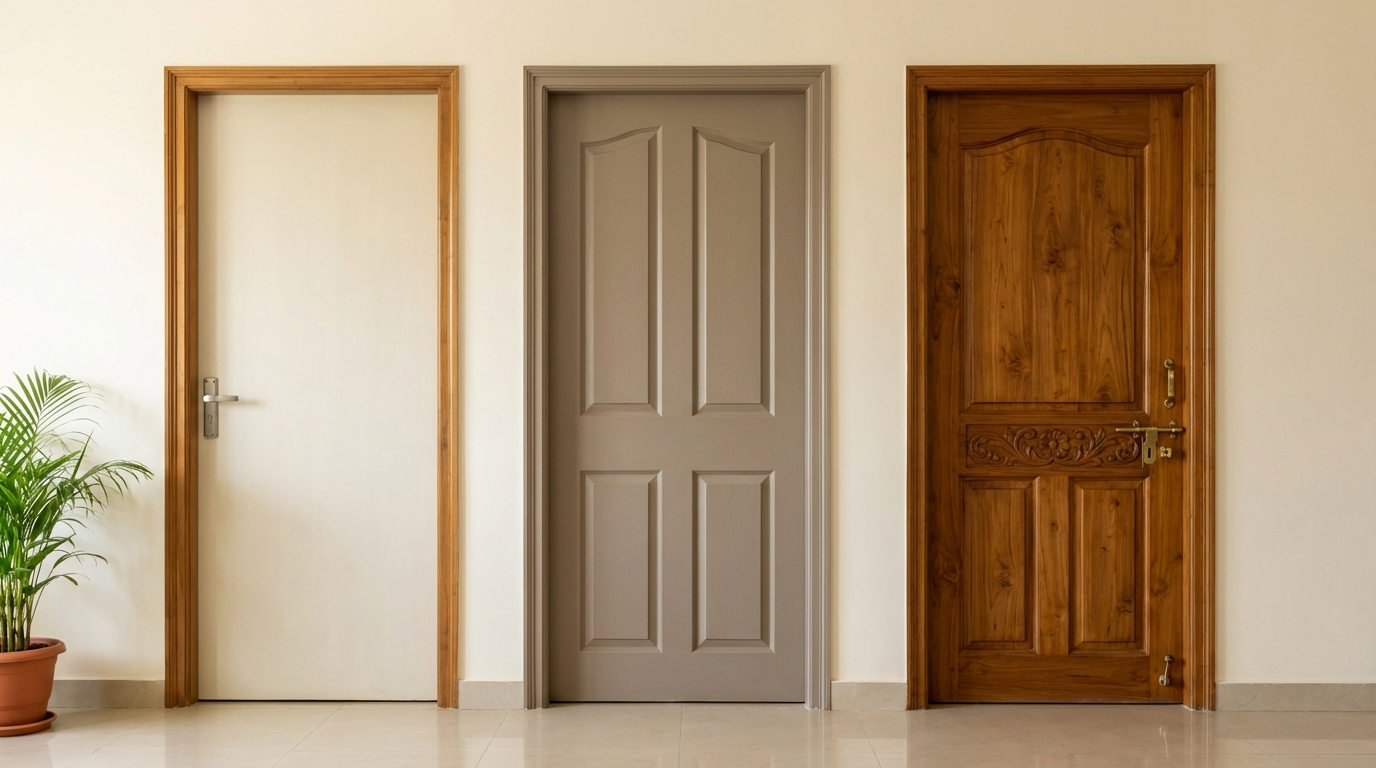
HDHMR vs Plywood: Which is Better for Kitchen, Wardrobe & Furniture?
Detailed HDHMR vs plywood comparison—strength, moisture resistance & screw holding. Find which board is better for kitchen, wardrobe & furniture in India.
HDHMR vs Plywood: The Quick Answer
The best material between HDHMR and plywood depends on your application: HDHMR is a practical, budget-friendly solution for most interior applications, especially in moisture-sensitive areas like kitchens and bathrooms. On the other hand, marine plywood excels in structural strength, long-term durability, and outdoor use.
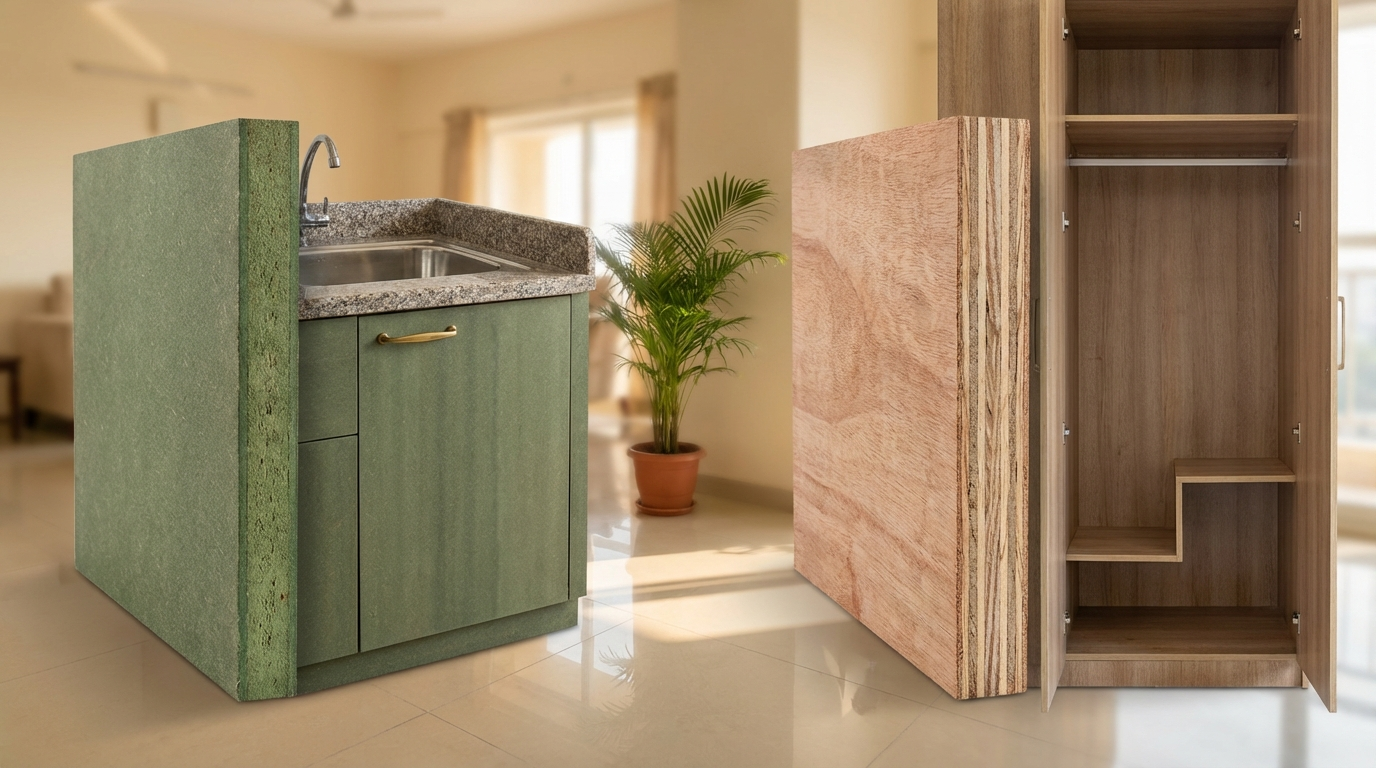
Short version: HDHMR offers better moisture resistance per cost than BWR plywood—the boards are more uniformly moisture resistant throughout the material. Some industry sources note that HDHMR boards are actually more cost-efficient than BWR plywood for interior applications like kitchen cabinets. But for under-sink base units and load-bearing shelves? Use branded waterproof plywood for under-sink cabinets, shelves and load-bearing areas anywhere moisture or weight is a concern.
HDHMR is right for you if:
- It's designed to withstand humidity, and offers a sleek, smooth surface ideal for laminates and paints.
- For kitchens with high humidity or areas around sinks and dishwashers, HDHMR board is the better choice.
- You want a material that won't delaminate—HDHMR is a homogenous product – nothing to delaminate.
- HDHMR is naturally resistant to termites, thanks to its engineered structure.
Skip HDHMR if:
- Plywood, particularly BWP (Boiling Water Proof) grade, tends to have better load-bearing capacity. Plywood is less likely to break under pressure, making it suitable for heavy kitchen cabinets.
- Marine plywood is preferable for outdoor applications or wet exposure but is costlier.
Bottom line: Branded waterproof plywood passes the durability and structural strength tests with flying colours, while HDHMR boards offer a cost-effective, sleek alternative for lighter, decorative applications. The smartest kitchen design isn't about picking one material over another—it's about knowing where each performs best.
Note: sainik710.com is an independent informational site and is not affiliated with any manufacturer.
What These Materials Actually Are
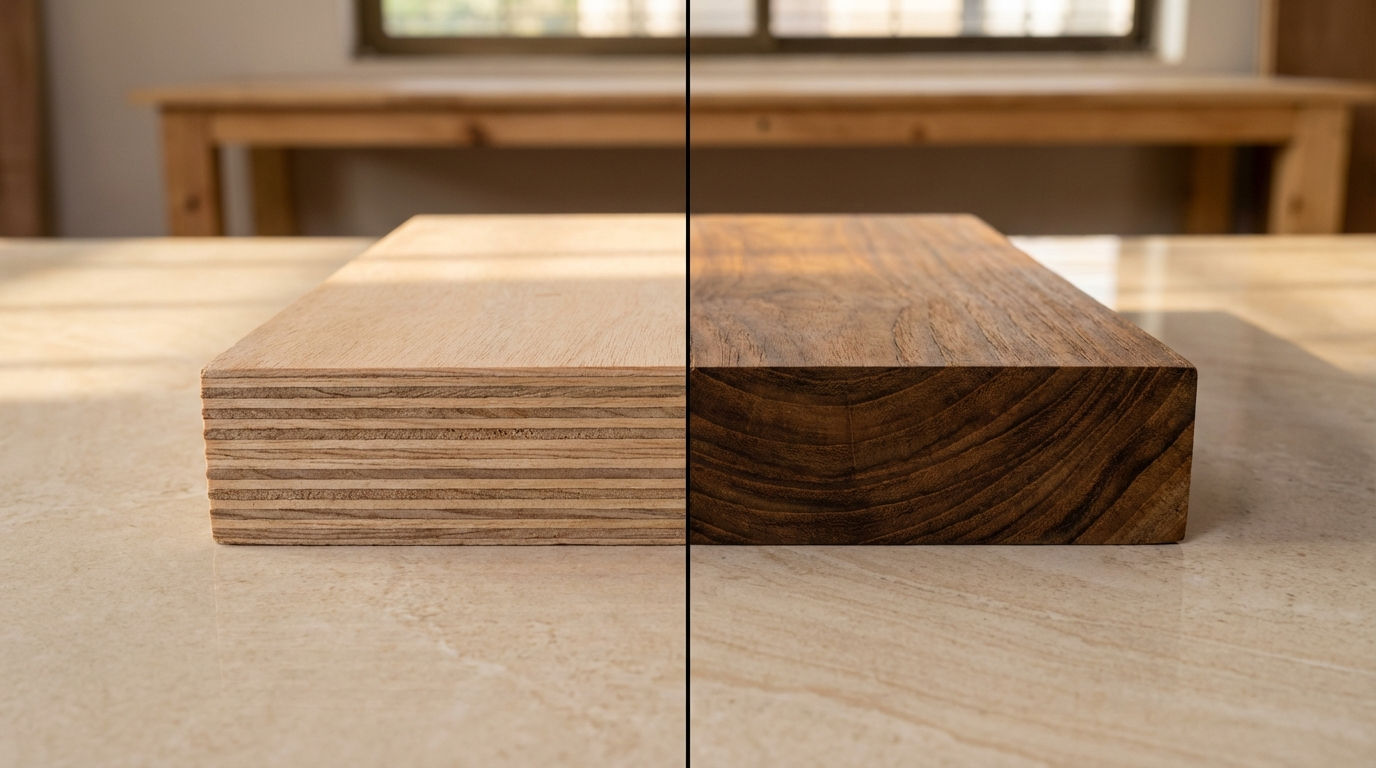
HDHMR stands for High-Density High Moisture Resistant board. These engineered materials are made from hardwood fibers which are compressed under high pressure to make a dense and strong board. In the course of manufacture, a special glue and resin mix is added to increase the board's resistance to moisture. Most people think it's just "fancy MDF." Actually, that's partly true—but the density and resin treatment make a huge difference in how it handles kitchen conditions.
Plywood is a versatile building material made from various cross-grain layers of wood veneers glued together. Since the grains run at right angles to each other, plywood acquires quite a decent amount of strength and stability. This cross-layered structure is why plywood can take heavy loads without cracking—something HDHMR struggles with under extreme stress.
Here's the misconception that drives me crazy. People assume HDHMR is "waterproof." HDHMR boards are moisture resistant but not fully waterproof. They resist humidity and splashes when laminated and sealed. There's a difference between handling bathroom steam and sitting in a puddle of water. If your mistri tells you HDHMR can handle direct water contact for hours, find a new mistri.
HDHMR composition involves high-density fiberboard made from wood fibers plus special resins for moisture resistance. The density is typically 750–880 kg/m³ (brand-dependent). The high density is what gives it strength and water resistance. Compare that to plywood, which typically ranges from 30-50 pounds per cubic foot (roughly 480-800 kg/m³).
Why This Matters in Indian Homes
Look, I've been consulting on interiors across Maharashtra and Karnataka for 18 years. The humidity question isn't academic—it's the difference between cabinets lasting 15 years and cabinets swelling up by their third monsoon.
Kitchens in Bangalore experience varying levels of humidity, especially during monsoons, and HDHMR's moisture-resistant properties make it an excellent choice. Mumbai is worse. Much worse. We hit 85-90% relative humidity during July-August, and your kitchen near the sink is basically a sauna. The dry climate of Ahmedabad (hot summers and mild winters with relatively low humidity) might not pose the same moisture challenges as coastal cities.
In places like Chennai or Mumbai, you'll notice standard plywood starts showing edge swelling within 2-3 years if the edges weren't sealed properly. Happens all the time. There was this flat in Bandra where I inspected the kitchen after just 18 months—the base cabinet near the dishwasher had completely bloated at the bottom. The carpenter had used MR-grade plywood (not BWR) and the client was furious.
HDHMR is ideal for choice for moisture-prone interiors. With high moisture resistance and melamine adhesive reinforcement, this board is meticulously crafted to handle humid indoor conditions. Its 5% moisture content and resilient composition make it suitable for Indian environments with fluctuating humidity.
Coastal Karnataka, the Konkan belt, humid Bengal—these regions need materials that can handle constant moisture in the air, not just occasional spills. Dry Rajasthan? Different story. You could probably get away with commercial-grade ply in Jaipur, but I still wouldn't recommend it for kitchen base units.
Is HDHMR actually worth the extra cost?
HDHMR is slightly more expensive than commercial-grade plywood but offers superior performance in humid conditions. Plywood is available across a wider price range, with options to suit most budgets. Here's my honest take: for wardrobes in a bedroom with air conditioning, the extra cost of HDHMR might not be justified. But for kitchen cabinets, especially the base units and the cabinet around your sink? Worth every rupee. Although HDHMR comes at a slightly higher price point than regular plywood, its long-term benefits in moisture-prone areas justify the investment by reducing maintenance and replacement costs.
Understanding the Different Grades and Options
Plywood comes in various grades: MR Plywood offers moderate moisture resistance and is suitable for areas with minimal water exposure. BWP Plywood, also known as Marine Plywood, is highly waterproof and can withstand maximum water exposure—ideal for areas prone to moisture. ISI Grade 303 Plywood is water-resistant and commonly used for upper head cabinets in kitchens.
HDHMR grades are simpler—you're mostly looking at density variations and whether it's plain or pre-laminated. Most HDHMR sold in lumber yards is plain by default, unless you specifically ask for prelam. So when someone says "HDHMR board" they usually imply plain unless noted.
My take: I've seen too many people overpay for marine plywood when they didn't need it. If you're doing overhead cabinets in a dry climate? Use HDHMR boards for shutters, wall panels and overhead cabinets where smooth finishes and consistent textures matter more. Save the BWP grade for the sink cabinet base.
| Grade/Type | Moisture Resistance | Best Application | My Recommendation |
|---|---|---|---|
| MR Plywood | Moderate | Dry areas, bedrooms | Skip for kitchens entirely |
| BWR Plywood | Good | Kitchens, bathrooms | Decent choice if budget is tight |
| BWP/Marine Plywood | Excellent | Sink cabinets, outdoor | Use for base units and heavy load areas |
| Plain HDHMR | Very Good | Most interior furniture | Great all-rounder for shutters, carcasses |
| Pre-lam HDHMR | Very Good | Modular kitchens, wardrobes | If you are paying significant labor for lamination, prelam can be cost-neutral or even cheaper in total cost, especially for large modular jobs. |
Price Reality Check (2026 Market)
HDHMR board price is ₹50-110 per sq ft in India depending on thickness, brand, and finish. Thin boards (6–9mm) are usually lower cost because they are used for back panels and partitions. Mid thickness (12mm) is very common for furniture and cabinet components. Heavy thickness (16–18mm) is the standard for kitchen carcasses, wardrobes, shutters, and load-bearing furniture panels. Extra thick (25mm+) is used for tabletops, door cores, and premium partitions.
Plywood pricing varies wildly by grade. Commercial MR-grade starts around ₹35-45 per sq ft for decent brands. BWR jumps to ₹55-75. Marine/BWP? Expect ₹85-120 depending on the brand and where you're buying. In Mumbai, everything costs 10-15% more than Ahmedabad (transport, warehousing costs, you know how it is).
GST note: Many quotes are exclusive of GST. HDHMR boards often attract GST (commonly 18%). Confirm whether your supplier quote is "+GST" or "inclusive". I've seen clients get caught out by this—their "budget" quote suddenly jumped 18% at billing.
Here's what actually affects your final bill:
- Thickness (18mm costs roughly 1.5x what 12mm costs)
- Brand positioning (There's a ₹10–₹25/sq ft difference between brands)
- Plain vs pre-laminated (prelam adds ₹25-45 per sq ft but saves labour)
- Your city and dealer markup
- Quantity discounts (bulk orders can knock off 8-12%)
HDHMR vs Plywood: Direct Head-to-Head Comparison
| Parameter | HDHMR | Plywood (BWR/BWP) | My Preference |
|---|---|---|---|
| Moisture Resistance | HDHMR boards offer superior resistance to moisture, making them ideal for humid environments. | Standard plywood can warp or delaminate when exposed to moisture, although marine-grade plywood offers better water resistance. | HDHMR for consistency |
| Load-Bearing Strength | Good for moderate loads | BWP grade tends to have better load-bearing capacity. Plywood is less likely to break under pressure. | Plywood for heavy shelves |
| Screw Holding | HDHMR boards can hold screws tightly because they have an even inside, making them tough and reliable. | Good, especially with cross-grain structure | Both work well honestly |
| Termite Resistance | These boards are treated to keep away termites and borers, so no worries about insects causing damage. | Susceptible to termite damage unless treated or made from hardwood varieties like marine-grade plywood. | HDHMR clearly better |
| Surface Finish | The smooth surface of HDHMR boards is ideal for painting and laminating, offering a refined finish. | Veneer finish gives it a natural wood look, appealing for traditional kitchen designs. | Depends on your aesthetic |
| Workability | HDHMR boards are dense, making them slightly more challenging to cut and shape compared to plywood. | Easy to cut, shape, and customize, making it ideal for intricate designs and detailed cabinetry. | Plywood for complex work |
| Edge Quality | Uniform, no voids—easy edge banding | Can have inner voids that show on edges | HDHMR wins here |
| Price Range (18mm) | ₹70-110/sq ft | ₹55-120/sq ft depending on grade | HDHMR is better value for most uses |
Choosing the right material depends on your priorities, be it cost, sustainability, or lifespan. You gain uniform moisture resistance with HDHMR but lose some load-bearing capacity. You gain natural wood aesthetics with plywood but need to worry more about termites and edge sealing.
Can you use HDHMR in bathrooms?
HDHMR boards are moisture resistant but not fully waterproof. They resist humidity and splashes when laminated and sealed. Avoid using them in direct water contact areas. For bathroom vanities? Yes, works fine if you seal the edges properly. Carpenters in Mumbai reported using Greenpanel boards for vanity cabinets with no swelling after two years, provided the boards were not in direct contact with water. But don't use it for the cabinet that sits directly on the bathroom floor—water will pool there during showers. Use WPC or marine ply for that.
How to Choose: Your Decision Framework
Step 1: Figure out where the furniture will live. Kitchen near sink? Bathroom? Bedroom? This determines 60% of your decision.
Step 2: If cost is a major concern, plywood might be a suitable option, especially for areas less prone to moisture. For kitchens with high humidity or areas around sinks and dishwashers, HDHMR board is the better choice.
Step 3: Check what your carpenter is comfortable working with. Some old-school mistrys haven't worked with HDHMR and may not know the right screw sizes or edge-banding techniques. This matters more than you'd think.
Step 4: Consider the finish you want. For painting surfaces with PU or Duco, HDHMR is a suitable choice. Want a wood-grain veneer look? Plywood might be more natural.
Exception: While HDHMR excels in moisture resistance and density, it may be more susceptible to expansion and contraction due to temperature fluctuations. If you're in a place with extreme temperature swings (Rajasthan, parts of Punjab), factor this in.
| Your Situation | Recommendation | Why |
|---|---|---|
| Kitchen base cabinets (near sink) | BWP Plywood or HDHMR combo | Use branded waterproof plywood for under-sink cabinets and load-bearing areas. |
| Kitchen wall cabinets | HDHMR | Less moisture exposure, smoother finish for laminates |
| Kitchen shutters | HDHMR | HDHMR for shutters where smooth finishes matter more. |
| Bedroom wardrobe | Either works | Low moisture area—go with budget |
| Bathroom vanity | HDHMR with sealed edges | Handles humidity well |
| Heavy bookshelves | BWR Plywood | Better load-bearing capacity |
| TV unit | HDHMR | Smooth surface, no moisture concerns |
| Outdoor furniture | Marine Plywood or WPC | Marine plywood is preferable for outdoor applications. |
Red flags to walk away from:
- Dealer insisting HDHMR is "100% waterproof"—it's not
- Plywood with visible inner voids when you look at the edge
- Price that's 30% below market rate (probably not genuine ISI)
- No brand marking on the board itself
Why do carpenters prefer plywood over HDHMR?
Honestly? Familiarity. Most mistrys have worked with plywood their whole careers. HDHMR boards are dense, making them slightly more challenging to cut and shape compared to plywood. Some carpenters complain the dust is finer and more irritating. Others say screws don't "bite" the same way—though consider using confirmat screws for 90° joints—they hold great in HDHMR. The good carpenters have adapted. The lazy ones will push you toward what they know.
Common Mistakes People Make
1. Using MR-grade plywood in kitchens. This one really frustrates me. MR stands for "moisture resistant," not "moisture-proof." Plywood is susceptible to moisture damage, requires additional waterproofing, and can attract termites if untreated. I've seen three kitchens this year alone where MR-grade was used for base cabinets. All had edge swelling within two monsoons.
2. Skipping edge sealing on HDHMR. If not laminating immediately, at least seal edges of pieces that might sit around. The edges are the weakest point—moisture enters through exposed fiber.
3. Assuming all plywood is equal. There's ISI-marked and there's "local grade." The difference in core quality is massive. A builder in Andheri learned this the hard way—bought "cheap BWR" that delaminated within a year. Turned out it wasn't actually BWR at all.
4. Not matching material to application. Moisture, weight, and time—these are the real tests of an Indian kitchen. Branded waterproof plywood passes them in durability and structural strength, while HDHMR boards offer a cost-effective alternative for lighter applications. Using HDHMR for a shelf that'll hold 40 pressure cookers? That's asking for sagging.
5. Ignoring thickness requirements. Heavy thickness (16–18mm) is the standard for kitchen carcasses, wardrobes, shutters, and load-bearing furniture panels. I've seen people try to save ₹2000 by using 12mm for everything. The shutters start drooping within a year.
6. Believing "termite-proof" marketing without verification. The termite resistance is effective when the boards are purchased from authorised dealers; some users encountered termite issues with unbranded HDHMR sold as "Greenply," which may have been counterfeit.
7. Going pre-lam when custom laminate makes more sense. (Or vice versa.) Plain HDHMR offers flexibility—you can choose any surface finish separately. It's also often easier to edge-band and process plain boards first, then finish them. But for large modular jobs, prelam can save significant labour costs.
Quality Checks You Can Do Yourself
Visual checks for HDHMR:
- Check the density or weight—HDHMR boards should feel quite heavy for their size (density ~850 kg/m³).
- Look at the edge—should be uniform, no gaps or different colored layers
- Color should be consistent (often grayish-brown or greenish)
- No visible chips or damage on surface
- Brand marking should be on the board itself
Visual checks for plywood:
- Edge should show multiple thin, uniform layers
- No inner voids visible when you look at cut edges
- ISI marking should be present (look for IS:710 for BWP, IS:303 for general)
- Surface should be smooth without bubbles
Questions to ask your dealer:
- "Is this genuinely BWP grade or just water-resistant?"
- "Can I see the ISI certification?"
- "What's the actual density of this HDHMR?" (if they don't know, be skeptical)
- "Is the price inclusive of GST?"
- "What's your return policy if the board has defects?"
Simple field tests:
- Tap test: Knock on the board. HDHMR should sound solid and dense. Plywood with inner voids sounds hollow in spots.
- Weight check: 18mm HDHMR sheet (8x4 ft) should weigh roughly 45-50 kg. If it feels light, question the density.
- Edge inspection: Run your finger along cut edges. Plywood should have tight layers. HDHMR should be uniform fiber throughout.
- Flex test: Try to bend a small offcut. HDHMR is stiffer and resists bending. Cheap MDF sold as HDHMR will flex more.
Warning signs:
- Price significantly below market rate
- Dealer reluctant to show ISI markings
- Mixed colors in plywood layers (indicates different wood types)
- Surface that feels rough or fibrous
- No proper brand labeling on the sheet
- Dealer can't explain the difference between MR, BWR, and BWP
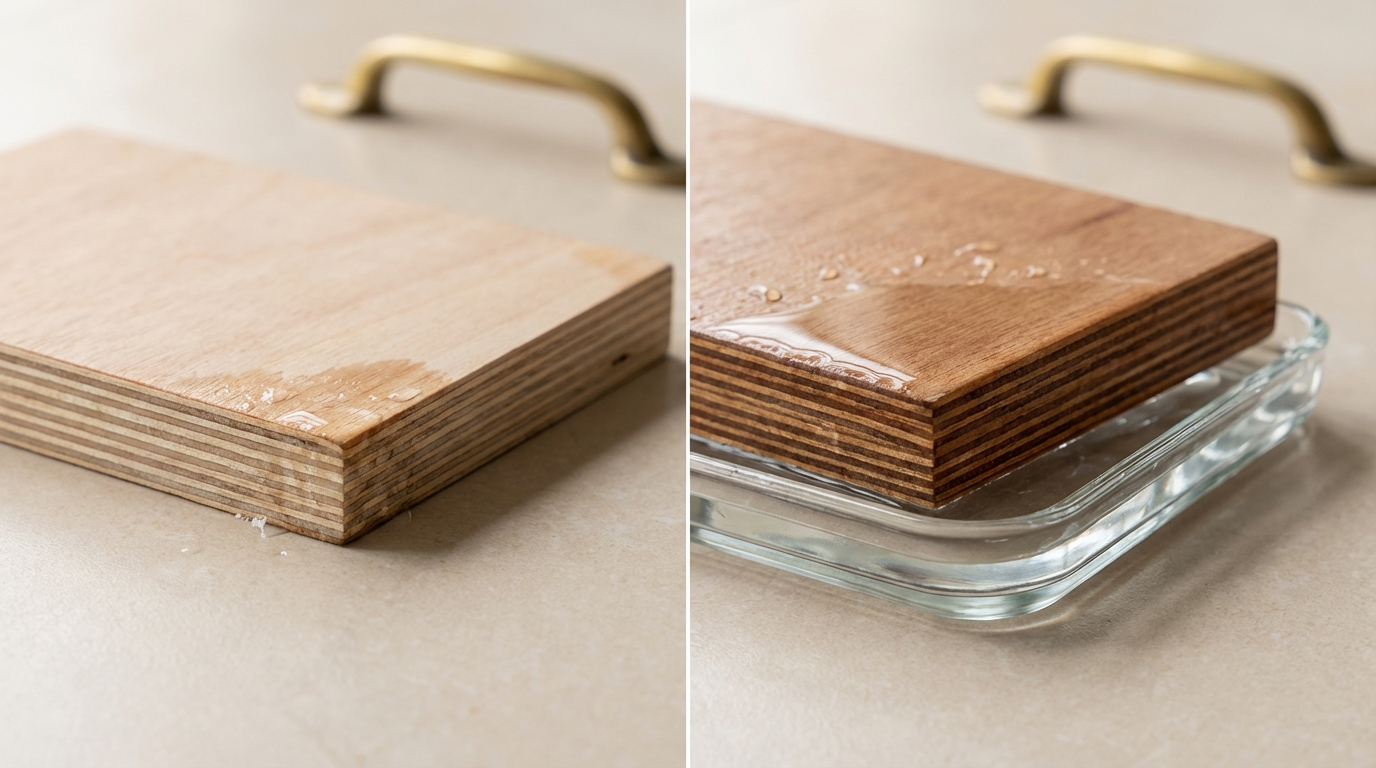
Here's a trick most dealers don't like: ask for a small offcut to take home and pour some water on it overnight. Genuine HDHMR or BWP will show minimal swelling. Fake stuff will bloat up obviously.
Workmanship & Installation
Pilot drill for screws and consider using confirmat screws for 90° joints. Safety: The dust from HDHMR cutting is fine—wear a mask and goggles, and do it in a ventilated area or attach a vacuum to tools if possible.
Cutting requirements: HDHMR cuts cleaner than plywood—no splintering. But it creates more fine dust. Your carpenter needs a sharp blade and ideally a dust extractor. Plywood needs scoring on the laminate side to prevent chipping.
Edge sealing: This is critical. Users should follow precautions: laminate both sides, seal edges and avoid long-term soaking. For HDHMR, edge banding with PVC tape works great because the surface is perfectly smooth. Plywood edges can be more challenging if there are inner voids.
Fastener guidance: For HDHMR, use 3.5mm x 35mm screws for 18mm boards. Always pre-drill—the density means screws can split the board if you just drive them in. For plywood, you can often skip pre-drilling in softer cores.
What to tell your carpenter:
- Pre-drill all screw holes in HDHMR
- Edge-band every exposed edge before installation—not after
- Don't leave boards lying on damp floors
- Use appropriate screws (not the same ones for every material)
- Seal cutouts for sinks and hobs immediately
- Handle with care—corners chip more easily than plywood
Storage notes: Avoid using HDHMR in direct water contact areas. Store flat, not leaning. Keep in a dry area before installation. If boards absorb moisture before installation, they'll warp after fitting.
I've seen carpenters skip edge banding on hidden edges "to save time." Three years later, those hidden edges have swelled because moisture travels through cabinet backs. Short-sighted savings become expensive repairs.
What thickness works best for kitchen cabinets?
Heavy thickness (16–18mm) is the standard for kitchen carcasses, wardrobes, shutters, and load-bearing furniture panels. For back panels, 5.5mm thickness works well. Don't let anyone convince you 12mm is enough for kitchen shutters—the hinges will pull out over time with daily use.
How Long Does Each Material Last?
Over 10-15 years, an HDHMR kitchen holds up very well. I've seen HDHMR kitchens from 2012 still looking decent (though the laminates show their age, the structure is fine). Both plywood and HDHMR can be termite-resistant, but plywood often comes with longer warranties, up to 30 years, providing a higher level of assurance.
In my experience, well-maintained HDHMR lasts 12-15 years for kitchen use, maybe 20+ years for bedroom wardrobes where there's no moisture stress. BWP plywood can last longer—I've seen 25-year-old marine ply cabinets still solid—but the cost was higher upfront.
What affects longevity:
- Edge sealing quality (probably the biggest factor)
- Ambient humidity in your city
- How often water spills happen near cabinets
- Quality of installation and hardware
- Whether you used the right grade for the right application
Signs of wear to watch for:
- Edge swelling near sinks or wet areas
- Laminate peeling at corners (moisture getting underneath)
- Hinges becoming loose (suggests screw holes are degrading)
- Sagging shelves
- Musty smell from cabinets (moisture trapped inside)
When to consider replacement: If the carcass is swelling or the structure is compromised, patching won't help. If it's just cosmetic—faded laminates, minor chips—resurfacing can extend life by 5-7 years.
Alternatives Worth Considering
Plywood remains a solid choice for specific uses, MDF for very budget/light uses, and WPC for water-contact situations.
If budget is tight: Commercial plywood with lamination works for wardrobes in dry areas. Just don't use it anywhere near water. You'll save 30-40% upfront but accept more risk.
If you need extreme moisture resistance: WPC (Wood Plastic Composite) is genuinely waterproof—not just resistant. Costs more and feels slightly different, but for bathroom cabinets or outdoor kitchens, it's worth considering. Our WPC guide covers this in more detail.
If you want a wood look: Block board with veneer gives you that solid wood aesthetic that HDHMR can't match. But it's heavier and needs more careful moisture protection.
For kitchen-specific applications, our kitchen cabinet material comparison goes deeper into the nuances between these options.
Frequently Asked Questions
Is HDHMR better than BWR plywood for modular kitchens?
While marine plywood is water resistant, prolonged humidity can still cause slight warping or fungus if not treated. HDHMR boards are more uniformly moisture resistant throughout the material. For most modular kitchen applications, HDHMR offers better value—you get consistent moisture resistance without paying marine ply prices. But for under-sink base units that might sit in puddles, BWP plywood still makes sense.
Is it true that HDHMR can't hold heavy loads?
Both HDHMR and plywood are strong and durable, but plywood, particularly BWP grade, tends to have better load-bearing capacity. Plywood is less likely to break under pressure, making it suitable for heavy kitchen cabinets. It's not that HDHMR can't hold weight—it's that for shelves holding 30-40 kg of utensils, plywood's cross-grain structure handles the stress better over time. For normal wardrobe shelves with clothes? HDHMR is fine.
Can I use HDHMR for outdoor furniture?
Absolutely not. Marine plywood is preferable for outdoor applications or wet exposure. HDHMR offers enhanced moisture resistance and durability, making it ideal for moisture-prone interiors. The key word is "interiors." Sun, rain, and extreme temperature changes will destroy HDHMR within a year or two.
Is it true that HDHMR is completely termite-proof?
HDHMR boards are typically termite and borer resistant due to chemical treatments and the resins in them. "Resistant" is the key word—not "proof." Some users encountered termite issues with unbranded HDHMR sold as "Greenply," which may have been counterfeit. Buy from authorized dealers to ensure the treatment is genuine.
What if I live in a coastal city like Chennai or Mumbai?
Humidity is your enemy. HDHMR with high moisture resistance and melamine adhesive reinforcement is crafted to handle humid indoor conditions. Use HDHMR for kitchen carcasses and shutters, but consider BWP plywood for sink cabinets. Edge banding becomes even more critical—don't skip any exposed edges.
Why is HDHMR more expensive than MDF but cheaper than marine ply?
HDHMR is marketed as being stronger and more water-resistant than MDF and more affordable than high-grade plywood. The manufacturing process adds special resins and higher compression, which costs more than regular MDF. But it's not marine plywood—the moisture resistance comes from different technology, not multiple waterproof veneer layers.
Is it true that HDHMR gives a smoother laminate finish than plywood?
Yes, this is actually true. HDHMR has a smooth finish without any bubbles, making the final product look really good. The smooth surface of HDHMR boards is ideal for painting and laminating, offering a refined finish. Plywood edges can show the layer lines through thin laminates, and sometimes internal voids cause uneven surfaces.
Should I use pre-laminated HDHMR or plain?
It depends on your project. Pre-laminated HDHMR boards come with factory-applied decorative laminate on one or both sides. If you are paying significant labor for lamination, prelam can be cost-neutral or even cheaper in total cost, especially for large modular jobs. For small jobs or if you want specific laminates, plain makes more sense.
How do I know if the HDHMR I'm buying is genuine?
Confirm board specifications—always ensure you're getting true HDHMR boards (High Density High Moisture Resistant) and not standard MDF or HDF. Check the density or weight—HDHMR boards should feel quite heavy for their size (density ~850 kg/m³). Ask for brand verification and check for proper markings on the board itself.
Can my carpenter handle HDHMR, or does it need special skills?
Pilot drill for screws and consider using confirmat screws for 90° joints. The dust from cutting is fine—wear a mask and do it in a ventilated area. Any decent carpenter can work with HDHMR, but some old-school mistrys need guidance on screw types and pre-drilling requirements.
Is it true that HDHMR expands and contracts with temperature?
While HDHMR excels in moisture resistance and density, it may be more susceptible to expansion and contraction due to temperature fluctuations. This is worth considering if you're in extreme climate zones. In most Indian cities with AC-controlled interiors, this isn't a practical concern.
What if my budget only allows for one material throughout?
If you have to pick one core material for most of your indoor carpentry, HDHMR board is likely the smartest choice, offering peace of mind against both climate and pests. It's the better all-rounder for Indian conditions. Just upgrade to BWP plywood for the sink cabinet base if possible.
That's the gist. Mix and match based on where each piece sits in your home—that's the real secret. Your carpenter might have different opinions, and honestly, if they've worked with both materials for years, it's worth hearing them out. Just don't let them push you toward MR-grade plywood for kitchens—I don't care how good a deal it seems. That never ends well.
Disclaimer: This content is provided for general informational purposes based on industry practices and publicly available information. Product specifications, standards, prices, and availability may vary by manufacturer, region, and time. Readers should independently verify details with manufacturers, dealers, or qualified professionals before making purchase or construction decisions.Want Plywood Suggestions?
Share a few details and a Sainik 710 specialist will suggest suitable brands and connect you to responsive dealers.