Flush Door vs Panel Door vs Solid Wood: Which Door Type is Best for Your Home?
Compare flush door vs panel door vs solid wood—durability, cost & aesthetics. Find the right door type for bedroom, bathroom & main entrance in India.
Quick Answer: Which Door Should You Pick?
The best door type for your Indian home depends on three things: where the door goes, your budget, and whether you're dealing with Mumbai-style humidity or Rajasthan-style dryness. That's really the crux of it.
Short version: Panel doors are much more expensive than flush doors. Flush doors are very good insulators of sound while panel doors are not. For most interior applications in Indian homes—bedrooms, study rooms, bathrooms—flush doors with solid cores make practical sense. Main entrances and living areas can benefit from panel or solid wood if your budget allows and you're in a drier region. I've seen people overspend on solid teak main doors only to watch them warp within two monsoons because they didn't account for humidity.
This is right for you if:
- Budget matters and you need doors for multiple rooms
- You want something the local mistri can install without drama—flush doors are easier to handle
- You want low maintenance and easy cleaning—flush doors take the win here with their smooth surfaces
- You're going for modern interiors where clean lines matter more than traditional detailing
Skip this if:
- You absolutely need that traditional carved wood look for a heritage-style home—panel doors deliver that character flush doors simply can't
Bottom line: For 8 out of 10 Indian homes I consult on, solid-core flush doors for interiors and either panel doors or veneered flush doors for the main entrance work perfectly. Don't overcomplicate this.
What Each Door Type Actually Means
Note: sainik710.com is an independent informational site and is not affiliated with any manufacturer.
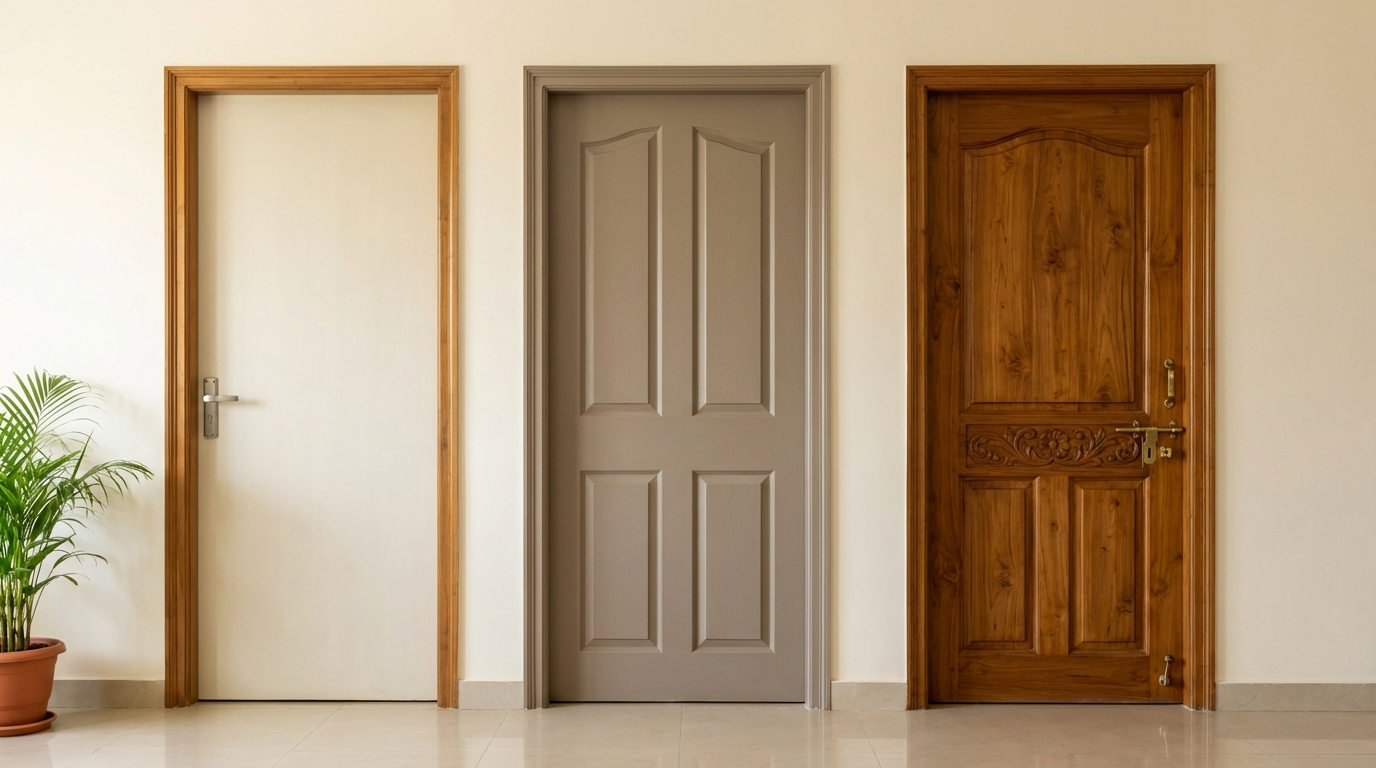
A flush door is a flat door with a flush surface and is not divided into any panels or moldings. It is composed of a wooden framework that is covered by ply, MDF Board, or natural wood on both sides, with smooth surfaces on both faces and hollow portions on the inside which are filled with an infill material like cardboard. Think of it as a sandwich—frame on the outside, filling in the middle. Simple.
Panel doors are made with traditional wood joiners like rails, stiles, and infill panels, which are assembled to make the door. They can be crafted with various kinds of wood and are available in different types of colors. These are what your dada's house probably had—the doors with those rectangular raised or recessed sections. Classic stuff.
Solid wood doors are crafted from premium grade woods such as teak wood, Indian rosewood (Sheesham) known for their long-lasting elegance and strength. This is the old-school option. Full timber, no engineered core, maximum weight, maximum prestige—and maximum headache if you don't maintain them properly.
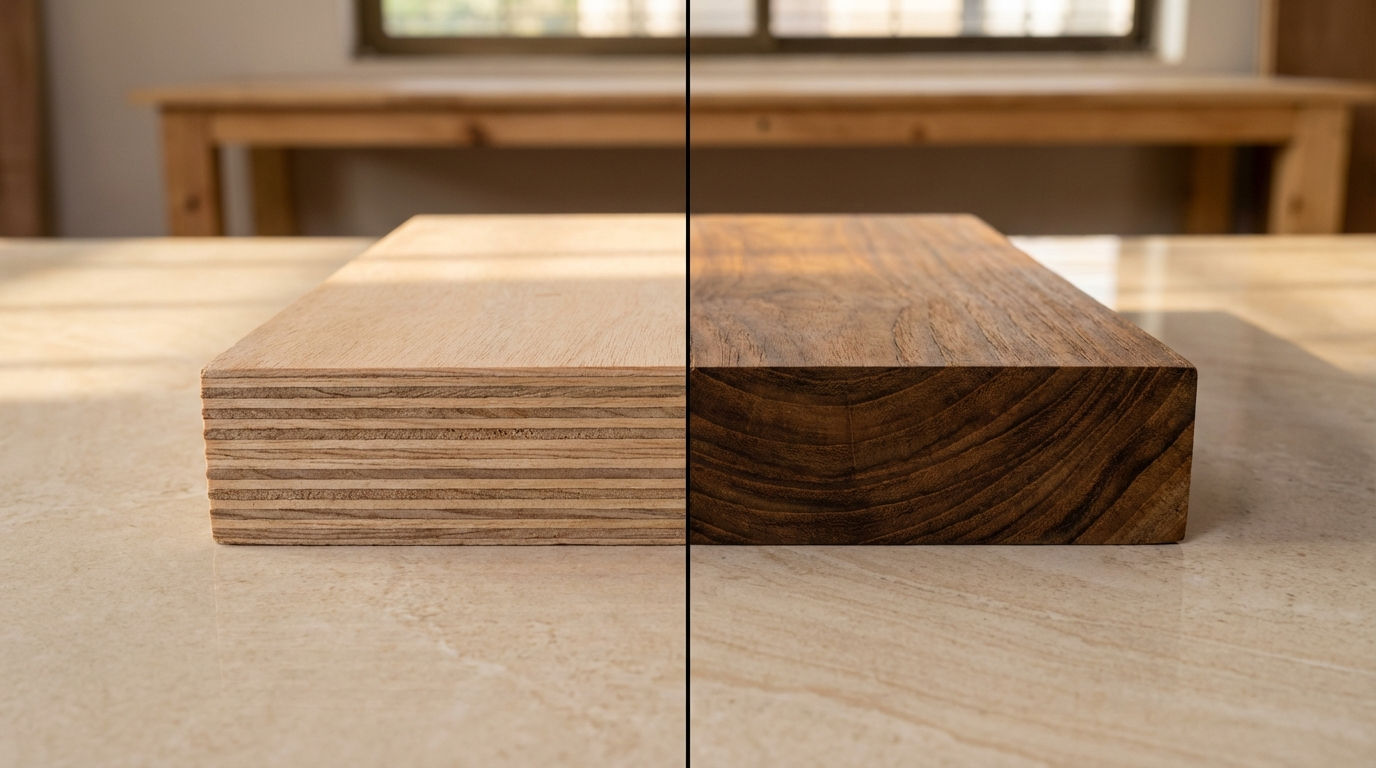
Most people think solid wood means "best quality." Actually, that's only half true. In India's extreme temperatures and high-humidity zones, solid wood doors tend to expand, warp, and develop surface cracks with time. A well-made flush door with BWP-grade plywood skin and blockboard core can outlast a poorly seasoned teak door. I've seen it happen more times than I can count.
Is solid wood actually worth the extra cost?
Here's my honest take after 18 years: solid wood is worth it only if you're getting properly seasoned timber from a reputable source and you're willing to maintain it. Teak, known for its high oil content, offers excellent resistance to moisture and pests, ensuring longevity even in challenging conditions. But if you buy cheap "teak" from a roadside dealer—well, that's not really teak, is it? You'll find out when it cracks.
For main doors, solid wood or high-quality panel doors make a statement. For the other 6-7 doors in your flat? Solid core flush doors are the smart money.
Why Door Choice Matters More in Indian Homes
Here's what most guides miss completely. India isn't one climate—it's about fifteen different climates stuffed into one country. India's climate varies dramatically—what works in Jharkhand plywood markets may not suit Odisha or Ranchi conditions.
The monsoon brings life—but it also brings moisture. High humidity makes wood absorb water, swell, and even warp. Doors can jam, and cabinets may lose their shape.
In Mumbai, where I'm based, relative humidity hits 85-90% during July-August. On the Ghatkopar side it can feel even more suffocating than Borivali—something about the air circulation, I think. Chennai, Kolkata, Kochi—same story. In humid regions, doors are prone to swelling and warping, necessitating the use of wood types that resist moisture absorption, such as teak or mahogany.
Now contrast that with Jaipur or Ahmedabad where you barely see rain for months. If the air humidity is too high, the solid wood door will absorb moisture and expand, causing the door to deform. If the air is too dry and moisture evaporates, the solid wood door may crack. Different problem, same root cause—wood doesn't like extremes.
Coastal Karnataka, the Konkan belt, humid Bengal—if you live in any of these places and you're considering solid wood without proper treatment, think twice. In high-moisture environments, traditional wooden doors are particularly susceptible to damage. Wood absorbs moisture easily, leading to swelling and warping.
There was this client in Navi Mumbai, must have been 2022. Insisted on full teak doors everywhere—bedroom, bathroom, the works. I told him to at least use flush doors for the bathrooms. "Sir, moisture-resistant ply for wet areas," I kept saying. He didn't listen. Eight months later, the bathroom door had swelled so badly it wouldn't close. Expensive lesson.
Breaking Down Your Options: Flush, Panel, and Solid Wood
Flush Door Types
Solid core flush doors have a solid core made of materials like particleboard, MDF, or lumber pieces. Solid core flush doors provide better insulation and soundproofing compared to hollow core doors.
Flush doors are typically built with a solid or hollow core—the core can be filled with materials like blockboard, particleboard, or honeycomb cardboard for strength and insulation.
Solid core flush doors: These are what you want for bedrooms and any door that's going to see regular use. Depending on the application and budget, the core may consist of solid blockboard for maximum strength, particleboard for a cost-effective option, or hollow materials to reduce weight while maintaining durability.
Hollow core flush doors: These are made from a honeycomb or grid-like core. They are lighter and more affordable but offer less sound insulation and security. Honestly, I only recommend these for store rooms or low-use areas. For anything else? Spend a bit more.
My take: Solid core doors are made from combination of blockboard, particle board, MDF, or laminated core, cross band, face veneer, etc. Blockboard core is my preference when screw-holding matters—like for heavy locks on main doors. Particleboard works fine for most interiors.
Panel Door Types
Panel doors come in many styles, each with its own charm. You can find everything from the classic raised panel to the modern recessed panel. Options like the six-panel, French panel, and shaker-style are also available.
The materials used in making panel doors affect their look and durability. Wood is a favorite, with choices like solid oak, maple, and pine. For something different, you can choose engineered wood or fiberglass doors.
Honestly: Panel doors in India are mostly about aesthetics. If your architect has designed a traditional or colonial-style interior, they'll push for panel doors—and they'd be right. But functionally? They need more maintenance.
Solid Wood Options
Mahogany is a popular choice for its rich color and resistance to decay, making it ideal for humid climates. Teak offers excellent resistance to moisture and pests. Cedar is prized for its natural repellents against insects. Oak, with its dense grain, provides robust strength and resistance to wear.
In India, teak and Sheesham dominate the market. But here's the thing—real well-seasoned teak is expensive. Really expensive. A lot of what gets sold as "Burma teak" is plantation teak from Africa or farm-grown stuff with much less natural oil content. Not bad, just different. Ask questions.
Comparison Table: Quick Overview
| Parameter | Flush Door (Solid Core) | Panel Door | Solid Wood Door |
|---|---|---|---|
| Typical cost range | ₹3,000-8,000 per door | ₹6,000-15,000 per door | ₹12,000-40,000+ per door |
| Weight | Medium (25-35 kg) | Heavy (35-50 kg) | Heaviest (45-70 kg) |
| Sound insulation | Good | Moderate | Excellent |
| Maintenance | Low—wipe and forget | Higher—dust collects in grooves | Highest—needs regular polishing |
| Humidity tolerance | Good (if BWP grade) | Moderate | Poor unless properly treated |
| Aesthetic appeal | Modern, minimal | Classic, elegant | Premium, traditional |
| Termite resistance | Good (engineered core) | Depends on wood | Depends on species |
| Best for | Bedrooms, bathrooms, offices | Living rooms, main areas | Main entrance, statement doors |
Price Reality Check (2026 Market)
Front door prices in India generally start at around ₹8,000 and can go above ₹18,000 depending on the plywood grade, shutter thickness and surface finish.
Flush doors are generally cheaper. That's a fact. They use less material, take less time to make, and don't involve the kind of craftsmanship panel doors require.
Here's what you're looking at in today's market:
Flush doors: Basic plain flush doors are typically priced from ₹2,544 to ₹8,480. Laminated flush doors, known for their durability, can cost between ₹5,936 and ₹12,720. Veneered flush doors, offering a natural wood finish, tend to be priced between ₹8,480 and ₹21,200. These ranges vary by city—expect 10-15% higher in metros.
Panel doors: GWS Solid Wood Panel Door runs around Rs. 5,075. Htt Sal 12 Panel Interior Door costs approximately Rs. 6,178. Howrah Timber New Akashmoni 2 Panel Interior Door is about Rs. 6,391. Higher-end carved designs? Easily ₹15,000-25,000.
Solid wood doors: Plantex Teakwood Door or CNC Wooden Door runs around Rs. 22,999. For a solid teak wood door with strength and visual attractiveness, expect to pay around Rs. 15,000 considering its quality and extended life. Custom carved teak main doors? I've seen quotes of ₹60,000-80,000 in Mumbai. Not for everyone.
Here's what actually affects your final bill:
- Core material—blockboard costs more than particleboard
- Thickness—32mm vs 30mm makes a difference in both price and performance
- Face finish—laminate vs veneer vs plain
- Hardware quality—don't cheap out here, it'll show
- Installation charges—varies wildly by city and carpenter
Quick detour: If your total door budget for a 2BHK is under ₹50,000, stick to flush doors. If you're building multiple rooms or looking at bulk orders, that price gap adds up real quick.
Direct Comparison: Making the Right Call
| Factor | Flush Door | Panel Door | Solid Wood | My Preference |
|---|---|---|---|---|
| Price | Budget-friendly | Mid to expensive | Most expensive | Flush (for interiors) |
| Durability | Good with solid core | Good if maintained | Excellent if seasoned well | Depends on usage |
| Maintenance effort | Low | Medium-high | High | Flush—no contest |
| Sound blocking | Good (solid core) | Average | Very good | Solid core flush |
| Visual appeal | Modern, clean | Classic, textured | Premium, rich | Subjective |
| Monsoon performance | Better (engineered) | Can struggle | Risk of warping | Flush (BWP grade) |
| Installation ease | Easiest | Moderate | Needs skilled carpenter | Flush |
| Fire resistance | Available in fire-rated | Generally poor | Poor | Fire-rated flush |
Choose flush doors when: You need practical, affordable, low-maintenance doors for bedrooms, bathrooms, and study areas. For contemporary spaces with a focus on simplicity and easy maintenance, flush doors are an excellent choice. They offer a clean look that complements modern decor while providing practical benefits like easy cleaning and potential fire resistance.
Choose panel doors when: Your interior design is traditional, colonial, or classical. The main living area and dining room benefit from that added character. You have budget and time for maintenance.
Choose solid wood when: It's the main entrance and first impressions matter. You're in a climate-controlled environment or drier region. You want something that can be passed down generations if maintained. Your budget is healthy.
Trade-off summary: You gain aesthetics with panel/solid wood but lose on maintenance convenience and humidity resistance. You gain practicality with flush doors but lose that premium look. There's no perfect door—just the right door for your situation.
How to Choose: A Practical Framework
Step 1: List every door opening in your home. Main entrance, bedroom 1, bedroom 2, bathroom 1, bathroom 2, kitchen, store room—write them all down.
Step 2: Categorize by function. High-traffic? Low-traffic? Wet area? Security needed?
Step 3: Match to climate. If you're in coastal Mumbai, Chennai, or Kolkata—prioritize moisture-resistant options. Bathrooms require shutters that resist swelling and surface damage. The plywood bathroom door price remains practical when moisture-resistant grades and sealed edges are used. If you're inland in Bangalore, Pune, or Delhi, you have more flexibility.
Step 4: Set a realistic budget per door, not just total. ₹3,500-5,000 per interior door is reasonable for flush. ₹8,000-12,000 for main entrance in flush or entry-level panel.
Step 5: Factor in installation and hardware. A good door with bad hardware fails faster than a mediocre door with quality hinges. Budget 15-20% extra for this.
Decision Matrix
| Situation | Recommendation | Why |
|---|---|---|
| 2BHK apartment, tight budget | Flush doors throughout, laminate finish | Cost-effective, consistent look, easy maintenance |
| 3BHK, mid-budget, modern interiors | Veneer flush for main door, laminate flush for others | Balance of premium look at entrance without overspending |
| Villa, traditional design, healthy budget | Solid wood main door, panel doors for living areas, flush for bedrooms/bathrooms | Statement entrance, character in public areas, practicality in private spaces |
| Coastal area with high humidity | BWP-grade flush doors everywhere | Moisture resistance is non-negotiable in your climate |
| Rental property for tenants | Basic solid-core flush doors | Durable, low maintenance, easy to replace if damaged |
Exception alert: If your bathroom is well-ventilated with exhaust fans and doesn't get direct splash, you might get away with MR-grade instead of BWP. But unless you're sure, don't take the risk.
Red flags to walk away from:
- Dealer can't tell you the core material
- No mention of glue grade (MR, BWR, BWP)
- Price seems too good—it probably is
- "Imported teak" at suspiciously low prices
- Rough edges or visible gaps in the door cross-section
Common Mistakes People Make
1. Using hollow core doors for bedrooms: I see this constantly. People buy the cheapest option for interior doors thinking "it's just a bedroom." Then they complain about noise bleeding through. Hollow core doors are lighter and more affordable than solid core doors but may not provide as much insulation or soundproofing. Spend a little more. Your sleep will thank you.
2. Ignoring humidity when choosing door type: This one really frustrates me. A builder in Panvel insisted on solid Sheesham doors for a ground-floor flat that was 200 meters from a creek. Beautiful doors. By the second monsoon, three of them had warped so badly they wouldn't latch. Moisture-rich environments pose unique challenges. The constant exposure to moisture and humidity can cause traditional doors to warp, swell, or even rot over time.
3. Not accounting for door weight during installation: Flush doors are generally lighter. Panel doors, while heavier, might require more skilled installation due to their weight and complexity. Your regular carpenter might struggle with a 60kg solid teak door. Make sure your hinges and frame can handle it.
4. Choosing based only on showroom appearance: Choosing doors based only on appearance without checking the core material affects strength and lifespan. Always ask to see a cut-sample or cross-section. What's inside matters more than what's outside.
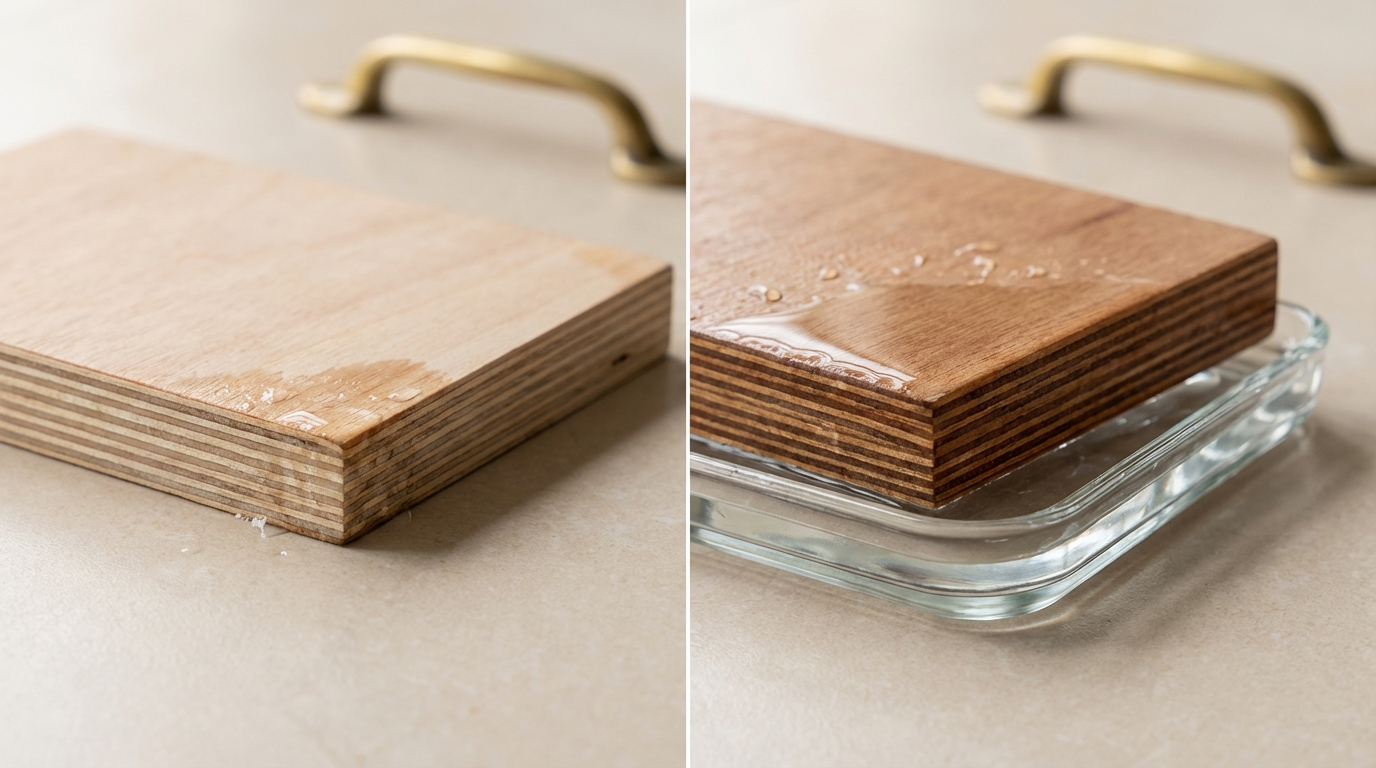
5. Skipping edge sealing: Ignoring edge sealing allows moisture to seep into the core over time. This is non-negotiable in humid cities. The exposed edges are where moisture attacks first. Seal them properly or watch your investment degrade.
6. Underestimating maintenance needs for panel and solid wood: Panel doors need more cleaning. Dust gets in the corners. And if the wood warps or cracks, repairs can get annoying and expensive. Painting can also be trickier because of the grooves. If you're buying solid wood expecting zero upkeep, you're in for disappointment.
7. Buying different doors for connected rooms: This sounds minor but looks terrible. If your living room opens into a dining area, matching or complementary doors matter. I've seen flats with three different door styles in visible proximity. Chaos.
8. Not planning for frame compatibility: Your new door needs to fit your frame. Sounds obvious, but I've seen people order doors without measuring the frame properly. Standard sizes help, but always measure twice.
9. Believing "termite-proof" marketing claims: Flush doors are termite-resistant while panel doors are not—but "resistant" and "proof" are different things. Regular checks still matter.
Quality Checks You Can Do Yourself
Visual inspection:
- Check surface for any bubbling or delamination—even small ones indicate poor bonding
- Look at edges for uniformity—gaps mean poor construction
- Examine both faces—they should be equally finished
- Check for straight lines—warping is visible if you look along the door edge
- For panel doors, inspect joint quality between panels and frame
- For solid wood, look for visible cracks or checks in the grain
Questions to ask your dealer:
- "What's the core material?" (Blockboard, particleboard, MDF?)
- "What glue grade is used?" (MR, BWR, BWP—if they don't know, walk away)
- "Can I see a cross-section sample?"
- "What's the face veneer/laminate thickness?"
- "Is there a warranty? What does it cover?"
Simple field tests:
- Tap test: Knock on the door surface. Solid core sounds muted and dense. Hollow core sounds, well, hollow. You can hear the difference.
- Weight check: Lift one end of the door. Solid core flush doors for a standard 7ft x 3ft size should weigh 25-35 kg. If it feels too light, it's probably hollow.
- Edge inspection: Run your finger along all four edges. Any roughness, gaps, or separation indicates problems.
- Flex test: For flush doors, try to flex the door slightly in the middle. Good quality won't flex much. Excessive flex suggests thin face or poor core.
Warning signs:
- Price significantly below market average—either inferior material or old stock
- No brand marking or ISI marking where applicable
- Dealer refuses to show cross-section or talks around your questions
- Surface feels gritty or uneven to touch
- Strong chemical smell—indicates low-quality adhesives or recent manufacture without proper curing
- Visible patches or color variations (unless it's natural wood grain)
Here's a trick most dealers don't like: Ask to see the scrap pieces from cutting. The cross-section reveals everything—core density, glue quality, veneer thickness. A confident dealer will show you. A sketchy one will make excuses.
Workmanship and Installation: Getting It Right
What thickness works best for doors?
Standard door thickness in India is 30mm to 35mm. Selecting very thin shutters to reduce cost leads to poor sound insulation and weaker hardware support. I recommend 32mm minimum for interior doors and 35mm for main doors. Anything under 30mm—avoid.
Cutting requirements:
Flush doors can be trimmed slightly (10-15mm from edges) without compromising structure. Panel doors? Don't even think about it—you'll destroy the proportions and possibly the structural integrity. Solid wood can be adjusted by skilled carpenters but needs proper edge treatment afterwards.
Edge sealing—why it's non-negotiable:
Always polish or laminate edges to block water seepage. The exposed MDF or particleboard core at edges is the vulnerability point. Use edge banding tape or apply sealant before installation. Your carpenter might skip this to save time. Don't let them.
Hardware and fastener guidance:
- Hinges: 4-inch hinges for standard doors, 5-inch for heavy solid wood doors
- Screws: 1.5 inch minimum for hinge mounting, 2 inch for strike plates
- Lock height: Standard is 36-38 inches from floor for comfortable use
- Door closer (if needed): Get the right strength—too weak won't close properly, too strong will slam
What to tell your carpenter—the briefing checklist:
- "Check frame alignment before hanging the door"—warped frames cause door problems blamed on the door
- "Leave 3-5mm gap at bottom"—for air circulation and floor clearance
- "Seal all edges before installation"—show them the sealant if they don't carry one
- "Use three hinges for heavy doors"—two won't hold solid wood properly over time
- "Pre-drill for screws"—prevents the wood from splitting, especially near edges
- "Check swing clearance"—nothing worse than a door hitting furniture or walls
Storage and acclimatization:
Before installing the solid wood door, it is recommended to place it in the installation environment for a period of time—generally more than 48 hours—to allow it to adapt to the local humidity and reduce deformation after installation. This applies to all wood doors, not just solid wood. If the door comes from a different climate zone, acclimatization is especially important.
I've seen carpenters skip this and install doors same-day. Called back to the site three weeks later because the door warped. The homeowner blamed the manufacturer. It wasn't the manufacturer's fault—it was improper acclimatization combined with Mumbai humidity. Could have been avoided.
How Long Each Door Type Really Lasts
Here's the honest truth, not marketing speak:
Flush doors (solid core): In my experience, well-maintained solid core flush doors last 15-20 years easily. Flush doors are constructed with strong materials, making them highly durable and long-lasting. Whether it's a solid core or laminated finish, these doors are built to withstand wear and tear. Replace the hardware every 7-10 years, and the door itself will keep going.
Panel doors: Traditional panel doors in Indian hardwood, properly maintained, can last 25-30 years. But "properly maintained" means regular polishing, checking for termites annually, and treating any cracks immediately. Skip the maintenance? You're looking at 10-15 years before major problems.
Solid wood doors: Premium teak with proper seasoning? Generations. My grandmother's house had teak doors from the 1960s still functioning. But—and this is important—they were maintained religiously. Modern solid wood doors without that care? Maybe 20 years before significant repairs are needed.
What affects longevity:
- Climate control: AC rooms extend door life significantly by reducing humidity fluctuation
- Usage frequency: Main entrance takes more abuse than guest bedroom door
- Maintenance routine: Even annual cleaning and inspection helps
- Initial quality: Cheap doors from unknown sources fail faster regardless of care
Signs of wear to watch for:
- Door starts sticking or jamming—could be humidity-related swelling
- Visible cracks appearing on surface
- Laminate peeling at edges
- Hardware becoming loose despite tightening
- Hollow sound developing where it used to sound solid (indicates internal deterioration)
When to consider replacement:
If more than 30% of the door surface shows damage, replacement often makes more sense than repair. Significant warping that prevents proper closing? Replace. Core rot from moisture infiltration? Replace. Minor cosmetic issues? Refinish or repair.
Alternatives Worth Considering
WPC (Wood Plastic Composite) doors: These have been gaining popularity in India, especially for bathrooms and external-facing doors. WPC doors are an option worth exploring for wet areas. They're completely waterproof, termite-proof, and don't need edge sealing. The look isn't quite like real wood, but for utility areas? Smart choice. Our WPC door guide covers specifications in more detail.
Engineered wood doors: For homeowners seeking the beauty of wood without the drawbacks of solid wood doors in high-moisture environments, engineered wood doors present a viable alternative. Engineered wood doors are constructed from multiple layers of wood veneers bonded together with adhesives, resulting in a stable and durable product that resists warping and swelling. More stable than solid wood, more premium-looking than basic flush doors.
Membrane doors: If budget is really tight, membrane-finished doors offer decent aesthetics at low cost. They won't last as long, but for rental properties or starter homes, they work. The membrane finish is basically a PVC sheet vacuum Disclaimer: This content is provided for general informational purposes based on industry practices and publicly available information. Product specifications, standards, prices, and availability may vary by manufacturer, region, and time. Readers should independently verify details with manufacturers, dealers, or qualified professionals before making purchase or construction decisions.
Want Plywood Suggestions?
Share a few details and a Sainik 710 specialist will suggest suitable brands and connect you to responsive dealers.