BWR vs BWP Plywood: Differences, IS Standards & Which One to Buy for Your Project
Understand BWR vs BWP plywood—IS standards, water resistance & best uses. Clear comparison guide to choose right waterproof grade for your furniture.
BWR vs BWP Plywood: The Straight Answer
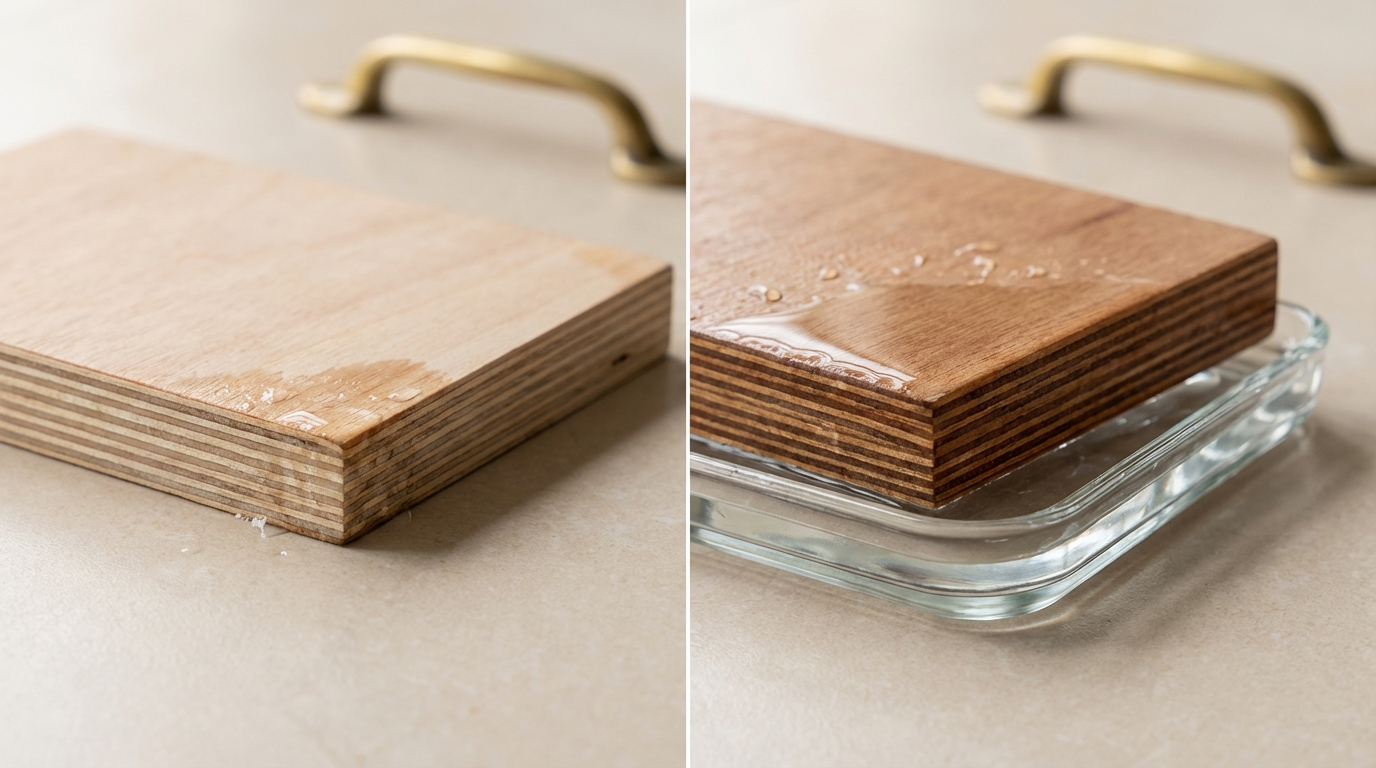
BWP plywood is fully waterproof and can survive continuous water exposure for 72+ hours, while BWR plywood is only water-resistant and handles moisture for about 8 hours before the layers start separating. That's the fundamental difference—one survives drowning, the other survives splashing.
Short version: If water is going to touch your plywood regularly—kitchen sink base, bathroom cabinet, washing machine area—you need BWP grade certified under IS:710. For areas that get humid but not wet, like the main kitchen cabinets away from the sink or wardrobes in coastal cities, BWR grade under IS:303 does the job at a lower price. Most of the confusion happens because dealers use these terms loosely.
This guide is right for you if:
- You're planning modular kitchen work and the carpenter is asking which grade to buy
- You've heard both terms thrown around and genuinely don't know what the difference means in practical terms beyond marketing talk
- Your home is in a humid city like Mumbai, Chennai, or Kolkata and you're worried about water damage
- You've been burned before by "waterproof" plywood that warped anyway
Skip this if:
- You're building dry-zone furniture like bedroom wardrobes in Rajasthan or Delhi—regular MR grade is probably enough and costs less
- You've already bought your plywood and just need installation guidance
Bottom line: BWP is genuinely waterproof and costs 25-40% more; BWR handles humidity but not submersion—pick based on actual water exposure, not fear.
What BWR and BWP Actually Mean
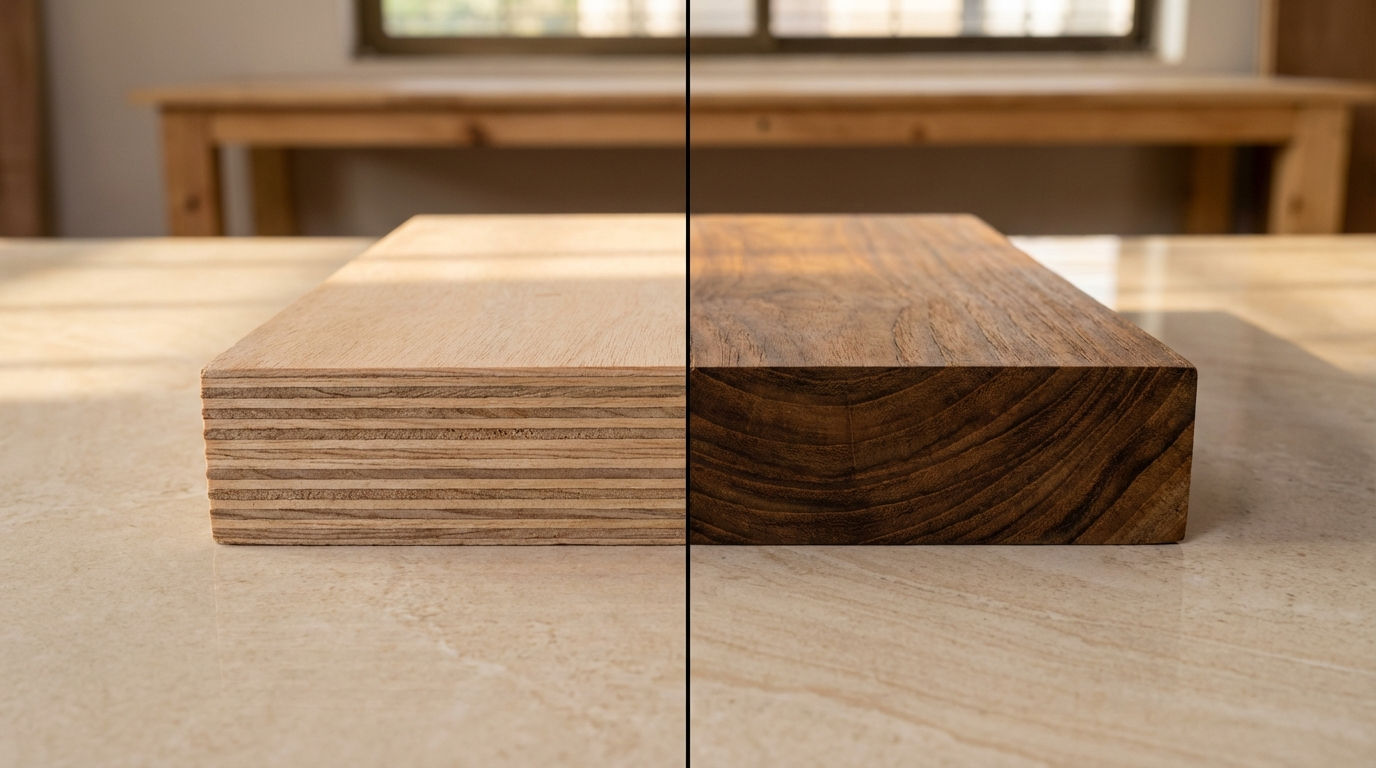
BWR plywood is Boiling Water Resistant plywood, a grade that can withstand moisture and humid conditions without immediate damage. BWP plywood is Boiling Water Proof plywood, meaning it survives direct, prolonged water contact including submersion. Both are better than commercial MR grade, but they're designed for completely different situations.
Most people think "resistant" and "proof" mean roughly the same thing. Actually, the gap between them is massive. Here's a way to picture it: BWR is like a raincoat—keeps you dry in a drizzle, but you'll get soaked if you jump in a pool. BWP is like a wetsuit—designed for submersion.
The technical difference comes down to the adhesive used to bond the veneer layers together. BWR plywood uses Melamine Urea Formaldehyde (MUF) resin. Decent stuff, handles steam and humidity, but breaks down when water sits on it for extended periods. BWP plywood uses Phenol Formaldehyde (PF) resin—the same stuff used in marine applications. This adhesive doesn't break down in water, period.
The Bureau of Indian Standards tests these differently too. BWR plywood is tested under IS:303 and needs to survive about 8 hours of boiling water without delamination. BWP plywood is tested under IS:710 and must survive 72 hours of boiling water. That's nine times longer. The IS:710 stamp is what separates genuine waterproof plywood from marketing claims—if it doesn't have that certification, it's not truly BWP regardless of what the shopkeeper says.
Is BWP plywood really worth the extra cost?
Depends entirely on where you're using it. For areas under the kitchen sink, behind the dishwasher, or bathroom cabinet bases—absolutely yes, BWP pays for itself the first time a pipe leaks. I've seen too many BWR cabinet bases turn to mush after one monsoon leak that wasn't caught for a few days. But for the upper kitchen cabinets that never see direct water? BWR is perfectly fine, and you save ₹30-50 per square foot across your entire kitchen. The mistake is going all-BWP or all-BWR. Mix grades based on actual water exposure.
Why This Matters More in Indian Homes
Here's the thing about India—we have humidity levels that would make European plywood manufacturers nervous. Mumbai hits 85-90% relative humidity during monsoon. Chennai stays above 70% RH for most of the year. Kolkata and the entire coastal Karnataka belt are similar stories. This isn't about occasional moisture; it's about your plywood fighting humidity every single day for decades.
In places like Chennai or Mumbai, you'll notice that even MR-grade plywood in a bedroom wardrobe starts showing subtle waviness after 4-5 years. The veneer doesn't delaminate dramatically—it just slowly absorbs ambient moisture and releases it, expanding and contracting with seasons. BWR grade handles this much better because the resin is more moisture-resistant from the start.
Coastal vs inland makes a real difference too. A home in Pune or Bangalore—decent humidity but nothing extreme—can get away with BWR in more places than a flat in Versova or Besant Nagar. The salt in coastal air accelerates everything. I had a client in Goa whose kitchen cabinets were BWR grade, and the bases under the sink needed replacing in under five years. Same plywood in a Bangalore apartment would've lasted twelve.
And then there's the groundwater factor in older buildings. Ground floor flats in Mumbai's older buildings often have moisture seeping up through the walls during monsoon. If your kitchen platform is against an exterior wall that gets damp, even the cabinet backs need better protection. This is where BWP makes sense even in places that don't "see" water directly.
Breaking Down the Grades and Standards
Alright, here's where it gets a bit technical, but this stuff matters when you're standing in the plywood shop trying to decode the stamps.
BWR Plywood (IS:303 Grade)
This is your workhorse grade for most interior applications. The IS:303 standard covers moisture-resistant plywood in general, with different classes within it. Good for modular wardrobes, TV units, study tables, kitchen cabinets (excluding sink base), bedroom furniture—basically anywhere that gets humid but not wet. Quality BWR plywood from reputable manufacturers handles steam exposure reasonably well, which is why it works in kitchens where cooking generates moisture.
My take: For 70% of residential furniture applications in India, this is the smart choice. Don't let anyone upsell you to BWP for a living room entertainment unit. Waste of money.
BWP Plywood (IS:710 Grade)
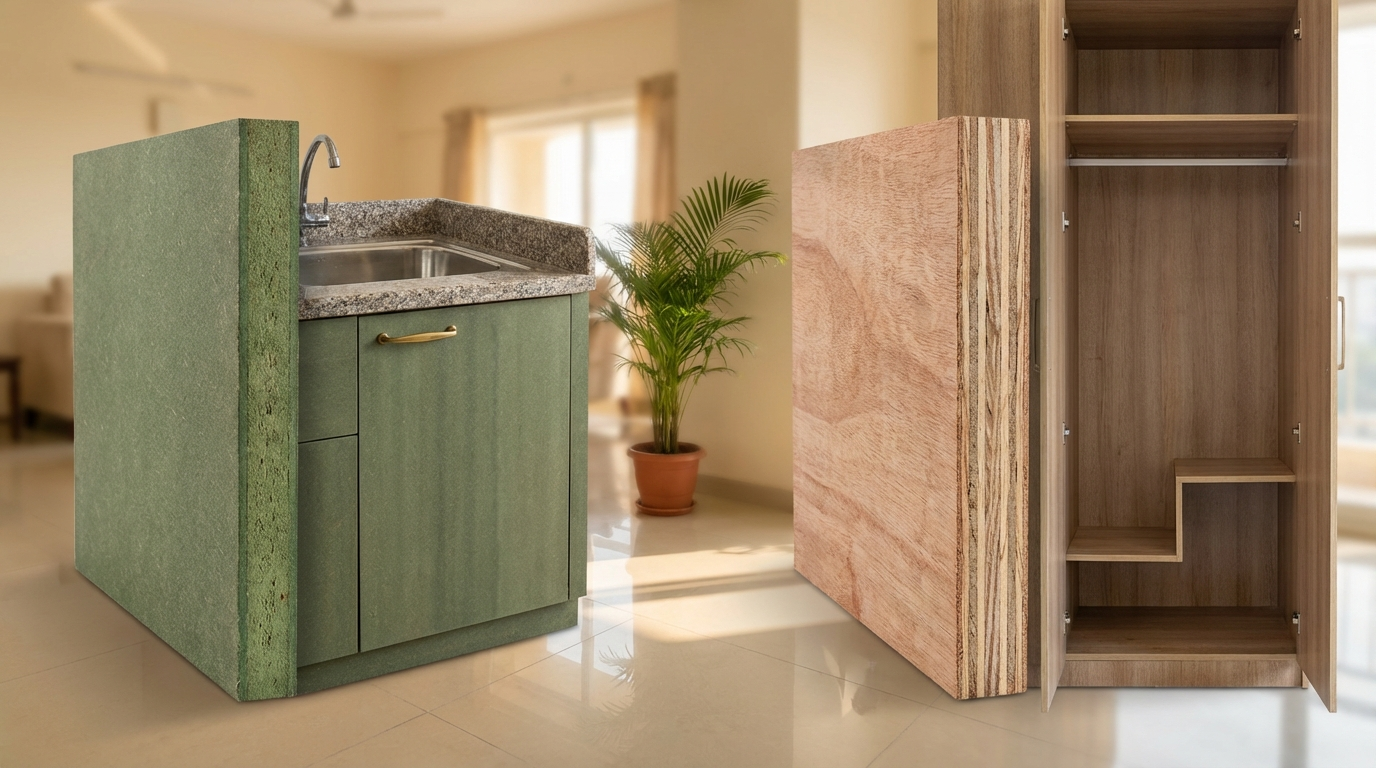
This is the genuine waterproof grade. The IS:710 certification is specific—it's not just a marketing stamp. The testing involves 72 hours in boiling water, which simulates years of water exposure in a compressed timeframe. Use this for kitchen sink bases, bathroom vanities, areas near washing machines, utility area storage, and any cabinet that might face a plumbing leak.
Honestly, IS:710-certified BWP plywood is harder to find than dealers would have you believe. Many claim their plywood is "BWP grade" without actual IS:710 certification. Always ask to see the ISI mark—it should specifically mention IS:710, not just "BWP" or "waterproof."
Marine Plywood (Also IS:710, but different)
This confuses people. Marine plywood is also certified under IS:710 but goes a step further with better core veneers and additional treatments. It's meant for boats, water tanks, exterior applications, and commercial bathrooms with serious water exposure. For residential kitchens and bathrooms, regular IS:710 BWP plywood is sufficient. Marine-grade is overkill unless you're building a shower enclosure or something that'll be perpetually wet.
| Aspect | BWR (IS:303) | BWP (IS:710) | Marine (IS:710 Premium) |
|---|---|---|---|
| Adhesive | MUF resin | Phenol Formaldehyde | PF resin + enhanced core |
| Boiling water test | ~8 hours | 72+ hours | 72+ hours with stricter standards |
| Typical use | Most furniture, kitchen uppers | Wet areas, sink bases, bathrooms | Exteriors, water tanks, boats |
| Price range | Base price | 25-40% premium over BWR | 40-60% premium over BWR |
| Availability | Common, most dealers stock it | Less common with genuine IS:710 | Specialty order usually |
| My recommendation | Default choice for dry zones | Necessary for wet zones | Only if genuinely needed |
Price Reality Check for 2026
Let me give you realistic numbers without pretending prices are static—they vary by city, by brand, by thickness, and by how well you negotiate.
For 18mm commercial plywood (which is what most furniture uses), expect roughly:
- BWR grade (IS:303): ₹75-125 per square foot depending on brand tier. The lower end is regional brands, the upper end is national brands with better quality control.
- BWP grade (IS:710): ₹95-180 per square foot. Yes, that's a wide range. Genuine IS:710 certified stuff from good manufacturers sits at the higher end. The cheap "BWP" that's not actually certified clusters at the lower end.
- Marine grade: ₹130-210 per square foot. If someone's offering marine plywood at BWP prices, I'd ask questions.
Here's what actually affects your final bill:
Thickness matters a lot. 12mm plywood costs 20-25% less than 18mm. For cabinet backs and drawer bottoms, 12mm BWR works fine. For shelves and cabinet bodies, 18mm is standard. Don't let anyone convince you that you need 19mm everywhere—it's marginally stronger but significantly more expensive.
Brand premium is real but sometimes justified. A top-tier brand's BWR might genuinely outperform a no-name brand's BWP because of better core veneers and more consistent manufacturing. I've seen cheap "BWP" plywood delaminate faster than good BWR from established manufacturers.
For a typical modular kitchen (say, 80-100 square feet of plywood), the difference between all-BWR versus mixed BWR/BWP versus all-BWP can be ₹12,000-25,000. That's significant. The smart approach: BWP only where water is a realistic threat, BWR everywhere else.
What thickness works best for kitchen cabinets?
18mm for cabinet carcasses—the body, the sides, the shelves. This gives you enough material for screw grip and structural strength. For back panels, 12mm is sufficient if you're using BWR grade in dry areas. The base cabinet under the sink? Use 18mm BWP for the sides and bottom. The frequently-made mistake is using thin plywood for shelf supports—they sag over time with heavy utensils. If a shelf spans more than 60cm without support, consider 19mm or add a center support strip.
BWR vs BWP: The Direct Comparison
Putting this in a table because this is what most people actually need—a clear side-by-side.
| Parameter | BWR Plywood | BWP Plywood | Which to Choose |
|---|---|---|---|
| Full form | Boiling Water Resistant | Boiling Water Proof | — |
| IS Standard | IS:303 | IS:710 | Check the stamp carefully |
| Water survival | ~8 hours boiling water test | 72+ hours | BWP if submersion risk exists |
| Humidity handling | Very good | Excellent | BWR is fine for humidity alone |
| Adhesive type | MUF resin | PF resin | PF is genuinely superior for water |
| Best for | Wardrobes, TV units, upper kitchen cabinets, study tables | Sink bases, bathroom vanities, utility areas, washing machine zones | Match to actual exposure |
| Termite resistance | Usually treated, varies by brand | Usually treated | Verify treatment for either grade |
| Price (18mm) | ₹75-125/sq ft | ₹95-180/sq ft | BWR saves money where appropriate |
| Delamination risk | Low in dry areas, moderate in wet areas | Very low even in wet areas | BWP for peace of mind near water |
| My preference | Default for most furniture | Only where specifically needed | Mixed approach is smartest |
Choose BWR when: The area gets humid but not actually wet. Upper kitchen cabinets, wardrobes (even in Mumbai), TV units, bookshelves, study tables, children's room furniture. Also works for kitchen bases that are away from the sink—say, the corner unit that stores containers.
Choose BWP when: Water contact is realistic. Under-sink cabinet, the cabinet next to the dishwasher, bathroom vanity base, utility room storage where wet mops are kept, washing machine platform if elevated. Also smart for ground-floor flats with wall dampness issues.
The trade-off summary: You gain genuine waterproofing and much longer lifespan in wet conditions with BWP, but you pay significantly more and get marginal benefit in dry areas. There's no single right answer—it depends on specific application.
How to Decide: A Practical Framework
Here's the approach I use with clients. Step-by-step, but honestly, most decisions are obvious once you think through water exposure.
Step 1: Map your furniture by water exposure zones
Go through each piece you're planning. Kitchen sink base cabinet? Wet zone—BWP. Bedroom wardrobe? Dry zone—BWR is plenty. Bathroom vanity? Wet zone—BWP. Kitchen overhead cabinets? Technically dry zone, though I'd use BWR minimum because of cooking steam in Indian kitchens.
Step 2: Consider your city's climate
If you're in Jaipur or Delhi, humidity is lower and BWR performs well in more applications. If you're in Mumbai, Chennai, Kolkata, or coastal Karnataka—bias slightly toward BWP in borderline cases. Not because BWR fails, but because the margin of safety matters when ambient moisture is already high.
Step 3: Factor in your building's age and floor
Ground floor of an older building with known dampness issues? Use BWP for any cabinet against exterior walls. Upper floor of a newer construction with good waterproofing? BWR handles almost everything.
Step 4: Calculate the cost difference
Get quotes for both grades in your required sizes. If the difference across your entire project is ₹8,000, it might be worth going higher-grade for peace of mind. If it's ₹40,000, be more strategic about where you actually need the upgrade.
| Situation | Recommendation | Reason |
|---|---|---|
| Kitchen sink base cabinet | BWP (IS:710) | Pipe leaks happen; when they do, you want survival |
| Kitchen upper cabinets | BWR (IS:303) | Steam exposure, not water immersion |
| Bedroom wardrobe in Mumbai | BWR (IS:303) | Humidity handled; direct water unlikely |
| Bathroom vanity base | BWP (IS:710) | Water splashes and humidity combined |
| TV unit in any city | BWR or even MR | No moisture exposure; save money |
| Utility area storage | BWP (IS:710) | Wet mops, occasional spillage |
| Washing machine platform | BWP (IS:710) | Water outlet nearby; leaks are common |
| Living room bookshelves | BWR or MR | Dry application; no need for premium grade |
Red flags to walk away from:
- Dealer can't show you ISI mark on the plywood sheet itself
- Price of "BWP" is the same as BWR—genuine IS:710 costs more
- Claims that "block board" is waterproof—block board is a different product entirely and needs its own evaluation
- Pushing marine grade for a regular bathroom vanity—overkill and margin padding
Common Mistakes I Keep Seeing
Using BWR for sink base cabinets to save money
This one really frustrates me because it's so predictable. A builder in Andheri learned this the hard way in 2022. Used BWR grade behind the kitchen sink because the overall quote looked better. First monsoon, there was a small leak at the pipe fitting—not even a major burst, just a slow drip. By November, the cabinet base was completely swollen. ₹65,000 repair because they had to redo the countertop too. The ₹3,000 saved on plywood grade cost them twenty times more.
Going all-BWP everywhere "just to be safe"
The opposite mistake. I get the logic, but it's wasteful. BWP for your bedroom wardrobe in Pune? That's ₹15-20,000 extra across a typical home that gives you zero additional benefit. The money is better spent on better hardware, better laminates, or a proper edge banding job.
Trusting verbal claims about "BWP grade"
If I'm being honest, maybe 4 out of 10 dealers I've dealt with misrepresent grades. Not always maliciously—sometimes they genuinely don't understand the difference. Always check the ISI stamp on the sheet itself. IS:303 is BWR. IS:710 is BWP. If there's no stamp, don't assume anything.
Ignoring edge sealing on BWR plywood
Even good BWR plywood is vulnerable at the edges because that's where moisture enters fastest. Not sealing edges properly in a kitchen environment basically invites problems. The mistri will often skip this step because it's time-consuming. Insist on it.
Buying by price alone
The cheapest BWP might be worse than mid-range BWR from a reputable manufacturer. The adhesive is important, but so are the core veneers. Cheap plywood uses inferior wood with voids and inconsistent density. I've seen budget "IS:710" plywood that technically passed certification but had so many core defects it didn't last.
Not checking plywood in the monsoon season
Here's a trick most dealers don't like—visit the godown in July or August. If the plywood is stored properly and still lying flat without warping, that tells you something about quality. If sheets are already showing waviness in storage, imagine what happens in your home.
Assuming thickness equals quality
I've seen this happen when people think 19mm plywood is automatically better than 18mm. It's marginally thicker, costs notably more, and the quality depends on the manufacturer, not the extra millimeter. Focus on grade and brand first.
Can you use BWR plywood in bathrooms?
For the vanity top and upper storage, yes—BWR handles bathroom humidity reasonably well. For the vanity base where water collects, drips, and sits? No, use BWP. The base cabinet in a bathroom sees actual water contact from sink splashes and occasional flooding from overflows. The upper bathroom cabinet that just stores toiletries? BWR is fine. Match the grade to actual exposure, even within the same room.
Quality Checks You Can Do at the Shop
Visual inspection:
- Look at the edges—count the veneer layers. Good 18mm plywood should have 9-13 layers. Fewer layers means each layer is thicker and more prone to cracking.
- Check for voids. Hold the sheet up to light if possible. Any gaps in the core? Pass on that sheet.
- Surface smoothness matters for laminate adhesion. Run your hand over it.
- Look for the ISI stamp. Not a sticker—an actual stamp or print on the sheet.
- Uniform color across the face veneer suggests consistent wood source.
Questions to ask the dealer:
- "Which IS standard is this certified under—303 or 710?" Watch how confidently they answer.
- "Can you show me the test report or certification?" Good dealers have this available.
- "What's the core wood species?" Hardwood cores (like Gurjan or eucalyptus) are better than softwood.
- "How long have you stocked this particular batch?" Plywood that's been sitting for a year in a damp godown is not the same as fresh stock.
Simple tests you can do:
- Tap test: Knock on the surface. Solid, consistent sound means good core density. Hollow spots suggest voids.
- Weight check: Lift the sheet. Good quality 18mm plywood should feel substantial. Suspiciously light sheets often have inferior cores.
- Edge inspection: Look at the cross-section. Layers should be uniform, tightly bonded, no gaps.
- Flex test: Gently flex a corner. Quality plywood has some give but returns to shape. If it feels brittle or has zero flex, the adhesive might be over-cured or the wood too dry.
Warning signs to walk away:
- Visible gaps between layers at the edges
- Strong chemical smell (over-cured or low-quality adhesive)
- Sheets already warping while stored flat
- No ISI mark anywhere on the sheet
- Dealer gets defensive when you ask about certification
- Price significantly lower than market rate for claimed grade
Getting the Installation Right
Even IS:710 certified BWP plywood will fail if installed badly. Most water damage in Indian kitchens isn't from plywood quality—it's from poor workmanship at edges and joints.
Cutting requirements:
Use a sharp blade. Seriously. Dull blades tear the veneer layers instead of cutting cleanly, creating entry points for moisture. If your carpenter's blade is chipped or worn, ask them to change it. Circular saw with a fine-tooth blade works best for clean cuts.
Edge sealing—this is where most failures start:
Every cut edge needs sealing. Options include edge banding tape (PVC or ABS), laminate strip, or at minimum, wood primer applied to exposed edges. The core layers absorb moisture fastest through unfinished edges. I've seen carpenters skip this "to save time" and then blame the plywood when it swells. The edge banding takes maybe 15 minutes per cabinet. Don't skip it.
Fastener guidance:
For 18mm plywood, use 25-30mm screws. Pre-drill pilot holes to prevent splitting. For hinges that'll carry weight (like cabinet doors), use 35mm screws if the hinge allows, with pilot holes slightly smaller than the screw diameter. Cam locks and dowels work well for flat-pack style assembly but need precise drilling.
What to tell your carpenter:
- All exposed edges must be sealed with edge banding or primer
- Pre-drill for all screws—no direct driving
- Keep a 3-5mm gap between cabinet base and floor, with a PVC baseboard to cover (allows floor mopping without water touching plywood)
- Apply silicone sealant at the joint between plywood and kitchen platform
- Don't leave plywood sheets stacked directly on a wet floor
- Use stainless steel hardware for sink cabinets
Storage and acclimatization:
If the plywood arrives from a godown and goes straight into cutting, you might get issues. Let it sit in your apartment for 2-3 days to acclimatize to your home's humidity level. Store flat, off the ground, in a dry area. Especially relevant during monsoon when godown humidity and apartment humidity can differ significantly.
I've seen carpenters skip acclimatization because they're on tight deadlines. A project in Powai a few years back—the plywood was cut same-day, cabinets assembled, then the laminate started bubbling within weeks because the plywood was still releasing moisture it had absorbed in a damp godown. Extra two days at the start saves headaches later.
How long does BWP plywood actually last?
In my experience, well-maintained IS:710 BWP plywood in a kitchen application lasts 15-20 years without structural issues. I've seen 25-year-old kitchen cabinets with BWP base that are still solid—the laminate looks dated, but the plywood is fine. BWR in similar applications runs 10-15 years if the area stays reasonably dry, but degrades faster if there's even occasional water contact. The killer is usually slow leaks that go unnoticed—even BWP can't survive months of continuous water exposure from a hidden leak. Regular inspection matters.
How Long You Can Expect Each Grade to Last
Honest lifespan expectations, not marketing numbers:
BWR plywood in appropriate applications (wardrobes, dry kitchen cabinets, furniture): 15-20 years easily. Maybe longer. I have BWR wardrobes from 2004 in my own home that are structurally perfect. The limiting factor is usually the hardware failing or design looking outdated, not the plywood.
BWR plywood in wet applications (if someone made this mistake): 3-7 years before problems show. Might look okay on the surface while the core slowly degrades. By the time you see warping, the damage is extensive.
BWP plywood in wet applications (sink bases, bathroom vanities): 15-25 years. The adhesive genuinely doesn't break down from water. What fails first is usually the laminate, the hardware, or the edge banding.
BWP plywood in dry applications: Same as BWR—15-20+ years. You're paying more for protection you don't need, but the plywood won't wear out faster.
What affects longevity:
- Edge sealing quality—number one factor
- Leak detection and quick repair—slow leaks kill everything
- Ventilation in kitchen—constant steam without exhaust degrades even BWR faster
- Floor protection—cabinets sitting in water during floor cleaning
Signs of wear to watch:
- Soft spots when you press the surface
- Laminate lifting at corners or edges
- Musty smell from cabinet interiors
- Visible swelling at base panels
- Screws or hinges loosening without apparent cause (underlying wood degrading)
Alternatives Worth Considering
Plywood isn't the only option, especially for specific applications.
HDHMR (High-Density High Moisture Resistance boards)
This is engineered wood—basically MDF but denser and more moisture-resistant. Works well for cabinet doors and drawer fronts where you want a perfectly flat surface for laminate or PU finish. Not as strong as plywood for structural applications like carcass bodies, but significantly cheaper. If budget is tight, consider HDHMR for doors and BWR plywood for the carcass.
Our HDHMR guide covers the comparison with plywood in more detail—worth reading if you're considering this route.
Block Board
Uses a core of solid wood strips with veneer on both sides. Excellent for long spans like table tops and desk surfaces because it doesn't sag. Not waterproof unless specifically treated. Works for applications where rigidity matters more than water resistance.
WPC (Wood Plastic Composite) for frames
If you're looking at door frames or bathroom partition frames, WPC is genuinely better than plywood because it's completely waterproof by nature—no certification needed. More expensive, but zero water concerns. There's a separate door frame guide that covers WPC vs wood frames extensively.
Marine plywood alternatives
For exterior applications or water tanks, marine plywood is traditional. But fiber cement boards and metal framing have taken over for many applications because they're easier to maintain and don't have the organic material that can eventually degrade.
Frequently Asked Questions
What's the full form of BWR and BWP plywood?
BWR stands for Boiling Water Resistant. BWP stands for Boiling Water Proof. The naming convention comes from the standardized test—how long the plywood survives in boiling water without delamination. BWR survives around 8 hours; BWP survives 72+ hours. The test simulates years of moisture exposure in a compressed timeframe.
Is it true that BWP plywood is completely waterproof?
The adhesive is waterproof—the bond between layers won't break down from water exposure, even prolonged immersion. But the wood veneer itself can still absorb some moisture. BWP plywood won't delaminate in wet conditions, but if submerged continuously for months (like in a water tank with no drainage), even BWP will eventually show some surface degradation. For all practical residential applications though, including flood-prone areas, BWP handles water far beyond what any home will experience.
Can I use BWR plywood for kitchen cabinets?
For upper cabinets, storage units away from the sink, tall units, corner carousels—absolutely yes. BWR handles cooking steam and kitchen humidity very well. I use BWR for probably 60-70% of a typical kitchen by area. The only places I'd insist on BWP are the sink base, dishwasher adjacent cabinet, and any cabinet in the utility/washing machine zone. Mixing grades is the smart approach.
Is it true that all plywood marked "waterproof" is BWP grade?
This drives me crazy—no, it's not. "Waterproof" is a marketing term anyone can use. The only reliable verification is the ISI stamp showing IS:710 certification. I've seen plywood labeled "100% waterproof" that was actually BWR grade or worse. Always check the actual IS number stamped on the sheet. If it says IS:303, it's BWR regardless of other claims. If it says IS:710, it's genuinely BWP.
What if I live in a coastal city like Mumbai or Chennai? Do I need BWP everywhere?
Not necessarily. Coastal humidity is higher, which makes BWR a minimum even for bedroom furniture (where MR might work in drier cities). But BWR handles humidity—it's just not meant for water immersion. Your Mumbai bedroom wardrobe with BWR plywood will be fine for decades. What coastal living changes is: 1) don't use MR grade anywhere, even bedrooms, 2) be more careful about edge sealing on BWR, 3) use BWP more liberally in borderline areas like kitchen tall units. It's about raising your baseline, not going all-BWP.
How do I verify if plywood is genuine IS:710 certified?
Look for the ISI mark directly stamped or printed on the plywood sheet—not on packaging, not a sticker, but on the wood itself. It should mention IS:710 specifically. Reputable manufacturers have this clearly visible. You can also ask for the test certificate—licensed manufacturers have these for each batch. If the dealer gets evasive, buy elsewhere. Between you and me, about half the "BWP" plywood in smaller dealer shops isn't genuinely certified.
Is it true that BWP plywood doesn't need edge sealing?
Common belief: BWP is waterproof so edges don't matter. Reality: The adhesive is waterproof but the wood fiber at cut edges still absorbs moisture. Edge sealing is slightly less critical for BWP than BWR—the consequences of skipping it are less severe. But proper edge banding extends the life of both grades and gives a better finish. Do it regardless of grade.
What thickness should I choose for bathroom vanity?
18mm BWP for the carcass—the body and sides. For the back panel, you can use 12mm BWP. Don't cheap out on bathroom vanity plywood thickness; the humidity cycles (hot shower, cold morning, hot shower again) stress thinner panels more than you'd expect. Some people use 12mm for the full carcass to save money, but you lose screw grip and long-term rigidity. Not worth the ₹800 savings across a single vanity.
Why do carpenters sometimes prefer BWR over BWP?
Easier to source and easier to work with. BWP's phenol formaldehyde resin makes the plywood slightly harder, which can dull blades faster and requires sharper tools for clean cuts. Some carpenters avoid BWP because their equipment isn't ideal for it. Also, BWR is available everywhere; genuine IS:710 BWP often needs to be ordered. None of these are good reasons to compromise on grade where water exposure exists, but they explain why you might get pushback.
Is it true that block board is better than plywood for shelves?
For long unsupported spans (like a 90cm-wide bookshelf), block board does resist sagging better because of its solid wood core. But block board isn't waterproof unless specifically treated. For kitchen shelves or bathroom storage, plywood is the right choice. For a study room bookshelf in a dry area? Block board can work well and costs slightly less. Different tools for different jobs.
What's the difference between BWP plywood and marine plywood?
Both are certified under IS:710, but marine plywood has additional specifications—better core veneers, more stringent quality control, sometimes additional treatments for fungal resistance. Marine plywood is designed for boats, water tanks, and continuous submersion. For residential kitchens and bathrooms, standard IS:710 BWP plywood is sufficient. Marine grade adds cost without proportional benefit for indoor use. If your contractor is pushing marine plywood for your modular kitchen, they might be padding the quote.
How much more does BWP cost compared to BWR?
Roughly 25-40% more for equivalent quality. The gap varies by brand and region. In Mumbai currently, expect approximately ₹85-110/sq ft for decent 18mm BWR versus ₹115-150/sq ft for genuine IS:710 BWP of similar quality. The gap is smaller for premium brands (because their BWR is already expensive) and larger for budget brands. Calculate the actual difference for your project—sometimes it's ₹10,000 across an entire kitchen, which might be worth spending. Sometimes it's ₹35,000, which deserves more strategic thinking.
Final Thought
The whole BWR vs BWP decision comes down to one question: will this surface get actually wet, or just humid? Answer that honestly for each part of your project, and the choice becomes obvious. Don't let fear push you to overspend, but don't let budget push you to regret. And whatever you choose—get the edges sealed properly. That single step matters more than most people realize.
Good luck with your project.
Disclaimer: This content is provided for general informational purposes based on industry practices and publicly available information. Product specifications, standards, prices, and availability may vary by manufacturer, region, and time. Readers should independently verify details with manufacturers, dealers, or qualified professionals before making purchase or construction decisions.Want Plywood Suggestions?
Share a few details and a Sainik 710 specialist will suggest suitable brands and connect you to responsive dealers.