Particle Board Guide: What is Particle Board, Uses, Price & Why Not for Kitchen
Complete particle board guide—what it is, uses, price & limitations. Understand why particle board fails in kitchens & when it's a good choice.
The Quick Answer on Particle Board
Particle board is a low-cost engineered wood made from compressed wood chips, sawdust, and resin—and it should never be used in wet areas like kitchens or bathrooms unless you want to replace it within 2-3 years.
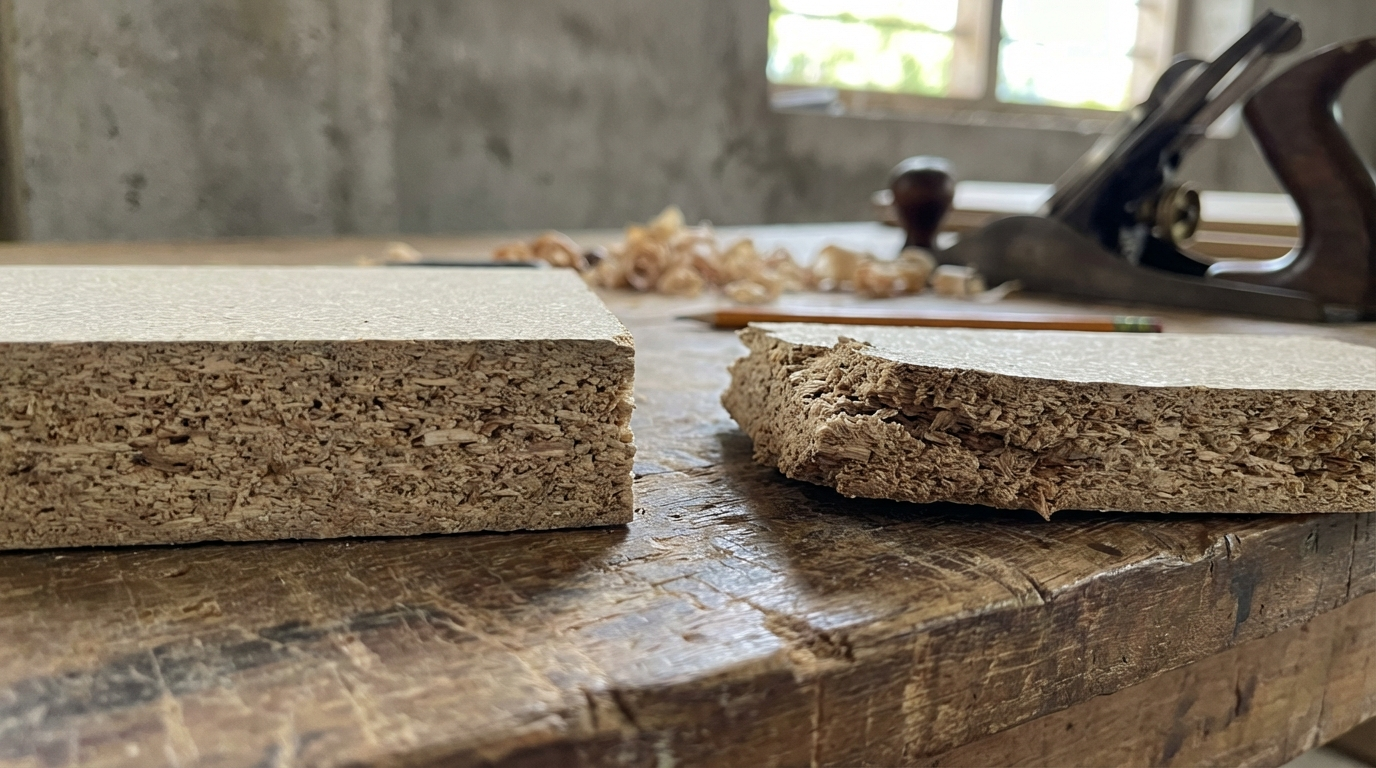
Short version: Particle board is an engineered wood product created by compressing wood chips, sawdust, and synthetic resin or other adhesives into a solid board. It's a popular choice for furniture, cabinets, and flooring due to its affordability and versatility. But here's what most salespeople won't tell you—the structure of particle board makes it highly susceptible to water damage. Unlike solid wood, particle board lacks a natural grain and is held together by adhesives that can deteriorate when exposed to moisture. When particle board gets wet, it absorbs water quickly, causing it to swell, warp, and lose its structural integrity.
This is right for you if:
- You're building budget furniture for a dry bedroom or living room
- The application is temporary—say 3-5 years max—and you know you'll renovate later
- It's for interior cabinetry and shelving where the melamine coating gives color options and doesn't need to be painted
- You need something flat for office desks or workstations away from water sources
Skip this if:
- You're doing kitchen cabinets, especially near the sink—I've seen too many disasters
- Your city has high humidity (Mumbai, Chennai, Kolkata—you know who you are)
Bottom line: Particle board saves you money upfront but costs you more in replacements if you use it wrong.
Note: sainik710.com is an independent informational site and is not affiliated with any manufacturer.
What Particle Board Actually Is
Particle board, also known as laminated particle board, is a popular engineered wood product used in a wide range of applications, including furniture, cabinets, flooring, and construction. It is made from wood particles or chips that have been bonded together using a synthetic resin adhesive under high pressure and temperature. The result is a strong, dense, and affordable material that is easy to work with and has a consistent surface finish.
Most people think particle board and MDF are the same thing. Actually, they're quite different. MDF is an engineered wood composite similar to particle board but much more dense and strong. MDF has no wood grains because it is composed of small wood fibers. Moreover, MDF has no voids due to its hard pressing at high temperatures, as you find in particle board.
Here's the technical bit for those who want it: the waste-wood materials are mixed using glue such as urea-formaldehyde resin and phenolic resin and these are formerly compressed under heat and high pressure to form particle board. The particles are bigger than what you'd find in MDF, which explains why the surface of the particle board is usually rough and porous due to the size and nature of its particles. This board can be laminated such as veneers, resin-impregnated décor paper or thermoplastic foils to obtain a smoother surface.
Is particle board actually cheaper than plywood?
Yes, significantly. The price of particle board in India generally ranges from ₹12 to ₹30 per square foot. Factors influencing these prices include thickness, quality, and regional availability. Compare that to decent MR grade plywood which runs ₹45-80 per square foot, and you see why budget-conscious builders gravitate toward it. The cost of particle board per sq ft in India varies depending on the thickness, size, and quality of the board. However, you can expect to pay anywhere from ₹12.50 to ₹50.00 per square foot for particle board in India. The upper range is for pre-laminated variants with good quality finish.
Why This Matters in Indian Homes
Look, if you're reading this from Rajasthan or Gujarat, particle board might actually work decently for you. Dry climate, low humidity—the board stays stable. But if you're in Mumbai where humidity hits 85-90% during July-August? That's a completely different story.
In areas with high humidity, particle board can absorb moisture from the air, leading to swelling and warping over time. Inadequate ventilation in areas like kitchens and bathrooms can trap moisture, accelerating the deterioration of particle board.
I had this client in Thane back in 2019—nice flat, good budget. His interior designer convinced him to use pre-lam particle board for the kitchen to save costs. "It has melamine coating," she said. "Water resistant." By the second monsoon, the cabinet base under the sink had puffed up like a sponge. The laminate was peeling at the edges. ₹1.2 lakh renovation that should have lasted 10 years barely made it past 18 months.
Chennai folks, listen carefully. The combination of heat AND humidity on the OMR stretch or near the coast is brutal on particle board. Same goes for coastal Karnataka and the Konkan belt in Maharashtra. Even with AC running, the moisture finds its way in through bathroom steam, cooking vapors, and the occasional water splash.
Kolkata's Salt Lake area, Bengaluru's older parts where ventilation isn't great—same problem. Cabinets are located in rooms—such as the bathroom and kitchen—where steam is common. For example, a hot water kettle, coffee pot, or dishwasher that causes steam to rise to cabinets above may eventually lead to moisture damage. Even something as simple as dripping water from the sink onto a cabinet below can result in problems over time.
Types of Particle Board Available
There are several types of particle boards available in the market, each with its unique properties and intended uses. Here's the breakdown:
Standard Particle Board: This type of particle board is the most common and affordable option available. It is made from small wood particles bonded together with a urea-formaldehyde resin adhesive. It is available in various thicknesses and sizes and can be used for a wide range of applications, including cabinetry, shelving, and furniture.
My take: Fine for office furniture, temporary setups, or rental properties where you know you'll renovate in a few years anyway.
Moisture-Resistant (MR) Particle Board: Moisture-resistant particle board, also known as MR grade particle board, is designed to resist moisture and humidity better than standard particleboard. It is treated with a special water-resistant resin during the manufacturing process, making it ideal for use in damp environments such as kitchens, bathrooms, and laundry rooms.
Honestly? The "moisture resistant" label is misleading. It's more moisture-tolerant than standard, but nowhere near waterproof. I still wouldn't use it near sinks.
Fire-Resistant Particle Board: Fire-resistant particle board is designed to resist the spread of flames and smoke in the event of a fire. It is made by adding a fire retardant to the adhesive during the manufacturing process. It is commonly used in buildings and furniture in areas where fire safety is a concern.
Pre-Laminated Particle Board (PLPB): This is what most people actually use. The particle board comes pre-covered with melamine or decorative paper, so you get a finished look without painting. It is great for interior cabinetry and shelving. The melamine coating gives color options and doesn't need to be painted.
| Type | Best For | Avoid For | Price Range (per sq ft) |
|---|---|---|---|
| Standard | Dry bedrooms, office furniture, backing panels | Any wet area, load-bearing shelves | ₹12-20 |
| Moisture Resistant | Wardrobes in humid cities (with proper sealing) | Kitchen sink cabinets, bathrooms | ₹20-35 |
| Fire Resistant | Commercial spaces, near electrical panels | Areas with water exposure | ₹30-45 |
| Pre-Laminated (PLPB) | Quick furniture, modular units away from water | Kitchen base units | ₹25-50 |
Price Reality Check (2026 Market)
In the first half of 2024, the particle board market in India experienced a notable recovery following the challenges of 2023. Last year, the industry faced a sharp decline in prices due to oversupply, particularly in key production regions such as Gujarat and Maharashtra, coupled with weak demand in the retail sector. However, 2024 brought a shift in market dynamics, primarily driven by increasing demand from the ready-made furniture sector and Original Equipment Manufacturers (OEMs).
So what does this mean for your wallet in 2026?
Thickness-wise pricing (approximate):
- 6mm plain particle board: ₹12-18 per sq ft
- 9mm: ₹15-22 per sq ft
- 12mm: ₹18-28 per sq ft
- 18mm: ₹25-38 per sq ft
- 25mm: ₹32-50 per sq ft
Several factors contribute to the price of particle board. The size of the particle board sheet (length, width, and thickness) will influence the price. Thickness: Thicker particle boards generally cost more than thinner ones. Density: Higher-density particle boards are typically more expensive due to their increased strength and durability.
The particle board cost per square foot can also vary depending on the type of resin binder used and the brand of the particle board. Particle board made with formaldehyde-free resin binder is typically more expensive than particle board made with urea-formaldehyde resin binder. Additionally, branded particle board products may cost more than generic particle board products.
Here's what actually affects your final bill—location matters a lot. Dealers in Mumbai or Bengaluru charge more than those in Ahmedabad or Hyderabad, even for the same brand. Buying in bulk (10+ sheets) usually gets you 8-12% off. And pre-laminated? Add another ₹15-25 per sq ft over plain boards.
Particle Board vs Plywood vs MDF
Strength and Durability: Plywood is the strongest and most durable of the three materials, followed by MDF and then particle board. Moisture Resistance: Plywood has the best moisture resistance, while MDF is more resistant than particle board. Surface Texture: Particle board has a rough texture, while MDF has a smooth, uniform surface. Plywood may have a rough or smooth texture, depending on the grade and finish.
| Parameter | Particle Board | MDF | Plywood | My Preference |
|---|---|---|---|---|
| Strength | Lowest—can't hold heavy loads | Medium | Highest | Plywood for anything structural |
| Moisture Resistance | Poor—swells fast | Poor to Medium | Good (BWP grade) | BWP plywood for kitchens, always |
| Screw Holding | Does not have interior strength and screws can easily strip | Better than particle board | Excellent | Plywood if you need to re-fix hardware |
| Surface Smoothness | Rough, needs laminate | MDF board won't have voids or splinters, provides a smooth finish, easy to paint and polish | Varies by grade | MDF for painted finishes |
| Cost | Cheapest | Mid-range | Most expensive | Depends on project lifespan |
| Weight | Light | Heavy | Medium | Particle board if weight matters |
| Edge Finishing | Difficult—tends to chip | Good | Good | MDF for detailed edge work |
| Lifespan (typical) | 3-5 years | 5-8 years | 10-15+ years | Plywood if you want it to last |
When choosing between particle board, MDF, and plywood, consider the specific requirements of your project, including strength, durability, moisture resistance, and surface texture. Particle board is a budget-friendly option suitable for interior projects with low moisture exposure, while MDF offers a smoother surface and better durability. Plywood is the strongest and most versatile option, making it suitable for a wide range of applications.
Choose particle board when: Budget is tight, area is bone-dry, and furniture is temporary
Choose MDF when: You need smooth painted surfaces and the area stays dry
Choose plywood when: Longevity matters, area has any moisture exposure, or you need load-bearing capacity
Trade-off summary: You gain significant cost savings with particle board but lose durability, moisture resistance, and screw-holding capacity.
Why do carpenters sometimes prefer particle board over plywood?
Three reasons, and two of them benefit the carpenter more than you. First, it's easier to cut—no splintering, no grain direction to worry about. Second, the job finishes faster because pre-lam boards don't need finishing. Third—and here's the part they won't say out loud—they make better margins. The material cost is lower, but the labor charge stays similar. A mistri who quotes ₹8,000 for a wardrobe in plywood will quote maybe ₹7,000 for particle board, but his profit per hour is actually higher because the work goes faster.
How to Choose: Decision Framework
Step 1: Define the location
Is there any water source within 3 feet? Sink, washing machine, bathroom door nearby? If yes, cross particle board off your list immediately. Done.
Step 2: Assess humidity
Do you live in a coastal city or anywhere with 70%+ humidity for more than 4 months a year? If yes, particle board needs exceptional sealing—usually not worth the hassle. Consider MDF or plywood instead.
Step 3: Calculate expected lifespan
Are you building this for 10+ years or just getting through 3-4 years before a renovation? Particle board makes sense for temporary applications. For long-term furniture, the cost-per-year of plywood actually works out lower.
Step 4: Check load requirements
It isn't strong enough to withstand heavy loads so you must be careful. For budget-friendly projects, particleboard is a great alternative to plywood and MDF. However, it is the least durable and warps easily.
Step 5: Factor in edge treatments
Particle board edges absorb moisture fastest. Budget for proper edge banding if you go this route—adds ₹8-15 per running foot.
| Situation | Recommendation | Why |
|---|---|---|
| Kitchen base cabinets | BWP Plywood—never particle board | Water splashes are inevitable near sink |
| Bedroom wardrobe (dry city) | Particle board OK with good edge sealing | No water source, cost savings make sense |
| Bedroom wardrobe (humid city) | MR Plywood or HDHMR | Monsoon humidity will affect unsealed particle board |
| Office workstation | Particle board fine | AC environment, no water, temporary nature |
| Bathroom vanity | BWP Plywood only | Steam and splashes guaranteed |
| TV unit in living room | Particle board or MDF both OK | Dry location, no load stress |
| Heavy bookshelf | Plywood | Particle board will sag under weight over time |
Red flags to walk away from:
- Dealer claims particle board is "waterproof"—it's not, it's water-resistant at best
- Carpenter suggests particle board for sink cabinet to "save money"
- Pre-lam board has visible chips or rough patches on surface
- No ISI mark or brand identification anywhere
- Suspiciously light weight for stated thickness
Common Mistakes People Make
1. Using particle board under the kitchen sink
This one really frustrates me because I see it constantly. It is important to remember that particle board will swell and deform very quickly if exposed to high levels of moisture. Avoid installing it under kitchen or bathroom sinks. The area under your sink will get wet—maybe not today, maybe not next month, but eventually there's a leak, a drip, a splatter. And then you're looking at a ₹30-40,000 replacement job.
2. Skipping edge banding
Particle board that isn't properly sealed, especially at the edges, is more vulnerable to water penetration. I've seen this happen when carpenters finish the laminate on top but leave the bottom edges raw "because nobody sees them." Within one monsoon, moisture wicks up from the floor through those exposed edges.
3. Installing in poorly ventilated areas
That storage unit in the corner where air doesn't really circulate? Bad idea. Inadequate ventilation in areas like kitchens and bathrooms can trap moisture, accelerating the deterioration of particle board.
4. Confusing "moisture resistant" with "waterproof"
MR grade particle board handles humidity better than standard—that's all. Direct water contact will still destroy it. It really depends on the coating used with the wood product. For example, a melamine particle board is water-resistant until the melamine coating is penetrated and water touches the wood chips.
5. Overloading shelves
Particleboard has some strength, but it's nowhere near as strong as MDF or plywood. In order to avoid these problems, particleboard surfaces have a weight limit and must be handled carefully. I had a client put all his heavy books on a particle board shelf—lasted maybe 8 months before it started sagging in the middle.
6. Driving screws directly without pilot holes
Avoid driving screws or nails into particle board. Because this material is made of small particles of ground wood, it can lose its shape when indentations are made on its surface.
7. Using for backsplash areas
Particle board should not be used for backsplashes either as they are constantly exposed to water and humidity. Even with tiles on top, moisture finds its way through grout lines.
8. Ignoring the weight difference
Particle board is significantly lighter than plywood or MDF. If your "18mm plywood" feels suspiciously light, you might have been sold particle board with a plywood veneer. This is more common than you'd think.
9. Choosing based on price alone
Yes, particle board costs less per sheet. But if you need to replace kitchen cabinets in 3 years instead of 15 years, what did you actually save?
Quality Checks You Can Do Yourself
Visual inspection:
- Surface should be uniform without visible bumps or depressions
- Look for any discoloration—could indicate moisture exposure during storage
- Edges should be clean-cut, not crumbly
- Pre-lam surface shouldn't have air bubbles or peeling corners
- Check for sawdust falling from cut edges—excessive looseness is bad
- Brand marking should be clearly visible
Questions to ask your dealer:
- "Is this E1 or E2 emission grade?" (E1 is lower formaldehyde—better for enclosed spaces)
- "What's the density of this board?" (Higher is generally stronger)
- "How was this stored?" (Particle board stored in damp godowns is compromised)
- "Do you have the test certificate?" (Good brands provide this)
- "What's your return policy if the board swells within 3 months?"
Simple field tests:
- Tap test: Knock on the surface. Should sound solid, not hollow. Hollow sound means low density or internal voids.
- Weight check: 18mm particle board should feel lighter than same-size MDF but not featherlight
- Edge inspection: Run your finger along a cut edge. Particles should be firmly bonded, not falling off
- Flex test: Gently try to bend a corner. Good particle board has minimal flex. Too much flex means weak binding.
Here's a trick most dealers don't like: Take a small sample, put a few drops of water on a raw edge, and check after 30 minutes. Good quality board will show minimal swelling. Cheap stuff puffs up visibly.
Warning signs to walk away:
- No brand marking anywhere on the board
- Strong chemical smell (excess formaldehyde)
- Uneven thickness across the sheet
- Edges already crumbling in the shop
- Dealer refuses to show test certificate
- Price significantly lower than market average (probably seconds or rejected stock)
Workmanship & Installation
Cutting requirements:
Particle board cuts easier than plywood—no grain direction to worry about. But it also chips easier. Use a fine-tooth blade (80+ teeth for circular saws) and cut with the laminate face up if using a table saw, face down if using a hand-held circular saw. This minimizes chipping on the visible surface.
Edge sealing—why it matters:
Ensure that all exposed edges of the particle board are sealed with waterproof sealant or paint to prevent water absorption. Every single cut edge is an entry point for moisture. Use PVC edge banding (2mm thickness for visible edges, 0.8mm for hidden edges) or apply multiple coats of primer on hidden edges at minimum.
Fastener guidance:
- Use coarse-thread screws, not fine-thread—they grip better in the loose particle structure
- Pilot holes are mandatory, not optional. Drill slightly smaller than screw diameter.
- Avoid repeatedly removing and re-inserting screws—the holes enlarge and won't hold
- For hinges and high-stress points, use cam locks or barrel nuts instead of direct screws
- Screw length should be 5-8mm less than board thickness to avoid punching through
What to tell your carpenter (briefing checklist):
- All edges must be banded before assembly, even edges facing walls
- No particle board within 3 feet of any water source—use plywood there
- Pre-drill every screw hole
- Apply edge primer to any cut edges before edge banding
- Leave 2-3mm gap from floor for all base units—prevents moisture wicking
- Cabinet backs should be properly sealed, not just left raw
Storage notes:
If boards are delivered before installation, store flat (never standing on edge), in a dry room, off the floor on battens. Particle board absorbs moisture from concrete floors surprisingly fast. Keep away from any wall that might have dampness.
I've seen carpenters skip the edge primer because "edge banding will cover it anyway." Three months later, the edge banding peels because moisture got underneath. An extra hour of work during installation saves you from a ₹20,000 repair job later.
How Long Does Particle Board Really Last?
Plain particle board is cost-effective, lightweight, denser, and weaker than plywood. Plain particle board has a life expectancy of over five years. Keeping good care, like distant from water or humidity, and maintenance can increase its durability.
In my experience, well-maintained particle board furniture in a dry bedroom lasts 5-8 years. In a moderately humid environment with good edge sealing, maybe 4-6 years. Near any water source or in poorly ventilated spaces? You're looking at 2-3 years before visible damage appears.
What affects longevity:
- Climate: Dry cities like Jaipur, Ahmedabad—longer life. Humid coastal cities—shorter.
- Quality of edge sealing: Properly banded edges can add 2-3 years to lifespan
- Location in house: Bedroom > Living room > Kitchen
- Load conditions: Overloaded shelves sag and fail faster
- Original board quality: Branded boards with higher density outlast generic ones
Signs of wear to watch for:
- Swelling and warping: The surface becomes uneven, and edges start to lift.
- Discoloration: The color of the particle board may change, often turning darker in affected areas.
- Edge banding peeling or separating
- Musty smell—indicates moisture absorption
- Shelves starting to sag in the middle
- Doors not closing properly (frame has warped)
When to consider replacement:
It's rare to see particle board that has been damaged beyond repair, at least from water. However, it can still happen. If you notice that your particle board cabinets have extensive signs of rot, have grown scary amounts of mold, or have become seriously weakened by water exposure, you may not be able to fix them. In this case, your only option is to replace your cabinetry.
Can particle board water damage be repaired?
Sometimes yes, sometimes no. Water-damaged particle board isn't too difficult to repair. In some cases, there may be enough damage that it requires new sheets of material. For minor swelling, you can dry it thoroughly, sand down the raised areas, fill with wood filler, and reseal. But if the board has become soft, crumbly, or has visible mold—replacement is your only real option. Trying to patch severely damaged particle board is just delaying the inevitable.
Alternatives Worth Considering
If budget is tight but you need better moisture resistance:
Consider HDHMR (High Density High Moisture Resistant) boards. They cost 40-60% more than particle board but handle humidity significantly better. Our HDHMR guide covers this in more detail.
If you need smooth painted surfaces:
MDF, or Medium Density Fiberboard, is stronger and denser than particle board. It is also a waste-wood material, and it's comprised of wood fibers rather than sawdust. While more elegant and heavier, it depends on the project to determine whether or not you need the quality that comes with MDF. MDF is also easier to paint with a nicer outcome, however it is more likely to deteriorate if it's exposed to water and moist conditions.
If longevity is the priority:
The cross-oriented layers of OSB and plywood make them the strongest options of the four. OSB and plywood also provide improved resistance to moisture. Plywood is highly versatile, with types suitable for applications ranging from home sheathing to furniture. Yes, it costs more. But plywood kitchen cabinets from 2010 are still going strong in many homes. Can't say the same for particle board.
The kitchen cabinet material comparison guide covers HDHMR vs plywood extensively if you're weighing options for a modular kitchen.
Frequently Asked Questions
What is particle board made of exactly?
Simply put, particle board is a waste-wood product made by heat pressing wood chips, sawmill shavings, or even sawdust and resin together. To make the end product water resistant, fireproof, and/or insect-proof chemicals are used including wax, dyes, wetting agents, and release agents. The quality depends heavily on the type of wood waste used and the binding resin quality. Branded manufacturers use better inputs; generic boards often use whatever's cheapest.
Is it true that particle board releases toxic fumes?
Particleboards are made with urea-formaldehyde resin: the source of formaldehyde gas. Yes, this is a real concern, especially for new boards in enclosed spaces. Look for E1 grade boards which have lower formaldehyde emissions. Open windows for ventilation during the first few weeks after installation. MDF-made furniture can off-gas and release toxic fumes, creating high levels of toxicity in small enclosed spaces and potentially causing health hazards. The same is true when working with MDF. This applies to particle board too, though typically at lower levels than MDF.
Can particle board be used outdoors?
Particle board should never be used for outdoor applications, because it will not withstand the moisture from rain or snow for long. Even covered outdoor areas like balconies aren't suitable—humidity and occasional rain spray will destroy it. Not even moisture-resistant grades are suitable for outdoor use.
What if I live in a coastal city like Chennai or Mumbai?
You're fighting an uphill battle. Humidity consistently above 70% puts constant stress on particle board. If you must use it, stick to only bedrooms with AC, ensure obsessive edge sealing, and accept that lifespan will be shorter. For kitchens and bathrooms in coastal cities, I strongly recommend BWP plywood only—no shortcuts.
Is it true that particle board furniture can't be moved?
Mostly true. Careful handling of particle board furniture is also important, especially when it is being moved. If possible, disassemble and carry smaller parts of the furniture to minimize the risk of damage. The joints weaken during disassembly, and re-using screw holes is problematic. If you move frequently, plywood furniture is a better investment.
What's the difference between particle board and chipboard?
Particle board, also known as chipboard, is a common type of wood that is used in many types of furniture and cabinets throughout your home. Same thing, different name. Some dealers use "chipboard" for thinner sheets and "particle board" for thicker ones, but that's not an industry standard—just local terminology.
Is it true that termites don't attack particle board?
Partially true. The resin in particle board makes it less appetizing to termites than natural wood, but it's not termite-proof. In heavy termite areas, you still need treatment. And honestly, if you've got termites, particle board will be the least of your worries—the whole house needs treatment.
Can I use particle board for a bathroom vanity if I seal it properly?
No. I know that's not what you want to hear, but no amount of sealing will protect particle board in a bathroom long-term. Steam from hot showers penetrates through microscopic gaps. Water splashes find their way to edges. The use of particle board in kitchen and bathroom walls or floors should be avoided whenever possible. Use BWP plywood or marine ply for bathroom vanities. The extra cost is worth not replacing your vanity every 2 years.
What about pre-laminated particle board—is that waterproof?
It really depends on the coating used with the wood product. For example, a melamine particle board is water-resistant until the melamine coating is penetrated and water touches the wood chips. The laminate provides a water-resistant surface, not a waterproof one. Any scratch, chip, or exposed edge becomes an entry point for moisture. Better than plain particle board, but still not suitable for wet areas.
How do I know if my existing cabinets are particle board or plywood?
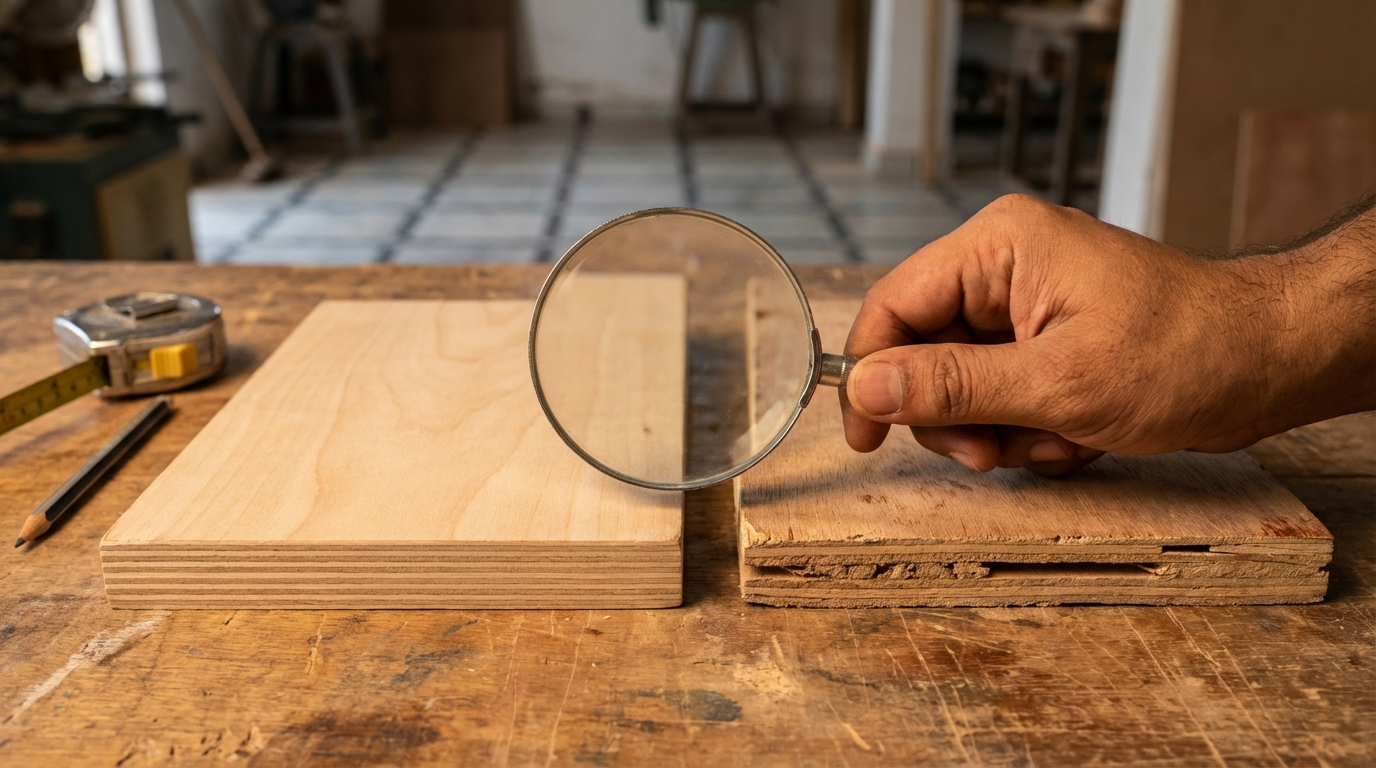
Look at any exposed edge—inside a cabinet, behind a drawer. Plywood shows distinct layers. Particle board shows compressed wood particles with no layer structure. You can also knock on it: plywood sounds more solid, particle board sounds slightly hollow. Weight is another clue—plywood is noticeably heavier for the same size.
Is it true that expensive branded particle board is as good as cheap plywood?
No. High-quality branded particle board is better than cheap unbranded particle board, but it's still particle board. However, plywood will last longer in comparison to particle board and MDF when exposed to water. The fundamental structural difference—layers vs compressed particles—means plywood will always have superior strength and moisture resistance. You're comparing apples and oranges.
What's the best particle board brand in India?
I'm not going to name specific brands here because quality varies by batch and region. Instead, look for ISI marking, check density ratings, ask for test certificates, and buy from authorized dealers. The brand on the sheet matters less than how it was stored and transported.
Final Thoughts
Particle board has its place—budget bedrooms, temporary setups, office furniture in AC environments. The mistake people make is stretching it beyond where it belongs. That kitchen project where you saved ₹40,000 by using particle board instead of plywood? Wait till you're replacing those base cabinets in 3 years. The math doesn't work out.
If you take one thing from this guide: keep particle board away from water. Not just direct water—humidity counts too. The Ghatkopar flat is different from the Jodhpur apartment. Know your climate, know your application, choose accordingly.
And seriously—don't skip the edge banding.
Disclaimer: This content is provided for general informational purposes based on industry practices and publicly available information. Product specifications, standards, prices, and availability may vary by manufacturer, region, and time. Readers should independently verify details with manufacturers, dealers, or qualified professionals before making purchase or construction decisions.Want Plywood Suggestions?
Share a few details and a Sainik 710 specialist will suggest suitable brands and connect you to responsive dealers.