Parallel Kitchen Design: 30+ Modern Galley Kitchen Ideas with Space Planning Guide
Explore 30+ parallel kitchen designs—galley layouts for narrow spaces. Get aisle width guide, storage tips & material options for efficient kitchens.
Parallel Kitchen Design: The Quick Answer You Need
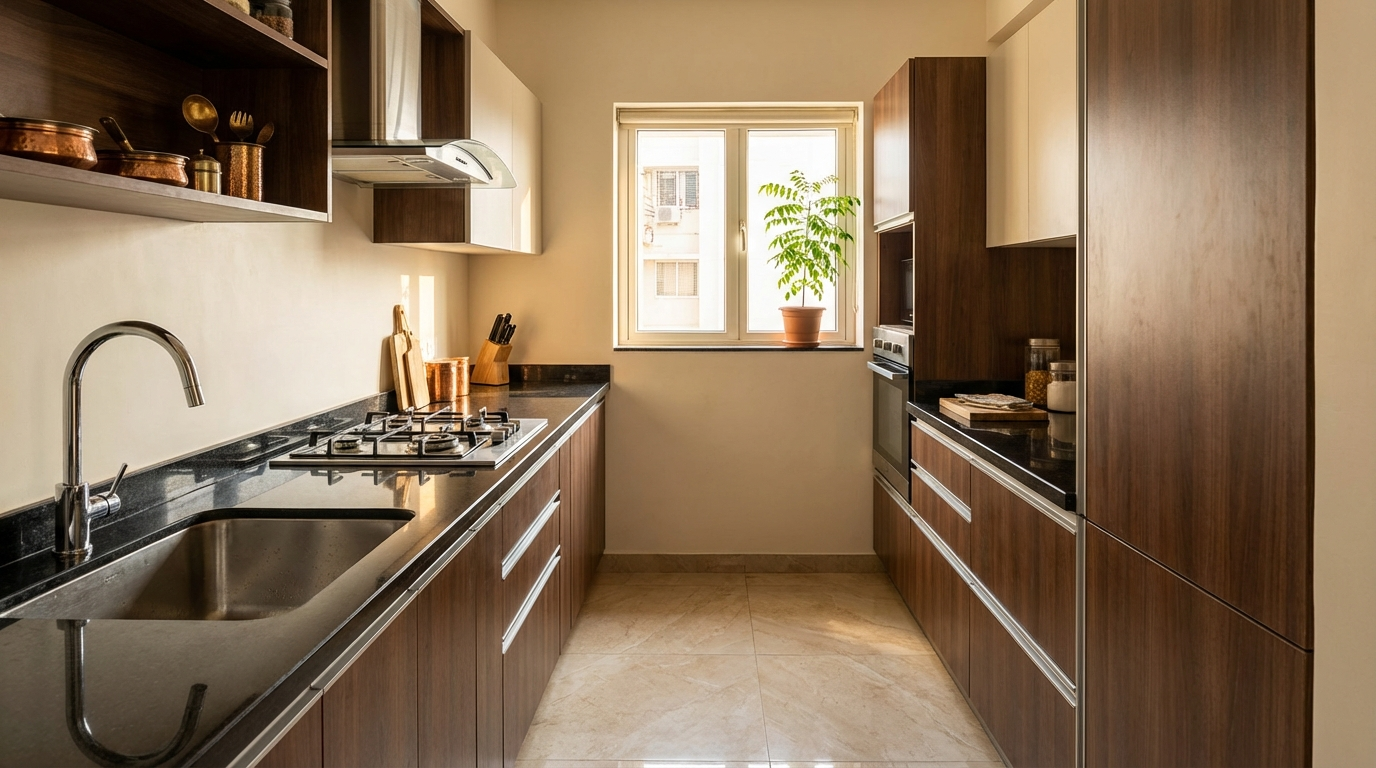
A parallel kitchen is a layout with two countertops running opposite each other, creating a corridor-style workspace that maximizes cooking efficiency in narrow or compact rooms. This space-saving design is perfect for narrow rooms and features two countertops running parallel with a walkway in between.
Short version: If your kitchen space is long and narrow—maybe 8 to 12 feet in length and you've got walls on two sides—a parallel layout is your best friend. The parallel kitchen design can be an ideal fit for small, medium, and also large kitchen spaces—this galley kitchen layout can solve your problem for compact kitchens. You get double the counter space, efficient workflow, and storage on both sides. But—and this is important—there should be at least 3 feet to 4 feet gap between the two parallel counters otherwise you'll be bumping into your spouse every time you open a drawer.
This is right for you if:
- Your kitchen is long and narrow, like in most Mumbai, Pune, or Bengaluru apartments
- You want maximum counter space and storage without an island taking up floor area
- Two cooks operate in your kitchen—parallel layouts let two people work simultaneously
- You need an efficient work triangle between sink, stove, and fridge without walking across the entire room
Skip this if:
- Your kitchen opens on one side to a living area (galley kitchens work better when enclosed)
- The available width is less than 7 feet total—you'll feel claustrophobic
Bottom line: For kitchens between 60 and 100 square feet with two walls facing each other, parallel layouts offer the best balance of efficiency, storage, and workflow for Indian cooking styles.
What a Parallel Kitchen Actually Means (And What It Doesn't)
A parallel kitchen—also called a galley kitchen—is a layout where two linear runs of cabinets, countertops, and appliances face each other across a central aisle. Parallel kitchens, also known as galley kitchens, are modern kitchen design concepts where two kitchen platforms along with crafty cabinets run parallel to one another. That's it. No island. No peninsula. Just two walls doing all the work.
Most people think this layout is only for tiny kitchens. Actually, the parallel kitchen layout is versatile, and although it is considered to be a great fit for a small kitchen space, it will be a seamless fit for larger luxury kitchens as well. I've seen parallel kitchens in 150 square feet bungalow spaces that looked stunning with an island added in between. The layout is flexible—people just don't realize it.
Now here's where it gets interesting. The term "galley" comes from ship kitchens—tight, efficient, zero wasted movement. A parallel kitchen is a popular kitchen layout among new homeowners. This design cleverly uses the limited space in a home by creating two countertops facing each other. It is a brilliant kitchen layout for small apartments looking for extra storage and space.
One thing I keep clarifying with clients: parallel doesn't mean cramped. The ideal distance between parallel kitchen platforms is typically between 3 to 4 feet to ensure sufficient movement and workspace. The main disadvantage is that it can feel cramped and limit movement, especially in narrow spaces where two people working at the same time may struggle for space. Get the aisle width right, and two people can cook simultaneously without elbow-fighting.
Why Parallel Layouts Work for Indian Homes
Indian cooking is different. We're not just reheating microwave meals. We're tempering tadka, rolling rotis, grinding masalas—often with multiple burners going and two people coordinating. The parallel layout handles this brilliantly.
The parallel kitchen layout, with counters on both sides, enhances the efficiency of meal preparation, a necessity in many Indian households where elaborate cooking and meal prep for ingredients are daily activities. This is exactly why I recommend this layout for most apartments I consult on.
In places like Chennai and Mumbai, you'll notice humidity levels hit 80-90% during monsoon. That moisture creeps into everything—cabinets, countertops, the backing of your shutters. Having two walls of cabinetry means more surface area exposed to potential water damage, so material selection becomes even more critical. More on that later.
Bengaluru and Pune homeowners have it slightly easier with 60-70% RH, but they face different problems—hard water leaves deposits, cooking oil accumulates fast. The good news? Parallel kitchens are easier to ventilate. You can position your chimney on one wall and get cross-ventilation from a window on the opposite side. Try doing that with an L-shaped layout in a corner.
And here's something most guides won't tell you: parallel kitchens work better for joint families. If there are multiple cooks, and helpers operate in the kitchen, parallel layout can make it easier for them to work simultaneously without running into each other. One person handles the wet zone (washing, prep), the other manages the cooking zone. No chaos.
What Aisle Width Actually Works for Indian Kitchens?
This is where I see the most mistakes. People copy Western guidelines blindly and end up with either too narrow or wastefully wide aisles.
The width of a work aisle should be at least 42 inches for one cook and at least 48 inches for multiple cooks. The work aisle is the measurement between the fronts of your countertops, tall cabinets, and appliances. That's roughly 3.5 to 4 feet.
But honestly? For single-cook households, I've seen 36 inches (3 feet) work fine. To facilitate comfortable movement while cooking, a minimum aisle width of 36 inches is recommended. The problem is when you go below that—opening the fridge and a base cabinet simultaneously becomes a gymnastics routine.
If you're someone who cooks with your partner regularly, aim for 48 inches. The ideal width between counters in a galley kitchen is 42 to 48 inches. This range provides enough space for comfortable movement and allows multiple people to work without feeling cramped.
Quick tip: measure your widest appliance door (usually the fridge) and add at least 18 inches for comfortable standing room behind it. That's your minimum aisle width.
Types of Parallel Kitchen Configurations
Not all parallel kitchens are identical. The configuration depends on what your walls allow and how much floor space you have.
Type 1: Enclosed Corridor (Both Ends Closed)
Classic galley. It is meant for enclosed kitchen spaces and not for an open-planned kitchen. Walls or doors on both ends. Best for traditional Indian homes where you want the kitchen smells contained. One downside: can feel tunnel-like if not lit properly.
Type 2: Open-Ended Corridor (One End Open)
More common in apartments. One end opens to the dining or living area. Better visual flow, easier to serve food. But you'll want a powerful chimney because cooking odors travel.
Type 3: Parallel with Island
You can widen the gap and place an island or dining table in between the counters when you want to plan a spacious luxury parallel modular kitchen design. This needs at least 13-14 feet of total width. I've done this in a few Thane and Powai apartments with larger kitchens—works beautifully for families who entertain often.
| Configuration | Minimum Kitchen Width | Best For | My Take |
|---|---|---|---|
| Enclosed Corridor | 7-8 feet | Small apartments, 1-2 cooks | Works great for privacy-focused Indian cooking |
| Open-Ended | 8-9 feet | Open-plan living, modern apartments | Good choice but invest in a 1200+ m³/hr chimney |
| Parallel + Island | 13-14 feet | Large bungalows, family kitchens | Luxury but honestly, most people don't need it |
| Parallel + Breakfast Counter | 10-11 feet | Young couples, small families | Practical middle ground |
Space Planning Dimensions You Need to Know
Two Row Galley Kitchens have linear lengths that range from 7'-12.5' (2.1-3.8 m) and should be planned with an overall area of roughly 108 ft² (10 m²). That translates to about 10 square meters minimum for a functional parallel kitchen.
Here's how I break it down for clients:
Counter Depth: Standard is 24 inches (600mm). Some people go 25-26 inches for deeper counters, but then you need more aisle width to compensate. In smaller kitchens, I actually recommend 22-inch depth—saves valuable floor space.
Cabinet Height: Base cabinets are typically 34-36 inches to countertop. Wall cabinets start 18-20 inches above the counter. For Indian homes, I suggest going all the way to the ceiling with lofts—storage is never enough.
Counter Length: Galley kitchens commonly have a linear length of 7'-12.5' | 2.1-3.8 m with a clearance width that varies between 4'-6' | 1.2-1.8 m. That's 7 to 12.5 feet on each side. Below 7 feet and you're squeezing too many functions into too little space.
The ideal width for a double counter galley is 10-12 feet (3.05-3.66 meters). At the very least, 3 feet (0.91 meters) between counter spaces will provide adequate turnaround space. Ideally, it's no wider than 5 feet (1.52 meters) apart, or you will lose efficiency.
That last point is crucial—too wide and you're walking unnecessarily. Too narrow and you're frustrated daily. The sweet spot is 42-48 inches.
The Work Triangle: Does It Still Matter?
The work triangle is a fundamental concept in kitchen design, particularly in galley kitchens. To create an efficient cooking work triangle, position the sink, refrigerator, and stove in a triangular layout for easy access. Ensure the total distance between these three points is between 13 and 26 feet.
In a parallel layout, this usually means:
- Sink and fridge on one wall
- Cooktop/hob on the opposite wall
- Or: Sink on one wall, fridge at one end, hob in between
When it comes to the parallel kitchen layout, implementation of the work triangle becomes a seamless affair. You can put the refrigerator & the sink on one end, and put the cooktop on the other counter. It would help you create the perfect triangle in the kitchen, boosting the workflow in the process.
Honestly? In 2026, I'm seeing more designers talk about "work zones" rather than the triangle. Wet zone (sink, dishwasher), hot zone (hob, oven), cold zone (fridge, pantry), prep zone (counter space). Works better for Indian cooking where you're often doing multiple things simultaneously.
Is a Parallel Kitchen Really More Efficient Than L-Shaped?
Depends on your space. For narrow rooms—yes, absolutely. Unlike the L-shaped modular kitchen designs for small kitchens, this layout does not have any corner spaces, therefore, no corner cabinets can be inserted.
Corner cabinets are the bane of kitchen storage. Those carousel or magic corner units? Expensive and often underused. With parallel layouts, every inch of counter and cabinet is linear and fully accessible. No awkward reaching into dark corners.
But if your kitchen is closer to a square shape—say 10x10 feet—an L-shape might utilize the space better. Parallel works best when the room is at least 1.5x longer than it is wide.
Material Selection for Parallel Kitchen Cabinets
Note: sainik710.com is an independent informational site and is not affiliated with any manufacturer.
This is where most people mess up. They pick materials based on looks alone, then wonder why the shutters are warping after two monsoons.
For the Carcass (Cabinet Body):
Plywood, MDF or HDF, particleboard or wood are the most common options for the cabinet carcass material.
Plywood is commonly used in modular kitchens because it's strong, stable, and resists moisture. Plywood is made by layering thin wood sheets and sticking them together with glue, which gives it good stability and reduces the chances of cracking.
For kitchens specifically, I recommend BWR or BWP grade plywood for base cabinets near the sink and hob. Boiling Water Resistant (BWR) plywood is preferable for spaces near dishwashers and sinks, as they can withhold the water and not get damaged.
BWP grade plywood is renowned for being highly resistant to water. It is known to withstand boiling water of 100°C for more than 72 hours without causing damage to the plywood.
Boiling water-resistant plywood goes perfectly for kitchen use as well as semi-outdoor furniture. On the other hand, moisture-resistant plywood works best for your bedroom and drawing room furniture.
| Material | Water Resistance | Cost (Relative) | Best Use | Avoid If |
|---|---|---|---|---|
| BWP/Marine Plywood (IS:710) | Excellent | ₹₹₹ | Base cabinets, sink area | Budget is very tight |
| BWR Plywood | Very Good | ₹₹ | All kitchen cabinets | Directly under sink without edge sealing |
| MR Plywood | Moderate | ₹ | Overhead cabinets, dry areas | Anywhere near water |
| HDHMR | Good | ₹₹ | Shutters, modern kitchens | Very humid coastal areas |
| MDF | Poor | ₹ | Only overhead units with good sealing | Any moisture-prone zone |
| Particle Board | Very Poor | ₹ | Temporary or rental setups | Long-term kitchen investment |
Go for Plywood or MDF cabinets since they are durable to Indian conditions and are compatible with laminate and acrylic materials. But between the two, plywood wins for base units every time.
For more on this, our BWR vs BWP plywood comparison guide covers the technical differences extensively.
What Thickness Works Best for Kitchen Cabinets?
For carcass sides: 18mm minimum. 19mm is better. Some budget manufacturers use 16mm—not recommended for base cabinets that hold heavy pressure cookers and utensils.
For shelves: 18mm for shorter spans (under 600mm), otherwise they'll sag over time. Add support battens for longer spans.
Back panels: 6mm is acceptable, but 8-9mm gives better rigidity and helps with alignment during installation.
There was this builder in Andheri—must have been 2022—who insisted on 12mm backs to save costs. Called me eight months later. The entire cabinet had gone out of square because the thin backs couldn't hold shape under the weight. Ended up spending more on repairs than he saved.
Price Reality Check: What Parallel Kitchens Cost in 2026
In India, a modular kitchen remodel typically costs between ₹1.5 to ₹6 lakhs, depending on materials, size, layout, and finishes. Premium designs with quartz countertops, soft-close hardware, and branded appliances may go up to ₹10+ lakhs.
For a parallel kitchen specifically, here's what I tell clients to expect:
Budget Range (₹1,200-1,800 per sq ft of cabinet area): MR plywood carcass, laminate finish, basic hardware, granite countertop. Fine for rental properties or if you're not heavy cooks.
Mid-Range (₹1,800-2,800 per sq ft): BWR plywood, decent laminates or membrane finish, Hettich/Hafele hardware, soft-close fittings. This is where most Bengaluru and Mumbai apartments sit. Good balance of durability and cost.
Premium (₹2,800-4,500 per sq ft): BWP plywood, acrylic or PU finish, full Blum hardware, quartz countertops, integrated appliances. If you're cooking daily for 10+ years, this makes sense.
Finishes (Laminates, Acrylic, PU, Veneer): ₹150 – ₹1,500 per sq. ft. Hardware & Accessories (Soft-close hinges, drawer channels): ₹5,000 – ₹50,000, depending on quality. Countertop (Granite/Quartz/Marble): ₹250 – ₹5,000 per sq. ft.
A typical parallel kitchen in a 2BHK might have 80-100 sq ft of cabinet area total. Do the math based on your finish preferences.
30+ Design Ideas: From Budget to Premium
Rather than just listing random designs, let me categorize what actually works for different situations:
For Compact Kitchens (Under 60 sq ft total):
- Light colors—white, cream, light grey—to open up the space
- Choose light, neutral colours to make the space feel bigger, or go for bold hues on one side for contrast
- Handle-less push-to-open shutters—saves clearance space in tight aisles
- Open shelving on one wall to reduce visual bulk
- Under-cabinet lighting—essential when overhead cabinets create shadows
For Medium Kitchens (60-100 sq ft):
- Two-tone designs—darker base cabinets, lighter wall units
- One wall for cooking/prep, opposite for storage and appliances
- Tall units at one end for pantry storage
- Subtle pattern laminates—geometric or wood-grain—add character
For Larger Spaces (100+ sq ft):
- A kitchen island can be a great addition to parallel kitchen designs, providing extra storage, counter space, and a seating place
- Mix materials—matte laminates with glossy accents
- Statement backsplash on the main cooking wall
- Integrated appliances for a seamless look
For Traditional Indian Aesthetics:
- Traditional parallel kitchen design features warm tones, intricate carvings, and natural materials.
- The aesthetic revolves around warm, earthy colours like deep red, brown, and gold
- Stone countertops (granite) over engineered stone
- Wood veneer finishes on shutters
For Modern Minimalist Look:
- Clean lines and a monochromatic color palette—this style can make small kitchens appear larger and more open
- Handle-less cabinets with J-profile or gola profiles
- Matte or satin finishes over high gloss
- Quartz countertops in solid colors
Storage Solutions That Actually Work
Designing storage in a kitchen is never an easy task. The parallel modular kitchen design solves this issue; the kitchen units are long and allow you to reserve one counter for building storage modules only. You can opt for long drawers and also utilize the vertical space by installing overhead cabinets.
Innovative storage solutions help you make the most of a galley kitchen's limited space. Add toe-kick drawers beneath base cabinets for additional storage. Incorporate a magnetic knife strip or utensil rail to free up drawer space. Install a pull-out pantry for floor-to-ceiling storage. Use vertical dividers in cabinets to organize baking sheets and cutting boards.
Some ideas I've found work especially well in parallel layouts:
- Tall units (2100mm height) at the end of one wall—massive storage
- Pull-out larders for spices and dry goods—Indian kitchens need this
- Under-sink organizers—don't waste the area around plumbing
- Corner carousel alternatives: just make the end cabinet a pull-out instead
- Overhead lofts—all the way to ceiling, use for seldom-needed items
- Plate and thali organizers in base drawers—stop the stack-and-dig routine
Common Mistakes People Make with Parallel Kitchens
1. Aisle too narrow. I've seen aisles at 28 inches. That's barely enough to stand sideways while someone passes. 36 inches absolute minimum. 42-48 inches ideal.
2. Ignoring the "door swing problem." While designing, keep in mind that cabinet doors and drawers do not clash or obstruct the flow in the kitchen. This happens when both sides have doors opening into the aisle simultaneously. Solution: use drawers instead of doors on lower cabinets, or stagger door positions.
3. Wrong appliance placement. Install a counter-depth refrigerator to preserve aisle space. Install the microwave over the range to save valuable counter real estate. Full-depth fridges jutting into the aisle are a nightmare.
4. Not accounting for chimney ducting. The hob goes on one wall, but where does the ducting exit? If there's no external wall behind the cooking area, you need ceiling routing—adds ₹5,000-15,000 to your project.
5. Forgetting electrical planning. Both walls need outlets. At least 4-6 points per wall for appliances. And a dedicated 15A socket for the microwave/OTG. I've seen kitchens where the mixer had to be plugged in across the aisle because there wasn't a point on the prep side. Frustrating to watch.
6. Using the same material everywhere. Your sink cabinet base sees 10x more moisture than your masala cabinet. Using MR ply under the sink "because the carpenter said it's fine" is asking for trouble. Differentiate materials by moisture exposure zone.
This one really frustrates me—
7. Skipping edge banding on cut edges. Every exposed edge of plywood or board material must be sealed. Water enters through edges, not surfaces. I've seen entire sink cabinets swell up from the bottom because the carpenter didn't edge-band the base panel where it contacts the floor.
8. Overhead cabinets too deep. Standard depth is 12-13 inches. Going deeper means you'll hit your head on the corners while working at the counter. This happens more often than you'd think.
9. No clearance above the hob. Minimum 24-26 inches between cooktop and chimney/overhead cabinet. Less than that and you're risking heat damage and fire hazards.
10. Ignoring the flooring transition. In a galley kitchen, run flooring parallel to the length of the kitchen. This orientation creates an illusion of a longer, wider space and draws the eye through the kitchen. Perpendicular tiles make the space look chopped up.
Quality Checks You Can Do Yourself
Visual checks for modular kitchen cabinets:
- Shutter alignment: close all doors and look for uneven gaps
- Edge banding: run your finger along all edges—any rough spots or peeling?
- Drawer movement: should glide smoothly with minimal effort
- Soft-close function: doors should close gently, not slam
- Counter joint: where two countertop pieces meet—feel for level difference
- Backsplash seal: silicone should be uniform, no gaps at counter edge
Questions to ask your modular kitchen vendor:
- "What grade plywood are you using for base cabinets versus wall cabinets?"
- "Show me the ISI mark on the plywood sheets before cutting"
- "What's the warranty on hardware separately from warranty on cabinets?"
- "How will you seal the sink cutout edges?"
- "What happens if a shutter develops warping within 6 months?"
Here's a trick most dealers don't like: Ask to see the back panel material. Many vendors quote BWR for the carcass but use cheap 4mm MDF for backs. That's where moisture attacks first in humid climates.
Red flags to walk away from:
- Can't specify exact plywood brand or grade
- Quotes "waterproof laminate" as if laminate alone makes it waterproof (it doesn't—the substrate matters)
- Won't provide hardware brand details in writing
- No site visit before quoting—good vendors always measure themselves
- Quote doesn't itemize materials, hardware, installation separately
Installation: What to Tell Your Carpenter
If you're going the carpenter-made route rather than factory modular:
- Use BWR minimum for all base cabinets. No MR grade within 3 feet of the sink.
- Edge band everything. All exposed edges, including bottom panels, internal shelves, and back edges where walls might be damp.
- Leave 25-30mm gap from floor. This protects cabinets from mopping water. Use adjustable legs, not wooden strips sitting directly on floor.
- Seal the sink cutout with waterproof sealant before installing the sink. Raw plywood edge around the cutout will absorb water from condensation.
- Install wall cabinets into wall studs or use heavy-duty anchors. Fully loaded wall cabinets can weigh 30-40kg. Falling cabinet = disaster.
- Check level and plumb at every stage. An unlevel base cabinet means unlevel countertop means water pooling in wrong areas.
There was this carpenter in Thane who skipped the gap between base cabinets and floor—"to save material cost," he said. First monsoon, the client's daughter spilled the mop bucket. Water sat at the cabinet base for maybe 10 minutes. By Diwali, the bottom panels had swelled so much the drawers wouldn't close. Complete rework.
How Long Does a Parallel Kitchen Last?
Honest answer? It depends entirely on:
Material quality: BWP plywood kitchens in humid Mumbai climates—15-20 years easy if maintained. MR plywood in the same conditions—maybe 8-10 years before issues start.
Hardware quality: Good Hettich or Blum soft-close hinges—rated for 200,000+ cycles. That's opening and closing a cabinet door twice a day for 274 years. The cheap ones from local markets? Maybe 5 years before they start sagging.
Usage patterns: A family that cooks twice daily with heavy tadka versus someone who mostly orders in—completely different wear patterns.
Maintenance: Wiping down cabinets after cooking, keeping sinks dry, not letting water sit on countertops—adds years to your kitchen.
This technical approach ensures your kitchen lasts 10–15+ years with minimal maintenance. That's a reasonable expectation for mid-range and above kitchens.
Signs your kitchen needs attention:
- Shutter hinges drooping—needs adjustment or replacement
- Edge banding peeling—re-glue or replace before moisture enters
- Drawer channels rough or noisy—lubricate or replace runners
- Discoloration near sink—check for water damage to substrate
- Musty smell from cabinets—possible moisture trapped inside
Alternatives Worth Considering
If parallel isn't quite right for your space:
L-Shaped Kitchen: Better if your kitchen is more square than rectangular. Offers one continuous work surface. Corner storage is the tradeoff—you'll need carousel or magic corner units.
Single Wall/One-Wall Kitchen: A single row or one-wall kitchen is considered the most suitable layout for a small kitchen. All necessary equipment and storage can be found in this design although it is noted to be lacking in sufficient counter space. Works for studio apartments or kitchens under 50 sq ft.
U-Shaped Kitchen: For larger spaces, wraps cabinets on three sides. Maximum storage but needs at least 100 sq ft to avoid feeling boxed in.
If you're deciding between layouts, our kitchen layout comparison guide covers this in more detail.
FAQs About Parallel Kitchen Design
Q: What's the minimum width needed for a parallel kitchen?
You need at least 7 feet (roughly 2.1 meters) total width to have two 2-foot-deep counter runs with a 3-foot aisle between them. Below this, the space becomes too cramped for comfortable movement. For two cooks, aim for 8-9 feet minimum. If your available width is under 7 feet, consider a single-wall kitchen instead.
Q: Is it true that parallel kitchens feel claustrophobic?
Common belief: parallel kitchens always feel narrow and cramped. Reality: it depends entirely on the aisle width, ceiling height, and lighting. Key guidelines for a galley kitchen include maintaining a minimum aisle width of 42 inches, ensuring proper lighting throughout, using light colors to create a sense of space. A well-designed parallel kitchen with 4-foot aisle, under-cabinet lighting, and light-colored finishes feels spacious.
Q: Can I have a dining area in a parallel kitchen?
A breakfast bar can be a great addition to parallel kitchen designs, adding a sense of informality and a friendly vibe. If you have extra width (10+ feet), you can add a fold-down breakfast counter at one end. Some people extend one counter slightly into the open end and add bar stools. For sit-down dining though, a separate dining area works better—trying to fit a table mid-corridor disrupts the workflow.
Q: What if I live in a coastal city like Chennai or Mangalore—does parallel kitchen design change?
In coastal areas like Mangalore where the extremely humid and moisture create havoc for the interior and exterior—material selection becomes non-negotiable. BWP grade plywood minimum for all cabinets, not just base units. Marine-grade hardware (stainless steel or coated). Edge band every single cut surface. Consider HDHMR or HDF boards which have better moisture resistance than particle board or MDF. And honestly, budget 10-15% more than inland cities because you can't cut corners on materials.
Q: Is it true that parallel kitchens don't work for Indian cooking?
Absolutely false. The parallel kitchen layout enhances the efficiency of meal preparation, a necessity in many Indian households where elaborate cooking and meal prep for ingredients are daily activities. The dual-counter setup is actually ideal for Indian cooking—one side for prep (chopping, grinding, marinating), other side for cooking (hob, tadka). The issue only arises if aisle width is too narrow to comfortably manage the back-and-forth movement.
Q: Should the sink and hob be on the same wall or opposite walls?
Ensure that the stove and sink are on the same side of the kitchen countertop for easy cooking and washing. This is one school of thought—keeps the wet and hot zones together, simplifies plumbing. The other approach puts sink on one wall, hob on the opposite—creates more counter space around each. I've seen both work well. If you regularly drain cooked vegetables from pot to sink, same-wall makes sense. If you need maximum counter space around the hob, opposite-wall works.
Q: How do I add an island to a parallel kitchen?
You can widen the gap and place an island or dining table in between the counters when you want to plan a spacious luxury parallel modular kitchen design. You need minimum 5-foot aisles on both sides of the island—so total width of 12-14 feet at least. The island should be 24-36 inches deep depending on function. If you're short on space but want additional counter area, a narrow (18-inch) butcher block on casters works as a moveable island alternative.
Q: What's the ideal height for countertops in a parallel kitchen?
Standard is 34-36 inches (roughly 850-900mm) to the countertop surface. This works for people between 5'2" and 5'10". If you're taller or shorter, adjust accordingly—cooking at the wrong height causes back strain. In parallel kitchens, I sometimes suggest making one counter slightly lower (by 2-3 inches) for prep tasks like rolling rotis, while keeping the cooking side at standard height.
Q: Is laminate or acrylic finish better for parallel kitchen shutters?
Laminate: More durable, scratch-resistant, easier to repair if damaged, wider color options, budget-friendly. Acrylic: High-gloss contemporary look, fingerprint magnet, scratches show easily, harder to repair, premium price. For most Indian kitchens with heavy daily use, laminate makes more sense. If you're doing a modern penthouse kitchen used primarily for entertaining, acrylic has visual appeal. Our HDHMR guide covers shutter material options in more detail.
Q: What lighting is best for parallel kitchens?
Lighting plays a major role in how your kitchen interiors turn out. Pendant lights above the bar, cooking area, or under cabinet lighting can create a cohesive and elegant look. The key is layering: task lighting under wall cabinets (LED strips work great), ambient lighting from ceiling (recessed or pendant), and accent lighting if you have open shelves or glass-fronted cabinets. Since parallel kitchens can feel tunnel-like, lighting at both ends plus along the counters prevents shadow zones.
Q: Is it true that parallel kitchens have less storage than L-shaped?
Common belief: L-shaped kitchens offer more storage because of the corner unit. Reality: corner storage is often inefficient—carousel units are expensive and items get lost in the back. The kitchen units in parallel layouts are long and allow you to reserve one counter for building storage modules only. Linear storage is more accessible. For the same floor area, a well-planned parallel kitchen often provides equivalent or better usable storage than L-shaped, especially when you maximize vertical space with tall units.
Q: Can I convert my existing L-shaped kitchen to parallel?
Possible but expensive. You'd need to relocate plumbing (sink position), possibly electrical points, and of course install new cabinets on the opposite wall. In most cases, if your L-shaped kitchen works reasonably well, it's more cost-effective to optimize the existing layout rather than convert entirely. The conversion makes sense only if you're doing a complete gut renovation anyway.
Final Thoughts
Parallel kitchens aren't complicated. Two walls, one aisle, efficient workflow. The details matter though—get the width right, choose materials appropriate for your climate, and don't let anyone convince you that 16mm particle board "will be fine for a few years."
If you're still unsure whether parallel is right for your space, sketch it out on paper first. Walk through your cooking routine mentally—where would you chop vegetables? Where's the bin? How far is the fridge from the hob? If the imaginary journey feels smooth, the layout will work.
Good luck with the project. And seriously—don't skip the edge banding.
Disclaimer: This content is provided for general informational purposes based on industry practices and publicly available information. Product specifications, standards, prices, and availability may vary by manufacturer, region, and time. Readers should independently verify details with manufacturers, dealers, or qualified professionals before making purchase or construction decisions.
Want Plywood Suggestions?
Share a few details and a Sainik 710 specialist will suggest suitable brands and connect you to responsive dealers.