Open Kitchen Design Ideas: 40+ Modern Layouts with Pros-Cons & Space Planning Guide
Discover 40+ open kitchen design ideas for Indian homes. Get layout options, pros-cons, ventilation tips & material guide for modular open kitchens.
Quick Decision Summary
Best open kitchen design for most Indian homes combines an L-shaped or parallel layout with a breakfast counter, BWR-grade plywood cabinets, and a powerful chimney for effective oil-spice ventilation.
If you're planning an open kitchen in India, prioritise ventilation first, layout second, and materials third. The typical 10x12 feet open kitchen works well for 2-3BHK apartments when you include a semi-partition or breakfast counter to contain cooking odours. Budget approximately Rs 2.5-4.5 lakhs for modular cabinets in BWR plywood with laminate finish, excluding appliances. Your chimney selection matters more than cabinet design—choose 1200+ m³/hr suction for Indian cooking styles.
- Choose open kitchen if: You have 150+ sq ft combined kitchen-living space, cook light meals frequently, or entertain guests while cooking
- Avoid open kitchen if: You do heavy tadka-based cooking daily, have a joint family, or your living room lacks cross-ventilation
- Best compromise: Semi-open kitchen with sliding partition or breakfast counter barrier
Key takeaway: Open kitchens look stunning but require 2-3x more ventilation planning than closed kitchens to work in Indian cooking conditions.
What Open Kitchen Design Actually Means
An open kitchen is a layout where the cooking area flows directly into the living or dining room without a separating wall, creating one continuous visual space. This design removes physical barriers between food preparation zones and social areas, allowing the cook to interact with family or guests while working. In Indian apartments, open kitchens typically occupy 80-120 sq ft within a larger 200-400 sq ft combined living-kitchen zone.
Technical Configuration Breakdown
Open kitchen designs are categorised by their cabinet arrangement and connection to adjacent spaces. The primary layouts include straight-line (single wall), L-shaped (two adjacent walls), parallel (galley style), U-shaped (three walls), and island configurations. Each layout affects workflow efficiency, storage capacity, and the visual integration with living spaces differently.
The golden triangle principle—positioning sink, stove, and refrigerator within comfortable walking distance—remains critical in open layouts but requires additional consideration for sightlines from the living area. Most Indian open kitchens position the cooking hob away from the living room view to minimise visible oil splatters and cooking mess.
Common Misconceptions Cleared
Many homeowners assume open kitchens are simply closed kitchens with walls removed. This is incorrect. Open kitchens require fundamentally different ventilation systems, cabinet material choices (moisture-resistant grades become essential), and storage planning (visible clutter becomes a design problem). The plywood grade that works in a closed kitchen may not perform adequately in an open layout where air circulation patterns change completely.
Another misconception is that open kitchens always make homes feel larger. In apartments below 800 sq ft, poorly planned open kitchens can make the entire home smell of cooking and create visual chaos that makes spaces feel cramped rather than spacious.
India-Specific Reality Check: Moisture, Odours, and Workmanship
Open kitchens in Indian conditions face three challenges that Western design guides rarely address: heavy oil-based cooking that generates persistent aerosol particles, monsoon humidity levels reaching 70-90% for months, and construction quality variations that affect how well ventilation systems perform. Understanding these factors prevents expensive retrofitting later.
Monsoon and Coastal Risk Factors
In Mumbai, Chennai, Kolkata, and other coastal or high-humidity cities, open kitchen cabinets face dual moisture exposure—from cooking steam and ambient humidity simultaneously. Standard MR-grade plywood begins showing edge swelling within 2-3 monsoons under these conditions. BWR or marine-grade plywood becomes necessary for all base cabinets and areas near the sink or dishwasher.
Coastal cities add salt-air corrosion concerns. Hardware selections need marine-grade stainless steel or brass options rather than standard zinc-plated hinges and channels. The cost difference is approximately 30-40% higher but prevents replacement within 3-5 years.
Why Ventilation Planning Comes First
Indian cooking generates 3-5x more particulate matter than Western cooking methods. A standard 800 m³/hr chimney adequate for continental cooking struggles with daily tadka, deep-frying, or tandoori preparations. Open kitchens require minimum 1200 m³/hr suction capacity, with 1500+ m³/hr recommended for homes where heavy cooking happens regularly.
Chimney positioning matters enormously. Installing the chimney at the standard 24-26 inch height above the hob works in closed kitchens, but open layouts may need 18-22 inch positioning to capture rising oil particles before they disperse into living areas. This affects cabinet design around the hob zone.
Common Contractor Practices and Pitfalls
Local carpenters (mistris) often build open kitchen cabinets using the same specifications as closed kitchen work. This creates problems: inadequate edge-banding that allows moisture penetration, base cabinet plinths without moisture barriers, and corner joints that aren't sealed against steam infiltration. Insist on marine-grade edge banding tape with hot-air sealing rather than adhesive-only application.
Electrical planning also differs. Open kitchens need concealed wiring routed carefully since exposed conduits visible from living areas look unprofessional. Plan dedicated 15-amp circuits for chimney, refrigerator, and microwave before cabinet installation begins.
Design Ideas with Practical Material Choices: 40+ Concepts
Open kitchen designs for Indian homes must balance aesthetic goals with practical material selections that withstand local cooking conditions. Below are proven design concepts grouped by layout type, with specific recommendations for plywood grade, thickness, and finish that work in real Indian homes.
L-Shaped Open Kitchen Ideas (Most Popular in India)
- Contemporary white with wooden accents: High-gloss white laminate on 18mm BWR plywood upper cabinets, walnut-finish lowers. Works in 10x8 feet minimum.
- Grey-toned minimalist: Slate grey matte laminate throughout, 19mm calibrated BWR core, handleless push-open mechanisms. Best for bachelor apartments.
- Two-tone earthy palette: Cream uppers with olive or sage green lowers in PU matte finish on marine plywood. Suits homes with wooden flooring.
- Industrial modern: Exposed brick-pattern laminate backsplash, charcoal cabinets in 18mm BWR, metal-finish handles. Works in loft-style apartments.
- Traditional-modern fusion: Shaker-style doors in off-white on 19mm BWR, brass-finish hardware. Complements Indian furniture collections.
- Compact efficiency design: Floor-to-ceiling storage on one arm, counter-height workspace on shorter arm. 18mm BWR throughout, maximum 10 feet per arm.
- Breakfast bar integrated: Extended counter at 900mm height on the living-room-facing arm, 25mm granite or quartz top supported by 18mm BWR carcass with steel brackets.
Parallel/Galley Open Kitchen Concepts
- Symmetrical efficiency: Mirror-image cabinet runs, one side wet (sink/dishwasher), one side dry (storage/appliances). 19mm BWR for wet side, 18mm BWR for dry side.
- Walk-through galley with view: Lower cabinets only on cooking side, open shelving on opposite wall. Maintains sightlines to living room.
- Professional-style layout: Extra-deep counters (700mm instead of 600mm), heavy-duty 19mm marine plywood throughout. For serious home cooks.
- Narrow space maximiser: 550mm depth cabinets, lift-up mechanisms for uppers, pull-out everything in lowers. Works in 7-foot width corridors.
- Display-integrated design: Glass-front uppers on living room side, closed storage on cooking side. Display crockery while hiding cooking items.
Island and Peninsula Kitchen Ideas
- Central island with seating: 1200x900mm island in 25mm BWP-grade plywood with waterfall quartz top. Needs minimum 1000mm clearance on all sides.
- Cooking island design: Hob integrated in island, downdraft ventilation. 19mm marine plywood mandatory, dedicated gas connection and electrical in floor.
- Storage island: Drawers and cabinets on kitchen side, open shelves on living side. 18mm BWR adequate if away from water sources.
- Peninsula breakfast counter: Extended L-shaped kitchen with seating peninsula. 18mm BWR for counter support, 25mm top overhang of 300mm maximum without additional support.
- Mobile island option: Lockable casters on butcher-block style island. 25mm BWP plywood top, lower storage. Allows flexibility in smaller spaces.
U-Shaped Open Kitchen Designs
- Compact U with one open side: Three walls of storage, fourth side open to living area. 18mm BWR throughout, maximum arm length 8 feet each.
- U-shaped with integrated dining: One arm extends as dining counter at 750mm height. Requires clear 1200mm passage width.
- Corner-optimised U-layout: Magic corner units and Le Mans systems in both corners. 19mm BWR for corner cabinet strength.
- High-storage U-design: Ceiling-height cabinets on back wall, standard height on arms. Visual balance maintained by lighter colours on tall units.
Single-Wall and Compact Open Kitchen Ideas
- Studio apartment linear: Complete kitchen in 10-12 running feet, 18mm BWR, integrated appliance housing. Maximum efficiency design.
- Murphy kitchen concept: Bi-fold doors hide entire kitchen when not in use. Heavy-duty 19mm marine plywood for door panels, soft-close mechanisms mandatory.
- Vertical storage focus: Narrow tall units flanking counter area. 18mm BWR, 300mm depth units for dry storage.
- Appliance garage design: Roll-up or lift-up doors hiding small appliances. Keeps counters clear when closed.
Semi-Open Kitchen Designs (Best Compromise)
- Glass partition with pass-through: Tempered glass wall with serving window. Blocks odours while maintaining visual connection.
- Sliding barn door separation: Full-height sliding panel closes kitchen when needed. 25mm BWP plywood door on ceiling-mounted track.
- Half-wall with counter: 1000mm high partition wall doubles as breakfast counter. Standard 18mm BWR construction with granite/quartz cap.
- Frosted glass upper partition: Lower area open, upper portion in frosted glass. Blocks direct view of cooking mess while maintaining light flow.
- Retractable café screen: Accordion-style folding screen. Open fully or partially as needed.
- Living green wall divider: Vertical planter creating soft boundary. Herbs grown here add to cooking convenience.
Modern Finish and Colour Combinations
- All-white contemporary: High-gloss white laminate, handleless design. Shows dirt easily—best for homes with domestic help.
- Warm wood tones: Oak, walnut, or teak-finish laminates. Hide fingerprints well, suit most Indian furniture styles.
- Bold colour accent: Navy, emerald, or terracotta on island/peninsula only. Remaining cabinets in neutral tone.
- Matte black statement: Fingerprint-resistant matte black laminate. Dramatic but requires consistent colour coordination throughout home.
- Textured concrete look: Cement-texture laminates on base cabinets, smooth uppers. Industrial aesthetic without maintenance issues of actual concrete.
For wardrobe-specific material guidance that applies similarly to kitchen storage units, see our detailed wardrobe plywood guide. Kitchen cabinet plywood comparison covers grade selection in greater depth.
Layout Selection Guide: Which Design Fits Your Space
Choosing the right open kitchen layout depends primarily on available floor area, wall configuration, plumbing locations, and how the space connects to living areas. The table below provides clear recommendations based on typical Indian apartment configurations.
| Available Space | Recommended Layout | Why It Works | Plywood Grade Needed |
|---|---|---|---|
| Under 60 sq ft (compact 1BHK) | Single wall | Maximum floor clearance, efficient for one cook | 18mm BWR |
| 60-80 sq ft (standard 2BHK) | L-shaped | Good work triangle, corner storage options | 18mm BWR (19mm for corners) |
| 80-100 sq ft (large 2BHK/small 3BHK) | L-shaped with peninsula | Additional seating, defines kitchen zone | 18mm BWR + 25mm for counter |
| 100-120 sq ft (standard 3BHK) | Parallel or U-shaped | Maximum storage, multiple work zones | 18mm-19mm BWR throughout |
| Over 120 sq ft (large apartments/villas) | Island kitchen | Central social hub, professional workflow | 19mm marine for island, BWR elsewhere |
Is L-Shaped Layout Best for Indian Kitchens?
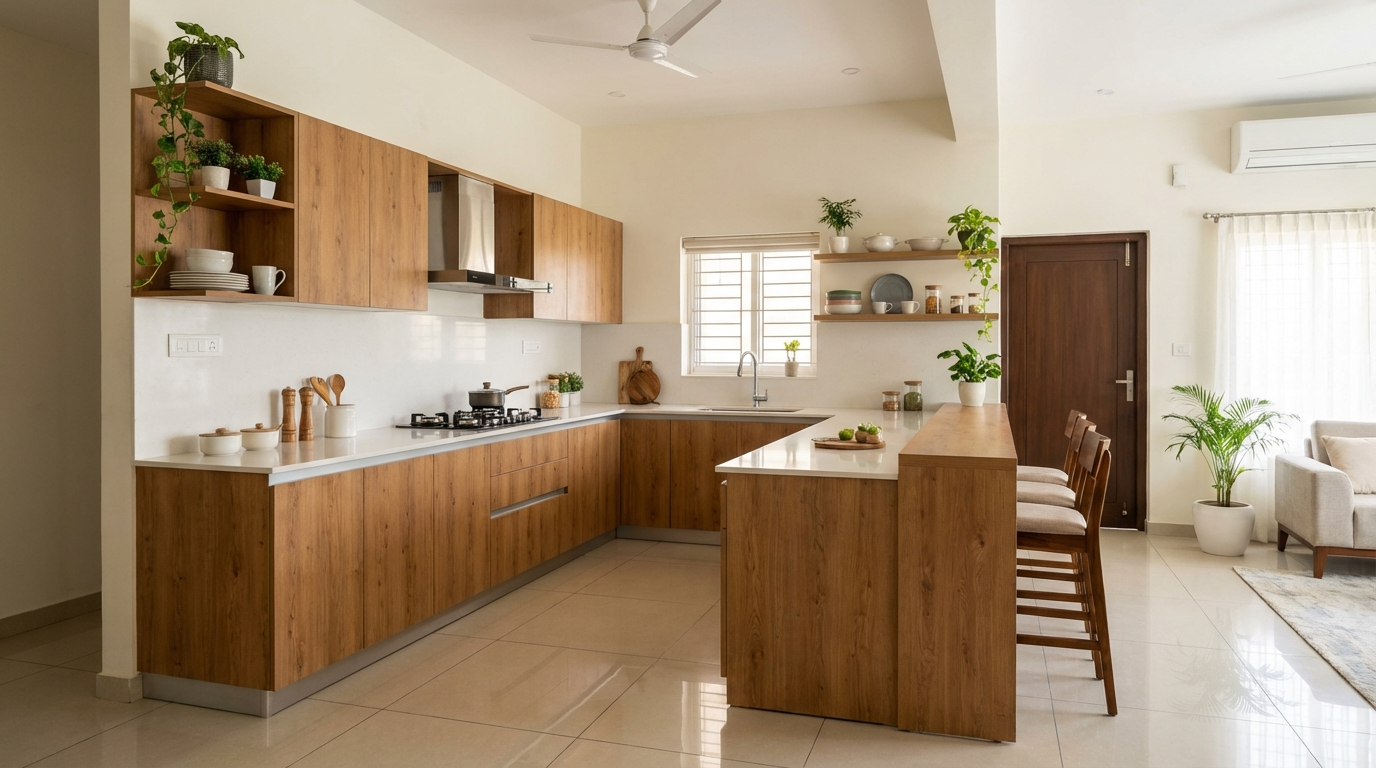
L-shaped layouts dominate Indian open kitchen installations for good reason—they fit standard apartment configurations, allow efficient work triangles, and leave one side fully open to living spaces. The corner created by L-shapes can be challenging for storage access, but modern carousel and magic corner accessories solve this effectively. For apartments in the 800-1200 sq ft range, L-shaped with a breakfast counter extension offers the best combination of efficiency, storage, and social interaction potential. This layout works especially well when the hob is positioned on the wall furthest from the living area, allowing the sink or prep counter to face guests.
Head-to-Head: Open vs Closed vs Semi-Open Kitchen
Before committing to an open kitchen, understanding how it compares to alternatives helps make informed decisions. This comparison addresses real-world performance in Indian conditions rather than theoretical benefits.
| Factor | Open Kitchen | Closed Kitchen | Semi-Open Kitchen |
|---|---|---|---|
| Odour containment | Poor without high-power chimney | Excellent with basic exhaust | Good with partition design |
| Visual space perception | Makes home feel 15-20% larger | Rooms feel separate/smaller | Moderate expansion feel |
| Cooking privacy | None—guests see everything | Complete | Adjustable with partitions |
| Cabinet material requirement | BWR minimum, marine for wet zones | MR adequate for most areas | BWR recommended |
| Chimney requirement | 1200+ m³/hr essential | 600-800 m³/hr sufficient | 1000+ m³/hr recommended |
| Maintenance frequency | High—oil films spread to living area | Low—contained to kitchen | Moderate |
| Cost comparison | 10-15% higher (materials + ventilation) | Baseline | 5-10% higher than closed |
| Resale appeal (2024-26 market) | High in metros, moderate in tier-2 | Standard | Good across markets |
Choose Open Kitchen When:
- You cook light meals (salads, sandwiches, continental) more often than heavy Indian cooking
- Single person or couple household with minimal oil-based cooking
- Entertainment and socialising while cooking is a priority
- Your apartment has good cross-ventilation with windows on opposite walls
- Budget allows for premium ventilation (Rs 25,000+ chimney) and BWR-grade materials throughout
Choose Closed Kitchen When:
- Daily heavy tadka, frying, or traditional Indian cooking happens
- Joint family with multiple people cooking simultaneously
- You prefer keeping cooking mess invisible to guests
- Budget constraints require MR-grade plywood
- The apartment has limited ventilation options
Choose Semi-Open (Best Compromise) When:
- You want the spacious feel but cook Indian food regularly
- Flexibility to close off kitchen when needed is valuable
- Budget sits between open and closed options
- You entertain guests occasionally but prioritise daily practicality
Material Selection for Open Kitchen Cabinets
Open kitchen cabinets require moisture-resistant materials because they face both cooking steam and ambient humidity from the larger living space without the containment that closed kitchens provide. Material selection directly affects durability and maintenance requirements.
Plywood Grade Selection Guide
BWR (Boiling Water Resistant) grade plywood is the minimum standard for open kitchen base cabinets and areas near sinks. This grade uses phenol-formaldehyde resin that resists moisture penetration for 8-10 years under normal use. For coastal cities or ground-floor installations with potential water seepage, upgrade to BWP/marine-grade plywood that withstands prolonged water exposure.
Upper cabinets in open kitchens can use BWR grade throughout since they face less direct moisture. However, the cabinet directly above the cooking hob—commonly called the chimney housing—needs marine-grade construction due to constant steam exposure. Many installations fail at this specific location when standard plywood is used.
What Thickness Works for Kitchen Cabinets?
Standard kitchen cabinet carcasses use 18mm thick plywood for sides, tops, and bottoms. This thickness provides adequate screw-holding strength for hinges and shelf pins. For cabinet backs, 6mm plywood suffices, but in open kitchens where moisture control matters more, upgrade to 9mm backs with sealed edges.
Countertop support structures and heavy-duty shelves (those holding mixers, grinders, or multiple vessels) benefit from 19mm thickness. Island constructions require 19mm throughout due to the structural loads and lack of wall support.
Alternative Materials Comparison
| Material | Suitability for Open Kitchen | Moisture Resistance | Cost vs BWR Plywood |
|---|---|---|---|
| HDHMR | Good for base units | Very high | 15-20% lower |
| Marine plywood | Excellent for wet zones | Highest | 25-35% higher |
| MDF | Avoid for Indian kitchens | Poor | 30-40% lower |
| Particle board | Not recommended | Very poor | 40-50% lower |
| WPC board | Excellent for base units | Very high | 20-30% higher |
| Stainless steel modular | Excellent but visible dents | Highest | 50-80% higher |
Our comprehensive material comparison guide covers HDHMR and MDF characteristics in detail for readers weighing these options against plywood.
Ventilation Planning: The Make-or-Break Factor
Ventilation determines whether your open kitchen enhances or ruins your living space. No amount of beautiful cabinetry compensates for a home that smells of yesterday's cooking. Plan ventilation before finalising cabinet layouts since chimney positioning affects upper cabinet design significantly.
Chimney Selection by Cooking Style
| Cooking Pattern | Minimum Suction Capacity | Recommended Type |
|---|---|---|
| Light cooking (reheating, salads, occasional meals) | 800 m³/hr | Slim profile ducted |
| Regular Indian cooking (daily dal-sabzi) | 1200 m³/hr | Pyramid ducted |
| Heavy Indian cooking (frequent frying, tadka) | 1500+ m³/hr | Island or ceiling-mounted |
| Professional/enthusiast cooking | 2000+ m³/hr | Commercial-style with make-up air |
Ducting Best Practices
Ductless/recirculating chimneys are inadequate for open kitchens regardless of filter quality. Always install ducted systems venting directly outside. The ducting path should be as short and straight as possible—every bend reduces effective suction by 10-15%. Maximum acceptable duct run is 10-12 feet with no more than two 90-degree bends.
Duct size matters equally. Standard 6-inch diameter ducting creates bottlenecks for high-capacity chimneys. Upgrade to 8-inch ducting for 1200+ m³/hr systems. Use smooth aluminium rigid ducting rather than flexible corrugated pipes, which create turbulence and reduce airflow.
How Long Does Kitchen Odour Linger in Open Plans?
With proper ventilation (1200+ m³/hr chimney, ducted to exterior), cooking odours clear within 15-30 minutes of finishing cooking. With inadequate ventilation, odours persist for 2-4 hours and gradually permeate soft furnishings in the living area. Over months, this creates permanent odour absorption in sofas, curtains, and carpets—a major reason some homeowners regret open kitchen decisions. If your apartment lacks exterior wall access for ducting, reconsider the open layout entirely or invest in premium air purification systems as backup.
Cost Estimation for Open Kitchen Projects (2026 Market)
Open kitchen costs vary based on size, material choices, and city location. The following framework helps estimate realistic budgets without misleading specific price quotes that change with market conditions.
Cost Components Breakdown
A complete open kitchen installation includes: cabinet carcasses (40-45% of total cost), doors/shutters with finish (20-25%), countertop (15-20%), hardware and accessories (10-15%), and chimney/appliances (remaining percentage). Labour typically adds 15-20% on top of material costs in metros, slightly less in tier-2 cities.
Budget Ranges by Kitchen Size
| Kitchen Size | Budget Range (BWR + Laminate) | Premium Range (Marine + PU/Acrylic) |
|---|---|---|
| 50-70 sq ft | Rs 1.8-2.8 lakhs | Rs 3.5-5 lakhs |
| 70-100 sq ft | Rs 2.5-4 lakhs | Rs 4.5-7 lakhs |
| 100-130 sq ft | Rs 3.5-5.5 lakhs | Rs 6-9 lakhs |
| Island addition | Add Rs 80,000-1.5 lakhs | Add Rs 1.5-3 lakhs |
Why Prices Vary Significantly
The 40-60% price range within each category reflects: plywood brand and actual grade verification (premium brands cost 25-30% more), hardware quality (imported soft-close systems cost 3-4x more than local), shutter finish (high-gloss acrylic costs 2x standard laminate), and countertop material (granite vs quartz vs Corian creates Rs 800-2500 per sq ft differences). City location adds another 10-20% variance—Mumbai and Delhi pricing runs higher than Pune, Ahmedabad, or Chennai.
Common Buyer Mistakes in Open Kitchen Projects
Learning from others' mistakes saves money and prevents regret. These seven errors appear repeatedly in open kitchen installations across Indian cities.
Mistake 1: Underestimating Chimney Requirements
What goes wrong: Homeowners install 600-800 m³/hr chimneys based on closed kitchen standards, then find cooking odours permeating the entire home. Why it happens: Dealers often recommend based on kitchen size alone, ignoring the open layout factor. How to avoid: Specify open kitchen configuration when selecting chimney. Minimum 1200 m³/hr for any open kitchen regardless of size.
Mistake 2: Using MR-Grade Plywood Throughout
What goes wrong: Base cabinet bottoms swell and edge-banding peels within 2-3 years. Why it happens: Contractors use whatever plywood costs less, assuming homeowners won't notice grade differences. How to avoid: Specify BWR grade in writing, verify ISI marks, and check carcass material before shutter installation.
Mistake 3: Ignoring Oil-Spatter Zones
What goes wrong: Cabinets near the hob develop permanent grease films that laminate finishes can't handle. Why it happens: Standard backsplash heights (18 inches) are inadequate for Indian cooking. How to avoid: Extend backsplash to 24-30 inches around hob, use glass or tile rather than laminate in this zone.
Mistake 4: Insufficient Electrical Planning
What goes wrong: Visible extension cords running to appliances, overloaded circuits causing trips. Why it happens: Electrical work is finalised before kitchen design is complete. How to avoid: Plan minimum 6-8 power points within counter zones before any construction, with dedicated 15-amp circuits for heavy appliances.
Mistake 5: Wrong Counter Height for Breakfast Seating
What goes wrong: Counter too high or too low for comfortable seating, stools don't fit underneath. Why it happens: Standard kitchen counter height (850-900mm) is used without adjustment for seating purposes. How to avoid: Breakfast counter sections should be 1000-1100mm height with 250-300mm knee clearance underneath. Select stools before finalising counter design.
Mistake 6: Neglecting Storage for Visible Zones
What goes wrong: Open shelves accumulate dust and grease, display items need constant cleaning. Why it happens: Design prioritises aesthetics over practical Indian kitchen storage needs. How to avoid: Limit open shelving to decorative items you'll actually clean weekly. All cooking-related storage should be behind doors.
Mistake 7: Selecting Finishes Based on Showroom Appearance
What goes wrong: High-gloss white surfaces show every fingerprint; dark matte finishes show dust constantly. Why it happens: Showroom lighting and cleaning frequency differ dramatically from home conditions. How to avoid: Request laminate samples to test in your home for 2-3 days. Medium tones with slight texture hide daily marks best.
Workmanship and Installation Requirements
Even premium materials fail with poor installation. These specifications ensure your open kitchen performs as intended over its expected 10-15 year lifespan.
Cutting and Edge Sealing
All plywood cuts must be sealed within 24 hours of cutting to prevent moisture absorption. Use hot-air edge banding rather than adhesive-only tape for durability. Edge band thickness should be 2mm minimum for visible edges, 1mm acceptable for hidden edges. Pay special attention to the underside of base cabinet shelves—often left unsealed by carpenters but exposed to under-counter humidity.
Hardware and Fastening Guidelines
Hinges need 32mm system drilling for adjustability over time. Cup hinges require minimum 18mm thick panels; thinner material causes hinge screws to pull through under repeated use. Use euro screws (not standard wood screws) in hinge plates. For drawer slides, full-extension ball-bearing slides with 45kg+ capacity prevent sagging with vessel loads. Soft-close mechanisms are not luxury features in open kitchens—they prevent noise that disturbs living spaces.
Installation Sequence
- Complete all electrical and plumbing rough-in work
- Install base cabinet carcasses, level precisely (use 2mm tolerance maximum)
- Connect plumbing to sink base before counter installation
- Install countertop with waterproof silicone seal to backsplash
- Mount upper cabinets (use wall studs or proper anchors for hollow walls)
- Install chimney and test ducting efficiency before closing ceiling access
- Hang doors and adjust hinges for perfect alignment
- Install drawer boxes and accessories
- Final hardware adjustment and quality inspection
Carpenter Briefing Checklist
Before work begins, confirm in writing: plywood grade and brand to be used, edge-banding method and material, hinge type and brand, hardware specifications, sealing requirements for moisture-prone areas, and warranty terms for workmanship. Take photos of material stacks before installation begins for verification.
Quality Checks Without Lab Equipment
You don't need laboratory testing to verify basic quality. These field checks catch common problems before they become expensive repairs.
Before Buying Materials
- Weight test: Lift a standard 8x4 sheet. BWR plywood should weigh 28-35 kg depending on thickness. Significantly lighter sheets indicate inferior core density.
- Edge inspection: Look at sheet edges for core gaps, voids, or thin veneer spots. Consistent layering indicates quality manufacturing.
- Tap test: Tap the sheet center firmly. Solid sound indicates dense core; hollow or rattling sounds suggest voids.
- ISI mark verification: Check for IS 303 (MR), IS 710 (BWR), or IS 848 (marine) markings. Request test certificates for brand verification.
During Installation
- Verify edge banding adhesion by pressing firmly—properly sealed edges won't lift
- Check hinge screw tightness before door hanging is complete
- Ensure countertop-to-backsplash joint has continuous silicone bead
- Test soft-close mechanisms before final installation
Warning Signs to Watch
Fresh-cut plywood with strong chemical odour may indicate high formaldehyde emissions—request E1 grade certification. Dark stains in core layers suggest moisture damage during storage. Peeling face veneer indicates poor glue bond that will worsen over time. Warped sheets shouldn't be used even if seller offers discount—cabinet doors will never hang straight.
Can Open Kitchen Plywood Be Used in Bathrooms?
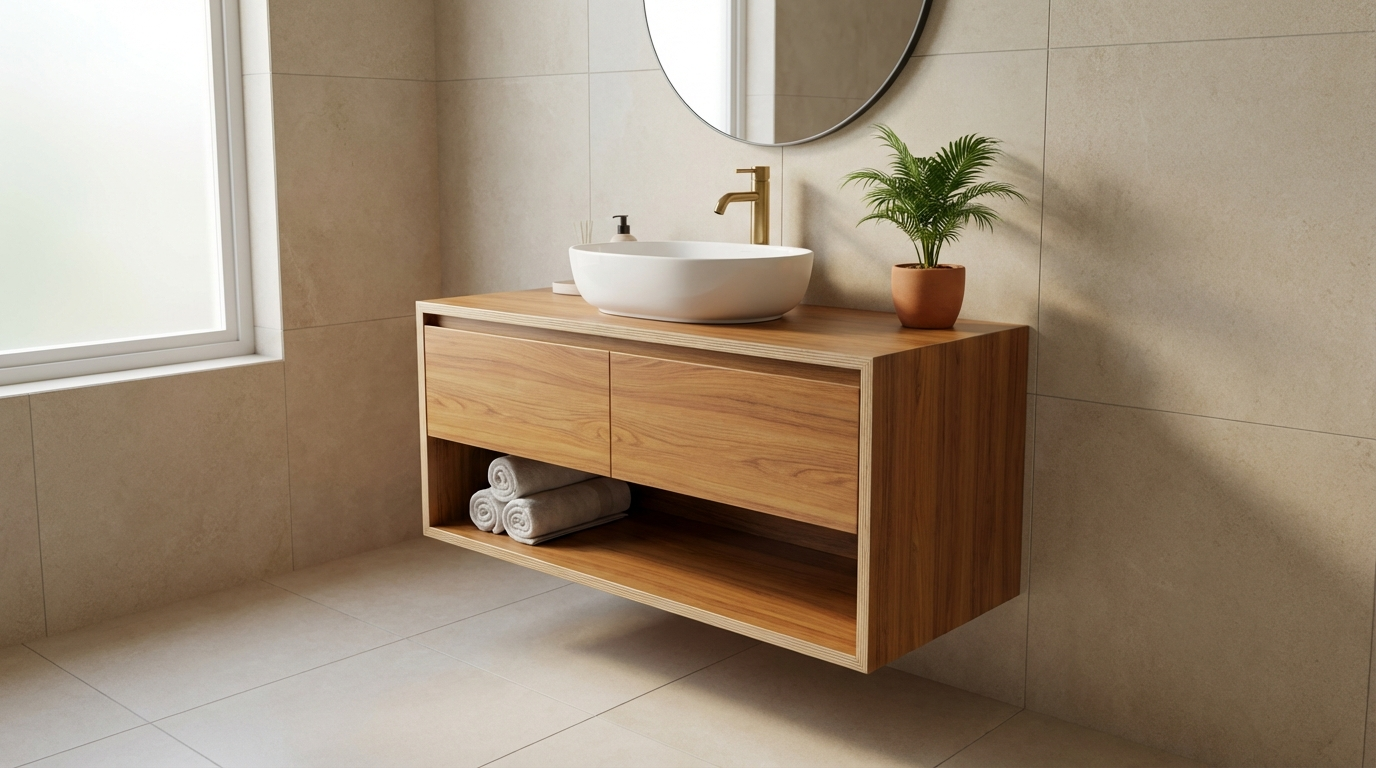
BWR-grade plywood specified for open kitchens performs adequately in bathroom vanity applications where splash exposure is controlled. However, direct shower zone cabinetry requires marine-grade (BWP) plywood with additional waterproofing treatment. Bathroom conditions differ from kitchens: prolonged high humidity rather than periodic cooking steam. For bathroom applications, all surfaces including backs and undersides need waterproof laminate or marine paint coating—not just the visible faces. Our bathroom vanity material guide covers this application in detail.
Frequently Asked Questions
What is the ideal size for an open kitchen in Indian apartments?
The ideal open kitchen size for Indian apartments ranges from 80-120 square feet, which accommodates L-shaped or parallel layouts with comfortable work triangles. This size allows adequate counter space (minimum 3 feet prep area), standard appliance placement (hob, sink, refrigerator), and storage for Indian cooking vessels and ingredients. Smaller spaces (60-80 sq ft) work but require single-wall or compact L-shaped layouts with creative storage solutions. Spaces below 50 sq ft are generally too cramped for open kitchen comfort and are better suited to closed designs where every inch can be utilised without aesthetic concerns about visible clutter.
Is open kitchen design suitable for joint families in India?
Open kitchens present significant challenges for joint families where multiple cooks work simultaneously and heavy cooking happens throughout the day. The continuous cooking cycle means odours never fully clear from living spaces, and the visual clutter of constant meal preparation becomes a permanent feature rather than occasional occurrence. However, semi-open designs with sliding partitions offer workable compromises—keeping the spacious feel while allowing closure during intensive cooking periods. For joint families committed to open layouts, invest in commercial-grade ventilation (1500+ m³/hr), specify marine-grade plywood throughout, and accept higher maintenance requirements as ongoing costs.
How much does an open kitchen cost compared to a closed kitchen?
Open kitchens typically cost 10-20% more than equivalent closed kitchen installations due to material upgrades and ventilation requirements. The primary cost increases come from mandatory BWR/marine plywood upgrades (vs MR-grade acceptable in closed kitchens), higher-capacity chimneys (Rs 25,000-50,000 more than basic models), enhanced finishing standards (visible-from-living-room quality throughout), and often more expensive countertop materials since the entire kitchen becomes a display feature. However, you save on construction costs if converting an existing closed kitchen by eliminating wall removal and refinishing expenses that would apply regardless of material choices.
What plywood grade is mandatory for open kitchen base cabinets?
BWR (Boiling Water Resistant) grade is the minimum mandatory specification for open kitchen base cabinets, with BWP/marine-grade recommended for sink cabinets, under-hob storage, and dishwasher housing. Base cabinets face moisture from floor cleaning, plumbing leaks, and humidity accumulation at lower levels. MR-grade plywood, while cheaper, lacks the phenol-formaldehyde resin bonding that protects against sustained moisture exposure. Within 2-3 monsoon cycles, MR-grade base cabinets in open kitchens show swelling, edge separation, and eventual structural failure. The 25-35% premium for BWR grade is negligible compared to complete cabinet replacement costs.
How do I prevent cooking odours from spreading to my living room?
Preventing odour spread requires a multi-layer approach: install a minimum 1200 m³/hr ducted chimney with exterior venting, position the cooking hob on the wall furthest from living areas, consider semi-open designs with glass partitions that close during cooking, ensure adequate cross-ventilation with windows on opposite walls, and maintain your chimney filters with monthly cleaning. Secondary measures include using splatter screens while frying, keeping exhaust running for 10-15 minutes after cooking completes, and avoiding fabric furnishings directly adjacent to kitchen zones. Some homeowners add air purifiers in living areas as backup systems during heavy cooking days.
Can I convert my existing closed kitchen to open layout?
Converting closed to open kitchens is feasible but requires structural assessment first. Load-bearing walls cannot be fully removed without beam support additions. Even non-load-bearing walls may house electrical conduits or plumbing that need rerouting. Budget approximately Rs 1-2 lakhs for wall removal, refinishing, and utilities rerouting before kitchen cabinet costs. Crucially, conversion projects must address ventilation—existing chimneys designed for closed spaces need upgrading, and ducting paths to exteriors may require ceiling boxing. The most cost-effective approach is partial wall removal creating a semi-open layout, which minimises structural work while achieving the desired spacious feel.
What is the best countertop material for open kitchen breakfast counters?
Quartz engineered stone offers the best combination of durability, aesthetics, and practicality for open kitchen breakfast counters. Unlike natural granite, quartz is non-porous (preventing staining from spills during eating), available in consistent patterns that coordinate with cabinet finishes, and doesn't require periodic sealing. For breakfast counter overhangs exceeding 300mm, the countertop thickness should be 25-30mm with steel brackets or corbels every 600mm for support. Granite remains popular for its lower cost (Rs 200-400/sq ft less than quartz) but shows visible seams in lighter colours and requires annual sealing in cooking zones.
How do soft-close mechanisms benefit open kitchen designs specifically?
Soft-close hinges and drawer slides prevent noise transfer from kitchen activities to living and dining areas—a problem unique to open layouts. In closed kitchens, cabinet noise stays contained; in open plans, every door slam and drawer bang disrupts conversations and media watching in adjacent spaces. Beyond noise control, soft-close mechanisms prevent door and drawer impact damage that shortens hardware life. For open kitchens, specify soft-close as mandatory for all doors and drawers without exception. The Rs 200-400 premium per door pays back through reduced maintenance and dramatically improved daily living experience.
What lighting works best for open kitchen layouts?
Open kitchens require three lighting layers: ambient (overall illumination matching living area), task (focused counter and hob lighting), and accent (highlighting design features or backsplash). The key difference from closed kitchens is colour temperature consistency—mismatched warm and cool lights across open spaces look jarring. Standardise on 3000-4000K LED fixtures throughout. Task lighting under upper cabinets (LED strips or puck lights) prevents shadows on work surfaces. For island or peninsula designs, pendant lights serve both task and aesthetic purposes but should hang 750-850mm above counter height. Dimmable fixtures allow mood adjustment for cooking versus entertaining scenarios.
Are open kitchens harder to keep clean than closed kitchens?
Yes, open kitchens require 30-50% more cleaning effort than equivalent closed kitchens because cooking residue spreads beyond contained kitchen boundaries. Oil microparticles from Indian cooking settle on living room surfaces within the 3-5 meter zone around cooking areas. This means regular cleaning extends to adjacent floors, nearby furniture, and display items visible from kitchen zones. The cleaning frequency for kitchen cabinets themselves also increases since any grease buildup is visible during normal living room use. Accept this maintenance reality before choosing open layouts—the aesthetic benefits come with ongoing lifestyle adjustments.
What is the minimum passage width around an open kitchen island?
Minimum passage width around kitchen islands is 1000mm (approximately 3.3 feet), with 1200mm recommended where two people need to pass simultaneously or cabinet doors open into the passage. Below 900mm, movement becomes awkward and cabinet doors cannot open fully without blocking the pathway. For islands with seating, add 600mm clearance behind occupied stools. These measurements mean islands require substantial floor space—typically 15-20 sq meters minimum for comfortable installation. Many Indian apartments under 1200 sq ft lack adequate space for proper island layouts, making peninsula designs (attached to one wall) the practical alternative.
How do I choose between modular and carpenter-made open kitchens?
Modular kitchen companies offer standardised dimensions, factory-controlled quality, and faster installation (typically 15-25 days versus 30-45 days for carpenter work). However, modular units cost 20-40% more than equivalent carpenter-made cabinets and offer limited customisation for non-standard spaces. Carpenter-made open kitchens suit irregular layouts, specific dimension requirements, and budget-conscious projects but require careful quality supervision. For open kitchens specifically, modular construction's precision manufacturing ensures consistent door alignment and finish quality that remains visible from living spaces—imperfections tolerable in closed kitchens become obvious in open layouts. Choose modular for premium finishes and standard spaces; choose carpenter-made for complex configurations with vigilant oversight.
Does open kitchen design affect home resale value in India?
Open kitchens currently add premium appeal in metro cities among younger buyers (25-40 age group) and nuclear families, potentially improving resale positioning. However, this preference isn't universal—joint family buyers and older demographics often prefer closed kitchens, and tier-2 city markets show mixed acceptance. The safest approach for resale-conscious homeowners is semi-open designs with partition options that allow future owners to use the space either way. Pure open kitchens may limit your buyer pool slightly while pure closed kitchens may seem dated to contemporary buyers. Property values in 2024-26 suggest open/semi-open layouts command 3-7% premiums in metro apartment markets where comparable units exist.
What warranty should I expect on open kitchen installations?
Reputable modular kitchen providers offer 5-10 year warranties on cabinets and hardware, with lifetime warranties on internal carcass structures becoming common among premium brands. Carpenter-made kitchens typically carry 1-2 year workmanship warranties only. For open kitchens, pay attention to warranty exclusions—most warranties void coverage for moisture damage even with BWR materials if ventilation inadequacy caused the problem. Document your chimney specifications, ducting installation, and maintenance records to protect warranty claims. Separately, chimney warranties (typically 2-5 years) and countertop warranties (5-10 years for quartz) should be obtained in writing from respective suppliers.
Final Considerations for Your Open Kitchen Project
Open kitchen design transforms how Indian families interact with cooking and living spaces, but success depends on respecting practical constraints rather than chasing aesthetic ideals alone. The 40+ design concepts above provide starting points, but every home requires customisation based on specific dimensions, family cooking patterns, ventilation possibilities, and budget realities.
Start your planning with ventilation requirements—this single factor determines whether your open kitchen enhances or diminishes daily living quality. Specify BWR-grade minimum for all cabinetry, accept the 10-20% budget premium as necessary investment, and plan realistic maintenance routines before installation rather than after. The semi-open approach with partition options offers the safest path for homes where cooking patterns may change over time or resale considerations matter.
Your local carpenter or modular kitchen provider should be consulted with specific requirements in hand rather than expecting them to guide material decisions—not all contractors understand the elevated requirements of open layouts versus traditional closed kitchens. Bring this specification knowledge to those conversations and insist on written commitments for grades, brands, and installation practices that protect your investment over its expected 10-15 year service life.
Disclaimer: This content is provided for general informational purposes based on industry practices and publicly available information. Product specifications, standards, prices, and availability may vary by manufacturer, region, and time. Readers should independently verify details with manufacturers, dealers, or qualified professionals before making purchase or construction decisions.Want Plywood Suggestions?
Share a few details and a Sainik 710 specialist will suggest suitable brands and connect you to responsive dealers.