Office Interior Design Ideas: 35+ Modern Workspace Designs for Small & Large Offices
Explore 35+ office interior design ideas—modern, small office, cabin & workstation layouts. Get furniture tips, color schemes & productivity boosters.
Quick Decision Summary
The best office interior design balances functionality, employee comfort, and brand identity while working within your space constraints and budget. Modern Indian offices increasingly combine modular furniture, biophilic elements, and flexible layouts that adapt to hybrid work patterns.
If you're in a hurry: Focus on three elements—adequate natural lighting, ergonomic seating, and clutter-free storage. For small offices under 500 square feet, prioritise vertical storage and multi-functional furniture. For larger spaces, create distinct zones for focused work, collaboration, and breaks. Budget around Rs 800–2,500 per square foot for mid-range commercial interiors, including furniture, partitions, and finishes.
- Choose open layouts if: Your team collaborates frequently, you have 10+ employees, and you want to maximise natural light penetration
- Choose cabin-based layouts if: Privacy is essential, client meetings happen daily, or noise control is critical
- Avoid generic catalog copies if: You want a space that genuinely improves productivity—cookie-cutter designs rarely account for your specific workflow
Key takeaway: The most successful office interiors aren't the most expensive—they're the ones designed around how people actually work, with materials chosen for Indian climate conditions.
What Office Interior Design Actually Means in the Indian Context
Office interior design is the strategic planning of workspace layouts, furniture selection, colour schemes, lighting, and material choices to create environments that support productivity, reflect brand values, and ensure employee well-being. In India, this involves additional considerations around monsoon humidity, power backup provisions, and varying real estate footprints across metro and tier-2 cities.
Unlike residential interiors where aesthetics often lead decisions, office interiors must prioritise functionality first. A beautiful reception area means nothing if employees struggle with inadequate desk space or poor ventilation. The best office designs emerge from understanding daily workflows—where do people need to concentrate, where do impromptu discussions happen, where do clients wait, and how does paperwork flow through the space.
Technical Components That Matter
Office interiors involve several interconnected systems that must work together:
- Space planning: The allocation of square footage across workstations, circulation paths, meeting rooms, storage, and utility areas
- Furniture systems: Desks, seating, storage units, and partitions—typically 40–50% of your interior budget
- Electrical and data infrastructure: Power points, network cabling, and provisions for future expansion
- HVAC considerations: Air conditioning load calculations based on occupancy and equipment heat generation
- Acoustic management: Ceiling treatments, partition materials, and floor finishes that control noise levels
Common Misconceptions Cleared
Many first-time office planners assume expensive materials automatically create better workspaces. Reality: A well-planned 500 square foot office with standard materials outperforms a poorly designed 1,000 square foot space with premium finishes. Another misconception involves "open plan" designs—while they encourage collaboration, Indian offices often need more privacy than Western models suggest, particularly for finance and HR functions that handle sensitive information.
India-Specific Reality Check: Climate, Space, and Local Practices
Indian office interiors face unique challenges that generic international design guides ignore. Monsoon humidity ranging from 70–90% in coastal cities affects material selection, termite risk varies dramatically between regions, and power fluctuations influence lighting and equipment choices.
Monsoon and Humidity Considerations
Offices in Mumbai, Chennai, Kolkata, and coastal Karnataka face 4–5 months of high humidity annually. This directly impacts material choices:
- Plywood for workstations: Use BWR grade minimum; BWP/marine grade for ground floor offices or areas near external walls
- Particle board furniture: Avoid entirely in high-humidity zones—swelling and delamination occur within 2–3 monsoons
- Metal furniture: Requires powder coating or galvanisation; raw steel rusts rapidly in coastal locations
- Fabric upholstery: Choose synthetic fabrics with moisture-wicking properties; natural fabrics develop mildew
Regional Variations Across India
Design requirements shift significantly based on location:
| Region | Primary Concern | Material Recommendation | Special Consideration |
|---|---|---|---|
| Coastal cities (Mumbai, Chennai, Kochi) | Humidity + salt air | Marine-grade ply, SS hardware, treated aluminium | AC mandatory; dehumidifiers for server rooms |
| North India (Delhi NCR, Jaipur) | Extreme temperature variation | Standard BWR ply, good quality laminates | Thermal insulation for walls, double glazing beneficial |
| East India (Kolkata, Bhubaneswar) | High humidity + cyclone risk | BWP ply, reinforced partitions | Waterproofing critical for lower floors |
| South India interiors (Bengaluru, Hyderabad) | Moderate humidity, dust | BWR ply, HDHMR for storage | Dust-resistant finishes, good ventilation |
Contractor and Carpenter Practices to Watch
Local contractors often follow shortcuts that compromise longevity. Watch for these practices:
- Using MR grade ply where BWR is specified: Cost difference is Rs 15–25 per square foot, but MR fails in AC environments where condensation occurs
- Skipping edge banding: Exposed plywood edges absorb moisture and delaminate—insist on proper ABS or PVC edge banding
- Undersized electrical provisions: Many carpenters run minimal wiring; plan for 30% extra power points than current needs
- Ignoring termite treatment: Pre-construction anti-termite treatment costs Rs 3–5 per square foot but saves lakhs in damage
Design Ideas with Practical Material Choices: 35+ Concepts
Modern office interior design ideas must translate into executable plans with specific material recommendations. Below are categorised concepts with the practical specifications needed for Indian conditions.
Small Office Ideas (Under 500 Square Feet)
- Floating desk installation: Wall-mounted desks using 18mm BWR plywood with metal brackets save floor space; works for 2–4 person startups
- Glass partition with frosted bands: 12mm toughened glass with 200mm frosted strip at eye level—privacy without blocking light
- Vertical storage towers: Floor-to-ceiling units in 19mm BWR plywood maximise storage; keep frequently used items at 900–1500mm height
- Fold-down meeting table: Wall-mounted 18mm marine ply table that folds when not in use—ideal for offices doubling as meeting spaces
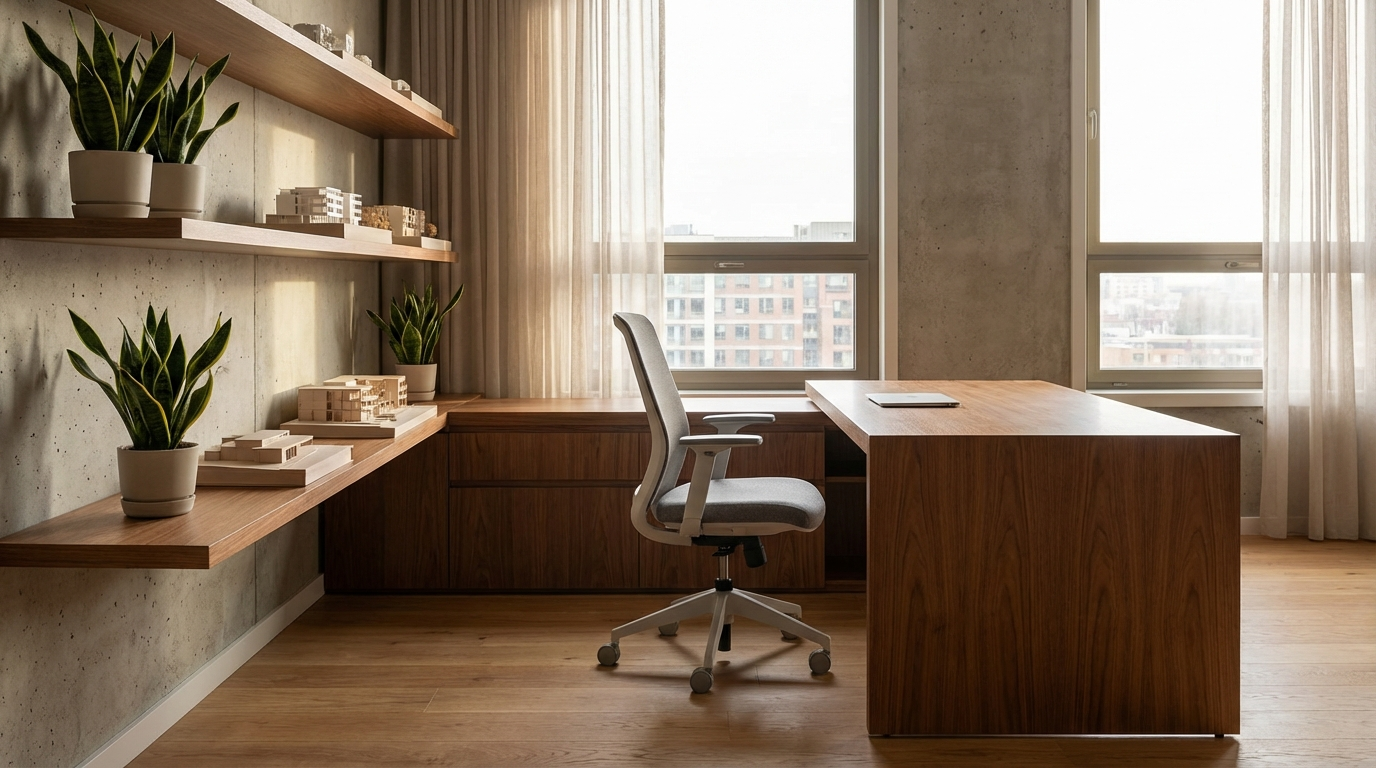
- L-shaped corner workstation: Utilises corner space; specify 25mm thickness for span over 1200mm without sagging
- Compact reception with storage: 1200mm wide unit combining visitor seating and file storage; use pre-laminated boards for quick installation
- Mirror wall expansion: Full-height mirror on one wall creates illusion of space; use 6mm bevelled mirror with safety backing
- Built-in window seating: If window sill is 450–600mm high, create storage seating with 18mm ply and 50mm cushion top
Mid-Size Office Ideas (500–2000 Square Feet)
- Modular workstation clusters: 4–6 person pods with 1200mm x 600mm desk surfaces; 12mm glass screens between stations
- Central collaborative island: Standing-height table (1050mm) in centre encourages quick discussions; use 25mm plywood with laminate
- Acoustic phone booths: 1200mm x 1200mm enclosed units with sound-absorbing panels; essential for open-plan offices
- Biophilic green wall: Vertical planter system on one wall; requires waterproof backing and drainage provision
- Breakout nook with booth seating: U-shaped seating for 4–6 people; high backs (1200mm) for acoustic privacy
- Glass-fronted meeting room: 10mm toughened glass walls with manifestation film; internal blinds for confidential meetings
- Pantry with service counter: 600mm deep counter in 18mm BWP ply with granite top; integrate sink and under-counter fridge
- Filing corridor: Narrow passage (900mm clear) lined with 400mm deep storage on one side; keeps files accessible but out of workspace
- Manager cabin with sit-out: 100 square foot cabin with 50 square foot attached seating area for informal discussions
- Hot-desking zone: Unassigned workstations with personal lockers; each employee gets 400mm x 400mm locker for belongings
Large Office and Corporate Ideas (2000+ Square Feet)
- Zoned open floor with neighbourhoods: Cluster teams in "neighbourhoods" of 8–12 desks with shared amenities
- Executive boardroom with AV integration: 20+ seater table in veneer finish; recessed cable management and motorised screen
- Training room with flexible furniture: Tables on castors that reconfigure; specify heavy-duty castors rated for 50kg per wheel
- Wellness room: Small space (60–80 square feet) for nursing mothers or prayer; sound-insulated with dimmer lighting
- Cafeteria with mixed seating: Combination of 4-seater tables, high stools, and lounge seating—calculate 15 square feet per person
- Reception with brand wall: Backlit logo panel using 18mm MDF with CNC routing; LED strip behind acrylic diffuser
- Server room with raised flooring: 300mm raised access floor for cable management; maintain separate AC with humidity control
- Director cabins with private washroom: 150–200 square feet with attached 35 square foot washroom; use marine-grade ply throughout
- Visitor waiting lounge: Comfortable seating for 8–10 with charging points; coffee table with magazine storage
- Archive room with compact storage: Mobile shelving systems that double storage capacity; floor must support 500 kg per square metre
What Works Best in Indian Corporate Culture
Indian offices typically need more enclosed spaces than international open-plan models suggest. Consider these cultural factors:
- Privacy for salary discussions, performance reviews, and HR matters—at least one enclosed room per 15 employees
- Separate visitor waiting area—clients shouldn't see operational workspace before meetings
- Hierarchy accommodation—senior staff expect distinct seating even in open plans; larger desks or preferred locations matter
- Pantry as social hub—Indians treat lunch and chai breaks as important bonding time; don't skimp on pantry space
How to Choose: 5-Step Decision Framework for Office Interiors
Designing an office interior requires systematic decisions rather than ad-hoc choices. This framework ensures you address critical factors in the right sequence.
Step 1: Assess Current and Future Space Needs
Calculate square footage requirements based on headcount and functions:
- Workstations: 40–60 square feet per employee for open plan; 80–100 square feet for cabins
- Meeting rooms: One 8-seater room per 20 employees; smaller 4-seater discussion rooms additionally
- Circulation: 25–30% of usable space for corridors, aisles, and movement areas
- Support areas: Pantry (2–3 square feet per employee), storage (varies by document-intensity of business)
- Growth buffer: Add 20% for 3-year expansion unless on short lease
Step 2: Define Functional Zones
Map activities to areas before finalising layouts:
- Identify tasks requiring concentration versus collaboration
- Note client-facing areas versus back-office operations
- Plan noisy zones (sales calls, customer service) away from quiet zones (accounts, legal)
- Position server room, electrical panels, and HVAC units in service areas
Step 3: Set Realistic Budget Allocations
Distribute interior budget across components (percentages are typical ranges):
| Component | Budget Share | Where to Invest More | Where to Save |
|---|---|---|---|
| Furniture (desks, chairs, storage) | 35–45% | Ergonomic chairs—employees sit 8+ hours | Storage units—standard options work fine |
| Partitions and civil work | 20–25% | Glass partitions for meeting rooms | Drywall instead of brick for flexibility |
| Electrical and networking | 15–20% | Adequate power points and data ports | Basic switches unless premium aesthetics needed |
| Flooring and ceiling | 10–15% | Durable flooring in high-traffic areas | Basic grid ceiling works for most offices |
| Finishing and decor | 5–10% | Reception area—first impressions matter | Back-office aesthetics can be minimal |
Step 4: Select Materials for Your Environment
Match material grades to your specific conditions:
- Check relative humidity levels in your city—above 60% average requires moisture-resistant grades
- Ground floor offices need higher specifications than upper floors
- Areas near washrooms and pantry need water-resistant materials within 3-foot radius
- High-traffic zones need scratch-resistant laminates (0.8mm or thicker)
Step 5: Plan for Maintenance and Changes
Design for longevity and flexibility:
- Use modular furniture systems that can be reconfigured
- Specify materials available locally for easy replacement
- Keep wiring accessible through cable trays or raised floors
- Document all specifications for future reference during repairs
Is Open Plan Actually Good for Indian Offices?
Open plan designs work well for collaborative teams but present challenges in Indian contexts. Advantages include better natural light distribution, easier supervision, and lower construction costs. However, Indian offices often deal with higher ambient noise from traffic and construction, making acoustic management critical. Solution: Implement "activity-based working" where different zones serve different needs—focused work areas with acoustic treatment, collaboration zones with writable surfaces, and quiet rooms for calls and concentration.
Head-to-Head Comparison: Office Furniture Material Options
Choosing the right material for office furniture affects durability, cost, and maintenance requirements. This comparison helps match materials to specific applications.
| Material | Typical Use | Durability (Years) | Cost Range (Rs/sq ft) | Best For | Avoid When |
|---|---|---|---|---|---|
| BWR Plywood + Laminate | Workstations, storage | 10–15 | 180–350 | Most office furniture | Outdoor or wet areas |
| Pre-laminated Particle Board | Modular systems, budget furniture | 5–8 | 80–150 | Quick installations, temporary setups | Humid cities, heavy loads |
| HDHMR/HDF | Cabinets, storage units | 8–12 | 120–200 | Painted finishes, CNC work | Load-bearing applications |
| Metal (MS Powder Coated) | Frames, filing cabinets | 15–20 | Varies by design | High durability needs, fire safety | Coastal areas without galvanising |
| Solid Wood (Veneer Finish) | Executive furniture, reception | 20+ | 400–800+ | Premium appearance | Tight budgets, large quantities |
Choose plywood-based furniture when: You need customisation, local carpenter fabrication, and reasonable durability for 10+ years. Our detailed plywood grade guide covers specifications in depth.
Choose modular systems when: Speed of installation matters, you're on a short lease, or you anticipate frequent reconfiguration. Factory-made modular furniture installs in days versus weeks for carpentry work.
Common Buyer Mistakes in Office Interior Projects
Office interior projects involve multiple decisions where errors compound costs and cause ongoing problems. Recognising common mistakes helps avoid them.
Mistake 1: Underestimating Electrical Requirements
What goes wrong: Offices end up with extension cords everywhere, tripping hazards, and overloaded circuits.
Why it happens: Planners count only computers, forgetting chargers, printers, coffee machines, and future additions.
How to avoid: Calculate 3–4 power points per workstation, dedicated circuits for pantry and server room, and 30% spare capacity.
Mistake 2: Choosing Aesthetics Over Ergonomics for Seating
What goes wrong: Employees develop back pain, productivity drops, and you eventually replace chairs anyway.
Why it happens: Buyers select chairs based on looks or price during a brief showroom visit.
How to avoid: Test chairs for 30+ minutes, check lumbar support adjustment, and prioritise ISI-marked ergonomic designs.
Mistake 3: Ignoring Acoustic Considerations
What goes wrong: Noise complaints, difficulty in phone calls, and reduced concentration in open plans.
Why it happens: Acoustics aren't visible and often cut from budgets.
How to avoid: Include ceiling acoustic tiles, carpet in critical zones, and acoustic screens between workstations.
Mistake 4: Wrong Material Grade for Environment
What goes wrong: Furniture swells, delaminates, or warps within 2–3 years.
Why it happens: Using interior-grade materials in high-humidity environments to save costs.
How to avoid: Match material specifications to local climate; consult our moisture-resistant plywood comparison for guidance.
Mistake 5: Inadequate Storage Planning
What goes wrong: Clutter accumulates on desks, files stack on floors, and the office looks unprofessional.
Why it happens: Storage seems boring compared to fancy furniture and gets minimised.
How to avoid: Audit current storage needs, add 25% buffer, and plan mix of personal (pedestal), team (cabinets), and archive storage.
Mistake 6: Skipping Proper Ventilation Assessment
What goes wrong: Stuffy air, AC overload, and employee discomfort.
Why it happens: Assumption that AC will handle everything without calculating actual load.
How to avoid: Calculate cooling load based on occupancy, equipment heat, and sun exposure; ensure fresh air intake provisions.
Mistake 7: Not Planning for Growth
What goes wrong: Cramped conditions within a year, costly re-work, or premature relocation.
Why it happens: Designing exactly for current headcount without expansion buffer.
How to avoid: Unless on a short lease, design for 20–30% growth; use modular furniture that can be added to.
Workmanship and Installation Tips for Office Furniture
Quality installation determines whether good materials perform well or fail prematurely. These guidelines ensure your office furniture lasts.
Cutting and Edge Sealing Requirements
All plywood and board edges must be sealed to prevent moisture ingress. Options include:
- ABS edge banding (1–2mm): Standard for visible edges; machine-applied for clean finish
- PVC edge banding: More flexible, suitable for curves; slightly lower quality than ABS
- Veneer edging: For premium furniture matching solid wood appearance
- Paint or laminate wrap: Acceptable for non-visible edges but less durable
Fastening and Screw Holding
Different materials have different screw holding capacities:
- Solid plywood: Excellent screw holding; use standard wood screws
- Particle board: Poor screw holding; use confirmat screws with larger threads
- HDHMR: Good screw holding; pre-drill to prevent cracking
- For hinges and heavy-duty hardware: Use backing blocks of solid wood or plywood even in particle board furniture
Hinge Zones and Reinforcement
Cabinet doors and drawers fail most often at hinge points. Ensure:
- Soft-close hinges rated for door weight (standard: 4–6 kg per door)
- Minimum 18mm thickness at hinge mounting points
- Solid backing for wall-mounted cabinets; anchors rated for total load including contents
- Drawer slides rated for expected load; full-extension slides for files
Site Storage and Acclimatisation
Materials need proper handling before installation:
- Store plywood flat on bearers, not leaning against walls (causes warping)
- Keep materials away from direct sunlight and moisture
- Allow 48–72 hours acclimatisation in AC environment before cutting
- Don't install during active painting or plastering work (humidity spikes)
Carpenter Briefing Checklist
Before work begins, ensure your carpenter understands:
- Specific plywood grades required for each component
- Edge banding requirements (all edges, not just visible ones)
- Hardware specifications (hinge type, drawer slide ratings)
- Electrical coordination requirements
- Acceptance criteria and inspection process
Quality Checks Without Lab Tests
You don't need sophisticated equipment to verify material and workmanship quality. These field checks catch most problems.
Visual Inspection Points
Before accepting furniture delivery or carpentry work:
- Check edges: Run finger along all edges—no exposed core should be visible
- Inspect laminate: Look for bubbles, lifting at corners, or colour mismatches
- Verify alignment: Doors should align with each other and close flush
- Test drawers: Smooth operation, no binding or excessive play
- Examine joints: No gaps, no adhesive squeeze-out visible
Questions to Ask Your Supplier
Legitimate suppliers should answer these without hesitation:
- What plywood brand and grade is being used? (Ask to see remnant pieces)
- What is the laminate brand and thickness?
- What hardware brands are installed? (Hettich, Hafele, or equivalent)
- What warranty coverage applies and what's excluded?
- Can I see the material purchase invoices?
Warning Signs to Watch For
These indicate poor quality materials or workmanship:
- Hollow sounds when tapped: Indicates core voids in plywood or particle board
- Musty smell: Suggests moisture damage or poor-quality adhesive
- Uneven weight: Compare similar-sized pieces; significant difference indicates density problems
- Rough edges under laminate: Indicates poor cutting before lamination
- Hardware misalignment: Suggests rushed installation without proper marking
Simple Field Tests
These require no equipment beyond your senses:
- Weight test: Lift corner of board; good quality feels substantial, not hollow
- Tap test: Knock on surface; consistent sound indicates uniform density
- Flex test: Slight pressure on unsupported span shouldn't cause visible deflection
- Edge check: Scratch edge lightly with fingernail; quality laminate shouldn't mark easily
What Thickness of Plywood Works Best for Office Furniture?
Plywood thickness selection depends on span, load, and application. Using wrong thickness causes sagging, poor screw holding, and premature failure.
For desk tops spanning 600mm or less: 18mm BWR plywood with laminate provides adequate stiffness. For spans up to 900mm, use 19mm or add metal framing underneath.
For desk tops spanning 900mm–1200mm: Minimum 25mm plywood or 18mm with apron rail support. Unsupported spans over 1200mm require additional framing regardless of thickness.
For cabinet sides and shelves: 18mm is standard; use 12mm only for back panels and very short spans. Shelves over 600mm span holding books or files need 18mm minimum.
For partitions: 12mm plywood on both sides of aluminium frame is standard. For acoustic partitions, add insulation between layers.
How Long Does Office Furniture Last in Humid Conditions?
Furniture longevity in humid Indian cities depends heavily on material selection and maintenance. With proper specifications, office furniture should last 10–15 years even in coastal locations.
In air-conditioned environments: Standard BWR plywood furniture lasts 12–15 years with normal use. AC maintains humidity around 50–60%, which is safe for most materials.
In non-AC or partially cooled spaces: Expect 30–40% shorter lifespan. Use marine-grade plywood for critical furniture, apply moisture-resistant coatings, and ensure good ventilation.
Ground floor offices: Higher moisture exposure from floor and walls—specify marine-grade ply for all furniture below 600mm height; treat floor contact points with waterproof coating.
Maintenance practices that extend life: Wipe condensation from surfaces daily during monsoon, keep furniture away from external walls by 50mm minimum, use dehumidifiers in storage rooms, and address any water leaks immediately.
Can Modular Furniture Replace Carpentry for Office Interiors?
Modular furniture systems offer compelling advantages but have limitations compared to custom carpentry. The right choice depends on your specific situation.
Choose modular when:
- Speed matters—modular installs in 2–5 days versus 2–4 weeks for carpentry
- You're on a lease shorter than 5 years and need to relocate furniture
- Standardisation is acceptable—modular comes in fixed sizes
- Budget is tight—modular is 20–30% cheaper than equivalent carpentry
Choose custom carpentry when:
- Space has unusual dimensions requiring custom sizing
- You want specific wood finishes or premium materials
- Built-in solutions (wall cabinets, corner units) are needed
- Long-term ownership is planned—carpentry often lasts longer
Hybrid approach: Many successful offices combine both—modular workstations for flexibility with custom carpentry for reception, executive cabins, and storage walls. Our modular versus carpentry comparison explores this in detail.
Price Range and Cost Drivers for Office Interiors (2026 Market)
Office interior costs vary significantly based on specifications, location, and project scale. These ranges reflect current Indian market conditions.
Overall Interior Cost Per Square Foot
| Category | Cost Range (Rs/sq ft) | What's Included |
|---|---|---|
| Basic/Startup | 400–800 | Essential furniture, basic partitions, standard lighting |
| Mid-range Corporate | 800–1,500 | Quality furniture, glass partitions, decent finishes |
| Premium Corporate | 1,500–2,500 | Designer furniture, premium materials, sophisticated lighting |
| Luxury/Flagship | 2,500–5,000+ | Custom design, imported materials, smart systems |
Why Prices Vary So Much
Key factors driving cost differences:
- Location: Metro cities cost 15–25% more than tier-2 cities for same specifications
- Material grades: BWP vs BWR plywood, laminate thickness, hardware brands
- Customisation level: Standard sizes cost less than custom dimensions
- Electrical density: More power points, data ports, and AV systems increase costs
- Ceiling type: Basic grid ceiling versus gypsum with cove lighting
- Flooring choice: Vinyl tiles versus carpet versus granite
Budget Estimation Method
For quick estimation of common furniture:
- Workstation (1200mm x 600mm): Rs 8,000–15,000 basic; Rs 15,000–25,000 with pedestal
- Executive desk: Rs 25,000–60,000 depending on size and finish
- Ergonomic chair: Rs 8,000–25,000 for quality options
- 4-seater meeting table: Rs 15,000–35,000
- Filing cabinet (4-drawer): Rs 8,000–18,000
- Reception counter (per running foot): Rs 3,500–8,000
Frequently Asked Questions
What is the ideal square footage per employee for office design?
The ideal allocation depends on work type and layout style. Open plan offices typically require 40–60 square feet per employee including workstation and circulation share, while cabin-based layouts need 80–100 square feet per person. Add common areas (meeting rooms, pantry, reception) which typically consume 25–35% of total space. For example, a 20-person office with open plan workstations needs approximately 1,200–1,500 square feet for work areas plus 400–500 square feet for common spaces, totalling 1,600–2,000 square feet minimum. Always plan for 20% growth unless on a short-term lease.
How do I choose between open plan and cabin-based office layout?
The choice depends on work nature, culture, and privacy requirements. Open plans suit collaborative teams, creative industries, and organisations wanting visible leadership. Cabin layouts work better for roles requiring concentration (accounting, legal), frequent confidential discussions, or hierarchical cultures. Many Indian offices benefit from hybrid approaches—open areas for operational staff with enclosed cabins for management and private meeting rooms accessible to all. Consider noise levels in your building; offices in noisy locations may need more enclosed spaces regardless of preference.
What plywood grade should I specify for office furniture in coastal cities?
Coastal cities like Mumbai, Chennai, Kochi, and Visakhapatnam require marine-grade (BWP) plywood for all furniture that might face moisture exposure. This includes furniture below 600mm height, items near external walls, and all pantry and washroom-adjacent cabinetry. Standard BWR grade works for elevated furniture in consistently air-conditioned environments, but the additional cost of marine grade (typically Rs 20–40 per square foot more) provides insurance against humidity damage that can ruin furniture within 3–4 years.
Is it worth investing in ergonomic chairs for office interiors?
Quality ergonomic chairs are among the best investments in office interiors, despite higher upfront costs. Employees sit 6–10 hours daily, and poor seating causes back pain, reduced productivity, and higher absenteeism. An Rs 15,000–20,000 ergonomic chair lasts 7–10 years, costing Rs 150–250 per month—far less than productivity losses from discomfort or healthcare costs. Look for chairs with adjustable lumbar support, seat depth adjustment, armrest adjustment, and breathable mesh back. Brands with ISI certification ensure minimum quality standards.
How can I make a small office look and feel bigger?
Several design strategies create perception of larger space without structural changes. Use light colours on walls and flooring—white, light grey, and pale wood tones reflect more light. Maximise natural light through glass partitions instead of solid walls. Install mirrors strategically to double visual depth. Choose furniture with visible legs rather than heavy plinths—this shows more floor area. Use vertical storage to keep floors clear. Avoid visual clutter by incorporating adequate closed storage. Consistent flooring throughout without transitions makes spaces flow together.
What is the typical lifespan of different office furniture materials?
Material lifespan varies significantly based on quality and maintenance. Solid wood executive furniture lasts 20–30 years with proper care. BWR plywood furniture in air-conditioned environments typically lasts 10–15 years. Pre-laminated particle board furniture has 5–8 year lifespan under optimal conditions but may fail earlier in humid environments. Metal furniture (powder-coated steel) lasts 15–20 years inland but requires special coatings in coastal areas. Upholstered items need fabric replacement every 5–7 years even if frames remain sound.
How do I reduce noise in an open-plan office?
Acoustic management requires addressing ceiling, floor, and vertical surfaces together. Replace standard grid ceiling tiles with acoustic-rated tiles (NRC 0.7 or higher). Add carpet tiles in zones requiring quiet—they absorb footfall noise and reduce sound reflection. Install acoustic screens (minimum 1200mm height) between workstation clusters. Consider acoustic phone booths or focus pods for calls and concentrated work. Soft furnishings like upholstered chairs and fabric panels absorb sound better than hard surfaces. White noise systems can mask conversation in very open areas.
What is the minimum meeting room size for different capacities?
Meeting room sizing depends on table configuration and comfort levels. For 4-person meetings, minimum 80–100 square feet allows a 1200mm x 800mm table with comfortable seating and one wall-mounted display. 6-person meetings need 120–150 square feet for a 1800mm x 900mm table. 8–10 person meetings require 180–220 square feet. Board rooms for 12–16 people need 300–400 square feet. These minimums assume rectangular tables; round tables need 15–20% more space for equivalent capacity. Allow extra space if video conferencing equipment or presentation areas are needed.
Should I choose carpet or vinyl flooring for my office?
Both options have distinct advantages depending on your priorities. Carpet tiles (modular carpet) offer superior acoustic performance, comfort underfoot, and easy replacement of damaged sections. They cost Rs 80–200 per square foot installed and suit offices prioritising quiet environments. Vinyl flooring costs Rs 60–150 per square foot, offers excellent durability, easier cleaning, and better performance in high-traffic areas. Vinyl also works better near pantries and areas with rolling chairs. Many offices use carpet in workstation areas and vinyl in circulation paths and pantries—combining benefits of both.
What electrical provisions should I plan for office workstations?
Modern workstations need more electrical provisions than many planners anticipate. Per workstation, plan minimum 3–4 power points (computer, monitor, charger, desk lamp/accessory), 1–2 data ports (primary connection plus backup), and USB charging point. Use modular electrical systems with cable management rather than surface conduit. For meeting rooms, add floor boxes or under-table power for every 2 seats. Server rooms need dedicated circuits with appropriate ratings. Calculate total electrical load and add 30% buffer for future additions—retrofitting electrical is disruptive and expensive.
How often should office interiors be renovated or refreshed?
Full renovation cycles depend on usage intensity and initial quality. Light refreshes (repainting, replacing worn upholstery, updating decor) should happen every 3–5 years to maintain appearance. Major furniture replacement typically occurs at 8–12 year intervals when ergonomic standards have evolved or layouts need significant changes. Complete interior overhauls happen every 12–15 years or when business requirements change substantially. However, maintaining flexibility through modular systems allows ongoing adjustments without full renovation, extending intervals between major projects.
Can I use residential furniture for small office setups?
Residential furniture occasionally works for very small home offices or startup spaces but generally isn't recommended for regular commercial use. Commercial furniture is built for 8+ hours daily use with higher duty cycles on hinges, drawer slides, and chair mechanisms. Residential desks often lack cable management provisions and may not meet commercial fire safety standards. However, quality residential dining tables can serve as meeting tables, and some residential storage solutions work for light-duty office storage. If budget is extremely tight, prioritise commercial-grade chairs (the most-used item) while economising on tables and storage.
What are the most common regrets people have after completing office interiors?
Based on common experiences, the biggest regrets include: insufficient power outlets forcing reliance on extension boards; inadequate storage leading to cluttered desks within months; poor acoustic planning making phone calls difficult; choosing cheap chairs that cause discomfort within a year; skipping professional lighting design resulting in eye strain; not planning for growth requiring expensive modifications within 2 years; and selecting trendy designs over timeless functionality that dates quickly. Most regrets stem from prioritising appearance over functionality or underestimating actual usage requirements.
How do I verify that the contractor is using specified materials?
Verification requires active oversight rather than trust. Request material purchase invoices showing brand, grade, and quantity before work begins. Mark delivered materials with paint or stamps before cutting. Inspect materials during delivery—check brand stamps on plywood edges, hardware packaging, and laminate backing labels. Make surprise site visits during cutting and assembly stages. Keep samples of specified materials to compare against installed products. Payment milestones should be tied to quality checkpoints. Reputable contractors welcome this scrutiny; resistance is a warning sign requiring extra vigilance.
Final Considerations for Your Office Interior Project
Creating effective office interiors requires balancing multiple factors—functionality for daily operations, comfort for employee well-being, flexibility for future changes, and appropriate materials for Indian conditions. The most successful projects result from thorough planning that considers how people actually work rather than following generic design trends.
Start with clear requirements gathering, understanding workflows, growth projections, and budget constraints before finalising designs. Invest appropriately in elements that affect daily experience—seating, lighting, and acoustic comfort matter more than decorative flourishes. Select materials appropriate for your climate and usage intensity, recognising that proper specifications prevent costly replacements.
Whether you're setting up a small startup office or planning a large corporate space, the principles remain consistent: plan thoroughly, specify correctly, supervise installation carefully, and maintain systematically. Our other guides on modular kitchen materials and wardrobe construction offer detailed specifications that apply equally to office storage and built-in units.
Disclaimer: This content is provided for general informational purposes based on industry practices and publicly available information. Product specifications, standards, prices, and availability may vary by manufacturer, region, and time. Readers should independently verify details with manufacturers, dealers, or qualified professionals before making purchase or construction decisions.Want Plywood Suggestions?
Share a few details and a Sainik 710 specialist will suggest suitable brands and connect you to responsive dealers.