Modular Kitchen Design: 40+ L-Shaped, U-Shaped & Parallel Layouts with Cost Guide
Discover 40+ modular kitchen designs—L-shaped, U-shaped, parallel & small kitchens. Get layout tips, material options & cost guide for Indian homes.
The Short Answer: Which Kitchen Layout Actually Works for Your Space?
Modular kitchen design is about choosing a layout that matches your room shape, cooking habits, and budget—not blindly copying Pinterest boards. Short version: L-shaped layouts suit most Indian apartments (60-100 sq ft kitchens), U-shaped works when you've got 100+ sq ft and need maximum storage, parallel/galley is surprisingly efficient for narrow spaces under 90 sq ft, and straight-line is your best friend for tiny 1BHK kitchens. Your material choice—HDHMR, BWP plywood, or MDF—matters more than most people realize.
This guide is right for you if:
- You're building a new flat or renovating an existing kitchen
- Your carpenter keeps recommending things without explaining why, and you want to understand the reasoning before spending ₹2-5 lakh
- You've seen forty Instagram kitchens and have no idea which design actually makes sense for Indian cooking with oil splashes, steam, and masala grinding
- Budget matters
Skip this if:
- You're looking for specific brand recommendations (I don't do that—too many variables)
- You want exact prices (market fluctuates, and I'd rather give you ranges than outdated numbers)
Bottom line: The best modular kitchen for Indian homes balances layout efficiency with moisture-resistant materials—get this wrong and you'll be redoing cabinets within 5 years.
Note: sainik710.com is an independent informational site and is not affiliated with any manufacturer.
What Modular Kitchen Design Actually Means
A modular kitchen is a modern, pre-designed kitchen setup made with factory-finished modules (cabinets, drawers, and storage units) that can be assembled on-site. Unlike traditional carpentry where your mistri builds everything from scratch, modular kitchens come in standardized units—think of it like LEGO blocks that fit together.
Most people think modular means "expensive imported kitchen." Actually, modular just means pre-manufactured components. You can have a ₹1.5 lakh modular kitchen or a ₹12 lakh one. The difference lies in materials, hardware quality, and finish—not the concept itself.
Unlike traditional carpentry kitchens, modular kitchens are customisable, durable, stylish, and easy to maintain. Here's why that matters practically: if one cabinet door gets damaged, you replace that shutter—not the entire setup. Try doing that with on-site carpentry work.
The technical bit: modular kitchen components include base units (below counter), wall units (above counter), tall units (floor to ceiling), and accessories like pull-outs, corner units, and drawer organizers. To calculate the basic modular kitchen price, it is important to first calculate the areas of wall units, base units, loft units and countertops. The rates for base units, loft units and wall units are obtained from their surface areas in elevations, while countertop rates are based on their surface areas in plan.
Why Layout Choice Matters More in Indian Homes
Indian cooking isn't like Western cooking. Full stop. We deep fry. We use tadka. We grind wet masalas. Our kitchens deal with steam, oil splatter, and humidity levels that would make European kitchen designers nervous.
In places like Mumbai and Chennai, you'll notice humidity hitting 80-90% during monsoon months. That's brutal on inferior materials. Kolkata's humidity is equally unforgiving—I've seen MDF cabinets in Salt Lake swell up within two monsoons because someone didn't seal the edges properly. Coastal Karnataka, the Konkan belt—same story.
The Ghatkopar side of Mumbai tends to get more humid than Borivali, believe it or not. Thane-side buildings near the creek? Even worse. Your kitchen material choice has to account for where you actually live, not some generic "Indian conditions" advice.
Does the work triangle still matter in 2026?
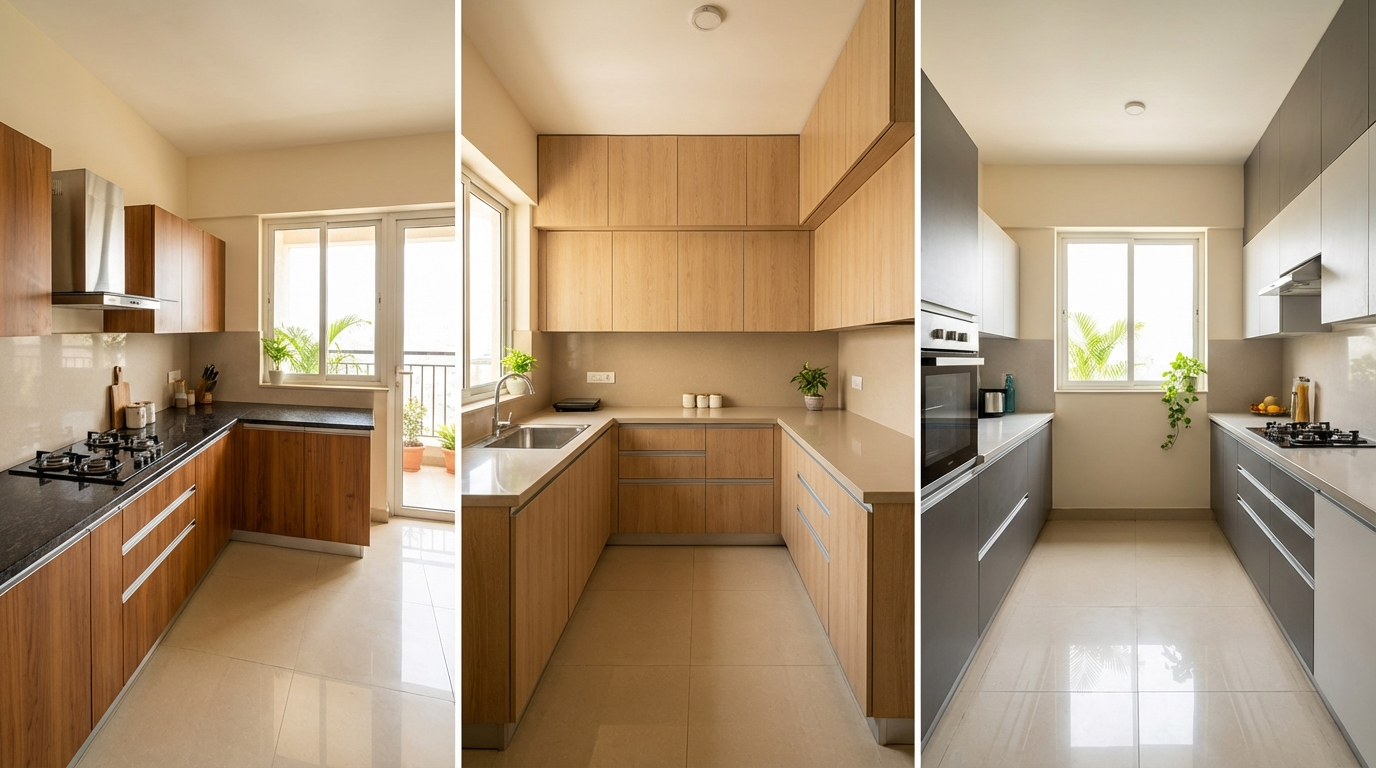
The U-Shaped kitchen is the most versatile layout for kitchens large and small because the layout offers continuous countertops and ample storage throughout the space. As the name suggests, this kitchen design and configuration is comprised of a three-walled "U" shaped design (sometimes also referred to as a "C-shaped" kitchen) with cabinetry and countertops spanning around three sides and an open end for access. It is known to be the most functional and efficient design due to its ideal work triangle layout that provides uninterrupted efficiency and safety when the user is preparing meals.
But honestly? The "work triangle" concept is somewhat outdated. Your work triangle still functions well but out of the stove, refrigerator and sink, two will be on one side instead of one on each wall. This is not as critical in today's kitchen design that is often based on work zones. Modern kitchen planning focuses on work zones—prep zone, cooking zone, cleaning zone—rather than the rigid triangle.
Kitchen Layout Types: Breaking Down What Actually Works
L-Shaped Kitchen
L shaped setups hit that sweet spot between space and cost, making them ideal for most Indian households. This is the layout I recommend to maybe 6 out of 10 clients. Why? It uses corner space efficiently, leaves room for a small dining table or additional workspace, and doesn't break the bank.
L-Shaped layouts work best in medium sized kitchens. Two rows of cabinets meet at the corner with ample space for storage and appliances. This design suits open floor plans as the sides of the L can sit against the walls, opening out onto the living and dining area.
A room with a run of at least 96 inches (8ft / 2.44m) for one side of the L and 36 inches (3ft / 92cm) on the other side will allow each tail of the L to accommodate an element of the kitchen triangle in a standard size. So roughly 8 feet by 3 feet minimum. Smaller than that, and you're forcing it.
Estimated cost range: ₹1.8-3.5 lakh depending on materials and finishes.
U-Shaped Kitchen
U-Shape Kitchens should be sized with an estimated area of around 107 ft² | 10 m². Common widths of U-Shape Kitchen layouts range from 9'-12' | 2.7-3.7 m with depths that vary as necessary.
Generally, U-shaped kitchens provide lots of storage and work surface. They're also very safe since they have only one entrance and no through traffic. This last point, however, also means that within small U-shaped layouts, there may be space for only one cook at a time. It's also worth noting that U-shaped layouts are typically more expensive than others, such as galley or L-shaped designs, because they require more cabinetry and countertop material for the additional run of cabinets.
A minimum central width of 5' (1.53 m) must be provided for use, but it is recommended that this zone be enlarged to between 6'-8' (1.8-2.4 m) to provide sufficient access and movement space for multiple people.
There was this project in Andheri—must have been 2022—where the client insisted on a U-shaped kitchen in an 80 sq ft space. I told them it wouldn't work, they'd feel boxed in. They went ahead anyway with another vendor. Called me eight months later asking if it could be modified to L-shaped. It couldn't. Had to rip out one entire wall of cabinets.
Parallel/Galley Kitchen
Galley kitchens consist of two parallel counters with a corridor running down the middle. Appliances are generally split up between the two sides, creating an effective work triangle between the fridge, stovetop, and sink.
A galley kitchen consists of two parallel sides with a narrow, hallway-like passage in between. The ideal distance between the two walls is four to six feet, which helps to maximize efficiency and workflow. A galley kitchen layout works best for small kitchens—less than 90 square feet. Four to 6 feet between parallel sides maximize efficiency and workflow.
Unpopular opinion: parallel kitchens are underrated in India. Everyone wants L or U shapes, but for narrow Mumbai flats or those corridor-style Chennai apartment kitchens? Parallel layout is genius. Both walls working, everything within reach. A parallel modular kitchen, often known as a galley kitchen, has two long counters that face each other. This setup keeps everything close to hand, which is the reason why many people choose it for small apartments.
Cost range: ₹1.3-2.8 lakh—one of the more affordable layouts.
Straight/Single-Wall Kitchen
A single row or one-wall kitchen is considered the most suitable layout for a small kitchen. Studio apartments, tiny 1BHKs, or when your kitchen is basically a galley that opens to the living room—this is your layout.
A straight kitchen keeps everything along one wall, so it stays simple, clean and easy to plan. It's perfect for small apartments where you want function without eating up too much space. Since it uses fewer units, the cost usually stays on the lower side, making it one of the most budget-friendly layouts.
Budget estimate: ₹1.2-2.5 lakh for a decent setup.
Island Kitchen
Modern, stylish, and suitable for spacious homes. Cost range: ₹3.5 lakh – ₹6 lakh+
Here's what I tell my clients: don't even think about island kitchens unless you have 150+ sq ft kitchen space. I keep seeing this nonsense online where people try to squeeze islands into 100 sq ft kitchens. What happens? No walking space. The island becomes a dumping ground for random stuff. And Indian cooking with its splatter and smoke? An open island in the middle of your living room? Good luck with that.
Layout Comparison: Which One Fits Your Situation?
| Layout | Min. Space Needed | Best For | Storage Capacity | Cost Range (2026) | Multiple Cooks? | My Take |
|---|---|---|---|---|---|---|
| Straight/Single-Wall | 40-60 sq ft | Studio, tiny kitchens | Limited | ₹1.2-2.5 lakh | No | Honest minimum |
| L-Shaped | 60-100 sq ft | Most Indian apartments | Good | ₹1.8-3.5 lakh | Yes, comfortably | Sweet spot for most |
| Parallel/Galley | 50-90 sq ft (narrow) | Corridor kitchens | Very good | ₹1.3-2.8 lakh | Tight, but possible | Underrated option |
| U-Shaped | 100-150 sq ft | Larger kitchens, serious cooks | Excellent | ₹2.5-4.5 lakh | Can be cramped | Only if you have space |
| Island | 150+ sq ft | Open-plan, luxury | Depends on design | ₹3.5-6+ lakh | Yes | Rarely practical in India |
Price Reality Check: What Modular Kitchens Actually Cost in 2026
Most homeowners spend ₹2–4 lakh for a standard modular kitchen. Smaller kitchens with basic materials sit at the lower end, while mid-range finishes and better hardware push the cost upward.
The usual range is ₹1,200–4,000 per sq ft. The lower side covers simple laminates and basic modules, while the higher side includes premium finishes, accessories and branded hardware.
Here's what actually affects your final bill:
Carcass material: The HDHMR modular kitchen cost ranges between ₹1,100 and ₹1,800 per square foot, while BWP plywood goes higher. PVC is the least expensive modular kitchen option, priced between ₹800 and ₹1,500 per square foot. It is also very moisture-resistant and requires low maintenance.
Shutter finish: Acrylic shutters for your cabinets can cost you more than laminate. Laminate is budget-friendly, acrylic adds ₹200-400 per sq ft, and PU paint finish adds even more.
Hardware: The prices of hardware fittings used in modular kitchens can vary widely with the type, material, brand and design. Soft-close hinges, tandem drawers, corner organizers—these add up fast. Indian brand hardware (Ebco, Hettich India line) costs less than imported Blum or Häfele.
Countertop: Quartz countertops also increase the modular kitchen cost compared to granite. Granite starts around ₹100-200 per sq ft, quartz ₹300-600 per sq ft.
Appliances: Hob prices start from ₹5,000 (basic two-burner hobs) and can go up to ₹80,000 (luxurious 4-5 burner hobs). The kitchen sink price typically ranges from ₹3,000 (basic stainless steel sink) to ₹1,00,000 (handcrafted stone sinks). Chimney prices generally start from ₹12,000 (basic chimney) and can go beyond ₹1,00,000 also (high-end concealed types).
How do I estimate my kitchen cost realistically?
Measure your kitchen area. Calculate running feet of base cabinets + wall cabinets you need. Multiply by per-square-foot rate based on material choice. Add 15-20% for hardware, accessories, countertop. Add appliance budget separately. Add 10% contingency. That's your realistic number.
Materials That Actually Survive Indian Kitchens
This matters more than most people think. I've seen gorgeous ₹4 lakh kitchens fall apart in 3 years because of wrong material choices. And I've seen ₹1.8 lakh kitchens last a decade with proper materials.
Is plywood or HDHMR better for kitchen cabinets?
It depends on where in the kitchen and your budget constraints.
Plywood is a traditional material made by pressing thin veneers of wood together, available in various grades like MR, BWP, and BWR, offering moisture resistance and waterproofing. HDHMR (High-Density High Moisture Resistant) board is a newer material made by combining wood fibers with resin, known for high strength, water resistance, and durability. Plywood has different moisture-resistant grades, with BWR and Marine Plywood being suitable for high water areas like kitchens and bathrooms.
Plywood will be stronger and last longer, whereas HDHMR will be more moisture-resistant and cost less. Use plywood when it has to be heavy, and HDHMR where there is a tendency to be moist.
Both materials support laminates and paints, but HDHMR has a smoother surface compared to plywood, allowing for seamless finishes. HDHMR boards might be the preferred option for modern, sleek kitchens.
My recommendation: Use BWP/BWR plywood for base units near sink, HDHMR for wall cabinets and shutters. Hybrid approach. Best of both worlds.
What about MDF?
HDF's superior strength and moisture resistance make it ideal for high-traffic kitchens, especially near sinks and dishwashers. While MDF is cheaper and easier to work with, its vulnerability to moisture makes it less suitable for long-term kitchen durability.
Standard MDF is not moisture-resistant. Must be avoided in wet zones. I've been saying this for years. Regular MDF near a kitchen sink? That's a recipe for swelling, warping, and replacement within 2-3 monsoons. Don't let anyone tell you otherwise.
| Material | Moisture Resistance | Screw Holding | Best Use in Kitchen | Price Tier | Termite Resistance |
|---|---|---|---|---|---|
| BWP/Marine Plywood | Excellent | Excellent | Base cabinets, sink area | Higher | Needs treatment |
| HDHMR | Very Good | Good | Wall cabinets, shutters | Mid-range | Inherent |
| MDF (Regular) | Poor | Moderate | Avoid near water | Budget | Inherent |
| WPC | Excellent | Poor | Termite-prone homes | Mid-range | Excellent |
| Stainless Steel | Perfect | N/A | Commercial-grade needs | Premium | N/A |
For more on cabinet materials, our HDHMR vs plywood comparison guide covers this in much more detail.
How to Choose Your Layout: Decision Framework
Step 1: Measure your actual kitchen space. Not approximate. Not "around 8x10 feet." Actual measurements. Wall to wall. Note window positions, door openings, electrical points, water inlet/outlet locations.
Step 2: Identify your cooking style. Do you cook elaborate meals daily? Just chai and basic breakfast? Multiple people cooking simultaneously? This affects counter space requirements.
Step 3: Calculate storage needs. Count your existing kitchen items. Vessels, appliances, groceries. Be realistic—most people underestimate by 30%.
Step 4: Match space to layout.
| Your Situation | Recommended Layout | Why |
|---|---|---|
| Kitchen under 50 sq ft | Straight/Single-wall | Only realistic option, maximize vertical storage |
| Narrow corridor kitchen (5-6 ft wide) | Parallel/Galley | Uses both walls efficiently, great workflow |
| Square/rectangular 60-100 sq ft | L-Shaped | Best balance of counter space, storage, and cost |
| Large kitchen 100+ sq ft | U-Shaped | Maximum storage, wrap-around counter, efficient |
| Open-plan living, 150+ sq ft kitchen zone | L-Shaped + Island OR U-Shaped | Consider island only if heavy entertaining |
| Budget is tight | Straight or Parallel | Fewer cabinets = lower cost |
| Lots of storage needed | U-Shaped or L-Shaped with tall units | Maximize every wall |
Step 5: Get 3-4 quotes. Not one. Not two. At least three or four. Compare line by line—material specifications, hardware brands, warranty terms. Don't just compare bottom-line numbers.
Red flags to walk away from:
- Vendor refuses to specify exact materials and hardware brands in writing
- Significant price difference (30%+ lower than others) with same "specifications"
- No physical showroom or factory visit possible
- Warranty terms that exclude "moisture damage"—that's a loophole waiting to bite you
- Pressure to decide immediately without allowing comparison
Common Mistakes People Make With Modular Kitchens
1. Ignoring the golden triangle—actually, work zones. Your sink, stove, and fridge should form an efficient work pattern. I've seen kitchens where the fridge is behind a door that swings open toward the cooking area. Every single time someone opens the fridge, the cook gets pushed. Frustrating to watch.
2. Underestimating storage. People design kitchens for current needs. Then they buy a mixer-grinder, an air fryer, a food processor. Suddenly there's no place for anything. Add 20-30% more storage than you think you need.
3. Choosing wrong materials for the sink area. This one really frustrates me. The base cabinet around your sink takes constant moisture exposure. Water splashes, wet hands opening doors, leaky pipes. This is NOT the place for MR plywood or regular MDF. Use BWP grade or marine plywood here. Period.
There was this builder in Powai—must have been 2021—who used commercial MR grade ply for all base cabinets including under the sink. The kitchen looked gorgeous for exactly eleven months. By the first anniversary of moving in, the cabinet bottoms were warped beyond repair. ₹1.2 lakh repair job to replace just the damaged sections.
4. Ignoring ventilation. Chimney placement matters. If your chimney is too high above the hob, it won't capture smoke effectively. Too low, and you'll hit your head. Standard recommendation: 24-30 inches above gas hob, 18-24 inches above induction.
5. Not planning for electrical points. Before finalizing layout, mark where you need power outlets. Above counter for small appliances (at least 4-5 points). Behind tall unit for microwave/OTG. Under cabinet for LED strips. Behind fridge. Near chimney. Miss these during planning, and your beautiful modular kitchen has extension cords running everywhere.
6. Forgetting about plumbing access. Your sink cabinet should have removable back panel or enough space to access pipes for maintenance. Many modular designs box everything in. When there's a leak? Nightmare to fix.
7. Obsessing over looks, ignoring functionality. Yes, that handleless acrylic finish looks stunning in the showroom. But will you enjoy pushing every cabinet to open it for the next 15 years? Sometimes a good handle is better than a push-to-open mechanism.
8. Choosing corner units without proper hardware. Corner cabinets are dead space unless you install proper corner carousel or magic corner units. These cost extra but make corners actually usable.
9. Not accounting for Indian cooking. Open shelving looks great in Scandinavian kitchens. In Mumbai kitchens with daily tadka? Those open shelves collect oil film within weeks. Think about this before following Western design trends.
10. Skipping edge banding on plywood. Even BWP plywood needs proper edge banding to prevent moisture ingress. I've seen carpenters skip this step because "it's already waterproof." Wrong. Exposed edges absorb moisture first. Insist on proper ABS or PVC edge banding on every cut edge.
Quality Checks You Can Do Before Paying
Visual inspection:
- Check if shutters align properly when closed—no gaps, no overlapping
- Open every drawer and cabinet. Do they move smoothly? Any sticking?
- Look at internal surfaces. Unfinished? Rough? That's corner-cutting.
- Check edge banding. Running your finger along edges, you shouldn't feel sharp transitions or peeling
- Examine countertop joints. Granite/quartz joint lines should be minimal and sealed properly
- Look under the sink cabinet. Is it properly sealed against moisture?
Questions to ask your vendor:
- "What exact plywood brand and grade are you using for carcass? Show me the label."
- "Which hardware brand for hinges and channels? Hettich? Ebco? Generic?"
- "What's the warranty on materials vs. hardware vs. workmanship separately?"
- "Who handles service calls after installation? What's the response time commitment?"
- "Can I visit your factory/workshop before finalizing?"
Simple tests:
- Tap test: Knock on cabinet sides. Hollow sounds suggest thin, cheap boards
- Weight check: Lift a drawer if possible. Too light usually means thin/cheap materials
- Edge inspection: Peel test on edge banding—it shouldn't come off easily
- Close-open test: Soft-close hinges should close smoothly without slamming for the full range of motion
Here's a trick most dealers don't like: Ask to see the boards being used BEFORE cutting. Take photos of brand labels, specifications. This creates documentation if there's a dispute later.
Workmanship and Installation: What to Tell Your Team
Before they start:
- All electrical and plumbing work must be complete before modular kitchen installation begins
- Wall surfaces should be dry and finished (no fresh plastering)
- Flooring should be done before kitchen installation—laying tiles after is messy and risks damage
Cutting requirements: All cuts should be factory-finished when possible. On-site cutting increases dust, reduces precision, and can compromise edge sealing.
Edge sealing: Plywood and HDHMR should be sealed at the edges to prevent moisture from damaging them. Every exposed edge—top, bottom, sides—needs proper banding. This isn't optional.
Fastener guidance: For HDHMR, use 35mm screws for hinges, 25mm for back panels. For plywood base cabinets carrying heavy loads, longer 40-45mm screws with proper wall plugs. High-density fibre bonding ensures screw holding capacity of up to 10 times more than plywood claims some manufacturers—reality is less dramatic, but HDHMR does hold screws well if you don't over-tighten.
What to tell your carpenter/installation team:
- Seal every cut edge before assembly—no exposed ends
- Leave 10mm gap from wall behind cabinets for air circulation
- Countertop joint near sink must have silicone sealant, not just butting together
- Check cabinet level with spirit level before fixing to wall—adjustments later are harder
- All drawers must glide freely when empty AND when loaded
- Chimney duct routing should be planned before mounting wall cabinets
I've seen carpenters skip the wall-gap step and then wonder why back panels develop moisture stains. The gap allows air movement, preventing trapped moisture from damaging cabinet backs—especially crucial in humid cities.
How Long Does a Modular Kitchen Actually Last?
Honest answer? It depends entirely on materials, installation quality, and how you maintain it.
Well-maintained kitchen with quality materials: 15-20 years easily. Maybe longer.
Budget materials with decent maintenance: 8-12 years before significant issues.
Wrong materials in wrong places: 3-5 years before you're looking at replacements.
Stainless steel kitchens have a lifespan of 25 years and very minimal maintenance. At first, the stainless steel modular kitchen costs more, but the product is superior in terms of durability, cleanliness, and resistance to moisture, heat, and pests.
What affects longevity:
- Climate: Coastal cities with high humidity stress materials more
- Usage: Daily cooking with oil/steam vs. occasional light cooking
- Maintenance: Regular cleaning, not letting water puddle, fixing leaks immediately
- Ventilation: Good chimney and airflow vs. enclosed kitchen with poor ventilation
Signs of wear to watch for:
- Shutter laminate peeling at edges (usually starts near stove/sink)
- Soft-close mechanism failing—doors banging shut
- Drawer channels becoming stiff or wobbly
- Visible swelling or warping of cabinet bases (moisture damage)
- Hinges loosening from repeated use
When you see base cabinet swelling or significant hinge loosening despite tightening, it's usually time to consider replacement of affected units.
Alternatives Worth Considering
If budget is really tight: Consider semi-modular approach. Factory-made shutters with on-site built carcass. Saves 20-30% typically. You lose some precision and warranty coverage, but it's a legitimate middle ground.
If you need maximum moisture resistance: WPC blends wood fibers/flour with plastics. Pros: Excellent water resistance, practically termite-proof (a huge advantage in termite-prone regions like modular kitchen materials India often requires), and becoming popular for its resilience. However, Cons: Very low screw-holding capacity in standard variants (channels and accessories can loosen over time), difficult to paint, applying laminates/acrylics can be costly.
If you want ultimate durability and budget permits: Stainless steel kitchens. Yes, they look industrial. But they're genuinely indestructible for practical purposes. Combine stainless steel base units with wood-finish wall cabinets for the best of both worlds.
For wardrobe and bedroom furniture with similar considerations, our wardrobe material guide covers what works best for storage units.
Frequently Asked Questions
What's the minimum kitchen size for modular design?
You can do modular in spaces as small as 40-50 sq ft with a straight/single-wall layout. Below that, you're really looking at a kitchenette rather than a kitchen. The modular approach actually helps maximize small spaces better than traditional carpentry because of standardized, optimized module dimensions.
Is it true that modular kitchens don't last as long as traditional carpentry kitchens?
Common belief: Modular kitchens are "temporary" compared to masonry or heavy carpentry. Reality: A well-made modular kitchen with BWP plywood and quality hardware lasts just as long—often longer—because of factory precision and proper moisture-resistant materials. Traditional on-site carpentry is only as good as your carpenter, and many use inferior materials without the homeowner knowing.
What if I live in a coastal city like Chennai or Mumbai?
Coastal humidity means you absolutely cannot compromise on moisture resistance. Use BWP/marine grade plywood for all carcass work, HDHMR for shutters, ensure proper edge banding everywhere, and consider stainless steel base units near the sink. Regular MDF is completely out of the question. HDHMR is made by compressing fibre chips under high pressure, giving it strength and moisture resistance far superior to standard MDF. This material is ideal for humid climates like India, where regular boards often swell or get damaged over time.
Is it true that branded modular kitchens are always better than local fabricators?
Not necessarily. Branded companies offer consistency, warranty backing, and professional installation. But good local fabricators using the same quality materials can deliver comparable results at lower costs. The catch: you need to know what to look for and supervise more closely. With branded companies, you're paying for reduced risk and hassle, not necessarily superior product.
Can I install a modular kitchen myself?
Theoretically possible for pre-assembled units from certain brands. Practically? I'd advise against it unless you have significant DIY experience. Leveling, wall mounting, countertop fitting, plumbing connections—these require skill. One mistake with a ₹15,000 countertop is an expensive learning experience.
How long does modular kitchen installation take?
Factory production: 2-4 weeks after design finalization. On-site installation: 3-7 days for a typical L or U-shaped kitchen, assuming all civil, electrical, and plumbing work is already complete. Add countertop fabrication time (3-5 days for granite/quartz) if not concurrent.
Is it true that soft-close hinges are just a luxury?
I've been saying this for years: soft-close is not a luxury, it's a necessity. Regular hinges mean cabinet doors slamming dozens of times a day. Over years, this loosens screws, damages edges, and wears out the hinges faster. The ₹3,000-5,000 extra for soft-close across your kitchen is money well spent.
What if my kitchen layout changes later—can I modify a modular kitchen?
Yes and no. You can add new modules, replace damaged units, or reconfigure somewhat. But major layout changes (L to U-shape, moving plumbing) essentially mean replacing large portions. This is where modular actually helps—you can swap specific units rather than demolishing everything. Still, get your layout right the first time if possible.
Is it true that acrylic finish kitchens are high-maintenance?
Partly true. Acrylic shows fingerprints more than matte laminate. It scratches if you're rough with it. But cleaning is actually easy—just wipe with a damp cloth. The maintenance question is really about your lifestyle. Households with young kids or heavy cooking might prefer matte laminate. But acrylic isn't the "nightmare to maintain" some make it out to be.
What's the real difference between ₹1,500 and ₹3,000 per sq ft quotes?
Usually: material grade (commercial plywood vs. BWP), hardware brand (generic vs. Hettich/Blum), shutter finish quality, and warranty scope. Sometimes it's legitimate efficiency—a bigger company with factory setup has lower per-unit costs. Sometimes it's corner-cutting you'll only discover later. Get detailed material specifications in writing before comparing bottom lines.
Should I go for handle-less push-to-open cabinets?
They look sleek. But the mechanisms add cost (₹300-500 per door typically) and have more failure points than simple handles. Also, your fingers touch the shutter surface every time—more fingerprints, especially on glossy finishes. My honest opinion: handles are fine. Good design makes handles a feature, not an eyesore.
Can I mix materials in my kitchen—like plywood carcass with HDHMR shutters?
Absolutely, and I often recommend this. Choose HDHMR when you need MDF-like finish with added moisture resistance and strength. The smartest modular furniture projects use all three materials in the right proportion. Use the strongest, most water-resistant materials where stress is highest (base units, sink area), and more economical options where less critical.
Right, that's the gist of modular kitchen planning. Your contractor or interior designer might have different opinions—worth hearing them out, especially on local factors I can't predict from Mumbai. But go in informed, ask the right questions, and don't let anyone rush you into decisions on something you'll use twice a day for the next decade.
Good luck with the project. And seriously—don't skip the edge banding.
Disclaimer: This content is provided for general informational purposes based on industry practices and publicly available information. Product specifications, standards, prices, and availability may vary by manufacturer, region, and time. Readers should independently verify details with manufacturers, dealers, or qualified professionals before making purchase or construction decisions.Want Plywood Suggestions?
Share a few details and a Sainik 710 specialist will suggest suitable brands and connect you to responsive dealers.