Modern Wardrobe Design: 50+ Sliding, Walk-in & Built-in Ideas with Storage Solutions
Get 50+ modern wardrobe designs—sliding, walk-in, built-in styles. Storage solutions, material guide & best plywood for durable bedroom wardrobes.
Modern Wardrobe Design: The Quick Answer
A modern wardrobe is a custom-built or modular storage unit designed to maximize bedroom space while providing organized storage for clothes, accessories, and personal items—sliding, walk-in, and built-in styles are the three dominant types in Indian homes today.
Short version: Wardrobe design in 2026 has stopped chasing Instagram-worthy looks and started solving real life. People want calm, clever storage that just works for how they actually dress, live, and move through the day. Your choice depends on three things: available space, budget, and whether you want full visibility or a sleek minimal look. For most Indian bedrooms under 150 sq ft, sliding wardrobes make the most sense. Walk-ins need at least 40-50 sq ft dedicated space. Built-ins work everywhere but cost more.
This is right for you if:
- You're building a new home or renovating your master bedroom
- You're tired of wardrobes planned once and lived with for years that leave you with too many shelves that never get used and drawers that are always awkward
- Your existing almirah is bulky, doesn't fit your current wardrobe, or has moisture damage from the last monsoon
- You want to understand the difference between MR, BWR, and BWP grade plywood before the contractor arrives
Skip this if:
- You're renting and just need a portable storage solution
- Your bedroom is under 80 sq ft—you're better off with a standalone armoire
Bottom line: Most wardrobe regrets come from planning based on ideals instead of routines. Before locking in a wardrobe design, pay attention to how you actually use your clothes—what gets worn weekly should be easiest to reach.
What Modern Wardrobe Design Actually Means
A modern wardrobe is a built-in or modular storage system that integrates with your bedroom architecture, featuring organized compartments for hanging, folding, and storing clothes along with specialized sections for accessories, shoes, and seasonal items. The latest wardrobe design is quieter now—less decorative, more aware of how people actually live inside their bedrooms.
Most people think wardrobes are just about doors and handles. Actually, the internal layout matters far more than the external finish. I've seen families spend lakhs on gorgeous laminate finishes only to realize six months later that they have twelve shelves but nowhere to hang long dresses. That's a planning failure, not a design one.
Fixed interiors are slowly disappearing. The latest wardrobe design favors adjustable shelves and flexible compartments, because people's storage needs change. A wardrobe that cannot adapt usually becomes inconvenient long before it wears out.
Here's what separates modern wardrobes from the old steel almirahs our parents used:
- Customizable internal sections—pull-outs, sliding baskets, dedicated shoe racks
- Soft-close mechanisms on doors and drawers (your spouse will thank you at 6 AM)
- Lighting inside wardrobes has become standard—soft LED strips along shelves, motion sensors, warm lights behind glass panels that make the wardrobe feel more thoughtful
- Floor-to-ceiling heights that eliminate the dust-trap gap at the top
Why Wardrobe Design Matters More in Indian Homes
A sub-optimal core can lead to warping, hinge misalignment, or surface bubbling over time—especially in Indian conditions with fluctuating humidity. This isn't some theoretical warning. I've seen wardrobes in Navi Mumbai swell up within two years because the designer used MR grade plywood right next to a bathroom wall.
Indian homes face unique challenges that most international design guides don't address:
Monsoon humidity hits different cities differently. Indian homes must withstand humid monsoons, hot summers, and sometimes freezing winters. In Mumbai and Chennai, humidity regularly crosses 80-85% between June and September. Kolkata's Salt Lake area stays damp almost year-round. Meanwhile, Jaipur and Ahmedabad deal with the opposite problem—extreme dryness that can crack solid wood veneers.
Here's what I tell clients based on location:
| City/Region | Primary Challenge | Recommended Plywood Grade | Finish Suggestion |
|---|---|---|---|
| Mumbai, Chennai, Kolkata | High humidity (75-90% RH) | BWR or BWP | Laminate (not veneer) |
| Bengaluru, Pune | Moderate humidity | BWR is enough | Either works |
| Delhi NCR | Extreme temperature swings | BWR with edge sealing | Laminate preferred |
| Jaipur, Ahmedabad | Very dry conditions | MR can work | Veneer looks better here |
| Coastal Karnataka, Kerala | Salt air + humidity | BWP mandatory | Laminate only |
Ask for chemically treated or vacuum-pressed plywood, especially in wardrobes placed near external walls or bathrooms. The Thane-Navi Mumbai belt and Ghatkopar side of Mumbai are particularly tricky because of the creek-influenced humidity. I've been saying this for years—the wall behind your wardrobe matters as much as the wardrobe itself.
Is it worth investing in BWP plywood for a bedroom wardrobe?
Your wardrobe needs to hold weight, support hardware like hinges and handles, resist moisture especially in humid cities, and stay termite-free. For most Indian wardrobes and cupboards, BWR plywood is the ideal balance between cost, durability, and moisture resistance.
So here's my honest take: BWP is technically better, but BWR is usually enough for bedroom wardrobes that don't share walls with bathrooms. BWP grade plywood is the best for wardrobes in bathrooms or areas with high humidity levels—it's manufactured using phenolic resins, making it highly resistant to water, fungal growth, and insects. But for a dry bedroom? You're paying extra for protection you may not need. The exception is coastal cities—if you're in Kochi or Goa, just go BWP and don't think twice.
Types of Modern Wardrobes: Complete Breakdown
Wardrobes in 2026 fall into three main categories: sliding door wardrobes, walk-in closets, and built-in (hinged door) wardrobes. Each serves different space configurations, budgets, and lifestyle patterns.
Sliding Door Wardrobes
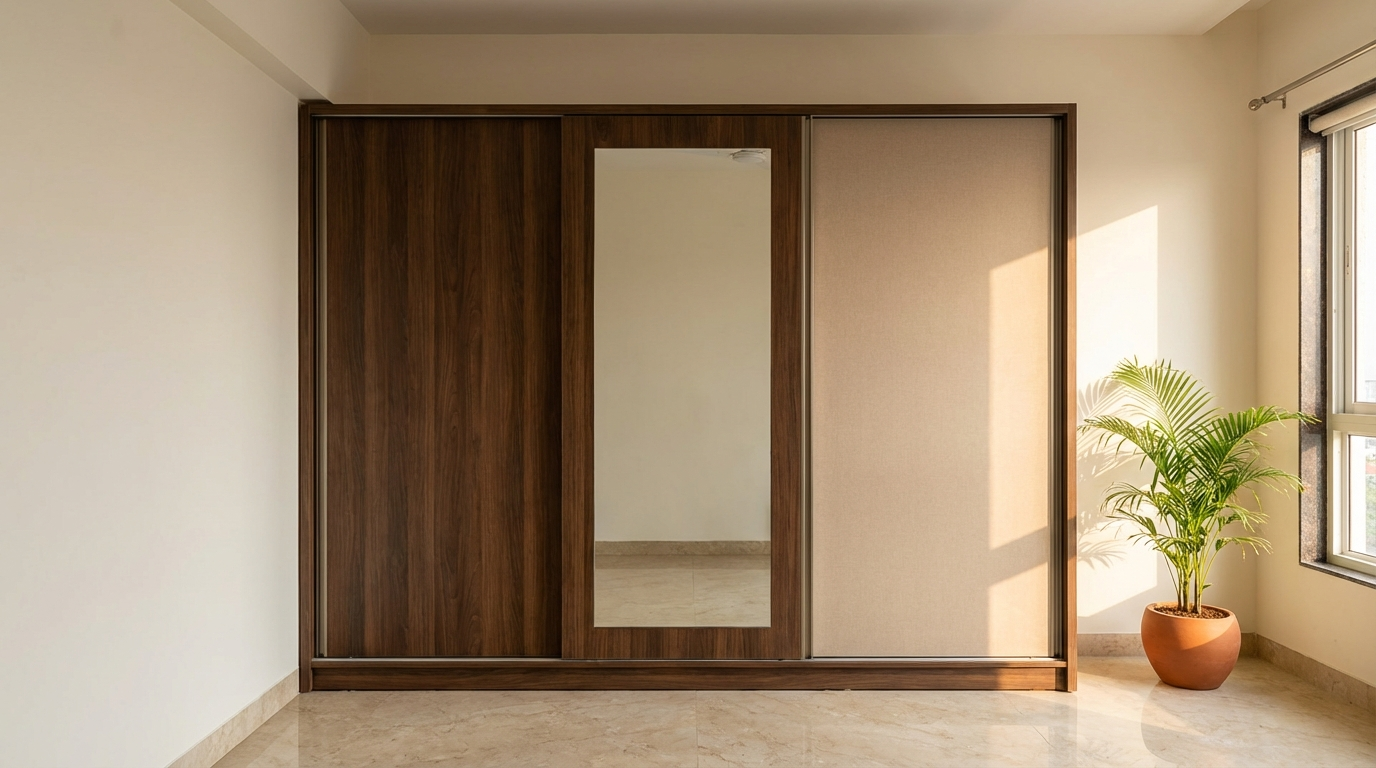
Modern sliding wardrobe design eliminates the swing radius needed by hinged doors, freeing up valuable floor space in front. They're ideal for narrow rooms or beds placed close to the wardrobe. This is the most popular choice in Mumbai, Bengaluru, and other metro cities where apartments rarely exceed 800-1000 sq ft.
This is one of the most practical space-saving trends, especially for urban apartments where every inch counts. You can choose frosted glass, mirrored panels, glossy laminates or soft matte finishes. Sliding wardrobes also allow for bigger spans, meaning fewer vertical partitions and more continuous storage inside.
My take: Sliding wardrobes work brilliantly in 90% of situations. But they have one major drawback—the main drawback of a sliding wardrobe door is that one side of the cupboard is always covered, making it impossible to open and see the cupboard in its entirety.
Walk-in Closets
A walk-in closet is basically a wardrobe large enough for you to walk into to retrieve or even wear your clothes. Luxury walk-in closets also have provision to store accessories like shoes and bags. The minimum space you need is 4 ft by 4 ft. For a proper L-shaped layout, you'll need around 5x5 feet, and for a parallel arrangement, 7x7 feet works best.
Walk-in closet designs are ideally placed between the bedroom and the bathroom. You don't need a very large area to plan it—a passageway with sufficient space for walk-in wardrobes on either side is good enough.
Honestly: Walk-ins look fantastic in magazine photos but make sense only if you have the space AND the wardrobe to fill it. There was this couple in Bandra—must have been 2022—who insisted on a walk-in despite having maybe 70 sarees and 20 suits between them. It looked empty and awkward. A well-designed sliding wardrobe would've served them better.
Built-in Wardrobes (Hinged Doors)
Hinged wardrobe doors give you a classic appeal along with full access. Hinged wardrobes are designed with doors that swing open on hinges and can be configured as single-door or double-door wardrobes. When fully opened, they offer unobstructed access to the entire interior, making it easy to manage your belongings.
Your hinged wardrobes need minimal maintenance. All you need to do is ensure that your hinges stay in top shape. If you start hearing a creaking sound, they might need oiling.
| Feature | Sliding Door | Walk-in | Built-in (Hinged) |
|---|---|---|---|
| Minimum room size needed | Any room size | 40-50 sq ft dedicated | Needs 2-3 ft clearance in front |
| Full wardrobe visibility | No—part always hidden | Yes—everything visible | Yes—when both doors open |
| Space efficiency | Excellent | Needs dedicated room | Good, but needs swing space |
| Hardware durability | Tracks need maintenance | Minimal hardware | Hinges are simple and durable |
| Cost (similar size) | Mid-range | Highest | Lower than sliding |
| Best for Indian flats? | Yes—most practical | Only luxury apartments | Traditional homes with space |
| My preference | Urban 2-3 BHKs | Master suites 200+ sq ft | Guest bedrooms |
Storage Solutions and Interior Accessories Worth Investing In
This is where most people get it wrong. They finalize beautiful doors and then tell the carpenter "andar jo bhi theek lage." Big mistake.
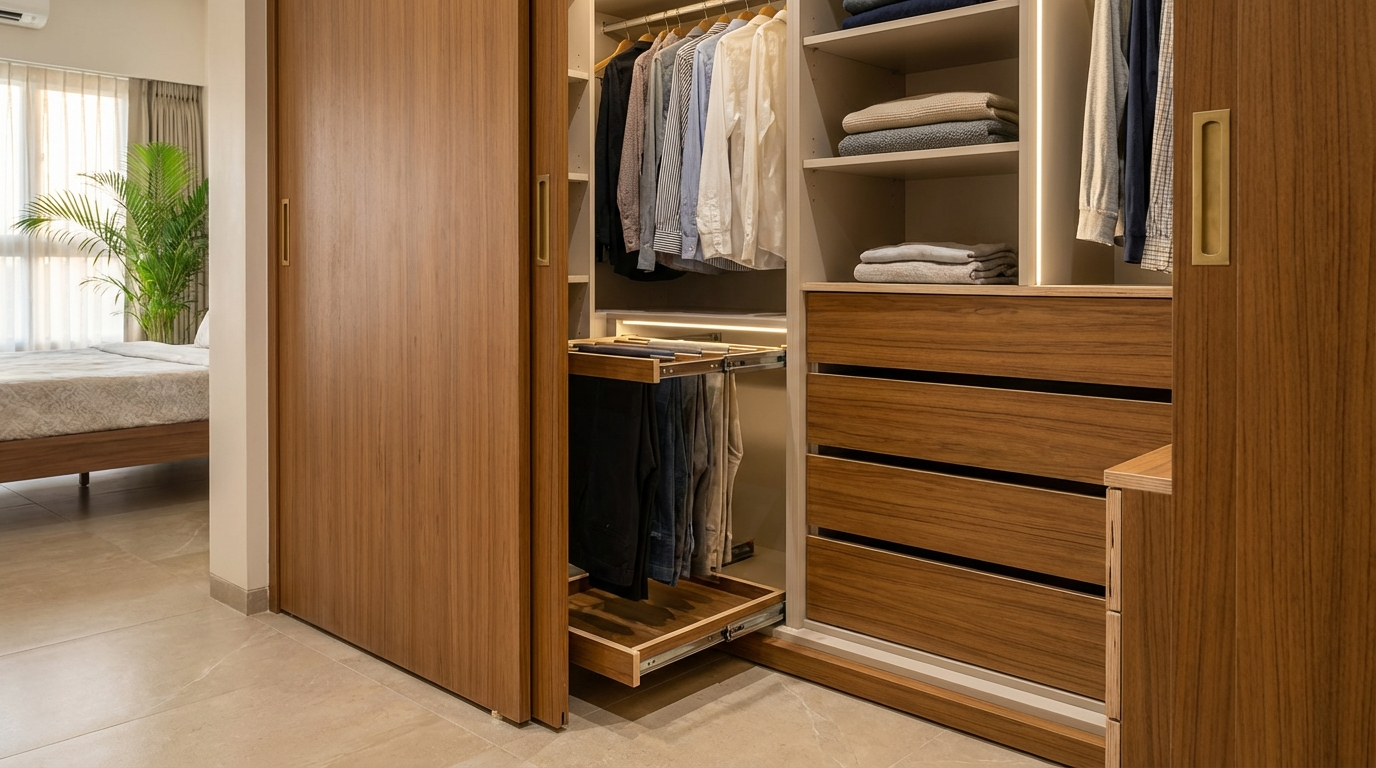
Whether you're a homeowner seeking clutter-free space or looking for reliable wardrobe fit-outs, modern organisers offer a blend of functionality, durability, and aesthetics. Space-saving solutions include pull-out trouser racks, tie and belt racks, velvet-lined accessory drawers, modular shoe trays, watch organisers, and telescopic hanging rods.
What actually works:
- Pull-out trouser racks: Worth every rupee. Keeps trousers crease-free without wasting shelf space.
- Adjustable hanging rods: One section at full height for dresses/kurtas, one at half-height for shirts and folded pants.
- Velvet-lined jewellery inserts: Only if you actually wear jewellery regularly. Otherwise it just collects dust.
- Shoe pull-outs: Designed to organize and protect footwear inside wardrobes, these wooden pull-out shoe racks feature smooth sliding bases with storage for 4-6 pairs of shoes—ideal for luxury wardrobe systems.
What's usually a waste:
- Built-in ironing boards—I've never seen one actually used after the first month
- Fold-down mirrors inside doors—they stress the hinges over time
- Too many fixed shelves—get basket drawers instead, they're more flexible
How many hanging sections do you really need?
Plan double-hanging for shirts and trousers, a full-height bay for long garments, and a steady wardrobe shelf above.
For most people: two-thirds hanging, one-third shelves/drawers. If you wear more traditional clothes (sarees, lehengas, sherwanis), flip that ratio. I had a client in Worli—probably 2020—who was a lawyer. She needed more hanging than shelving because everything was formal. Her husband worked from home and wore t-shirts. Same wardrobe, completely different internal layouts. That's what customization should mean.
Price Reality Check: What Modern Wardrobes Cost in 2026
I'm not going to give you exact prices because they vary by city, carpenter, and the brands you choose. But here's a realistic framework:
Plywood costs (per 8x4 sheet, roughly):
- MR Grade 18mm: ₹70-100 per sq ft
- BWR Grade 18mm: ₹90-130 per sq ft
- BWP Grade 18mm: ₹120-160 per sq ft
Complete wardrobe costs (material + labour + hardware + finish):
- Budget sliding wardrobe (6ft wide x 7ft tall): ₹50,000-75,000
- Mid-range with good hardware: ₹80,000-1,50,000
- Premium with soft-close everything, accessories: ₹1,50,000-3,00,000
- Walk-in closet setup: ₹2,50,000 and upwards
Here's what actually affects your final bill—
- Plywood grade: BWP costs 40-50% more than MR
- Hardware brand: Hettich or Hafele hinges cost 3-4x more than local brands, but last forever
- Finish type: High-gloss PU paint doubles finishing costs compared to laminate
- Internal accessories: Each pull-out basket adds ₹2,000-5,000
- Carpenter skill: Experienced carpenters in metros charge ₹600-900 per sq ft for labour alone
18mm calibrated boards have higher screw holding strength for soft-close shutters. Design with standard panel sizes to reduce wastage and cut costs.
Sliding vs Hinged vs Walk-in: The Decision Matrix
| Your Situation | Best Choice | Why |
|---|---|---|
| Small bedroom (100-150 sq ft) | Sliding | No swing space needed, doesn't block walkway |
| Medium bedroom (150-200 sq ft) with bed close to wardrobe | Sliding | Doors won't hit the bed |
| Medium bedroom with 3+ ft clearance | Either sliding or hinged | Personal preference—hinged gives full visibility |
| Large master suite (200+ sq ft) | Walk-in or hinged | You have space to enjoy both |
| Guest bedroom | Hinged | Simpler, cheaper, less maintenance |
| Couple with very different wardrobes | Walk-in | Separate sections, dressing space inside |
| Humid coastal area | Sliding with BWP plywood | Fewer gaps for moisture ingress |
Trade-off summary: The decision between sliding and hinged doors depends on your space, style, and preference. Hinged wardrobe doors give you a classic appeal along with full access. Sliding wardrobe doors offer sleek, space-saving functionality.
Exception to remember: Since hinged doors are supported on the vertical axis with hinges, the maximum limit for door width is 600mm. Beyond this dimension, the doors tend to strain the hinges, resulting in failure—so avoid them for longer spans or divide into multiple shutters.
How to Choose Your Wardrobe: Step-by-Step
Measure your space properly. Not just width and height—measure the clearance in front of the wardrobe wall. If it's less than 60cm after placing the bed, sliding is your only real option.
List what you actually own. Count your hanging clothes. Count your folded items. What gets worn weekly should be easiest to reach. What stays untouched for months should not dominate the space.
Choose plywood grade based on location. For most Indian wardrobes and cupboards, BWR plywood is the ideal balance between cost, durability, and moisture resistance. Use BWP only for bathroom-adjacent walls or coastal cities.
Decide on door type before anything else. This determines the internal layout possibilities.
Plan internal sections in detail. Don't leave this to the carpenter. Draw it out or use an online planner.
Budget for good hardware. The wardrobe plywood should be 12mm thick at the back and 19mm thick for the verticals. If you're planning to hang heavy objects, choosing 19mm will be the right choice.
Get edge banding done. Plywood requires edge banding or finishing. Non-negotiable—exposed edges absorb moisture and look terrible within a year.
Red flags to walk away from:
- Carpenter who can't explain the plywood grade they're using
- Quotes that don't separately list hardware costs (they might be using local substitutes)
- Anyone who says "MR is enough for bathroom-side wall"
- Pre-laminated boards sold as "BWP"—check ISI marking
Common Mistakes People Make With Wardrobes
1. Choosing finish before structure. I've lost count of how many clients show me Pinterest photos and ask "can you make this exact colour?" before they've even decided on layout. The laminate shade is the last decision, not the first.
2. Skipping the loft. Many Indian homes now incorporate lofts above their main wardrobe units. This layout provides seamless vertical storage and is ideal for storing seasonal or bulky items. If your ceiling is 9 feet or higher, you're wasting space without a loft section.
3. Too many fixed shelves. Adjustable shelves cost maybe ₹500-1000 more per section. They're worth it. Your storage needs will change—kids' rooms especially.
4. Ignoring lighting inside the wardrobe. You can never have enough light. People often underestimate the need for a window or lighting in their walk-in wardrobes—natural light makes even a small wardrobe space look pleasant and airy.
5. Wrong plywood for the location. There was this flat in Goregaon—2021 I think—where the owner saved ₹8,000 by using MR instead of BWR. By 2023 the back panel had swelled, pushing out the laminate. The repair cost ₹35,000. Not worth it.
6. Trusting the wrong thickness claims. Plywood should be of the thickness it claims to be. It's common to find low-quality manufacturers who sell plywood with under-thickness—you may find plywood sold as 12mm being just 10mm thick.
7. Skipping soft-close mechanisms. They cost ₹200-400 per hinge extra. Your family will use this wardrobe 4-5 times daily for the next 15 years. The sound of slamming doors gets old fast. Trust me.
8. Not planning for saree/suit storage. This one really frustrates me—international design inspiration almost never accounts for Indian garments. You need proper fold-out drawers or dedicated deep sections for sarees. Standard shirt hanging won't work.
9. Placing the wardrobe against an external wall. External walls stay damp during monsoons. If you have no choice, create a 2-inch gap between the wardrobe back and the wall, or use an additional moisture barrier.
Quality Checks You Can Do Yourself
Visual checks before buying plywood:
- If the plywood layers split when nailed, it means poor-quality ply not suitable for furniture or wardrobe making purposes.
- Look at the cross-section—are the veneers uniform in thickness? Gaps between layers = poor quality
- The quality plywood is usually ISI certified. Look for the CM/L number as well as the grade number on top of the ISI mark.
- Check for warping—lay the sheet flat and see if any corner lifts
- Press the surface—it should feel solid, not hollow in spots
Questions to ask your dealer:
- "Is this IS 710 certified?" (for BWP grade)
- "What's the actual measured thickness?" (bring a measuring tape)
- "Is this calibrated plywood?" (essential for modular work)
- "What's the face veneer species?"
- "Do you have the test certificate?"
Simple field tests:
- Weight test: 18mm BWR should feel noticeably heavier than MR of the same size
- Tap test: Knock on the surface—a hollow sound indicates voids
- Edge inspection: Clean, consistent layers with no gaps
- Flex test: A good sheet shouldn't bend too easily when held from one end
Here's a trick most dealers don't like— ask to see the same brand/grade from a different batch. If quality varies significantly between batches, that supplier has consistency issues. Walk away.
Workmanship and Installation: What to Tell Your Carpenter
Your carpenter briefing checklist:
- "Use only the plywood I've purchased—don't substitute without asking"
- "All exposed edges need 2mm ABS edge banding, not PVC"
- "Pre-drill for all screws—I don't want the ply splitting"
- "Leave a 10mm gap at the bottom for airflow and cleaning"
- "Use 18mm calibrated boards for soft-close shutters"
- "I want to approve internal layout on-site before you fix anything permanent"
Edge sealing—why it matters:
Plywood is moisture-resistant, especially BWR or BWP grade, accepts laminates and veneers beautifully, and resists warping and cracking. But only when edges are sealed. Exposed edges absorb humidity like a sponge. I've seen carpenters skip this step because it's fiddly work—and by the next monsoon, the laminate starts peeling from the edges.
Hardware and screw guidance:
- Use 35mm cup hinges for standard doors (25mm for overlay)
- Drawer slides: soft-close, full-extension, rated for 25-35kg
- Screws: 25mm for face fixing, 35mm for edge fixing, always pre-drill
Storage and acclimatization:
I've seen carpenters skip this and then wonder why the doors warp. If your plywood arrives during monsoon, let it sit in the room for 2-3 days before cutting. Let it adjust to the humidity of that specific space. Same with laminates—don't install straight from the godown.
How Long Does a Modern Wardrobe Actually Last?
A well-made wardrobe with BWR plywood, proper edge sealing, and good hardware should last 15-20 years without major issues. Plywood is the most balanced choice between cost, strength, and longevity—it's made by pressing thin sheets of wood together and is widely used in Indian wardrobes.
But longevity depends heavily on:
- Plywood quality: Cheap MR grade in humid areas? 5-7 years max
- Hardware quality: Local hinges fail within 3-4 years; Hettich/Hafele last 15+
- Edge treatment: Unsealed edges cut lifespan by 30-40%
- Usage pattern: Daily-use wardrobes show wear faster than guest room ones
Signs of wear to watch for:
- Doors not closing flush anymore (hinge adjustment needed)
- Laminate peeling at edges (moisture damage starting)
- Drawers sticking (humidity swelling or runner failure)
- Hollow sounds when tapping (delamination inside)
- Musty smell even after cleaning (moisture trapped in core)
When to consider replacement:
If the core is damaged (swelling, warping), no amount of refinishing helps. You can re-laminate doors that have surface damage, but structural issues mean it's time for a new unit. In my experience, well-maintained wardrobes last about 15-18 years in coastal cities and 20+ in dry regions like Jaipur or Ahmedabad.
Alternatives Worth Considering
If budget is tight, consider:
- Pre-laminated particleboard: Smooth finish perfect for painted or lacquered wardrobes. Great for modern designs with curves and minimal thickness—affordable and easily available. But it has drawbacks—not very strong and may sag with heavy loads. Absorbs moisture if not sealed properly. Best suited for guest rooms or rental properties.
- HDHMR boards: Better than particle board, more uniform. Our HDHMR vs plywood guide covers this extensively if you want the detailed comparison.
If you need better moisture resistance:
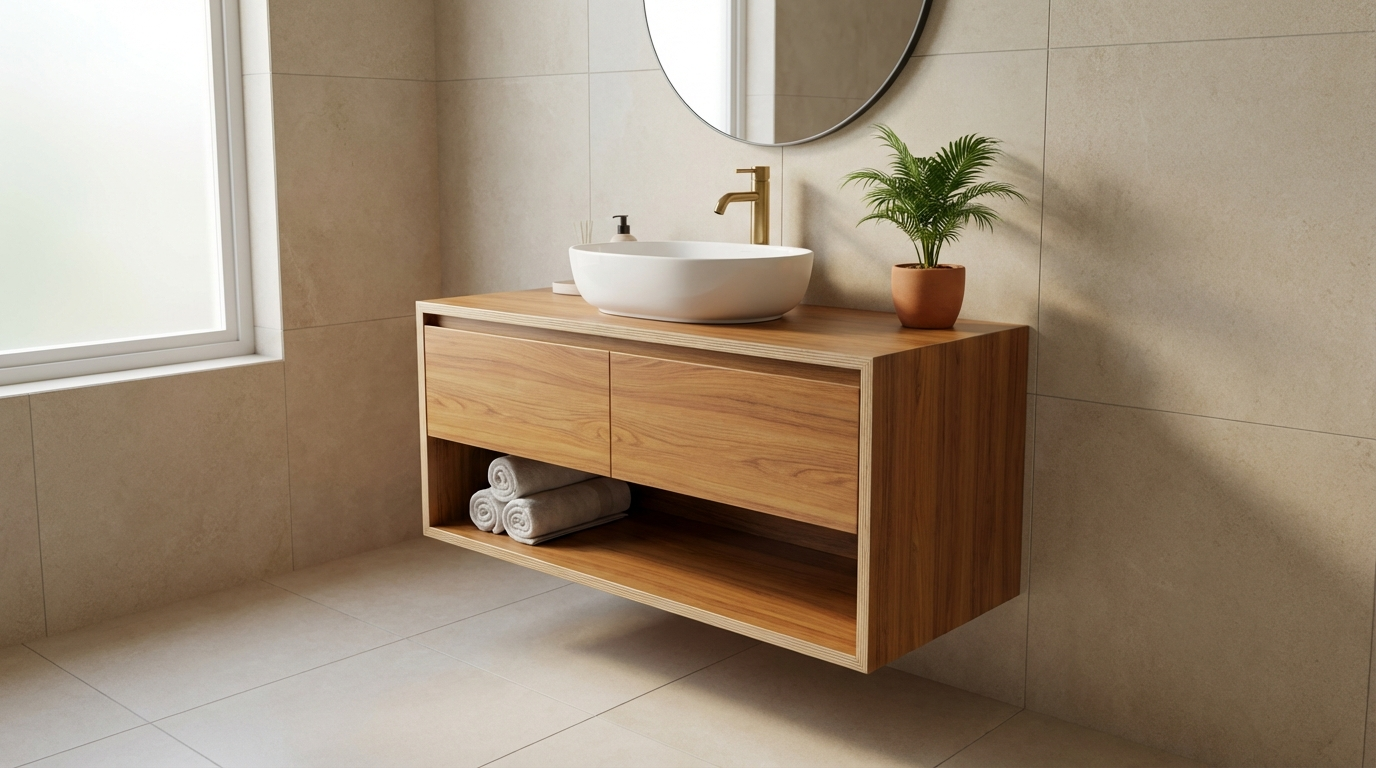
- Marine plywood: Marine grade plywood, or BWP, is the best quality plywood and is used for marine applications. It's void-free, without knotholes and cracks, to adhere to extreme weather conditions. Overkill for most bedroom wardrobes, but necessary for bathroom vanities.
If budget allows premium:
- Solid wood: Solid wood for premium designer wardrobes. BWP-grade plywood for daily-use family wardrobes. MDF for budget-friendly and custom painted wardrobes. Teak or sheesham wardrobes last generations but cost 3-4x plywood options.
Frequently Asked Questions
What is the ideal depth for a wardrobe in Indian bedrooms?
Standard depth is 22-24 inches (55-60cm). This accommodates most hanging garments without them touching the back panel. For standard dimensions, the depth of a hinged wardrobe is around 60-62cm plus handle. The sliding version will have a depth of around 65-66cm because doors slide one above the other. For very small rooms, you can go down to 20 inches, but you'll struggle with winter jackets and blazers.
Is it true that sliding doors need more maintenance than hinged ones?
For long-term durability, it's important to ensure good workmanship and opt for only good-quality hardware that is rust-proof. Do make it a point to clean the tracks and lubricate the rollers regularly; also get a carpenter to periodically readjust the sliding panels for a stable fit. So yes, sliding needs more maintenance—but we're talking 10 minutes every 6 months, not major servicing. Unlike sliding doors which require tracks and may accumulate dust and debris, hinged doors don't require such tracks. This makes maintenance easier.
Can I convert an existing hinged wardrobe to sliding doors?
Technically possible but rarely worth it. You'd need to replace the entire frame, add tracks, and the existing internal layout may not suit sliding access patterns. Usually cheaper and better to build new.
What if I live in a coastal city like Goa or Kochi—does MR plywood work at all?
No. Hard no. Salt air plus humidity is brutal on furniture. Wardrobes are susceptible to termite attacks, especially in humid climates. Opt for plywood treated with anti-termite chemicals. Marine and BWR plywood often come with inbuilt pest resistance. Go BWP minimum, get it sealed properly, and still expect to refinish every 7-8 years. The Konkan belt from Ratnagiri down to Kerala has destroyed more MR wardrobes than I can count.
Is it true that glossy finishes are going out of fashion?
Glossy surfaces that show fingerprints and scratches easily are losing popularity. The latest mica design for wardrobes favors matte textures and subtle patterns that handle everyday wear better. Matte and textured finishes are much more practical—and honestly look more expensive than high gloss these days.
How much space do I really need for a walk-in closet?
A minimum of 4 to 5 feet in depth is ideal for a compact walk-in wardrobe, ensuring easy movement and storage. Popular layouts include L-shaped, U-shaped, sliding door wardrobes, and open walk-ins that double as display units. That's for a basic single-wall walk-in. For a proper parallel arrangement with storage on both sides, you need 7 feet width minimum.
Should I add a mirror to the wardrobe door or get a separate full-length mirror?
Wardrobes with mirrored shutters combine functionality with design—they save space by eliminating the need for a separate dressing mirror while making rooms appear larger. I personally prefer mirrors on hinged doors rather than sliding—less stress on the track mechanism. Full-length mirrors work better if you have a small dressing area adjacent to the wardrobe.
What's the real difference between BWR and BWP plywood?
BWR (Boiling Water Resistant) handles humidity and occasional moisture exposure. BWR plywood, often referred to as marine plywood, provides enhanced moisture resistance. For environments with higher moisture exposure like bathrooms, BWP (Boiling Water Proof) takes durability up a notch. For bedroom wardrobes not sharing bathroom walls, BWR is sufficient. For kitchens, bathrooms, or coastal cities, insist on BWP with IS 710 certification.
How do I prevent that musty smell inside wardrobes?
First, ensure proper ventilation—don't cram clothes too tight. Second, use silica gel packets or neem sachets. Third, and this is what most people miss, make sure there's a small gap between wardrobe back and wall for air circulation. Fourth, avoid storing damp clothes even for a day. That musty smell usually means moisture has already entered the wood core—by then it's too late.
Is it true that IKEA-style modular wardrobes don't suit Indian homes?
Partially true. When compared to the regular wardrobe, a walk-in wardrobe design can burn a big hole in a tight budget because it means more material, shelving units, drawers, lighting, flooring and hardware. IKEA systems are designed for European climates and wardrobe patterns—fewer sarees, more jeans. They also assume you'll disassemble and move them. If you're permanently settling, a carpenter-built wardrobe with good plywood often works out cheaper and more customized to Indian storage needs.
Which plywood brands should I look for?
When you buy plywood manufactured by some of the leading manufacturers in India like GreenPly, CenturyPly, Superior Club Prime, Western India, Anchor Ply, Kenwood, etc., and hand it to a skilled woodworker, you can be assured of having a classy, durable wardrobe you'd be proud of. I've personally had good experiences with CenturyPly and GreenPly for the premium segment. For mid-range, local ISI-certified brands often offer better value—just verify the certification is genuine.
Can the same wardrobe design work for kids' rooms and master bedrooms?
The external design can be similar, but internal layouts should differ completely. Kids need more shelves (clothes are smaller and folded), lower hanging rods (they should be able to reach), and closed storage for toys that'll inevitably end up inside. Master bedrooms need more hanging space, accessory organizers, and potentially full-height sections for traditional wear.
—
That covers most of what you need to know. One last thing—don't let anyone rush you through the planning phase. I've seen people spend three months choosing a sofa and three hours deciding wardrobe layout. It should be the other way around. You'll use this wardrobe every single day for the next fifteen years. Take your time getting it right.
Disclaimer: This content is provided for general informational purposes based on industry practices and publicly available information. Product specifications, standards, prices, and availability may vary by manufacturer, region, and time. Readers should independently verify details with manufacturers, dealers, or qualified professionals before making purchase or construction decisions.Want Plywood Suggestions?
Share a few details and a Sainik 710 specialist will suggest suitable brands and connect you to responsive dealers.