Modern Bed Design Ideas: 75+ Wooden, Storage & King Size Designs for Indian Bedrooms (2026)
Explore 75+ bed design ideas—wooden, storage, king size & modern styles. Get material guide, size chart & plywood recommendations for durable beds.
Quick Answer (TL;DR)
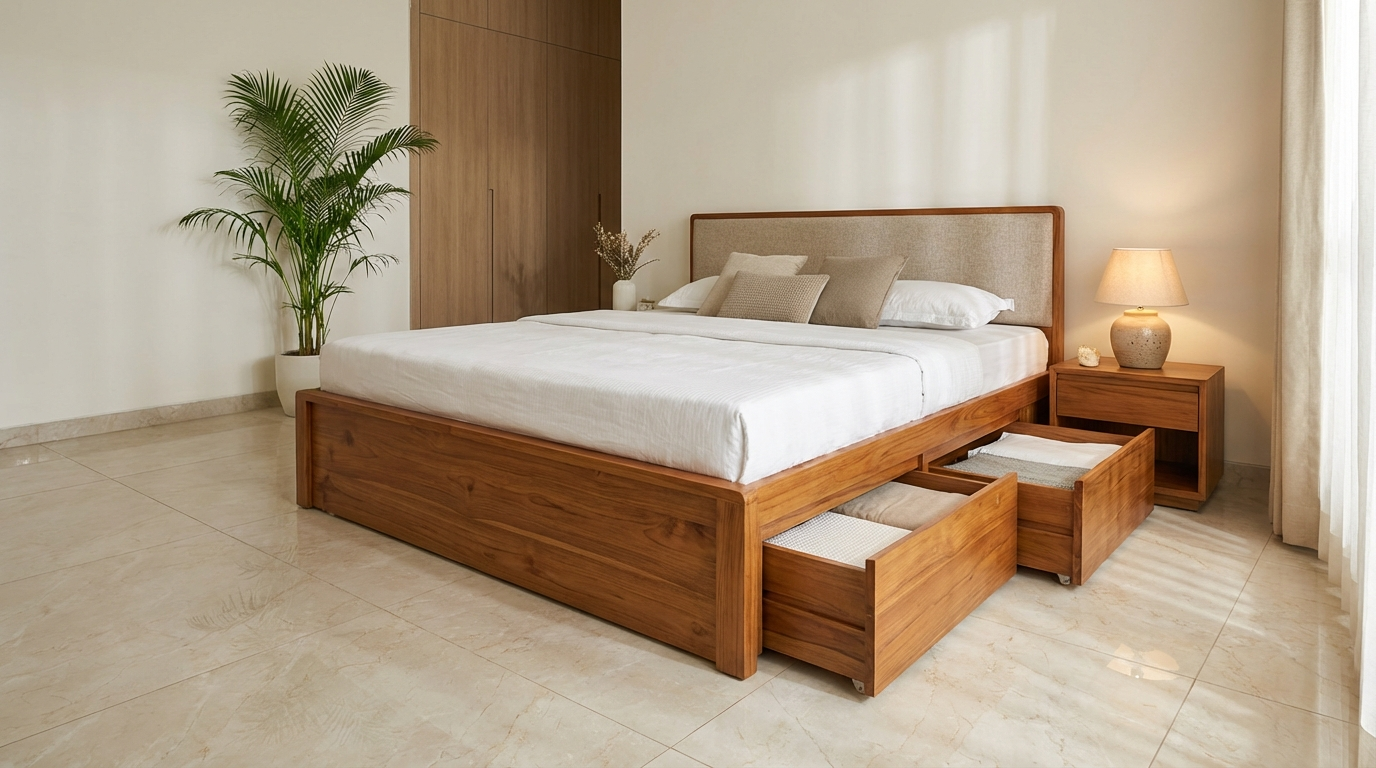
The best modern bed design for Indian bedrooms in 2026 is a platform storage bed made with 18mm BWR or BWP plywood, featuring a minimalist headboard and under-bed storage.
Bottom line: For Indian homes balancing space, style, and durability, a king-size hydraulic storage bed (6×6.5 ft or 72×78 inches) with a plush upholstered headboard offers the best combination of contemporary aesthetics, practical storage, and monsoon-resistant construction when built using calibrated BWR-grade plywood.
Choose this if:
- You want maximum under-bed storage in compact Indian bedrooms
- Your city experiences monsoon humidity above 70% RH
- You prefer low-maintenance, durable furniture lasting 15+ years
- Your master bedroom is 10×12 ft or larger
Skip this if:
- Your bedroom is under 10×10 ft (consider a queen bed instead)
- You prefer solid wood's natural patina over plywood construction
- Budget is extremely tight (basic metal frames cost less)
Key takeaway: Invest in 18mm BWR plywood for the bed frame and 12mm for headboards—this is the plywood thickness combination most Indian carpenters recommend for beds that won't sag, warp, or creak within the first decade.
What Modern Bed Design Actually Means in Plain Terms
A modern bed design refers to a bed that prioritizes clean lines, functional storage, and minimal ornamentation while using engineered materials like plywood and laminate for durability. One of the most prominent trends is the rise of minimalist bed designs, driven by the growing popularity of minimalist interior design, which emphasizes simplicity, functionality, and clean lines.
In the Indian context, modern bed design typically means:
- Platform or box-style construction with hydraulic or drawer storage
- Upholstered or laminated headboards replacing carved wooden ones
- Standardized sizes fitting Indian mattress dimensions
- Engineered wood cores (plywood, MDF, or particle board) with decorative finishes
Myth: "Modern beds are fragile because they don't use solid wood."
Reality: The cross-grain structure of plywood provides improved strength and stability compared to solid wood, making it less prone to splitting and warping, ensuring your bed stays strong for many years. In fact, well-made plywood beds often outlast solid wood beds in India's humidity-variable climate because plywood resists dimensional changes better.
Myth: "Expensive imported beds are always better quality."
Reality: Locally made beds using quality BWR plywood with proper edge sealing often perform better than imported knockdown furniture because they're designed for Indian humidity levels (70-90% during monsoons in coastal cities).
Why Modern Bed Design Matters for Indian Homes Specifically
Indian homes face unique challenges that make bed design choices critical. In India, where homes often balance compact layouts with multifunctional furniture needs, the double bed remains one of the most popular and practical choices.
Monsoon and humidity factors: In cities like Mumbai, Chennai, and Kolkata, relative humidity regularly exceeds 80% during monsoon months. This causes solid wood to swell, warp, and eventually crack. While solid wood tends to swell or shrink depending on humidity levels, plywood doesn't shrink or expand over time and maintains your bed frame's sturdiness intact for years.
Coastal vs. inland considerations:
- Mumbai, Chennai, Kochi, Visakhapatnam: BWP (marine) grade plywood essential for bed frames; salt air accelerates corrosion of metal hardware
- Delhi, Jaipur, Lucknow: MR-grade plywood acceptable; lower humidity but extreme temperature swings require stable materials
- Kolkata, Guwahati, Bhubaneswar: BWR minimum; high humidity year-round demands moisture-resistant construction
Common Indian home scenarios:
- 10×10 ft bedrooms in 2BHK apartments need queen beds with storage
- Joint family homes require durable beds handling heavier use patterns
- Rental properties benefit from knockdown designs for easy relocation
- High-rise apartments in coastal cities face salt-laden winds affecting exposed furniture
In my experience with coastal installations in Mumbai's western suburbs, beds made with MR-grade plywood showed visible edge swelling within 18-24 months, while identical designs using BWR plywood remained problem-free after 5+ years.
Bed Size Chart for Indian Bedrooms (2026 Standards)
The standard double bed size in feet in India is 4.5 feet wide and 6.25 feet long, suitable for two adults and medium-sized bedrooms. However, Indian bed sizes have evolved, and understanding the full range helps you choose correctly.
| Bed Type | Width (ft) | Length (ft) | Width (inches) | Length (inches) | Minimum Room Size | Best For |
|---|---|---|---|---|---|---|
| Single | 3 | 6–6.5 | 36 | 72–78 | 8×10 ft | Kids, guest rooms, hostel |
| Diwan/Double | 4–4.5 | 6–6.5 | 48–54 | 72–78 | 10×10 ft | Single adult, couples (tight) |
| Queen | 5–5.5 | 6–6.5 | 60–66 | 72–78 | 10×12 ft | Couples, most popular |
| King | 6 | 6.5–7 | 72 | 78–84 | 12×14 ft | Master bedroom, co-sleeping |
| Super King | 6.5 | 7 | 78 | 84 | 14×16 ft | Large master suites |
A minimum bedroom size of 10 ft × 10 ft is recommended for a double bed, while 10 ft × 12 ft provides better comfort and furniture placement. Always leave at least 2 feet clearance on three sides for comfortable movement.
What size bed fits a 10×12 ft Indian bedroom?
A queen-size bed (5×6.5 ft or 60×78 inches) is ideal for a 10×12 ft bedroom. This leaves approximately 5 feet for wardrobe placement along one wall and 2-foot clearance on both walking sides of the bed. Queen (60" or 66" wide) is India's most popular couple size, great for most couples or a parent plus small child. Avoid king-size unless you can sacrifice wardrobe depth or eliminate side tables.
Design Ideas with Material Recommendations
In Indian homes, modern wooden bed designs blend traditional craftsmanship with contemporary aesthetics—delivering the perfect mix of elegance and warmth. Here are 75+ bed design ideas categorized by style, with specific material and thickness recommendations:
Minimalist Platform Beds (10 Ideas)
- Low-rise Japanese-inspired platform: 18mm calibrated BWR plywood, matte laminate finish, 6-inch mattress height
- Floating platform with LED strip: 19mm BWP plywood with concealed metal support, acrylic diffuser lighting
- Scandinavian white oak veneer platform: 18mm MR plywood with 0.5mm veneer, tapered solid wood legs
- Industrial concrete-look platform: 18mm plywood with textured laminate, black metal hairpin legs
- Walnut veneer minimal frame: 19mm calibrated plywood, natural walnut veneer, no visible hardware
- Tatami-style floor bed: 12mm plywood base on rubber feet, suitable for firm mattress preference
- Monochromatic grey platform: 18mm plywood, slate grey matte laminate, integrated side ledges
- Split-level platform with niche: Two 18mm plywood levels creating built-in nightstand effect
- Curved-edge contemporary platform: 18mm plywood with postformed edge, rounded corners
- Slatted platform base: Alternating 18mm plywood slats (10 slats for king), allows mattress ventilation
Storage Beds (15 Ideas)
- Hydraulic lift storage bed: Hydraulic wooden beds are trending for 2026, making it easy to lift the mattress and store everything underneath; these smart designs maximize space without compromising aesthetics. Use 19mm BWP plywood for base
- Box bed with front drawers: 18mm BWR plywood, telescopic drawer channels, 4-drawer configuration
- Side-opening ottoman storage: 18mm plywood with gas-lift mechanism, fabric upholstery top
- Bookcase headboard storage bed: 12mm plywood for shelving, 18mm for frame, integrated reading lights
- Captain's bed with deep drawers: Six 400mm deep drawers, 18mm plywood throughout
- Modular storage cubes headboard: Mix of open and closed 12mm plywood cubes
- Bed with under-mattress compartments: Segmented storage with 12mm dividers, 18mm base
- Pull-out trundle with storage: 18mm plywood trundle on heavy-duty castors
- Combination drawer and lift storage: Front drawers + hydraulic center section
- Storage headboard with charging ports: 18mm plywood with routed cable management
- Blanket box integrated footboard: 450mm high storage at foot, 18mm plywood construction
- Wall-mounted floating storage bed: Concealed steel wall brackets, 19mm plywood
- Murphy-style fold-down with storage: Heavy-duty mechanism, 18mm calibrated plywood
- Storage platform with removable panels: Top-access storage, 12mm removable lids
- Daybed with triple function storage: Seating, sleeping, and storage combined
Upholstered Beds (15 Ideas)
- Channel-tufted velvet headboard: 12mm plywood backing, 50mm foam, velvet upholstery
- Wingback upholstered bed: Combining warm wood tones with plush upholstery, this design adds a touch of luxury; the padded headboard not only enhances comfort but also creates a soft, inviting feel.
- Curved bouclé headboard: Arched 12mm plywood, bouclé fabric trending in 2026
- Leather panel headboard: Leatherette over 12mm plywood, easy-clean finish
- Floor-to-ceiling upholstered panel: Full wall coverage, acoustic benefits
- Floating upholstered platform: Fully fabric-wrapped 18mm plywood frame
- Button-tufted traditional headboard: Classic Chesterfield style, 12mm plywood
- Modular padded panel headboard: Removable panels for easy cleaning
- Slipcover headboard design: Washable fabric cover over foam and plywood
- Asymmetric upholstered wing: Single-side extended design
- Bench-integrated upholstered footboard: Matching fabric, storage bench
- Quilted headboard with piping: Contrast piping detail, 40mm foam
- Suede-finish microfiber headboard: Stain-resistant, easy maintenance
- Two-tone upholstered frame: Contrasting headboard and base colors
- Art deco geometric upholstered: Angular stitching patterns, metallic accents
Wooden Bed Designs (20 Ideas)
- Sheesham solid wood with storage: A sleek, low-rise platform bed crafted from solid Sheesham wood highlights the natural wood grain while offering durability and style, perfect for small Indian bedrooms where simplicity is key.
- Teak king bed with carved headboard: Teak wood beds remain an elite choice for premium interiors; the wood's natural oils protect it from decay, ensuring your bed lasts for generations.
- Mango wood rustic finish: Hand-rubbed wax finish, visible wood grain
- Rubber wood contemporary: Budget-friendly hardwood alternative, lacquer finish
- Acacia wood live-edge headboard: Natural edge detail, oil finish
- Plywood with premium veneer: Engineered for stability, veneer for aesthetics
- Cane and wood combination: Blending natural cane panels with solid wood frames introduces an earthy, tropical vibe, airy, lightweight, and uniquely Indian in character.
- Pine wood Scandinavian: Light-toned, perfect for compact bedrooms
- Reclaimed wood industrial: Distressed finish, metal accents
- Bamboo and plywood fusion: Sustainable material combination
- Oak veneer modern: European aesthetic, 18mm plywood core
- Walnut veneer with brass inlay: Premium finish, CNC-routed patterns
- Whitewashed wooden frame: Shabby-chic aesthetic, sealed finish
- Ebony-stained plywood bed: Dark dramatic finish, 18mm BWR base
- Two-tone wood headboard: Light and dark wood combination
- Geometric wooden headboard: CNC-cut patterns, backlit option
- Spindle-back wooden headboard: Mid-century modern revival
- Carved lattice wooden bed: Traditional Indian inspired, modernized
- Wooden bed with metal accents: Mixed material contemporary
- Canopy frame wooden bed: Four-poster modern interpretation
King Size Bed Designs (15 Ideas)
- King platform with extended headboard: Wall-to-wall headboard effect, integrated nightstands
- King storage with side access: Dual hydraulic lifts, 19mm BWP throughout
- King upholstered with memory foam headboard: 75mm memory foam layer
- King four-poster contemporary: Slim metal or wood posts, minimal canopy
- King bed with bedside extensions: Built-in floating nightstands
- King panel bed with lighting: Recessed LED in headboard panel
- King bed with TV lift: Motorized TV mechanism in footboard
- King bed with built-in USB ports: Integrated charging on both sides
- Super king for co-sleeping families: 78×84 inches, maximum space
- King bed with adjustable base: Split mechanism for different sleeping positions
- King bed with hidden safe: Concealed safe compartment in storage
- King bed with pet step: Integrated step for elderly pets
- King bed with air purifier niche: Concealed filter compartment
- King bed with massage mechanism: Built-in vibration motors
- King bed with climate control: Heating/cooling coil integration
Best Plywood for Bed Construction in India
For bed frames, a thickness of at least 18 mm (3/4 inch) is recommended to provide sufficient strength and support. However, the right choice depends on your location's climate and the specific bed component.
| Plywood Grade | IS Standard | Moisture Resistance | Best For | Price Range (₹/sq ft) |
|---|---|---|---|---|
| MR (Moisture Resistant) | IS 303 | Moderate | Dry climate bedrooms | ₹35–55 |
| BWR (Boiling Water Resistant) | IS 303 | Good | Standard Indian homes | ₹55–80 |
| BWP/Marine | IS 710 | Excellent | Coastal cities, high humidity | ₹80–120 |
| Calibrated BWR | IS 303 | Good | Precision furniture, CNC work | ₹70–95 |
The thickness of plywood is a deciding factor in the strength and durability of a bed frame. Preferably, the plywood bed frame thickness should be 12mm to 18mm for the bed base (supporting structure or slats) and 18mm to 25mm for the main frame or headboard for extra strength.
Why do carpenters prefer 19mm calibrated plywood for bed frames?
Calibrated plywood offers consistent thickness across the entire sheet, typically within ±0.5mm tolerance. For platform beds, always use 18mm or thicker calibrated ply. Standard plywood can vary by 1-2mm, causing uneven surfaces, gaps between joints, and squeaking sounds over time. While calibrated plywood costs 15-20% more, it saves labor time during fitting and produces a more professional result. In my experience, the extra cost pays for itself in reduced callbacks and customer complaints about bed noises.
Decision Framework: Which Bed Design Suits Your Situation?
| Your Situation | Recommended Design | Why |
|---|---|---|
| Compact 10×10 ft bedroom | Queen hydraulic storage bed | Maximizes floor-to-ceiling storage without consuming floor space |
| Large master bedroom 14×16 ft | King platform with extended headboard | Creates statement piece without appearing lost in space |
| Mumbai/Chennai high humidity | BWP plywood box bed with drawer storage | Drawers ventilate better than hydraulic; marine grade handles humidity |
| Delhi/Jaipur dry climate | Solid wood or MR plywood | Lower moisture issues; solid wood patina develops beautifully |
| Rental property/frequent moves | Knockdown modular bed | Easy disassembly, fits through narrow staircases |
| Budget under ₹25,000 | Metal frame with plywood headboard | Durable, affordable, easy to transport |
| Co-sleeping with toddler | Super king low platform | Maximum width, low height for safety |
| Guest room (occasional use) | Sofa-cum-bed or trundle | Space-efficient when not hosting |
Common Mistakes When Choosing or Building Beds in India
Mistake #1: Ignoring Plywood Grade in Humid Cities
What goes wrong: Edge swelling, surface delamination, musty smell developing within 1-2 years.
Why it happens: Using MR-grade plywood in Mumbai or Kolkata where monsoon humidity regularly exceeds 80% RH. MR plywood's phenol-formaldehyde glue isn't designed for prolonged moisture exposure.
How to avoid: Marine plywood is made using waterproof glue and high-quality veneers, making it resistant to water damage and fungal attacks; while more expensive, it is an excellent choice for beds in humid environments. Minimum BWR grade for any coastal or high-humidity location.
Mistake #2: Using Thin Plywood for Bed Base
What goes wrong: Mattress sagging in center, plywood cracking along slats, creaking noises during movement.
Why it happens: Using 12mm plywood to save ₹500-800 on the entire bed construction.
How to avoid: The plywood thickness for a bed frame needs to offer ample support; for the slats or frame, 3/4″ (19 mm) plywood is generally recommended to ensure strength. Never go below 18mm for any load-bearing component.
Mistake #3: Skipping Edge Sealing
What goes wrong: Moisture enters through exposed plywood edges, causing internal layer separation and swelling.
Why it happens: Carpenters rushing to complete work; edge banding seen as optional cosmetic step.
How to avoid: Insist on PVC edge banding (2mm thickness minimum) or polyurethane edge sealing for all exposed edges. This adds ₹15-25 per running foot but extends bed life by 5-8 years.
Mistake #4: Wrong Mattress Size Assumption
What goes wrong: Mattress hangs over edges or leaves gaps; sheets don't fit properly.
Why it happens: "Double" vs "Diwan": many catalogs use Diwan = 48" (4 ft) wide; "Double" can also mean 48" or 54" depending on brand—always read the chart.
How to avoid: Measure your existing mattress before ordering bed; confirm inner dimensions with carpenter, not outer frame dimensions.
Mistake #5: Poor Hardware Selection for Hydraulic Beds
What goes wrong: Hydraulic mechanism fails within 2-3 years; bed won't stay open; potential safety hazard.
Why it happens: Using cheap gas-lift mechanisms rated for lighter loads than actual mattress + storage weight.
How to avoid: Calculate total weight (mattress 20-30 kg + potential storage 50-80 kg) and specify hydraulic lifts rated for 30-40% more than calculated weight. Branded mechanisms cost ₹800-1500 more but last 10+ years.
Mistake #6: Ignoring Cross-Brace Requirements
What goes wrong: Bed develops wobble over time; joints loosen; squeaking sounds.
Why it happens: Skipping center support rail or diagonal bracing to reduce material cost.
How to avoid: For queen and king beds, always include center rail (minimum 100mm wide, 18mm thick). Add corner brackets at 45° for additional rigidity.
Mistake #7: Not Planning for Mattress Ventilation
What goes wrong: Mattress develops mold on underside; unpleasant odor; reduced mattress life.
Why it happens: Solid plywood base without ventilation holes; common in hydraulic storage beds.
How to avoid: Include 50mm ventilation holes every 150mm across base plywood, or use slatted base design. For hydraulic beds, drill holes in storage compartment sides.
Workmanship and Installation Tips from the Field
Cutting Requirements
Always cut plywood with the good face up when using a hand saw, face down when using a circular saw or jigsaw. This prevents chipping on the visible surface. For CNC routing (common for decorative headboards), use 6mm plywood for intricate patterns, 12-18mm for structural panels.
Edge Sealing Methods
- PVC edge banding (2mm): Heat-applied using edge banding machine or hot iron; trimmed flush with router
- ABS edge tape: Premium option, more impact-resistant than PVC
- Polyurethane sealer: For exposed edges in hidden areas (under-storage compartments)
- Veneer edge tape: For veneer-finished beds; must match face grain
Screw and Fastener Specifications
- Frame joints: 40mm wood screws with pilot holes; 8-10 screws per joint
- Plywood to plywood: Countersunk screws with wood filler; avoid near edges (minimum 25mm from edge)
- Hardware mounting: Use T-nuts for removable hardware; cam locks for knockdown designs
- Headboard attachment: French cleats for heavy headboards; direct screws for light designs
Site Storage and Acclimatization
Store plywood sheets horizontally on flat surface for minimum 48 hours in the room where bed will be installed. This allows the material to acclimatize to ambient humidity levels, reducing post-installation warping. In monsoon months, extend this to 72-96 hours.
Carpenter Briefing Checklist
- Confirm inner mattress dimensions, not outer frame size
- Specify plywood grade and brand preference
- Clarify edge banding material and color
- Agree on hardware brand for hydraulic/drawer mechanisms
- Discuss center support rail requirement for larger beds
- Confirm ventilation hole pattern for solid bases
- Specify leg/castor requirements and floor clearance
- Agree on finish type: laminate, veneer, PU, or paint
Quality Checks (No Lab Required)
Visual Inspection Checkpoints
- Surface smoothness: Run palm across face—no raised areas, splinters, or rough patches
- Edge layer visibility: Check the edges for gaps in the layers. Tight, uniform layers indicate quality pressing
- Core visibility: Look at exposed edges for core wood type—hardwood cores appear denser than poplar
- Flatness: Ensure the plywood is flat and free from warping. Lay sheet on flat floor; no rocking
- Veneer quality: No bubbles, patches, or grain mismatches on face veneer
- Grade marking: Look for the appropriate grade markings and certifications. ISI mark, IS number, and manufacturer name
Questions to Ask Your Dealer
- "Is this IS 303 or IS 710 certified?" (confirms testing standard)
- "What's the core wood species—hardwood, poplar, or mixed?"
- "Is this calibrated or standard thickness?"
- "What's the warranty on delamination?"
- "Do you have the same batch if I need additional sheets later?"
- "What's the formaldehyde emission rating?" (E1 or E0 preferred)
Warning Signs to Avoid
- Sheets stored vertically or leaning (causes permanent warping)
- Visible moisture stains or dark patches on surface
- Musty or chemical smell beyond mild wood odor
- Price significantly below market average (indicates rejects or downgrades)
- No ISI marking or unclear grade labeling
- Delamination visible at corners or edges
Simple Field Tests
- Tap test: Knock on surface—solid, uniform sound indicates good bonding; hollow spots suggest voids
- Weight test: 18mm BWR plywood should feel noticeably heavier than MR of same size
- Flex test: For 6-12mm sheets, gentle flex should return to flat; permanent bend indicates moisture damage
- Edge test: Press fingernail into edge—should not easily indent if properly bonded
What Thickness of Plywood Works Best for Different Bed Components?
The thickness of plywood is a deciding factor in the strength and durability of a bed frame. Preferably, the plywood bed frame thickness should be 12mm to 18mm for the bed base and 18mm to 25mm for the main frame or headboard for extra strength.
| Bed Component | Minimum Thickness | Recommended Thickness | Grade | Notes |
|---|---|---|---|---|
| Mattress base (solid) | 12mm | 18mm | BWR/BWP | Include ventilation holes |
| Mattress slats | 18mm | 19mm | MR acceptable | 75-100mm width, 50mm gaps |
| Side rails/frame | 18mm | 19mm | BWR minimum | Structural, load-bearing |
| Headboard panel | 12mm | 12-18mm | MR acceptable | Non-structural; veneer/laminate finish |
| Footboard panel | 12mm | 12-18mm | MR acceptable | Match headboard thickness |
| Drawer fronts | 12mm | 18mm | MR/BWR | Thicker for hardware stability |
| Drawer boxes | 12mm | 12mm | MR acceptable | Weight reduction important |
| Storage base (hydraulic) | 18mm | 19mm | BWR/BWP | Must support lift mechanism |
| Back panel (storage) | 6mm | 6-8mm | MR acceptable | Dust cover function only |
How Long Does a Plywood Bed Last in Indian Climate Conditions?
A well-constructed plywood bed using appropriate grade materials lasts 15-25 years in typical Indian conditions. Plywood's one-of-a-kind construction—multiple layers of wood veneers stacked over one another with strong adhesives—provides superior stability, flexibility, and warping resistance. While solid wood tends to swell or shrink depending on humidity levels, plywood doesn't shrink or expand over time.
Lifespan factors:
- Plywood grade: BWP in coastal cities adds 5-8 years vs. MR
- Edge sealing: Proper PVC banding adds 3-5 years
- Hardware quality: Good hinges/lifts prevent structural stress
- Mattress ventilation: Prevents moisture accumulation underneath
- Usage pattern: Guest beds outlast daily-use beds by 50%+
For detailed wardrobe plywood guidance, our wardrobe material guide covers similar grade selection principles applicable to bedroom furniture.
Trade-offs and Honest Limitations
Plywood vs. Solid Wood for Beds
Plywood advantages: Plywood is generally more affordable, stable, and less prone to warping compared to solid wood, making it a durable and cost-effective option for bed construction.
Solid wood advantages: Develops character/patina over decades; can be refinished multiple times; perceived premium value; better in dry climates
The trade-off: Choose plywood for humid climates and budget optimization; choose solid wood for heirloom quality and dry climate homes
Storage Beds: Hydraulic vs. Drawers
Hydraulic lift: Full base access, easier loading, but mechanisms fail after 5-10 years; heavier to operate; requires 19mm plywood minimum
Drawer storage: More durable long-term, ventilates better, but limited access angle; telescopic channels add cost
The trade-off: Hydraulic for seasonal storage (blankets, suitcases); drawers for daily-access items (clothes, linens)
Platform vs. Legged Beds
Platform: More storage space, modern aesthetic, but harder to clean underneath; can trap heat
Legged: Better ventilation, easier cleaning, but no under-bed storage; requires robust leg construction
The trade-off: Platform for maximum storage utility; legged for monsoon-heavy regions needing airflow
Price Estimation and Cost Drivers (2026 Market)
Bed pricing in India varies significantly based on materials, size, storage complexity, and city. Here's a framework for estimation:
Material Cost Breakdown (King Size Storage Bed)
- 18mm BWR plywood (12 sheets): ₹8,000–12,000
- Hardware (hydraulic or drawer channels): ₹3,000–6,000
- Laminate/veneer finish: ₹2,500–5,000
- Edge banding: ₹800–1,500
- Screws, hinges, fixtures: ₹500–1,000
- Carpenter labor (metro city): ₹6,000–12,000
Total range: ₹22,000–38,000 for carpenter-made king storage bed
Ready-made and modular alternatives typically cost ₹35,000–85,000 for comparable specifications, but include transportation, installation, and warranty.
Cost Drivers Explained
- Plywood grade: BWP costs 40-50% more than MR
- Calibration: Adds 15-20% to plywood cost
- Storage type: Hydraulic mechanisms cost more than drawer channels
- Finish complexity: PU coating costs more than laminate; veneer costs more than both
- City variation: Mumbai/Delhi labor 30-40% higher than tier-2 cities
Can Plywood Beds Be Used in Bathrooms or Extremely Humid Spaces?
Marine plywood is not necessary for all bed frames but is an excellent choice for beds in humid environments due to its moisture resistance and durability. However, no plywood bed should be placed directly in bathrooms or areas with direct water exposure.
For attached bathroom scenarios (common in master bedrooms):
- Ensure bathroom door seals properly to contain humidity
- Use exhaust fan to reduce ambient moisture
- Position bed away from bathroom wall if possible
- Apply additional polyurethane sealer to bed components nearest bathroom
- Choose BWP grade regardless of city location
Our kitchen cabinet comparison covers HDHMR vs plywood considerations for high-moisture applications that may help inform bathroom-adjacent bedroom furniture decisions.
Frequently Asked Questions
What is the ideal bed height for Indian bedrooms?
The standard bed height in India ranges from 450mm to 550mm (18-22 inches) from floor to mattress top. This works well with typical Indian bed sheet sizes and allows comfortable sitting at the bed edge. For elderly users or those with mobility concerns, 500-550mm is preferred for easier getting in and out. Low platform beds (250-350mm) suit younger users and create a more spacious room perception but make cleaning underneath more challenging.
Is MR plywood sufficient for bed frames in North India?
MR (Moisture Resistant) plywood is a popular and practical choice for bed frames; it's made from hardwood or softwood and treated with special glue for enhanced moisture resistance. This makes MR plywood a good option for humid environments as it resists warping and rotting better than untreated wood. Additionally, MR plywood is both budget-friendly and widely available. For cities like Delhi, Jaipur, and Lucknow with relatively lower humidity (50-70% RH typically), MR grade performs adequately for bedroom furniture. However, if your home lacks air conditioning and rooms remain closed during monsoon, BWR is safer.
How do I calculate how many plywood sheets I need for a king bed?
A standard king bed (72×78 inches) with storage requires approximately 10-14 sheets of 8×4 ft plywood depending on design complexity. Basic box bed: 8-10 sheets. Hydraulic storage: 10-12 sheets. Drawer storage with headboard: 12-14 sheets. This includes wastage factor of 15-20%. Your carpenter should provide detailed cutting list before purchase to optimize material usage and minimize waste.
Myth: Particle board beds are as good as plywood if laminated properly
Myth: "Laminate seals particle board completely, making it moisture-proof and equal to plywood."
Reality: While laminate protects the visible surface, any drill holes, edge joints, or screw points expose the particle board core. Particle board absorbs moisture rapidly through these points and swells irreversibly. Plywood maintains structural integrity even when edges are partially exposed. Particle board beds may cost 30-40% less initially but typically need replacement within 5-7 years in Indian conditions versus 15-25 years for plywood.
What type of finish is best for plywood beds in India?
Laminate finish offers the best balance of durability, moisture resistance, and cost-effectiveness for most Indian homes. High-pressure laminate (HPL) at 0.8-1mm thickness withstands daily use without scratching. PU (polyurethane) finish provides a more premium, natural wood appearance but costs 50-70% more and requires more maintenance. Melamine finish is budget-friendly but less scratch-resistant. Veneer finish looks most authentic but needs periodic polishing and is vulnerable to humidity damage at edges.
How much weight can a plywood bed support?
A properly constructed 18mm plywood bed with adequate center support handles 300-400 kg distributed load safely—sufficient for two adults plus mattress plus storage contents. Critical factors: center rail presence, corner bracing quality, and slat/base spacing. For heavier requirements (three sleepers, very heavy mattress), upgrade to 19mm calibrated plywood and add extra cross-braces every 300mm.
Can I convert a regular bed to a storage bed?
Converting existing beds to storage is possible but often not cost-effective. The existing base usually lacks the structural reinforcement needed for hydraulic lifts or drawer weight. Drawers require precise channel alignment that's difficult to retrofit. Hydraulic conversion needs at least 400mm height clearance. In most cases, building new storage bed costs only 20-30% more than conversion attempts and provides better results. Consult your carpenter for honest assessment before deciding.
Myth: Imported beds are automatically better quality than Indian-made
Myth: "European or Chinese imported beds use superior materials and construction."
Reality: Imported knockdown furniture often uses particle board or MDF cores with decorative finishes designed for climate-controlled Western homes. These materials fail rapidly in Indian humidity. Locally manufactured beds using BWR/BWP plywood outperform many imports because they're engineered for local conditions. The exception is premium European solid wood furniture, which does offer superior quality—but at 3-5x the price of comparable Indian plywood construction.
What's the difference between box bed and platform bed?
A box bed has enclosed storage space beneath the mattress (accessed via drawers or hydraulic lift), creating a solid-sided box appearance. A platform bed has an open or slatted base supported on legs or a minimal frame, without enclosed storage. Box beds maximize storage; platform beds improve ventilation and floor visibility, making rooms appear larger. Hybrid designs combine platform aesthetics with storage functionality through side-access compartments.
How do I prevent termite damage in wooden beds?
Pests like wood borers, termites, and bed bugs can ruin your sleep and cause skin infections. This is why quality solid wooden beds are treated to keep termites at bay, with primer coating followed by sealer coating to keep allergens like fungus at bay. For plywood beds, choose pre-treated boards and apply boric acid-based wood preservative to all exposed surfaces during construction. Annual inspection of bed legs and floor contact points helps catch early infestations. In termite-prone areas, consider metal legs or plastic leg caps to break soil-to-wood contact.
Is it better to buy ready-made or get custom-made bed?
Custom carpenter-made beds offer material control, size flexibility, and often better value for storage beds. Ready-made beds provide immediate availability, consistent finish quality, and warranty protection. Choose custom for: non-standard room sizes, specific material preferences, complex storage needs, or when you have a trusted carpenter. Choose ready-made for: quick timeline requirements, lack of reliable carpenter, preference for branded warranty, or modular furniture integration with other pieces.
Myth: Higher ISI number means better plywood quality
Myth: "IS 710 is always better than IS 303 because it's a higher number."
Reality: IS numbers indicate different testing standards, not quality hierarchy. IS 303 covers commercial plywood (MR and BWR grades); IS 710 covers marine plywood (BWP grade). IS 848 covers decorative plywood. Within each standard, quality varies by manufacturer and specific grade. IS 710 marine plywood is essential for high-moisture applications but overkill and cost-prohibitive for standard bedroom use where IS 303 BWR performs adequately.
Emerging Bed Design Trends for Indian Homes (2026)
The latest bedroom interior design trends for 2026 focus on creating spaces that feel restful yet stylish, modern yet timeless. From soothing colour palettes and sustainable materials to smart lighting and furniture that adapts to your lifestyle, this year's designs are all about balance and well-being.
Key trends shaping Indian bed design in 2026:
- Earthy tones and natural finishes: Trending colour palettes for bedrooms in 2026 bring a mix of warmth, calm and natural depth, inspired by earthy landscapes and coastal tones.
- Multi-functional furniture: With more people using bedrooms as multi-functional spaces, 2026 design leans into subtle zoning.
- Curved and organic forms: Curvy forms will be everywhere in bedroom furniture trends 2026, showing up as deep, cushioned bubble chairs or low, rounded loveseats.
- Sustainable material preference: Sustainable furniture is a big trend in 2025-2026, with beds made using eco-friendly materials and ethical manufacturing.
- Integrated technology: USB ports, wireless charging pads, and LED lighting built into headboards
- Customizable modular systems: Reconfigurable components adapting to life changes
Our complete door frame material guide addresses complementary bedroom design elements that work with modern bed aesthetics.
Note: sainik710.com is an independent informational site and is not affiliated with any manufacturer.
Disclaimer: This content is provided for general informational purposes based on industry practices and publicly available information. Product specifications, standards, prices, and availability may vary by manufacturer, region, and time. Readers should independently verify details with manufacturers, dealers, or qualified professionals before making purchase or construction decisions.Want Plywood Suggestions?
Share a few details and a Sainik 710 specialist will suggest suitable brands and connect you to responsive dealers.