MDF Full Form & Guide: What is MDF Board, Types, Uses, Price & Comparison with Plywood
Learn MDF full form (Medium Density Fibreboard), types, uses & price. Compare MDF vs plywood vs particle board—find what's best for your furniture.
Quick Decision Summary
MDF full form is Medium Density Fibreboard—an engineered wood panel made from compressed wood fibres bonded with resin, offering a smooth surface ideal for painted finishes, decorative work, and budget-friendly furniture.
If you're in a hurry: MDF works brilliantly for wardrobe shutters, TV units, wall panelling, and any furniture requiring a flawless painted finish. It costs significantly less than plywood and machines beautifully for CNC-cut designs. However, standard MDF swells when exposed to water, has poor screw-holding on edges, and isn't suitable for structural or outdoor applications. For kitchens and humid areas, you'll need moisture-resistant MDF or consider BWR plywood instead.
- Choose MDF if: You need smooth painted finishes, decorative mouldings, CNC-cut patterns, wall panels, or budget furniture in dry rooms
- Choose MDF if: You're building display units, study tables, bedroom wardrobes in air-conditioned spaces, or designer partition walls
- Avoid MDF if: The furniture will contact water regularly (sink cabinets, bathroom vanities, outdoor use)
- Avoid MDF if: You need heavy load-bearing shelves, structural components, or furniture that requires repeated screw insertion
Key takeaway: MDF excels at decorative applications where surface finish matters more than moisture resistance or structural strength.
What MDF Actually Means: Grade, Construction, and Properties
MDF (Medium Density Fibreboard) is an engineered wood product manufactured by breaking down hardwood or softwood residuals into fine wood fibres, combining them with wax and resin binders, then forming panels through high-temperature and high-pressure compression. The resulting board has a density typically ranging from 600 to 800 kg/m³, creating a uniformly smooth, dense material with no visible grain pattern.
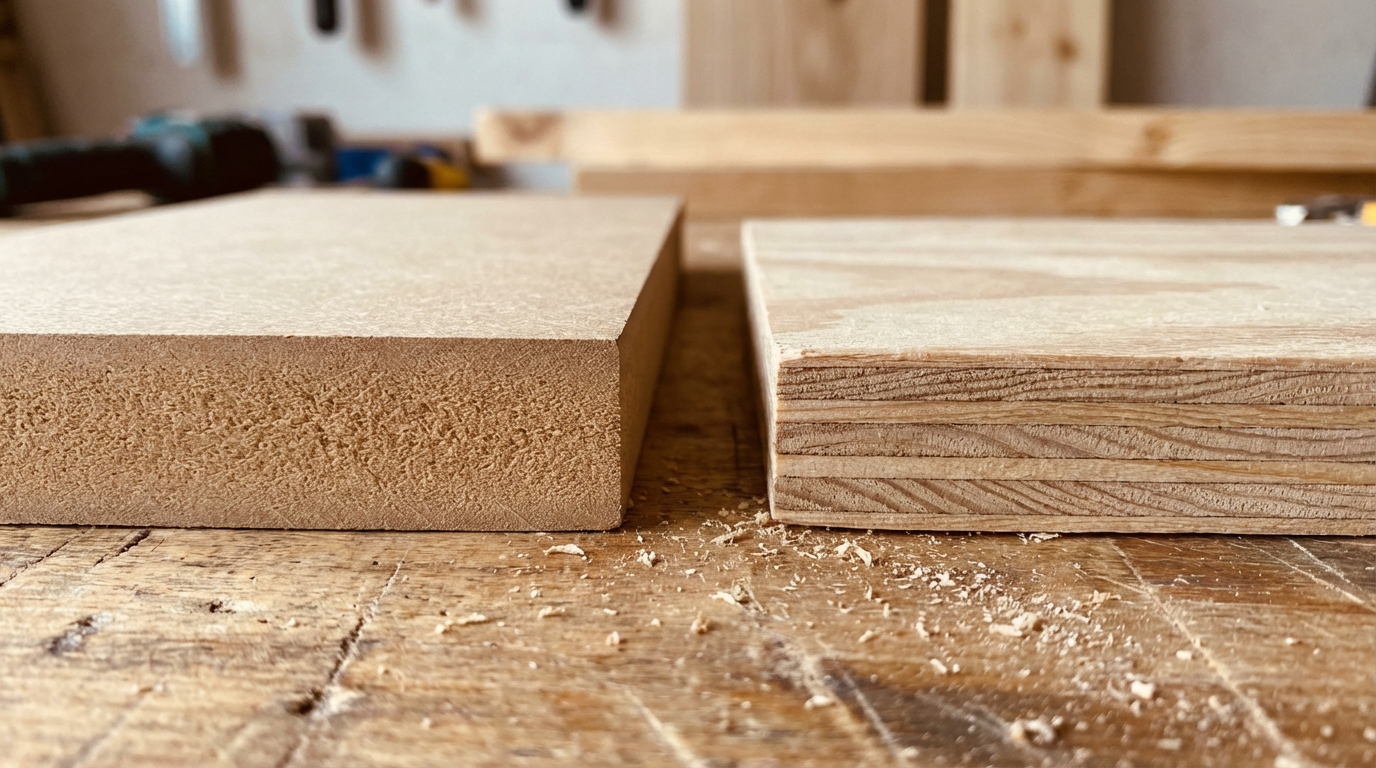
Unlike plywood which uses layers of wood veneers, or particle board which uses larger wood chips, MDF uses extremely fine wood fibres that create an almost homogeneous structure. This manufacturing process eliminates the natural variations found in solid wood—no knots, no grain direction to worry about, no voids or weak spots. The surface comes out remarkably smooth, almost like dense cardboard, making it the preferred substrate for painted finishes and veneer applications.
How MDF Density Affects Performance
The "medium density" in the name distinguishes it from Low Density Fibreboard (LDF) and High Density Fibreboard (HDF). Standard MDF boards fall between 600-800 kg/m³, while HDF exceeds 800 kg/m³. Higher density means better screw holding, cleaner edge cuts, and improved durability—but also heavier weight and higher cost. For most furniture applications in Indian homes, standard MDF in the 700-750 kg/m³ range provides adequate performance without excessive weight.
Common Misconceptions About MDF
Many buyers confuse MDF with particle board, assuming they're interchangeable. They're not. Particle board uses wood chips and has a rough, inconsistent core, while MDF uses fine fibres for a uniform, smooth structure throughout. Another misconception: "MDF is just cheap plywood." In reality, MDF serves different purposes—it's not a cheaper substitute for plywood but rather a different material optimized for different applications. Plywood offers structural strength and moisture resistance; MDF offers surface smoothness and design flexibility.
India-Specific Reality Check: Moisture, Termites, and Workmanship
Standard MDF is highly vulnerable to moisture—this is the single most critical limitation for Indian conditions. During monsoon months when humidity regularly exceeds 70-80% in coastal cities like Mumbai, Chennai, and Kolkata, unprotected MDF edges can absorb atmospheric moisture and begin swelling within weeks. In extreme cases, MDF furniture stored in poorly ventilated godowns has shown visible edge bloating during extended monsoon storage.
Regional Moisture Risk Assessment
Coastal cities (Mumbai, Chennai, Kochi, Visakhapatnam) present the highest risk due to salt-laden humid air. Even with edge banding, standard MDF requires careful placement away from windows and wet zones. North Indian cities (Delhi, Jaipur, Lucknow) have lower humidity concerns except during monsoon, making MDF more suitable year-round. Hill stations and northeastern regions have persistent humidity that makes moisture-resistant variants essential.
How Indian Sites Often Mishandle MDF
Common site practices that damage MDF before installation:
- Storing boards directly on concrete floors (moisture absorption from below)
- Leaving cut edges unsealed overnight during humid months
- Stacking boards near active plumbing or before walls are fully cured
- Cutting without dust extraction (fine MDF dust is a respiratory hazard)
Proper handling requires storing MDF horizontally on wooden battens, in covered spaces away from open windows, with cut pieces sealed within 24 hours. Many carpenters (mistris) unfamiliar with MDF treat it like plywood, leaving edges exposed for days—a practice that significantly shortens furniture lifespan.
Is MDF Termite-Proof?
Unlike natural wood and plywood, MDF has inherent termite resistance due to the resins and chemicals used in manufacturing. Termites find little nutritional value in the highly processed fibre-resin matrix. However, this doesn't mean complete immunity—in severe infestations, termites can damage MDF, though it's typically the last material they attack. For termite-prone areas, MDF offers a practical advantage over untreated hardwood plywood.
Types of MDF Board Available in India
MDF boards come in several variants designed for specific applications, each with different moisture resistance, density, and finish characteristics. Understanding these types helps you select the right board for your project's requirements and environmental conditions.
Standard MDF (Plain MDF)
The most common and economical variant, standard MDF suits dry interior applications like bedroom furniture, study tables, TV units, and decorative wall panels. It offers excellent machinability and surface smoothness but has minimal moisture resistance. Thickness ranges from 3mm to 25mm, with 18mm being standard for cabinet carcasses and shutters.
Moisture Resistant MDF (MR MDF / Green MDF)
Manufactured with moisture-resistant resins, MR MDF can withstand higher humidity levels without immediate swelling. Often identified by a green-coloured core, it's suitable for kitchen cabinet shutters, bathroom vanities (not sink cabinets), and humid climate applications. Note that "moisture resistant" doesn't mean waterproof—direct water contact will still cause damage over time.
Boiling Water Resistant MDF (BWR MDF)
A step above MR MDF, BWR variants use enhanced resin formulations that survive the boiling water test. These work for kitchen carcasses where steam exposure is common, though they're still not recommended for sink cabinets or areas with regular water splashing.
High Density Fibreboard (HDF / HDHMR)
HDF and HDHMR (High Density High Moisture Resistant) boards exceed 800 kg/m³ density, offering superior screw holding, edge strength, and moisture performance. These premium boards are increasingly popular for modular kitchen carcasses in metro cities. They cost 40-60% more than standard MDF but provide plywood-like durability with MDF's smooth finish.
Pre-Laminated MDF
Factory-laminated with decorative surfaces (solid colours, wood grains, textures), pre-laminated MDF eliminates on-site finishing. It speeds up production and ensures consistent finish quality. However, any cuts expose raw edges that must be sealed with edge banding, and you're limited to available patterns and colours.
Fire Retardant MDF
Treated with fire-retardant chemicals, these boards comply with IS 12406 standards and are used in commercial spaces, public buildings, and areas where fire safety codes mandate flame-resistant materials. They cost significantly more than standard MDF and are rarely needed for residential applications.
| MDF Type | Density (kg/m³) | Moisture Resistance | Best For | Price Level |
|---|---|---|---|---|
| Standard MDF | 600-750 | Poor | Bedroom furniture, TV units, wall panels | Budget |
| MR MDF (Green) | 650-780 | Moderate | Kitchen shutters, humid rooms | Mid-range |
| BWR MDF | 680-800 | Good | Kitchen carcasses, utility areas | Mid-High |
| HDF/HDHMR | 800-900 | Very Good | Modular kitchens, heavy-use furniture | Premium |
| Pre-Laminated | Varies | Depends on base | Quick-finish furniture, ready-to-assemble | Varies |
MDF Uses and Applications: Where It Excels
MDF's primary strength lies in applications requiring smooth painted finishes, intricate machined designs, and cost-effective construction. Its uniform density throughout the board enables CNC routing, profile cutting, and detailed moulding work that would be difficult or impossible with plywood or particle board.
Furniture Applications
Wardrobe shutters and sliding doors: MDF's smooth surface takes paint and lacquer finishes beautifully, creating the seamless look modern wardrobes require. For bedroom wardrobes in air-conditioned or well-ventilated spaces, 18mm MDF with PU paint or laminate finishing delivers excellent aesthetics at lower cost than plywood.
TV units and display shelves: Light to moderate load-bearing applications suit MDF well. TV units, book displays, and decorative shelving work fine in 18mm thickness for spans under 60cm. Longer spans need thicker boards or intermediate supports.
Study tables and desks: Desktop surfaces in MDF with laminate or veneer finishing provide durable, smooth writing surfaces. The uniform density prevents pen impressions that can occur with particle board.
What Thickness of MDF is Best for Wardrobes?
For wardrobe carcasses (sides, top, bottom), 18mm MDF provides adequate strength for standard residential wardrobes. Shutter panels work well in 18mm for painted finishes or 12mm if using profile routing with painted MDF. Internal shelves can use 15-18mm depending on span—shorter spans under 45cm can use 15mm, while longer spans need 18mm or support rails. Back panels typically use 6mm MDF or 4mm HDF. For heavy-duty wardrobes or taller units exceeding 8 feet, consider HDHMR for carcasses to prevent sagging over time.
Wall Panelling and Decorative Elements
MDF has become the go-to material for contemporary wall panelling in Indian homes. CNC-routed patterns, fluted panels, geometric designs, and wainscoting all leverage MDF's workability. Typical installations use 12-18mm MDF with PU or duco paint finishing. For our detailed wall panelling material guide, refer to the dedicated article on decorative panel options.
Mouldings and Trim Work
Skirting boards, cornices, architraves, and decorative mouldings made from MDF accept paint uniformly without the grain-raise issues of solid wood. Factory-produced MDF mouldings offer consistent profiles at lower costs than wood equivalents.
Cabinet Doors (Not Carcasses)
MDF shutter doors for kitchen cabinets—especially for painted, membrane, or lacquer finishes—deliver smooth aesthetics. However, kitchen cabinet carcasses (the box structure) benefit from moisture-resistant plywood or HDHMR rather than standard MDF due to steam and humidity exposure near cooking areas.
MDF vs Plywood: Detailed Comparison for Indian Buyers
The MDF versus plywood debate dominates Indian furniture discussions, but it's often framed incorrectly as "which is better." The accurate question is "which suits your specific application." Each material has distinct advantages that make it superior for certain uses and inferior for others.
Structural Strength and Load Bearing
Plywood wins decisively for structural applications. Its cross-laminated veneer construction provides tensile strength that MDF cannot match. For kitchen carcasses, heavy bookshelves, bed frames, and any application bearing significant weight, plywood (particularly BWR or calibrated grades) remains the professional choice. MDF's particle structure makes it prone to sagging under sustained loads, especially across longer spans.
Surface Finish and Paint Quality
MDF outperforms plywood for painted finishes. Plywood's grain pattern shows through paint unless extensive filling and sanding is done. MDF's smooth, grain-free surface accepts primers and paints directly, producing flawless lacquer and duco finishes with less preparation. For high-gloss painted furniture, membrane shutters, or designer wall panels, MDF delivers superior aesthetics.
Moisture and Water Resistance
BWR plywood handles moisture significantly better than standard or even MR MDF. Plywood's layered structure doesn't absorb water as rapidly through edges. For kitchen sink cabinets, bathroom vanities with direct water contact, and coastal applications, quality BWR plywood remains the safer choice. Even BWR MDF shouldn't be used where standing water or regular splashing occurs.
Is MDF Good for Indian Kitchens?
MDF can work for kitchen cabinet shutters (doors and drawer fronts) if you choose MR or BWR variants and ensure proper edge sealing. The smooth finish suits the lacquered and membrane door styles popular in modular kitchens. However, for carcasses (the cabinet boxes), especially under sinks and near wet areas, BWR plywood or HDHMR boards outperform MDF. Steam exposure from cooking, humidity fluctuations, and occasional water contact make plywood or HDF the safer choice for long-term kitchen performance. For comprehensive kitchen material selection, see our dedicated modular kitchen plywood guide.
| Parameter | MDF | Plywood (BWR) | Winner For |
|---|---|---|---|
| Surface smoothness | Excellent—grain-free | Good—shows veneer grain | MDF for painted finishes |
| Structural strength | Moderate | Excellent | Plywood for load-bearing |
| Moisture resistance | Poor to Moderate (MR/BWR) | Good to Excellent | Plywood for wet areas |
| Screw holding (face) | Good | Excellent | Plywood for hardware-heavy use |
| Screw holding (edge) | Poor—tends to split | Good | Plywood for edge fastening |
| CNC/Profile cutting | Excellent | Difficult | MDF for decorative work |
| Weight | Heavier | Lighter (similar thickness) | Plywood for large wall units |
| Cost | Lower | Higher | MDF for budget projects |
| Termite resistance | High (resin content) | Moderate (needs treatment) | MDF for termite-prone areas |
| Durability (years) | 5-8 years typical | 12-20 years typical | Plywood for longevity |
MDF vs Particle Board: Understanding the Difference
Particle board and MDF both fall under engineered wood products but differ significantly in construction, performance, and appropriate applications. Particle board uses larger wood chips and particles bonded with resin, while MDF uses fine wood fibres that create a denser, more uniform structure.
Key Differences in Construction
Particle board's larger particles create visible texture in cross-section and a slightly rough surface. MDF's fine fibres produce a smooth, almost cardboard-like texture throughout. This difference fundamentally affects how each material machines, finishes, and holds fasteners.
Performance Comparison
MDF offers significantly better screw holding than particle board, though both struggle with edge fastening compared to plywood. MDF's smooth surface accepts paint directly; particle board requires more preparation and shows texture through thin finishes. MDF weighs more than equivalent particle board due to higher density. For edge profiles and routing, MDF cuts cleanly while particle board tends to chip and crumble.
When to Use Each
Particle board works for hidden components, back panels, drawer bottoms, and extremely budget-constrained projects where appearance doesn't matter. MDF suits visible surfaces, painted furniture, decorative panels, and applications requiring clean machined edges. Neither should be used for structural or wet applications.
Price Range and Cost Drivers (2026 Market)
MDF pricing in India varies based on thickness, grade, brand, and regional availability. Understanding cost drivers helps you budget accurately and identify whether quoted prices represent fair market value.
Thickness-Wise Price Ranges
Standard MDF typically ranges from ₹28-55 per square foot for 12-18mm thickness, with significant brand and regional variation. Moisture-resistant MDF costs 25-40% more than standard grades. HDF and HDHMR boards command premium pricing of ₹55-90 per square foot for 18mm thickness. Pre-laminated boards add ₹15-40 per square foot depending on finish quality and pattern.
Factors Affecting MDF Prices
- Density class: Higher density boards cost more due to increased material content
- Moisture treatment: MR and BWR variants use costlier resins
- Brand reputation: Established manufacturers charge 15-25% premium for quality consistency
- Regional logistics: Coastal cities and tier-2 towns may have higher prices due to transport costs
- Quantity: Bulk purchases (full bundles vs single sheets) offer 5-10% savings
- Thickness: Very thin (3-6mm) and very thick (25mm+) boards cost more per square foot than standard 18mm
Budget Estimation for Common Furniture
For a standard 7x7 feet wardrobe using 18mm MDF with laminate finishing, material costs typically range ₹18,000-28,000 for boards alone, excluding hardware, fittings, and labour. A TV unit (6 feet width) runs ₹8,000-15,000 in MDF material. Wall panelling per running foot (floor to ceiling) costs ₹800-1,500 including basic profiles. These estimates vary significantly by city—metro pricing runs 15-25% higher than tier-2 cities.
Common Buyer Mistakes When Purchasing MDF
Years of field observations reveal recurring mistakes that lead to premature furniture failure, budget overruns, and disappointed homeowners. Avoiding these errors saves money and ensures your MDF furniture performs as expected.
Mistake 1: Using Standard MDF in Kitchens
What goes wrong: Standard MDF in kitchen cabinets swells and deteriorates within 2-3 years due to cooking steam and humidity. Why it happens: Budget constraints lead to material compromises, or inexperienced carpenters use whatever's available. How to avoid: Insist on MR MDF minimum for kitchen shutters, BWR MDF or HDHMR for carcasses. Pay the 30-40% premium—it's cheaper than replacement.
Mistake 2: Ignoring Edge Sealing
What goes wrong: Unsealed edges absorb moisture and swell, causing visible bulging along furniture edges within months. Why it happens: Carpenters skip edge banding to save time and cost. How to avoid: Specify edge banding on all exposed edges. For painted furniture, ensure edges receive primer and paint coats.
Mistake 3: Overloading Shelves
What goes wrong: MDF shelves sag permanently under heavy loads, especially across spans exceeding 60cm. Why it happens: Buyers expect MDF to perform like plywood structurally. How to avoid: Use plywood for book shelves and heavy storage. If using MDF, limit spans to 45-50cm or add intermediate supports.
Mistake 4: Face Screwing Without Pilot Holes
What goes wrong: MDF surface cracks or bulges around screws driven without pilot holes. Why it happens: Carpenters accustomed to plywood use same technique. How to avoid: Always drill pilot holes, especially within 25mm of edges. Use coarse-thread screws designed for MDF.
Mistake 5: Edge Screwing
What goes wrong: Screws driven into MDF edges cause splitting and provide minimal holding strength. Why it happens: Standard joinery techniques don't account for MDF's particle structure. How to avoid: Use dowels, biscuits, or cam-lock fittings for edge joining. If screws are unavoidable, use longer screws at wider spacing with pilot holes.
Mistake 6: Storing Improperly Before Installation
What goes wrong: Boards stored on damp floors or exposed to rain warp and swell before they're even installed. Why it happens: Site storage conditions aren't controlled. How to avoid: Store horizontally on wooden battens, in covered areas, away from active construction moisture.
Mistake 7: Choosing by Price Alone
What goes wrong: Cheapest MDF often has lower density, inconsistent quality, and shorter lifespan. Why it happens: All MDF looks similar to untrained eyes. How to avoid: Buy from established brands, check density specifications, and inspect boards for consistent colour and feel.
Mistake 8: Using MDF for Bed Frames
What goes wrong: MDF lacks the structural strength for bed frames, leading to joint failures and safety risks. Why it happens: Cost savings seem attractive. How to avoid: Always use plywood or solid wood for bed frames and structural components.
Workmanship and Installation Tips for Carpenters
Proper MDF handling and installation techniques significantly impact furniture longevity. Whether you're briefing your carpenter or supervising modular furniture installation, these guidelines ensure professional results.
Cutting and Machining
MDF cuts cleanly with carbide-tipped blades designed for engineered wood. Standard wood blades dull quickly and produce rough edges. For CNC routing and profile work, use proper dust extraction—MDF generates fine particles that pose respiratory hazards and damage machinery. Cut pieces should be sealed within 24 hours during monsoon to prevent moisture absorption.
Edge Banding Requirements
All exposed edges require sealing. Options include PVC edge banding (0.4mm-2mm thickness), painted edges with proper priming, or veneer tape. For kitchen applications, 1-2mm PVC with hot-melt adhesive provides moisture protection. Thinner edge bands (0.4mm) suffice for bedroom furniture in dry environments.
Fastening and Hardware
Use coarse-threaded screws specifically designed for particle board and MDF. Pilot holes are mandatory—drill at 70-80% of screw diameter. Maintain minimum 20mm edge distance for face screwing. For edge joining, prefer cam locks, dowels, or wooden biscuits over direct screwing. Hinge mounting in MDF benefits from reinforcement blocks or metal inserts for heavy doors.
How Long Does MDF Last in Humid Conditions?
Standard MDF in consistently humid environments (above 65% RH year-round) may show edge swelling within 3-5 years even with edge banding. In air-conditioned spaces maintaining 50-55% humidity, well-made MDF furniture lasts 8-12 years with proper care. MR MDF extends these timelines by 30-40%. Key factors include edge sealing quality, ventilation in storage spaces, and avoiding direct contact with walls in humid rooms. For coastal cities without air conditioning, consider HDHMR or BWR plywood for furniture expected to last beyond 7-8 years.
Site Storage and Acclimatization
Store MDF boards horizontally on flat surfaces with wooden battens preventing ground contact. Allow 48-72 hours acclimatization in the installation room before cutting, especially if boards were stored in different humidity conditions. Keep away from active plastering, painting, or concrete curing to avoid moisture absorption.
Carpenter Briefing Checklist
- Confirm MDF grade matches application (MR for humid areas)
- Verify edge banding on all exposed edges
- Check pilot hole drilling before all fastening
- Ensure proper dust control during cutting
- Confirm no edge screwing without reinforcement
- Specify shelf span limits and support requirements
- Verify hardware compatibility (soft-close hinges need reinforcement)
Quality Checks Without Lab Tests
You don't need laboratory equipment to assess MDF quality. These field-practical checks help identify good boards and reject substandard material before purchase or acceptance.
Visual Inspection Points
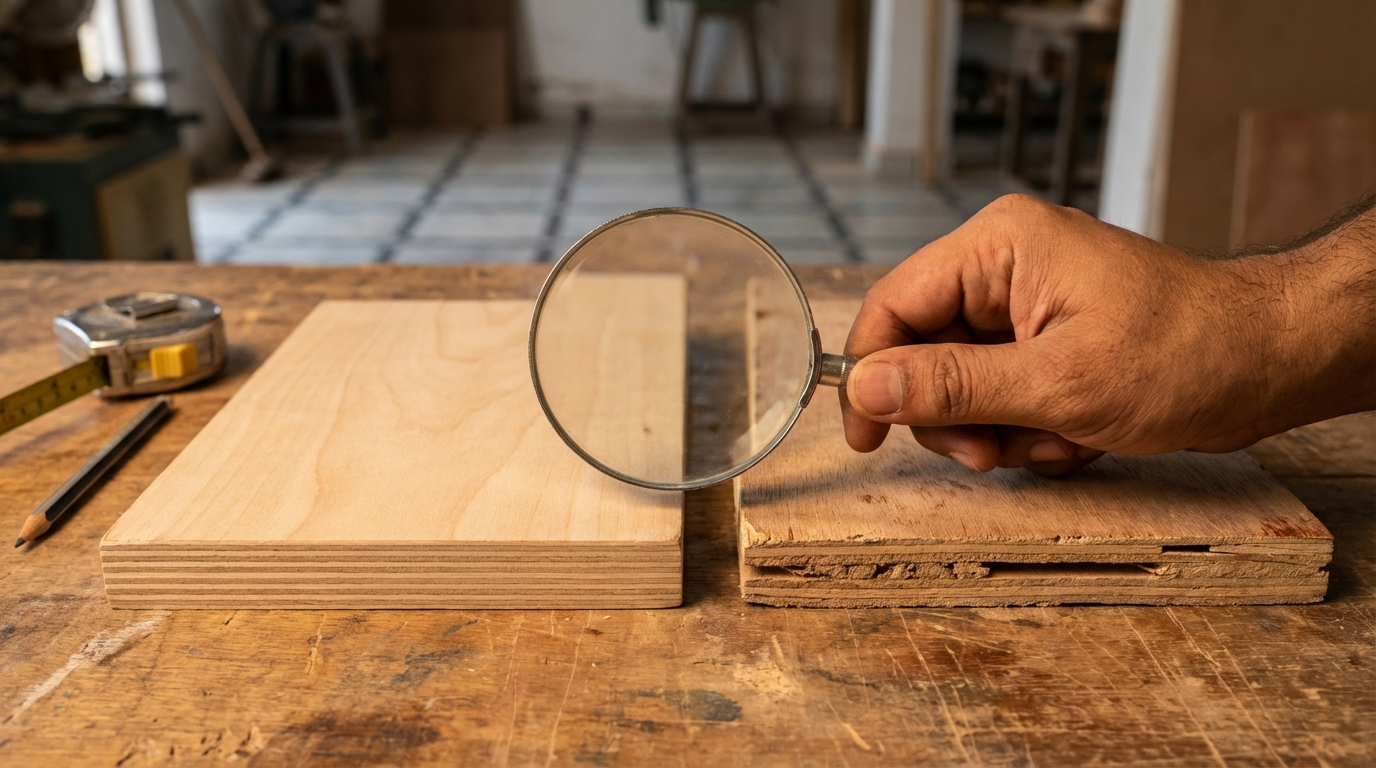
Examine the board surface for uniform colour—variation suggests inconsistent manufacturing. Check edges for smoothness; quality MDF has clean, dense edges without visible voids or layers. Look for any surface bubbles, depressions, or rough patches. Face should be uniformly smooth without raised fibres or texture variations.
Weight and Density Check
Lift and compare similar-sized boards from different bundles or sources. Heavier boards generally indicate higher density and better quality. An 8x4 feet sheet of 18mm standard MDF typically weighs 45-55 kg. Significantly lighter boards may have density issues affecting durability and screw holding.
Tap Test
Tap the board surface at multiple points. Quality MDF produces a consistent, dense sound throughout. Hollow or variable sounds suggest internal voids or density inconsistencies. Compare against a known quality board if available.
Edge Check
Run your finger along cut edges. Quality MDF feels smooth and dense. If edges feel crumbly, show visible particles, or produce powder easily, the board has low density or poor resin bonding.
Moisture Content
In the absence of moisture meters, check for any visible warping or cupping. Boards should lie flat without twisting. Edges shouldn't feel soft or show signs of swelling. Dark spots or discolouration may indicate moisture damage.
Questions to Ask Dealers
- What is the board density (should be 700+ kg/m³ for quality MDF)?
- Is this standard, MR, or BWR grade?
- What formaldehyde emission class (E1 or E2)?
- How long has this batch been in storage?
- Can you show the manufacturer's specification sheet?
Warning Signs to Reject Boards
- Visible warping or bowing when laid flat
- Inconsistent thickness across the sheet
- Musty smell indicating moisture damage
- Surface bubbles or delamination
- Soft, crumbly edges that powder easily
- Significant colour variation within the same board
Decision Framework: Choosing the Right Board
This framework helps you match your specific application to the appropriate board choice, considering Indian conditions and practical constraints.
| Application/Scenario | Recommended Choice | Reasoning |
|---|---|---|
| Bedroom wardrobe (AC room) | Standard MDF 18mm | Controlled humidity, surface finish matters |
| Bedroom wardrobe (non-AC, coastal) | MR MDF or BWR Plywood | Humidity risk requires moisture protection |
| Kitchen cabinet carcasses | BWR Plywood or HDHMR | Steam, moisture, structural loads |
| Kitchen cabinet shutters (painted) | MR MDF 18mm | Smooth finish for paint, moderate moisture |
| TV unit (living room) | Standard MDF 18mm | Light loads, finish quality priority |
| Heavy bookshelf | BWR Plywood 18mm | Sustained heavy loads need structural strength |
| CNC-cut wall panels | Standard MDF 12-18mm | Excellent machinability, decorative use |
| Bathroom vanity (away from sink) | MR MDF with sealed edges | High humidity but no direct water contact |
| Sink cabinet base | Marine Plywood or HDHMR | Direct water exposure risk |
| Budget furniture (dry room) | Standard MDF 15-18mm | Cost-effective for non-critical applications |
| Children's room furniture | E1 grade MDF (low formaldehyde) | Indoor air quality consideration |
| Office workstations | Standard or MR MDF 18mm | Surface finish, moderate durability needed |
MDF Maintenance for Long Life
Proper maintenance extends MDF furniture lifespan significantly. While MDF requires more care than plywood, simple practices prevent common deterioration issues.
Daily Care
Clean MDF surfaces with dry or slightly damp cloth. Avoid wet mopping or excessive water during cleaning. Wipe spills immediately—even on laminated MDF, water can seep through joints and edges. Use coasters and mats under water containers, especially on painted MDF surfaces.
Protecting from Moisture
Ensure adequate ventilation in wardrobe interiors—closed cabinets can trap humidity. In coastal areas, silica gel packets inside wardrobes help absorb excess moisture. Keep MDF furniture slightly away from exterior walls in monsoon-prone areas. For kitchen MDF, ensure exhaust fans operate during cooking to reduce steam exposure.
Can MDF Be Used in Bathrooms?
MDF can work for bathroom vanity tops and storage cabinets positioned away from direct water splash zones, but only with MR or BWR grades and meticulous edge sealing. Standard MDF is entirely unsuitable. Even moisture-resistant variants shouldn't be used for sink cabinets or areas within splash range of showers and taps. For bathroom applications, waterproof materials like marine plywood, WPC boards, or stainless steel remain safer long-term choices. If MDF is used, ensure all edges are sealed with PVC banding or waterproof paint, and maintain good bathroom ventilation.
Touch-Up and Repairs
Minor surface scratches on painted MDF can be touched up with matching paint. For laminated surfaces, repair options are limited—consider laminate repair pens for small scratches. Edge damage requires professional attention; swollen edges cannot be restored and need component replacement. Loose hinges in MDF often require relocating to fresh material rather than re-screwing into damaged holes.
Frequently Asked Questions
What is the full form of MDF and what does it mean?
MDF stands for Medium Density Fibreboard, an engineered wood panel manufactured by breaking down wood residuals into fine fibres, combining them with wax and resin binders, then forming panels under high pressure and temperature. The "medium density" refers to its position between low-density fibreboard and high-density fibreboard, typically ranging from 600-800 kg/m³. This manufacturing process creates a smooth, uniform material without the grain patterns, knots, or voids found in natural wood, making MDF ideal for applications requiring consistent surface quality and machinability.
Is MDF stronger than plywood?
No, MDF is not structurally stronger than plywood. Plywood's cross-laminated veneer construction provides superior tensile and bending strength, making it better for load-bearing applications, bed frames, heavy shelving, and structural components. MDF's advantage lies in surface smoothness, uniform density, and machinability rather than strength. For furniture carcasses requiring structural integrity—like kitchen cabinet boxes or tall wardrobe units—quality plywood outperforms MDF. However, MDF excels for decorative shutters, wall panels, and painted furniture where surface finish matters more than structural strength.
Can MDF get wet? What happens if water touches MDF?
Standard MDF absorbs water readily, causing swelling, warping, and permanent damage. When water contacts MDF, the compressed fibres expand and the board loses its dimensional stability—this damage is irreversible. Even moisture-resistant (MR) MDF only delays this process rather than preventing it entirely. MR and BWR MDF variants can withstand humidity and occasional light moisture but shouldn't be exposed to standing water or regular splashing. For wet areas, marine plywood, HDHMR, or waterproof materials like WPC remain safer choices. Always seal all MDF edges to minimize moisture ingress risk.
Is MDF safe for home furniture? What about formaldehyde?
MDF manufactured to modern standards is generally safe for residential use, though formaldehyde-based resins in the binding process warrant consideration. Formaldehyde emissions vary by manufacturing quality—look for E1 grade certification indicating low emissions meeting European standards. Once installed and finished (painted or laminated), formaldehyde off-gassing reduces significantly. For children's rooms or spaces with concerned occupants, E1 or E0 rated MDF provides additional assurance. Proper ventilation during and after installation helps dissipate any residual emissions. Most quality MDF from established manufacturers meets safety standards acceptable for residential furniture.
How does MDF compare to particle board in quality?
MDF significantly outperforms particle board in most quality parameters. MDF's fine fibre construction creates a denser, smoother, more uniform material compared to particle board's coarse chip composition. MDF offers better screw holding (though not as good as plywood), cleaner machined edges, superior surface for painted finishes, and higher structural integrity. Particle board chips and crumbles during cutting, shows rough texture through finishes, and has the weakest fastener retention among engineered woods. Particle board costs less but suits only hidden components, back panels, or extremely budget-constrained projects where appearance and durability don't matter.
What thickness of MDF should I use for different furniture?
Thickness selection depends on application and span requirements. For wardrobe and cabinet carcasses, 18mm provides standard adequate strength for residential use. Shutter panels and doors work well in 16-18mm. Wall panelling typically uses 12-18mm depending on profile depth and mounting method. Back panels and drawer bottoms use 6mm MDF or 4mm HDF. Study and dining table tops benefit from 25mm for rigidity. For shelving, thickness depends on span—18mm suits spans under 60cm while longer spans need thicker boards or intermediate supports. When in doubt, choose thicker; the cost difference is minimal compared to sagging or failure issues.
Why do carpenters sometimes prefer plywood over MDF?
Experienced carpenters often prefer plywood because it forgives common installation practices better than MDF. Plywood allows edge screwing, handles moisture exposure more gracefully, holds fasteners more reliably, and doesn't require the same careful handling. MDF demands pilot holes, proper edge sealing, moisture protection, and specific fastening techniques that traditional carpentry training may not cover. Additionally, plywood structural strength means fewer concerns about sagging, and mistakes are often repairable. However, carpenters skilled with MDF appreciate its superior finish quality and predictable machining characteristics for decorative work.
Is MDF waterproof? Which MDF type is best for kitchens?
No MDF variant is truly waterproof—even BWR (Boiling Water Resistant) MDF has limits. For kitchens, MR MDF serves adequately for cabinet shutters and doors away from direct water contact, while BWR MDF or HDHMR works for carcasses facing steam and humidity. However, sink cabinet bases should use marine plywood or fully waterproof alternatives rather than any MDF type. The hierarchy for kitchen moisture resistance runs: Standard MDF (unsuitable) < MR MDF (shutters only) < BWR MDF (carcasses away from sinks) < HDHMR (better moisture resistance) < Marine Plywood (sink areas). Our kitchen cabinet material guide covers selection in greater detail.
How do I know if MDF quality is good before buying?
Quality assessment starts with weight—heavier boards typically indicate higher density and better quality. Examine edge smoothness; quality MDF has clean, dense edges without visible voids or crumbling. Surface should be uniformly smooth without bubbles, depressions, or texture variations. Tap the board—consistent dense sound throughout indicates uniform density, while hollow sounds suggest voids. Ask dealers for density specifications (quality boards exceed 700 kg/m³) and manufacturer documentation. Compare boards from different sources; significant weight differences between same-thickness sheets indicate quality variation. Buy from established brands with consistent quality control.
Can MDF be painted directly without primer?
While technically possible, direct painting without primer produces inferior results. MDF's absorbent surface soaks up paint unevenly, requiring multiple coats and often showing blotchy finish. Proper preparation involves sealing the surface with MDF-specific primer or thinned PVA sealer, allowing complete drying, light sanding, then applying primer before paint coats. Edge sealing is critical—raw edges absorb far more than faces and require multiple sealer coats. For professional-quality painted MDF furniture, budget for proper priming; it reduces total paint consumption, ensures even finish, and improves long-term durability significantly.
Does MDF attract termites like regular wood?
MDF has inherent termite resistance superior to untreated natural wood and many plywood types. The resins and chemicals used in MDF manufacturing make it unappealing to termites—they find little nutritional value in the processed fibre-resin matrix. While not completely termite-proof in severe infestations, MDF is typically the last material termites attack when alternatives exist. This advantage makes MDF particularly suitable for termite-prone regions in India where untreated wood and even some plywood face significant pest risks. However, if termites establish in adjacent natural wood components, they may eventually damage MDF through their tunnelling paths.
What is HDHMR and how is it different from regular MDF?
HDHMR (High Density High Moisture Resistant) represents the premium tier of fibreboard products, combining density exceeding 800 kg/m³ with enhanced moisture-resistant resins. Compared to standard MDF (600-750 kg/m³), HDHMR offers significantly better screw holding, edge strength, moisture resistance, and overall durability. It bridges the gap between MDF's smooth finish advantages and plywood's structural performance. HDHMR costs 50-70% more than standard MDF but provides plywood-like performance with better surface finish. For modular kitchens, heavy-use wardrobes, and applications requiring both durability and smooth finish, HDHMR offers compelling value despite higher initial cost.
How long does MDF furniture typically last in Indian conditions?
MDF furniture longevity varies dramatically based on grade selection, installation quality, and usage environment. In air-conditioned spaces with 50-55% humidity, well-made standard MDF furniture lasts 8-12 years with proper care. In non-AC coastal environments with 70%+ humidity, standard MDF may deteriorate within 4-6 years even with edge sealing. MR MDF extends these timelines by 30-50%. Kitchen MDF shutters typically show wear after 6-8 years in active use. Compare this to quality BWR plywood furniture lasting 15-25 years in similar conditions. For furniture expected to last beyond a decade, plywood remains the safer investment despite higher initial cost.
Is pre-laminated MDF better than raw MDF with separate laminate?
Both approaches have merits depending on your project. Pre-laminated MDF offers factory-consistent finish quality, faster production, and no on-site laminating errors—ideal for standardised designs with available colour matches. However, you're limited to manufacturer's pattern inventory and any cuts expose raw edges requiring banding. Raw MDF with separate laminate application provides unlimited design flexibility, colour matching, and seamless finishes around complex profiles. For custom furniture with specific design requirements or matching existing décor, raw MDF with professional laminate application offers better results. Pre-laminated works for production furniture with standard finishes.
Note: sainik710.com is an independent informational site and is not affiliated with any manufacturer. All information represents general industry knowledge applicable to MDF products across brands. Verify specific product specifications with your supplier before purchase.
Disclaimer: This content is provided for general informational purposes based on industry practices and publicly available information. Product specifications, standards, prices, and availability may vary by manufacturer, region, and time. Readers should independently verify details with manufacturers, dealers, or qualified professionals before making purchase or construction decisions.Want Plywood Suggestions?
Share a few details and a Sainik 710 specialist will suggest suitable brands and connect you to responsive dealers.