MDF Board: Full Guide to Types, Thickness, Uses & Price Comparison with Plywood
Complete MDF board guide—types (Plain, Laminated, HDF), uses for furniture & thickness options. Compare MDF vs plywood with price guide for India.
Quick Answer: What Is MDF Board and Should You Use It?
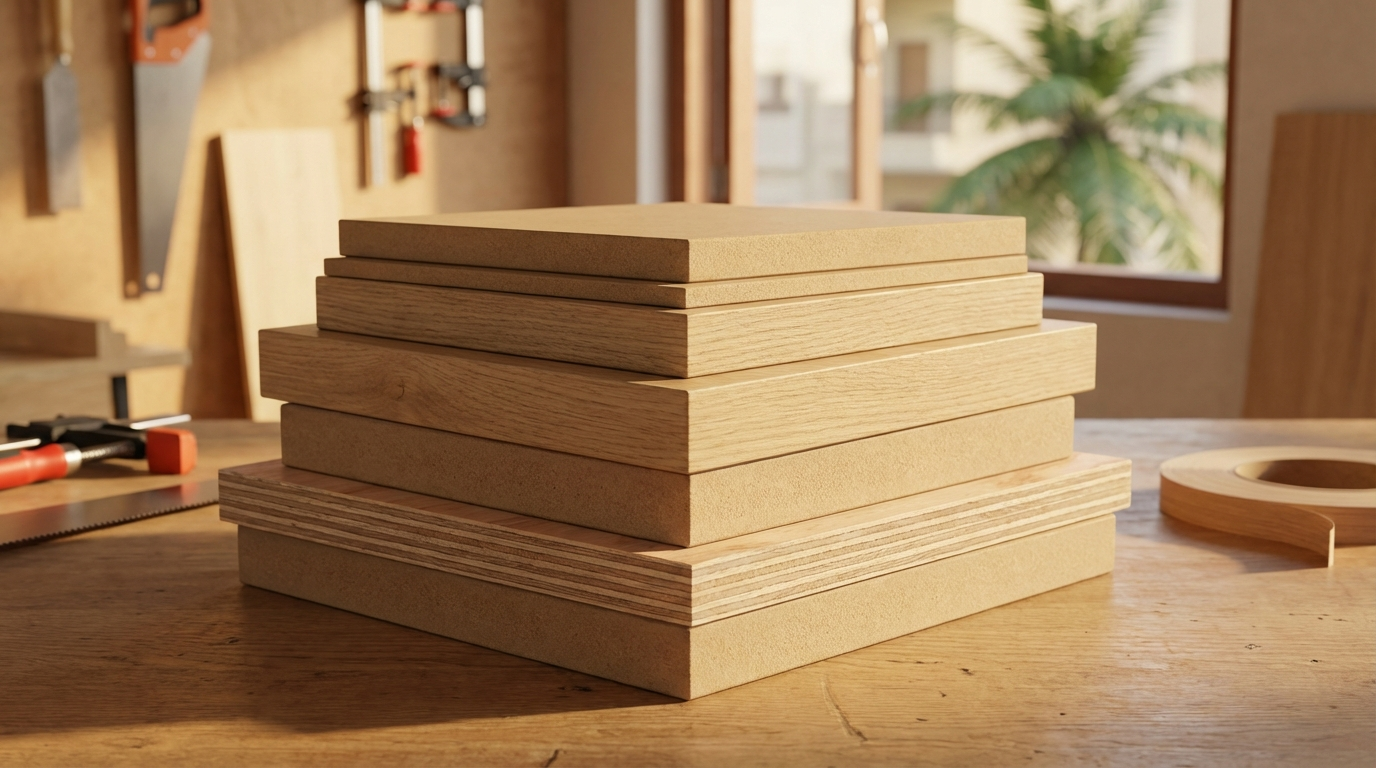
MDF board is an engineered wood panel made from compressed wood fibers bonded with resin—it's denser than plywood, smoother than natural wood, and about 20-40% cheaper for most interior furniture work.
Short version: Medium Density Fibreboard (MDF) is a panel made from wood fibres combined with resin and wax, compressed under high pressure. It offers a smooth surface ideal for painted finishes and CNC routing, but isn't as structurally strong as plywood. For decorative panels, cabinet shutters, and painted furniture where moisture exposure is minimal—it makes good sense. For kitchens, bathrooms, or anything load-bearing—you'll regret it within two monsoons.
This is right for you if:
- You're planning painted furniture or wall panelling in dry, air-conditioned rooms
- You need intricate laser-cut jalis, wave panels, architraves, and feature walls
- Budget is tight and you're furnishing a bedroom or study that stays dry
- Your carpenter has experience with MDF edge-banding—this matters more than people realize
Skip this if:
- The space is high-moisture (kitchens, bathrooms), or the furniture is weight-bearing (wardrobes, beds)
- You live in a coastal city and don't have consistent AC running—the humidity will destroy unprotected MDF faster than you'd expect
Bottom line: MDF works brilliantly for decorative applications in dry interiors, but asking it to perform like plywood in humid Indian conditions is setting yourself up for a ₹30,000-50,000 repair job.
What MDF Actually Means—And What It Doesn't
MDF stands for Medium Density Fibreboard. It is created by finely grinding up leftover hardwood or softwood pieces, combining them with wax and a resin binder, and then putting intense heat and pressure on the mixture. Generally speaking, it is denser than plywood.
Now here's where people get confused. They hear "denser" and assume "stronger." Not the same thing. Not even close. MDF is like a very tightly packed biscuit—uniform, smooth, predictable. MDF is created by breaking down wood fibers, mixing them with resin, and compressing them under high heat and pressure. The result is a dense, smooth board with no wood grain. That's why you can cut gorgeous CNC patterns into it without chipping.
Most people think MDF and plywood are interchangeable. Actually, these two materials are definitely not interchangeable. Both are often used in building kitchens and modular furniture and like every other material, MDF and plywood come with their set of advantages and disadvantages.
The biggest misconception I keep hearing: "MDF is waterproof because it's engineered." Where do people get this from? If not sealed well, MDF soaks up water and other liquids like a sponge and swells. I've seen beautifully crafted wardrobe shutters turn into lumpy disasters after one Mumbai monsoon because the mistri "forgot" the edge banding. More on that later.
Is MDF actually worth the extra savings over plywood?
It depends on what you're building. For a decorative wall panel in your living room? Absolutely. MDF plywood is highly recommended for decorative pieces or panels that just need to be finished with paint. MDF is a cheap, budget-friendly material. For 18mm wardrobe boards, MDF ranges ₹50-90 per sq ft; BWR plywood ₹80-140 per sq ft. That's a significant difference when you're doing an entire room. But here's the catch: that savings evaporates quickly if you're in a humid area and need to replace swollen boards after two years. The plywood guide on this site breaks down the durability math in more detail.
Why MDF Behaves Differently Across Indian Cities
India isn't one climate—it's twenty. And MDF reacts to humidity like a mood ring reacts to temperature.
In monsoon-prone India, MDF swells 10-15% faster than BWR plywood if stored flat on bare floors—elevate stacks on pallets. Coastal areas like Mumbai or Chennai demand MR grades with phenolic resins to fight 80%+ humidity. I've seen the same board brand perform perfectly in Pune but fail miserably in Thane. Same city, technically. But the Thane side gets that humid Konkan breeze that Pune escapes.
Here's the city-wise reality:
Mumbai/Navi Mumbai: Standard MDF in bedrooms works if you run AC regularly. Near the kitchen or bathroom? Forget it. I had a client in Borivali who used plain MDF for their utility room shelves. By December (just four months after installation), the bottom shelves had swelled beyond repair. ₹22,000 down the drain.
Chennai/Kolkata: Similar story. The majority of India has a tropical climate; therefore, the surface has to withstand water, moisture, and heat at some point. The OMR stretch in Chennai—despite being the "IT corridor"—has terrible humidity six months of the year. If you're building there, MR-grade MDF at minimum, and even then only for non-structural applications.
Delhi NCR/Jaipur/Ahmedabad: Hot-dry regions like Rajasthan favor standard MDF for cost, but always acclimatize 48 hours before fixing. This is where MDF actually shines. Low humidity, less risk. The Gurgaon-side projects I've consulted on have had almost zero MDF failures compared to coastal cities.
Bengaluru: The weather's mild, but don't get complacent. October-November rains can push indoor humidity past 75% in older buildings without proper ventilation. Assess site humidity: Bedroom/coastal? Go BWR plywood. Dry AC room? MDF ok.
Types of MDF: The Full Breakdown
MDF isn't just one thing. There are grades, densities, and finishes—and dealers love to blur the lines between them to push whatever stock they have. Here's what actually matters.
Plain MDF (Standard/Interior Grade)
This is your basic, no-frills MDF. Brown color, smooth surface, meant for dry indoor use only. MDF is classified into four categories; Ultra-light MDF, the least expensive, to MDF plain, average price, and Fire-resistant MDF, slightly more costly. The most expensive is moisture-resistant MDF.
Honestly, for most decorative applications—jali panels, TV unit backing, skirting—this works fine. The problem starts when people use it for applications it was never designed for.
Moisture Resistant MDF (MR MDF/Green MDF)
This is treated with special resins to handle humidity better. Usually has a green core (hence the name). Costs maybe 20-30% more than standard. Worth it if you're in Mumbai, Chennai, or Kolkata.
One thing to understand: "moisture resistant" doesn't mean waterproof. It just buys you more time before the swelling starts. Still need edge banding, still need sealing. Most guides won't tell you this, but MR-grade MDF in a truly wet environment still fails—it just fails slower.
HDF (High Density Fibreboard)
Denser, harder, more expensive. Used for laminate flooring underlays mainly. Some premium cabinet manufacturers use it for shutter cores. For regular furniture? Overkill unless you're going high-end.
Pre-Laminated MDF
Pre-laminated MDF sheets, laminated MDF sheets come with a factory-applied laminate finish—saves the lamination step on-site. Edges still need protection though. Popular for modular wardrobes and office furniture.
| MDF Type | Best For | Humidity Tolerance | Price Range (₹/sq ft) | My Take |
|---|---|---|---|---|
| Plain/Standard MDF | Wall panels, decorative jalis, TV units | Low—fails fast in moisture | ₹25-50 | Fine for dry rooms with AC |
| MR MDF (Green) | Bedroom furniture in humid cities | Moderate—buys you 2-3 extra years | ₹40-70 | The minimum I'd recommend for Mumbai/Chennai |
| HDF | Flooring underlays, premium cabinet cores | Good | ₹60-100 | Usually overkill for regular furniture |
| Pre-Laminated MDF | Modular wardrobes, office partitions | Depends on base MDF grade | ₹55-120 | Convenient but edge-banding still essential |
| Fire Retardant MDF | Commercial spaces, public buildings | Varies | ₹80-140 | Rarely needed for homes—compliance requirement mostly |
Price Reality Check: What MDF Actually Costs in 2026
Note: sainik710.com is an independent informational site and is not affiliated with any manufacturer.
Prices swing wildly based on where you're buying, when you're buying, and frankly—how much your dealer thinks you know. Here's the honest picture.
MDF prices typically range Rs 40-120 per sq ft for 18mm thickness, varying by city (higher in metros like Delhi/Bengaluru due to logistics). Thinner 6-12mm sheets cost 30-50% less. The wildest variation I've seen was in Kolkata—same brand, same thickness, ₹15/sq ft difference between two dealers in Salt Lake. Always get multiple quotes.
What actually drives MDF prices?
Thickness plays a key role, as thicker boards are more expensive. Density also affects pricing, with high-density MDF costing more due to durability. Brand and quality influence costs, with premium brands charging higher rates. Market demand and supply fluctuations impact pricing, especially during peak construction periods.
MR grade adds 20-30%, calibration and smooth face up another 10-15%, brand consistency reduces wastage. Bulk buys drop 10-20%.
Budget estimation approach:
For a 10x8 ft wardrobe using 18mm MDF (carcass + shelves + shutters), figure roughly 100-120 sq ft of material. At ₹50-70/sq ft for decent MR-grade MDF, that's ₹5,000-8,500 just for the base boards. Add laminate (₹25-50/sq ft), edge banding (₹8-15 per running foot), hardware, and labor—you're looking at ₹25,000-45,000 total depending on finish quality.
Laminate sheet + adhesive + labor (varies): often adds ₹40–₹90/sq ft depending on laminate brand + labor. That's on top of your board cost. This is where people's budgets go sideways—they price the MDF but forget the finishing.
MDF vs Plywood: The Honest Comparison
The plywood vs MDF debate isn't about which is better overall—it's about which is better for the specific need. Here's the head-to-head that actually matters for Indian homes.
| Parameter | MDF | Plywood | Winner For... |
|---|---|---|---|
| Surface Smoothness | Excellent—no grain, no knots | Visible wood grain, which can be a plus if you're going for a natural look | MDF for paint; plywood for natural finish |
| Structural Strength | More fragile in certain ways. It can handle light to moderate loads but may split if screws are placed too close to its edges. | Stronger material. Its layered construction makes it resistant to cracking, splitting, and warping. | Plywood—not even close |
| Moisture Resistance | Poor unless MR-grade, even then limited | BWR/Marine grade handles humidity well | Plywood for kitchens, bathrooms |
| Screw Holding | Lower screw hold without inserts | Strong screw retention in face and edges | Plywood for hinges, hardware |
| CNC/Carving | Smooth surface, ideal for painting and finishing. Excellent for detailed cutting and carving. | Edges splinter, less suitable for intricate cuts | MDF dominates here |
| Weight | Compared to plywood, it's much lighter. Therefore, it's a great material for window shutters. | Heavier, bulkier to transport | MDF if weight matters |
| Cost (18mm) | ₹40-90/sq ft | ₹70-150/sq ft (BWR grade) | MDF—20-40% cheaper typically |
| Durability (10+ years) | Limited unless climate-controlled | Holds up well with basic care | Plywood for long-term |
Plywood is usually the better pick for kitchens. It holds up well in humid conditions, doesn't sag over time, and is strong enough to support regular use. MDF can be used for cabinet shutters or inside panels, but for overall durability, plywood is more reliable in Indian kitchens.
Trade-off summary: Plywood delivers under pressure—literally. MDF brings finesse where form matters more than load. You gain smoothness and cost savings with MDF, but you lose structural reliability and moisture tolerance. When in doubt, specify both: Plywood for the core build, MDF for surface styling.
The HDHMR vs plywood comparison we've done separately goes deeper into engineered board differences if you're considering that route.
How to Choose: The Decision Framework
Forget the marketing. Here's how I actually recommend people choose.
Step 1: What room are you furnishing? If bathroom, kitchen, utility, balcony—stop here. Go plywood. MDF will fail.
Step 2: What's the humidity profile? Assess site humidity: Bedroom/coastal? Go BWR plywood. Dry AC room? MDF ok. Spec thickness/load: 18mm carcass/shelves; tap for solid core.
Step 3: What finish are you planning? MDF has a very smooth surface, so it's great if you're planning to paint or want intricate designs. Plywood has a more natural grain and works well with laminates or wood veneers. Go with MDF for a sleek, uniform look, and choose plywood if you prefer a natural wood feel.
Step 4: Will this bear significant weight? Wardrobes storing heavy items, bed frames, bookshelves—plywood or reinforced MDF only.
| Your Situation | Recommendation | Why |
|---|---|---|
| Decorative wall panels in AC living room | Plain MDF | Cost-effective, smooth finish for paint, low moisture risk |
| Bedroom wardrobe in Mumbai | MR MDF shutters + plywood carcass | Combines cost savings with structural integrity |
| Kitchen cabinets anywhere in India | BWR plywood | Steam, water splashes, heat—MDF can't handle it |
| CNC jali partition | Plain MDF (12mm) | Nothing carves cleaner |
| Coastal city wardrobe | BWR plywood throughout | Humidity will kill MDF despite precautions |
| Budget study table in Delhi | MR MDF | Dry climate + cost savings make sense |
| Book shelves with heavy loads | 18mm BWR plywood | Standard MDF handles 15-25kg per shelf short-term but sags in humid Indian homes without reinforcement. |
Exception: If your entire project is modular/factory-made with factory-sealed edges and factory-applied laminates, MDF becomes more viable even in slightly humid conditions. MDF excels in factories for smooth CNC cuts and repeatability, ideal for OEMs. Plywood better for site-built strength.
Red flags to walk away from:
- Dealer pushing "waterproof MDF"—no such thing exists in practical terms
- Carpenter suggesting plain MDF for kitchen cabinets—he's either uninformed or cutting corners
- Pre-laminated MDF with visible edge swelling at the shop—storage issue, quality compromised
- Unusually low prices without clear explanation—often mixed grades or old stock
Common Mistakes People Make With MDF
Eighteen years of watching projects go wrong—here's what keeps happening.
Mistake 1: Using plain MDF in bedrooms during monsoon season without AC
This one really frustrates me. People assume "it's indoors, so it's fine." But in Mumbai or Chennai, indoor humidity during July-September regularly hits 80-85%. In monsoon-prone India, MDF swells 10-15% faster than BWR plywood if stored flat on bare floors. Same principle applies to installed furniture. Without consistent AC or dehumidifier, standard MDF slowly absorbs ambient moisture. By December, shutters don't close properly. By March, you're tearing them out.
Mistake 2: Skipping edge banding
Skipping edge banding on MDF. Why: Swells fast. Do: Insist 2mm PVC all around. The exposed edge is where all the trouble starts. Those tiny wood fibers? They're like little straws waiting to suck up any moisture in the air. I've seen carpenters "save time" by banding only visible edges. Six months later, the back edges have bubbled up and pushed the laminate face forward. Not worth the ₹500 saved.
Mistake 3: Buying the thinnest possible boards
Buying thinnest boards. Why: Sags shelves. Do: Stick 18mm min. For wardrobe carcasses and shelves, 18mm is the bare minimum. I've seen 12mm shelves that looked great during installation but had a visible bow after three months of storing clothes. False economy.
Mistake 4: Using MDF for kitchen cabinets
A builder in Andheri called me last year. Used MR-grade MDF for his entire kitchen carcass to "save budget." Within 14 months, the base cabinets under the sink had swelled, the hinges had pulled out of the softened material, and two doors had visible warping. Total replacement: ₹1.8 lakhs. He'd saved maybe ₹40,000 by choosing MDF over plywood originally. Big mistake.
Mistake 5: Not acclimatizing boards before installation
Vertical racks, covered, off floor—48hrs acclimatization. Avoid direct sun/rain. Site stacks invite warping. Especially relevant in extreme climate cities. If MDF goes from a cold AC godown straight into a hot construction site, it can warp before the carpenter even cuts it. Two days of adjustment in the actual room makes a difference.
Mistake 6: Ignoring screw specifications
It may split if screws are placed too close to its edges. The recommended edge distance for screws in MDF is 25-30mm minimum. I keep seeing hardware mounted 10-15mm from edges because "it looked centered." Cracks show up within weeks.
Mistake 7: Assuming all MDF brands are the same
Always verify calibration and edge moisture resistance on-site, as monsoon storage affects performance. Check thickness uniformity and ask for recent batch samples before bulk buy—regional dealers vary stock freshness. I've been saying this for years—the consistency difference between premium and budget brands shows up in screw holding and edge integrity.
Quality Checks You Can Do Yourself
Don't rely on labels. Here's how I actually test MDF before buying.
Visual Checks:
- Surface should be uniformly smooth—run your palm across it, any rough patches mean poor processing
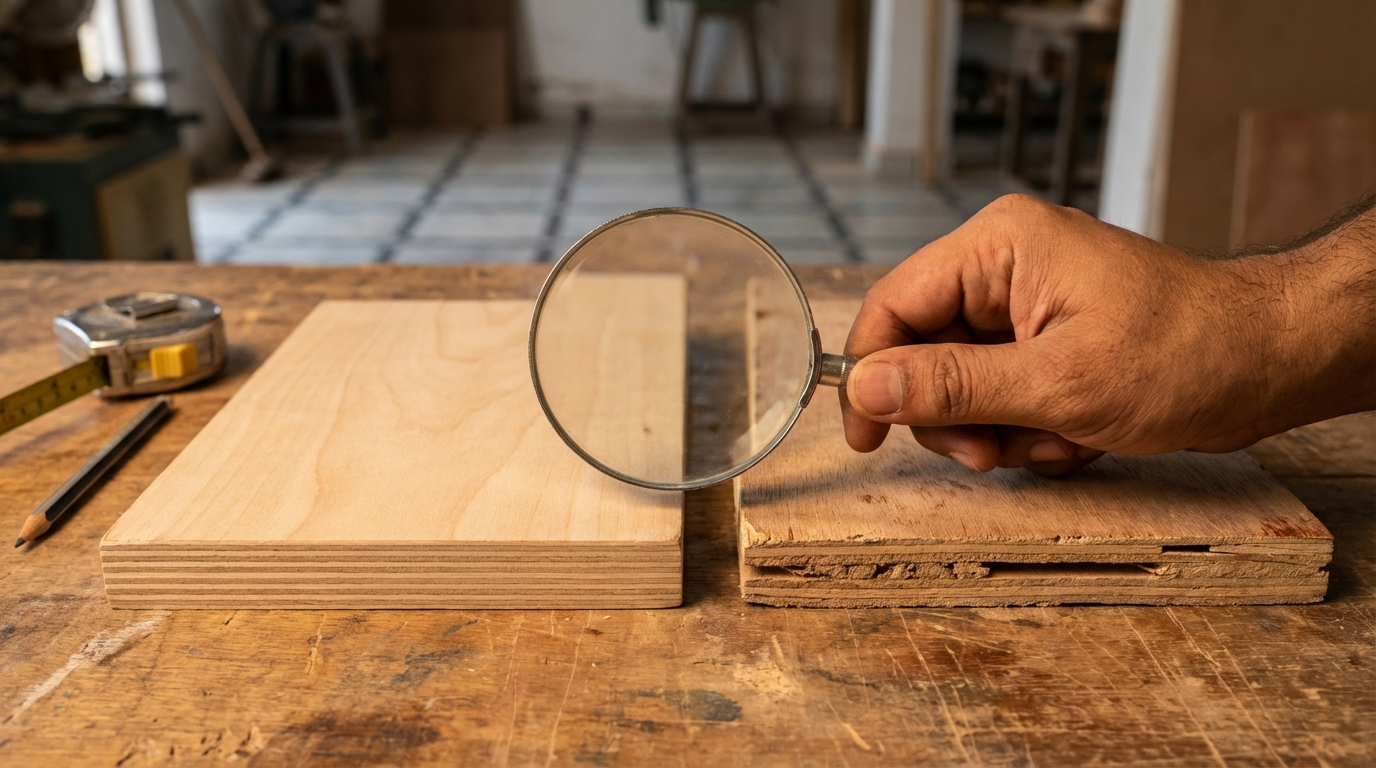
- Edges should be clean-cut without visible layers or voids
- Color should be consistent throughout—patchy coloring indicates mixing of different batches
- No visible swelling on edges (especially important in humid season)
- Check for warping—lay board flat on floor, all four corners should touch
Questions to Ask Your Dealer:
- "When did this batch arrive?"—older stock has moisture issues, especially post-monsoon
- "Is this calibrated MDF?"—calibrated boards have uniform thickness for better lamination
- "Can I see the cross-section?"—you want to check core density
- "What's the formaldehyde rating?"—E0 or E1 is what you want for indoor furniture
- "Do you have MR-grade in this thickness?"—always clarify, dealers often push what's in stock
Simple Field Tests:
Compare by dropping a sample sheet from waist height—consistent thud means uniform density. Test screw hold by driving 4-5 screws per sq ft; pull-out resistance should exceed 100kg without crumbling. For moisture, wipe edges with wet cloth after 24 hours; no swelling indicates better glue formulation.
Here's a trick most dealers don't like: ask for a small offcut sample, take it home, leave it on your balcony for 48 hours, then check the edges. If they've swelled noticeably in just two days of outdoor exposure, imagine what the monsoon will do to your furniture.
Warning Signs—Walk Away If:
- Edges are already slightly swollen even in the shop
- Board flexes significantly when held from one end
- Dealer refuses to let you see the edge cross-section
- Price is suspiciously lower than market rate with no clear reason
- Boards are stored flat on concrete floor without pallets
- Strong chemical smell beyond the normal resin scent—indicates off-gassing issues
Workmanship: What to Tell Your Carpenter
Even good material fails with bad installation. Contractor workflows often expose boards to site dust, causing adhesion failures; cover during transit. Workmanship issues like uneven screwing lead to sagging cabinets.
Cutting Requirements:
Cut MDF slow to minimize dust; plywood fast with zero-clearance blade. Pre-drill hinge zones 3mm, edge-band before assembly. MDF generates extremely fine dust—way more than plywood. Your carpenter needs a proper mask, and honestly, you should stay out of the room during cutting. The dust settles on everything and is terrible for lungs.
Edge Banding (Critical):
Every cut edge needs protection. Options:
- PVC edge banding (2mm)—most durable, requires hot-press or manual gluing
- ABS edge tape (0.8-2mm)—slightly more eco-friendly alternative
- Wood veneer edge—looks premium but less protective in humidity
The visible edges need matching edge tape for aesthetics. But even hidden edges—the back of a shelf, the bottom of a shutter—need at least a coat of sealant. This is where carpenters cut corners. Insist on full protection.
Screw/Fastener Guidelines:
- Use coarse-thread screws, not fine-thread—they grip the fiber structure better
- Pre-drill pilot holes always—MDF splits easily without them
- Minimum 25mm from edges, 30mm preferred for hinge screws
- For heavy loads (drawer slides, hinges), use insert nuts with machine screws
- Don't overtighten—the material compresses and loses grip
Briefing Checklist for Your Carpenter:
- Acclimatize boards for 48 hours before cutting—lay them flat in the room they'll be installed
- Pre-drill all screw holes—no exceptions
- Edge-band every cut surface, including hidden ones
- No screws within 25mm of any edge
- Apply sealant/primer to all surfaces before lamination
- Store boards flat on pallets or battens, never directly on floor
There was this project in Powai—2021 I think—where the carpenter stored MDF boards standing upright against the wall for a week. Half the batch developed a slight bow. The wardrobe shutters never sat flush properly. Had to replace three of them. All because of improper storage during the work period.
Can you use MDF in bathrooms?
Short answer: no. Longer answer: technically MR-grade MDF with factory-sealed surfaces and proper edge protection can survive in a dry toilet where there's no shower. But why take the risk? Indoors only, sealed. Failures common in verandahs. Alternate: Cement boards. For any bathroom application, go marine plywood or HDHMR. The MDF savings aren't worth the replacement hassle when it inevitably fails.
How Long Does MDF Really Last?
Here's what I tell my clients: "Under the right conditions, 8-12 years. Under the wrong conditions, 8-12 months."
The right conditions mean:
- Dry room with AC or good ventilation
- Proper edge banding on all surfaces
- Quality sealant/laminate finish
- No water exposure
- No heavy loads if using standard grade
In places like Delhi or Jaipur with dry climates and consistent indoor conditions, I've seen MDF furniture last 15+ years without issues. A client's TV unit from 2008 is still going strong.
But in Mumbai? In my experience, even well-made MDF furniture in non-AC bedrooms starts showing issues around year 4-5. Edges soften, shutters stick, surfaces may develop subtle waviness. Both: Termite treatment essential in India; no material is fully "maintenance-free" in humidity.
Signs of Wear to Watch:
- Edges becoming soft or crumbly
- Doors not closing flush anymore
- Surface laminate bubbling or peeling at edges
- Screws loosening in hinge zones
- Visible swelling on exposed edges
- Musty smell in enclosed furniture
When to Replace: If more than 30% of a piece shows these symptoms, repair becomes more expensive than replacement. Don't throw good money after bad.
Alternatives Worth Considering
MDF isn't your only option for smooth-surface furniture. Depending on your budget and requirements:
HDHMR (High-Density High Moisture Resistance): HDHMR boards remain one of the most in-demand materials in India's plywood and MDF ecosystem. Basically a premium engineered board that handles moisture way better than standard MDF. Costs more—₹80-130/sq ft for 18mm—but significantly more reliable in humid conditions. Our HDHMR guide covers this in more detail.
Prelam Particle Board: Cheaper than MDF but less durable. For lightweight furniture, particleboard can work for temporary furniture, office partitions, or rental property furnishing where long-term durability isn't the priority. The particle board selection guide breaks down when this makes sense.
BWR Plywood: For most Indian wardrobes, pick BWR grade plywood over standard MDF. It handles humidity better, supports heavier loads on shelves, and resists warping longer. If budget is tight, even commercial-grade plywood outperforms MDF in structural applications. Costs 20-40% more but lasts significantly longer in Indian conditions.
Frequently Asked Questions
Is MDF weaker than plywood?
When considering if MDF is stronger than plywood, it's important to note that plywood is generally stronger due to its layered construction. While MDF offers a smooth finish and is less prone to warping, it lacks the structural strength and durability found in plywood. For decorative non-structural work, MDF's strength is adequate. But for anything load-bearing—shelves, bed frames, cabinet carcasses—plywood wins. MDF board is a relatively soft material that tends to sag or split under heavy weight.
Is it true that MDF causes health problems?
The main concern is formaldehyde off-gassing from the resin binders. This is more pronounced in poorly manufactured MDF or in poorly ventilated spaces. Good quality MDF with E0 or E1 rating has minimal formaldehyde emissions. The dust during cutting is a more immediate concern—extremely fine particles that can irritate lungs. Always use a proper N95 mask during cutting operations. Once installed and sealed, health risks drop significantly.
What if I live in Goa or coastal Karnataka?
I'd strongly advise against MDF for any furniture in coastal regions. Even MR-grade struggles with 85%+ humidity that's common for six months of the year. Coastal areas like Mumbai or Chennai demand MR grades with phenolic resins to fight 80%+ humidity. But even then, you're fighting a losing battle. Stick to marine plywood or HDHMR. The premium you pay upfront saves you replacement costs within 3-5 years.
Is it true that MDF is more eco-friendly than plywood?
It is also eco-friendly, as it is made from repurposed wood! There's some truth here—MDF uses wood waste that might otherwise be discarded. But it also contains synthetic resins, and the manufacturing process is energy-intensive. Plywood uses logs directly but from managed plantations. Neither is dramatically better environmentally. If sustainability is your priority, look for FSC-certified products of either type.
How long does MDF really last in Indian conditions?
Dry interiors with AC: 10-15 years realistically. Humid bedrooms without AC: 4-7 years before significant issues. Near moisture sources (kitchens, bathrooms): 1-3 years maximum, often less. The key variable is edge protection and ambient humidity. A well-sealed MDF piece in a Delhi home will outlast a poorly sealed one in Mumbai by at least five years.
Is it true that carpenters prefer plywood over MDF?
Plywood: Stronger but dustier cuts, needs precise carpenter skills; heavier transport. MDF: Smooth/cheaper but edge fragility demands full banding (adds labor); lower screw hold without inserts. Honestly, preferences vary. Some carpenters love MDF because it cuts cleanly without splinters and doesn't need grain-matching. Others hate it because of the dust, the weight, and the edge-banding requirements. Skilled modular furniture makers often prefer MDF. Traditional carpenters usually lean toward plywood.
Can MDF be used for exterior applications?
Absolutely not. Even "exterior grade" MDF products marketed in some countries aren't truly outdoor-suitable for Indian conditions. Direct rain, intense sun, and humidity fluctuations will destroy MDF faster than almost any other material. For exterior applications, consider marine plywood, WPC boards, or cement boards. The door frame guide covers exterior-suitable materials in detail.
What's the difference between MDF and HDF?
HDF (High-Density Fibreboard) is essentially MDF compressed to a higher density—typically above 800 kg/m³ compared to MDF's 600-800 kg/m³. HDF is harder, more durable, and more expensive. It's commonly used for laminate flooring cores and premium cabinet doors. For regular furniture, HDF is usually overkill unless you specifically need the extra hardness for high-traffic surfaces.
What if my carpenter suggests MDF for wardrobe carcass in Hyderabad?
Hyderabad sits in the middle ground—not as humid as coastal cities, but not as dry as Delhi. Standard MDF is risky; MR-grade MDF with full edge banding could work for bedroom wardrobes with decent ventilation. If you're in older parts of the city with less consistent AC, I'd lean toward plywood for the carcass and MDF for shutters only. The wardrobe materials guide covers this region-wise decision in more depth.
Is it true that prelam MDF eliminates moisture problems?
Prelam (pre-laminated) MDF has a factory-applied laminate on the faces, which helps with surface moisture protection. But—and this is crucial—the edges are still raw MDF until you band them. Most prelam failures happen at cut edges that were left exposed or poorly sealed. Factory lamination helps, but it doesn't make MDF waterproof. Edge protection remains essential.
How do I calculate how much MDF I need for a project?
Standard sheet size is 8x4 feet (32 sq ft) in India. Measure all your panels, add 10-15% for cutting waste and errors, then calculate total square footage needed. For a basic wardrobe, figure 3-4 sheets for carcass, 1-2 sheets for shutters depending on size. Always buy from the same batch to ensure color and density consistency. Your carpenter should give you a cutting list before you purchase.
Is it true that MDF is termite-proof?
Common misconception. Common confusions include mistaking MDF for plywood strength or assuming all brands resist termites equally—MDF relies on sealed finishes. The resin content makes MDF slightly less attractive to termites compared to natural wood, but it's not immune. In India, especially in older buildings or ground-floor flats, termite treatment remains essential regardless of material. Some premium MDF brands add boron compounds for termite resistance, but don't assume protection without verification.
Quick tip before I sign off: Ask quotes specifying: "18mm MR calibrated MDF, recent batch, sample density test." That one sentence in writing to your dealer eliminates half the quality issues I see. And seriously—don't skip the edge banding.
Disclaimer: This content is provided for general informational purposes based on industry practices and publicly available information. Product specifications, standards, prices, and availability may vary by manufacturer, region, and time. Readers should independently verify details with manufacturers, dealers, or qualified professionals before making purchase or construction decisions.
Want Plywood Suggestions?
Share a few details and a Sainik 710 specialist will suggest suitable brands and connect you to responsive dealers.