Marine Plywood vs BWP Plywood: Differences, IS Standards, Price Drivers & Best Uses
Understand marine plywood vs BWP plywood—standards, bonding and core quality, best uses, and what really drives price in the market.
Quick Decision Summary
Marine plywood (IS:710) edges out standard BWP plywood (IS:303) for extreme wet zones due to superior core density and glue strength, but standard BWP suffices for most Indian kitchens and wardrobes.
If you're in a hurry: Opt for marine plywood only in high-risk coastal or perpetually damp areas like Mumbai bathrooms or Kerala home spas—its stricter standards prevent core failure under prolonged boiling water exposure (72 hours vs 8 hours). For typical modular kitchens or humid wardrobes inland, IS:303 BWP grade handles monsoons well at lower cost. Always verify the IS stamp and core quality on-site, as mislabeling is common in local markets.
- Choose marine plywood (IS:710) if: Constant submersion risk (e.g., boat building, coastal partitions), heavy structural loads, or termite-prone zones needing preservative-treated plies.
- Choose BWP plywood (IS:303) if: Semi-wet interiors like kitchens or bathrooms with good ventilation, budget constraints, or lighter installations.
- Avoid marine plywood if: Dry interiors (bedrooms/TV units)—overkill and expensive; opt for BWR instead.
- Avoid standard BWP if: Marine-like exposure without ventilation—risks delamination over 5-7 years.
What This Actually Means (Grade, Construction, and Use)
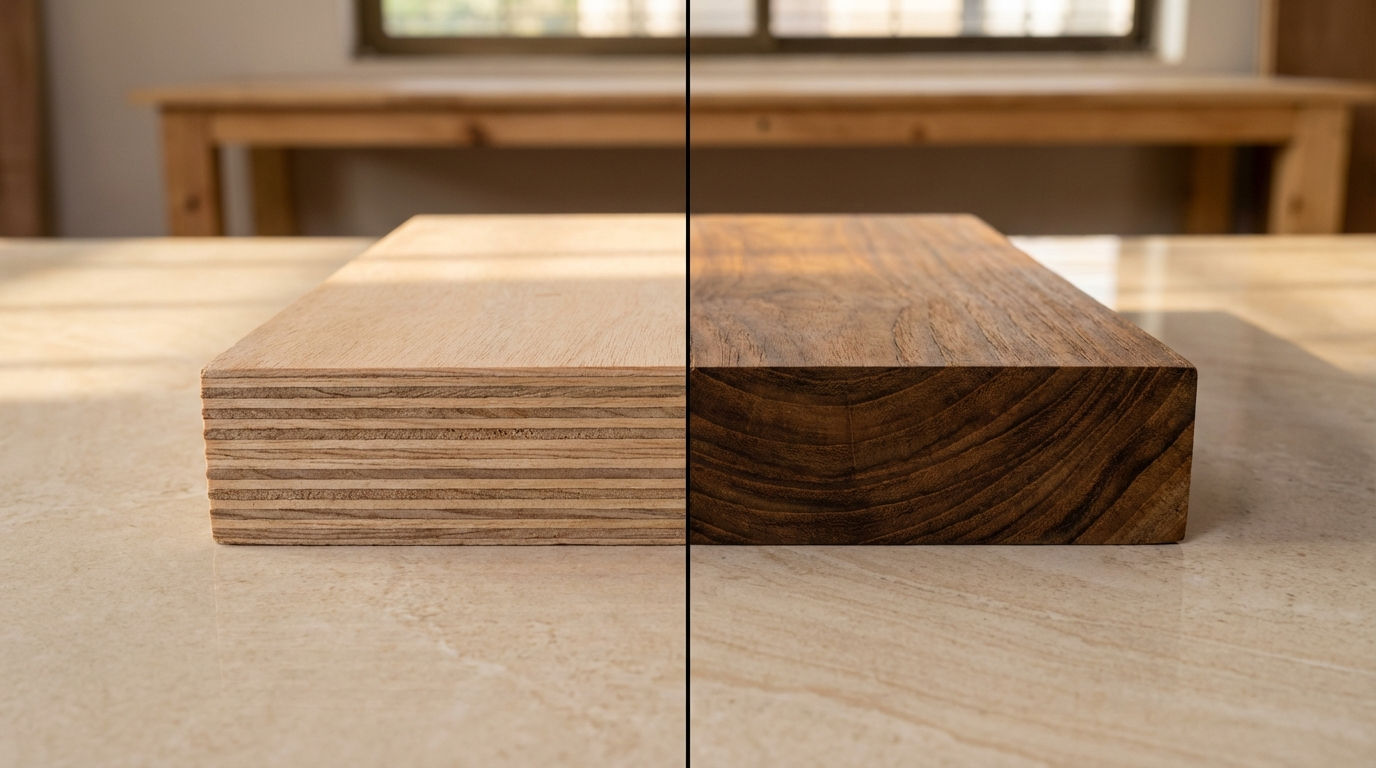
In Indian plywood grading, BWP stands for Boiling Water Proof, typically certified under IS:303, the standard for general-purpose plywood. This grade must endure boiling water cycles for at least 8 hours without delaminating, using phenolic resin glue and cross-banded veneers. Construction involves 5-13 plies depending on thickness, with faces often in softwood or hardwood veneers (0.5-1.5mm thick) and a mixed core of poplar, eucalyptus, or mango. It's designed for interiors with intermittent moisture, like splash-prone kitchen cabinets or wardrobe bases in humid cities such as Delhi during rains.
Marine plywood, governed by IS:710, elevates this to structural levels—think boat hulls or high-humidity facades. It withstands 72 hours of boiling without failure, mandates 100% hardwood cores (teak-like tropical woods), zero voids or knots over 25mm, and preservative treatments against fungi/termites. Glue is pure phenol formaldehyde, ensuring zero gap construction. Thicknesses from 4mm to 25mm are common, with calibrated surfaces for seamless laminates. Everyday uses include modular kitchens in coastal Goa homes, bathroom vanities in Chennai apartments, or partition walls in spas—anywhere plywood faces repeated wetting-drying cycles.
The core difference lies in rigor: IS:303 BWP allows minor defects and mixed woods for cost control, suiting carpenter-led wardrobes. IS:710 demands uniformity, making it architect-preferred for load-bearing shelves. Both resist termites better than MR grades due to glue additives, but marine's density boosts screw-holding by 20-30%. In practice, uncalibrated BWP warps faster in monsoons without edge sealing, while marine holds shape longer.
Thickness guides use: 12-18mm for cabinets (shelves up to 1m span), 6-9mm for doors/back panels. Always pair with matching finishes—veneers on marine for premium looks, laminates on BWP for budget modulars.
India-Specific Reality Check (Moisture, Termites, and Workmanship)
India's climate turns plywood choices into survival tests: monsoons dump 80-90% humidity for months, coastal salt air corrodes edges, and poor site storage invites swelling. In Kolkata or Mumbai, untreated BWP (IS:303) delaminates in 3-5 years if stacked outdoors without covers, as carpenters often do during site delays. Marine (IS:710) fares better with its sealed plies, but even it fails if not acclimatized 48-72 hours indoors before cutting.
Termites thrive in tropical soils—northern plains see subterranean attacks, southern coasts white ants. BWP glues offer moderate protection, but marine's preservatives (copper-based) extend life to 15+ years. Workmanship pitfalls abound: local fabricators skip edge sealing on BWP shelves, leading to core exposure and warping. In ventilated kitchens, BWP shines; unvented bathrooms demand marine to avoid fungal blooms.
Handling norms: Store sheets flat, elevated 6-12 inches off ground, wrapped in plastic. Coastal contractors in Kochi report 20% rejection rates from salty fog on standard BWP—marine cuts this to under 5%. Contractor practices like using undersized screws strip marine's dense core less, but overload BWP shelves cause sagging. Ventilation logic: Pair with exhaust fans; without, upgrade to marine for wet zones. Real-world: Inland Ahmedabad wardrobes use BWP fine; Chennai sea-facing balconies need marine or risk panel blowouts in cyclones.
Comparison That Actually Helps
This side-by-side breaks myths—marine isn't "always better"; it suits extremes where BWP buckles. Focus on your exposure level, not labels.
| Feature | BWP Plywood (IS:303) | Marine Plywood (IS:710) |
|---|---|---|
| Water Resistance Test | 8 hours boiling | 72 hours boiling |
| Core Material | Mixed (poplar/eucalyptus/softwood) | 100% Hardwood (tropical) |
| Defect Tolerance | Minor voids/knots allowed | Zero voids >25mm; knot-free |
| Strength (Modulus of Rupture) | Medium (40-50 N/mm²) | High (55+ N/mm²) |
| Termite/Fungi Treatment | Glue additives | Preservative impregnated |
| Typical Thickness Range | 6-18mm | 4-25mm |
| Best For | Kitchens, wardrobes (ventilated) | Bathrooms, coastal, structural |
Use this for quick scans: If your project hits 3+ marine columns, upgrade. Trade-off: Marine weighs 20% more, raising transport costs in hilly areas like Shimla.
Price Range and Cost Drivers
Expect wide variation—₹1,800-3,500 per 8x4 sheet for 18mm, but city-wise: Mumbai/Coastal 15-20% premium over inland like Lucknow. BWP (IS:303) typically ₹2,000-2,800/sheet (18mm); marine (IS:710) ₹2,800-4,000+. Thinner 12mm drops 25-30%: BWP ₹1,400-2,000, marine ₹2,000-2,800.
Key drivers: Core type (hardwood adds ₹400-800/sheet vs mixed); glue purity (pure PF 10-15% hike); calibration (sanded uniform +₹200-400); batch/region (monsoon logistics +10%). Brand premiums vary, but focus on IS marks. For a 10x6ft modular kitchen (40 sheets 18mm): BWP ₹80,000-1,10,000; marine ₹1,10,000-1,60,000—factor 20% extra for edges/laminates.
Estimate rule: Base ₹110-150/sqft (18mm BWP) x area x 1.2 (waste/logistics). Coastal buyers add 15% buffer; verify vendor batches as quality dips in peak demand. Avoid "BWP deals" under ₹1,800/18mm—likely downgraded cores.
How to Choose in 5 Steps
- Map moisture risk: Low (dry rooms)=BWR; medium (kitchen splashes)=BWP IS:303; high (bath/coastal)=marine IS:710. Score ventilation: poor=upgrade.
- Verify standards: Insist on IS:303 BWP or IS:710 stamps per sheet—fake labels abound. Ask for boil test certs if bulk.
- Inspect core: Knock for solid thud (no hollows); check edges for uniform plies, no gaps. Hardwood marine feels denser/heavier.
- Match thickness/use: 18mm shelves (600mm span); 12mm carcasses. Calibrated for CNC routing.
- Test hold/fasteners: Screwdriver twist—marine grips 2x screws without stripping. Budget check: Total cost vs 10-year lifespan.
This framework saves 20-30% rework. Architect tip: Hybrid—marine for wet bases, BWP uppers.
Quality Checks You Can Do Without Lab Tests
Skip fancy tools: At godowns, lift sheets—marine/IS:710 feels hefty (25-30kg/18mm) vs lighter BWP. Tap surfaces: Uniform dull thud signals void-free; hollow echoes voids. Edge scrutiny: No ply gaps/delam; uniform glue lines (dark brown PF). Smell fresh phenolic—no musty rot.
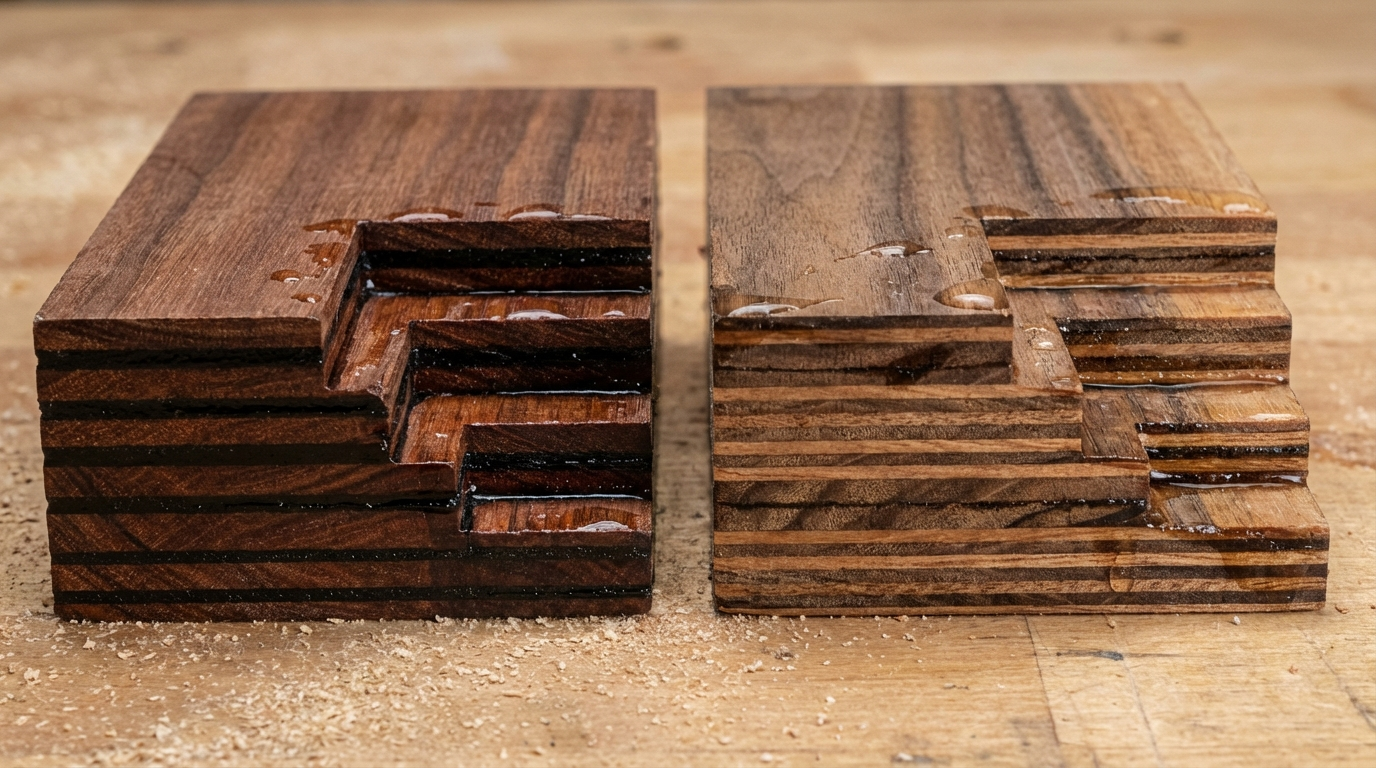
Questions for vendors: "Show last batch IS test reports? Core wood origin? Boil retention %?" Warning signs: Warped stacks (pre-moisture damage); mismatched stamps (fakes); soft screw insertion (weak glue). Field test: Wet corner 24hrs—minimal swell (<5%) good. Carpenters: Cut sample—clean edges sans fuzz mean calibrated. Coastal buys: Probe salt resistance via vendor refs.
Common Buyer Mistakes and How to Avoid Them
1. Misreading labels: "BWP" everywhere, but few true IS:710. Avoid: Demand stamp photos pre-delivery.
2. Ignoring core voids: Mixed cores gap in humidity. Avoid: Edge-check 3 sheets randomly.
3. Skipping acclimatization: Direct install swells panels. Avoid: 72hrs site-stacked.
4. Undersizing thickness: 12mm sags loaded shelves. Avoid: Span charts—18mm/600mm max.
5. Poor edge sealing: Exposed cores wick moisture. Avoid: PVC tapes full perimeter pre-laminate.
6. Overlooking screw zones: Weak holds drop doors. Avoid: Pilot holes + marine for hinges.
7. Coastal downgrade: BWP fails salty air. Avoid: IS:710 + annual polish.
8. Batch inconsistency: Varies by vendor load. Avoid: Single-source full project.
9. No ventilation plan: Traps humidity. Avoid: Exhaust specs upfront.
Workmanship & Installation Tips
Cutting: CNC for marine (dense, less tear-out); circular saw BWP with zero-clearance blade. Post-cut: Seal raw edges same-day with epoxy/PU—prevents monsoon wicking. Laminates: Heat-press marine faces (better bond); vacuum-press BWP.
Fastening: Marine holds 50-60kg/m² screws; pre-drill 3mm pilots. Hinges: Reinforce 50x50mm marine blocks in wet zones—BWP needs doubles. Handles: Top-load shelves limit to 75% capacity first year.
Storage: Vertical racks, 30% RH ideal. Acclimatize: Match site humidity 3 days. Installer QC: Level checks post-monsoon; silicone caulk joints. Fail modes: Rushed sealing=warps; overload=creaks. Carpenter pro: Marine routs finer for curved vanities.
Best Uses and Real-World Scenarios
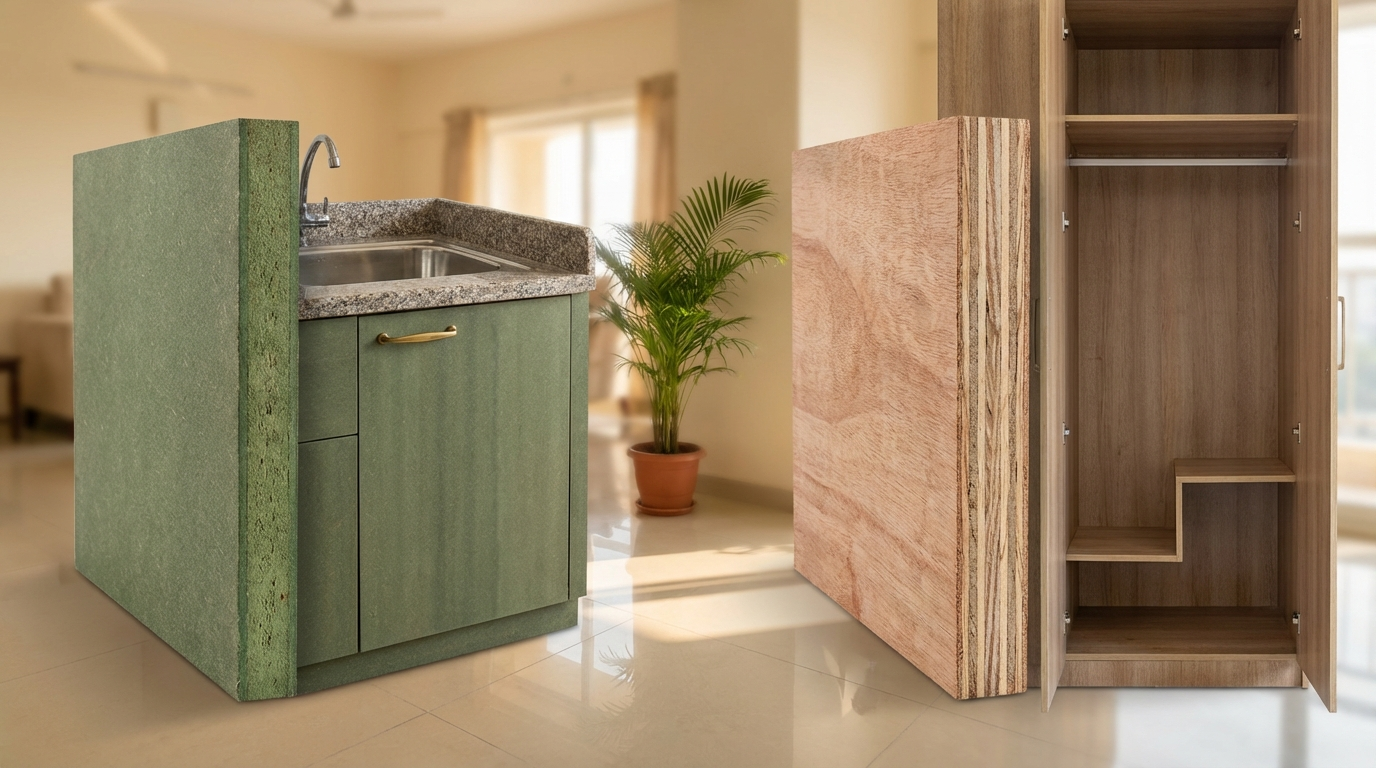
BWP IS:303: Modular kitchens (carcasses/shelves) in ventilated Pune flats—handles spills, lasts 10yrs. Wardrobe bases in humid Bangalore. TV units with wet bars.
Marine IS:710: Chennai sea-view bathrooms (vanities/showers); Kerala spa partitions; Mumbai high-rise balconies. Boat seating, spa benches. Contractor scenario: 20-flat project—BWP saves ₹5L, marine for pilot wet units.
Homeowner: Coastal villa kitchen—island in marine, uppers BWP. Architect: Load-bearing lofts=marine. OEM modulars: BWP for mass, marine premium lines.
Trade-offs and Limitations
| Use Case | Best Choice | Why? (Trade-offs) |
|---|---|---|
| Modular Kitchen (Ventilated) | BWP IS:303, 18mm | 80% durability at 60% cost; lighter for install. Limitation: Avoid unvented sinks. |
| Bathroom Vanity | Marine IS:710, 12-18mm | Zero swell; holds steam. Trade-off: Heavier, pricier cuts. |
| Wardrobe Base (Humid) | BWP 18mm | Termite ok; easy laminate. Limit: Elevate 10cm off floor. |
| Coastal Partition | Marine 18mm | Salt-proof. Trade-off: Stains harder. |
| Bed Frame | BWP 12mm | Overkill marine adds weight/cost. |
Honest limits: Marine harder to hand-cut (blunts blades); both warp if unsealed. BWP cheaper but 20% less span strength.
Frequently Asked Questions
Is marine plywood always better than BWP?
No, marine (IS:710) excels in extreme submersion like coastal baths, but standard BWP (IS:303) matches for typical Indian kitchens with ventilation. Over-specifying marine inflates budgets 30-50% without proportional gains in dry zones, where its density adds unnecessary weight during handling by carpenters.
Can BWP plywood be used for bathrooms?
Yes, IS:303 BWP works in well-ventilated bathrooms with proper sealing, lasting 8-12 years against splashes. However, in steamy unvented spaces like Indian joint bath-toilets, upgrade to marine to dodge delamination from constant 90% humidity—pair with exhaust fans and silicone joints for best results.
What thickness for kitchen cabinets?
Typically 18mm for carcasses and shelves spanning 600mm, holding 20-30kg loads without sag. Use 12mm for backs/sides to cut weight/cost. Marine suits sink bases; BWP fine elsewhere. Always calibrate for flat laminates, as uneven thickness warps under monsoon humidity.
How to spot fake marine plywood?
Check every sheet for crisp IS:710 mark (not photocopied); dense thud on tap; no edge voids. Vendors faking with BWP—demand boil test proof. Weight test: Genuine marine 18mm ~28kg vs lighter fakes. Coastal markets rife; buy certified batches only.
Does marine plywood resist termites better?
Yes, IS:710 mandates preservatives throughout plies, outperforming BWP's glue-only protection in termite belts like UP or TN. Expect 15+ years vs 10; still, site-treat bases with oil for extras. Mixed cores in cheap BWP invite faster attacks if unsealed.
Price difference between marine and BWP?
Marine runs 30-50% higher due to hardwood cores and tests—e.g., 18mm sheet gap of ₹800-1,200. Varies by city (coastal premium) and calibration. Budget wisely: BWP covers 80% needs affordably; marine pays off in wet failures avoided over decade.
Can I use BWP for outdoor furniture?
Not recommended—UV/moisture cycles delam even sealed BWP in 2-3 years. Marine better but still needs heavy varnish; prefer WPC alternatives. Indoor-outdoor like covered patios: Marine with polish works marginally.
Edge sealing essential for both?
Absolutely—unsealed edges wick humidity, swelling cores in monsoons regardless of grade. Use PU sealant or PVC tapes pre-install; marine's density slows it, but BWP accelerates. Skip=50% lifespan cut; carpenter staple.
Screw holding: Marine vs BWP?
Marine's dense hardwood grips 2x pulls (50 cycles no strip) vs BWP's mixed core. Ideal for heavy doors; reinforce BWP with inserts. Pre-drill always—avoids splits in humid sites.
Best for modular wardrobes in humid areas?
BWP 18mm base/12mm sides, elevated 15cm, sealed edges—handles 70-80% RH fine for 10yrs. Marine overkill unless coastal/poor vent; hybrid saves cost while protecting vulnerable bottoms.
IS standards: What if no stamp?
Reject—stamps guarantee tests; unstamped risks 40% failure rate in wet use. IS:303 BWP for basics, 710 for pro. Vendor claims mean nothing without per-sheet marks.
Disclaimer: This content is provided for general informational purposes based on industry practices and publicly available information. Product specifications, standards, prices, and availability may vary by manufacturer, region, and time. Readers should independently verify details with manufacturers, dealers, or qualified professionals before making purchase or construction decisions.Want Plywood Suggestions?
Share a few details and a Sainik 710 specialist will suggest suitable brands and connect you to responsive dealers.