Main Hall Modern TV Unit Design: 60+ Wall-Mounted, Panel & Cabinet Ideas with Size Guide
Get 60+ TV unit designs for main hall—wall-mounted, panel, cabinet styles. Size guide, material options & best plywood thickness for lasting TV units.
Quick Answer (TL;DR)
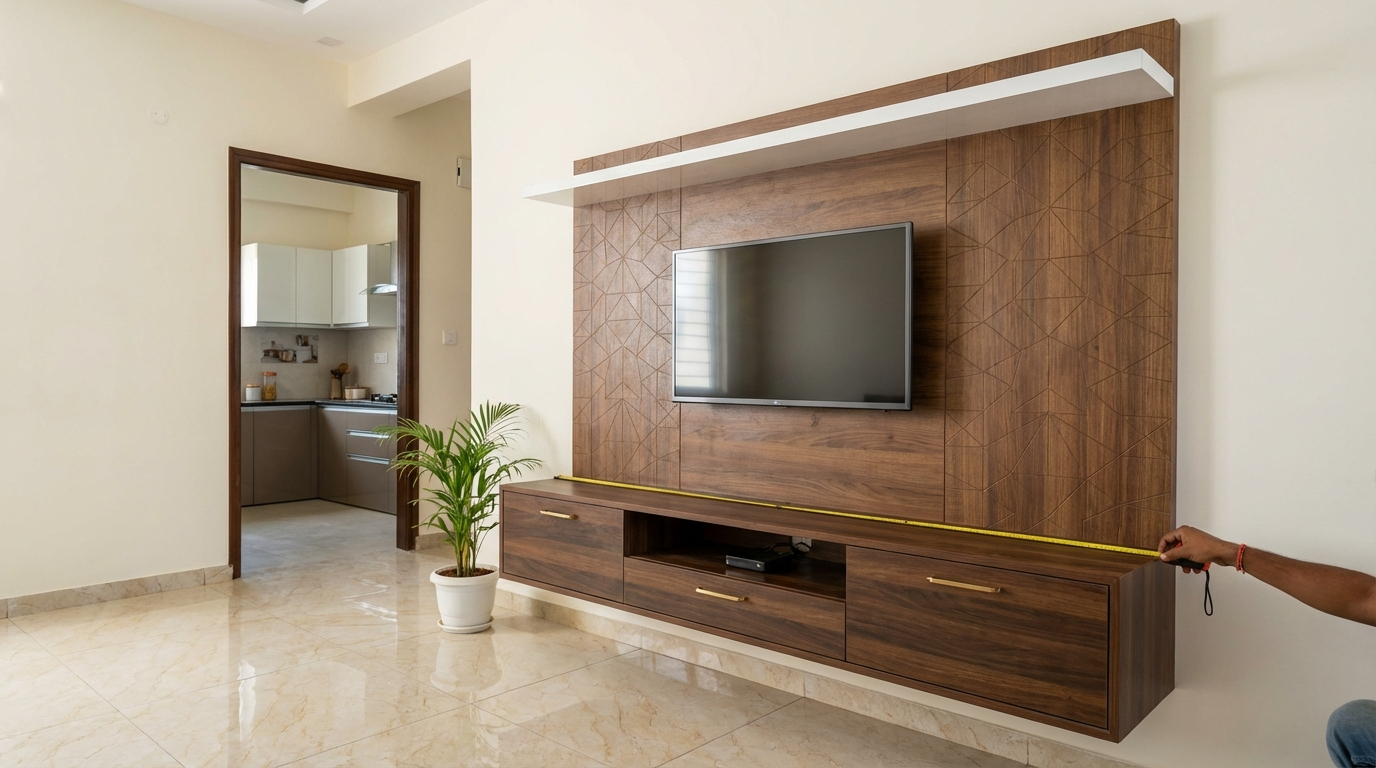
Best TV unit for Indian halls: A wall-mounted or floating plywood unit (18mm BWR-grade) with integrated storage, sized 10-15cm wider than your TV on each side, keeps your main hall modern, practical, and humidity-resistant.
Bottom line: Modern TV unit designs for Indian halls in 2026 prioritize sleek wall-mounted panels, floating units with LED backlighting, and modular cabinet systems that combine entertainment needs with smart storage. The trend has shifted toward "Media Walls"—sleeker, lower-profile designs that give you storage without the bulk, functioning as a curated part of the wall rather than a heavy box sitting against it.
Choose this if:
- You want a clutter-free, spacious-looking living room
- Your hall has limited floor space but adequate wall width
- Your apartment is in a humid Indian city where wall-mounted units save floor space and offer a clean look
- You need integrated storage for set-top boxes, gaming consoles, and remotes
Skip this if:
- You live in a rental where wall drilling is restricted
- Your wall cannot support mounting brackets (weak plaster or hollow construction)
- You prefer furniture that can be moved during rearrangements
Key takeaway: The ideal main hall TV unit balances aesthetics with India-specific needs—humidity resistance, cable management, and multi-functional storage—while keeping the room visually open.
Note: sainik710.com is an independent informational site and is not affiliated with any manufacturer.
What a Modern TV Unit Actually Means in Plain Terms
A modern TV unit is a furniture piece or wall-mounted system designed to support your television, manage cables, and provide storage for media accessories. A TV console is furniture designed to support and house a television and related accessories, often including shelves, drawers, or cabinets for storage, designed in various styles to complement home decor.
In the Indian context, the term "TV unit" (sometimes called TV cabinet, entertainment unit, or simply "TV stand" by carpenters) has evolved significantly. TV units have evolved from mere functional pieces to integral components of home decor, and as we step into 2026, the designs have become more innovative and stylish, catering to a wide range of tastes and preferences.
Technical Breakdown for Informed Buyers
TV units typically fall into these categories:
- Wall-mounted/Floating units: Floating TV units are attached to the wall without supports, shelving, or legs—by positioning the TV off the ground, homeowners can enjoy more floor space and create a visually interesting focal point.
- Floor-standing consoles: Traditional units that rest on the floor with cabinets and drawers
- Full-wall entertainment panels: The most exciting trend involves integrating multiple textures and finishes into a single, cohesive media wall, turning the area into a piece of architectural art.
- Modular/Sectional systems: Modular TV units consist of multiple separate components that can be arranged, placed, and customized to suit the needs of the homeowner and their space.
Myth: "Wall-mounted TV units damage walls permanently and aren't suitable for Indian homes."
Reality: With proper installation using appropriate wall anchors and a backing plywood plate behind the mounting area, wall-mounted units are completely secure. Attaching a plywood or MDF backing plate behind the bracket location, fixed with construction adhesive and screws, strengthens the wood panel behind the TV and improves load distribution. The few anchor holes can be easily filled during future renovations.
Why This Matters for Indian Homes Specifically
Indian living rooms face unique challenges that Western TV unit designs rarely address. Understanding these factors ensures your TV unit lasts 15-20 years without warping, swelling, or looking dated.
Monsoon and Humidity Factors (70-90% RH)
During monsoon months (June-September), relative humidity in cities like Mumbai, Chennai, and Kolkata can exceed 85%. Plywood with a laminate finish is the most durable and cost-effective option for Indian homes—it handles weight well and resists humidity. Standard MR-grade plywood absorbs this moisture, leading to gradual swelling of shutters, warping of panels, and eventual edge delamination. In my experience installing TV units in Mumbai's coastal areas, units made with MR-grade ply show visible warping within 3-4 years, while BWR-grade units remain stable for 10+ years.
Coastal vs Inland Considerations
MDF works for intricate designs but isn't ideal in humid regions. For coastal cities (Mumbai, Chennai, Visakhapatnam, Kochi), I always recommend BWR or BWP-grade plywood with all edges properly sealed. Inland cities with drier climates (Delhi, Jaipur, Nagpur) can safely use MR-grade plywood for TV units, though BWR remains the safer long-term choice.
Common Indian Home Scenarios
In Indian homes, modular units with set-top box trays, wire cutouts, and closed drawers help maintain aesthetics—mix open and closed storage to balance display and utility without adding bulk.
Typical Indian hall requirements include:
- Space for DTH/cable set-top box with ventilation
- Storage for Wi-Fi router (often placed near the TV)
- Drawer for remotes, batteries, and chargers
- Display shelves for religious items, family photos, or decor
- Cable management for multiple devices
TV Unit Size Guide: Dimensions for Every TV Screen
The ideal standard size of a TV cabinet should be at least 8" to 10" (20-25cm) wider than the TV size on each side—this helps the TV be placed at the center and provides the best viewing experience.
What Size TV Unit Do I Need for Different TV Sizes?
On a general note, the unit's width should be approximately 15 to 30 cm on either side of the screen—this creates visual balance and offers ample surface for speakers or decor elements.
| TV Size (Diagonal) | TV Width (Approx.) | Recommended Unit Width | Minimum Unit Depth | Ideal for Room Size |
|---|---|---|---|---|
| 32 inches | 73 cm | 100-120 cm (3.5-4 ft) | 30 cm | Small bedroom, 10x10 ft hall |
| 43 inches | 97 cm | 130-150 cm (4.5-5 ft) | 35 cm | Medium hall, 12x12 ft |
| 55 inches | 123 cm | 160-180 cm (5.5-6 ft) | 40 cm | Standard living room, 14x14 ft |
| 65 inches | 145 cm | 180-210 cm (6-7 ft) | 45 cm | Large hall, 16x16 ft+ |
| 75 inches | 167 cm | 210-240 cm (7-8 ft) | 45 cm | Spacious living, home theatre |
What Height Should a TV Unit Be in Indian Homes?
The ideal height to place your TV depends on your eye level when seated—the centre of the TV screen should be at eye level, which is usually around 42 to 48 inches (107-122 cm) from the floor.
A 45 to 60 cm tall TV unit keeps the screen at a comfortable height and prevents neck strain during extended viewing. For floor-sitting arrangements common in many Indian homes (watching TV while sitting on mattresses or floor cushions), lower units around 35-40 cm work better.
60+ Modern TV Unit Design Ideas by Style Category
Wall-Mounted and Floating TV Unit Designs (15 Ideas)
A big trend for 2025-2026 is the floating TV unit, a minimalist design solution that's gaining traction in modern homes thanks to its visually striking appearance and practical benefits that elevate interiors and support clutter-free living rooms.
- Sleek white floating console – 18mm pre-laminated HDHMR, matte white finish, 150cm width, single long drawer with push-to-open mechanism
- Walnut veneer floating unit with LED backlight – 18mm BWR plywood, natural walnut veneer, concealed LED strip behind, 180cm width
- Grey and white minimalist floating panel – Two-tone laminate finish, asymmetric open shelf design, ideal for 55-inch TVs
- Floating console with hidden cable box – Flip-down door concealing set-top box tray, proper ventilation cuts
- Industrial floating unit – Metal frame with BWR plywood shelves, exposed hardware aesthetic
- Scandinavian-style floating unit – Light oak laminate, clean lines, 2 soft-close drawers
- Compact floating shelf system – Single 120cm floating shelf with 2 wall-mounted cubbies
- L-shaped floating unit – Corner-mounted design for small halls, maximizes unused wall space
- Floating unit with side tower – Main console plus vertical cabinet for books/display
- Backlit floating panel without storage – Pure aesthetic panel with concealed wall bracket mounting
- Floating unit with integrated soundbar shelf – Dedicated slot below TV for soundbar placement
- Dual-tone floating console – Charcoal base with wood-grain drawer fronts
- Floating unit with open metal frame – Minimalist wire frame supporting plywood shelves
- Compact floating unit for bedroom – 100cm width, single drawer, ideal for 32-43 inch TVs
- Premium floating unit with veneer and PU finish – High-gloss polyurethane coat over real wood veneer
Full Wall Panel TV Unit Designs (15 Ideas)
Key materials include fluted wood panels paired with luxurious marble or sintered stone cladding, and textured plaster juxtaposed with sleek metallic inlays.
- Full-height fluted panel wall – Vertical grooved MDF panels from floor to ceiling, TV mounted centrally
- Stone-finish accent panel – PVC-laminated panel with marble texture, budget-friendly luxury look
- Wooden slat TV wall – Horizontal wooden battens creating textured backdrop, 19mm plywood base
- Two-tone media wall – Half wood panel, half painted wall, TV bridging both sections
- Backlit panel with floating console – Illuminated acrylic or frosted glass strip behind TV
- Textured wallpaper panel – Combining TV panel design with wallpaper adds texture and color for visual interest
- Concrete-effect panel – Industrial aesthetic using textured laminates mimicking cement finish
- Gold accent panel – Neutral base with metallic gold inlay strips for festive Indian aesthetic
- Geometric pattern panel – CNC-routed geometric designs on MDF panel
- Rustic wood plank wall – Reclaimed wood effect using textured laminates
- Niched panel with display shelves – Recessed TV area with side niches for decor
- Fabric-wrapped acoustic panel – Sound-absorbing panel for home theatre effect
- Mirror-strip accent panel – Alternating wood and mirror strips for visual depth
- Leather-textured panel – Premium leatherette finish panel for contemporary luxury
- Terrazzo-pattern panel – Trendy terrazzo-effect laminate for modern halls
Cabinet-Style TV Unit Designs with Storage (15 Ideas)
Multifunctional storage units are like the Swiss Army knives of furniture—TV stands that offer functions beyond just supporting your television, incorporating work-from-home desks, coffee counters, mini bars, and even puja units.
- Classic floor-standing console with drawers – Traditional 150cm unit with 3 drawers, 2 open shelves
- Entertainment centre with side towers – Full-width unit with vertical display cabinets on both sides
- TV unit with integrated bookshelf – Combining bookshelf or showcase with your TV unit is a smart, space-efficient idea—use vertical open shelves on one or both sides for books, artefacts, or photos
- TV unit with closed cabinets – All-concealed storage for dust-free electronics
- Combination TV and study unit – Side desk extension for work-from-home needs
- TV unit with puja shelf – Integrated small temple/puja space for religious homes
- TV unit with bar cabinet – Pull-out or flip-down bar section for entertaining
- Multi-drawer media console – 6+ drawer unit for maximum storage capacity
- TV unit with glass display – Tempered glass door cabinets for showcase items
- TV unit with integrated lighting – LED strip lights enhance visual appeal and create theatre-like ambiance—warm or cool white LEDs behind the panel or under floating units work well
- Asymmetric cabinet design – Non-symmetrical layout for contemporary appeal
- Low-height cabinet unit – Japanese-inspired low profile, ideal for floor-seating rooms
- TV unit with adjustable shelves – Flexible internal configuration
- TV unit with pull-out trays – Dedicated gaming console and DTH box trays
- Handleless cabinet TV unit – Push-to-open mechanisms for sleek finish
Corner and Space-Saving TV Unit Designs (10 Ideas)
In smaller living rooms, corner TV units are an excellent alternative—they make the most of often-neglected corner spaces while offering an attractive display for your television.
- Triangular corner unit – Custom-fit for 90-degree corners, 18mm BWR plywood
- L-shaped corner console – Wraps around corner with storage on both walls
- Compact corner floating shelf – Minimal footprint for very small rooms
- Corner unit with swivel mount – Swivel TV units allow you to rotate your TV to face different parts of the room, ideal for open-plan living spaces or multi-functional rooms
- Corner entertainment centre – Full-height corner unit with display and storage
- Tall narrow corner unit – Vertical design maximizing corner height
- Corner unit with plant shelf – TV walls with niches and shelves for plants soften the look and bring freshness to small apartments
- Diagonal corner unit – Unit placed diagonally across corner for flexible TV positioning
- Corner unit with mirror back – Creates illusion of more space
- Compact corner console – Simple 90cm unit for bedrooms with small TVs
Traditional and Ethnic TV Unit Designs (10 Ideas)
- Carved wooden TV unit – Traditional Indian jali work on cabinet doors
- Teak finish classic console – Rich brown teak veneer with brass handles
- Temple-integrated TV unit – Dedicated puja mandap section with TV cabinet
- Antique-style TV cabinet – Distressed finish with vintage hardware
- Rosewood-look TV unit – Premium sheesham-effect laminate
- Rajasthani-inspired TV unit – Bright colours with traditional motifs
- South Indian-style TV unit – Dark wood with brass inlay details
- Colonial-style TV console – British-era inspired design with turned legs
- Moroccan-pattern TV unit – Geometric pattern doors with metallic accents
- Indo-contemporary fusion unit – Modern form with traditional Indian patterns
Best Plywood Thickness for TV Units: Complete Guide
The plywood thickness you choose directly impacts the unit's durability, cost, and ability to hold weight without sagging.
Why Does Plywood Thickness Matter for TV Units?
Whether you're working on a modular kitchen, wardrobe, TV unit, or office storage, the wrong board thickness can lead to warping, breakage, or poor finish.
| Component | Recommended Thickness | Why This Thickness | Alternative Material |
|---|---|---|---|
| Main structure/carcass | 18mm BWR plywood | High screw-holding capacity and reduced flexing across large spans | 18mm HDHMR |
| Floating unit frames | 18-19mm BWR plywood | Must support TV weight plus mounting stress | 19mm blockboard |
| Shelves (open/unsupported) | 18mm minimum | 19mm plywood for open shelves not supported from bottom | 18mm HDHMR |
| Cabinet doors/shutters | 12-15mm plywood | Doors should remain light yet sturdy—too thick adds unnecessary weight on hinges | 12mm MDF for intricate designs |
| Back panels | 6mm plywood/MDF | Lightweight and easy to cut, ideal for covering concealed areas | 4mm hardboard |
| Drawer bottoms | 6mm plywood | Light items only; doesn't need structural strength | 6mm MDF |
| Wall-mount backing plate | 18-19mm BWR plywood | Must distribute TV mounting load across wall | None recommended |
Is 12mm Plywood Enough for TV Unit Shelves?
Only for supported shelves under 60cm span. For unsupported shelves wider than 60cm, 12mm plywood will sag over time under the weight of set-top boxes, speakers, or decor items. I've seen many budget TV units with 12mm shelves develop a visible bow within 2-3 years. Always use 18mm for horizontal surfaces carrying weight.
BWR vs MR Grade: Which Is Best for TV Units?
For indoor applications, MR (Moisture Resistant), BWR (Boiling Water Resistant) and BWP (Boiling Water Proof) plywood boards are commonly picked—MR grade can be safely used for furniture in dry zones like living areas and bedrooms, while BWR and BWP serve best for areas exposed to dampness.
For TV units specifically:
- MR grade (IS 303): Acceptable for dry inland cities (Delhi, Jaipur, Lucknow) in air-conditioned rooms
- BWR grade (IS 710): Recommended for all Indian homes—handles humidity fluctuations during monsoon
- BWP/Marine grade: Overkill for TV units unless the unit is in a bathroom or outdoor setting
Material Comparison: Plywood vs MDF vs HDHMR for TV Units
Plywood with a laminate finish is the most durable and cost-effective option for Indian homes—it handles weight well and resists humidity. MDF works for intricate designs but isn't ideal in humid regions. Veneer finishes offer a premium look but need more maintenance. For long-term use, opt for BWR-grade plywood with scratch-resistant laminates.
| Parameter | BWR Plywood | MDF | HDHMR | Particle Board |
|---|---|---|---|---|
| Moisture Resistance | Excellent | Poor | Good | Very Poor |
| Screw Holding | Excellent | Moderate | Good | Poor |
| Weight Bearing | Excellent | Good | Good | Moderate |
| Surface Finish Quality | Good (needs laminate) | Excellent | Excellent (pre-laminated) | Fair |
| Suitability for CNC Routing | Moderate | Excellent | Good | Poor |
| Termite Resistance | Needs treatment | Inherent | Inherent | Needs treatment |
| Cost (Relative) | Medium-High | Low-Medium | Medium | Low |
| Best For | Humid areas, load-bearing | Intricate designs, dry areas | Pre-laminated shutters | Budget units, dry areas only |
Common Mistakes When Designing or Buying TV Units
Mistake #1: Ignoring Wall Load Capacity for Mounted Units
What goes wrong: The load-bearing capacity of plywood walls is limited—mounting a heavy TV can cause the wall to bend or break, posing a safety risk.
Why it happens: Many Indian homes have hollow brick or lightweight block walls that cannot support heavy mounted units directly.
How to avoid it: Always check wall construction. For hollow walls, use toggle bolts or install a plywood backing plate anchored to multiple studs. For solid brick/concrete walls, standard lag bolts work well.
Mistake #2: Undersized Unit Causing Visual Imbalance
What goes wrong: A TV unit that's too narrow makes the TV appear to float awkwardly and creates a cramped visual effect.
Why it happens: Buyers focus on budget rather than proportion, choosing smaller units to save costs.
How to avoid it: Measure your TV and ensure the unit is at least a few inches wider on both sides for stability and aesthetic balance.
Mistake #3: Ignoring Ventilation for Electronics
What goes wrong: Set-top boxes, gaming consoles, and routers overheat when enclosed in tight cabinets, reducing their lifespan and causing malfunctions.
Why it happens: Carpenters and homeowners prioritize appearance over function, creating fully enclosed cabinets.
How to avoid it: Include ventilation cuts (at least 2-inch gaps or mesh-covered openings) in any cabinet housing electronics. Ideally, keep 5cm clearance on all sides of heat-generating devices.
Mistake #4: Using Thin Plywood for Load-Bearing Shelves
What goes wrong: Shelves sag under the weight of speakers, decor, or stacked items.
Why it happens: Cost-cutting during fabrication—12mm plywood costs significantly less than 18mm.
How to avoid it: Never use less than 18mm for any unsupported horizontal surface exceeding 60cm span. For longer spans, add a vertical divider or use 19mm plywood.
Mistake #5: Poor Cable Management Planning
What goes wrong: Visible tangled cables behind and around the TV unit ruin the clean aesthetic.
Why it happens: Cable routing is treated as an afterthought rather than a design element.
How to avoid it: Install a wooden or MDF panel behind the TV with grooves or cove sections to house concealed wiring—use a separate switch or smart controller for power. Include dedicated cable cutouts in the back panel.
Mistake #6: Wrong Height Placement
What goes wrong: Viewers experience neck strain from looking up at a TV mounted too high.
Why it happens: Copying Western fireplace-mounted TV placements or placing above existing furniture without considering viewing angle.
How to avoid it: Find a TV unit design that matches your viewing height or design one slightly below eye level—this ensures you don't crane your neck or watch in an uncomfortable position.
Mistake #7: Neglecting Edge Sealing in Humid Climates
What goes wrong: Exposed plywood edges absorb moisture, leading to swelling and delamination.
Why it happens: Carpenters skip edge banding to save time and cost, especially on hidden edges.
How to avoid it: Insist on PVC edge banding on all exposed edges. For back panels and hidden areas, at least apply PU sealant or primer on raw edges. This is especially critical in coastal cities and high-humidity regions.
Decision Framework: Choose Your Ideal TV Unit Type
| Your Situation | Recommended TV Unit Type | Why |
|---|---|---|
| Small hall (under 150 sq ft) | Wall-mounted floating unit | Wall-mounted types work best for compact urban homes—they save floor space and offer a clean look |
| Rental apartment (no wall drilling) | Floor-standing console | Floor-standing units are ideal if drilling is restricted |
| Large living room (300+ sq ft) | Full-wall entertainment panel | Fills the wall proportionally, creates dramatic focal point |
| Open floor plan (living + dining) | TV unit as room divider | TV panel design can serve as partition to segregate living and dining areas |
| Lots of books/collections to display | Entertainment centre with side towers | Combines TV unit with bookshelf/display functions |
| Work-from-home needs | TV unit with integrated desk | Modern designs incorporate work-from-home desks into TV units |
| Traditional home aesthetic | Wooden cabinet with carved details | Matches ethnic decor while providing storage |
| Minimalist preference | Simple floating shelf/console | Minimalist approach works wonders in small spaces—simple design with clean lines creates sophisticated ambiance |
| Awkward corner space | Corner TV unit | Utilizes unused corner, frees central floor space |
| Multiple viewing areas needed | Swivel TV unit | Allows TV rotation to face different seating areas |
Workmanship and Installation Tips for TV Units
Cutting Requirements
Always use a sharp circular saw blade (minimum 60 teeth) for clean cuts on laminated plywood. Request machine-cut panels from your dealer rather than hand-cutting on site—this ensures perfectly square edges essential for proper unit assembly.
Edge Sealing: Why, How, and Which Sealant
Unsealed plywood edges are the primary entry point for moisture. Use:
- 0.8mm-1mm PVC edge banding: Best for all visible edges, applied with edge banding machine or iron-on method
- Melamine edge tape: Budget alternative, less durable than PVC
- PU wood sealant: For hidden edges and cut-outs that won't have banding
Screw and Fastener Specifications
For 18mm plywood TV units:
- Carcass assembly: Use 32-35mm particle board screws (4mm diameter)
- Hinge mounting: 16-20mm screws for cup hinges
- Wall mounting (to plywood backing): 50mm wood screws minimum
- Wall mounting (to masonry): 8mm wall plugs with 50mm screws, or 10mm anchors for heavier loads
Hinge Placement and Selection
For TV unit cabinet doors:
- Doors under 60cm: 2 hinges sufficient
- Doors 60-90cm: 3 hinges recommended
- Doors over 90cm: 4 hinges or consider sliding mechanism instead
Always use soft-close hinges—the repeated slamming of standard hinges loosens screws over time, especially in particle board or MDF.
Site Storage and Acclimatization
If you're getting a custom TV unit delivered to your home:
- Store panels flat, not leaning against walls (causes warping)
- Allow 48-72 hours acclimatization in the room before installation
- Keep away from direct sunlight and AC vents during storage
- Ensure the room isn't freshly painted—paint fumes and humidity can affect laminate adhesion
Carpenter Briefing Checklist (Before Work Starts)
- Confirm plywood grade (BWR/MR) and verify ISI mark on sheets
- Check laminate thickness (0.8mm minimum for quality finish)
- Specify edge banding on ALL edges, including back panel edges
- Mark exact cable exit points before fabrication
- Discuss ventilation requirements for electronics storage
- Confirm hinge type (soft-close vs standard) and drawer slides (ball-bearing vs roller)
- Specify whether backs should be recessed or flush-mounted
- Discuss wall reinforcement needs for mounted units
Quality Checks for TV Units (No Lab Equipment Required)
Visual Inspection Checklist (5+ Checkpoints)
- Surface finish: Run your hand across laminate surfaces—should be perfectly smooth with no bubbles, ripples, or rough spots
- Edge banding: Check all edges are fully covered with no gaps between banding and panel
- Corner joints: Inspect where panels meet—gaps indicate poor craftsmanship
- Door/drawer alignment: All doors should close flush; drawers should slide smoothly
- Back panel: Should be firmly fixed with no rattling; check for any gaps at corners
- Laminate colour consistency: Compare all panels—should match perfectly without shade variation
Questions to Ask Your Dealer/Carpenter
- "Which grade plywood is being used—MR or BWR? Can I see the ISI stamp?"
- "What is the plywood thickness for main panels and shelves?"
- "Is the laminate 0.8mm or 1mm thick? Which brand?"
- "Are edges sealed with PVC banding or just painted?"
- "What hardware brand is being used for hinges and slides?"
- "Is the unit designed for wall mounting, and what wall reinforcement is needed?"
- "What warranty do you provide on material and workmanship?"
Warning Signs (Red Flags)
- Visible core gaps when viewing plywood edge (indicates poor quality ply)
- Strong chemical smell from laminate or board (indicates high formaldehyde emission)
- Laminate lifting at edges or corners
- Doors that don't close properly or spring back open
- Shelves that already show slight bowing before any weight
- Different laminate shades between doors/panels
- Rough or splintered edges visible under banding
Simple Field Tests
- Tap test: Knock on panels—solid plywood gives a dull thud; hollow or particle board sounds hollow
- Weight test: Compare similar-sized panels—quality plywood feels heavier than cheap alternatives
- Edge test: Look at exposed edges before banding—layers should be uniform without gaps or voids
- Flex test: Gently press on unsupported shelf centers—quality 18mm should not flex noticeably under hand pressure
TV Unit Pricing: What Drives Cost in India (2026 Market)
TV unit prices vary significantly based on material, design complexity, and city. Here's what actually affects your final cost:
Material Cost Factors
- Plywood grade: BWR costs 15-25% more than MR grade
- Plywood brand: Premium brands (Greenply, Century, Kitply) cost more than local alternatives
- Laminate quality: Greenlam, Merino, and Royale are premium; local laminates cost 40-50% less but have shorter life
- Thickness: 18mm vs 12mm makes significant cost difference
Design Complexity Factors
- Wall-mounted units: Require additional labour for secure installation and wall reinforcement
- Full-wall panels: More material and complex edge finishing
- LED integration: Electrical work adds cost
- Curved or CNC-routed designs: Significantly higher than straight-line designs
- Hardware quality: Soft-close hinges/slides cost 3-4x more than standard
Price Range Expectations
| TV Unit Type | Basic (₹/sq ft) | Mid-Range (₹/sq ft) | Premium (₹/sq ft) |
|---|---|---|---|
| Simple floating console | 800-1,000 | 1,000-1,400 | 1,400-2,000 |
| Floor-standing cabinet unit | 750-950 | 950-1,300 | 1,300-1,800 |
| Full-wall entertainment panel | 900-1,200 | 1,200-1,600 | 1,600-2,500+ |
| Corner unit | 800-1,100 | 1,100-1,500 | 1,500-2,200 |
Note: Prices vary by city—metros like Mumbai, Delhi, Bangalore typically cost 10-20% more than tier-2 cities. These are indicative ranges; always get multiple quotations.
TV Unit Care and Maintenance Tips
Clean TV units regularly using soft dried cloth—dampened cloth is never a go-to option. A soft cleaning brush can also be used, and regular cleaning makes your home look stunning.
Daily/Weekly Care
- Dust with microfiber cloth weekly
- Wipe laminate surfaces with slightly damp cloth, then dry immediately
- Never use abrasive cleaners or scrubbers on laminate
- Check cable organization monthly—tangled cables indicate clutter buildup
Monsoon-Specific Care
- Run AC or dehumidifier in the room to maintain 50-60% humidity
- Check for any signs of moisture damage monthly
- Ensure back panel has airflow—don't push unit completely flush against wall
- Wipe down all surfaces weekly during high-humidity months
Long-Term Maintenance
- Tighten hinge screws annually
- Lubricate drawer slides with silicone spray yearly
- Re-seal any exposed edges showing wear
- Check wall mounting bolts annually for mounted units
Related Topics You Should Explore
For detailed wardrobe plywood guidance, our wardrobe material guide covers thickness and grade selection extensively. The kitchen cabinet comparison explains the HDHMR vs plywood debate in depth for those considering similar materials. If you're planning a complete interior project, the complete door frame material guide addresses WPC vs wood frames for coordinated design.
Our laminate selection guide helps choose the right finish for your TV unit, while the modular furniture buying guide covers quality checks applicable to all furniture types.
Frequently Asked Questions
What is the best material for TV units in Indian homes?
Plywood with a laminate finish is the most durable and cost-effective option for Indian homes—it handles weight well and resists humidity. For long-term use, opt for BWR-grade plywood with scratch-resistant laminates. In my 15+ years of experience, BWR-grade plywood with 0.8mm-1mm Greenlam or Merino laminates consistently outperforms other materials in Indian conditions, lasting 15-20 years without significant issues. MDF is suitable only for intricate carved designs in dry, air-conditioned environments.
How wide should a TV unit be for a 55-inch TV?
A good rule of thumb is to measure the size of your TV diagonally, then add an extra margin of 10 cm all around for the perfect TV unit size. For a 55-inch TV (approximately 123cm wide), your TV unit should ideally be 160-180cm wide. This provides visual balance and space for speakers or decorative items on either side. Units narrower than 150cm for a 55-inch TV look cramped and unbalanced.
Can I mount a TV on plywood backing instead of wall studs?
The thickness of plywood is crucial for mounting TV—standard interior plywood is typically 1/2 inch to 3/4 inch (12-19mm) thick, which might be sufficient for lightweight items, but a TV mount exerts considerable force. Yes, you can mount on plywood if: (a) the plywood is at least 18mm thick, (b) it's firmly attached to wall studs or masonry, and (c) you use appropriate fasteners. For added security, use a backing plate that spans at least two stud locations.
Is MDF suitable for TV units in Mumbai or Chennai?
MDF works for intricate designs but isn't ideal in humid regions. I strongly advise against using standard MDF for TV units in coastal cities like Mumbai, Chennai, or Kolkata. MDF swells irreversibly when exposed to moisture, and the 80%+ humidity during monsoons will damage it within 3-5 years. If you want MDF for its smooth finish, use only HDHMR (High Density High Moisture Resistance) boards, which have better moisture tolerance.
What is the ideal height for a TV unit in a living room?
A 45 to 60 cm tall TV unit keeps the screen at a comfortable height and prevents neck strain during extended viewing. The key is positioning the center of your TV screen at seated eye level, typically 100-120cm from the floor. For sofa seating, a TV unit height of 40-50cm usually achieves this. For floor seating common in many Indian homes, consider lower units around 25-35cm.
How do I prevent my TV unit from getting damaged during monsoon?
Myth: "Applying varnish on plywood makes it waterproof."
Reality: Surface finishes like varnish provide limited protection. The real solution is using BWR-grade plywood, sealing all edges with PVC banding, and maintaining room humidity below 70% using AC or dehumidifiers. Additionally, leave a 2-3cm gap between the unit and wall to prevent moisture trapping.
Should I buy a ready-made TV unit or get it custom-made?
Both options have merit. Ready-made units from reputable brands offer consistent quality and immediate availability but limited size options. Custom-made units fit your exact wall dimensions and storage needs but depend heavily on carpenter skill. For standard room sizes, quality ready-made units work well. For unusual spaces, wall-to-wall installations, or specific material requirements, custom fabrication is better.
Can I use particle board for TV units to save cost?
Particle board is the weakest option for TV units. It has poor screw-holding strength (screws loosen over time), zero moisture resistance, and significantly shorter lifespan than plywood or HDHMR. While it costs less upfront, you'll likely replace a particle board TV unit within 5-7 years. The long-term cost of BWR plywood is actually lower when you factor in durability.
What thickness edge banding should I use for TV units?
Use 0.8mm-1mm PVC edge banding for all exposed edges. Thinner banding (0.4mm) peels easily and doesn't provide adequate moisture protection. For premium finishes, 2mm thick edge banding gives a more substantial, furniture-quality appearance. Always ensure banding adhesion is complete with no gaps—poor banding is worse than no banding because it creates moisture-trapping pockets.
How do I hide cables behind a wall-mounted TV unit?
Install a wooden or MDF panel behind the TV with grooves or cove sections to house concealed wiring. Use diffused acrylic sheets for an even glow if adding lighting. Power the lights through a separate switch or smart controller. For cable management, include a dedicated cable chase (conduit behind the panel), use cable ties to bundle wires neatly, and install power outlets behind the unit to minimize visible cables.
Is a floating TV unit safe for mounting a 65-inch TV?
Yes, but proper installation is critical. Wood paneling of 1/2-inch or thicker is strong enough to support a TV bracket and television. For a 65-inch TV (typically 20-25kg), ensure: (a) the floating unit is built with 18-19mm BWR plywood, (b) it's mounted into wall studs or properly anchored masonry, and (c) the mounting bracket is rated for your TV's weight plus 50% safety margin. Always use multiple mounting points spread across the unit width.
What is the current trend for TV unit colours in India?
Neutral tones such as off-whites, soft greys, and natural wood veneers look best due to their versatility. For bolder statements, navy blue, charcoal, and rich walnut finish offer sophisticated charm that remains evergreen. Two-tone combinations (white with wood accents, grey with walnut) are particularly popular in 2026, offering visual interest while remaining versatile enough to work with various decor styles.
How long does a good TV unit last in Indian conditions?
A well-made BWR plywood TV unit with quality hardware and proper edge sealing should last 15-20 years with basic maintenance. MR-grade plywood units typically last 8-12 years in dry climates but may show issues within 5-7 years in humid coastal cities. HDHMR units with good construction last 12-15 years. The laminate surface typically outlasts the underlying board when properly maintained.
Final Thoughts: Creating Your Perfect TV Unit
The TV unit in your main hall isn't just furniture—it's the anchor of your living space where family gathers daily. TV unit designs play a pivotal role in home decor, offering both functionality and aesthetic appeal—they serve as the focal point of the living room, providing a stylish and organized way to display your television and entertainment essentials. A well-designed TV cabinet can significantly enhance the overall ambience of a room.
Whether you choose a minimalist floating console or an elaborate full-wall entertainment system, prioritize these fundamentals: BWR-grade plywood for humidity resistance, 18mm thickness for structural panels, proper edge sealing, and adequate ventilation for electronics. The initial investment in quality materials and craftsmanship pays off over 15+ years of daily use.
Take time to measure your space accurately, consider your storage needs realistically, and communicate clearly with your carpenter or dealer about material specifications. The perfect TV unit balances your aesthetic preferences with India-specific practical requirements—creating a space where both your technology and your family feel at home.
Disclaimer: This content is provided for general informational purposes based on industry practices and publicly available information. Product specifications, standards, prices, and availability may vary by manufacturer, region, and time. Readers should independently verify details with manufacturers, dealers, or qualified professionals before making purchase or construction decisions.Want Plywood Suggestions?
Share a few details and a Sainik 710 specialist will suggest suitable brands and connect you to responsive dealers.