Main Door Design Ideas for Indian Homes: 75+ Trendy Designs with Materials & Cost Guide (2026)
Explore 75+ main door designs for Indian homes—wooden, modern, single, double door options. Get material guide, cost breakdown & expert tips for entrance doors.
Quick Decision Summary
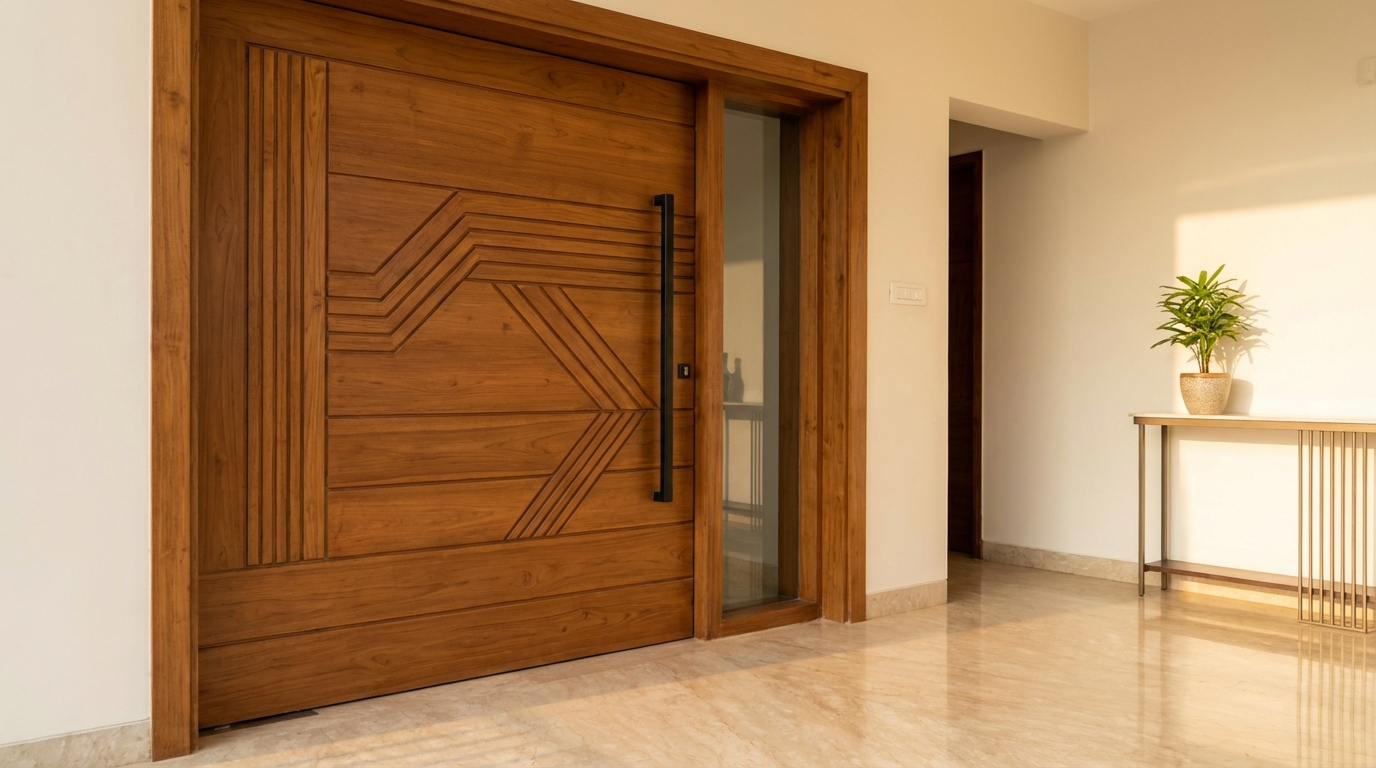
The best main door for Indian homes is a solid hardwood door (teak or sal) with 32-35mm thickness for durability, security, and weather resistance in most climatic zones. For budget-conscious buyers, engineered wood core doors with teak veneer finish offer 60-70% cost savings while maintaining appearance.
If you're in a hurry: Choose solid teak or sal wood doors for premium homes expecting 25+ years of service. For mid-range budgets, go with flush doors using BWR-grade plywood core and decorative laminate or veneer finish. Modern apartments with covered entrances can opt for designer fibre or WPC doors that resist warping better than wood in poorly ventilated lobbies. Always prioritize frame quality—a weak chaukhat undermines even the best door shutter.
- Choose solid wood if: Budget permits ₹25,000+, you want heirloom quality, the entrance faces weather directly
- Choose flush doors if: Budget is ₹8,000-18,000, modern aesthetic preferred, protected entrance area
- Choose fibre/WPC if: Extreme humidity zone, termite-prone area, minimal maintenance desired
- Avoid cheap hollow doors if: Security matters, door faces sun/rain, you live in ground floor or independent house
Key takeaway: Spend 40% of your door budget on the frame and hardware—this prevents 80% of door problems.
What Main Door Design Actually Involves: Materials, Construction, and Structural Logic
Main door design encompasses three interconnected decisions: the door shutter material and construction, the frame (chaukhat) type and installation method, and the hardware selection including hinges, locks, and handles. Indian homes require different considerations than Western designs due to climate variations, security needs, and the cultural significance of the entrance as per Vastu principles.
The shutter—the moving panel you push or pull—can be constructed from solid timber, engineered panels (plywood/blockboard/MDF with surface finish), metal, fibre-reinforced composites, or combinations thereof. Solid timber doors use thick planks of hardwood joined together, offering maximum strength and natural beauty but requiring skilled joinery to prevent warping. Engineered doors sandwich a core material between face sheets, allowing complex designs at lower costs.
Understanding Door Construction Types
Solid wood doors are crafted from 32-50mm thick hardwood planks, typically teak (sagwan), sal (sakhua), sheesham, or mahogany. Premium doors feature mortise-and-tenon joinery with minimum 3-4 horizontal rails connecting vertical stiles. The grain orientation matters—quarter-sawn timber resists warping better than flat-sawn cuts, though it costs 15-25% more.
Flush doors feature a hollow or solid core covered with face veneers or laminates. For main entrances, only solid-core flush doors with BWR or BWP-grade blockboard/plywood cores are appropriate—hollow-core versions lack the security and sound insulation required. The face can be natural wood veneer, decorative laminate, or PU-coated MDF.
Panel doors combine a solid wood frame with inset panels—the traditional "Darwaza" style. Panels can be wood, glass, or modern materials like back-painted glass or etched acrylic. The stile-and-rail framework provides structural integrity while panels add design interest.
Common misconception: Many believe thicker doors are always better. Actually, a well-constructed 32mm door with proper joinery outperforms a poorly made 45mm door. Focus on construction quality and material grade rather than thickness alone.
India-Specific Reality Check: Climate, Termites, and Workmanship Challenges
Indian main doors face challenges rarely encountered in temperate climates: monsoon humidity swings from 40% to 95% within months, termite pressure that can destroy untreated timber in 2-3 years, and direct sun exposure that reaches 60°C surface temperatures on south-facing doors. Your material selection must account for your specific region's demands.
Regional Climate Considerations
Coastal cities (Mumbai, Chennai, Kochi, Vizag): Salt-laden air accelerates metal hardware corrosion and promotes fungal growth on wood. Stainless steel (SS304 or SS316) hardware is mandatory, not optional. Teak with marine-grade finishes or fibre doors perform best. Avoid untreated sal wood—it's prone to fungal attack in humid coastal conditions despite being termite-resistant.
High humidity zones (Kolkata, Assam, Kerala): Doors swell during monsoons, causing jamming and misalignment. Allow 8-10mm clearance gaps (not the standard 5-6mm) between shutter and frame. Flush doors with BWP-grade cores and laminate faces resist moisture better than solid wood here.
Dry northern plains (Delhi NCR, Punjab, Rajasthan): Extreme temperature variations (5°C winter to 47°C summer) cause expansion-contraction cycles that loosen joints. Solid wood doors need re-tightening of hardware every 1-2 years. Dry air cracks untreated surfaces—regular oiling or wax polishing is essential.
Hill stations (Shimla, Ooty, Darjeeling): Lower termite pressure but higher moisture from fog. Hardwood doors perform excellently. Avoid particle board cores—they swell irreversibly in persistent dampness.
Termite Reality in Indian Conditions
Subterranean termites affect 85% of Indian geography. Even "termite-resistant" woods like teak contain heartwood and sapwood—only heartwood resists termites naturally. Many teak doors include sapwood portions that remain vulnerable. Insist on heartwood-only timber for ground-floor installations and independent houses. Chemical treatment (Chlorpyrifos or newer termiticides) during frame installation is non-negotiable—this isn't optional maintenance, it's basic construction practice.
Common Contractor Practices to Watch
Shortcut framing: Some mistris use 3" x 2" frames instead of specified 4" x 3" to save material. This reduces structural integrity and limits hinge screw depth. Verify frame dimensions before plastering covers them permanently.
Skipping treatment: Anti-termite soil treatment costs ₹15-25 per running foot—some contractors bill for it but don't apply it. Request to witness application or ask for treatment certificate.
Wrong hinge placement: Hinges should be positioned 6-8 inches from top and bottom edges, with a third hinge centered for doors over 7 feet height. Improper placement causes sagging within months.
75+ Main Door Design Ideas Organized by Style and Application
Main door designs for Indian homes range from ornate traditional carved panels to sleek contemporary minimalist statements. Your choice should balance architectural style, security requirements, maintenance commitment, and budget. Below are categorized ideas with practical material recommendations for each.
Traditional and Classic Designs (15+ Ideas)
1. Carved teak double doors with brass fittings: The quintessential Indian prestige entrance. Use 38-42mm thick teak, hand-carved motifs (lotus, elephant, peacock), patinated brass handles. Budget: ₹75,000-2,50,000 per pair depending on carving complexity.
2. Temple-style arched door: Features a curved top rail mimicking temple architecture. Requires custom frame construction. Solid sal or teak recommended. Best for bungalows and heritage-style homes.
3. Sheesham door with geometric jali: Rosewood with traditional lattice (jali) work in upper panels. Provides ventilation while maintaining privacy. Ideal for homes with foyer/entry passages.
4. Antique reproduction doors: Salvaged haveli doors or new doors crafted to replicate Rajasthani/Gujarati heritage styles. Verify structural integrity of antique pieces before installation—many have hidden termite damage.
5. South Indian temple door: Characterized by multiple horizontal panels, brass strips, and deity carvings. Traditionally uses jackfruit wood or teak. Frame includes carved side pilasters for authentic look.
6-10. Regional variations: Chettinad doors (Tamil Nadu), Kerala-style naluketttu doors, Assamese ikora motif doors, Kashmiri walnut carved doors, and Odia temple-style entrances—each uses local timber and traditional craft techniques.
11-15. Classical adaptations: Georgian panel doors, Victorian-inspired designs with glass inserts, Edwardian proportions with Indian motifs, Art Deco geometric patterns, and Mediterranean arched entries—all executable in Indian hardwoods with local craftsmanship.
Modern and Contemporary Designs (20+ Ideas)
16. Flush door with designer laminate: Clean, budget-friendly option using high-pressure laminate (HPL) on solid blockboard core. Thousands of patterns available including wood grain, abstract, metallic, and textured finishes. 35mm thickness adequate for most apartments.
17. PU-coated MDF door: Smooth, lacquered finish in any color. Requires climate-controlled interior location—not suitable for doors facing exterior directly. Best for apartment main doors within covered lobbies.
18. Pivot door: Large-format door rotating on floor and ceiling pivots instead of side hinges. Creates dramatic entrance but requires substantial structural support. Minimum 900mm width recommended for visual impact.
19. Floor-to-ceiling door: 8-10 feet height doors that visually increase ceiling perception. Requires heavyweight hinges (3 or 4 per shutter) and precise frame installation. Premium apartments and villas.
20. Mixed material modern: Wood with metal strips, glass panels with steel frames, or concrete-textured finishes. Industrial aesthetic popular in urban lofts and contemporary homes.
21-25. Minimalist styles: Handleless push-to-open doors, single large panel without visible framing, asymmetric designs, cantilevered look, and floating appearance with hidden frames.
26-35. Material explorations: Corten steel (weathering steel), backlit onyx panels, resin-embedded botanical elements, leather-wrapped panels, fabric-upholstered acoustic doors, mirror-polished stainless steel, patinated bronze sheets, blackened steel with wood inlay, copper sheet facing, and zinc cladding.
Double Door Designs (10+ Ideas)
36. Symmetrical carved double doors: Traditional choice for villas and bungalows. Ensure both leaves match in carving depth and wood grain orientation. Central meeting point requires astragal molding or rebated edges for weathertightness.
37. Unequal leaf double doors: One wide panel (750-900mm) for daily use, one narrow panel (300-450mm) for occasional wide opening. Practical compromise between grand appearance and everyday functionality.
38. Glass-paneled double doors: Wood or metal frames with safety glass (toughened or laminated) inserts. Allows natural light into foyer. Privacy options include frosted, tinted, or patterned glass.
39-45. Style variations: French doors with multiple glass panes, Dutch doors (split horizontal), stable doors with independent upper/lower leaves, folding double doors, sliding double doors on barn-door hardware, and pivot double doors.
Single Door Designs for Apartments (15+ Ideas)
46. Standard flush door with premium hardware: Most apartment main doors are 810mm x 2100mm (3' x 7') single shutters. Upgrade basic developer-installed doors by changing hardware—mortise lock with SS finish, 4-inch butt hinges (3 nos), and designer handle can transform appearance for ₹3,000-8,000.
47. Laminate upgrade: Remove existing veneer/laminate and apply fresh 1mm HPL in contemporary design. Complete door refresh for ₹4,000-7,000 including labor and material.
48-55. Design variations: Vertical grooved patterns, horizontal slat appearance, geometric panel designs, textured surface laminates, metal strip accents, number plate integration, peephole + doorbell integrated panel, and smart lock-ready door preparation.
56-60. Security-focused designs: Multi-point locking system compatible doors, reinforced edge strips for deadbolt installation, vision panel with one-way viewing, intercom integration, and fire-rated apartment doors (mandatory in high-rises per NBC 2016).
Designer and Specialty Doors (15+ Ideas)
61. Pooja room entrance doors: Often feature brass bells, deity carvings, and lattice work for incense ventilation. Silver coating popular for auspicious appearance. Smaller scale (typically 600-700mm width) with ornate detailing.
62. Security-cum-main doors: Combined MS grill outer door with wooden inner door. Provides ventilation in summer while maintaining security. Common in independent houses and ground-floor flats.
63-70. Fusion concepts: Traditional carving with backlit panels, classic proportions with modern materials, heritage restoration with modern hardware, Vastu-compliant contemporary designs, eco-conscious reclaimed wood modern designs, smart door with traditional appearance, biometric lock integrated classical door, and voice-controlled door systems in traditional frames.
71-75. Statement pieces: Artist-commissioned unique carvings, ancestral door restoration and integration, antique door with new surrounding frame, oversized 10-foot height statement doors, and custom fabricated metal-art doors.
Material Selection Guide: Wood Types, Engineered Options, and Modern Alternatives
Main door material selection directly impacts longevity, maintenance requirements, security, and budget. Indian market offers both traditional timber options and modern engineered alternatives, each with specific advantages for different applications.
Premium Hardwoods for Main Doors
| Wood Type | Durability | Termite Resistance | Workability | Price Range (per cu.ft.) | Best For |
|---|---|---|---|---|---|
| Teak (Sagwan) | Excellent | High (heartwood) | Good | ₹3,500-6,000 | All climates, premium installations |
| Sal (Sakhua) | Excellent | High | Difficult | ₹1,800-2,800 | Heavy-duty, structural applications |
| Sheesham (Rosewood) | Very Good | Medium | Good | ₹2,200-3,500 | Carved doors, decorative work |
| Merbau (Imported) | Very Good | High | Good | ₹2,500-4,000 | Contemporary designs |
| Burma Teak | Excellent | Very High | Excellent | ₹7,000-12,000 | Heirloom quality doors |
Engineered Core Options
BWR-grade plywood core: Boiling Water Resistant plywood (IS 303 compliant) forms the core of quality flush doors. Look for 25mm or 30mm thickness with veneer or laminate facing. Total door thickness reaches 32-35mm. Cost-effective for mid-range budgets with good moisture resistance.
BWP/Marine plywood core: Boiling Water Proof grade uses phenolic resin, offering superior moisture resistance for coastal/humid zone installations. Higher cost but justified for ground-floor doors or those with direct weather exposure.
Blockboard core: Solid wood battens between veneers provide excellent screw-holding for hardware. Preferred for doors with heavy locks and frequent operation. Verify 19mm or 25mm thick blockboard with minimum 8-10mm face veneers.
HDHMR core: High-Density High Moisture Resistant boards offer stable, flat surfaces ideal for PU coating or laminate facing. Better dimensional stability than plywood but lower screw-holding—use screw inserts or through-bolts for hardware installation.
Modern Alternative Materials
Fibre/FRP doors: Fiberglass Reinforced Plastic doors offer complete termite immunity, water resistance, and color-through construction (no surface coating to peel). Available in wood-grain textures. Best for utility entrances, apartment secondary doors, or extreme humidity locations. Limited design options compared to wood.
WPC doors: Wood Plastic Composite offers wood-like appearance with plastic durability. Heavier than fibre doors, better for main entrance applications. Machine-carved designs possible but lack the warmth of real wood grain.
Metal doors: Pressed steel doors provide maximum security for independent houses and godowns. Hollow metal doors with honeycomb cores reduce weight while maintaining strength. Powder coating prevents rust but dents show easily. Industrial appearance limits residential application to utility roles.
Cost Guide and Budget Planning for Main Doors (2026 Market)
Main door costs vary dramatically based on material, size, design complexity, hardware selection, and regional labor rates. Budget planning should separately account for shutter, frame, hardware, finishing, and installation to avoid surprises.
Shutter Cost Ranges by Type
| Door Type | Single Door (3' x 7') | Double Door (5' x 7') | Notes |
|---|---|---|---|
| Basic flush door (commercial grade) | ₹2,500-4,500 | ₹5,000-9,000 | Builder quality, MR-grade core |
| Quality flush door (BWR core + laminate) | ₹6,000-12,000 | ₹12,000-24,000 | Residential standard |
| Premium flush door (veneer + polish) | ₹12,000-25,000 | ₹24,000-50,000 | With PU or melamine finish |
| Solid wood (sal/merbau) | ₹18,000-35,000 | ₹36,000-70,000 | Plain panels, no carving |
| Solid teak (plain) | ₹35,000-60,000 | ₹70,000-1,20,000 | Indian plantation teak |
| Carved teak door | ₹50,000-1,50,000 | ₹1,00,000-3,00,000+ | Complexity dependent |
| Fibre door | ₹4,000-8,000 | ₹8,000-15,000 | With frame |
| WPC door | ₹8,000-15,000 | ₹16,000-30,000 | With frame |
Frame Costs (Often Underestimated)
Teak frame (4" x 3"): ₹8,000-15,000 for single door, ₹12,000-20,000 for double door frame. This assumes seasoned heartwood—sapwood frames cost 30-40% less but have shorter lifespan.
Sal frame: ₹5,000-8,000 for single, ₹8,000-12,000 for double. Excellent structural choice but difficult for intricate molding.
Steel frame: ₹3,500-6,000 for single door hollow section frame with anti-rust treatment. Best for fibre/WPC door combinations.
Installation cost: ₹2,000-4,000 for frame fixing in new construction, ₹4,000-8,000 for replacement installations requiring masonry modification.
Hardware Budget Allocation
Quality hardware typically costs 15-25% of shutter cost but directly impacts daily usage experience. Minimum recommended investment for main door hardware:
- Mortise lock: ₹1,500-4,000 (SS body, branded like Godrej, Yale, Europa)
- Handle set: ₹800-3,000 (SS or brass, lever type for ease of use)
- Hinges (3 nos): ₹600-1,500 (4-inch ball bearing hinges for smooth operation)
- Door closer (if required): ₹1,500-4,000
- Additional security: Night latch ₹500-1,200, tower bolt ₹200-500, chain ₹300-600
Total Budget Framework
Economy (apartment main door upgrade): ₹15,000-25,000 including shutter, hardware upgrade, and installation.
Mid-range (independent house single door): ₹40,000-80,000 including quality wood or premium flush door, proper frame, and good hardware.
Premium (bungalow double doors): ₹1,50,000-4,00,000+ for carved teak doors with brass fittings, stone frame surround, and professional installation.
How to Choose: 5-Step Decision Framework for Main Door Selection
Selecting the right main door requires systematic evaluation of your specific requirements. This framework helps avoid common decision errors and ensures your choice serves well for decades.
Step 1: Assess Location and Exposure
Document your main door's environmental exposure:
- Does rain directly hit the door? (Requires weather-resistant material)
- Does afternoon sun fall on the door? (Causes expansion, fading)
- Is the entrance covered by porch/canopy? (More material options viable)
- Ground floor or elevated? (Ground floor needs better termite protection)
- Coastal location? (Salt air corrosion factor)
Step 2: Define Security Requirements
Security needs vary by building type:
- Apartment with building security: Focus on privacy and aesthetics; basic locking sufficient
- Ground-floor flat: Multi-point locks, solid core, reinforced frame edges
- Independent house: Maximum security—steel-reinforced frame, heavy door, advanced locking
- Gated community villa: Balance security with design; perimeter security allows design freedom
Step 3: Match Budget to Expectations
Avoid the common trap of choosing expensive shutter with inadequate frame/hardware. Better to reduce shutter grade and invest in proper frame and fittings. A ₹15,000 door in ₹10,000 frame with ₹3,000 hardware outperforms a ₹25,000 door in ₹5,000 frame with ₹2,000 hardware.
Step 4: Consider Maintenance Commitment
Be honest about maintenance reality:
- High maintenance tolerance: Solid wood with natural polish (annual oiling required)
- Medium maintenance: PU-finished wood or laminated flush doors (periodic cleaning)
- Low maintenance: Fibre or WPC doors (occasional washing)
Step 5: Verify Vastu Requirements (If Applicable)
Many Indian homeowners follow Vastu principles for main doors:
- Door should open inward (clockwise when entering)
- Two-shutter doors preferred over single (symbolically welcoming)
- Auspicious symbols or motifs if traditional design chosen
- Door height typically exceeds 7 feet for prosperity
Common Buyer Mistakes and How to Avoid Them
Main door purchases frequently go wrong due to preventable errors. Understanding these mistakes helps you make better decisions and avoid costly corrections later.
Mistake 1: Ignoring Frame Quality
What goes wrong: Premium door shutter installed on undersized or poor-quality frame. Door sags, scrapes floor, or doesn't close properly within 1-2 years.
Why it happens: Frames are hidden after installation—easy to compromise without visible evidence. Contractors pocket savings or genuinely underestimate frame importance.
How to avoid: Specify frame dimensions in writing (minimum 4" x 3" for main doors). Inspect frame before plastering. Verify wood species matches specification.
Mistake 2: Choosing Style Over Climate Suitability
What goes wrong: Beautiful carved door warps, cracks, or swells because material isn't suited to local humidity/temperature conditions.
Why it happens: Decisions based on showroom or catalog images without considering real-world exposure.
How to avoid: Ask specifically about material performance in your climate. Visit installed examples 3-5 years old in similar conditions.
Mistake 3: Undersizing Hardware
What goes wrong: Small hinges can't support door weight; locks fail under normal use; handles become loose.
Why it happens: Hardware appears minor in overall budget; cheap options seem acceptable visually.
How to avoid: Size hinges to door weight (minimum 4" x 3" for doors over 25kg). Buy branded locks with service network. Test handle operation before purchase.
Mistake 4: Neglecting Anti-Termite Treatment
What goes wrong: Termites damage frame within 2-3 years, requiring complete replacement.
Why it happens: Treatment is invisible; easy to skip or fake. Termites work silently until extensive damage occurs.
How to avoid: Witness treatment application or require dated photographs. Use treated timber for frames. Schedule annual inspections.
Mistake 5: Ordering Without Measuring
What goes wrong: Door doesn't fit opening; requires modification that compromises appearance or function.
Why it happens: Reliance on "standard" sizes without verifying actual opening dimensions.
How to avoid: Measure opening at multiple points (openings are rarely perfectly rectangular). Order 15-20mm undersize for fitting adjustments.
Mistake 6: Ignoring Threshold Detailing
What goes wrong: Water enters under door during rain; dust and insects come through bottom gap; thermal/acoustic insulation compromised.
Why it happens: Bottom seal and threshold often considered afterthoughts.
How to avoid: Specify threshold treatment (marble/stone strip, automatic drop seal, or brush seal). Ensure 3-5mm maximum gap when door closed.
Mistake 7: Choosing Based on Price Alone
What goes wrong: Cheap door requires replacement in 5-7 years; lifetime cost exceeds quality door's single purchase cost.
Why it happens: Initial budget constraints; failure to calculate long-term value.
How to avoid: Calculate cost-per-year over expected lifespan. A ₹50,000 door lasting 30 years (₹1,667/year) beats a ₹20,000 door lasting 8 years (₹2,500/year).
Installation and Workmanship Guidelines
Proper installation determines whether your main door performs to its potential. Even premium materials fail when installed incorrectly. These guidelines help ensure quality workmanship whether you supervise installation yourself or brief your contractor.
Frame Installation Checklist
Before frame fixing:
- Verify opening dimensions match frame outer dimensions plus 15-20mm play
- Check frame for warping using straightedge—reject if deviation exceeds 3mm over length
- Confirm anti-termite treatment applied to frame timber
- Verify holdfast locations planned (minimum 3 per side, 4 for double doors)
During installation:
- Frame must be plumb (vertical) and level (horizontal)—check with spirit level
- Holdfasts embedded minimum 4" into masonry with cement-sand mortar
- Gaps between frame and masonry packed with mortar, not just foam
- Allow 48 hours for mortar to cure before shutter hanging
Shutter Hanging and Hardware Installation
Hinge placement:
- Top hinge: 6-8 inches from top of door
- Bottom hinge: 8-10 inches from bottom
- Middle hinge: Centered, mandatory for doors over 7 feet height
- All hinges must be perfectly aligned vertically—use hinge template or precision marking
Lock installation:
- Strike plate mortised into frame, not just surface-mounted
- Lock body should not touch hinge knuckles at any position
- Handle height typically 36-40 inches from floor (adjust for user comfort)
- Deadbolt should extend minimum 1 inch into frame for security
Finishing and Sealing
Edge sealing (critical for flush doors): All edges must be sealed with paint, polish, or edge banding before installation. Exposed edges absorb moisture, causing delamination within months in humid conditions.
Bottom seal: Gap between door bottom and floor/threshold should be 3-5mm maximum. Install appropriate seal—brush seal for carpeted areas, rubber seal for hard floors, automatic drop seal for exterior doors.
Quality Checks Without Laboratory Testing
You can assess main door quality through observation and simple tests without specialized equipment. These checks help verify material claims and identify potential problems before purchase or acceptance.
Visual Inspection Points
For solid wood doors:
- Grain pattern should be consistent across panels—mismatched grain indicates pieced construction
- Check for filler (wood putty) patches—small repairs acceptable, large filled areas indicate inferior timber
- Joint lines should be tight with no visible gaps—gaps will widen over time
- Surface should be sanded smooth—rough patches indicate rushed finishing
For flush doors:
- Face veneer/laminate should be uniformly adhered—press firmly across surface to detect hollow spots
- Edges should show core construction clearly—verify blockboard or plywood as specified
- Both faces should use same quality material—some manufacturers use inferior backing
Simple Physical Tests
Weight test: Lift or tilt the door. Solid wood and solid-core flush doors feel substantial. Excessive lightness indicates hollow-core or inferior material. A 7' x 3' solid teak door typically weighs 35-50kg; equivalent flush door 20-30kg.
Tap test: Knock across door surface with knuckles. Solid construction produces consistent, dull sound. Hollow areas sound distinctly different—"boxy" resonance. Core voids in flush doors detectable this way.
Straightness check: Sight along door edges from corner. Any twist or bow visible indicates seasoning problems or manufacturing defect. Slight bow may worsen after installation.
Questions to Ask Dealer/Supplier
- What is the moisture content of this timber? (Should be 12-15% for interior use)
- Is this heartwood or does it include sapwood? (Heartwood preferred for termite resistance)
- What is the core material and grade? (For flush doors—verify ISI mark if claimed)
- What warranty do you provide against manufacturing defects?
- Can you provide references for similar installations 3-5 years old?
Is Wooden Main Door Better Than Modern Alternatives?
Wooden main doors remain the preferred choice for Indian homes when appearance, warmth, and traditional values matter most. Wood's natural grain, warmth to touch, and centuries of cultural association create emotional connections that modern materials cannot replicate. However, wood demands maintenance commitment—annual oiling or polish touch-up, periodic hardware tightening, and protection from direct weather.
Modern alternatives like WPC, fibre, and metal doors offer practical advantages: zero termite risk, waterproof construction, and minimal maintenance. They suit utility applications, extreme climate zones, and homeowners unwilling to perform periodic care. The trade-off is appearance—even the best wood-grain textures don't match real timber's depth and character.
Bottom line: For main entrances visible to guests and residents daily, wood remains superior for visual and tactile experience. For secondary entrances, utility doors, or harsh exposure conditions, modern materials provide better value through reduced maintenance and longer service life.
What Thickness is Ideal for Indian Main Doors?
Main door thickness should be 32-35mm minimum for flush doors and 38-45mm for solid wood doors in Indian conditions. This thickness provides adequate structural rigidity to resist warping, sufficient depth for mortise lock installation, and proper insulation against heat and sound.
Thinner doors (25-30mm) suit interior applications where security and weather resistance matter less. Thicker doors (45-50mm) are appropriate for oversized openings, double doors, or where enhanced sound insulation is required. Extra thickness adds weight, requiring heavier hinges and potentially reinforced frames.
For apartments with lobby-protected entrances, 32mm flush doors are adequate. Independent houses with direct exterior exposure benefit from 35-40mm solid or solid-core doors. Premium installations often use 45mm or thicker for the substantial feel associated with quality entrances.
How Long Does a Quality Main Door Last in Indian Conditions?
A well-maintained teak main door can last 40-60 years in Indian conditions, often outlasting the building itself. Sal wood doors achieve 30-40 years with proper care. Quality flush doors with BWR/BWP cores and proper edge sealing typically last 15-25 years before requiring replacement. Fibre and WPC doors promise 20-30 years based on manufacturer claims, though real-world data is limited given their recent market introduction.
Lifespan depends critically on installation quality, exposure conditions, and maintenance discipline. The same door might last 35 years in covered apartment entrance versus 15 years facing direct monsoon exposure. Climate-appropriate material selection extends service life significantly—using marine-grade materials in coastal areas, for example.
Frequently Asked Questions
Which wood is best for main door in India?
Teak (Sagwan) is widely considered the best wood for main doors in India due to its natural oils that resist termites, excellent dimensional stability across humidity variations, and beautiful grain that ages gracefully. Burma teak represents the premium choice, followed by Indian plantation teak. Sal wood offers comparable durability at lower cost but is harder to work for intricate designs. Sheesham (Indian Rosewood) is excellent for carved decorative doors but requires proper treatment for termite protection. For budget-conscious buyers, Merbau imported from Southeast Asia provides good balance of durability and cost.
What is the ideal main door size as per Vastu?
Vastu Shastra recommends main door height of minimum 7 feet (84 inches), with 8 feet considered more auspicious for prosperity. Width should be proportional—typically half of height, giving 42-48 inches for single doors. The door should be the largest entrance in the home, symbolically welcoming positive energy. Two-leaf doors are preferred over single doors. The door should open inward and clockwise when entering. Odd measurements (like 81 or 84 inches rather than 80) are sometimes preferred based on specific Vastu calculations. Consulting a Vastu expert for your specific home orientation provides customized recommendations.
How much does a good quality main door cost in India?
Good quality main door costs range from ₹15,000-25,000 for premium flush doors with laminate finish, ₹30,000-60,000 for solid hardwood plain doors, and ₹75,000-2,00,000+ for carved teak double doors. These figures cover the shutter only—add 25-40% for frame and 10-15% for hardware. Regional variations are significant: Mumbai and Delhi prices run 15-25% higher than tier-2 cities. Installation costs ₹2,000-5,000 depending on complexity. Total budget for quality single main door installation typically falls between ₹25,000-80,000; double doors ₹50,000-3,00,000+ depending on material and design complexity.
Can laminate doors be used for main entrance?
Laminate-faced doors can be used for main entrances when the door has a solid core (blockboard or BWR plywood) and proper edge banding. High-Pressure Laminate (HPL) with 1mm thickness provides better durability than standard 0.8mm options. However, laminate doors work best for protected entrances—apartment lobbies, covered porches—rather than doors facing direct rain or intense sun. UV exposure fades laminate colors over 5-7 years; moisture at edges can cause peeling. For exterior-facing main doors in independent houses, solid wood or PU-coated doors offer better long-term performance despite higher initial cost.
What are the best hinges for heavy wooden main doors?
Heavy wooden main doors weighing 30-50kg require 4-inch or 5-inch ball-bearing butt hinges made from solid brass or stainless steel. Use three hinges minimum—four hinges for doors over 8 feet height or exceptionally heavy constructions. Ball-bearing hinges rated for 40-60kg capacity ensure smooth operation even after years of use. Avoid ordinary butt hinges or piano hinges for main doors—they wear quickly under load. Parliament hinges allow doors to swing clear of architraves if needed. For pivot doors, floor springs with hold-open function from brands like Dorma or GEZE provide smooth, controlled operation.
How do I protect wooden main door from termites?
Termite protection for wooden main doors requires three-layer defense: treated timber (factory-applied borax or termiticide solution), anti-termite soil treatment during frame installation (chemical barrier around foundation), and surface finish that seals the wood. Use only heartwood for frames—sapwood lacks natural termite resistance. Apply termiticide solution to frame rebate where shutter meets frame. Annual visual inspection catches early infestation signs—mud tubes, hollow-sounding wood, frass deposits. For existing doors showing termite activity, professional treatment injection into timber may save the door if caught early. Prevention costs far less than replacement.
Is double door better than single door for main entrance?
Double doors suit wide entrances (over 4 feet opening width) where single door would be impractically heavy or out of proportion. They create grander appearance appropriate for villas, bungalows, and premium apartments. Practically, double doors require more hardware (4-6 hinges instead of 3, two locks or coordinated locking system) and careful installation for proper alignment. Single doors are easier to operate daily, more cost-effective, and adequate for standard apartment entrances. Choose based on opening width, architectural style, budget, and usage pattern—frequently-used entrances often work better with single doors for convenience.
What is the maintenance required for main doors?
Main door maintenance varies by material. Solid wood doors need annual oiling or wax application to prevent drying and cracking, especially in dry climates. Polish touch-up every 2-3 years maintains appearance. Hardware requires periodic tightening and lubrication—hinges annually, locks every 6 months. Laminate doors need only cleaning with damp cloth; avoid abrasive cleaners. Fibre and WPC doors require minimal maintenance—occasional washing. All doors benefit from regular inspection of weatherstripping, threshold seals, and frame-wall junction for gaps or deterioration. Early intervention on small issues prevents costly repairs later.
Can I install a wooden door in bathroom entrance?
Wooden doors can be used for bathroom entrances if properly selected and finished. Use BWP (Boiling Water Proof) grade plywood core flush doors with waterproof laminate or PU finish on all surfaces including edges. Solid wood is not recommended for bathroom use—humidity causes swelling and mold growth. Ensure ventilation gap at bottom (minimum 15mm) for air circulation—this is more important than door material choice. Alternative materials like WPC, fibre, or uPVC are better suited for bathroom conditions. For wet areas like shower rooms, avoid wood entirely. Our bathroom door material guide covers this topic in detail.
What direction should main door face according to Vastu?
Vastu recommends north, east, or northeast-facing main doors as most auspicious—these directions receive morning sunlight associated with positive energy. South-facing doors are traditionally considered inauspicious but can be remediated with specific Vastu corrections. West-facing doors are neutral. Beyond direction, the door's position within that wall matters—doors should ideally be in the left half of the wall for auspicious entry. However, Vastu should be balanced with practical considerations—a well-designed south-facing door is preferable to awkward placement forced by directional constraints. Many modern Vastu consultants offer flexible interpretations accommodating contemporary architecture.
How do I choose between custom and ready-made main doors?
Ready-made doors suit standard openings (common sizes like 7' x 3' or 7' x 2.5'), budget-conscious projects, and straightforward designs. They're available immediately, cost 20-40% less than custom, and quality is consistent for branded products. Custom doors are necessary for non-standard sizes, specific design requirements, matching existing architecture, or premium carved work. Custom manufacturing takes 3-8 weeks depending on complexity. For apartments with standard openings, ready-made or semi-custom doors (standard base modified with chosen finish) often provide best value. Independent houses with unique architectural features benefit from custom doors that complement the overall design language.
What is the difference between flush door and panel door?
Flush doors have flat, smooth surfaces without visible framework—the face material (laminate, veneer, or paint) covers the entire shutter uniformly. They suit modern, minimalist interiors and cost less than panel doors. Panel doors feature visible stile-and-rail framework with inset panels creating three-dimensional surface pattern. Panels can be raised, flat, or glass-filled. Panel doors offer traditional appearance, accommodate decorative elements, and work well with classical or colonial architecture. Structurally, quality examples of both types perform comparably. Choice depends primarily on aesthetic preference and architectural style—neither is inherently superior for main door application.
Can smart locks be installed on traditional wooden doors?
Smart locks can be installed on most traditional wooden main doors with proper preparation. Electronic locks require flat mounting surface minimum 45mm wide and door thickness adequate for lock body (typically 35mm minimum). Verify power source—battery-operated locks simplify installation; wired locks need cable routing through frame. Some smart locks fit standard mortise lock cutouts; others require new preparation. Hardwood doors accommodate smart locks well; flush doors need reinforcement at lock area if core is hollow. Professional installation recommended to ensure waterproofing (for exterior doors) and proper alignment. Many homeowners combine smart locks with traditional wooden door aesthetics successfully.
How often should main door be replaced?
Well-maintained quality main doors shouldn't need replacement for 25-40+ years. However, consider replacement when: visible structural damage (cracks, splits, significant warping) compromises security or weatherproofing; excessive repair history makes further investment uneconomical; style updates warrant complete change for aesthetic reasons; or significant home renovation changes entrance configuration. Often, refinishing (stripping and repolishing) extends solid wood door life without replacement. Hardware replacement and weatherstripping updates address many functional issues. Full replacement makes sense when door has served reasonable lifespan and shows multiple issues simultaneously. Budget for eventual replacement by allocating portion of annual home maintenance fund.
Disclaimer: This content is provided for general informational purposes based on industry practices and publicly available information. Product specifications, standards, prices, and availability may vary by manufacturer, region, and time. Readers should independently verify details with manufacturers, dealers, or qualified professionals before making purchase or construction decisions.
Want Plywood Suggestions?
Share a few details and a Sainik 710 specialist will suggest suitable brands and connect you to responsive dealers.