Louvers Panel Design: 25+ WPC, Wooden & PVC Louver Ideas for Wall & Ceiling
Discover 25+ louvers panel designs—WPC, wooden & PVC options for wall & ceiling. Get material comparison, installation tips & price guide for India.
The Short Answer on Louvers Panel Design
Louvers panel design is a modern interior solution using slatted panels made from WPC, PVC, or wood to add texture, depth, and elegance to your walls and ceilings. Short version: A louver panel is a decorative panel made using diverse materials including wood fibers and plastic, used in both internal and external applications like partition walls, facades, window coverings, and more. If you want that premium "magazine cover" look without the full renovation, louvers panels are probably your fastest path there—and they work in everything from TV unit backdrops to complete ceiling treatments.
This is right for you if:
- You want an instant upgrade that transforms flat, boring walls into feature statements
- Your budget doesn't allow solid wood paneling but you still want that natural warmth and texture
- You need something versatile, easy to install, that gives any space a premium look without breaking the bank—from TV units and bedrooms to hallways and balconies
- Mumbai monsoons or Chennai humidity worry you (WPC and PVC handle moisture well)
Skip this if:
- You're looking for heavy-duty structural panels—these are primarily decorative
- You want something that can be sanded down and refinished multiple times like solid hardwood
Bottom line: Louvers panels are the easiest way to add architectural character to any room, and with WPC and PVC options, you're not sacrificing durability for looks anymore.
What Louvers Panel Design Actually Means
Louver interior design refers to the use of slatted or angled panels to shape modern partitions, walls, and decorative elements that help regulate light, airflow, and privacy. Originally developed for ventilation in architecture, louvers are now widely used as a sleek interior feature that combines practicality with visual appeal. That's the textbook definition. Here's what it actually means in your home.
Most people think louvers are just those slanted slats you see on old window shutters or AC vents. Actually, modern louvers panels have evolved into a completely different beast—they're transforming plain walls into stylish backdrops and giving spaces that layered, architect-designed look that used to cost lakhs to achieve. You can opt for louvers in horizontal or vertical layouts, depending on the look and function you want. They may be fixed or adjustable and are available in materials such as polystyrene, MDF, PVC, aluminium, metal alloys, and glass.
Now here's where it gets interesting. The technical side involves understanding fluting depth, panel thickness, and slat spacing. WPC louvers come in various series like 10mm, 17mm, 12mm, and 14mm thickness options. The deeper the flutes, the more dramatic the shadow play when light hits them—this is what creates that expensive-looking effect behind your TV unit or bed.
Is WPC louvers panel actually worth the extra cost over PVC?
Depends entirely on where you're installing. WPC panelling generally outperforms PVC in terms of resistance to impact, scratching, and denting due to the presence of wood fibers which provide a more rigid and robust structure. PVC, while resistant to moisture and corrosion, can be more susceptible to damage from physical impacts. So if this is going behind a high-traffic area like an entryway where bags and keys hit the wall—go WPC. But for a ceiling application where nobody's touching it? PVC does the job fine at lower cost. PVC is cheaper than WPC panels due to its composition and cost of production, making it a more affordable option.
Why Louvers Panels Matter in Indian Homes
Here's the thing about designing in India—we're not working with London weather conditions. Mumbai sees humidity hitting 85-90% during July-August. Chennai stays humid almost year-round. Kolkata gets that sticky saltwater air from the Bay. These aren't minor considerations. They're deal-breakers for material selection.
The popularity of WPC panels has grown because they provide the aesthetic appeal of wood with better resistance to moisture, termites, UV rays, and fire. In places like Thane or Navi Mumbai, I've seen solid wood panels warp within two monsoons. Real teak veneer started peeling. The owners weren't happy—understatement of the year. While wood panels look elegant, they can face issues like rotting and termites—problems that don't easily arise in WPC panels. Engineered to last long and safe from decay and pest problems, wood plastic composite panels are an excellent option.
Coastal areas like Mangalore, Kochi, and the entire Konkan belt need extra moisture resistance. The unique composition and high polymer content of WPC panels makes them 100% waterproof, making them the most ideal solution for damp walls and ceilings. But inland cities like Pune, Bangalore, or Hyderabad can get away with slightly less protection—though honestly, why risk it?
Quick comparison for Indian conditions:
| City/Region | Humidity Challenge | Best Material Choice | Why |
|---|---|---|---|
| Mumbai, Chennai, Kolkata | Consistently 70-90% RH | WPC or PVC | Wood simply won't last |
| Bangalore, Pune | Moderate, 50-70% RH | WPC preferred, wood possible | More forgiving climate |
| Jaipur, Ahmedabad | Dry, below 40% RH | All options work | Watch for extreme heat on PVC |
| Coastal Kerala, Goa | Saltwater humidity | High-grade WPC only | Salt corrosion is real |
Types of Louvers Panels: Breaking Down Your Options
Right, let's get into the main material types. This is where most people get confused because dealers tend to push whatever gives them better margins.
WPC Louvers Panels
WPC panels are engineered composite boards made from a blend of wood flour, thermoplastics, and additives. They are manufactured using high-pressure extrusion or molding techniques, giving them the look of natural wood while maintaining enhanced durability. WPC is best when you want that authentic wood appearance without wood's maintenance headaches.
WPC panels typically consist of 70% wood fibers and 30% thermoplastic resin. This mix gives you the warmth and grain of real wood but with the moisture resistance of plastic. Aesthetically, WPC panelling offers a more authentic wood-like appearance, complete with grain patterns that can mimic various types of wood. It can be manufactured in a wide range of colors and finishes, and is easy to integrate with devices such as televisions and LED displays.
Honestly, if budget allows, WPC is my go-to recommendation for most living room and bedroom applications.
PVC Louvers Panels
PVC louvers are made of polyvinyl chloride (PVC), a robust yet lightweight synthetic material known for its longevity and adaptability. These panels are completely waterproof and termite-proof, making them suitable for moist or high-traffic regions.
PVC panels are inherently waterproof, making them ideal for areas prone to moisture or humidity. They're easy to clean and require minimal maintenance, are highly resistant to chemicals, and being lightweight, can simplify installation especially for ceiling and wall applications.
PVC is best when you're working with bathrooms, kitchens, or exterior-facing balconies where water splash is a concern. Also great if you're on a tighter budget.
Wooden Louvers Panels
Wooden louvers are panels made of slats placed at an angle. Wooden louvers are architectural components composed of angled slats or panels. Apart from providing privacy, shade, and aesthetic appeal, these slats are made to allow light and air in. Louvers are utilized structurally in windows, walls, doors, and ceilings and can be fixed or adjustable.
Real wood options include teak, oak, and pine. Wood types include teak, oak, pine, or engineered wood. Finishes range from natural (keeping wood grain visible), polished (glossy, rich look), painted (smooth finish in custom colors), to textured (bold and artistic appearance).
I'll be honest—I rarely recommend solid wood louvers for humid Indian cities anymore. The maintenance is relentless. But if you're in Bangalore or somewhere with cooperative weather, and you want that irreplaceable solid wood feel, go for it.
Charcoal/Bamboo Charcoal Panels
Quick detour here. You'll see these being pushed heavily in markets like Delhi. They have decent acoustic properties and look good, but WPC panels are the most economical alternate to real wood paneling—in comparison to panels made of wood, MDF, or charcoal, the total cost per square foot after installation is at least 30% cheaper than its competitors.
Material Comparison Table
| Parameter | WPC | PVC | Solid Wood | My Take |
|---|---|---|---|---|
| Look & Feel | Natural wood grain | Smooth, glossy | Authentic warmth | WPC wins for most people |
| Water Resistance | Excellent | Excellent | Poor without treatment | Never use wood near water |
| Termite Proof | Yes | Yes | No | Big deal in India |
| Weight | Medium | Light | Heavy | PVC easier for ceilings |
| Installation | Moderate | Easy | Complex | PVC panels are easier to install because they usually only require glue |
| Durability | 10-15 years | 8-12 years | 20+ years (if maintained) | WPC for long-term value |
| Price Range | ₹150-350/sq ft | ₹50-150/sq ft | ₹400-800/sq ft | PVC for tight budgets |
| Best For | Living rooms, bedrooms | Bathrooms, exteriors | Premium interiors | Match to application |
Price Reality Check (2026 Market)
Here's what actually affects your final bill—and dealers don't always explain this clearly.
In India, WPC wall panel cost ranges from ₹200–₹600 per sq ft. That's a wide range, I know. The variation comes from panel thickness, finish quality, and brand positioning.
Thickness-wise breakdown:
- WPC Louver, 9.5 Ft X 6.5 Inch, 5 Sq Ft Coverage: ₹360-₹550 per piece (original MRP around ₹900-₹1100)
- WPC Louvers Panels, 14mm thickness: around ₹90/square feet at wholesale
- WPC louvers in Hyderabad: approximately ₹220-₹240/sq ft for standard panels
- WPC Louvers in Delhi with 10-year warranty, 26mm thickness: ₹180-₹220/sq ft
Cost drivers you should know:
- 6mm, 8mm, 12mm WPC panels are commonly used for walls and are cost-effective. 19mm WPC panels are more expensive, often used for furniture and heavy-duty applications.
- Custom sizes can add 10-20% to the cost. Wood grain finish looks natural but may cost 5-10% more. Matte or glossy finish prices vary based on demand.
- Installation adds another ₹30-60/sq ft depending on your city
- Aluminum louvers cost more: ₹225-₹358/sq ft in Delhi
Budget estimation for common uses:
| Application | Typical Area (sq ft) | Material Cost Range | Installation Extra |
|---|---|---|---|
| TV backdrop wall | 40-60 | ₹8,000-₹20,000 | ₹2,000-₹4,000 |
| Bedroom feature wall | 80-120 | ₹16,000-₹40,000 | ₹4,000-₹8,000 |
| Living room ceiling | 150-250 | ₹30,000-₹80,000 | ₹8,000-₹15,000 |
| Full living room walls | 200-350 | ₹40,000-₹1,20,000 | ₹10,000-₹20,000 |
WPC vs PVC Louvers: Direct Comparison
When comparing the two, WPC panels are known for offering better strength, lasting durability, and natural appearance. Whereas PVC panels are known for their lightweight, different textures and designs, and water resistivity.
| Factor | WPC Louvers | PVC Louvers | Winner |
|---|---|---|---|
| Appearance | More like solid wood with distinct grain and texture | Shiny, smooth surface with no visible texture, more plastic-like | WPC |
| Impact Resistance | More impact resistant | Less durable against physical impacts | WPC |
| Waterproofing | Excellent | PVC is inherently waterproof | Tie |
| Weight | Heavier, more difficult to install | Lighter, easier to install | PVC |
| Fire Resistance | More fire and heat resistant | Lower ignition point | WPC |
| Stain Resistance | Less stain resistant | More stain-resistant, easier to clean | PVC |
| UV Resistance | More resistant to UV radiation | Less UV resistant | WPC |
| Installation Method | Tongue and groove, clips, screws, or adhesives | Usually only adhesives | PVC for simplicity |
Choose WPC when: Living room feature walls, bedroom headboard panels, exterior cladding in semi-covered areas, anywhere you want that natural wood aesthetic.
Choose PVC when: Areas exposed to moisture, such as bathrooms or kitchens, due to their waterproof nature. Also budget-constrained projects, quick renovations, ceiling applications where weight matters.
Trade-off summary: You gain durability and natural aesthetics with WPC but lose the price advantage and lightweight handling that PVC offers. For most living areas, I lean toward WPC. For wet areas and tight budgets, PVC.
How to Choose the Right Louvers Panel: Decision Framework
Step 1: Identify your space. Is this a living room feature wall? TV backdrop? Bedroom ceiling? Bathroom partition? The application determines 70% of your decision.
Step 2: Check your humidity situation. If you're in Mumbai, Chennai, Kolkata, or any coastal area—eliminate solid wood from consideration unless you're prepared for annual maintenance.
Step 3: Set your realistic budget. Include installation costs (typically 20-40% of material cost). Don't forget accessories like corner trims, LED channel strips if you want backlighting, and the adhesive or framework.
Step 4: Consider the look you want. If you want the warmth and charm of real wood without the maintenance hassles, WPC panels are a great choice. They work well in outdoor decking and wall cladding projects.
Step 5: The best material depends on what you want from your space. If you're aiming for a smooth, elegant look, MDF, engineered wood, and decorative planks are great choices. If durability and easy maintenance matter more, aluminium and high-quality plastics are practical options.
| Situation | Recommendation | Why |
|---|---|---|
| Budget under ₹15,000 | PVC louvers | Maximum coverage per rupee |
| TV unit backdrop | WPC with LED channels | Backlight creates drama |
| Bathroom wall | PVC only | 100% waterproof needed |
| Living room full wall | WPC or charcoal panels | Natural warmth, durability |
| Exterior facade | Heavy-duty WPC (26mm+) | WPC louvers are meticulously engineered to withstand harsh weather conditions |
| Ceiling application | PVC or lightweight WPC | Weight matters overhead |
| Rental apartment | PVC with adhesive | Easy removal later |
Red flags to walk away from:
- Dealer can't provide a sample you can take home and test
- No warranty documentation—reputable WPC panels come with 10-15 year warranties
- Price seems too good—genuine WPC Louvers typically cost ₹90-110/sq ft minimum at wholesale
- Panel feels too light for claimed thickness
- Strong chemical smell that doesn't fade
Common Mistakes People Make with Louvers Panels
1. Ignoring the substrate condition. Most people focus entirely on the panel and forget what's behind it. If your wall has moisture seepage, dampness, or uneven plaster, the louvers will eventually show problems. Fix the wall first. Always.
2. Choosing purely based on showroom appearance. Imagine vertical fluted panels in a warm wooden finish, with spotlights casting shadows across the grooves—feels like an upgrade instantly. But that showroom lighting is designed to flatter. Take samples home. See how they look under YOUR lights—tube lights, natural daylight, evening ambiance. Big difference.
3. Underestimating installation complexity. This one really frustrates me. I've seen homeowners buy beautiful panels, then hand them to the local carpenter who's never worked with WPC before. He drills wrong, cracks the panels, creates uneven gaps. Hire a local carpenter familiar with the installation of louvers. If they haven't done it before, at least watch a few installation videos together.
4. Wrong material for the application. If you want to renovate the kitchen and bathroom, especially the bathroom, choose PVC panels because they have better waterproof characteristics. I've seen people install WPC in bathroom partitions thinking "water resistant" means "waterproof." Different things.
5. Ignoring expansion gaps. WPC and PVC expand slightly with temperature changes. Skip the expansion gaps and you'll see buckling within a year—especially in spaces with direct sunlight or near AC vents.
6. Buying from unverified sources for small savings. There was this builder in Andheri—2022 if I remember right—who bought "WPC" panels from an unknown supplier at almost 40% lower than market rates. Turned out to be low-grade material with almost no wood content. Faded badly within eight months. The entire installation had to be redone.
7. Not planning for electrical points. Where are your switches? Where do LED strips go? Where does the TV mount attach? If you don't plan cutouts BEFORE installation, you're looking at ugly patching work later.
8. Mismatched accessories. Corner trims, edge profiles, LED channels—these should match your panel color and finish. Using generic accessories cheapens the entire look.
9. Forgetting about acoustics. Louvers enhance airflow, acoustics, and light management while adding depth, texture, and sophistication. But hollow PVC panels can create echo in large rooms. If sound matters, consider solid-core or add acoustic backing.
Quality Checks You Can Do Yourself
Visual checks:
- Look for consistent color across multiple panels—batch variation is common with cheap brands
- Check edge straightness—place two panels together and look for gaps
- Inspect surface finish for bubbles, pitting, or uneven texture
- Examine the flutes/grooves for depth consistency
- Look at the cross-section if available—quality WPC shows even wood fiber distribution
Questions to ask your dealer:
- What's the actual wood content percentage in this WPC? (Should be 40-70%)
- Do you have warranty cards and what does the warranty actually cover?
- Can I see the panels after 2-3 years of installation somewhere?
- What's the fire rating? Any test certificates?
- Do you supply matching trims and accessories?
Simple field tests:
- Tap test: Hollow cheap panels sound tinny. Quality solid-core WPC has a dull, substantial sound
- Weight check: Pick up the panel. Solid WPC panels are stronger, more durable, and slightly heavier than hollow ones
- Edge inspection: Run your finger along cut edges. Quality panels have clean edges, not jagged or crumbly
- Flex test: Gently try to bend a sample. It should flex slightly but not crack or splinter
- Scratch test: Use your fingernail firmly across the surface. Quality finishes resist casual scratching
Warning signs to watch for:
- Panel warps when left upright overnight
- Strong plastic smell that persists after airing out
- Finish peels at corners when you apply adhesive tape and remove
- Inconsistent thickness when you measure multiple points with calipers
- Dealer refuses to provide samples for home testing
Here's a trick most dealers don't like: ask for a small sample and submerge it in water for 24 hours. WPC panels are considered highly resistant to water, however they are not completely waterproof considering the fact that they are made of wood fiber. Quality panels should show minimal swelling or edge softening.
Workmanship & Installation: Getting It Right
Hire a local carpenter for the installation of louvers. The louvers could be directly installed on the wall if the surface is even. Sounds simple. But here's what actually matters.
Can you install louvers panels on uneven walls?
Technically yes, but not directly. For uneven walls (and most Indian walls ARE uneven), you need a framework first. This is typically done using thin battens or aluminum channels mounted vertically at regular intervals—usually 12-18 inches apart. The panels then attach to this framework, creating that perfectly even surface.
Cutting requirements: WPC and PVC cut well with standard woodworking tools. Use a fine-toothed blade for clean edges. WPC material offers greater flexibility and is easy to bend, shape, and cut to fit any area. However, the edges of PVC wall panels cannot be shaped and require more tools to make any changes.
Edge finishing: This matters more than most people realize. Cut edges need to be covered with matching trims. Corner trims are cost-effective accessories for inside corners that interlock with panels to give a neat, sharp finish. They also work well for furniture edges.
What to tell your carpenter—a briefing checklist:
- Check wall surface and moisture level before starting
- Create a proper leveled framework if wall is uneven
- Leave 2-3mm expansion gaps at corners and ceiling/floor junctions
- Plan all electrical cutouts BEFORE installation begins
- Use manufacturer-recommended adhesive or fastening system
- Install corner trims and edge profiles for finished look
Fastener guidance: WPC can be installed using tongue and groove, clips and screws, or adhesives. For wall applications, adhesive plus concealed clips work best. For ceilings, mechanical fixing is non-negotiable—adhesive alone won't hold overhead weight safely.
Storage and acclimatization: Let panels sit in the room for 24-48 hours before installation. This allows them to adjust to room temperature and humidity levels, reducing post-installation movement.
I've seen carpenters skip the framework step and glue panels directly onto slightly uneven walls. Looked fine initially. Within three months, you could see ripples and shadow lines everywhere. The whole installation had to be redone with proper battens. ₹35,000 wasted because someone wanted to save ₹5,000 on the framework.
How Long Do Louvers Panels Actually Last?
Exterior louvers will not only be an investment once but will last for many years. But let's be more specific.
Realistic lifespan expectations:
- Quality WPC panels: Built tough to stand the test of time with genuine 15 years product warranty. Actual lifespan with good maintenance: 15-20 years
- PVC panels: 8-12 years depending on UV exposure and physical wear
- Solid wood panels: 20-30 years with proper maintenance, but requires periodic refinishing
What affects longevity:
- Direct sunlight exposure (UV degradation over time)
- Physical impact and abrasion
- Cleaning methods (harsh chemicals damage finishes)
- Humidity levels at installation location
- Quality of initial installation
In my experience, well-maintained WPC panels in a controlled indoor environment (living room, bedroom) easily last 12-15 years with original appearance. PVC louvers have a long lifespan and require little upkeep because they are immune to wear, moisture, and scratches.
Signs of wear to watch for:
- Color fading in sun-exposed areas
- Edge lifting or delamination
- Surface dulling or loss of texture definition
- Cracking at stress points near cutouts
- Warping in humid conditions (indicates quality issues)
When to consider replacement: When more than 20-30% of panels show visible wear, patching becomes impractical. Better to replace the entire section for consistent appearance.
Alternatives Worth Considering
Not everyone needs louvers panels. Here are situations where alternatives might serve you better:
If budget is tight: Consider high-quality paint techniques like textured paint or geometric stenciling. You won't get the depth of louvers, but you can create visual interest for 30-40% of the cost. Our wall panel alternatives guide covers this in more detail.
If you need maximum sound absorption: Acoustic louvers are perfect for spaces that need to be quiet and comfortable because they improve sound absorption without sacrificing design. But specialized acoustic panels (fabric-wrapped or perforated) outperform standard louvers for pure acoustics. Worth considering for home theaters or music rooms.
If exterior facade is the priority: Aluminum louvers offer superior weather resistance compared to WPC for truly exposed outdoor applications. Aluminum louvers cost ₹225-₹358/sq ft in Delhi—more expensive but virtually maintenance-free.
Comparison with alternative materials:
- MDF fluted panels: Cheaper but not moisture resistant. Interior-only use.
- Veneer panels: Beautiful but expensive and need careful maintenance
- HPL (High Pressure Laminate): Excellent durability but lacks the 3D texture of louvers
- Stone veneer: Heavier, more expensive, but offers completely different aesthetic
For detailed comparisons of plywood versus panel materials, our plywood selection guide goes deeper into this topic.
25+ Design Ideas: Where to Use Louvers Panels
Living Room Applications
TV units look 10x better with louvers behind them. They hide wires and add texture. A dark charcoal louvers panel as your TV backdrop makes movie nights feel like a theatre experience.
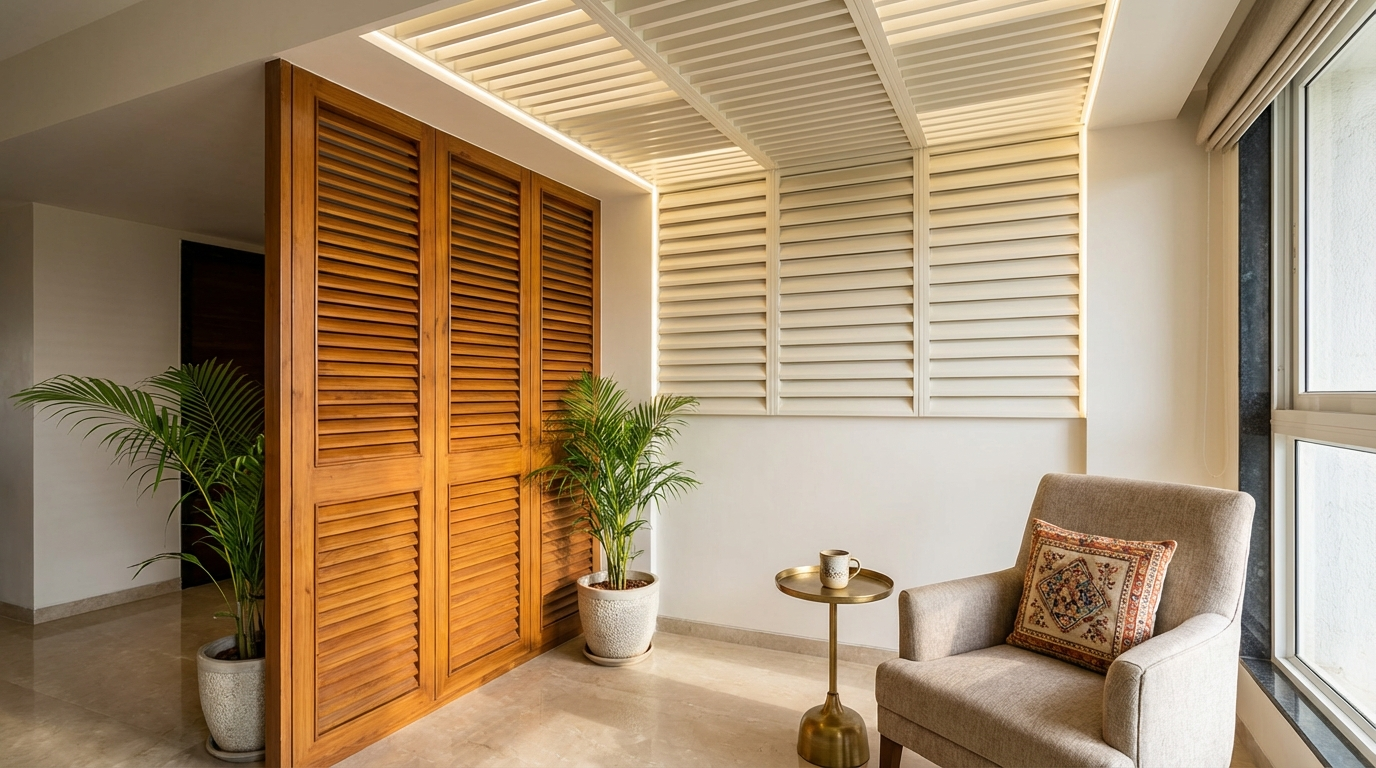
Use louvers behind the TV unit to create depth and highlight your entertainment wall. As a divider, they can subtly separate living and dining zones while keeping the space open and connected.
Bedroom Ideas
A gold-toned fluted wall panel behind your bed, paired with white sheets, feels royal yet modern. Bedrooms benefit from warmer tones—walnut, teak, or oak finishes work beautifully.
These panels function well as chic headboard panels for bedrooms and provide visual style to boring walls in hallways.
Ceiling Applications
Don't limit panels to walls. Louvers on ceilings make a space stand out. A wooden louver ceiling design in your hallway with recessed lighting creates immediate drama.
Ceiling application is an emerging trend where louvers are installed on ceilings to add texture and movement overhead, breaking the monotony of plain ceilings.
Office & Commercial Spaces
Office interiors require a balance of functionality and design. Louvers are ideal for reception backdrops, meeting room dividers, and open-plan workspace definition.
More Design Applications
- TV unit backdrop with integrated LED strips
- Full-height bedroom accent wall behind headboard
- Living room partition wall (semi-transparent design)
- Dining room feature wall with pendant lighting
- Corridor/hallway walls to create visual length
- Pooja room entrance surround
- Home office Zoom backdrop
- Kids' room accent wall with hidden storage
- Bathroom ceiling (PVC only)
- Balcony ceiling treatment
- Staircase wall running vertically
- Wardrobe sliding door panels
- Kitchen island facing
- False ceiling partial treatment
- Reception desk fascia
- Restaurant booth dividers
- Retail store display walls
- Hotel lobby feature walls
- Gym changing room partitions
- Café counter cladding
- Clinic reception backdrop
- Salon styling station walls
- Spa treatment room ambiance walls
- Exterior building facade accents
- Covered parking ceiling
Frequently Asked Questions
Is it true that WPC louvers are completely waterproof?
WPC panels are considered highly resistant to water, however they are not completely waterproof considering the fact that they are made of wood fiber. They handle humidity, occasional splashes, and damp conditions far better than wood. But for areas with constant water contact—like inside a shower—go with 100% PVC instead. WPC works great for bathroom walls away from direct water spray, but I wouldn't use it where water pools or runs continuously.
Can I install louvers panels myself, or do I need professional help?
Most PVC louvers and WPC wall panels are quick and mess-free to install. For small areas like a single TV backdrop wall, a competent DIY person with basic tools can manage. But larger installations, ceiling work, and anything requiring electrical cutouts—get professional help. The material cost is high enough that one major mistake wipes out any labor savings. We advise you to hire a local carpenter for the installation of louvers.
What if I live in a coastal city like Goa or Vizag—will WPC survive the saltwater humidity?
Standard WPC handles coastal humidity well for interior applications. The salt content in the air doesn't directly damage WPC the way it corrodes metal. That said, for exterior applications in coastal areas, go for UV-stabilized, co-extruded WPC specifically rated for exterior use. WPC exterior louvers are meticulously engineered to withstand harsh weather conditions. Interior installation in coastal homes—no special precautions needed beyond normal.
How do I clean louvers panels? Any special products needed?
WPC panelling is low maintenance—it doesn't require staining, sealing, or painting, and it's resistant to staining and fading. To keep it looking its best, simply wash it with soap and water occasionally. Dusting the louvers regularly with a soft cloth or cotton duster can keep them clean. Use a damp towel and soapy water to gently cleanse the panels for a deeper cleaning. Avoid abrasive cleaners or harsh chemicals. A simple microfiber cloth works perfectly for weekly dusting.
Is it true that darker louvers show more dust?
Yes and no. Dark colors show dust more visibly, but they also show fingerprints and smudges less. Light colors hide dust better but show every touch mark. Choose based on your maintenance habits and whether the area gets touched often. For high-touch areas like corridors, medium tones work best. For untouched accent walls, go with whatever look you prefer.
What thickness should I choose for different applications?
Thicker panels (17mm-26mm) give deeper shadows and more dramatic visual effect but cost more and weigh more. Thinner panels (10mm-12mm) work fine for ceilings and budget applications. Common thicknesses include 8mm for homes and offices like living rooms and bedrooms. For TV backdrops where shadow play matters, I'd suggest 17mm or higher. For general wall coverage, 12-14mm balances cost and appearance nicely.
Can louvers panels be painted or refinished later?
PVC panels can be painted with proper preparation (light sanding, primer, compatible paint), but why would you? The whole point is the pre-finished surface. WPC theoretically accepts paint but it's rarely worth it. If you think you might want to change colors later, consider light neutral tones initially. Or accept that these panels are a long-term design commitment.
Is it true that PVC panels release harmful chemicals?
Quality PVC panels from reputable manufacturers meet safety standards and don't off-gas harmful chemicals under normal conditions. The concern was more valid with older formulations. Modern panels, especially those with E1 or E0 certifications, are safe for indoor use. That said, don't buy completely unbranded material from unknown sources—those may not meet safety standards. Slight initial smell is normal and fades within days.
How do louvers panels compare to standard wall paint in terms of long-term value?
Paint costs roughly ₹15-30/sq ft for decent quality including labor. Quality WPC louvers with installation run ₹200-400/sq ft. That's 10-15x more expensive initially. But paint needs refreshing every 3-5 years. WPC panels come with genuine 15 years product warranty and need virtually no maintenance. Over 15 years, the total cost often works out similar—with louvers giving you superior aesthetics throughout.
What if my ceiling has a slight slope—can louvers still work?
Yes, with proper framework. The batten framework compensates for unevenness. Slopes up to about 5 degrees are manageable with standard installation techniques. Steeper slopes require more complex framework or consideration of alternative approaches. Your installer should assess this during the initial site visit.
Is it true that WPC is more eco-friendly than PVC?
Since both panels contain plastic, they are less eco-friendly than traditional wood panels. But if you want a slightly greener pick, opt for WPC panels that are made of a mix of materials. WPC uses recycled wood fibers and plastics in many cases. WPC uses recycled materials, which is what environmental programs would choose—this also saves resources. Neither is perfect from an environmental standpoint, but WPC edges out PVC slightly.
Can I use louvers panels in my kitchen near the stove?
Not directly behind the stove or in the splash zone. Heat and grease are problems. Both WPC and PVC are fire resistant, but WPC panels are more fire and heat resistant. For kitchen feature walls away from cooking zones, PVC works well due to its easy cleaning. But maintain at least 3-4 feet distance from direct flame and heat sources.
Final Word
Louvers panels have genuinely changed how we approach wall and ceiling design in Indian homes. They bridge that gap between "I want something premium" and "I have a realistic budget." Louvers combine style and functionality—they enhance airflow, acoustics, and light management while adding depth, texture, and sophistication to walls and partitions.
For most people in metro cities dealing with humidity concerns, WPC is the sweet spot. Coastal dwellers should lean toward WPC or PVC depending on application. And if you're in a dry climate with moderate budget, even good PVC will serve you well for years.
Oh, one more thing—whatever you choose, get samples and live with them for a few days before ordering the full quantity. See them in morning light, evening light, tube light. Touch them. Show them to your carpenter. This single step prevents more regrets than anything else I can tell you.
Note: sainik710.com is an independent informational site and is not affiliated with any manufacturer.
Disclaimer: This content is provided for general informational purposes based on industry practices and publicly available information. Product specifications, standards, prices, and availability may vary by manufacturer, region, and time. Readers should independently verify details with manufacturers, dealers, or qualified professionals before making purchase or construction decisions.Want Plywood Suggestions?
Share a few details and a Sainik 710 specialist will suggest suitable brands and connect you to responsive dealers.