Living Room Partition Design (25+): Room Dividers That Don’t Block Light + Right Boards & Thickness
25+ living room partition ideas that keep light and space. Learn the right boards, thickness, finishing and installation tips for long-lasting partitions.
Quick Decision Summary
Choose slatted or open-shelf partitions in 15-18mm BWR plywood or HDHMR for light flow, strength, and Indian humidity resistance.
If you're in a hurry, prioritize designs with 40-60% open space like vertical slats or geometric cutouts to maintain airflow and brightness in typical Indian living rooms. Use calibrated BWR grade plywood or HDHMR boards at 15-18mm thickness for stability against monsoon warping. Pair with laminate or paint finishes, ensure edge sealing, and acclimatize sheets on-site for 48 hours before cutting. This setup balances aesthetics, durability, and cost at roughly 150-250 rupees per sqft material-wise, varying by city and core quality.
- Choose this if: You want semi-private zones in open-plan homes without darkening the space, need good screw-holding for shelves, or live in humid/coastal areas.
- Avoid this if: Full privacy is essential (opt for solid panels instead), budget under 100 rupees/sqft, or installing in extreme termite-prone zones without treatment.
What This Actually Means (Grade, Construction, and Use)
Living room partitions act as room dividers that separate spaces like living from dining or kids' play areas while preserving openness. "Designs that don't block light" specifically refer to semi-transparent or open structures—think slatted panels, perforated screens, or shelf-integrated dividers—allowing 30-70% light and air passage. Unlike solid walls, these use frames of 2x2 inch timber or metal with infill panels, preventing a cave-like feel in compact Indian apartments.
Construction involves a sturdy frame (often hardwood battens) clad with boards like plywood, MDF, or WPC. Plywood grades matter: MR for interiors only (dry zones), BWR for boiling water resistance (bathroom-adjacent living rooms), and BWP marine for high-humidity coastal use. Calibrated plywood ensures flatness for clean CNC cuts. Thickness ranges from 12mm for lightweight decorative screens to 18-25mm for load-bearing shelf partitions. Use cases include zoning open living rooms in 2BHK flats, hiding storage without enclosing, or creating TV lounges that flow into dining.
Key is balance: too open lacks privacy; too dense blocks light. Field reality shows these partitions double as display units, so screw-holding strength from mixed-core or hardwood plywood prevents sagging shelves over time.
India-Specific Reality Check (Moisture, Termites, and Workmanship)
In India, living room partitions face monsoon humidity (70-90% RH), coastal salt air, and poor ventilation in urban high-rises, leading to swelling or delamination if using low-grade MR boards. Coastal cities like Mumbai or Chennai demand BWP marine plywood to resist 3-5 boil cycles equivalent, while inland Delhi-NCR suits BWR. Termites thrive in untreated softwood cores, especially post-monsoon; always verify BIS IS:303 certification visually and opt for treated veneers.
Workmanship pitfalls include carpenters skipping acclimatization—boards must lie flat on-site 48-72 hours to match ambient 30-40% MC. Common issues: uneven cuts causing gaps, skipped edge sealing leading to moisture ingress, or undersized screws stripping holds. Storage mishaps like stacking wet plywood cause core voids. Contractor practices vary: modular firms use CNC for precision, while local carpenters rely on table saws—insist on zero-gap joints and putty-filled edges for 10+ year life.
25+ Living Room Partition Design Ideas with Material Choices
These ideas focus on light-permeable designs suited to Indian homes, grouped by style. Each includes typical dimensions (height 7-8ft, width per room size), board/thickness, and finish for practicality. Aim for 40-60% open area to retain brightness.
Modern Minimalist (Clean lines, paint finishes):
- Vertical slats 2-4 inches wide, spaced 3-6 inches: 18mm HDHMR, emulsion paint; 8x10ft for L-shaped rooms.
- Horizontal louvers adjustable angle: 15mm calibrated BWR plywood, matte laminate; 7.5x6ft near windows.
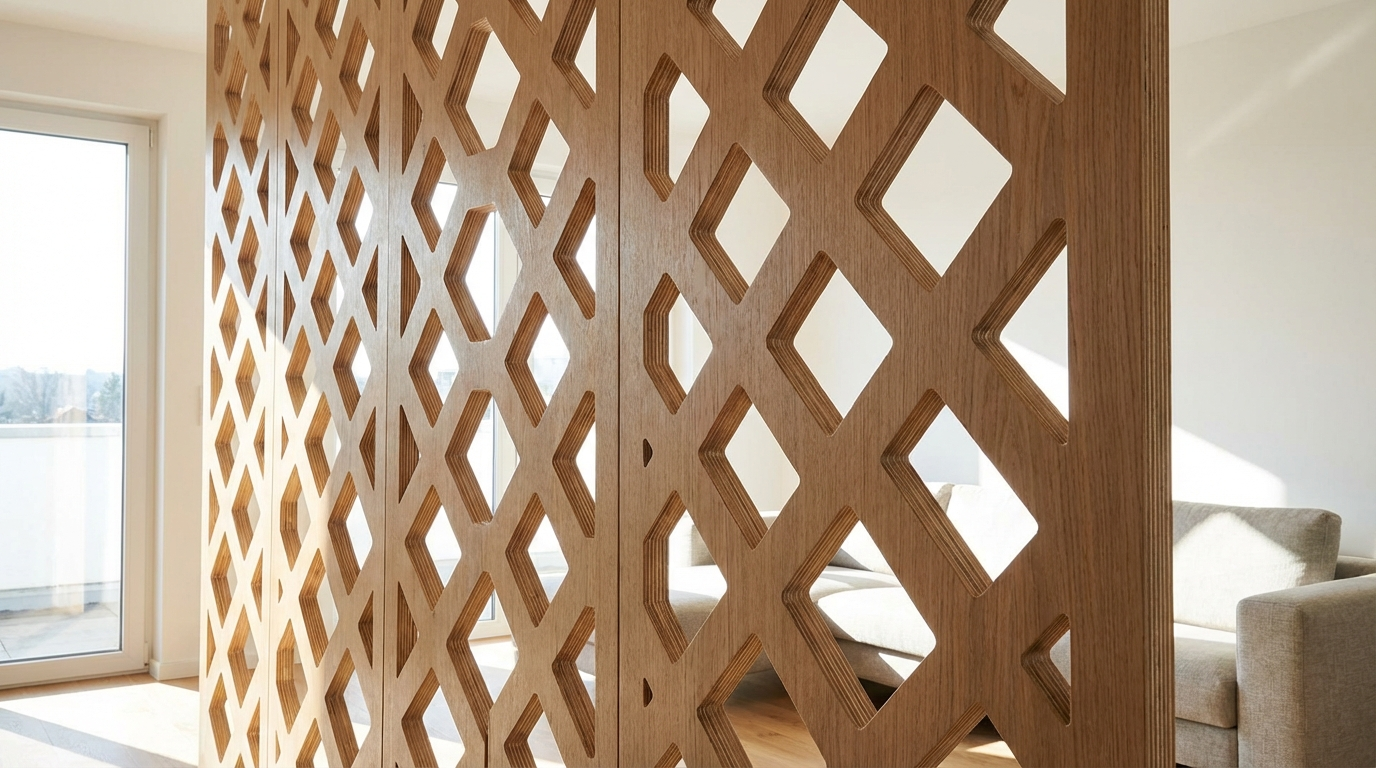
- Geometric laser-cut patterns (hexagons): 12mm MDF, PU polish; 8x8ft corner divider.
- Asymmetric wavy cutouts: 18mm BWP marine, veneer; 7x12ft for coastal open plans.
Traditional Indian Fusion (Jaali-inspired):
- Floral jaali screens: 15mm blockboard, teak veneer; 8x7ft with brass accents.
- Arched lattice with shelves: 18mm mixed-core plywood, laminate; 7.5x9ft dining separator.
- Mandala perforated panels: 12mm WPC board, acrylic paint; 8x5ft TV unit backdrop.
- Jharokha-style cutouts: 18mm hardwood plywood, melamine finish; 7x10ft balcony-facing.
Functional Shelf-Based (Storage + division):
- Open cube shelves staggered: 18mm BWR plywood, laminate on exposed faces; 8x8ft with books/plants.
- Floating asymmetric shelves: 15mm HDHMR, glass shelves inset; 7.5x7ft play area divider.
- Ladder-style leaning shelves: 12mm calibrated plywood, rope accents; 8x6ft renter-friendly.
- Integrated planters vertical garden: 18mm BWP, powder-coated metal frame; 7x9ft humid zones.
Contemporary Textured (Add warmth):
- Reeded wood panels vertical: 18mm veneer-faced plywood, natural polish; 8x10ft.
- Mesh wire + wood frame: 15mm MDF backing, fabric insert; 7.5x8ft industrial vibe.
- Layered frosted acrylic slats: 12mm plywood frame, acrylic sheets; 8x7ft semi-private.
- Hexagonal honeycomb open cells: 18mm blockboard, whitewash; 7x12ft large halls.
- Bamboo-inspired slats: 15mm treated plywood, bamboo veneer; 8x9ft eco-touch.
Budget/Quick-Fix Ideas:
- DIY pipe + board grid: 12mm MR plywood, spray paint; 7x6ft temporary.
- Curtain rod + slat drops: 15mm HDHMR, fabric drapes; 8x5ft flexible.
Scale dimensions to room: 20-30% of wall length for balance. Carpenters often combine 2-3 ideas for custom flow.
Price Range and Cost Drivers
Material costs for living room partitions typically range 120-350 rupees per sqft, installed 200-500 rupees/sqft depending on design complexity. Breakdown: basic slatted 12mm HDHMR at 120-180/sqft; premium 18mm BWP marine with veneer 250-350/sqft. Thickness jumps price 20-30%: 12mm lightest/cheapest, 18mm standard for shelves adds 40-50 rupees/sqft.
Drivers include core type (hardwood 20% pricier than mixed), glue grade (BWP premium 30% over MR), calibration (flatness adds 15-20 rupees), face finish (veneer/laminate 50-100 extra), and logistics (Tier-1 cities 10-15% higher). Custom CNC cuts add 50-80/sqft labor. For 50sqft partition, budget 10,000-25,000 rupees total—confirm local rates as they vary 20-30% by region/batch.
How to Choose in 5 Steps
Step 1: Assess needs—light/privacy ratio (40% open for max light), load (shelves? 18mm+), location (humid? BWR/BWP).
Step 2: Measure space—height 7.5-8ft standard, width 20-40% room length; sketch airflow paths.
Step 3: Select board—HDHMR for paint/smooth cuts, plywood for screw strength; test knock for voids.
Step 4: Pick thickness/finish—15mm light designs, 18mm functional; laminate for durability over paint.
Step 5: Verify installer—ask for acclimatized stock, edge sealing, 2-inch screws; site-inspect post-install.
Board Comparison for Light-Permeable Partitions
| Board Type | Best For | Thickness Range | Strengths | Weaknesses | Cost Driver |
|---|---|---|---|---|---|
| Plywood (BWR/BWP) | Shelves, humid areas | 15-18mm | Screw holding, warp-resistant | Visible grain needs veneer | Core/glue grade |
| HDHMR | Painted modern looks | 12-18mm | Smooth CNC cuts, termite-resistant | Lower screw hold long-term | Density calibration |
| MDF | Decorative screens | 12mm | Cheap, paint-ready | Swells in humidity | Basic vs moisture-grade |
| WPC | Wet zones, outdoor-ish | 12-15mm | Waterproof, lightweight | Poor screw hold | Extrusion quality |
| Blockboard | Heavy shelves | 18-25mm | Strong core | Heavy, gaps possible | Block spacing |
Decision Framework: Design vs Conditions
| Room Condition | Design Pick | Board/Thickness | Trade-off |
|---|---|---|---|
| High humidity/coastal | Slatted louvers | BWP 18mm | Durability over cost (+30%) |
| Dry inland, budget | Open shelves | HDHMR 15mm | Speed vs screw life |
| Small space, max light | Perforated jaali | MDF 12mm | Light vs stability |
| Load-bearing shelves | Cube grid | Plywood 18mm | Strength vs weight |
| Renter/flexible | Leaning ladder | Calibrated ply 12mm | Easy install vs permanence |
7 Common Buyer Mistakes and Fixes
- Wrong grade for climate: Picking MR plywood in humid living rooms leads to delamination. Fix: Upgrade to BWR/BWP; check boil test claim.
- Undersized thickness: 9mm sags under shelves. Fix: Minimum 15mm for spans over 2ft; reinforce frame.
- No edge sealing: Exposed cuts absorb moisture. Fix: Apply 2-coat PU sealer or PVC tape immediately post-cut.
- Ignoring acclimatization: Mill-fresh boards warp on-site. Fix: Stack horizontally 48hrs in install room.
- Poor frame design: Weak battens cause lean. Fix: 2x2 inch hardwood, spaced 16 inches max.
- Skipping screw tests: Weak holds fail later. Fix: Pre-drill, use 2.5-inch countersunk screws; load-test sample.
- Overlooking voids: Hollow knocks mean core gaps. Fix: Tap test every sheet; reject echoes.
Workmanship and Installation Tips
Cutting: Use CNC for intricate slats (precision ±0.5mm) or table saw for straights—clean with 80-grit sand. Edge sealing critical: Fill with wood putty, 2 coats melamine polish, or boiling water-proof adhesive tape to block humidity. Fastening: 2-2.5 inch wood screws every 12 inches into frame; pilot holes prevent splits. For hinges/handles in shelf zones, reinforce with 25mm blockboard inserts for 50-100kg load.
Installation sequence: Frame first (anchor to floor/ceiling), infill panels (screw from back), finish last. Acclimatize 72hrs in monsoon; level with shims. Common fail: No expansion gaps (1/8 inch) causing buckle—leave at joints. Carpenters often rush; supervise for plumb lines and dust-free polish.
Quality Checks You Can Do Without Lab Tests
Visually inspect: Uniform color, no black spots (fungal), straight edges (±1mm). Knock test: Solid thud across surface—no hollow drums indicating voids. Edge glue: Scrape test—chips should show continuous glue line, not layered peels. Moisture feel: Cool/damp? Reject (over 12% MC). Ask vendor: Core composition (hardwood/mixed?), glue type (UF/PF?), treatment proof.
Warning signs: Bulging faces (poor pressing), fuzzy cuts (uncalibrated), termite nibbles on sample edges. On-site post-cut: Check flatness with straightedge; warp over 2mm needs replacement. These field checks catch 80% defects before install.
FAQs
Can I use 12mm boards for all partition designs?
12mm works for purely decorative, no-load screens like perforated jaali in dry interiors, but for slatted or shelf designs, it risks sagging under 10-15kg books/plants. In Indian homes with fans/vibrations, upgrade to 15-18mm BWR/HDHMR for spans over 2ft. Trade-off: Lighter/cheaper install but shorter life in humid conditions—test load on sample first.
What's better for painted finishes: MDF or HDHMR?
HDHMR edges out MDF for Indian climates due to higher density (850+ kg/m3) and moisture resistance, preventing swelling in 40% RH swings. Both take emulsion paint well after primer, but HDHMR holds routing for slats without chipping. Use in non-wet zones; for coastal, pair with sealer coats.
How much open space for "no light block"?
Aim 40-60% open (slat gaps, cutouts) to retain 70-80% natural light in 10x12ft rooms—measure by overlaying grid on sketch. Too open (70%+) loses privacy; test with phone light app. Ventilation bonus in poorly AC-ed homes.
Do partitions need floor-to-ceiling height?
Not always—7ft high suffices for most 9-10ft ceilings, saving 20% material/cost while allowing air circulation. Full height for acoustics/privacy; half-height shelves for casual zoning. Anchor tops to beams for stability.
BWP vs BWR: When to splurge?
BWP marine for coastal/high-humidity (Chennai/Mumbai) resisting 100+ hours boiling; BWR for inland moderate wet (Delhi monsoons). BWP 25-40% costlier but lasts 15+ years vs BWR's 10. Skip MR entirely for partitions.
How to fix warping post-install?
Early warp from no acclimatization—remove panels, dry flat 1 week, re-cut gaps. Prevention: PF glue boards, PU seal. Severe cases need full replace; common in uncalibrated stock.
Shelves in partitions: Weight limits?
18mm plywood shelves span 2-3ft hold 20-30kg uniform; reinforce mid-support for more. Use blockboard cores for 50kg+. Distribute loads; avoid point weights like TVs.
Termite-proofing for wooden partitions?
Opt pre-treated boards (CIB-approved chemicals), seal all edges/joints. Annual spray in prone areas; avoid ground contact. HDHMR/WPC naturally resistant.
CNC vs manual cutting for designs?
CNC ideal for complex slats/jaali (±0.2mm accuracy, dust-free), 20% faster; manual table saw for straights but gaps-prone. Modular firms excel CNC; locals improve with jigs.
Maintenance for laminate finishes?
Wipe dry, avoid abrasives—lasts 10+ years. Edges chip? Touch-up sealer. Humidity causes peel if unsealed; coastal needs annual polish refresh.
Best for renters: Removable partitions?
Leaning ladder shelves or tension-rod slats in 12mm calibrated ply—disassemble no-damage. Add rubber pads for grip; under 5kg/sqft pressure.
Disclaimer: This content is provided for general informational purposes based on industry practices and publicly available information. Product specifications, standards, prices, and availability may vary by manufacturer, region, and time. Readers should independently verify details with manufacturers, dealers, or qualified professionals before making purchase or construction decisions.Want Plywood Suggestions?
Share a few details and a Sainik 710 specialist will suggest suitable brands and connect you to responsive dealers.