L-Shaped Kitchen Design: 35+ Modern Layouts with Size Guide & Material Tips
Get 35+ L-shaped kitchen designs for Indian homes. Space-efficient layouts, material guide & cost breakdown for small to large L-type modular kitchens.
L-Shaped Kitchen Design: The Quick Answer
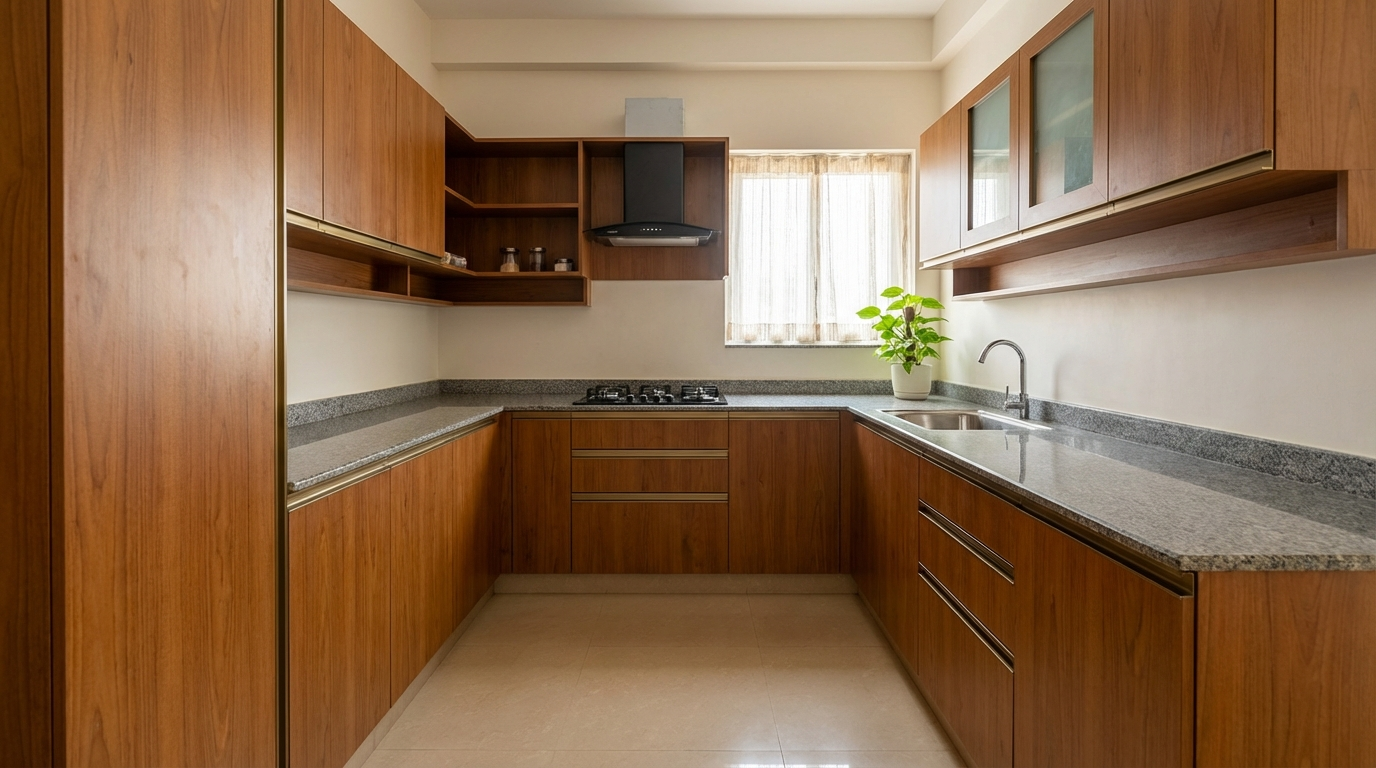
An L-shaped kitchen design uses two adjacent walls meeting at a right angle to create an efficient cooking space that naturally separates wet and dry work zones while keeping everything within arm's reach.
Short version: The L-shaped layout works brilliantly for Indian homes because it fits into corners that other designs can't use, accommodates our multi-burner cooking style, and leaves one or two sides open for ventilation—critical when you're doing tadka or frying fish. Most 2BHK and 3BHK apartments between 80-180 sq ft kitchen area find this layout ideal.
This is right for you if:
- Your kitchen sits in a corner of your home with two available walls
- You have between 60-200 sq ft and need maximum efficiency from limited space
- Multiple family members cook simultaneously—this layout handles that well
- You want an open feel connecting to dining or living areas
Skip this if:
- Your kitchen is a narrow galley with opposite parallel walls—go for a straight or parallel layout instead
- You have a massive kitchen above 250 sq ft where a U-shape or island would serve you better
Bottom line: The L-shaped kitchen remains the most practical layout for 70% of Indian urban apartments, and there's good reason interior designers keep recommending it.
What L-Shaped Kitchen Design Actually Means
An L-shaped kitchen layout arranges cabinets, countertops, and appliances along two perpendicular walls, forming the letter "L" when viewed from above. This configuration creates the classic work triangle between your sink, stove, and refrigerator without requiring you to walk across the entire kitchen.
Most people think you need a big kitchen for an L-shape. Actually, this layout works better in compact spaces than almost any alternative. I've seen stunning L-shaped kitchens in 60 sq ft Mumbai flats and equally functional ones in 200 sq ft Bangalore apartments. The secret isn't square footage—it's how you use the corner.
Here's what makes it technically different from other layouts: your primary work counter typically runs 8-12 feet along one wall, with a secondary counter of 6-10 feet on the perpendicular wall. The corner junction—that 90-degree meeting point—is where most people waste space. But with magic corners, carousel units, or even simple lazy Susans, that dead corner becomes premium storage.
The "work triangle" everyone talks about? In an L-shaped design, it forms naturally. Your sink usually sits on one arm, the hob on the other, and the fridge anchors one end. Walking distance between these three points stays under 6-7 feet total. That's why professional kitchen designers call this the most ergonomically efficient layout after the U-shape.
Why This Layout Works So Well in Indian Homes
Indian cooking isn't like Western cooking. We don't just heat and serve—we grind, temper, fry, and often run two or three preparations simultaneously. The L-shaped design accommodates this chaos better than you'd expect.
In places like Chennai or Mumbai, you're dealing with 80-90% relative humidity for four to five months every year. That moisture affects your kitchen cabinets, especially around the sink and cooking areas. The L-shape keeps your wet zone (sink, dishwasher) on one arm and dry storage on the other, naturally separating moisture exposure. I've seen this simple separation add years to cabinet life in coastal cities.
Ventilation matters enormously. Kolkata kitchens in older buildings often have just one small window. The L-shaped layout leaves two sides completely open—no cabinets blocking airflow. When you're doing that smoky tadka at full flame, having cross-ventilation isn't luxury, it's necessity. Bangalore and Hyderabad homes with their relatively better weather still benefit from this airflow during summer months.
Quick detour: there's also a cultural factor nobody talks about. Indian families often have two people in the kitchen—maybe mom cooking rice while daughter-in-law makes sabzi. The L-shape creates two distinct work zones where people don't bump into each other constantly. I've seen this reduce kitchen arguments in joint families more than any other layout change.
Is the L-shape actually better than a U-shape for Indian cooking?
Depends entirely on your space and who's cooking. U-shaped kitchens offer more storage and counter space, no question. But they require at least 10-12 feet width to avoid feeling cramped, and having three walls of cabinets can make smaller kitchens feel claustrophobic. The L-shape gives you 85% of the functionality with better airflow and a more open feel. For kitchens under 150 sq ft with one or two regular cooks, I'd pick L-shape every time. Above 180 sq ft with a dedicated kitchen entrance? Consider U-shape.
Types of L-Shaped Kitchen Layouts
Not all L-shaped kitchens are created equal. The basic L can be configured in at least five distinct ways depending on your space, cooking style, and budget.
Compact L-Shape (60-90 sq ft)
This is your 1BHK and small 2BHK territory. Both arms typically measure 6-8 feet each. You're fitting essentials only: 2-burner hob, single-bowl sink, under-counter fridge, and maybe 8-10 feet of base cabinet storage. Honestly, if designed well, this handles a family of three without problems. The trick is going vertical—use full-height wall cabinets up to the ceiling.
Standard L-Shape (90-140 sq ft)
Most common in 2BHK and 3BHK apartments. One arm runs 10-12 feet, the other 6-8 feet. You get space for a full 3-4 burner hob, chimney, double-bowl sink, and proper tall unit for pantry storage. This is the sweet spot where the layout really shines.
Open L-Shape with Dining Integration
Popular in modern apartments where kitchen opens into living-dining. One arm of the L often becomes a breakfast counter with bar stools. Looks great in renders and Instagram photos. My take: make sure that breakfast counter is at least 12 inches deep and has some knee space underneath, otherwise it's just a ledge nobody uses.
L-Shape with Island
Best for homes with 150+ sq ft kitchen area. The island adds prep space, can house your hob or sink, and doubles as a serving counter. But here's what most designers won't tell you: you need minimum 36-42 inches clearance around all sides of the island. Less than that, and you'll hate walking around it within a month.
Luxury L-Shape
Think 180-250 sq ft with premium everything: quartz countertops, soft-close drawers throughout, built-in appliances, and often a separate wet kitchen behind. If budget allows, this is where you go full modular with imported fittings. But I've seen ₹25 lakh kitchens that function worse than ₹4 lakh ones because the basic workflow was wrong.
| Layout Type | Ideal Space | Best For | Watch Out For |
|---|---|---|---|
| Compact L | 60-90 sq ft | 1BHK, studio apartments, couples | Limited counter space—plan every inch |
| Standard L | 90-140 sq ft | Most 2-3 BHK families, this is your default choice | Corner utilization—don't waste the junction |
| Open L with Dining | 100-160 sq ft | Modern apartments, entertainment-friendly homes | Oil splatter travels to dining area, needs good chimney |
| L with Island | 150-220 sq ft | Larger homes, serious home cooks | Clearance requirements often underestimated |
| Luxury L | 180-250+ sq ft | Premium homes, villas | Budget can spiral fast—set limits early |
Material Choices: What Actually Works for L-Shaped Kitchens
Here's where most kitchen projects go wrong. People obsess over layout and ignore materials, then wonder why their ₹6 lakh kitchen looks terrible in three years.
For the cabinet carcass—that's the box structure, not the visible doors—you have three main options in India: commercial plywood, BWR/BWP plywood, and engineered boards like HDHMR or marine-grade MDF. The plywood selection guide on this site covers this extensively, but quick version: for kitchens, especially in humid cities, BWR grade minimum. Commercial grade MR plywood near your sink is asking for trouble.
For shutters and doors, the visible part that everyone sees:
- Laminate finish: Budget-friendly at ₹750-1,200 per sq ft for the shutter. Durable, easy to clean, huge color range. But edges can peel in humidity if not sealed properly.
- Acrylic finish: High-gloss, modern look at ₹1,400-2,200 per sq ft. Scratches show easily on dark colors. Looks stunning initially but needs careful maintenance.
- PU (Polyurethane) paint: Smooth matte or gloss finish, ₹1,600-2,500 per sq ft depending on quality. More repairable than acrylic if damaged. My preference for most clients.
- Membrane/3D: Budget option for decorative doors, ₹600-900 per sq ft. Not recommended for areas near heat or moisture—edges lift.
- Glass shutters: Profile glass or lacquered back, typically ₹1,200-2,000 per sq ft. Great for upper cabinets to display items, but fingerprint nightmare near cooking.
For countertops, granite remains king in Indian kitchens for good reason. Black granite handles turmeric stains, hot vessels, and daily abuse. Quartz looks better and offers seamless looks but costs 2-3x more and can discolor with extreme heat. I've seen brand-new quartz counters with heat marks from putting a kadai directly on them. If you're going quartz, always use trivets.
What's the best plywood thickness for kitchen cabinets?
For base cabinets carrying heavy loads—think granite countertop weight plus stored utensils—use 18mm BWR plywood for the carcass sides and 12mm for back panels. Shelves can be 15mm or 18mm depending on span. For wall-mounted upper cabinets, you can drop to 16mm or even 12mm for the structure since they carry less weight. But never go below 18mm for base cabinet sides in a kitchen—I've seen 12mm panels bow under counter weight within two years.
Size Planning: Dimensions That Actually Work
Forget generic advice. These are the measurements that work in real Indian kitchens based on what I've seen succeed and fail.
Counter height: Standard is 34-36 inches from floor. But if the primary cook is shorter, 32-33 inches reduces back strain enormously. I've seen too many kitchens built at "standard" height where the person cooking is uncomfortable daily. Measure based on who uses the kitchen, not what the catalog says.
Counter depth: Base cabinets are typically 24 inches deep, with countertop overhanging 1-1.5 inches. Don't go deeper than 26 inches unless you have extra-long arms—you won't be able to reach the back wall.
Upper cabinet height: Mount bottom of upper cabinets 18-20 inches above the counter. This gives working space while keeping upper shelves reachable. Full-height upper cabinets reaching ceiling work great for storage but accept that the top shelf will need a step stool.
Clearance requirements:
- Between opposite counters (if any): minimum 42 inches, 48 inches preferred
- In front of refrigerator: 36 inches minimum to open door fully
- Around island: 36-42 inches all sides
- Chimney height above hob: 24-30 inches depending on model
Arm length planning: Measure the longer arm of your L based on wall availability, but keep the shorter arm proportional. A 12-foot × 4-foot L creates an awkward layout. Aim for roughly 60-70% ratio between arms—so a 10-foot main arm pairs well with a 6-7 foot secondary arm.
Cost Reality Check: What You'll Actually Pay in 2026
Pricing for modular kitchens varies wildly based on materials, finish, accessories, and your city. But here's a realistic breakdown based on current market rates:
Budget segment (₹1,200-1,800 per sq ft of modular work): Commercial plywood carcass, laminate finish shutters, basic hardware, granite countertop. A 100 sq ft L-shaped kitchen runs ₹1.5-2.5 lakhs including appliances. Functional but not fancy.
Mid-range (₹2,000-3,500 per sq ft): BWR plywood carcass, acrylic or PU finish, Hettich or Hafele hardware, soft-close mechanisms, granite or entry-level quartz. The 100 sq ft kitchen hits ₹3.5-5.5 lakhs. This is where most urban middle-class kitchens land.
Premium (₹4,000-7,000 per sq ft): Marine plywood or HDHMR carcass, imported finishes, full soft-close with accessories like magic corners, pull-out pantry units, imported quartz or Corian. Same 100 sq ft now costs ₹6-10 lakhs. Delhi, Mumbai, and Bangalore premiums can push this higher.
Here's what actually affects your final bill:
- Accessories: A single magic corner unit costs ₹15,000-35,000. Four of those and you've added a lakh to your budget.
- Finish: Jumping from laminate to acrylic adds 40-60% to shutter cost alone
- Appliances: Chimney plus hob plus built-in oven can run ₹80,000-2 lakhs depending on brand
- City: Same kitchen costs 15-25% more in Mumbai or Delhi compared to Ahmedabad or Jaipur
Between you and me, most people underbudget accessories and appliances. They plan ₹4 lakhs, then get sticker shock when accessories alone hit ₹1.2 lakhs. Plan your accessory budget as 20-30% of total kitchen cost from the start.
How to Plan Your L-Shaped Kitchen: A Practical Framework
Forget those generic 10-step guides. Here's the actual sequence that works:
Step 1: Measure your actual kitchen space, including windows, doors, electrical points, and plumbing locations. A drawing with exact dimensions is essential before talking to any designer. Do it yourself or pay someone—but don't estimate.
Step 2: Fix your plumbing and gas locations first. Moving a gas pipeline or sink drain after cabinet installation costs a fortune and usually means ripping out completed work. The sink should sit near existing drain lines; hob near gas inlet. Work with constraints, not against them.
Step 3: List everything that MUST go in the kitchen—fridge size, planned appliances, number of burners needed, typical grocery storage, specific utensils like pressure cookers and kadais. This creates your real requirements, not generic assumptions.
Step 4: Plan the work triangle. Position sink, hob, and fridge so total walking distance between them stays under 20-22 feet. In an L-shape, sink usually goes on one arm, hob on the other arm, fridge anchors one end.
Step 5: Allocate zones: prep area (needs maximum counter space), cooking zone (near hob with heat-resistant counter), washing zone (around sink with draining space), and storage zones (both daily-use and bulk storage).
Oh, one more thing—electrical planning happens at this stage, not later. You need dedicated points for chimney, fridge, water purifier, mixer-grinder, microwave, and potentially dishwasher and oven. Under-cabinet lighting needs points too. I've seen finished kitchens with extension boards everywhere because electrical planning came as an afterthought.
| Your Situation | Recommended Configuration | Why This Works |
|---|---|---|
| Small kitchen, single cook | Compact L, 2-burner hob, single sink | Maximizes counter space you actually need |
| Medium kitchen, 2-3 family members | Standard L, 3-4 burner, double sink preferred | Balances cooking and prep needs |
| Kitchen opens to living area | Open L with breakfast counter, good chimney essential | Smoke and smell control becomes critical |
| Heavy Indian cooking daily | L-shape with tall unit, extra-deep chimney | Spice storage and fume extraction need priority |
| Frequent entertaining | L with island if space permits | Island becomes serving/conversation hub |
| Budget-constrained | Standard L, laminate finish, local hardware | Get the layout right, upgrade finishes later |
Common Mistakes I Keep Seeing
Ignoring the corner: The L-junction corner is prime real estate. Leaving it as dead storage—where things go to disappear—wastes 15-20% of your cabinet potential. Invest in a carousel, magic corner, or at least a lazy Susan. Yes, they cost ₹8,000-30,000 depending on type. Worth every rupee.
Matching everything: Every surface doesn't need to be the same color. I've seen all-white kitchens that look like hospital labs and all-wood kitchens that feel like they're from 1985. Mix materials—maybe wood-finish base cabinets with white uppers, or neutral cabinets with a bold countertop.
Skimping on lighting: A single ceiling light doesn't cut it. You need under-cabinet task lighting over prep areas—LEDs work great—plus general overhead lighting. Cooking in your own shadow is annoying and actually dangerous when you're handling knives and hot oil.
Forgetting the tall unit: Where will your broom, mop, and cleaning supplies go? Where's the pantry for rice, atta, and bulk groceries? A tall unit (floor-to-ceiling cabinet) solves both. Most people add this as an afterthought when it should be planned from day one.
Wrong countertop around sink: This one really frustrates me. Laminate countertops near sinks absorb water at edges and swell over time. Around any wet zone, use granite, quartz, or solid surface—never laminate or veneer. A builder in Andheri learned this the hard way. Gorgeous Italian laminate countertop, completely swollen edges within eight months because water kept pooling near the sink. Entire counter replacement.
Not planning for Indian cooking: Western kitchen designs assume you'll boil pasta and bake chicken. Indian kitchens deal with oil splatter, turmeric stains, and heavy vessels. Keep hob at least 6-8 inches from walls to give elbow room. Ensure backsplash extends at least 20 inches above counter—tiles, not paint. Add a dedicated masala drawer near the hob.
Overcomplicating hardware: Every drawer doesn't need a soft-close mechanism. Every cabinet doesn't need a push-to-open system. Start with quality hinges and runners on frequently-used areas—soft-close on the three drawers you open most, standard hardware elsewhere. You can upgrade later if budget allows.
Quality Checks Before You Finalize
Visual inspection of materials:
- Check plywood edges—no voids or gaps between layers should be visible
- Laminate samples should have protective film; if scratched already, expect damage during installation
- Hardware sample: operate soft-close mechanism 20-30 times, check for any catching or resistance
- Countertop samples: pour water and oil, see how easily they wipe off after 10 minutes
Questions to ask your modular kitchen vendor:
- "What's the carcass material—exact brand and grade, not just 'plywood' or 'HDHMR'?"
- "What warranty do you offer on structure versus hardware versus finish?" Get this in writing.
- "Who handles installation? Your team or outsourced carpenters?" Direct teams usually mean better quality control.
- "Can I see a kitchen you installed 2-3 years ago?" Any confident vendor will agree.
- "What happens if a shutter gets damaged in two years? Can I get exact color match for replacement?"
Red flags to walk away from:
- No physical showroom or workshop you can visit
- Significantly cheaper than three other quotes—they're cutting corners somewhere
- Unwilling to specify material brands in the quotation
- All-inclusive "package deals" without itemized breakdown
- Pushing for full payment before installation begins
- No samples available—only catalog pictures
Here's a trick most dealers don't like: ask for offcut pieces of the actual plywood and laminate they'll use. Take these home, pour water on them overnight, see what happens to the edges. Any quality BWR plywood handles this fine. MR grade or poor laminate will show damage.
Working With Your Carpenter or Modular Kitchen Team
Whether you're going fully modular or semi-modular with carpenter-made cabinets, communication is everything.
Briefing checklist—tell them upfront:
- Maximum budget (including buffer of 10-15% for overruns)
- Non-negotiable requirements: specific appliances, must-have features
- Timeline expectations and penalties for delays
- Approval process: who signs off on design, material arrival, and installation stages
- Your working hours: when can they access the site
For plywood-based kitchens, edge banding is critical. This isn't optional. Every exposed plywood edge—especially around sink cabinet and under-counter areas—needs 1-2mm PVC edge banding, heat sealed. I've seen carpenters skip this on hidden edges to save time. By the first monsoon, those edges absorb moisture and begin to swell. Insist on seeing edge banding done, even on interior edges of base cabinets.
If your kitchen uses HDHMR or MDF boards, the edge banding becomes even more important because these materials absorb water faster than plywood if exposed. The material comparison guides on this site cover this in detail for those interested in the technical differences.
Why do some carpenters prefer plywood over HDHMR for kitchens?
It's mostly familiarity and workability. Carpenters have worked with plywood for decades—they know how it behaves, how to cut it without chipping, how screws hold in the material. HDHMR is relatively newer in India, and not all carpenters have adapted their techniques. That said, good quality HDHMR (from established brands, with proper density of 850+ kg/m³) performs excellently in kitchens. The mistri preference is often about comfort zone, not actual material performance. If your carpenter is experienced with HDHMR, there's no reason to avoid it.
How Long Your Kitchen Will Actually Last
Nobody wants to hear this, but let me be honest: modular kitchen lifespan depends entirely on materials, installation quality, and maintenance.
With quality BWR plywood carcass, good hardware, and proper sealing, expect 12-15 years before needing significant work. Some kitchens I installed in 2010-2012 still look decent because owners maintained them.
Budget kitchens with commercial plywood or poor-quality boards? Trouble starts around year 4-5. Boards near sink start swelling, shutters begin warping where hinges are mounted, laminates lift at edges. By year 7-8, you're looking at partial or full replacement.
What affects longevity:
- Humidity: coastal cities see faster deterioration than dry-weather cities
- Ventilation: closed kitchens without exhaust accumulate moisture and cooking residue
- Usage intensity: a kitchen cooking three meals daily wears differently than occasional-use kitchens
- Cleaning habits: harsh chemicals damage finishes; gentle cleaning extends life
- Water management: splashing water carelessly near cabinet bases is the number one destroyer
Signs of wear to watch for:
- Swelling at cabinet bases—indicates moisture penetration
- Shutter alignment getting worse—hinges wearing out
- Drawers becoming hard to open—runner mechanism degrading
- Laminate edges lifting or peeling—sealant failure
- Soft spots in countertop near sink—substrate damage underneath
In my experience, well-maintained kitchens in cities like Bangalore or Pune last 2-3 years longer than identical kitchens in Mumbai or Chennai, simply because of humidity differences. Climate matters more than most people realize.
Alternatives Worth Considering
If the L-shape doesn't fit your space perfectly, here's what else works:
Parallel/Galley kitchen: If your kitchen is long and narrow (like many Mumbai apartments), two parallel counters work better than forcing an L. You lose the corner but gain efficiency in a different way. The kitchen cabinet material comparison on this site discusses parallel layouts in detail.
U-shaped kitchen: If you have 140+ sq ft and three available walls, the U-shape offers maximum storage and counter space. More expensive than L-shape but excellent for serious home cooks with space to spare.
Straight/Single-wall kitchen: For studio apartments or open plans where minimal footprint matters. Everything lines up on one wall. Limited but works for singles or couples with light cooking needs.
Semi-modular with carpenter: If budget is tight, consider having a carpenter build the basic structure using plywood while buying only shutter panels and hardware from modular brands. Costs 30-40% less than fully modular. The wardrobe plywood guide discusses similar hybrid approaches for bedroom storage that apply to kitchens too.
FAQs
Is it true that L-shaped kitchens waste corner space?
This was true with old-style carpentry, but modern solutions have fixed it completely. Magic corner units, carousel systems, and Le-mans corner accessories can store more in that corner than regular cabinets elsewhere. The corner only becomes wasted space if you actively choose not to use proper corner accessories—which I'd argue is a planning failure, not a layout failure. Budget ₹15,000-35,000 for good corner solutions and that dead space becomes your most efficient storage.
What if I live in a coastal city like Mumbai or Chennai—does L-shape work?
Works perfectly fine, but material selection becomes critical. In humid coastal conditions, commercial plywood fails within 3-4 years. Use BWR or marine-grade plywood only, ensure all edges are banded and sealed, and consider HDHMR for carcass—it handles humidity better than most people expect. Also invest in proper ventilation: a good chimney and exhaust fan. I've seen L-shaped kitchens in Marine Drive apartments going strong after 12 years because owners didn't cut corners on materials.
Can I add an island to an existing L-shaped kitchen?
Yes, if you have clearance space. Minimum requirement: 36-42 inches between island and existing counters on all sides. The island needs minimum 24 inches depth to be functional—anything less is just a decorative table. Electricals for island (if you want power outlets) need to be planned with a good electrician. It's easier to add a mobile island unit on wheels than a fixed one if you're retrofitting.
Is it true that modular kitchens don't last as long as carpenter-made kitchens?
This is outdated thinking. Modern modular kitchens with quality materials last as long as carpenter-made ones—sometimes longer because factory-made components have better consistency. What fails quickly is cheap modular work with substandard boards and hardware. A ₹1.5 lakh modular kitchen will likely disappoint you. A ₹4 lakh one with proper materials will last 12-15 years easily. The variable isn't modular vs. carpenter—it's quality vs. cheap.
How much counter space do I actually need in an L-shaped kitchen?
For Indian cooking, minimum usable counter: 4-5 feet continuous stretch near the hob for active cooking, plus 2-3 feet near sink for washing prep. That's the bare minimum. Comfortable cooking needs 8-10 feet total across both arms. The mistake people make is covering every inch with appliances and dish racks, leaving no prep space. Plan appliance positions so you maintain landing areas near hob and sink.
What if my kitchen window falls in the middle of where cabinets should go?
Don't fight the window—design around it. Windows are precious for ventilation and light. Run base cabinets under the window, stop wall cabinets where the window starts. Or use open shelving around the window instead of closed cabinets. One of the best L-shaped kitchens I've seen had a large window on one arm—the counter below became a beautiful herb-growing area with morning light. The window became a feature, not a problem.
Is granite actually better than quartz for Indian cooking?
Both work, with different trade-offs. Granite handles extreme heat—you can place hot kadais directly. Quartz can discolor or crack under extreme heat, so trivets become mandatory. But quartz is non-porous, so turmeric stains wipe away more easily than from porous granite. Quartz also offers seamless joints for large counters. My preference for heavy Indian cooking is still black granite for the working counter area near hob, with option of quartz for the secondary counter if aesthetics matter.
How do I ensure my L-shaped kitchen gets proper ventilation?
Three elements: chimney over hob (1200 m³/hr minimum for Indian cooking—bigger is better), exhaust fan on opposite wall or window to pull replacement air in, and no ceiling-height cabinets blocking airflow completely. If your chimney just recirculates without ducting outside, it's doing half the job. Ducted chimneys cost more to install but actually remove smoke and smell. In cities like Kolkata with older buildings, this becomes especially important.
Can I use the same kitchen layout if I'm renting and might move?
Consider semi-modular or portable options. Some modular manufacturers offer designs that can be disassembled and reassembled—costs more initially but moves with you. Alternatively, minimal fixed installation (just countertop and chimney) with freestanding storage units gives flexibility. That said, fully custom kitchens don't travel well. Factor this into your decision—if you're moving in 2-3 years, perhaps invest less in permanent kitchen work.
Is it true that white kitchens show dirt more and shouldn't be used in Indian homes?
Partly true, but manageable. White does show turmeric splatter and oil marks faster. But quality laminate or acrylic finishes in white wipe clean easily—you just have to wipe more often. Matte whites hide smudges better than glossy whites. If you love the white look, go for it—just commit to wiping down surfaces after heavy cooking. In my experience, medium tones (greys, beiges, light wood finishes) offer the best balance between aesthetics and practical maintenance for Indian kitchens.
What's the minimum budget for a decent L-shaped modular kitchen?
For a 100 sq ft kitchen in 2026, below ₹2 lakhs is risky territory where corners get cut on materials. ₹2.5-3.5 lakhs gets you a functional kitchen with decent materials that'll last 8-10 years with proper care. ₹4-6 lakhs enters comfortable mid-range with good hardware and finishes. Above that, you're paying for premium aesthetics and imported components. Don't believe anyone promising full modular quality under ₹1.5 lakhs for a standard-sized kitchen—something will be sacrificed.
Final Thought
The L-shaped layout has stayed popular for decades because it genuinely works—for studio apartments in Mumbai and large homes in Bangalore alike. Get your measurements right, don't cheap out on materials near wet zones, and spend time planning the workflow before worrying about cabinet colors. And seriously—budget for those corner accessories. That junction point is where L-shaped kitchens either shine or waste potential.
Disclaimer: This content is provided for general informational purposes based on industry practices and publicly available information. Product specifications, standards, prices, and availability may vary by manufacturer, region, and time. Readers should independently verify details with manufacturers, dealers, or qualified professionals before making purchase or construction decisions.Want Plywood Suggestions?
Share a few details and a Sainik 710 specialist will suggest suitable brands and connect you to responsive dealers.