Kitchen Cabinet Design: 30+ Modern Upper & Lower Cabinet Ideas with Material Guide
Explore 30+ kitchen cabinet designs—upper, lower & corner options. Material guide (BWP plywood vs HDHMR), hardware tips & cost breakdown for India.
Quick Answer: What Makes a Kitchen Cabinet Design Actually Work
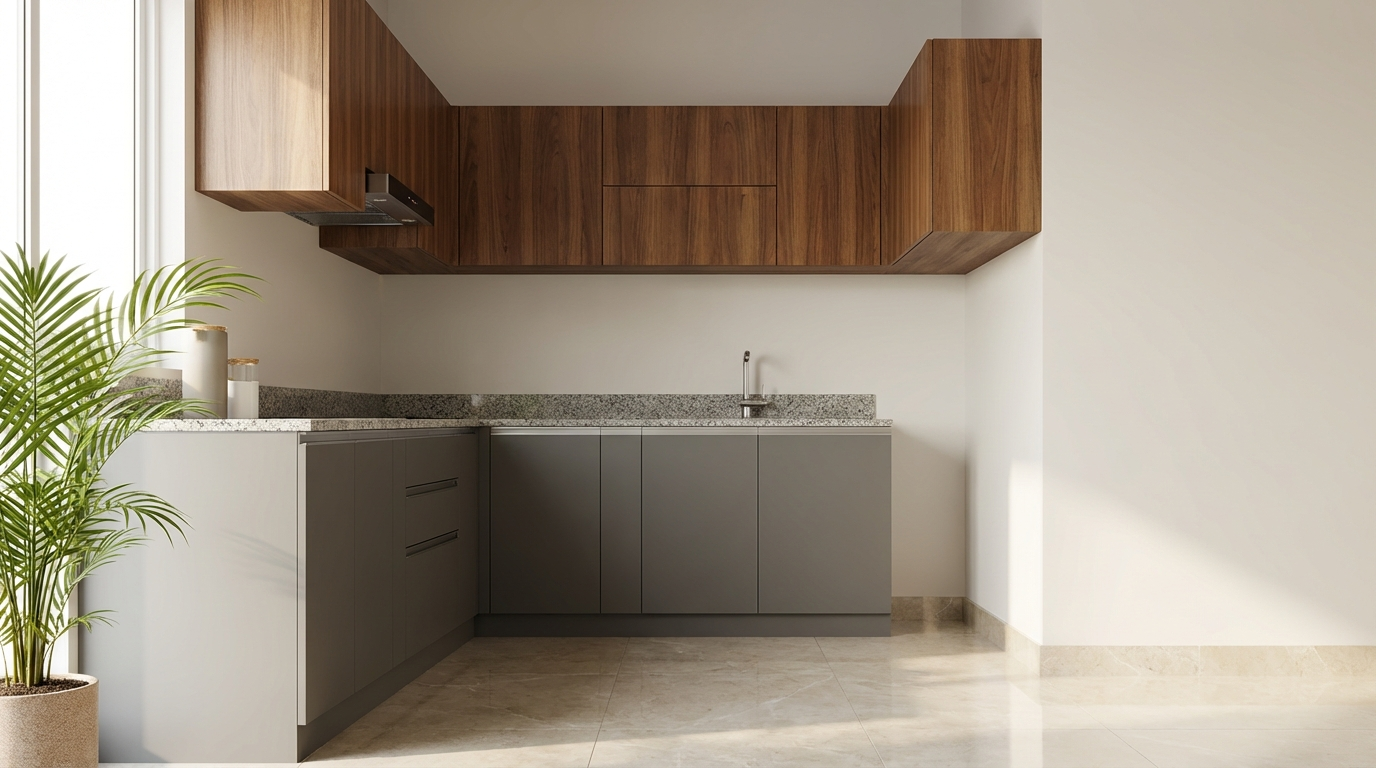
The best kitchen cabinet design balances storage depth with your cooking style—upper cabinets for daily-use items within arm's reach, lower cabinets for heavy cookware and appliances, and corner solutions that don't waste the 20-30% of space most Indian kitchens lose to poor planning.
Short version: Your cabinet layout matters more than the finish you choose. I've seen gorgeous-looking kitchens that are a nightmare to cook in because someone prioritized aesthetics over function. Get your upper cabinets at 500-600mm depth maximum (or you'll hit your head), lower cabinets at 550-600mm, and for the love of all things practical, don't cheap out on the hinges and channels. The material underneath—BWP plywood or HDHMR—will determine if your cabinets survive their first monsoon.
This guide is right for you if:
- You're planning a new kitchen or renovation and want designs that actually work for Indian cooking
- Confused about upper vs lower cabinet depths
- Your budget is anywhere from ₹1.5 lakh to ₹8 lakh for cabinets
- You've been burned before by swelling cabinets or hardware that failed within two years—and you're not doing that again
Skip this if:
- You're looking for ready-made modular kitchen catalogs with exact prices
- You just want pretty pictures without the technical stuff
Bottom line: A well-designed kitchen cabinet system should last 15-20 years minimum—but only if you get the material, hardware, and dimensions right from the start.
What Kitchen Cabinet Design Actually Means (Beyond the Pretty Pictures)
Kitchen cabinet design is the systematic planning of storage units in your kitchen—covering the cabinet box construction (carcass), door styles (shutters), internal fittings, and the hardware that holds everything together. It's not just about picking a colour or finish; it's about engineering storage that works with your specific kitchen dimensions and cooking habits.
Most people think cabinet design is about choosing between glossy or matte finishes. Actually, that's maybe 10% of the decision. The real design work happens in figuring out what goes where, how deep each cabinet should be, what material the box is made from, and which hardware will handle the daily abuse an Indian kitchen dishes out.
Here's what I mean: that beautiful handleless cabinet you saw on Instagram? It needs expensive push-to-open mechanisms that fail in humid conditions unless you buy the German stuff. Those sleek floor-to-ceiling cabinets? They need specific wall anchoring that most carpenters skip. The soft-close hinges everyone wants? There's a massive quality difference between the ₹40 variety and the ₹350 ones.
When I consult on kitchen projects, I break cabinet design into four layers: the structural layer (what material, what thickness), the functional layer (what storage solutions inside), the mechanical layer (hinges, channels, lift-up systems), and finally the aesthetic layer (finish, handles, colour). Most homeowners start with the last layer and work backwards. That's exactly the wrong approach.
Why Cabinet Design Matters More in Indian Homes
Indian kitchens are brutal on cabinets. Not being dramatic here—I've seen kitchens in Mumbai and Chennai where cabinets deteriorated faster than they would in temperate climates simply because of what we cook and how we cook it.
The humidity factor alone changes everything. In coastal cities like Mumbai, Chennai, or Kochi, you're dealing with 75-90% relative humidity for four to five months a year. In places like Kolkata during monsoon, I've measured 85%+ humidity inside closed kitchens. Standard MDF shutters in these conditions? They start warping by the second year. I've seen it happen repeatedly in Thane and Navi Mumbai apartments—the sink cabinet base swells, the doors stop closing properly, and by year three you're looking at a replacement.
Then there's the cooking style. Deep frying, tadka, pressure cooking—all of this generates steam and oil vapour that settles on cabinet surfaces. Upper cabinets near the hob take the worst beating. A kitchen in Bengaluru (relatively dry climate) will see less moisture damage than one in Mangalore (coastal, humid). Same design, completely different outcomes.
The termite situation is another thing. In older buildings across Delhi, Hyderabad, and Chennai, I've seen termites destroy cabinet backs within 18 months. The solution isn't just treated plywood—it's also leaving gaps for inspection, using metal base legs instead of wooden plinths in ground-floor kitchens, and choosing HDHMR for areas where plywood isn't practical.
Do upper cabinets really need different material than lower cabinets?
Not necessarily different, but they face different stresses. Lower cabinets deal with water splashes, pipe leaks, and heavy loads—so BWP grade plywood (IS:710) is non-negotiable for the carcass near sinks and under the hob. Upper cabinets face steam rising from cooking and oil deposits, but less direct water contact. You could use BWR grade (IS:303) for upper cabinet carcasses to save 15-20% on material costs—but honestly, for the price difference, I'd just use BWP throughout and not worry about it. The shutters are where you have more flexibility.
Types of Kitchen Cabinets: What Works Where
Let me break down the main cabinet types you'll be choosing from. This isn't exhaustive, but it covers what 90% of Indian kitchens actually need.
Upper Wall Cabinets
These are your wall-mounted units, typically 600-700mm tall and 300-350mm deep. Go deeper than 350mm and you'll keep hitting your head on the bottom edge while working at the counter. Trust me on this—I made this mistake in my own kitchen fifteen years ago.
The standard height from countertop to upper cabinet bottom is 450-500mm. Go higher and short family members can't reach the first shelf. Go lower and you lose workspace visibility.
Best material for upper cabinet carcass: 18mm BWR or BWP plywood, or 18mm HDHMR. Shutters can be 17-18mm HDHMR with laminate, or membrane/acrylic on MDF if you're in a drier city.
Lower Base Cabinets
These carry the real weight—literally. Your granite countertop, the mixer grinder, heavy kadais, pressure cookers. Standard depth is 550-600mm (not including countertop overhang), and they're typically 850-900mm tall including the countertop.
My take: Never compromise on lower cabinet material. Use 18mm or 19mm BWP plywood for the carcass. The sink unit specifically—I'd go with marine-grade even if it costs 30% more. A Chennai-based architect I know says she replaces more sink unit cabinets than any other type. The problem is always the same: water damage from slow leaks that weren't noticed for months.
Tall Units (Larder/Pantry Cabinets)
These floor-to-ceiling units are great for storage but tricky to execute. The carcass needs to handle the weight of everything inside without bowing in the middle. I've seen poorly designed tall units where the shelves sag within a year because someone used 12mm material instead of 18mm.
Standard width is 450-600mm. Go wider and the shelves need centre support.
Corner Cabinets
Here's where most kitchens waste space. A standard L-shaped kitchen has at least one corner that's either dead space or fitted with a lazy susan that never works smoothly after year two.
Better options: Magic corner units (pull-out trays that swing out), carousel systems with solid bottom trays (not wire baskets—they let small items fall through), or blind corner pull-outs. These cost ₹8,000-25,000 depending on brand and mechanism, but they recover 70-80% of corner space compared to maybe 40% with a basic lazy susan.
| Cabinet Type | Standard Depth | Recommended Carcass Material | Typical Hardware | Where It Goes |
|---|---|---|---|---|
| Upper Wall Cabinet | 300-350mm | 18mm BWR/BWP or HDHMR | Soft-close hinges, lift-up (optional) | Above countertop, 450-500mm gap |
| Lower Base Cabinet | 550-600mm | 18mm BWP plywood (19mm near sink) | Soft-close hinges, drawer channels | Below countertop |
| Sink Unit | 550-600mm | Marine-grade BWP, 19mm | Hinges with integrated dustbin | Below sink area specifically |
| Tall Pantry | 550-600mm | 18mm BWP, 25mm shelves or 18mm with support | Pull-out larder systems | End of kitchen run |
| Corner Unit | Varies by solution | 18mm BWP | Magic corner, carousel, or blind pull-out | L or U kitchen corners |
| Overhead Microwave Unit | 350-400mm (needs depth for ventilation) | 18mm BWP or HDHMR | Drop-down door hinge | Above counter, usually near cooking zone |
The Material Reality: BWP Plywood vs HDHMR vs Everything Else
Alright, here's where we get into the stuff that actually determines whether your cabinets last. I'm going to be direct because I'm tired of seeing people get confused by marketing.
BWP Plywood (IS:710 Grade)
This is boiling water proof plywood—the gold standard for kitchen carcasses in India. It's made from hardwood veneers bonded with phenolic resin that can handle prolonged moisture exposure. The "710" refers to the IS (Indian Standard) specification.
For kitchen cabinets, 18mm thickness is standard for sides and shelves, 12mm for backs. Some people use 19mm near sinks for extra insurance. Brands like CenturyPly, Greenply, and Kitply all make good BWP. The key is ensuring it's actually IS:710 certified—ask to see the ISI stamp, not just the brand sticker.
Rough cost: ₹85-120 per square foot depending on brand and city. Marine ply (even better water resistance) runs ₹100-140 per square foot.
HDHMR (High Density High Moisture Resistant)
HDHMR is an engineered wood product—basically compressed wood fibres with moisture-resistant resins. It's denser than MDF, smoother than plywood, and naturally termite-resistant because termites can't digest the binding agents.
I've been recommending HDHMR more frequently over the past three years, especially for shutters and upper cabinet carcasses. The surface is perfectly smooth, which means laminates adhere better and you get a cleaner finish. For coastal cities, it holds up surprisingly well—though I'd still use BWP plywood for lower cabinets in the sink zone. As noted by many interior specialists I've worked with, HDHMR handles kitchen humidity without warping or delaminating like regular MDF would.
Rough cost: ₹65-90 per square foot for 18mm. That's 15-25% cheaper than equivalent BWP plywood.
MDF (Medium Density Fibreboard)
MDF is smooth, affordable, and excellent for painted finishes or CNC-routed decorative doors. But—and this is critical—standard MDF has poor moisture resistance. In Chennai or Mumbai, using MDF for cabinet carcasses is asking for trouble.
My recommendation: Use MDF only for shutter faces in dry-zone kitchens (think Jaipur, interior Karnataka, Hyderabad in non-monsoon times), and only if you're going for a duco paint or high-gloss finish that MDF handles better than plywood.
Particle Board/Pre-Laminated Particle Board (PLPB)
Budget modular kitchens often use PLPB for carcasses. It's cheap—₹30-50 per square foot. But it's also weak, swells badly with moisture, and doesn't hold screws well after repeated hinge adjustments. I've seen PLPB cabinet bottoms sag under granite countertop weight within two years. If budget is extremely tight, use PLPB only for internal drawers and upper cabinet interiors, never for lower cabinet carcasses or sink units.
Which Material for Which Cabinet Part?
| Cabinet Component | Best Material | Acceptable Alternative | Avoid |
|---|---|---|---|
| Lower cabinet carcass (sink zone) | 19mm BWP or marine ply | 18mm BWP | MDF, PLPB, HDHMR |
| Lower cabinet carcass (other areas) | 18mm BWP | 18mm HDHMR | MDF, PLPB |
| Upper cabinet carcass | 18mm BWP or HDHMR | 18mm BWR | Standard MDF |
| Cabinet backs | 12mm BWP | 9mm HDHMR, 12mm BWR | 6mm anything |
| Shutters (high humidity city) | 18mm HDHMR with laminate | 18mm BWP with laminate | Standard MDF |
| Shutters (moderate humidity) | 18mm HDHMR or MDF with membrane | BWP with veneer | Bare MDF |
| Internal shelves | 18mm BWP | 18mm HDHMR, 16mm BWP for short spans | 12mm anything for full-width shelves |
30+ Kitchen Cabinet Design Ideas That Actually Work
Now for the designs. I'm grouping these by where they go and what problem they solve, not just by how they look.
Upper Cabinet Ideas (12 Designs)
1. Standard single-door wall units: 400-450mm wide, single shutter. Simple, effective, cheap. Use soft-close hinges—the ₹200-350 per pair range, not the ₹40 ones.
2. Double-door wall units: 600-900mm wide, two shutters meeting in the middle. Great for storing larger items. Make sure the hinges can handle the door weight.
3. Lift-up mechanism cabinets: The door lifts up instead of swinging out. Ideal above the hob area where a swinging door would hit your head while cooking. These need good-quality lift-up stays (₹800-2,500 per unit depending on mechanism type).
4. Glass-front display cabinets: Frosted or clear glass in an aluminium frame. Looks good, but be honest—are you actually going to keep those shelves organized? If yes, go for it. If no, you'll just be displaying your chaos.
5. Open shelving units: No doors at all. Trendy, and some people love the accessibility. But in Indian kitchens, oil vapour settles on everything. Open shelves near the hob get grimy fast. Use them on the far side of the kitchen, not near cooking zones.
6. Corner upper unit with bi-fold doors: Two doors hinged together that fold back. Gives better access than a standard corner door that blocks half the opening.
7. Narrow spice rack cabinet: 150-200mm wide, perfect for vertical spice jar storage. Usually placed near the hob. Internal shelves should be adjustable.
8. Microwave cabinet with drop-down door: Deeper than standard upper cabinets (350-400mm) to accommodate the microwave. The drop-down door means you're not reaching into a cave.
9. Full-height upper cabinet (to ceiling): Runs from standard upper cabinet height all the way to ceiling. Top section stores items you rarely use. Needs a step stool to access, but maximizes storage.
10. Plate rack cabinet: Vertical dividers inside for organizing plates. Old-school but works brilliantly for South Indian households with lots of stainless steel plates.
11. Pull-down shelf unit: The entire shelf mechanism pulls down to counter level for access, then goes back up. Expensive (₹15,000-30,000 for the mechanism) but fantastic for people who can't reach upper shelves easily.
12. Integrated chimney cabinet: Upper cabinets on either side of the chimney, with a decorative panel or open space connecting them. Cleaner look than cabinets awkwardly ending at the chimney.
Lower Cabinet Ideas (12 Designs)
1. Standard base unit with shelves: The default. A single or double door, one or two internal shelves. Works, but you end up stacking things and losing visibility of items at the back.
2. Drawer base unit: Instead of doors, the entire unit is drawers—usually three. Top drawer shallow for cutlery, middle for utensils, bottom deep for larger items. This is my preference for most lower storage because you see everything when you pull out a drawer.
3. Sink base cabinet with tilt-out tray: The panel in front of the sink (usually fake) tilts out to reveal a tray for sponges and scrubbers. Small touch, very practical.
4. Pull-out dustbin cabinet: Usually next to the sink. Single dustbin or double (for wet/dry separation). Make sure the cabinet has waterproof lining at the bottom—leaks happen.
5. Under-sink organizer cabinet: Shelves designed around the plumbing. U-shaped or pull-out trays that work with the pipes instead of pretending they don't exist.
6. Corner carousel unit: A rotating tray system in the corner. Works okay for the first year, then the mechanism often gets sticky. Buy good quality or skip it entirely.
7. Magic corner pull-out: The better corner solution. Trays swing out and forward when you open the door. Costs more (₹12,000-25,000) but actually recovers corner space you can use.
8. Deep drawer for pots and pans: A single deep drawer (250-300mm internal height) sized for pressure cookers, kadais, and large pots. Uses heavy-duty drawer channels rated for 30-50kg.
9. Vertical tray divider unit: Narrow cabinet with vertical dividers for storing cutting boards, baking trays, and thalis vertically. Usually 200-300mm wide.
10. Pull-out pantry unit: A narrow cabinet (300-450mm wide) with multiple shelves that pulls out entirely. Great for oils, masalas, and small packaged items.
11. Appliance garage: A cabinet with a rolling shutter or lift-up door at counter level. Store mixer, toaster, kettle inside—pull them out when needed, hide them when not. Keeps the counter clear.
12. Base unit with internal drawers: The exterior has doors, but inside there are smaller drawers instead of shelves. Best of both worlds—the organized storage of drawers with a traditional cabinet look.
Tall Unit & Specialty Cabinet Ideas (8 Designs)
1. Full-height larder with pull-outs: Floor to ceiling, 450-600mm wide, with 4-6 pull-out trays. Stores an enormous amount in a small footprint. The mechanism costs ₹15,000-45,000 depending on brand.
2. Broom closet: A tall narrow unit (300-400mm wide) for mops, brooms, and cleaning supplies. Often overlooked but incredibly useful.
3. Tall oven and microwave cabinet: Built-in oven at a comfortable height (waist level), microwave above or below. Needs ventilation space and heavy-duty carcass.
4. Refrigerator surround cabinet: Cabinets above and beside the fridge, giving a built-in look. Leave 50mm ventilation gaps on sides and top or the fridge compressor struggles.
5. Breakfast bar with storage: A small counter extension with cabinets underneath on the kitchen side. Casual seating on the outside, storage on the inside.
6. Island with base storage: If you have space, a central island with drawers and cabinets. Usually 900-1200mm wide. Needs 900-1000mm clearance on all sides for movement.
7. Dish drying cabinet (Finnish style): An upper cabinet above the sink with a slotted bottom shelf. Washed dishes dry in the cabinet, water drips into the sink. Keeps the counter clear and dishes out of sight.
8. Chimney duct box: Not storage, but worth mentioning. The decorative box that hides the chimney duct pipe when the chimney doesn't exhaust directly out the wall. Use matching cabinet material for a seamless look.
Hardware That Makes or Breaks Your Cabinets
You can have the best plywood and the nicest shutters, but cheap hardware will ruin the experience within two years. I've seen this so many times it genuinely frustrates me.
Hinges
Soft-close hinges are standard now—and for good reason. But there's a massive quality range:
- Budget (₹40-80/pair): Works for six months, then either stops soft-closing or loosens at the screws
- Mid-range (₹150-300/pair): Decent brands like Hettich basic range, Ebco. Lasts 3-5 years with normal use
- Premium (₹350-600/pair): Hettich Sensys, Blum Clip Top. Lasts 10+ years, adjustable in three axes, and the soft-close action stays consistent
For a kitchen with 20-25 doors, the difference between budget and premium hinges is ₹6,000-12,000 total. That's nothing in a kitchen that costs ₹3-5 lakh. Spend on hinges.
Drawer Channels (Slides)
Three types matter:
Roller slides (basic): Cheap, limited extension (usually 75%), can handle 15-20kg. Fine for light-use drawers in upper cabinets.
Ball-bearing telescopic slides: Full extension, handles 25-35kg, smoother action. This is the minimum I recommend for kitchen lower drawers.
Undermount soft-close slides: Hidden under the drawer (not visible from the side), full extension, soft-close, 30-50kg capacity. More expensive (₹600-1,500 per pair) but the drawer action is significantly better and the look is cleaner.
Why do carpenters prefer certain hardware brands over others?
Honestly, it comes down to what they're used to installing and what's available locally. Many carpenters I know stick with Ebco or Hettich because the fitting is standardized and they know exactly which screw goes where without checking manuals. Blum is technically superior but the installation is slightly different and replacement parts are harder to find outside metro cities. A Hettich hinge failing in Coimbatore is fixed in a day; a Blum hinge failing there might take a week to get parts. For most kitchens, mid-range Hettich is the sweet spot—good quality, widely available, carpenters know it well.
Price Reality Check: What Kitchen Cabinets Actually Cost in 2026
I'm not giving exact quotes because prices vary by city, by dealer relationship, and by the specific specs you choose. But here's how to think about costs.
Cabinet Cost Drivers
Your final cost per square foot of cabinet depends on:
- Carcass material: PLPB is cheapest (₹30-50/sqft), HDHMR mid (₹65-90/sqft), BWP plywood higher (₹85-120/sqft), marine ply highest (₹100-140/sqft)
- Shutter material and finish: Laminate on HDHMR (₹70-100/sqft), membrane/PU on MDF (₹90-140/sqft), acrylic (₹120-180/sqft), glass and aluminium (₹150-250/sqft)
- Hardware: Budget hardware adds ₹8,000-12,000 total; premium adds ₹25,000-50,000
- Internal fittings: Corner solutions, pull-outs, organisers—these add up fast, ₹20,000-80,000 depending on what you choose
- Labour: Varies dramatically by city and whether you're using a modular kitchen company or local carpenters
Rough Budget Ranges for a 100-sqft Kitchen
Basic (₹1.2-1.8 lakh): PLPB carcass, laminate shutters, budget hardware, minimal internal fittings. Will work for 5-7 years in a dry climate, maybe 3-4 years in humid cities.
Mid-range (₹2.5-4 lakh): HDHMR or BWR carcass, laminate or membrane shutters, mid-range Hettich hardware, a couple of internal fittings like a corner carousel and drawer organisers. Should last 10-12 years with maintenance.
Premium (₹4.5-7 lakh): BWP carcass throughout, premium finishes (acrylic, PU paint, veneer), Hettich/Blum hardware throughout, multiple pull-out systems, soft-close everything. Lasts 15-20 years easily.
High-end (₹7-12+ lakh): Marine ply in wet zones, imported hardware, handleless push-to-open systems, integrated lighting, specialty finishes, full internal organisation systems. Basically, you're paying for everything to be top-spec.
Quick detour: these ranges don't include countertop, backsplash, or appliances. Those add another ₹50,000-2,00,000 depending on choices.
How to Choose: A Decision Framework That Works
Here's the process I walk clients through:
Step 1: Measure your kitchen accurately. Not just length and width—measure wall heights, window positions, door swings, electrical points, plumbing locations. Every centimetre matters.
Step 2: List what you need to store. Actually inventory your cookware, appliances, groceries. Most people underestimate storage needs by 20-30%.
Step 3: Decide your cooking style. Heavy Indian cooking with lots of frying? You need better ventilation space and moisture-resistant materials near the hob. Mostly reheating and light cooking? You can get away with slightly less heavy-duty specs.
Step 4: Choose material based on your city's climate and your budget. Use the table earlier as a guide. If you're in Chennai or Mumbai, don't compromise on moisture resistance for lower cabinets—I've said this three times now because it matters that much.
Step 5: Allocate budget—roughly 50-55% to carcass and shutters, 15-20% to hardware, 15-20% to internal fittings, 10-15% buffer for unforeseen additions.
Step 6: Get quotes from at least three sources—a modular kitchen brand showroom, a local modular fabricator, and a carpenter with modular experience. Compare like-for-like specs, not just total price.
| Situation | Recommendation | Why |
|---|---|---|
| Rental apartment, 2-3 year stay | Budget to mid-range, HDHMR carcass, laminate shutters | Not worth investing in premium when you won't be there long |
| Own home, coastal city (Mumbai, Chennai, Kochi) | BWP carcass throughout, HDHMR shutters, premium hardware | Humidity will destroy anything less in 5-7 years |
| Own home, dry inland city (Jaipur, Nagpur, interior Karnataka) | HDHMR carcass, MDF shutters with membrane/duco, mid-range hardware | Less moisture stress means more material flexibility |
| Ground floor flat in older building | BWP or marine ply, metal base legs, termite treatment, no contact with walls | Termite risk is highest here; water seepage from floor possible |
| Very tight budget | HDHMR carcass (not PLPB), laminate shutters, upgrade only hardware | If you must compromise somewhere, make it finish not structure |
| Heavy cooking household | Premium materials near hob and sink, extra clearance for chimney, deep drawers for heavy cookware | Your kitchen sees more stress than average; build for it |
Red flags to walk away from
- Dealer can't show ISI certification stamps on plywood sheets
- Quote shows "waterproof ply" without specifying IS:710 or IS:303 grade
- Hardware brand is unidentifiable or suspiciously cheap in the quote
- No breakdown of carcass vs shutter vs hardware costs—just one lump sum
- Unwillingness to let you see sample materials before ordering
- Promises of "lifetime warranty" on particle board products (that's not how particle board works)
Common Mistakes People Make with Kitchen Cabinets
1. Prioritizing looks over structure. I've seen people choose a gorgeous high-gloss finish on a PLPB carcass because the overall price was lower. Two years later, the drawers don't close properly and the shutter edges are chipping. The finish is still fine—the structure underneath failed.
2. Ignoring ventilation around built-in appliances. Ovens, microwaves, and refrigerators generate heat. You need 50-100mm gaps for airflow. Skip this and you'll shorten appliance life and potentially damage adjacent cabinet panels.
3. Using MDF carcass in humid climates. This one really frustrates me because it's completely predictable. A contractor in Navi Mumbai installed MDF carcasses for a client in 2022 because "the finish is smoother." Called me in 2024 for advice—the sink cabinet had swelled so badly the doors wouldn't close. Complete replacement needed. Use HDHMR or BWP in humid cities. Period.
4. Not planning for plumbing access. Your sink cabinet needs to allow access to pipes for maintenance. Removable back panels or access panels are essential. Many designs seal everything up and then someone has to damage the cabinet to fix a leak.
5. Making all upper cabinets the same height. Not every upper cabinet needs to go to the ceiling. Having some shorter cabinets creates visual interest and reduces the "wall of boxes" effect. Also, full-height cabinets everywhere can feel oppressive in smaller kitchens.
6. Cheap drawer channels on heavy-use drawers. The cutlery drawer gets opened 20 times a day. The utensil drawer holds 5-10kg of steel items. These need ball-bearing channels minimum. Roller slides will fail within 18 months.
7. Forgetting lighting. Under-cabinet lighting (LED strips or puck lights) makes a massive difference in usability. Plan for this in the electrical layout before cabinet installation, not after.
8. Corner cabinets with no access solution. That L-shaped corner with just a blind cabinet? You've created a black hole where items go to be forgotten. Either invest in a corner mechanism or leave it as open shelving where you can at least see what's there.
9. Standard upper cabinet depth near the cooking zone. If your upper cabinet above the hob is 350mm deep, you'll hit your head on it when leaning over pots. Use 300mm maximum here, or better yet, have no upper cabinet directly above the hob—just the chimney.
10. Ignoring the triangle. The work triangle (fridge → sink → hob) should have walking distances of 1200-2700mm each leg. I've seen kitchens where the fridge is 4 meters from the sink. That's a lot of walking while cooking.
Quality Checks You Can Do Yourself
Visual Inspection of Plywood
Look at the edge of the sheet. Count the layers—more layers (7-ply, 9-ply) generally indicate better quality. Gaps between layers? Reject it. Uneven layer thickness? Reject it. The core wood should be uniform in colour without large voids or patches of different wood.
Check for the ISI stamp. For BWP, it should show IS:710. For BWR, IS:303. No stamp, or just a "waterproof" sticker without ISI? That's a red flag.
Physical Tests
Tap test: Tap the surface with your knuckle. A hollow sound indicates voids in the core. A solid, dull sound is what you want.
Flex test: For 18mm plywood, a 2-foot span shouldn't flex significantly under moderate hand pressure. Excessive flex means lower density or poor bonding.
Weight check: BWP plywood is denser than BWR. An 18mm 8x4 sheet of good BWP should feel heavy—25-35kg depending on the wood species. If it feels light, question the grade.
Edge inspection: Run your finger along the edge. You should feel consistent density, not soft spots alternating with hard. Soft spots indicate poor core material.
Questions to Ask Your Dealer
- "Can you show me the ISI certification stamp on the actual sheet I'm buying?"
- "What's the specific grade—IS:710 or IS:303?"
- "What wood species is used in the core?" (Hardwood faces with softwood core is common but should be priced accordingly)
- "Do you have the manufacturer's test certificate for this batch?"
- "What's your policy if I find defects after delivery?"
Here's a trick most dealers don't like: Ask for a small offcut sample and soak it in water overnight. BWP grade should show minimal swelling or delamination. BWR will show some but not dramatic changes. MR grade will swell noticeably. This tells you more than any certification stamp.
What to Tell Your Carpenter: A Pre-Work Briefing
Before work starts, have this conversation:
1. Material handling: "Don't store the plywood sheets standing vertically against a wall for more than a day. Lay them flat, supported evenly. And keep them inside, not in the balcony."
2. Acclimatization: "Let the sheets sit in the kitchen space for 2-3 days before cutting. The moisture content needs to equilibrate or we'll get warping after installation."
3. Edge sealing: "Every cut edge needs to be sealed before assembly. Use edge banding tape or at minimum a sealer coat. Do not leave raw edges exposed—that's where water gets in."
4. Screw specifications: "For hinges, use 3.5x16mm screws minimum in HDHMR, 3.5x18-20mm in plywood. Pre-drill every hole. No hammering screws in."
5. Wall fixing: "Upper cabinets get at least 4 wall anchors each, rated for the expected load. Check that the wall anchor is hitting concrete or brick, not just plaster."
6. Back panel installation: "The back panel sits in a groove, not just nailed to the edge. This gives structural integrity and looks cleaner."
I've seen carpenters skip edge banding because "nobody sees the inside anyway." Three years later, that's exactly where the delamination starts. A carpenter in Borivali learned this lesson on a job I consulted on—the client called both of us back when the cabinet bases started swelling. We opened them up and found every internal edge was raw, unsealed. The carpenter had to redo all the base cabinets at his cost. Don't let that be your kitchen.
How Long Kitchen Cabinets Actually Last
Honest lifespan expectations:
PLPB carcass with laminate: 4-6 years in dry climates, 2-4 years in humid cities. The screws loosen, the particle board crumbles around fittings, shelves sag. Not worth repairing—replacement cost is often similar to repair.
HDHMR carcass with laminate: 10-15 years with good maintenance. The material itself holds up; failures usually happen at edges if not sealed properly or at hardware points if cheap fittings were used.
BWP plywood carcass with laminate: 15-20 years easily, sometimes longer. I've seen BWP kitchens from the early 2000s still functioning perfectly—dated aesthetically but structurally sound.
Marine ply carcass: 20+ years. Practically indestructible in kitchen conditions. The shutters will look outdated long before the carcass fails.
In my experience, well-maintained BWP plywood kitchens in moderate climates (Pune, Bengaluru) can go 20-25 years. The shutters might need refinishing or replacement at year 12-15, but the boxes keep going.
Signs of wear to watch for
- Doors not closing flush anymore (hinge wear or carcass distortion)
- Drawer channels sticking or not extending fully
- Visible swelling at edges or near sink
- Laminate peeling at corners
- Musty smell inside closed cabinets (moisture trapped)
- Screws pulling out or not tightening properly
If you see swelling, act fast. Small affected areas can sometimes be cut out and patched. Full-panel swelling usually means replacement.
Alternatives Worth Considering
If standard plywood cabinets don't fit your situation, here are other paths:
Full stainless steel modular kitchens: Commercial kitchen style, completely waterproof, termite-proof, and essentially indestructible. Costs 2-3x more than plywood equivalents. Looks industrial—not everyone likes it, but it's getting trendier. Good for very humid climates or if you want a 30-year kitchen without maintenance.
Aluminium frame with board infills: Aluminium frame structure with HDHMR or glass panel infills. Waterproof frame, decent looks, mid-range pricing. The aluminium won't corrode, but the joints can loosen over time if not well-engineered.
WPC (Wood Plastic Composite): For certain components, particularly door frames around the kitchen entry. WPC is waterproof and termite-proof. Our door frame guide covers WPC applications in detail if that's relevant to your project.
If budget is tight: Use HDHMR throughout instead of BWP. It's 15-25% cheaper and performs well in most conditions. Just don't use it in direct water contact zones—keep BWP for sink cabinets.
If you need better moisture resistance: Marine-grade plywood for all lower cabinets, or consider the stainless steel option for sink units specifically. The kitchen cabinet material comparison on this site goes into more detail on marine vs BWP choices.
Frequently Asked Questions
Is it true that HDHMR is better than plywood for kitchen cabinets?
Not exactly "better"—it's different. HDHMR is denser, smoother (better for laminate adhesion), naturally termite-resistant, and cheaper. But BWP plywood has superior screw-holding strength over time and handles direct water contact better than HDHMR. For upper cabinets and shutters, HDHMR is often the better choice. For lower cabinet carcasses, especially near the sink, I still recommend BWP plywood. The best approach is usually using both materials where their strengths apply.
Can I use MDF for kitchen cabinets in Mumbai?
For the carcass? Absolutely not. Mumbai's monsoon humidity will destroy standard MDF carcasses within 2-3 years—warping, swelling, and delamination at the edges. For shutter faces only, if you're doing a high-gloss duco paint finish and the kitchen has excellent ventilation, MDF can work. But even then, I'd lean toward HDHMR for the moisture resistance. The risk-reward just isn't there for MDF in coastal cities.
What thickness should I use for cabinet shelves that will hold heavy items?
18mm is the standard for shelves up to 600mm span. For wider spans (800mm+) or heavy loads like steel utensils and masala containers, either use 25mm material or add a centre support underneath. I've seen 12mm shelves sag within months under kitchen loads—never use 12mm for full-width shelves in base cabinets. The wardrobe plywood guide on this site has more detail on shelf thickness calculations, though kitchen loads are generally heavier.
How much should I budget for a modular kitchen in a 100 sqft space?
Depends entirely on your choices. A basic functional kitchen with HDHMR carcass and laminate shutters runs ₹1.2-1.8 lakh. Mid-range with BWP carcass and decent hardware hits ₹2.5-4 lakh. Premium finishes, full soft-close everything, and internal organisers push to ₹4.5-7 lakh. High-end imported hardware and specialty finishes can exceed ₹10 lakh. The range is huge because material choices multiply out quickly when you're doing 50-70 sqft of cabinet surface.
Is it true that soft-close hinges fail faster in humid climates?
The soft-close damper mechanism can be affected by humidity if it's a cheap oil-filled type. The hydraulic fluid gets sluggish or the seals degrade. Premium hinges from Hettich or Blum use better seals and materials that handle humidity without issues. I haven't seen soft-close failure on quality hinges even in Mumbai kitchens after 8-10 years. Budget hinges, yes—they start losing the soft-close action within 2 years in humid conditions. This is one area where spending more genuinely gives you longer life.
What if I live in a coastal city like Chennai—do I really need marine plywood everywhere?
Not everywhere. Marine ply is overkill (and overpriced) for upper cabinets that don't get direct water exposure. Save it for the sink unit base and any cabinet within splash distance of the sink. The rest can be standard BWP grade. That said, don't use BWR for lower cabinets in Chennai—the humidity alone stresses BWR-grade adhesives even without direct water. I'd say marine for sink zone, BWP for other lower cabinets, BWP or HDHMR for uppers.
How do I know if the plywood I'm buying is actually BWP grade?
Look for the ISI mark with IS:710 stamped on the sheet itself—not just a sticker but an ink stamp or burn mark. Ask for the batch number and manufacturer's test certificate if available. The soaking test I mentioned earlier is your ultimate check: properly made BWP plywood will show minimal swelling after 72 hours of water immersion. If your dealer refuses to let you test a sample, question why.
Can I mix different brands of plywood in the same kitchen?
Technically yes, but I'd keep consistency in quality grade even if you mix brands. Using CenturyPly for lower cabinets and Greenply for uppers is fine if both are BWP grade. What you shouldn't do is use a premium brand for visible areas and a cheap unknown brand for internal structures—the cheap material will fail first and you'll have to disassemble the good cabinets to fix it. Match quality levels even if brands differ.
Is it worth paying extra for anti-bacterial or fire-retardant plywood?
Anti-bacterial treatment is mostly marketing for residential kitchens—keeping surfaces clean matters more than any embedded treatment. Fire-retardant plywood (FR grade) is worth considering for the cabinet directly adjacent to the hob if you're in a high-rise with strict fire codes, or if you do a lot of high-heat cooking. It adds 15-25% to material cost. For most kitchens, I'd say nice-to-have but not essential—a properly installed chimney and standard cooking practices are your real fire safety.
What's the deal with handle-less (push-to-open) kitchen designs?
They look sleek in photos. The reality is that push-to-open mechanisms (tip-on devices) are finicky about alignment and can get sticky in humid conditions if they're not high-quality. They also require more precise cabinet construction because any misalignment shows immediately. If you want this look, budget for German-made push mechanisms (Blum Tip-On or Hettich Push-to-Open Pro) and a modular kitchen fabricator who has done this before. Local carpenters usually struggle with the precision needed.
Should I go for drawers or shelves in lower cabinets?
Drawers, whenever possible. A deep drawer lets you see everything inside when you pull it out. A shelf means you're crouching and reaching into darkness to find that kadai at the back. The only exception is under the sink where plumbing takes up space, and for very large items (stock pots) that need more height than a standard drawer offers. For those, doors make sense. But wherever you can, choose drawers—your back will thank you at 50.
How long before I should expect to renovate or replace my kitchen cabinets?
With good material choices (BWP plywood, mid-range hardware), you should get 15+ years before structural issues force replacement. Most people renovate at year 10-15 because styles change or because they want updated appliances and layouts—not because the cabinets failed. If your cabinets are failing at year 5-7, something went wrong with material choice, installation, or maintenance. Budget kitchens might need shutter replacement at year 5-6 as laminates fade or chip.
Final Thought
Right, that's the gist of kitchen cabinet design. The specific layout and styles depend on your space and taste, but the fundamentals—good material for the carcass, appropriate choices for your climate, reliable hardware, proper edge sealing—those apply to every kitchen. Your carpenter or modular kitchen vendor might have different opinions on some details. Worth hearing them out, especially if they've been working in your city for years and know the local conditions. But don't let anyone talk you into MDF carcasses in Mumbai or particle board anywhere that matters.
And seriously—don't skip the edge banding.
Disclaimer: This content is provided for general informational purposes based on industry practices and publicly available information. Product specifications, standards, prices, and availability may vary by manufacturer, region, and time. Readers should independently verify details with manufacturers, dealers, or qualified professionals before making purchase or construction decisions.Want Plywood Suggestions?
Share a few details and a Sainik 710 specialist will suggest suitable brands and connect you to responsive dealers.