Kids Wardrobe Design: 25+ Colorful & Functional Ideas for Boys & Girls Rooms
Get 25+ kids wardrobe designs—colorful, functional ideas for boys & girls rooms. Growth-friendly layouts, safety tips & storage solutions for children.
Quick Answer: What Makes a Great Kids Wardrobe Design?
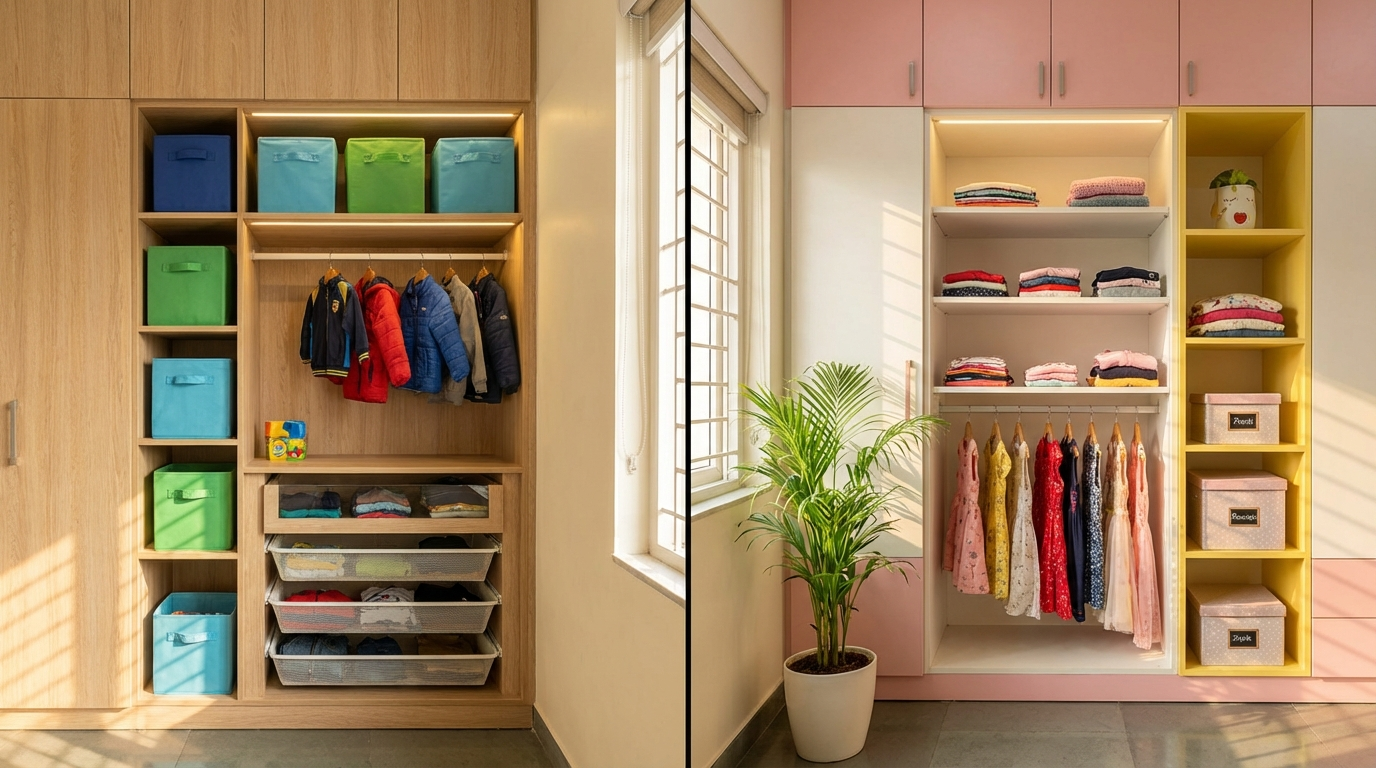
A great kids wardrobe design balances accessibility, safety, and growth-friendly storage that adapts as your child ages from toddler to teenager.
Short version: Kids wardrobes need low-hanging sections children can actually reach, rounded edges to prevent injuries, adjustable shelving that grows with them, and separate zones for clothes, toys, and school stuff. The best ones are built with BWP or BWR grade plywood for durability, especially in humid Indian cities where MR grade just won't cut it for something that needs to last 12-15 years.
This guide is right for you if:
- You're designing a kids room from scratch or renovating an existing one
- Your child has outgrown their current wardrobe and you need something that'll last through their school years
- You want practical storage ideas, not just pretty Pinterest pictures
- You're confused about what plywood grade to use for children's furniture
Skip this if:
- You're looking for ready-made wardrobe recommendations—this is about custom-built designs
- Your budget is under ₹15,000 total (you'll need more for a proper growth-friendly wardrobe)
Bottom line: A well-designed kids wardrobe isn't just smaller adult furniture—it's a completely different approach to storage that accounts for how children actually use their stuff.
What a Kids Wardrobe Design Actually Involves
Kids wardrobe design is the planning of storage units specifically tailored for children's rooms, incorporating height-appropriate sections, safety features, and flexible compartments that can be reconfigured as the child grows. It's not just about making things colorful—it's about functional ergonomics for smaller humans.
Most people think you just need a smaller version of an adult wardrobe. Actually, kids interact with storage completely differently. A seven-year-old can't reach a hanging rod at 5 feet height. They'll yank on drawer handles instead of pulling smoothly. They'll stuff cricket bats where socks should go. Your design needs to anticipate this chaos.
The technical side involves calculating rod heights based on your child's current height plus a 3-4 year growth buffer, choosing plywood cores that won't warp under humidity stress, and planning modular internals that can be swapped without rebuilding the whole unit. For a 4-year-old, the primary hanging section should be around 30-36 inches from the floor. For a 10-year-old, you're looking at 42-48 inches.
There's also the durability question. A wardrobe in a kids room takes more abuse than any other furniture in your house. Doors get slammed. Shelves get overloaded with LEGO sets. The back panel gets kicked when they're looking for that one specific t-shirt at the bottom of the pile. If I'm being honest, most cheap particle board wardrobes don't survive past three years in an active child's room.
Why Kids Wardrobe Design Matters More in Indian Homes
Indian homes present unique challenges that Western design guides completely ignore. Our climate, space constraints, and family dynamics are just different.
Does humidity really affect kids furniture differently?
Absolutely. During monsoon months, Mumbai sees relative humidity hitting 85-90%, Chennai hovers around 80-85%, and even inland cities like Pune experience 70-75% during peak season. This moisture attacks plywood from every angle. Kids wardrobes suffer more because they're opened and closed dozens of times daily—sometimes left open entirely when your child runs off mid-dressing. That constant humidity exposure means MR grade plywood, which works fine for adult bedroom wardrobes that open maybe twice a day, fails much faster in a kids room. I've seen MR grade backing panels develop fungus within two monsoons in Navi Mumbai apartments. The backing panel just starts smelling musty, and by then it's too late.
In Kolkata's Salt Lake area, the combination of humidity and temperature fluctuation is brutal on furniture. A client there had to replace the entire wardrobe backing within 18 months because they'd used commercial grade plywood—the plywood had literally started crumbling at the edges where their daughter's dupatta hooks were screwed in.
Coastal Karnataka and the Konkan belt are even more challenging. Salt-laden air accelerates hardware corrosion. Standard hinges rust within a year. So beyond plywood grade, you're also choosing stainless steel fittings over regular ones—adds maybe ₹800-1,200 to your total hardware cost, but saves you from stuck doors and orange rust stains on your child's white school shirts.
Types of Kids Wardrobe Designs: Finding What Actually Works
Right, moving on to the actual design types. I've built or supervised maybe forty-odd kids wardrobes over the years, so this is based on what I've seen work in real homes—not showroom setups.
1. Single-Door Compact Wardrobe
Best when you have a small room (under 100 sq ft) or the wardrobe is supplementing other storage. Works for children under 6 who don't have extensive wardrobes yet. Usually 2-2.5 feet wide, with a single hanging section and 2-3 shelf compartments. Honestly, most families outgrow this within 2-3 years as their child starts school and accumulates uniforms, sports gear, and the inevitable birthday party outfit collection.
2. Two-Door Swing-Open Wardrobe
The standard choice for most Indian homes. 4-5 feet wide gives you room for hanging sections on both sides—one at child-accessible height, one higher for off-season or formal clothes. My take: this is what I recommend for most families with kids aged 4-12. Enough space to stay organized, not so big that it overwhelms a typical 120-150 sq ft bedroom.
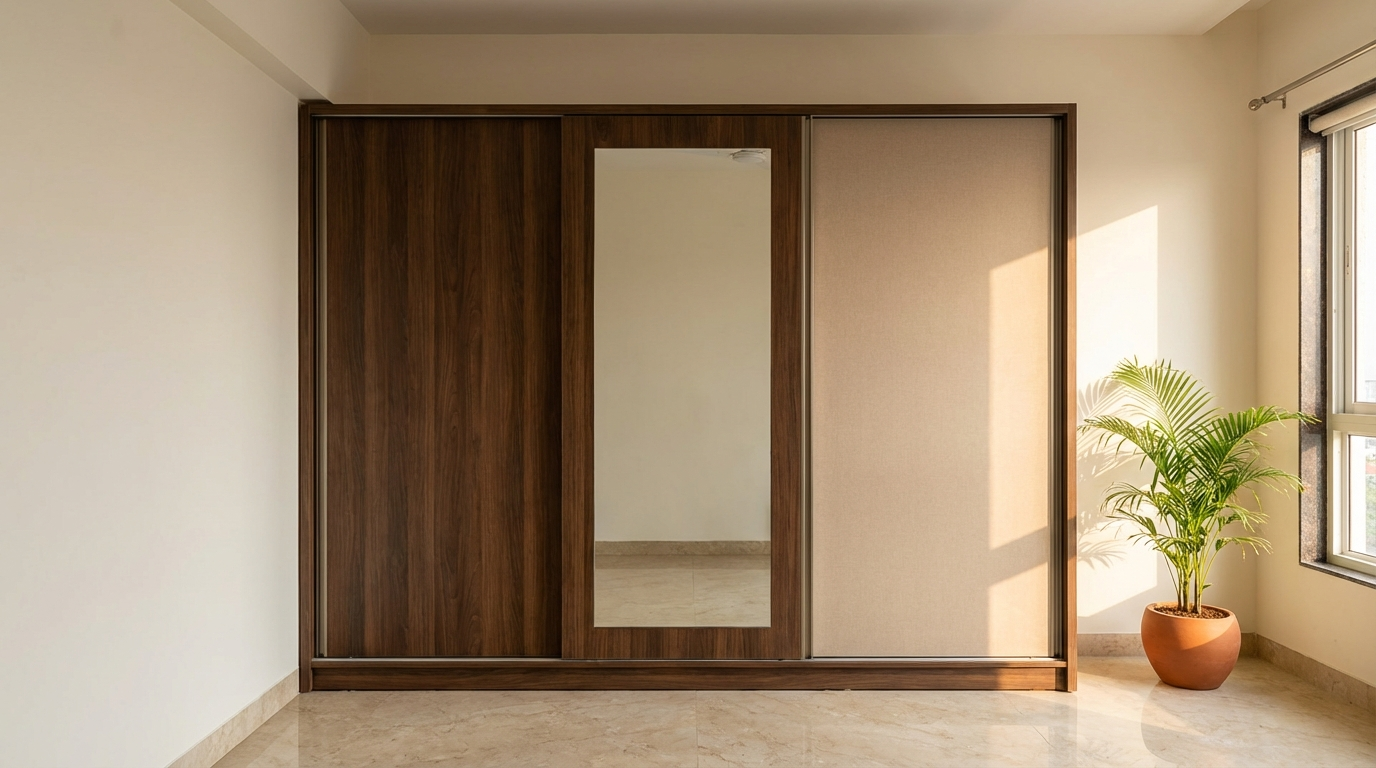
3. Sliding Door Wardrobe
Best when floor space is tight and you can't accommodate door swing clearance. The doors slide past each other, so you only need the footprint of the wardrobe itself. Downside? You can only access half the wardrobe at any time. For kids who are always searching for "that one shirt," this gets frustrating. I've had clients switch back to swing doors because their 8-year-old just couldn't handle only seeing half his stuff at once. [homelane.com](https://www.homelane.com/design-ideas/bedroom-design/kids-bedroom-cupboard-designs/) mentions these as space-savers, which they are—just know the trade-off.
4. Built-in Wall Wardrobe
Custom-built into a wall niche or spanning an entire wall. Maximum storage, clean look, no furniture sitting out taking floor space. Expensive to build, essentially permanent—you're not taking this with you if you move. Best for families who own their home and plan to stay put. According to [greenply.com](https://www.greenply.com/blogs/space-saving-kids-wardrobe-designs-that-keep-things-organised), built-in wall wardrobes work well for limited floor area situations, and they're right about that.
5. Wardrobe with Integrated Study Unit
Combines wardrobe storage with a study desk—all in one wall unit. Ideal for apartments where you can't fit separate furniture pieces. The study section typically sits at one end with overhead storage for books and the wardrobe section at the other. I've seen these done beautifully in 2BHK apartments across Bangalore's OMR stretch where bedrooms are barely 100 sq ft.
6. Loft-Style Wardrobe
Uses vertical space above the main wardrobe for seasonal storage. The loft section (upper cabinet) stores winter clothes, hand-me-downs waiting for younger siblings, old toys you can't throw away. Essential in Mumbai apartments where every cubic foot counts.
| Wardrobe Type | Best Room Size | Age Group | Cost Range | My Preference |
|---|---|---|---|---|
| Single-Door Compact | Under 100 sq ft | 0-6 years | ₹12,000-20,000 | Temporary solution only |
| Two-Door Swing | 100-180 sq ft | 4-14 years | ₹25,000-55,000 | Recommended for most families |
| Sliding Door | Tight spaces, any size room | 8+ years | ₹35,000-70,000 | Good but has access limitations |
| Built-in Wall | Any size, permanent install | All ages | ₹50,000-1,20,000+ | Best value long-term if you own the home |
| With Study Unit | 100-140 sq ft multifunctional rooms | 6-16 years | ₹45,000-90,000 | Excellent for space-constrained apartments |
| Loft-Style | Any—adds vertical storage | All ages (parents access loft) | Adds ₹8,000-15,000 | Always worth adding if ceiling height allows |
25+ Design Ideas: Colorful and Functional Options
Alright, here's the fun part. These are actual design approaches I've seen work in Indian homes, not just Pinterest fantasy setups.
For Boys' Rooms (But Really, Anyone Can Use These)
1. Sports Theme with Equipment Storage: Deep bottom section specifically for cricket bats, footballs, badminton rackets. Open shelving with jersey display area. Works brilliantly for active kids. Use a navy blue or forest green laminate.
2. Adventure/Safari Theme: Earthy tones—olive green, brown, beige. Animal-shaped handles (elephants, lions). Hidden compartment for "treasure" (their special collections). One client in Thane did this with a painted mural behind glass cabinet doors. Gorgeous.
3. Space Explorer Theme: Navy or black base with metallic silver accents. Star-shaped cutouts with LED backlighting. Rocket-shaped pull handles. [magicbricks.com](https://www.magicbricks.com/web-stories/best-wardrobe-design-for-kids/135607.html) mentions themed designs like these, and they really do make organizing more appealing to kids.
4. Minimalist Modern: Clean lines, white or grey laminate, no visible handles (push-to-open mechanism). For older boys (10+) who've outgrown cartoons. Add one accent color panel—maybe electric blue or deep red.
5. Industrial Look: Exposed metal handle bars, grey concrete-texture laminate. Very popular with teenage boys currently. Pair with a small locker-style section for valuables.
For Girls' Rooms (Again, These Work for Anyone)
6. Princess Castle Theme: Pink and white with castle turret-shaped top molding. Glass-front display section for dolls or awards. Sparkly knobs. Works for ages 3-8 typically, then feels too young.
7. Garden/Floral Theme: Soft pastels—mint green, lavender, peach. Flower-shaped handles or butterfly decals. This one ages better than full princess themes.
8. Modern Glam: Rose gold hardware, dusty pink or mauve laminate, mirror panel on one door. Very sophisticated—works from age 8 right through to teenage years. [livspace.com](https://www.livspace.com/in/magazine/kids-wardrobe-designs) suggests neutral yet bright colors for longevity, and this approach follows that principle.
9. Bohemian Style: Mix of colors, macramé-style decorative elements, wooden accents with white base. Great for creative kids.
10. Ballet/Dance Theme: Full-length mirror on one door (essential for dancers), soft pink or lavender, special section for dance costumes that need to hang full-length.
Gender-Neutral Designs
11. Rainbow Stripe: White base with rainbow-colored handles or stripe accents across drawers. Cheerful without being theme-specific.
12. Chalkboard Panel: One door or side panel is actually chalkboard-painted. Kids can draw, make lists, write reminders. Repaint when it gets too scratched—maybe every 2 years.
13. Yellow and Grey: Currently very trendy. Warm yellow accents on grey or white base. Works for any age, any gender.
14. Aqua and White: Ocean-inspired without being obviously "beach themed." Relaxing colors that age well.
15. Natural Wood Finish: Veneer or laminate that shows wood grain. Pairs with anything else in the room. The most versatile long-term choice.
Functional Innovation Ideas
16. Wardrobe with Built-in Bench: Lower section has a pull-out bench or fixed seat for sitting while putting on shoes or socks. Life-changing for getting kids ready in the morning.
17. Pull-Down Hanging Rod: Mechanism that lets you pull down the high hanging rod to child level, then push it back up. Expensive (the hardware alone is ₹3,000-5,000) but fantastic for growing kids. [livspace.com](https://www.livspace.com/in/magazine/kidsroom-kids-wardrobe) recommends two-level hanging rods for similar reasons.
18. Backpack Station: Dedicated hooks at child height inside the wardrobe door specifically for school bags. Plus a shelf above for lunch boxes.
19. Shoe Rack Integration: Bottom 12-15 inches is angled shoe storage. Kids can see all their shoes at a glance, actually put them away.
20. Hidden Toy Chest: Deep bottom drawer on full-extension slides—essentially a toy chest built into the wardrobe. Gets toys off the floor and into the "getting dressed" zone.
21. Clothes Sorting System: Multiple small bins or baskets on one shelf, labeled (Monday uniform, Tuesday uniform, etc.). Some parents prep the whole week's outfits on Sunday.
22. Display Window: One small section behind glass or acrylic—for trophies, art projects, current favorite toys. Changes what you display as interests change.
23. LED Strip Lighting: Motion-activated LED strips inside. Kids can see what they're doing without turning on room lights. ₹400-800 for a decent strip.
24. Adjustable Shelf System: Shelves on movable pegs rather than fixed. Reconfigure as needs change. Costs barely extra but adds years of flexibility.
25. Divided Drawers: Drawer inserts that create separate sections for socks, underwear, handkerchiefs. Teaches organization.
26. Growth Chart Panel: One side panel is marked as a height chart. Mark your child's height every birthday. Sentimental and functional.
Price Reality Check: What Kids Wardrobes Actually Cost in 2025-26
Here's what actually affects your final bill—because the "starting from ₹X" numbers you see online are essentially meaningless.
For a basic two-door kids wardrobe (4 feet wide, 6.5 feet tall) in a metro city, expect these ranges:
Plywood body with laminate finish: ₹28,000-45,000 for MR grade, ₹35,000-55,000 for BWR grade. The difference comes down to hardware quality, laminate brand, and carpenter skill level.
Marine plywood (BWP grade) throughout: Add 25-30% to above figures. Worth it only in high-humidity zones or if the wardrobe backs onto a bathroom wall.
Premium finishes: Acrylic shutters instead of laminate add ₹4,000-8,000. Soft-close hinges across all doors/drawers add ₹2,000-4,000. Push-to-open mechanisms add ₹1,500-3,000.
Themed designs: Custom-painted elements, shaped cutouts, special handles—add 15-25% for the "creativity tax." But if your child actually loves the result, it's worth it.
What drives costs up: thick (18mm vs 16mm) plywood everywhere, branded European hardware (Hettich, Hafele), complex internal configurations with pull-out accessories, branded laminates (Merino, Century) vs generic ones.
What you can economize on: back panels can be 6mm instead of thicker (unless humidity is extreme), internal shelves can be 12mm in some areas, locally-made hardware works fine for doors that won't be slammed (like upper loft sections).
Safety Features: Non-Negotiable for Children's Wardrobes
This isn't optional. Kids wardrobes need specific safety considerations that adult furniture doesn't.
Edge treatments: All exposed plywood edges must be edge-banded—no exceptions. Kids touch everything. A raw plywood edge can splinter and cause nasty cuts. 2mm PVC edge banding is the minimum; ABS edge banding lasts longer.
Corner rounding: External corners should have a minimum 10mm radius curve. Either use rounded edge profiles on your laminate, or have the carpenter chamfer and round the corners before finishing. Sharp 90-degree corners on a wardrobe at a child's eye level is asking for forehead injuries.
Anti-tip anchoring: This one really frustrates me because hardly anyone does it. Wall-mount the wardrobe to prevent tip-over. A simple L-bracket at the top connected to the wall costs ₹100 and fifteen minutes of work. Yet I've seen kids injured by furniture tipping when they climbed on open drawers. Do this.
Soft-close mechanisms: Not just for luxury—they prevent finger pinching. Soft-close drawer slides and door hinges are essential for kids wardrobes. Add ₹1,500-2,500 total but prevent emergency room visits.
Drawer safety stops: Drawers should have stops preventing them from pulling completely out. Without stops, a child pulling a heavy drawer can have it fall on their feet.
Glass alternatives: If you want a display section, use acrylic or polycarbonate instead of glass. It's shatter-resistant. For mirrors, use safety-backed mirror or acrylic mirror panels.
Decision Framework: Choosing the Right Design
| Situation | Recommendation | Why This Works |
|---|---|---|
| Child under 4 years old | Lower cabinets only, no high sections they can't reach | Everything accessible builds independence; add upper sections later |
| Shared sibling room | Mirror-image twin wardrobes or single unit with clearly divided sections | Prevents territorial fights; each child owns their space |
| Room under 100 sq ft | Sliding door or built-in wall wardrobe with loft | Saves floor space; uses vertical space |
| Rental apartment, may move in 2-3 years | Freestanding two-door unit; avoid built-ins | Can take it with you or sell it |
| High-humidity city (Mumbai, Chennai, Kolkata) | BWR minimum, BWP for bottom sections; stainless hardware | MR grade fails too quickly in these conditions |
| Child aged 8-12 | Design with teenager years in mind; avoid overly childish themes | They'll outgrow cartoons fast; neutral with accent colors works longer |
| Limited budget (under ₹30,000) | Two-door basic unit, MR grade with good laminate; upgrade hardware later | Get the structure right now; soft-close etc can be added |
Red flags to walk away from:
- Carpenter refuses to edge-band internal shelves—find someone else
- Quote doesn't specify plywood grade—get it in writing
- No discussion of wall-anchoring—they're not thinking about safety
- Identical low quote compared to other estimates—likely cutting corners on invisible parts
Common Mistakes Parents Make with Kids Wardrobe Design
1. Building at adult height: I see this constantly. The main hanging rod at 5 feet, all the good shelves above 4 feet. Your 6-year-old can't reach any of it. Then you wonder why their clothes end up on the floor. Build the primary access zone at their current height.
2. Ignoring the loft: People skip the upper loft section to save ₹8,000-12,000. Then they complain about storage space for two years, finally get it added, and pay ₹15,000 because it's a retrofit. Just include it from the start.
3. Over-theming: That full Frozen-themed wardrobe is adorable when your daughter is 5. She's 8 now and embarrassed by it. Themes should be changeable—decals you can peel off, handles you can swap, paint you can update. Not permanent structural elements.
4. Skipping the shoe section: Shoes end up everywhere in kids rooms. A dedicated shoe area in or next to the wardrobe keeps them contained. Doesn't need to be fancy—just angled slats at the bottom.
5. Poor drawer placement: Heavy items (jeans, sweaters) in high drawers that kids have to reach up and pull. They'll struggle and eventually stop using those drawers. Heavy items go in bottom drawers. Light items (t-shirts, undergarments) can go higher.
6. This one really frustrates me—no lighting inside: Kids get ready for school before sunrise during winter months. A wardrobe without internal lighting means they're either turning on the room light (waking siblings) or grabbing random clothes in the dark. A ₹500 LED strip solves this.
7. Choosing MR grade in bathroom-adjacent walls: There was this family in Kandivali—their son's wardrobe shared a wall with the bathroom. Used MR grade plywood to save money. Within two monsoons, the back panel had visible mold spots. The entire wardrobe had to be pulled apart, back panel replaced with BWR grade. What would have been ₹3,000 extra upfront became ₹18,000 in retrofit costs. Learn from their mistake.
8. Fixed shelf heights: Children's clothing sizes change dramatically. A shelf that perfectly fits folded 4-year-old clothes is useless for 10-year-old clothes. Use adjustable shelving wherever possible.
9. Forgetting backpack storage: School bags are bulky and kids dump them anywhere. A designated hook or shelf for bags inside or beside the wardrobe creates a routine. It's a small thing that makes mornings much smoother.
Quality Checks Before and During Installation
Visual checks before installation:
- Check plywood sheets for any visible warping—hold a straight edge against them
- Look at cut edges—core should be uniform, no voids or gaps visible
- Laminate bonding should be complete—no bubbles, no loose edges
- Hardware should match what was quoted—check hinge brands, slide types
- Edge banding should be applied on ALL cut edges, not just visible ones
Questions to ask your carpenter:
- "What grade plywood are you using? Show me the stamp on the sheet"
- "How are you waterproofing the bottom section?"
- "Which edges are you not edge-banding and why?"
- "What's the warranty you're offering on workmanship?"
Simple tests you can do:
- Tap test: Knock on finished panels—should sound solid, not hollow
- Weight check: Lift a small piece of scrap plywood—BWP/BWR is noticeably heavier than MR or commercial grade
- Edge inspection: Run your finger along internal edges—should feel smooth, not rough or splintery
- Drawer test: Pull drawers out repeatedly—should glide smoothly, close completely
- Door alignment: Close doors and check gaps are even all around
Here's a trick most carpenters don't like: Ask to keep one scrap piece from the plywood they used. Mark it with the date and project. If you ever suspect quality issues later, you can compare or even get it tested. Most good carpenters have no problem with this. The ones who resist are often hiding something about the actual material used.
What to Tell Your Carpenter: The Briefing Checklist
- Specify the plywood grade in writing: "BWR grade, minimum 16mm for carcass, 18mm for shelves bearing weight, 6mm BWR for back panel"
- Discuss height requirements: "Primary hanging rod at 36 inches from floor for now, second rod at 54 inches for growth"
- Edge banding everywhere: "I want ALL cut edges edge-banded, not just visible ones"
- Safety features: "Soft-close on all drawers and main doors, anti-tip wall bracket, rounded external corners minimum 10mm radius"
- Hardware specifics: "Show me the hardware before installation—I want to see brand markings"
- Adjustability: "Shelf pegs, not fixed shelves wherever possible"
I've seen carpenters skip edge-banding internal surfaces "because you can't see them." In humid conditions, those unsealed edges become moisture entry points. The laminate starts lifting from inside out. By the time you notice, the damage is extensive. Insist on it.
Storage before installation matters too. If plywood sheets are delivered and stored in your society compound for a week before work starts, they're absorbing moisture. Ask the carpenter to acclimatize the material in the room where it'll be installed for at least 48-72 hours before cutting.
How Long Kids Wardrobes Actually Last
In my experience, a well-built kids wardrobe using BWR grade plywood with proper edge sealing lasts 12-18 years in typical Indian conditions. That's enough to take your child from toddler through school to college.
What shortens lifespan:
- Using MR grade in humid cities—expect 5-7 years maximum before problems emerge
- Poor edge sealing—cuts lifespan by 30-40%
- Water damage from spills not cleaned promptly—permanent
- Overloading shelves beyond their capacity—causes sagging that worsens over time
Signs your wardrobe needs attention:
- Doors no longer close properly—usually hinge issues, can be fixed by adjustment or replacement
- Musty smell inside—moisture problem, may need back panel replacement
- Drawer bottoms sagging—overloaded or poor quality originally, can replace just the bottom
- Laminate peeling at edges—moisture ingress, needs edge repair
- Shelves bowing in the middle—overloaded, needs reinforcement or replacement
Quick maintenance extends life: wipe spills immediately, don't let wet clothes sit in the wardrobe, keep silica gel packets in humid months, tighten loose hinges and handles annually.
Alternatives Worth Considering
If budget is tight, consider a well-made MDF wardrobe with proper moisture-resistant treatment. It won't last as long as plywood, but a quality MDF unit costs 20-30% less and can give you 6-8 years—enough until your child is older and you can invest in a proper long-term solution. Our guide to MDF vs plywood goes deeper into when this trade-off makes sense.
If you need better moisture resistance than even BWP plywood, look at WPC (Wood Plastic Composite) for the carcass. It's genuinely waterproof, not just water-resistant. Costs more, but in coastal cities or ground-floor apartments with rising damp, it's worth considering. The WPC board section of our materials guide covers this.
If space is extremely limited, consider a capsule wardrobe approach—smaller built-in wardrobe plus external hooks and organizers. Sometimes the best solution isn't a bigger wardrobe but a combination of storage solutions.
Frequently Asked Questions
What's the ideal wardrobe size for a kids room?
For most Indian bedrooms (100-150 sq ft kids rooms), a 4-foot wide wardrobe works well for a single child. For shared rooms with two children, either go with a 6-foot single unit with divided sections or two separate 3-foot units. Depth should be 22-24 inches to accommodate hangers properly—anything less and clothes stick out awkwardly.
Is it true that kids don't need full-length hanging space?
Mostly true for younger children. Kids under 10 rarely have clothes that need full-length hanging—maybe one or two ethnic outfits. A double-rod system (shorter items above and below) makes much better use of space. But include at least one full-length section for those occasional long garments, and for growth into teenage years when kurtas and dresses become more common.
Can I use the same plywood grade throughout the wardrobe?
You can, but it's often unnecessary expense. Bottom sections exposed to floor moisture and back panels against external walls need the highest grade (BWP in humid cities, BWR elsewhere). Upper sections, internal shelves, and areas away from moisture sources can use one grade lower. A mistri who knows what they're doing can advise on this balance—it might save you ₹2,000-4,000 without compromising durability.
What if I live in a dry city like Jaipur or Ahmedabad?
You have more flexibility with plywood grades. MR grade performs adequately in genuinely dry climates, though I'd still recommend BWR for bottom sections and back panels—even "dry" cities have occasional humidity spikes, and you're building something meant to last a decade. The cost difference is maybe ₹3,000-4,000 total for a standard wardrobe. Cheap insurance.
How do I make a themed wardrobe that won't look dated in two years?
Keep the structure neutral and add theme elements through changeable components: decals, removable wallpaper panels, swappable handles, and hanging organizers in themed patterns. The base wardrobe in white, grey, or natural wood finish stays timeless. When your daughter moves on from unicorns to K-pop, you're swapping ₹800 worth of accessories rather than rebuilding a ₹40,000 wardrobe.
Is it true that sliding doors are better for small rooms?
They save swing space, yes—but you lose easy access. With sliding doors, you can only see half the wardrobe contents at any time. For kids who need to find things quickly (every school morning), this creates frustration. My recommendation: use swing doors if you have even minimal clearance space. Reserve sliding doors for rooms where swing clearance genuinely doesn't exist, or for teenage children who can handle the access limitation.
Should I choose handles or push-to-open mechanisms for kids wardrobes?
For children under 8, handles are better—they're intuitive and provide grip for smaller hands. Push-to-open requires more precise pressure to operate. That said, push-to-open eliminates protruding hardware that kids can bump into. Best compromise: handles for main doors at child height, push-to-open for upper sections parents access.
What happens if water spills inside the wardrobe?
If caught quickly and dried thoroughly, minor spills on properly sealed plywood cause no damage. If water sits—especially on unsealed internal edges or in corners—it gets absorbed and the swelling begins. In BWR or BWP grade, this takes longer to cause damage than MR grade, but no plywood is completely waterproof. Wipe spills immediately, leave doors open to air-dry if needed, and inspect for edge damage a week later.
Is it true that European hardware is worth the extra cost?
For soft-close hinges and full-extension drawer slides—absolutely yes. The difference in smoothness and durability between Hettich/Hafele and budget hardware is significant. I've seen cheap soft-close mechanisms fail within 18 months. European hardware lasts the life of the wardrobe. For basic shelf brackets and hanging rods? Indian brands work fine—not worth overpaying.
How do I get my child to actually use their wardrobe properly?
Design it for their success, not yours. Primary storage at their eye level and arm reach. Labels or picture tags on drawers showing what goes where. A low hook for their school bag right inside the door. Make putting things away easier than dropping them on the floor. Kids aren't inherently messy—they're just efficient, and currently "floor" is their most efficient storage option. Change the efficiency equation.
Can the same wardrobe work for a 4-year-old and a 14-year-old?
With proper planning, yes. Adjustable shelving is essential—what works for small folded clothes won't work for teenager wardrobes. Include at least one full-height section for growth. Design the theme to be adaptable—avoid Peppa Pig permanently painted on the doors. If your 4-year-old's wardrobe is built right, you'll be adjusting internal components over the years, not replacing the whole unit.
What's the most common regret parents have after installing a kids wardrobe?
Two things come up repeatedly: "I wish I'd added the loft section" and "I wish I'd paid extra for soft-close everywhere." Both are easy to include initially, expensive and disruptive to add later. Third most common: not including internal lighting. These three features add maybe ₹5,000-8,000 total upfront but save years of frustration.
Right, that covers the essentials. The biggest thing to remember: this furniture is going to be opened and closed, climbed on, stuffed beyond capacity, and generally abused for the next decade or more. Build accordingly. And seriously—wall-anchor it. That part costs almost nothing and might literally save your child from injury.
Disclaimer: This content is provided for general informational purposes based on industry practices and publicly available information. Product specifications, standards, prices, and availability may vary by manufacturer, region, and time. Readers should independently verify details with manufacturers, dealers, or qualified professionals before making purchase or construction decisions.Want Plywood Suggestions?
Share a few details and a Sainik 710 specialist will suggest suitable brands and connect you to responsive dealers.