Kids Room Design Ideas: 35+ Fun, Functional & Safe Designs for Boys & Girls
Get 35+ kids room designs—functional, fun & safe interiors for boys & girls. Theme ideas, furniture tips & storage solutions for children's bedrooms.
The Quick Answer: What Makes a Kids Room Actually Work
A well-designed kids room balances three things: fun themes that spark imagination, furniture that won't injure a curious toddler, and storage that a 5-year-old can actually use independently. Short version: Forget the Pinterest-perfect spaces for a moment. A kids room needs to survive marker stains, jumping on beds, and that one phase where everything becomes a fort. Build with MR-grade plywood minimum for furniture frames, keep all edges rounded, and choose finishes that can be wiped clean—because they will need wiping. Every. Single. Day.
This guide is right for you if:
- You're planning a room for children aged 2-12
- Your space is between 80-150 square feet (typical Indian bedroom size)
- You want furniture that lasts through at least two growth phases—toddler to primary school, or primary to preteen
- You've already lost sleep over whether to do themes or keep it neutral
Skip this if:
- You're designing a nursery for a newborn (that's a different conversation entirely)
- You have unlimited budget and want a professional interior designer's input—this guide is for people doing the thinking themselves
Bottom line: The best kids room design grows with the child, stays safe during rough play, and doesn't need a complete overhaul every two years.
What Kids Room Design Actually Means in 2026
Kids room design is the intentional planning of a child's bedroom to support sleep, study, play, and storage—all in a space that's typically under 120 square feet in most Indian apartments. For a child, a bedroom is more than just a place to sleep—it's a spot to do schoolwork, play games, rough-house, read, daydream, visit with friends and stockpile toys.
Most people think it's about picking a superhero wallpaper or princess bed frame. Actually, that's about 15% of the decision. The real work is figuring out how a 6-year-old will use the space versus how a 10-year-old will need it to function. Because kids' room themes are endless they pose a design challenge, as children's preferences change very often. The trick to a smart design for a playroom, teen or kids bedroom is choosing one that will go the distance with fun, growth and practicality.
Here's what I tell clients in Mumbai and Pune: design for the next 5 years, not the next 5 months. That Peppa Pig obsession? Gone by age 6, guaranteed. The bed frame you built? That needs to work until they're 12.
Why This Matters More in Indian Homes
Indian conditions throw specific challenges at kids room furniture that most Western design guides completely ignore. In Mumbai, we hit 85-90% relative humidity during July-August. That plywood headboard you installed? If it's not properly sealed, you'll see warping by Diwali.
Plywood is more stable than solid wood and resists cracking, splitting, and shrinking, making it perfect for the Indian climate, where humidity levels can vary. But here's what dealers won't mention—the grade matters more than the brand. Before choosing plywood for any bedroom component, you should know the three most common grades used in India: MR grade suitable for indoor spaces with normal humidity, great for bedroom units that don't face moisture, but not suitable for bathroom-adjacent wardrobes.
In Chennai, the salt air near coastal areas accelerates rust on hinges and handles. Bangalore homes deal with different issues—dust more than humidity. Contemporary homes like those in Bangalore need furniture that is multi-functional. Kolkata's monsoon is brutal on anything particle-board based. I've seen bedside tables swell up and literally fall apart in single-humidity flats near the Hooghly.
The point is: what works in Delhi NCR's dry winters needs different treatment than what survives a Goa monsoon.
Theme Ideas That Won't Embarrass Your 10-Year-Old
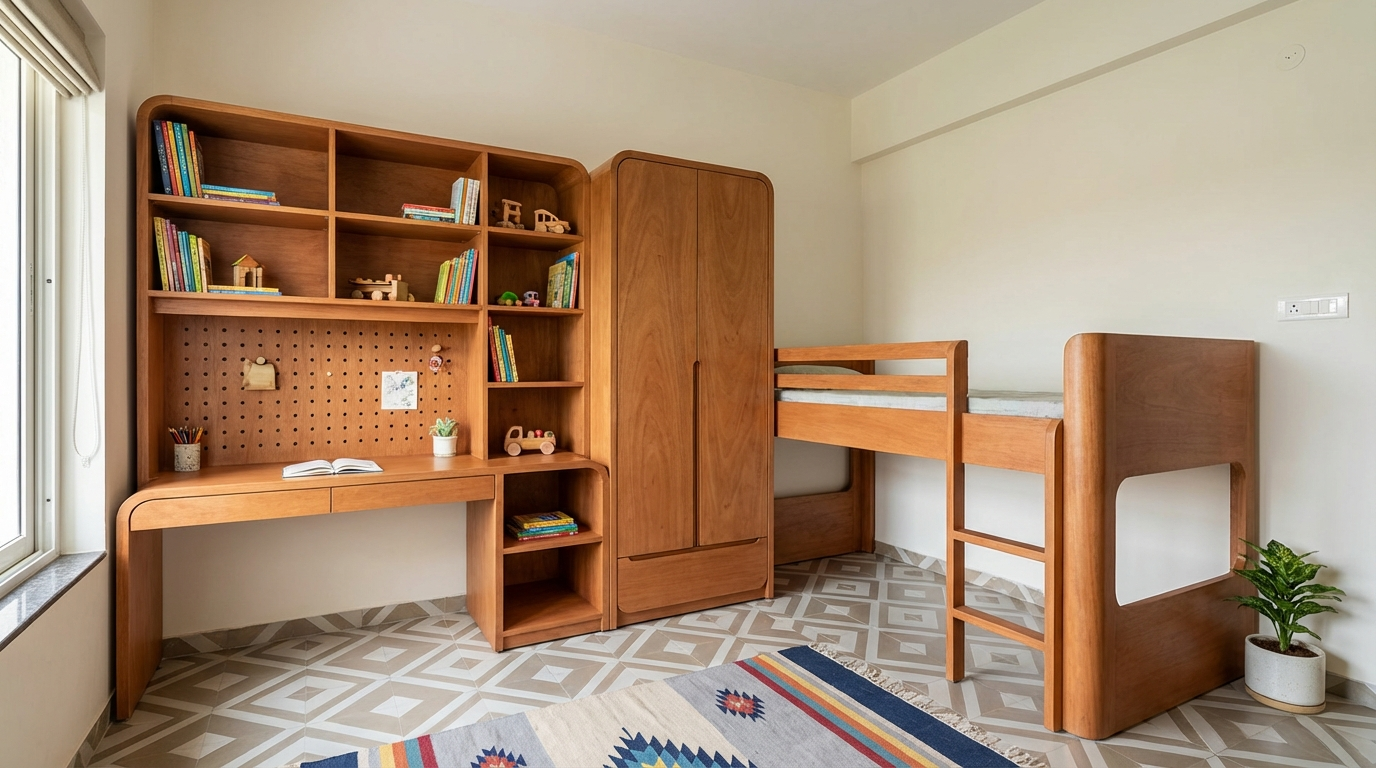
Alright, let's talk themes. Compact yet functional kids bedroom designs focus on freedom of movement by wall-aligning stylish and safe chamfered wooden furniture. The vivid roadmap wallpaper by the study area acts as an interactive backdrop to pique a child's imagination.
I've seen maybe 200 kids rooms over the years. The ones that age best share one thing: neutral base furniture with theme-based accessories. That means your bed, wardrobe, and study table stay in whites, light woods, or subtle colors. The "theme" comes from bedding, curtains, wall decals, and accessories you can swap out.
Is a themed kids room worth the extra cost?
Honestly? Depends on how you do it. A full themed room with custom furniture—like those car-shaped beds or princess castle wardrobes—costs 2-3x more than a neutral setup with themed accessories. And here's the kicker: kids typically outgrow themes in 18-24 months. The ultimate experts on what kids like best are kids themselves, so get them involved in the design process by letting them help with selections. That being said, children's preferences change often, so use accessories and colors that can be easily replaced. Better to spend ₹8,000 on a themed bedding set you'll replace in 2 years than ₹80,000 on a themed bed frame you'll regret by age 7.
| Theme Category | Best Age Range | Longevity | Budget Impact | My Recommendation |
|---|---|---|---|---|
| Character-based (Frozen, Spider-Man) | 3-6 years | Low—usually 1-2 years max | High if custom furniture, low if accessories only | Accessories ONLY |
| Nature/Jungle | 4-10 years | Good | Medium | Safe bet |
| Space/Astronomy | 5-12 years | Excellent—grows with interest | Medium-high for glow elements | Highly recommended |
| Sports | 6-14 years | Good if generic, poor if team-specific | Low to medium | Go generic—avoid team colors |
| Ocean/Underwater | 3-8 years | Medium | Medium | Works well in coastal cities |
| Minimalist/Scandinavian | 8+ years (or design-conscious parents) | Excellent | Can vary widely | Best for small rooms |
Safety Standards Every Parent Should Know
Key safety features include sturdy construction, rounded edges, non-toxic materials, tip-over prevention hardware, and proper weight limits. Always verify that furniture meets current safety standards.
I'm going to be blunt here. In India, we don't have enforcement of children's furniture safety standards the way Western countries do. The Consumer Product Safety Commission called for improved safety standards due to the high number of injuries among children as a result of unsafe Children's furniture. For example, an estimated 77,300 people were treated in emergency rooms for injuries associated with children's furniture and products. That's a US number, but the risk is universal.
What this means for you: don't assume that "kids furniture" label means anything was tested. Check these things yourself:
- Rounded edges on everything—run your hand along all corners
- Tip-over prevention—every tall piece (wardrobe, bookshelf, chest of drawers) needs wall anchoring. Mandates the use of furniture straps or L-brackets to prevent furniture from tipping over, a significant cause of injury among young children.
- No pinch points—check drawer slides and hinges
- Non-toxic finishes—All children's furniture must feature non-toxic finishes, avoiding lead, phthalates, and other harmful chemicals to ensure safe interaction for children.
- Weight capacity—if kids will climb it (they will), it needs to hold an adult's weight
Why do carpenters rarely talk about safety anchoring?
Because it's extra work and extra cost—maybe ₹500-800 per piece for proper wall anchors. And because they've never seen the statistics. According to a report by the U.S. Consumer Product Safety Commission, between 2000 and 2018, there were 459 reported tip-over-related deaths involving children aged 17 and younger. A staggering 93% of these tragic incidents involved children five years old and younger. I started insisting on wall anchoring for all wardrobes and bookcases in kids rooms after seeing one almost topple on a client's child in Vashi. The father had opened the wardrobe door while the kid was climbing the shelves. Missed him by inches.
Material Choices: Plywood vs MDF vs Particle Board
Let me settle this debate that I hear constantly. Plywood, MDF, and particleboard are all engineered woods, but of the three plywood is by far the strongest. This is a result of the different processes used when engineering the woods. Plywood is a "sandwich" of thin sliced layers of solid wood. These thirteen thin layers are glued together into a panel, alternating the direction of the wood grain so it is stable in all directions.
For kids furniture? Plywood wins. Period. Here's my actual recommendation breakdown:
| Component | Minimum Plywood Grade | Recommended Thickness | Why |
|---|---|---|---|
| Bed frame | BWR (IS 303) | 18-19mm | Beds endure heavy daily use—weight, movement, humidity, and sometimes kids using them as trampolines. So your plywood choice must align with the load. |
| Wardrobe structure | MR grade minimum, BWR better | 18mm | Handles door weight and daily opening/closing |
| Study table top | MR grade | 18mm | Resists pen pressure, spills, scratching |
| Bookshelf | MR grade | 12-16mm for shelves, 18mm for frame | Prevents sagging under book weight |
| Drawer bottoms | MR grade | 6-8mm | Light duty, just needs to not warp |
The thickness of plywood typically ranges from 6mm to 25mm. Thicker plywood is generally stronger and more durable, making it suitable for load-bearing furniture like beds and wardrobes.
MDF has its place—for decorative headboards, carved elements, or routed designs where you need smooth finish. But never for structural components. If sealed improperly, MDF and particle board both soak up any moisture, easily warping the wood.
Price Reality Check (2026 Market)
Alright, let's talk money. This is where most online guides fail you completely because they either give outdated numbers or Western prices.
For a complete kids room in Mumbai, Pune, or Bangalore—including bed, wardrobe (3-door), study table with chair, and one bookshelf—expect to pay roughly:
- Budget tier (particle board furniture): ₹80,000-1,20,000. Will last maybe 4-5 years with care. Not my recommendation.
- Mid-range (MR plywood with laminate): ₹1,50,000-2,50,000. Good quality, 8-10 year lifespan. Best value for most families.
- Premium (BWR/BWP plywood with veneer or PU finish): ₹3,00,000-4,50,000. Built to last 15+ years, can be repainted/refinished.
Here's what actually affects your final bill:
- Plywood grade and brand—biggest variable
- Hardware quality—soft-close hinges add ₹400-800 per piece vs ₹80-150 for standard
- Finish type—laminate (cheapest), acrylic, PU, or veneer (most expensive)
- Built-in vs modular—built-in wardrobes cost 20-30% more but use space better
- City—same work costs 15-20% more in Mumbai than Ahmedabad
Storage Solutions That Kids Actually Use
Designing a child's room that stays tidy and functional can feel like an uphill battle. Between the growing pile of toys, the rotating wardrobe, art supplies, and books, storage often becomes an afterthought.
I've learned this the hard way from watching clients' kids ignore expensive storage systems: if a child can't reach it or open it independently, they won't use it.
One of the best kid's room storage ideas is keeping cubbies, baskets and bins low to the ground. It makes it easy for kids to take toys they want to play and can also help them develop the habit of putting them back once done. Making color code or label for each storage will help children put things back in the right place.
What storage height works for different ages?
- Age 2-4: Everything accessible should be below 70cm (about waist height for an adult)
- Age 5-7: Up to 100cm is reachable
- Age 8-10: Standard wardrobe height works, but keep daily items on middle shelves
- Age 11+: Adult-height storage is fine
Beds with built-in drawers are great for storing extra bedding, toys, or seasonal clothes. They take advantage of under-bed space that would otherwise go unused. I push under-bed storage heavily in Mumbai and Bangalore apartments where rooms are under 100 sq ft. Under-bed storage can be a blessing in kids bedroom design for small spaces. Large rolling bins or drawers can keep blankets, toys and clothes for the season.
A few more practical tips:
- Keep only a few toys on display, while the rest stay stored away in labelled bins or drawers. Swap them out every couple of weeks to keep the play area fresh and exciting.
- Open shelving beats closed cabinets for kids under 6—they need to see what's inside
- Drawers beat doors for clothing storage—easier for small hands to operate
- Beds with drawers, benches with internal storage, and desks with compartments are ideal as they combine use with storage, helping keep the room tidy without taking up extra space.
Boys Room vs Girls Room: Does It Matter?
Here's an unpopular opinion: in 2026, the whole "blue for boys, pink for girls" thing feels dated. I've had plenty of parents specifically ask for gender-neutral designs that can work for siblings sharing, or that don't box their child into stereotypes.
That said, some practical differences exist:
| Factor | Typical "Boys" Setup | Typical "Girls" Setup | My Neutral Recommendation |
|---|---|---|---|
| Color palette | Blues, greens, greys | Pinks, purples, whites | White/cream base + 1-2 accent colors of child's choice |
| Storage emphasis | More floor space for play | Often more display shelving | Balance both—open shelves + floor area |
| Durability priority | Often higher (rough play) | Sometimes lower (perceived) | Always build durable—all kids are rough on furniture |
| Study area integration | Often separate from bed zone | Often vanity/study hybrid | Dedicated study area with good lighting for both |
Honestly? The bigger variable is the individual child's personality, not their gender. I've designed "rugged" rooms for girls who love sports and soft, pastel rooms for boys who are into art.
Common Mistakes Parents Make
After 18 years of seeing kids rooms done right and very, very wrong, here's what I keep seeing:
1. Buying furniture that's too big for the room. This one kills me. I had a client in Bandra who bought this gorgeous king-size car bed for their 5-year-old. Room was 10x12 feet. The bed took up maybe 60% of the floor space. Kid couldn't even play in his own room. Measure twice, buy once.
2. Skipping the wall anchoring. Already covered this, but I'll say it again because it's literally a life-safety issue.
3. Choosing aesthetics over function. When designing kids' room ideas for boys and girls, it's all about balancing fun with practicality. Make storage a priority to keep the floor clutter-free and use playful décor that can be easily updated. That floating shelf looks gorgeous but if it's not reachable, it's useless.
4. Ignoring lighting completely. Most people install one ceiling light and call it done. A kids room needs: ambient ceiling light, focused study lamp, and ideally a dim nightlight option. Task lighting at the study table prevents eye strain—I've seen so many setups where kids are practically squinting at their homework.
5. No growth planning. Adding playful details into a neutral room design is a great way to create a space that evolves with your child, saving you from frequent redesigns as they grow. While a pastel-themed nursery can be charming, it may not be the most practical choice for kids' room ideas that will last as your child grows. Choosing versatile wallpaper and décor that can easily transition from toddler to tween will save you time and money in the long run.
6. Using adult-height furniture. I've seen wardrobes where the hanging rod is at 5 feet. The 7-year-old can't reach her own clothes without a stool. Either install an adjustable rod or add a lower secondary rod.
7. Particle board in humid cities. This one really frustrates me. Client in Chennai bought a full modular setup in particle board because it was ₹80,000 cheaper than plywood. By the second monsoon, the wardrobe doors wouldn't close properly. Swelling. Ended up replacing everything within 4 years.
8. Forgetting the "chaos zone." Every kids room needs one area where mess is acceptable—a reading corner, play mat area, something. If the whole room has to be pristine, you'll all go crazy.
9. Over-investing in the bed frame, under-investing in the mattress. The mattress affects your child's sleep quality and spine development. Spend proportionally.
10. Not involving the child at all. Even a 4-year-old has preferences. They might not be practical, but some input makes them take ownership of keeping the space tidy.
How to Brief Your Carpenter or Interior Designer
When you're getting kids room furniture made, don't assume the mistri knows what's important for children's spaces. Give them this checklist:
- All exposed edges must be rounded—minimum 6mm radius, preferably 10mm
- No sharp hardware visible—countersink screws, use covered hinges
- Provide wall anchor points—even if I don't use them immediately
- Seal all edges completely—no exposed plywood edges, use edge banding
- Test drawer glides with 10kg weight—kids will sit on pulled-out drawers
- Leave 2-3cm gap behind wardrobes—for ventilation and to run charging cables
- Confirm plywood grade before cutting—check ISI stamp yourself
The edge banding one is critical. I've seen carpenters skip this on back panels or inside surfaces to save time. If sealed improperly, MDF and particle board both soak up any moisture, easily warping the wood. Same applies to plywood—unsealed edges absorb humidity.
Quality Checks You Can Do Yourself
Visual checks before installation:
- Look at the plywood cross-section—layers should be uniform, no large voids
- Check for the ISI mark—Always ask for ISI stamped plywood (IS:303 or IS:710).
- Surface should be smooth, no rough patches that snag fabric
- Laminate or veneer shouldn't have bubbles or lifting edges
- Smell test—strong chemical smell means high formaldehyde
Questions to ask your dealer or contractor:
- "What's the exact plywood grade? Show me the stamping."
- "Is the laminate 0.8mm or 1mm thick?" (1mm is more durable for kids furniture)
- "What's the warranty on hardware specifically?"
- "Are the hinges soft-close or standard?" (Soft-close prevents pinched fingers)
- "How thick is the back panel?" (Should be minimum 6mm, not 4mm)
Here's a trick most dealers don't like: Ask to see a sample offcut of the actual plywood being used. Hold it, try to bend it slightly, check the layers. If they refuse, that's a red flag.
Simple field tests:
- Tap test: Knock on the panel surface—solid sound means dense core, hollow sound means voids
- Weight test: 18mm BWR plywood should feel substantial, roughly 9-11 kg per square meter
- Edge inspection: Check for gaps between layers at cut edges
- Flex test: A 2-foot length of 18mm ply shouldn't bend noticeably under moderate hand pressure
How Long Does Kids Room Furniture Last?
Replace furniture when it shows signs of wear that compromise safety, when your child outgrows it, or when it no longer meets their developmental needs. This typically occurs every 3-5 years.
That's for average quality furniture. Here's what I've actually seen in practice:
| Material Type | Expected Lifespan | Conditions |
|---|---|---|
| Particle board furniture | 3-5 years | Less in humid coastal cities |
| MR grade plywood | 8-12 years | With proper finishing and normal humidity |
| BWR/BWP plywood | 15-20+ years | Can be refinished, outlasts most kids' needs |
| Solid wood | 20+ years | But expensive and can crack in dry climates |
Signs of wear to watch for:
- Warped doors that don't close flush
- Drawer slides sticking or grinding
- Laminate peeling at edges
- Wobbly joints or loose screws that keep coming undone
- Visible water damage staining
My honest advice? For kids furniture specifically, invest in BWR grade minimum for structural components. Bedroom furniture is an investment—in comfort, durability and everyday convenience. The right plywood ensures your interiors stay strong for years: Beds don't sag. Wardrobes don't warp. Drawers glide smoothly. You avoid expensive repairs. Your 5-year-old's furniture can become your 12-year-old's furniture with just new paint and hardware.
Space Planning for Different Room Sizes
Most Indian bedrooms fall into three categories. Here's how I approach each:
Compact (70-90 sq ft): Common in Mumbai 1BHKs and 2BHKs. Bunk beds are your friend if you have two kids. If you have more than one child, a bunk bed with built-in storage is the way to go. The minimalist bunk bed comes with built-in wardrobes, drawers at the base and even cleverly concealed storage areas under the stairs. With this single piece, you can save on space by eliminating the need for separate wardrobes. For single kids, loft beds with study underneath work brilliantly. Wall-mounted desks save floor space. Skip the standalone bookshelf—integrate it into the wardrobe design.
Medium (90-120 sq ft): Most comfortable to work with. Single bed with storage drawers, 3-door wardrobe, dedicated study corner. Leave a 4x5 feet open floor area for play.
Spacious (120-150+ sq ft): Here you can add a reading nook, separate play zone, maybe even a small seating area. Resist the urge to fill every corner—kids need open floor space. Thoughtfully carving a stepping playscape with plenty of open floor area ensures the bedroom is the perfect spot to entertain friends, while maintaining a certain charm.
Alternatives Worth Considering
If budget is tight: Ready-made modular furniture from brands like Godrej Interio, Urban Ladder, or Pepperfry works for a first room. Quality varies, but it's cheaper than custom-built. Just check the material specs—most budget options are particle board.
If you need better moisture resistance: BWP Grade (Boiling Water Proof) is the ultimate in moisture-resistance—suitable for service areas, bathrooms, and high-humidity zones. Worth the premium in coastal cities.
If you want ready-to-assemble with better quality: HDHMR boards are gaining popularity. Our HDHMR vs plywood comparison guide covers this in detail. They offer good screw-holding compared to particle board, though not quite as strong as plywood.
For specific furniture guidance: Our wardrobe plywood selection guide goes deeper into choosing materials for storage units specifically. The kitchen cabinet material comparison is also relevant if you're thinking about built-in study units.
Frequently Asked Questions
Is it true that kids room furniture needs special plywood grades?
Not "special" grades, but appropriate grades. MR Grade (Moisture Resistant) is ideal for low-moisture interiors—bedrooms, studies, and display units. BWR Grade (Boiling Water Resistant) is a great mid-range choice for kitchens, dining tables, and wardrobe exteriors. For a standard kids bedroom away from bathrooms, MR grade works fine. If the room shares a wall with a bathroom or is in a high-humidity zone, upgrade to BWR. The "kids" part doesn't change the grade—the usage and environment does.
What if I live in Chennai or Mumbai where humidity is always high?
Use BWR grade minimum for all structural components. Pay extra attention to edge sealing—every cut edge needs proper banding. Consider a dehumidifier in monsoon months. Avoid particle board entirely. I've seen furniture survive 15+ years in Mumbai with BWR plywood and proper maintenance versus failing in 3 years with MR grade in the same conditions.
Is it true that bunk beds are dangerous for young children?
The Consumer Product Safety Commission has determined that unreasonable risks of injury and death are associated with bunk beds that are constructed so that children can become entrapped in the beds' structure or become wedged between the bed and a wall. The key is proper construction and age appropriateness. Don't put kids under 6 on the top bunk. Check that any gaps on, in or around your child's elevated loft or bunk bed are less than 3.5" (9cm) or more than 9" (23cm). Remember to include ladders or added accessories in this check. Guardrails are mandatory.
How much floor space should I leave for play?
Minimum 15-20% of the room should be open floor space. In a 100 sq ft room, that's about 4x5 feet clear area. Sounds small, but kids can work with it. For rooms under 90 sq ft, this becomes challenging—consider vertical play options (climbing elements) or keeping toys in a separate living room play area.
Is it true that themed furniture has poor resale value?
Yes, unfortunately. That car bed or princess castle wardrobe is hard to sell secondhand because it appeals to such a narrow buyer group. Neutral furniture holds value much better. If you must do themed, invest in accessories (bedding, curtains, wall decals) rather than permanent furniture pieces.
What's the ideal height for a study table for different ages?
Table height should allow the child's feet to rest flat on the floor while elbows are at 90 degrees when writing. For ages 5-7, about 50-55cm. Ages 8-10, about 60-65cm. Ages 11-13, about 70cm (standard adult height). Choose adjustable furniture like height-adjustable desks and chairs, provide adequate lighting, and ensure proper ergonomics. Adjustable tables are worth the extra investment.
Is it true that white furniture shows wear faster in kids rooms?
It shows marks more visibly, but that doesn't mean it wears faster. White high-pressure laminate is actually very easy to clean—marker, crayon, most stains wipe right off. The issue is scratches show more than on wood-tone finishes. If your kids are particularly rough, choose a light wood tone instead of pure white.
What if my children share a room—how do I create separate zones?
If you have two or more kids at different ages, with varying styles, tastes and preferences, creating a shared Indian childrens' bedroom design can be difficult. Start by giving each one of them their dedicated space. If you're not constrained by space then split the room so that each kid has their own bed and dresser on "their" side of the room. If that isn't possible, find an arrangement that feels fair and doesn't cloister them too close together. Color coding each child's zone helps—different bedding, different shelf colors on a shared bookcase.
Is it true that Montessori-style low furniture is better for toddlers?
Encouraging independence is key—and low-height shelves, floor beds, and self-accessible storage are gaining popularity. There's good evidence that child-height furniture helps with independence and confidence. Floor beds work for some families. But practically, floor beds in Indian homes can have dust issues, and you may want to transition to a regular bed by age 3-4 anyway. A reasonable middle ground: standard toddler bed (low to ground) with open, low shelving for toys.
How do I make the room work for homework AND play?
Clear zoning. Physically separate the study area from the play area, even if it's just by orientation. The study desk should face a wall or window, not the toy storage. Set up dedicated spaces for things like creative and focused activities. Put pens, paper, stationery and craft materials in easy-to-access boxes and organizers on an open shelf near their desk so children can just sit down and get started. Good task lighting at the desk makes a difference in signaling "this is work time."
What's the best flooring for a kids room in India?
Vitrified tiles with area rugs are the most practical combination—easy to clean, cool in summer, and the rug provides a soft play surface. Wooden flooring looks nice but scratches easily and needs more maintenance. Vinyl flooring is gaining popularity—softer than tiles, quieter, easier on falls. Avoid polished marble—too slippery when kids run.
Is it true that I need to replace kids furniture every 3-5 years?
Only if you buy cheap furniture. Good quality plywood furniture can last 10-15 years with a fresh coat of paint at the 7-year mark. What you will likely need to replace more often: mattress (every 5-7 years), bedding (as it wears or tastes change), and storage accessories like bins and baskets.
Final Practical Tips
Look, designing a kids room isn't rocket science, but it's not as simple as picking colors either. The mistakes I see most often come from prioritizing aesthetics over function, or from not planning for growth.
Three things to get right above all else: safety anchoring on tall furniture, appropriate plywood grade for your climate, and storage at kid-reachable heights. Everything else—the themes, the colors, the cute accessories—those can change. The structural decisions you make now will be with you for a decade.
And seriously—don't skip the edge rounding on custom furniture. Your shins will thank you during those midnight bed-check rounds.
Disclaimer: This content is provided for general informational purposes based on industry practices and publicly available information. Product specifications, standards, prices, and availability may vary by manufacturer, region, and time. Readers should independently verify details with manufacturers, dealers, or qualified professionals before making purchase or construction decisions.Want Plywood Suggestions?
Share a few details and a Sainik 710 specialist will suggest suitable brands and connect you to responsive dealers.