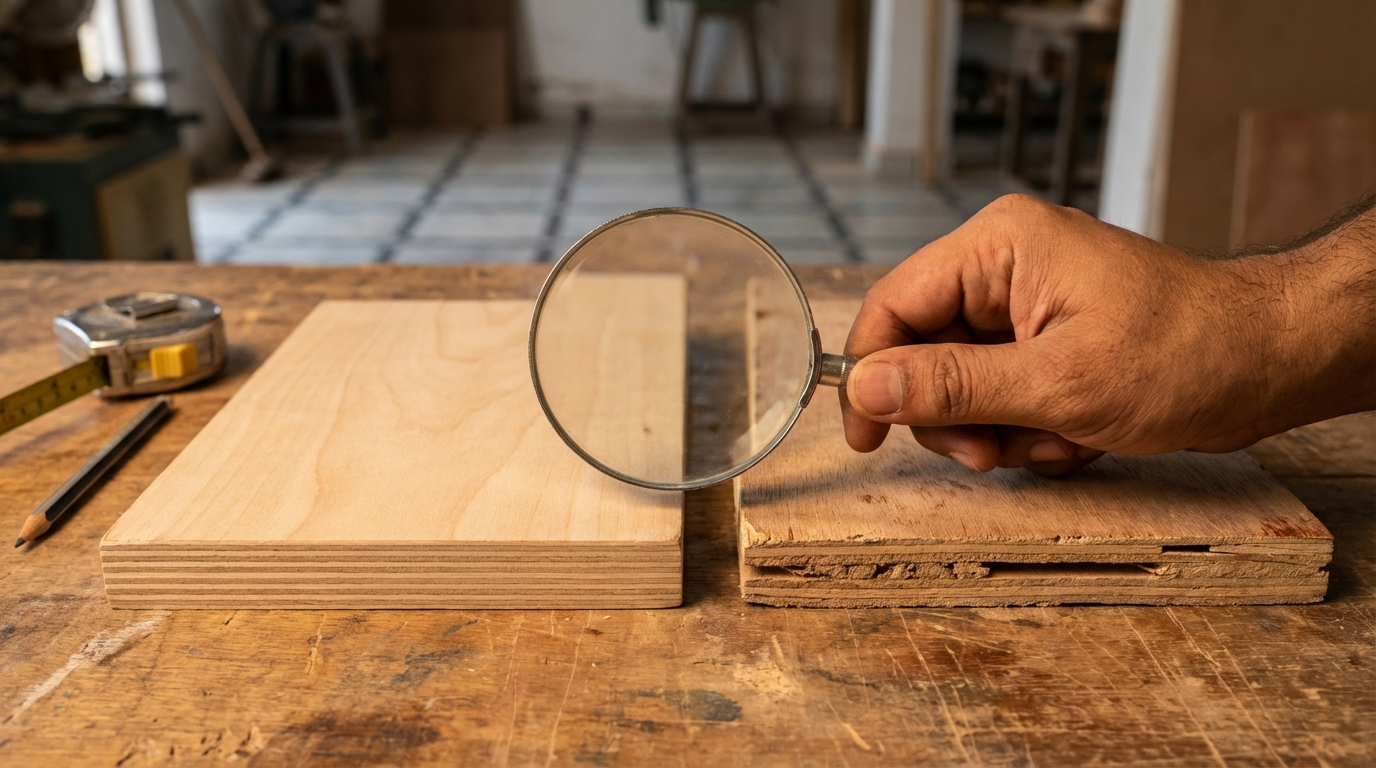
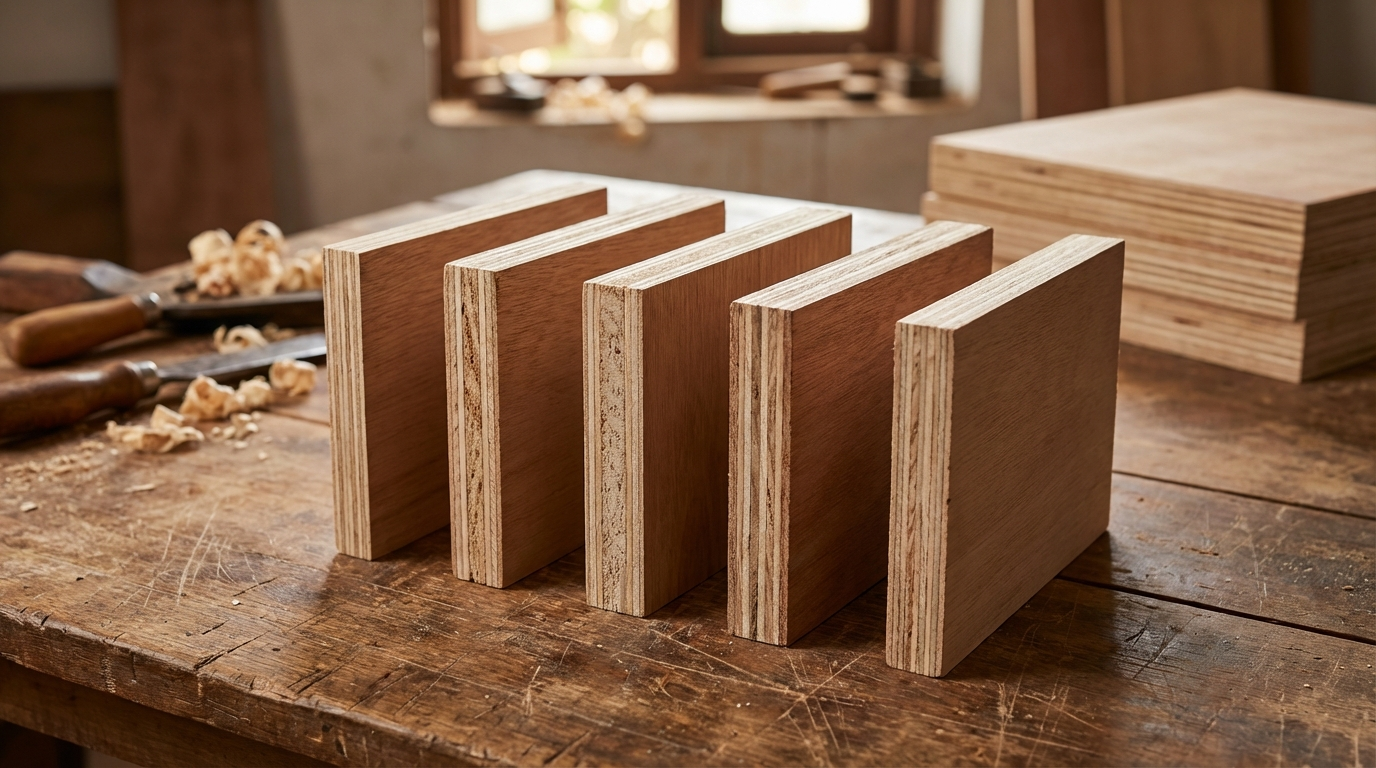
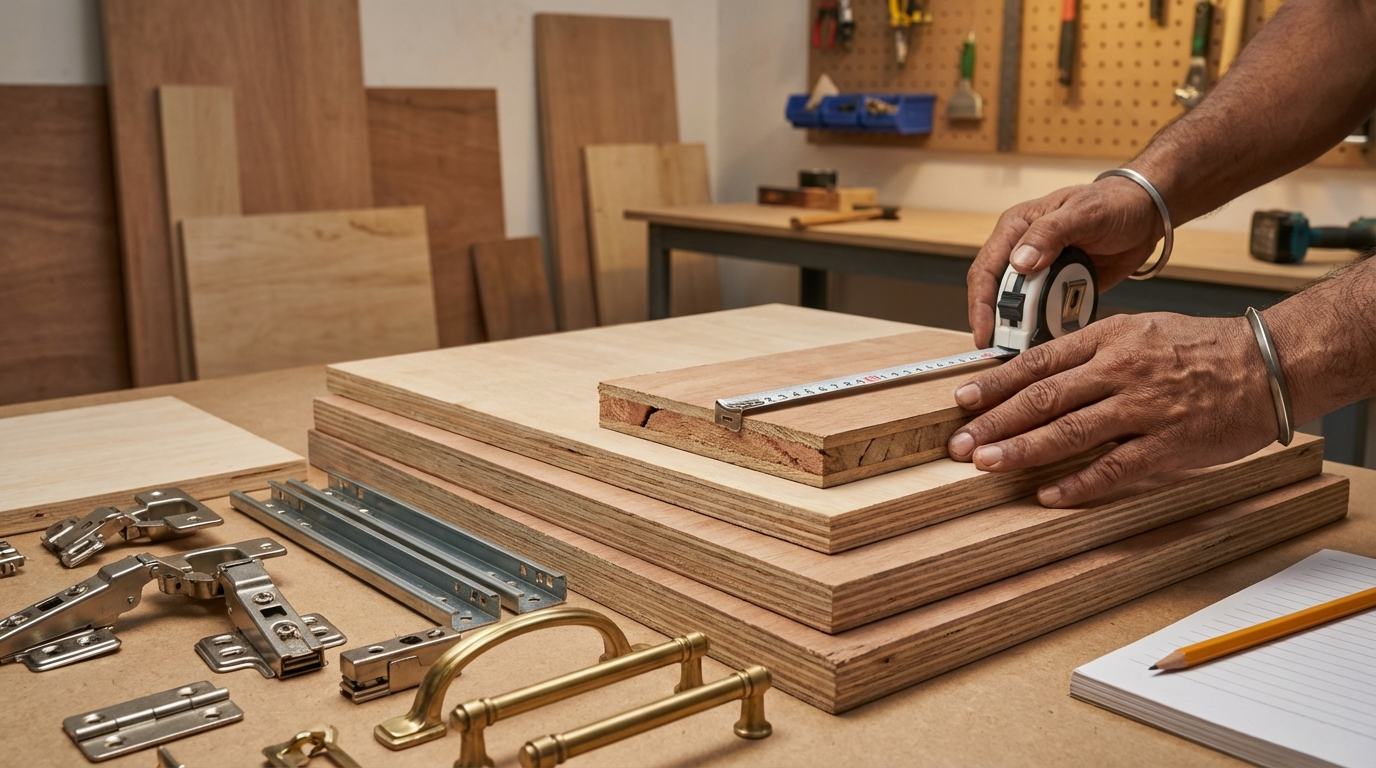
HDHMR Full Form & Guide: What is HDHMR Board, Uses, Price & Comparison with Plywood
Learn HDHMR/HDMR full form, uses & price. Complete comparison of HDHMR vs plywood vs MDF—find the best board for kitchen, wardrobe & furniture.
Quick Decision Summary
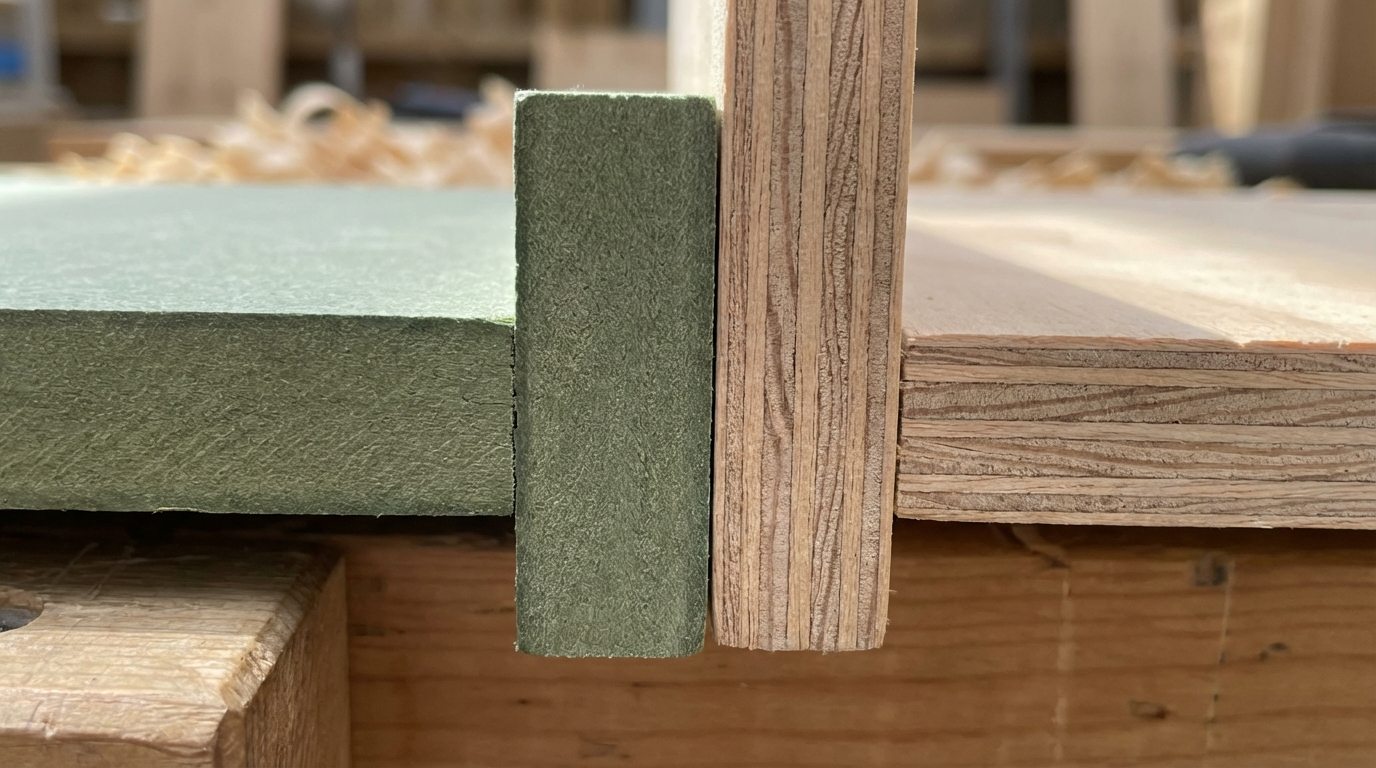
HDHMR stands for High Density High Moisture Resistant board—a dense engineered wood panel offering superior moisture resistance compared to standard MDF, making it suitable for kitchen cabinets and humid environments in Indian homes.
If you're in a hurry: HDHMR is essentially a premium version of MDF with better moisture tolerance and higher density (typically 800-880 kg/m³). It works well for modular kitchen carcasses, wardrobe interiors, and bathroom vanities when properly sealed. However, it's not waterproof—prolonged water contact will still cause swelling. For areas with direct water splash, BWR or marine plywood remains safer. HDHMR typically costs ₹50-110 per square foot depending on thickness and brand.
- Choose HDHMR if: You want a smooth, consistent surface for lamination or paint finish, need moisture resistance for kitchen/wardrobe interiors, prefer factory-calibrated thickness for modular work, or want termite-resistant panels without chemical treatment.
- Avoid HDHMR if: You need structural strength for long unsupported spans, require true waterproofing for bathroom wet zones, want to use traditional carpentry joinery, or need outdoor-grade durability.
Key takeaway: HDHMR fills the gap between standard MDF and plywood—offering moisture resistance that MDF lacks while providing the smooth, uniform surface that plywood cannot match.
What HDHMR Actually Means: Grade, Construction, and Use
HDHMR is an engineered wood product made by compressing wood fibres with moisture-resistant synthetic resins under high heat and pressure. The full form—High Density High Moisture Resistant—describes its two key properties: density above 800 kg/m³ (compared to standard MDF at 600-750 kg/m³) and resistance to humidity-induced swelling through special resin formulation.
The manufacturing process starts with wood waste and fibre chips, typically from rubberwood, pine, or plantation hardwoods. These fibres are mixed with melamine-urea-formaldehyde or phenolic resins along with wax and other additives. The mixture gets compressed at temperatures exceeding 200°C, creating a homogeneous panel without the layered structure of plywood.
Understanding the Technical Specifications
When evaluating HDHMR boards, focus on these specifications:
- Density: Quality HDHMR ranges from 800-880 kg/m³. Higher density means better screw holding and surface hardness.
- Thickness swell: Good HDHMR shows less than 8% swell after 24-hour water immersion (standard MDF swells 25-35% in the same test).
- Internal bond strength: Should exceed 0.8 N/mm² for furniture applications.
- Formaldehyde emission: E1 or E0 grade boards emit minimal formaldehyde, important for enclosed spaces like wardrobes.
Common Misconceptions About HDHMR
The biggest misconception is that HDHMR is waterproof. It's not. The "moisture resistant" designation means it tolerates humidity better than standard MDF and resists temporary water exposure—but submerging HDHMR or leaving it in standing water will cause swelling, especially at cut edges. Another misconception is confusing HDHMR with HDF (High Density Fibreboard). While related, HDF used for laminate flooring may lack the moisture-resistant additives present in furniture-grade HDHMR. Always verify the specific grade when purchasing.
Some buyers assume HDHMR can replace plywood in all applications. This isn't accurate. HDHMR lacks plywood's cross-grain structure that provides bending strength and superior screw retention at edges. For long shelves, structural applications, or areas requiring edge-screwing, plywood remains superior.
India-Specific Reality Check: Moisture, Termites, and Workmanship
HDHMR's performance in India depends heavily on regional climate conditions and local workmanship practices. The material behaves differently in Mumbai's 85% monsoon humidity compared to Delhi's dry winters or Chennai's year-round coastal dampness.
Monsoon and Coastal Risk Factors
During monsoon months in Mumbai, Kolkata, or Kerala, relative humidity regularly exceeds 80%. While HDHMR resists this ambient moisture better than MDF, problems arise when:
- Cut edges remain unsealed during installation delays
- Boards sit in semi-open godowns absorbing moisture before use
- Kitchen sink areas experience repeated splash exposure
- Cabinets are installed against damp external walls without vapour barriers
In coastal cities like Chennai, Visakhapatnam, or Mangalore, salt air accelerates degradation of unsealed surfaces. The combination of high humidity and salt creates conditions where even moisture-resistant boards face challenges. Contractors in these regions typically recommend additional edge sealing with PU sealant and ensuring laminate extends beyond cut edges by at least 2mm.
Storage and Handling on Indian Sites
The typical Indian construction site lacks controlled storage conditions. Boards often arrive weeks before installation and sit in partially completed spaces exposed to rain ingress, construction moisture from plastering, and ground dampness. This creates problems specific to Indian conditions:
- Acclimatization issues: Boards stored in air-conditioned showrooms then moved to humid sites can absorb moisture and swell.
- Ground contact: Boards stacked directly on cement floors absorb moisture through the bottom sheets.
- Rain exposure: Temporary covers often blow away or leak during monsoon, damaging stored materials.
Best practice involves storing HDHMR boards flat on wooden battens (not directly on floor), covered with plastic sheeting, in the driest part of the site. Allow 48-72 hours for acclimatization before cutting and installation.
Common Contractor Practices and Pitfalls
Many Indian carpenters (mistris) learned their trade working with solid wood and plywood. HDHMR requires different handling:
- Traditional carpenters may over-tighten screws, stripping the hole in HDHMR's consistent-density core
- Edge banding gets skipped to save time, leaving moisture-entry points
- Cutting with dull blades causes edge chipping that compromises laminate adhesion
- Joints designed for plywood's edge-screw strength fail in HDHMR
When briefing contractors, specify pilot hole requirements, confirm edge-sealing methods, and verify they understand HDHMR's differences from plywood. For detailed guidance on cabinet construction, our kitchen cabinet material guide provides comprehensive specifications.
Price Range and Cost Drivers (2026 Market)
HDHMR board prices in India typically range from ₹50-110 per square foot for plain boards, varying by thickness, brand, and city. Pre-laminated versions cost ₹80-150 per square foot depending on laminate quality. Understanding cost drivers helps you budget accurately and evaluate dealer quotes.
Thickness-Wise Price Expectations
| Thickness | Typical Price Range (₹/sq ft) | Common Applications |
|---|---|---|
| 6mm | ₹18-25 | Cabinet backs, drawer bottoms |
| 9mm | ₹22-32 | Wall panels, lightweight partitions |
| 12mm | ₹30-45 | Upper cabinet shutters, small furniture |
| 16/17mm | ₹45-65 | Cabinet carcasses, wardrobe sides |
| 18mm | ₹55-80 | Kitchen cabinets, heavy-duty shelving |
| 25mm | ₹85-110 | Countertop substrates, thick door panels |
Why Prices Vary Significantly
Several factors create the wide price variation you'll encounter:
- Brand premium: Established brands like Action Tesa, Century, or Greenpanel command 15-25% premium over regional manufacturers due to consistent quality and warranty support.
- Calibration: Calibrated boards (precision sanded for uniform thickness) cost more but save time in modular furniture production.
- Resin type: Boards made with phenolic resins offer better moisture resistance than urea-formaldehyde versions, at higher cost.
- City variations: Mumbai and Delhi dealers typically price 8-12% higher than Tier-2 cities due to rent and logistics costs. Coastal cities may have limited brand availability.
- Quantity discounts: Bulk orders (10+ sheets) often receive 5-10% discount from dealers.
Budget Estimation for Common Furniture
To estimate HDHMR costs for your project, use this framework:
- Modular kitchen (8x7 feet): Typically requires 8-10 sheets of 18mm HDHMR, costing ₹15,000-25,000 for boards alone (excluding laminate, hardware, labour).
- 6x8 feet wardrobe: Requires 5-6 sheets, approximately ₹12,000-18,000 in boards.
- TV unit (6 feet): Requires 2-3 sheets, approximately ₹5,000-8,000.
Factor in 15-20% wastage for cutting, plus laminate/veneer costs (typically ₹20-60 per sq ft), edge banding (₹8-15 per running foot), and hardware. Labour costs vary significantly by city and contractor.
Head-to-Head Comparison: HDHMR vs Plywood vs MDF
Choosing between HDHMR, plywood, and MDF requires understanding their distinct characteristics and matching them to your specific application. Each material excels in different situations, and the "best" choice depends entirely on your use case, budget, and local conditions.
Comprehensive Comparison Table
| Property | HDHMR | BWR Plywood | Standard MDF | Best For |
|---|---|---|---|---|
| Density | 800-880 kg/m³ | 550-650 kg/m³ | 600-750 kg/m³ | HDHMR for surface hardness |
| Moisture Resistance | Good (with sealing) | Excellent | Poor | Plywood for wet areas |
| Surface Smoothness | Excellent | Moderate | Excellent | HDHMR/MDF for paint finish |
| Screw Holding (Face) | Good | Excellent | Moderate | Plywood for heavy hardware |
| Screw Holding (Edge) | Moderate | Excellent | Poor | Plywood for edge joints |
| Termite Resistance | Inherent | Requires treatment | Inherent | HDHMR/MDF naturally resistant |
| Bending Strength | Moderate | High | Low-Moderate | Plywood for long spans |
| CNC Machinability | Excellent | Difficult | Excellent | HDHMR/MDF for detailed work |
| Weight | Heavy | Medium | Medium | Plywood for wall-hung units |
| Cost (18mm) | ₹55-80/sq ft | ₹70-120/sq ft | ₹35-50/sq ft | MDF for budget projects |
When to Choose HDHMR Over Plywood
Select HDHMR when you need:
- Ultra-smooth surfaces for high-gloss laminate or paint finishes without grain telegraphing
- Consistent calibrated thickness for modular furniture with precision tolerances
- CNC-routed decorative patterns on wardrobe doors or wall panels
- Termite resistance without chemical treatment concerns
- Kitchen cabinet carcasses in moderately humid conditions (with proper sealing)
When Plywood Remains the Better Choice
Stick with plywood for:
- Long shelves (over 80cm unsupported span) where bending resistance matters
- Areas with direct water exposure—sink cabinets, bathroom floors, outdoor applications
- Applications requiring strong edge-screw joints
- Heavy-duty drawer boxes and pull-out mechanisms
- Projects where weight is a concern for wall-mounted installations
Our plywood grade comparison guide covers BWR and marine plywood specifications in detail for moisture-critical applications.
How to Choose: 5-Step Decision Framework
Selecting between HDHMR, plywood, and MDF becomes straightforward with a systematic approach. Follow these steps to match material choice with your specific requirements.
Step 1: Assess Moisture Exposure Level
Rate your application's moisture exposure:
- High (direct water contact): Bathroom floor cabinets, outdoor furniture, sink base interiors → Choose BWR/BWP plywood
- Moderate (humidity, occasional splash): Kitchen cabinets, wardrobes in humid cities → HDHMR acceptable with sealing
- Low (climate-controlled interiors): Bedroom furniture, living room units in dry regions → MDF or HDHMR both work
Step 2: Evaluate Structural Requirements
Consider load-bearing needs:
- Shelves over 60cm span bearing books or heavy items → Plywood preferred
- Cabinet carcasses with proper support structure → HDHMR acceptable
- Door shutters and decorative panels → HDHMR excellent for smooth finish
- Drawer bottoms and cabinet backs → 6mm HDHMR or plywood both work
Step 3: Determine Finish Requirements
Your desired finish influences material selection:
- High-gloss laminate or acrylic finish: HDHMR provides the smoothest substrate
- Veneer finish: Both HDHMR and plywood work; HDHMR offers more consistent bonding
- Paint/lacquer finish: HDHMR machines beautifully for painted furniture
- Natural wood appearance: Veneer-faced plywood or solid wood
Step 4: Factor in Budget and Availability
Check local availability and budget constraints:
- Branded HDHMR may have limited availability in smaller towns
- For tight budgets with low moisture exposure, MDF saves 20-30%
- Quality plywood costs more but offers versatility across applications
- Pre-laminated HDHMR saves finishing labour but limits design flexibility
Step 5: Verify Contractor Expertise
Confirm your carpenter/contractor's familiarity:
- Traditional carpenters may be more comfortable with plywood
- Modular kitchen installers typically prefer HDHMR for carcass work
- CNC-based manufacturers handle HDHMR/MDF better than traditional workshops
Decision Framework Table
| Your Situation | Recommended Material | Reason |
|---|---|---|
| Modular kitchen in Mumbai/Chennai | HDHMR carcass + BWR plywood for sink area | Balances moisture resistance with smooth finish |
| Wardrobe in dry Delhi apartment | HDHMR or MDF | Low moisture risk; smooth finish for laminates |
| Bathroom vanity in any city | BWR/BWP plywood | Direct splash exposure requires true water resistance |
| Budget furniture, interior rooms | MDF with proper sealing | Cost-effective for low-moisture applications |
| CNC-cut decorative panels | HDHMR or MDF | Homogeneous structure enables clean routing |
| Heavy-duty office storage | Commercial plywood | Load-bearing and edge-screw requirements |
Common Buyer Mistakes and How to Avoid Them
Years of observing interior projects reveal consistent errors buyers make with HDHMR. Understanding these pitfalls helps you avoid costly corrections and disappointing results.
Mistake 1: Treating HDHMR as Waterproof
What goes wrong: Buyers install HDHMR for sink base cabinets without additional protection, then face swelling and delamination within 1-2 monsoon seasons.
Why it happens: Marketing terminology like "moisture resistant" gets interpreted as "waterproof." The distinction matters significantly.
How to avoid: Use BWR plywood for direct water exposure zones. If using HDHMR, apply waterproof membrane coating on bottom surfaces and seal all edges with PU sealant.
Mistake 2: Skipping Edge Sealing
What goes wrong: Cut edges absorb moisture faster than laminated surfaces, causing localized swelling and edge delamination of laminates.
Why it happens: Contractors skip edge banding to save time and cost, especially on non-visible edges inside cabinets.
How to avoid: Insist on edge banding or PU sealant on ALL cut edges, including hidden ones. This adds ₹8-15 per running foot but prevents moisture entry.
Mistake 3: Wrong Thickness Selection
What goes wrong: Using 12mm boards for cabinet carcasses leads to sagging shelves and weak hinge zones. Using 18mm for backs wastes money and adds unnecessary weight.
Why it happens: Buyers follow contractor suggestions without understanding structural requirements.
How to avoid: Use minimum 16-18mm for carcass sides, shelves bearing weight, and shutter panels. Use 6mm for backs and drawer bottoms, 9-12mm for light-duty applications.
Mistake 4: Ignoring Acclimatization
What goes wrong: Boards cut immediately after delivery expand or contract post-installation, causing gaps, warping, or laminate bubbling.
Why it happens: Tight project timelines push immediate processing without allowing boards to stabilize to site conditions.
How to avoid: Store boards at installation site for 48-72 hours before cutting. This allows moisture content to equalize with ambient conditions.
Mistake 5: Using Wrong Fastening Methods
What goes wrong: Standard wood screws strip out of HDHMR when overtightened or used at edges. Joints fail under load.
Why it happens: Contractors apply plywood techniques to HDHMR without understanding the material's different properties.
How to avoid: Use confirmat screws with pilot holes for 90-degree joints. Never rely on edge screws for structural connections—use dowels or cam locks instead.
Mistake 6: Buying Unbranded "HDHMR"
What goes wrong: Lower-density boards labelled as HDHMR fail moisture tests and swell like regular MDF.
Why it happens: Price-focused purchasing without verifying specifications or brand authenticity.
How to avoid: Purchase from authorized dealers, check for brand stamps/printing on board edges, and verify density by lifting—genuine HDHMR feels notably heavy.
Mistake 7: Improper Storage Before Installation
What goes wrong: Boards stored on damp floors or exposed to rain damage before installation, leading to edge swelling and surface waviness.
Why it happens: Construction sites lack proper storage facilities; materials get neglected during delays.
How to avoid: Store flat on wooden battens, covered with plastic, away from wet work areas. Inspect boards before use and reject any showing edge swelling or surface damage.
Workmanship and Installation Guidelines
Proper installation techniques determine whether HDHMR delivers its promised performance. These guidelines help you brief contractors and verify work quality.
Cutting and Edge Treatment
HDHMR requires sharp, carbide-tipped blades for clean cuts. Recommended specifications:
- Table saw or panel saw with 60-80 tooth blade (for 8-10 inch diameter)
- Cutting speed moderate—too fast causes chipping, too slow burns the surface
- Support boards fully during cutting to prevent breakout at exit point
- Apply edge banding within 24 hours of cutting in humid conditions
For CNC routing, use single-flute or compression bits at 18,000-24,000 RPM. HDHMR routes cleaner than MDF due to higher density, making it excellent for decorative panel work.
Is HDHMR Good for Indian Kitchens?
HDHMR works well for Indian kitchen cabinets when installed correctly. The material handles cooking steam and humidity better than MDF, while its smooth surface accepts laminate finishes that resist oil and spice stains. For best results, use 18mm HDHMR for carcasses, seal all edges including back panel grooves, and consider BWR plywood for the sink base unit. The combination provides cost-effective construction with targeted protection where moisture risk is highest. Our kitchen plywood selection guide details specific configurations for Indian cooking environments.
Fastening and Hardware Installation
HDHMR's screw-holding characteristics require specific techniques:
- Face screws: Pre-drill pilot holes 70% of screw diameter; HDHMR holds face screws reasonably well
- Edge screws: Avoid wherever possible; use dowels, biscuits, or cam-lock fittings instead
- Hinges: Use 35mm Euro hinges with mounting plates; three hinges minimum for doors over 1200mm height
- Confirmat screws: Ideal for 90-degree joints in cabinet construction
Hinge Zones and Reinforcement
Heavy doors or frequently used cabinets benefit from reinforcement:
- Install solid wood or plywood strips at hinge locations for better screw retention
- Use soft-close hinges to reduce impact stress on screw connections
- For wardrobe doors over 600mm width, use three hinges to distribute weight
- Verify hinge spacing allows full door opening without binding
Site Storage and Acclimatization Protocol
Follow these steps for proper site handling:
- Designate a dry, covered storage area away from plastering and wet work
- Place boards flat on minimum three wooden battens (not directly on floor)
- Cover with plastic sheeting, allowing air circulation at edges
- Allow 48-72 hours before cutting for moisture equalization
- Inspect each board before use—reject any with visible edge swelling or surface damage
Quality Checks Without Laboratory Tests
You don't need lab equipment to verify HDHMR quality. These field-practical methods help identify genuine quality boards and spot potential problems before purchase or installation.
Visual Inspection Points
Examine boards carefully before accepting delivery:
- Surface consistency: Should be uniformly smooth without patches, bumps, or depressions
- Edge integrity: Edges should be clean and hard, not crumbly or showing visible voids
- Colour uniformity: Consistent colour throughout indicates proper manufacturing (slight variations between batches are normal)
- Flatness: Sight along the length—boards should be flat, not bowed or twisted
- Brand markings: Genuine branded boards have printed identification on edges or back
What Thickness of HDHMR is Best for Wardrobes?
For wardrobe construction, 18mm HDHMR is the standard choice for side panels, shelves, and doors. This thickness provides adequate rigidity without excessive weight. Use 16mm for internal partitions if budget is tight, but 18mm offers better screw holding for adjustable shelf fittings. Wardrobe backs typically use 6mm HDHMR or plywood—thinner boards work since backs are supported within grooves. Our wardrobe material guide covers loft sections and long-span shelving requirements in detail.
Simple Field Tests
These quick tests help evaluate board quality:
- Weight test: Pick up an 18mm sheet—it should feel notably heavy (approximately 45-50 kg for 8x4 sheet). Suspiciously light boards may be lower density.
- Tap test: Knock on the surface in multiple spots. Should produce a consistent, solid sound. Hollow sounds indicate internal voids or density variations.
- Edge hardness: Press your thumbnail into a cut edge. Quality HDHMR resists indentation; softer boards may be standard MDF mislabelled.
- Scratch test: Light fingernail scratch should not leave visible marks on calibrated surface.
Questions to Ask Your Dealer
Get these answers before purchasing:
- What is the board's density rating?
- What resin type is used—is it E1/E0 emission rated?
- Is this calibrated (thickness-guaranteed) stock?
- What warranty does the manufacturer provide?
- How long has this batch been in storage?
- Can you provide a test certificate or specification sheet?
Warning Signs to Watch For
Reject boards showing these issues:
- Edge swelling or softness indicating moisture absorption
- Surface waviness visible when viewed at an angle
- Visible core voids or density variations in cut edges
- Delamination or surface peeling at corners
- Strong chemical odour indicating poor resin cure or high formaldehyde
- Missing or illegible brand identification
How Long Does HDHMR Last in Humid Conditions?
Properly installed and maintained HDHMR typically lasts 10-15 years in moderately humid Indian conditions like Bangalore or Pune interiors. In highly humid coastal cities or poorly ventilated spaces, lifespan may reduce to 7-10 years even with proper sealing. The key factors affecting longevity are edge sealing quality, laminate integrity, and ventilation around installed furniture. Regular inspection of sink area cabinets and prompt repair of any laminate damage extends service life significantly. For coastal homes, annual checks during post-monsoon season help catch moisture damage early.
Applications and Use-Case Recommendations
HDHMR serves specific applications better than others. Understanding optimal use cases helps you specify the right material for each component of your project.
Kitchen Applications
HDHMR excels in kitchen cabinet construction when used appropriately:
- Cabinet carcasses (sides, top, bottom): 18mm HDHMR with proper edge sealing—handles cooking humidity well
- Shelves: 18mm HDHMR for spans up to 60cm; add support for longer spans
- Shutters/doors: 18mm HDHMR provides excellent substrate for laminate or membrane finish
- Sink base: Prefer BWR plywood; if using HDHMR, add waterproof membrane on bottom and seal all edges
- Tall units: 18mm HDHMR acceptable; use three hinges per door due to weight
Wardrobe and Bedroom Furniture
Wardrobes represent an ideal HDHMR application:
- Carcass and shelving: 18mm HDHMR throughout; lower moisture risk than kitchen
- Doors: 18mm HDHMR takes laminate, veneer, or paint finishes excellently
- Drawer boxes: 12mm HDHMR acceptable for light drawers; plywood better for heavy-duty applications
- Loft storage: 18mm HDHMR; ensure adequate support brackets for long spans
Can HDHMR Be Used in Bathrooms?
HDHMR works for bathroom vanity cabinets and storage units positioned away from direct splash zones. The material handles bathroom humidity when properly laminated and edge-sealed. However, never use HDHMR for shower enclosure panels, flooring, or cabinet bases directly under sinks without waterproof membrane protection. For consistently wet areas, marine plywood or PVC boards remain safer choices. If budget requires HDHMR in bathroom applications, ensure excellent ventilation and immediately repair any laminate damage to prevent moisture entry.
Commercial and Specialized Applications
HDHMR finds use beyond residential furniture:
- Office furniture: Desks, partitions, and storage units benefit from HDHMR's surface quality
- Retail fixtures: Display units and shelving—smooth finish accepts high-quality finishes
- Exhibition stands: CNC-cut decorative panels take advantage of HDHMR's routing characteristics
- Hotel furniture: Room furniture where appearance matters more than extreme durability
Maintenance and Long-Term Care
HDHMR furniture requires minimal maintenance but benefits from proper care practices that extend service life and maintain appearance.
Regular Care Practices
Follow these guidelines for ongoing maintenance:
- Cleaning: Wipe with slightly damp cloth followed by dry cloth; avoid soaking surfaces
- Spill response: Clean spills immediately—don't let liquids stand on surfaces or pool at edges
- Chemical avoidance: No harsh chemicals, abrasives, or solvents that might damage laminate
- Hardware maintenance: Tighten loose hinges promptly before screws strip the material
- Ventilation: Ensure cabinets have adequate air circulation to prevent moisture buildup
Damage Prevention and Repair
Prevent common damage scenarios:
- Use coasters and mats under hot or wet items
- Avoid dragging heavy objects across surfaces
- Repair laminate chips immediately with matching touch-up or edge-sealing compound
- Check under-sink areas monthly during monsoon for any moisture signs
- Re-seal edges if edge banding peels or loosens
When to Consider Replacement
HDHMR furniture may need replacement when:
- Core swelling becomes visible despite surface appearing intact
- Multiple hinge or hardware mounting points have failed
- Persistent musty odour indicates internal moisture damage
- Structural sagging or warping affects functionality
- Surface damage is too extensive for cost-effective repair
Frequently Asked Questions
What is the full form of HDHMR and what does it mean?
HDHMR stands for High Density High Moisture Resistant board. The name describes two key properties: density exceeding 800 kg/m³ (compared to standard MDF at 600-750 kg/m³) and enhanced resistance to humidity-induced swelling through special moisture-resistant resins. The "high density" provides better screw holding, surface hardness, and overall strength compared to regular MDF, while "high moisture resistant" means the board tolerates humid environments better than standard MDF, though it's not waterproof. This combination makes HDHMR suitable for kitchen and bathroom applications where MDF would swell and fail.
Is HDHMR better than plywood for kitchen cabinets?
Neither is universally "better"—each suits different aspects of kitchen construction. HDHMR offers superior surface smoothness for laminate finishes, consistent calibrated thickness for modular work, and inherent termite resistance. Plywood provides better moisture resistance for direct water exposure, superior screw holding especially at edges, and greater structural strength for long shelves. The optimal approach combines both: HDHMR for cabinet carcasses and doors where smooth finishes matter, BWR plywood for sink base units and areas with direct water contact. This combination balances cost-effectiveness with targeted performance.
What is the difference between HDHMR and MDF boards?
HDHMR and MDF are related products with important differences. MDF (Medium Density Fibreboard) has lower density (600-750 kg/m³) and uses standard urea-formaldehyde resins that swell significantly when exposed to moisture. HDHMR uses moisture-resistant resins and achieves higher density (800-880 kg/m³), resulting in better humidity tolerance and stronger screw holding. In practical terms, MDF works fine in dry, climate-controlled environments and costs less, while HDHMR is necessary for kitchens, bathrooms, or any location with elevated humidity. The price difference (HDHMR typically costs 30-50% more than MDF) reflects this enhanced performance.
Can HDHMR be used for outdoor furniture?
No, HDHMR is not suitable for outdoor furniture. Despite being moisture-resistant, HDHMR cannot withstand prolonged exposure to rain, direct sunlight, and temperature fluctuations that outdoor furniture faces. UV exposure degrades the surface, rain penetration causes core swelling, and thermal cycling leads to warping and delamination. For outdoor furniture, choose materials specifically designed for exterior use: marine plywood with exterior-grade finish, WPC (wood-plastic composite), powder-coated aluminium, or weather-resistant plastics. Even for covered outdoor areas like balconies, HDHMR is risky due to indirect moisture and humidity exposure.
Does HDHMR board require edge banding?
Yes, edge banding is essential for HDHMR in all applications, not optional. Cut edges of HDHMR absorb moisture faster than laminated surfaces because the exposed wood fibres act as wicks drawing humidity into the core. Without edge sealing, moisture enters through edges causing localized swelling that compromises laminate adhesion and structural integrity. Always apply edge banding (PVC tape ironed on, or ABS edge band) or seal edges with PU sealant on non-visible surfaces. This applies to all edges including back panel grooves, shelf supports, and internal surfaces—not just visible exterior edges.
What thickness of HDHMR should I use for kitchen cabinets?
For standard kitchen cabinet construction, use 18mm HDHMR for carcass sides, top, bottom, and shelving. This thickness provides adequate rigidity, good screw holding for hardware, and appropriate weight for hinged doors. Cabinet backs use 6mm HDHMR or plywood—thinner is acceptable since backs sit within grooves and don't bear load. Shutters (doors) also use 18mm for consistent appearance when hinged to 18mm carcasses. Some contractors suggest 16mm to reduce costs, but 18mm offers noticeably better hardware retention and long-term stability. For base units supporting heavy countertops, 18mm is minimum; 25mm provides extra rigidity.
Is HDHMR termite proof?
HDHMR boards are inherently resistant to termites and wood borers due to the manufacturing process and additives used. Unlike natural wood or even plywood (which requires chemical treatment for termite resistance), HDHMR's synthetic resins and processing make it unattractive to insects. However, "termite proof" and "termite resistant" differ—while termites won't actively attack HDHMR, they may travel across it to reach other wood in the structure. Branded HDHMR from reputable manufacturers includes anti-borer additives for enhanced protection. This inherent resistance makes HDHMR attractive for coastal and humid regions where termite activity is prevalent.
Why is HDHMR heavier than plywood?
HDHMR's higher density (800-880 kg/m³ versus plywood's 550-650 kg/m³) makes it significantly heavier per square foot at the same thickness. An 8x4 foot sheet of 18mm HDHMR weighs approximately 45-50 kg, while equivalent plywood weighs 32-38 kg. This weight comes from the compressed wood fibre structure with no air gaps, unlike plywood which has natural porosity between veneer layers. The weight has practical implications: wall-mounted cabinets need stronger fixings, doors require more hinges, and handling during installation requires more labour. However, this density also provides HDHMR's smooth surface and consistent properties.
Can HDHMR boards be painted directly?
Yes, HDHMR accepts paint excellently, making it preferred for painted furniture over plywood. The smooth, uniform surface eliminates grain patterns that telegraph through paint on plywood. For best results, lightly sand the surface (180-220 grit), apply a sealing primer coat (especially on edges which absorb more), then finish with acrylic or polyurethane paint. Edges require extra primer attention due to higher porosity. Two to three paint coats typically achieve full coverage with professional appearance. HDHMR's density means it machines cleanly for routed decorative patterns that can be painted for effect—popular for shaker-style and contemporary wardrobe doors.
How much does HDHMR cost compared to BWR plywood?
HDHMR typically costs 15-25% less than quality BWR plywood at comparable thickness. An 18mm HDHMR board runs approximately ₹55-80 per square foot, while BWR plywood of similar thickness costs ₹70-120 per square foot depending on brand and core quality. However, total project cost comparison requires factoring in application-specific requirements. HDHMR needs edge banding everywhere (additional cost), while plywood can leave some edges exposed. HDHMR requires different fastening approaches. When combining HDHMR for most surfaces with plywood for wet zones, the overall cost typically falls between using exclusively HDHMR or exclusively plywood.
Is HDHMR safe for home use regarding formaldehyde emissions?
Quality branded HDHMR meets E1 or E0 emission standards, meaning formaldehyde release falls within safe limits for residential use. E1 certification limits emissions to 0.1ppm or less—considered safe for enclosed furniture. Premium variants from major manufacturers specifically target low-emission applications with E0 certification (near-zero formaldehyde). When purchasing, ask for emission certification or choose brands explicitly marketing low-emission products. Ensure good ventilation during and after installation while fresh-cut edges off-gas. Once furniture is installed and edges sealed, emissions drop significantly. Avoid unbranded boards without certification, as emission levels may be unknown.
Can I use HDHMR for making doors and door frames?
HDHMR works well for cabinet doors and wardrobe shutters but is not recommended for main doors or door frames. For cabinet and wardrobe doors, 18mm HDHMR provides excellent surface quality for laminate, veneer, or paint finishes. However, main entry doors and door frames require materials that handle heavier hardware loads, repeated impact stress, and edge-screwing for hinges and strikes—areas where plywood or solid wood excels. Door frames also need to accept screw fixings at various points, something HDHMR handles poorly at edges. For flush door cores, specialized HDF or honeycomb cores are typically used rather than HDHMR.
What are the disadvantages of HDHMR board?
Despite its advantages, HDHMR has notable limitations. Weight is significant—18mm boards are heavy to handle and require robust wall fixings for mounted installations. Edge screw holding is weaker than plywood, restricting joint design options. The material cannot withstand standing water despite being moisture-resistant, limiting wet-area use. Long unsupported spans may sag under load where plywood would remain rigid. HDHMR cannot be bent or curved like thin plywood. Availability in smaller towns may be limited to fewer brands. Finally, improper handling and installation can negate its moisture-resistant properties, meaning success depends heavily on workmanship quality.
How do I identify genuine HDHMR from fake or lower-grade boards?
Genuine branded HDHMR can be identified through several checks. Look for manufacturer printing or stamps on board edges or backs—brands like Action Tesa, Century, and Greenpanel mark their products. Weight indicates density—pick up the board and compare; genuine HDHMR feels notably heavy. Edge appearance should be uniformly dense without visible voids, fibre variations, or crumbling. Tap the surface listening for consistent solid sound rather than hollow spots. Purchase from authorized dealers who can provide invoices showing brand and grade. If price seems unusually low compared to market rates, suspect lower-grade MDF being sold as HDHMR. Ask to see test certificates or specification sheets from genuine manufacturers.
Note: sainik710.com is an independent informational site and is not affiliated with any HDHMR manufacturer or brand mentioned in this article.
Disclaimer: This content is provided for general informational purposes based on industry practices and publicly available information. Product specifications, standards, prices, and availability may vary by manufacturer, region, and time. Readers should independently verify details with manufacturers, dealers, or qualified professionals before making purchase or construction decisions.Want Plywood Suggestions?
Share a few details and a Sainik 710 specialist will suggest suitable brands and connect you to responsive dealers.