Glass Door Design: 25+ Modern Sliding, Partition & Main Door Ideas for Indian Homes
Explore 25+ glass door designs—sliding, partition & main door options. Toughened glass types, privacy options & frame materials for modern Indian homes.
Glass Door Design: What Actually Works for Indian Homes
Glass doors in Indian homes work best when you match the glass type, frame material, and privacy level to your specific application—whether that's a main entrance, room partition, or balcony slider. Short version: Glass doors have gone from being a "luxury" thing to something pretty common in apartments and independent houses alike. The trick is understanding that "glass door" isn't one product—it's a category with maybe 30+ combinations of glass types, frame materials, and opening mechanisms. Get the combination wrong, and you're looking at condensation issues, privacy problems, or worse—cracked panels from thermal stress.
This is right for you if:
- You want to bring natural light into interior spaces
- Your flat has a balcony or garden area you want to connect visually with the living room—especially in cities like Mumbai where outdoor views matter
- You're dealing with a compact apartment where visual openness makes rooms feel bigger
- You need partition doors but don't want the solid, heavy look of wooden shutters
Skip this if:
- Your budget is extremely tight—quality glass doors aren't cheap once you add frames and installation
- You have small children who treat every surface as a potential cricket pitch
Bottom line: A well-chosen glass door transforms a space, but the wrong glass-frame combination will give you headaches for years.
What Glass Doors Actually Are (And What They're Not)
A glass door is a door panel where glass—either single-pane or double-glazed—serves as the primary material instead of wood, plywood, or metal sheet. The glass is supported by frames made from aluminium, wood, uPVC, steel, or sometimes frameless systems using heavy-duty hinges and clamps.
Most people think all glass doors are fragile. Actually, toughened glass used in modern doors is 4-5 times stronger than regular float glass and breaks into small, rounded pieces instead of sharp shards. That said—and this is what the showroom guys won't emphasize—even toughened glass has its limits. Thermal shock, edge damage during installation, or impurities in the glass can cause spontaneous breakage. Rare, but it happens.
The technical stuff for those who want it: Glass thickness for doors typically ranges from 8mm to 12mm for standard applications, going up to 18-20mm for larger sliding panels. Anything below 8mm really shouldn't be used for door applications in India—the thermal stress alone during peak summer can cause problems. There's also laminated glass, where two sheets are bonded with a PVB interlayer, giving you both strength and safety. If a laminated panel cracks, it stays in place instead of collapsing.
Why This Matters Differently in Indian Homes
Here's where things get interesting for Indian conditions. The humidity factor alone changes everything about glass door selection.
In cities like Mumbai and Chennai, you're dealing with 75-90% relative humidity for 4-5 months. In places like Chennai or Mumbai, you'll notice condensation forming on glass surfaces when the AC is running—this is moisture from humid air meeting the cold glass surface. If your frame joints aren't properly sealed, this water gets into wooden frames and causes swelling and rot over time. I've seen this happen repeatedly in Bandra and Worli apartments where architects specified beautiful wooden-framed glass doors without considering humidity.
Coastal Karnataka, the Konkan belt, Kolkata—similar story. The salty air adds another dimension. Aluminium frames work better here, but only if they're powder-coated properly. Raw aluminium will pit and corrode within 2-3 years.
Compare this to Bengaluru or Pune. Drier climate, lower humidity even during monsoon, less thermal swing between seasons. You have more flexibility with frame materials here. Wooden frames hold up much better. Less condensation to worry about.
Then there's Delhi-NCR with its extreme temperature range—from 5°C winter mornings to 46°C summer afternoons. Glass expansion and contraction becomes a real consideration. Single-pane glass in large sliding doors can experience enough thermal movement to stress the frame joints. Double-glazed units perform better here, not just for insulation but for dimensional stability.
Does glass door work in high humidity areas?
Yes, but your frame material choice becomes critical. Aluminium or uPVC frames are your safest bet in coastal cities and areas with humidity above 70% for extended periods. If you insist on wooden frames—and I understand the aesthetic appeal—go for treated teak with marine-grade finish, and make sure every joint is sealed with silicone. Expect to reapply sealant every 18-24 months. The glass itself handles humidity fine; it's always the frame and the frame-glass junction where problems start.
Types of Glass Doors: The Real Breakdown
Right, let me organize this properly because the categories overlap in confusing ways.
By Opening Mechanism
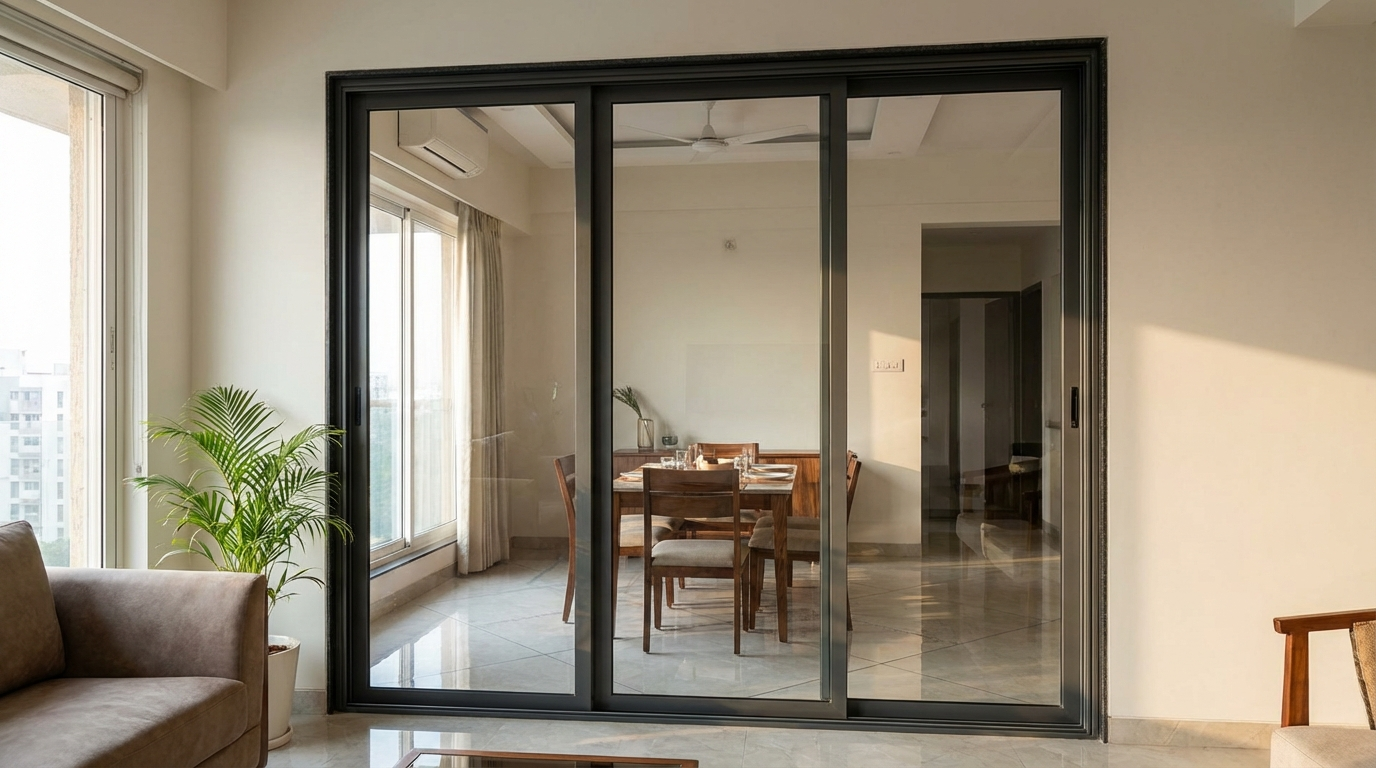
Sliding glass doors—the most popular type for balconies and room divisions. The glass panels slide on tracks, either two-track (two panels, one slides behind the other) or three-track (three panels). Best when you have limited floor space and don't want a door swinging into the room. The 2-door sliding configuration works for openings up to about 6 feet wide; beyond that, go for 3-door systems.
Swing doors—traditional hinged operation, can be single or double leaf. Better for main entrances where you want the door to be a statement piece. Requires clearance space for the swing arc. My take: If you're doing a frameless glass swing door, spend extra on quality floor springs—the cheap ones fail within 3-4 years.
Folding/bi-fold doors—multiple panels hinged together that fold accordion-style. Excellent for opening up an entire wall to a garden or terrace. But honestly, the mechanism complexity means more potential failure points. I've seen beautiful bi-fold installations in Gurgaon villas where one panel's roller fails and the whole system becomes unusable.
Pocket sliding doors—the panel slides into a cavity inside the wall. Clean look when open, but requires wall thickness of at least 6-7 inches and proper cavity construction. If something goes wrong with the track inside the wall, repairs are a nightmare.
By Glass Type
| Glass Type | Best For | Thickness Range | Privacy Level | My Take |
|---|---|---|---|---|
| Clear toughened | Balcony doors, living room-garden connections | 8-12mm | None | The default choice. Works well for most applications. |
| Frosted/acid-etched | Bathroom partitions, bedroom doors | 8-10mm | High | Excellent privacy without blocking light. Shows fingerprints easily. |
| Tinted (grey/bronze/blue) | West-facing balconies, sun control | 8-12mm | Low to Medium | Reduces heat gain but makes interiors feel darker |
| Reflective | Commercial, street-facing apartments | 8-12mm | High (daytime only) | Privacy reverses at night—looks great outside, but people can see in when your lights are on |
| Laminated | Main entrances, high-security areas | 10-16mm (with interlayer) | Depends on outer glass | Worth the extra cost for entry doors. Stays in frame even if broken. |
| Double-glazed (IGU) | AC rooms, noise-prone areas, extreme climates | 20-24mm (overall) | Depends on glass choice | Energy savings justify the premium in Delhi/Chennai. Overkill for Bengaluru. |
| Lacquered/back-painted | Kitchen partitions, decorative panels | 6-8mm | Complete | More decorative than functional. Good for kitchen pass-throughs. |
By Application Area
Main entrance doors—need maximum security and impact resistance. Laminated toughened glass with robust aluminium or steel frames. Often combined with decorative elements like etching or colored film. Not recommended as the sole security barrier; most homes with glass main doors have a secondary grille gate.
Balcony/terrace doors—sliding systems dominate here. Clear toughened glass 10-12mm thick. Weather sealing becomes important—the bottom track especially needs proper drainage channels. In Mumbai, I've seen track buildup during monsoon that prevents smooth operation.
Room partitions—this is where design flexibility really opens up. Full-height frosted panels for bedrooms, clear glass with minimal frames for living-dining separation, even colored glass for aesthetic statements.
Kitchen-dining partitions—frosted or lacquered glass common here. Keeps cooking smells contained while maintaining visual connection. Sliding mechanisms preferred over swing doors in compact kitchens.
Bathroom doors—frosted, acid-etched, or film-coated for privacy. Smaller panel sizes mean 8mm glass usually sufficient. Frame sealing critical to prevent water ingress.
Frame Materials: What Actually Holds Everything Together
The frame often matters more than the glass. Seriously. I've seen beautiful 12mm toughened panels ruined by cheap aluminium frames that warped within two years.
Aluminium frames—the workhorse option. Lightweight, corrosion-resistant (when properly treated), available in various profiles from ultra-slim to heavy-duty. Powder coating essential for longevity. The slim-frame systems trending now use aluminium profiles as thin as 20-25mm visible width—looks stunning but requires precision manufacturing. Expect to pay ₹350-600 per running foot for quality aluminium frames, more for slim/minimal profiles.
Steel frames—stronger and allows for even thinner profiles than aluminium. Popular in industrial/contemporary designs. But—and here's what designers don't mention—steel rusts. Even "stainless" steel can show rust spots in coastal areas if it's lower-grade 304 instead of 316. Proper galvanizing or powder coating non-negotiable.
Wooden frames—warmest aesthetic, works beautifully in traditional and contemporary fusion designs. Teak the gold standard; sal and meranti work in drier climates. The issue: wood moves with humidity. In coastal cities, I'd strongly advise against it unless you're prepared for annual maintenance.
uPVC frames—excellent for thermal insulation and moisture resistance. Zero maintenance required. But the profiles tend to be bulkier than aluminium, and the plastic appearance doesn't suit every design sensibility. For balcony sliders in humid climates, honestly one of the best practical choices.
Frameless systems—glass panels connected with minimal hardware, hinges directly into floor/ceiling. High design impact. But requires absolutely level floors and properly reinforced ceilings. Installation complexity means this goes wrong fairly often. I've seen frameless shower enclosures in Delhi where the glass actually came away from the floor spring.
Price Reality Check: 2026 Market
Glass door costs vary wildly based on glass type, frame material, size, and mechanism complexity. Let me give you realistic ranges rather than precise figures that'll be outdated in three months.
Basic sliding balcony door (2-track, 6x7 feet, clear toughened, standard aluminium frame): Expect roughly ₹25,000-40,000 fully installed. The variance comes from glass thickness (8mm vs 10mm), frame profile quality, and your city's labor rates.
Premium sliding door (slim-frame aluminium, 10mm toughened, soft-close mechanisms): ₹50,000-80,000 for similar dimensions.
Double-glazed units add 60-80% to glass cost alone.
Laminated glass adds 40-50% over standard toughened.
Main entrance glass door (laminated, decorative, steel/aluminium frame): ₹60,000-1,50,000 depending on design complexity.
Here's what actually affects your final bill—
- Non-standard sizes cost disproportionately more due to cutting waste
- Tinted and reflective glass carries 15-25% premium over clear
- Hardware quality varies enormously—cheap rollers might last 2 years, quality ones 10+
- Site access matters: if your apartment requires manual carry up 4 floors, add ₹3,000-5,000 for handling
- Track type: floor-mounted vs top-hung systems have different cost implications
Budget tip: Get quotes for the same configuration from at least three suppliers. The variance I've seen for identical specs is sometimes 35-40%.
Glass vs Solid Doors: When to Choose What
| Parameter | Glass Door | Solid Wood/Ply Door | Winner For... |
|---|---|---|---|
| Natural light | Excellent—transforms dark spaces | None | Glass (obviously) |
| Privacy | Variable—depends on glass type | Complete | Solid if privacy is non-negotiable |
| Sound insulation | Moderate (better with double-glazed) | Good to excellent | Solid for bedroom/study doors |
| Security | Good with laminated glass, but psychologically feels less secure | Excellent with proper locks | Solid for main doors unless paired with grille |
| Space efficiency | Sliding variants unbeatable | Requires swing clearance | Glass sliding for compact spaces |
| Maintenance | Tracks need cleaning; glass shows smudges | Periodic refinishing | Depends on your tolerance |
| Cost | Higher for quality systems | More affordable usually | Solid if budget is primary concern |
| Heat insulation | Poor (single-pane); Good (double-glazed) | Good | Solid for non-AC rooms in hot climates |
Choose glass when: You want to make a room feel larger, need light flow into interior spaces, have a view worth showcasing, or want contemporary aesthetics.
Choose solid when: Privacy is essential, sound blocking matters (home office, bedroom), budget is tight, or traditional aesthetics suit your home better.
My preference: Glass for living areas and balcony connections; solid core doors for bedrooms and bathrooms. The combination works better than committing to one throughout.
How to Choose: A Practical Framework
Step 1: Identify the application. Main entrance? Balcony? Room partition? Bathroom? This narrows your options immediately.
Step 2: Check your opening dimensions. Width over 8 feet usually means multi-panel sliding or folding systems. Height over 8 feet requires thicker glass and heavier frames. Measure three times.
Step 3: Assess your climate. Coastal humid city? Aluminium or uPVC frames only. Extreme temperature swings? Consider double-glazed. Heavy monsoon? Ensure proper track drainage for sliding doors.
Step 4: Decide on privacy needs. This determines glass type more than anything else. Clear for living spaces, frosted for bedrooms/bathrooms, tinted for sun-facing balconies.
Step 5: Set a realistic budget. Include installation, which typically runs 15-20% of product cost. Include hardware—soft-close mechanisms, quality handles, proper locks.
| Situation | Recommendation | Why |
|---|---|---|
| Compact apartment, north-facing balcony | 2-track sliding, clear 10mm toughened, slim aluminium frame | Maximizes light in already light-challenged space |
| Living-dining partition, need some privacy | Frosted toughened glass, minimal frame or frameless | Defines zones without blocking visual flow |
| Master bedroom balcony, sea-facing Mumbai | 3-track sliding, double-glazed with tinted outer pane, uPVC frame | Humidity resistance + noise reduction + heat control |
| Kitchen-utility partition | Frosted sliding door, aluminium frame, easy-clean glass coating | Contains smells while allowing light |
| Ground floor main entrance | Laminated toughened in steel frame + secondary security grille | Security without compromising on aesthetics |
| Budget-conscious bathroom door | Frosted 8mm toughened in standard aluminium frame | Gets the job done without premium pricing |
Red flags to walk away from:
- Dealer can't show you ISI mark on glass or won't provide written specification
- Frame profiles feel flimsy when you flex them
- Track rollers are plastic instead of metal-bearing
- No provision for adjustment screws on hinges/rollers
- Installation "included" but no mention of sealing, hardware adjustment, or post-installation check
Is frameless glass door worth the extra cost?
Depends entirely on your situation. Frameless systems look spectacular when done right—that clean, minimalist aesthetic is genuinely transformative. But they're 40-60% more expensive than framed alternatives, require more precise installation, and have higher failure rates if the floor isn't perfectly level or ceiling anchors aren't reinforced properly. Worth it for feature applications—a single statement door between living and dining. Not worth it for every door in the house. The maintenance is also higher; every fingerprint shows.
Common Mistakes People Make
Choosing based on showroom appearance alone. That beautiful slim-frame sliding door in the display might have different glass thickness, better-quality tracks, and premium hardware compared to what they actually deliver. Ask for exact specifications in writing.
Ignoring the track design. For sliding doors, the track matters as much as the glass. Cheap tracks accumulate dirt, have poor drainage, and their rollers fail within 3-4 years. This one really frustrates me—people spend ₹50,000 on beautiful glass panels and then accept ₹2,000 quality tracks because it's "included in the price." The door becomes difficult to slide within 2 years, and replacing tracks on an installed door is messy and expensive.
Skipping the site survey. Professional installation requires measurement of floor level, wall plumb, ceiling condition, and electrical/plumbing routing behind the wall. I've seen a beautiful glass partition installation in Andheri fail because nobody checked that a water pipe ran exactly where the bottom track needed anchoring. Complete reinstallation required.
Underestimating condensation. AC rooms with glass doors facing humid areas will have condensation on the glass and frame. Plan for it. Use aluminium or uPVC frames, ensure frame-glass junction is properly sealed, and accept that you'll need to wipe the glass occasionally during monsoon.
Wrong glass thickness for the span. I keep seeing this with larger doors. Someone wants a 10-foot sliding panel with 8mm glass because it's cheaper. The glass might not crack, but it'll flex visibly when wind loads hit it, the sliding mechanism will strain, and the whole thing will feel flimsy. Rule of thumb: Over 7 feet either dimension, go minimum 10mm. Over 9 feet, seriously consider 12mm or double-glazed units.
Assuming all "toughened" glass is equal. There's properly tempered glass, and there's glass that's been heat-treated just enough to technically qualify. The difference shows in edge quality, consistency of breakage pattern, and long-term reliability. Stick with known glass brands—Saint-Gobain, Asahi, Modi Float—especially for larger panels.
Neglecting the hardware budget. Handles, locks, soft-close mechanisms, floor springs—this hardware often costs 25-40% of the total installation. Cutting corners here means squeaky hinges, doors that don't close properly, and handles that loosen within months.
Forgetting about cleaning access. That floor-to-ceiling glass panel looks amazing until you realize you can't reach the top 2 feet for cleaning without a ladder. For very tall installations, consider panels that tilt inward at the top, or accept that you'll need professional cleaning periodically.
Quality Checks You Can Do Yourself
Visual inspection:
- Look for distortion by viewing through the glass at an angle—quality toughened glass should show minimal waviness
- Check edges for chips or rough spots; properly processed toughened glass has smooth, polished edges
- Inspect the corner stamps—genuine toughened glass will have a permanent etch mark from the manufacturer
- Look at the frame joints; there should be no visible gaps or sealant overflow
- Examine powder coating on aluminium frames—should be uniform without patches or bubbling
Questions to ask your dealer:
- "What's the glass thickness and who manufactured it?" (Should be able to answer immediately)
- "Is this tempered before or after cutting?" (Correct answer: Toughened glass must be cut to size first, then tempered)
- "What's the warranty on frame, glass, and hardware separately?" (Hardware often has shorter warranty; know what you're getting)
- "Can I see a sample of the track roller mechanism?" (Quality dealers will have this)
- "What's included in installation—just fitting or also sealing and adjustment?"
Simple field tests:
- Tap test: Tempered glass sounds different from annealed—more resonant, less dull
- Edge check: Run your finger along the edge (carefully); should be smooth, not sharp
- Track test: Slide the door—should move smoothly with minimal force, no jerking or grinding
- Frame flex: Press on the frame mid-span; shouldn't flex noticeably
- Level check: Use your phone's level app on the installed track
Here's a trick most dealers don't like—ask to see the breakage pattern if they have any rejected pieces. Genuine toughened glass breaks into small, relatively uniform pieces (called "dice"). If the breakage shows large shards or irregular patterns, the tempering wasn't done properly.
Installation: What Your Contractor Needs to Know
Glass doors aren't furniture that you can adjust after installation. The framework must be precise from day one.
Pre-installation requirements:
- Floor must be level to within 3mm across the entire door span—use self-leveling compound if needed
- For frameless doors, ceiling must be reinforced where hardware anchors; standard false ceiling won't hold
- All electrical and plumbing work in adjacent walls should be complete and documented
- Flooring should be installed first; track sits on top of finished floor
- Measure the opening at top, middle, and bottom—walls aren't always parallel
During installation checklist:
- Track should be shimmed perfectly level before anchoring—this is where 80% of sliding door problems start
- Glass panels need rubber or silicone gaskets at frame contact points—glass should never touch metal directly
- All anchor points should be in solid masonry or properly reinforced, never just in plaster
- Silicone sealant at bottom track and frame-wall junction—prevents water ingress
- Roller adjustment to be done with glass panel in place, checking for smooth operation across entire travel
I've seen carpenters skip the leveling step and try to compensate with roller adjustment later. Never works properly. The door always drifts to one side, and the rollers wear unevenly. A contractor in Pune did this on a ₹1.2 lakh installation last year—within six months, the door wouldn't stay where you left it, and the soft-close mechanism stopped working because the track wasn't level. Had to remove everything, fix the floor, and reinstall. The homeowner ended up paying 40% extra for what should have been done correctly the first time.
Post-installation:
- All hardware should be adjusted for smooth operation
- Check soft-close function (if applicable) at multiple positions
- Locks should engage smoothly; multiple check points if multi-point locking
- Weatherstrip/rubber seals should be continuous with no gaps
- Remove protective film only after any touch-up work is complete
How Long Glass Doors Actually Last
The glass itself? Pretty much indefinitely if not damaged. I've seen 25-year-old glass panels still perfectly functional. Toughened glass doesn't degrade from UV exposure or temperature cycles the way some materials do.
The weak points are always elsewhere.
Frame longevity:
- Quality powder-coated aluminium: 15-20 years in moderate climates, 10-12 years coastal
- uPVC: 15-20 years almost regardless of climate; UV stabilizers in quality uPVC prevent degradation
- Wood: Highly variable—5-8 years in humid climates without maintenance, 15+ years with proper care in dry climates
- Steel: 10-15 years if properly maintained; rust spots appear earlier in coastal areas
Hardware longevity:
- Quality track rollers: 10-12 years with normal use
- Cheap plastic rollers: 2-4 years
- Floor springs (frameless): 8-12 years for quality units; replacement is straightforward
- Soft-close mechanisms: 5-8 years typically; can be replaced without changing the door
Signs of wear to watch for:
- Grinding sound when sliding—rollers wearing out
- Door drifting open or closed on its own—track leveling issue developing
- Visible corrosion spots on aluminium frame—powder coating failing
- Condensation between panes in double-glazed units—seal failure, needs unit replacement
- Door becoming harder to lock—frame alignment shifting
In my experience, well-maintained glass sliding doors with quality hardware last about 12-15 years before needing significant hardware replacement. The glass rarely needs replacing unless accidentally damaged. Plan for roller and seal replacement around year 8-10 as preventive maintenance.
Can you repair a chipped glass door?
Short answer: not really, not properly. Unlike car windshields that use laminated glass with resin injection repair techniques, door panels are typically single-pane toughened. Once toughened glass is chipped, the stress distribution is compromised. Small edge chips might not cause immediate failure, but the panel should be replaced. Laminated glass offers better repairability—chips in one layer don't require full replacement if the other layer and interlayer are intact. But for standard toughened door panels, a chip means replacement.
Alternatives Worth Considering
Glass doors aren't always the answer. Sometimes the alternatives make more sense.
Polycarbonate panels: If you're worried about breakage—ground floor, kids, etc.—polycarbonate offers similar transparency with much higher impact resistance. Downsides: scratches more easily than glass, can yellow over years with UV exposure, and doesn't have quite the same "premium" feel. For utility areas or children's play zones, worth considering.
Glass-filled doors: A wooden or aluminium door with glass panels rather than full glass. You get natural light without the maintenance or privacy concerns of full-glass. Common for main entrances where security perception matters. Our door frame materials guide covers the frame options in more detail.
Translucent acrylic or resin panels: For decorative partitions where the light diffusion matters more than actual transparency. Lighter than glass, more design flexibility in terms of patterns and colors, but definitely not the same look. Works better in certain design contexts.
If budget is tight, consider glass partition for just one feature location rather than trying to do glass doors throughout. One well-done living room sliding door makes more impact than three cheap ones throughout the house.
FAQs
Is it true that toughened glass can shatter spontaneously?
Yes, though it's quite rare. Nickel sulfide inclusions in the glass—tiny particles that weren't fully transformed during tempering—can cause spontaneous breakage months or even years after installation. Happens maybe in 1 in 500-1000 panels. Heat-soaking the glass after tempering significantly reduces this risk by causing susceptible panels to fail in the factory rather than on your wall. Ask if your supplier uses heat-soaked glass for large panels, especially floor-to-ceiling installations.
What's the minimum thickness for a bathroom glass door?
8mm toughened is the practical minimum for bathroom swing doors under 7 feet height. For sliding shower partitions, you can sometimes get away with 6mm if the panel is small. That said, 10mm feels more substantial, closes with a more satisfying weight, and handles hardware better. The cost difference between 8mm and 10mm is usually 15-20%—worth spending for a door you'll use multiple times daily.
Is it true that frosted glass provides complete privacy?
Not exactly. Standard frosted glass obscures detail at normal viewing distances, but silhouettes are visible, especially with backlighting. In bathrooms, for example, someone standing right behind the glass is somewhat visible as a shape. If you need complete privacy—no silhouette visible under any lighting conditions—look at heavily sandblasted, acid-etched (multiple passes), or film-applied privacy glass. Alternatively, frosted glass with a decorative pattern provides additional obscuration.
What if I live in a coastal city like Chennai or Mumbai?
Your frame material choice becomes critical. Avoid wooden frames unless you're prepared for high maintenance and potential replacement within 5-7 years. Aluminium frames must be powder-coated, and marine-grade powder coating is worth the premium. uPVC frames actually perform best in coastal conditions—zero corrosion, low maintenance, excellent seal integrity. For the glass itself, no special considerations—glass handles salt air fine. It's always the frame, hardware, and seals that suffer.
Can glass doors be made soundproof?
Soundproof? No. Noise-reducing? Yes, significantly. Standard single-pane glass doors offer poor sound insulation—maybe 20-24 dB reduction. Double-glazed units with acoustic interlayers can achieve 35-40 dB reduction, which makes a meaningful difference for street noise or adjacent room sound. For serious sound blocking—recording studios, meditation rooms—you'd need specialized acoustic glass with asymmetric pane thickness and sealed acoustic frames. That's a different category of product and pricing.
Is it true that double-glazed glass doors don't need curtains?
Depends on why you'd use curtains. Double-glazed units reduce heat transfer significantly, so you won't need curtains for thermal comfort the way you might with single-pane. But for privacy, light blocking during sleep, or aesthetics, you'll still want window treatments. Many homeowners with double-glazed balcony doors use sheer curtains for diffused light and privacy while letting the glazing handle thermal performance.
How do I maintain sliding door tracks properly?
Quarterly cleaning is usually sufficient. Vacuum loose debris from the track channel, then wipe with a damp cloth. For stuck-on grime, mild soap solution works—avoid harsh chemicals that might affect the track finish. Apply silicone spray lubricant to rollers annually, or whenever door movement feels less smooth. Check the drain holes at track ends—these get blocked and cause water accumulation during monsoon. A thin wire or pipe cleaner clears them easily. Rollers themselves don't need lubrication if they're bearing-type, but check them for wear annually.
What's the difference between laminated and toughened glass for doors?
Different failure modes, different safety profiles. Toughened glass is 4-5x stronger than regular glass and breaks into small, relatively harmless pieces. Laminated glass uses two panels bonded with a plastic interlayer—when it breaks, the pieces stick to the interlayer instead of scattering. For doors, toughened is standard and sufficient. Laminated adds security (harder to break through completely, stays in frame even when broken) and safety (no falling shards). Main entrances, floor-to-ceiling panels, and high-risk areas justify the laminated upgrade.
Can you install glass doors in rental apartments?
Usually yes, but check your agreement. Most landlords are fine with sliding door installations that don't involve structural changes—surface-mounted tracks, for example. Floor-mounted systems that require drilling into flooring or wall-mounted systems that leave visible holes might need explicit permission. The key question: Can you restore the original condition when leaving? Frame-mounted partition systems designed for easy removal exist specifically for rental situations. They're slightly more expensive but leave no permanent alterations.
How much does it cost to replace just the glass panel?
Just the glass, without frame or hardware? Roughly ₹500-800 per square foot for standard 10mm toughened clear glass in most cities. Frosted or tinted adds 15-25%. The catch is that replacement requires removing the panel from existing frames, which has labor implications if the frame wasn't designed for easy glass replacement. Some frames have removable beading that allows glass swap-out; others require significant disassembly. When choosing a door system initially, ask about glass replacement procedure—it matters eventually.
Is it true that black aluminium frames are trending in 2026?
Yes. Black and dark grey aluminium profiles are currently the most requested finish in urban Indian homes. The contrast against clear glass creates a bold, contemporary look. Practical consideration: black frames show dust more readily than silver or white. In Delhi or construction-heavy areas, you'll be wiping down those frames more frequently. Also, black absorbs more heat in direct sunlight—generally not a problem for the frame integrity, but the metal does get noticeably hotter to touch on sun-facing balconies.
What's the lead time for custom glass door installation?
Standard sizes from stock: 1-2 weeks including installation. Custom dimensions requiring glass cutting to order: 2-3 weeks typically. Complex configurations—corner systems, oversized panels, decorative glass with etching or printing—can stretch to 4-6 weeks. During peak seasons (pre-monsoon in Mumbai, pre-wedding season generally), add another week. My advice: finalize specifications at least 6 weeks before your move-in or event deadline. Rush orders are possible but cost 20-30% premium and sometimes compromise quality control.
That covers most of what you need to know. If you're planning a larger interiors project and considering glass for multiple applications, our interior plywood selection guide might help with the supporting furniture and fixture decisions. And seriously—invest in quality tracks. The glass gets all the attention, but the track makes or breaks the experience.
Disclaimer: This content is provided for general informational purposes based on industry practices and publicly available information. Product specifications, standards, prices, and availability may vary by manufacturer, region, and time. Readers should independently verify details with manufacturers, dealers, or qualified professionals before making purchase or construction decisions.Want Plywood Suggestions?
Share a few details and a Sainik 710 specialist will suggest suitable brands and connect you to responsive dealers.