Flush Door Design: 30+ Modern Ideas with Materials, Sizes & Price Guide for Indian Homes
Explore 30+ flush door designs—wooden, laminated & painted options. Get size guide, material comparison & price range for flush doors in India.
Quick Decision Summary
Flush doors are flat, smooth-surfaced doors ideal for modern Indian homes, offering clean aesthetics at budget-friendly prices ranging from ₹1,800 to ₹12,000 depending on core type, finish, and size.
If you're in a hurry: For bedroom and living room interiors, choose commercial-grade flush doors with laminate finish in standard 7×3 feet size. Budget ₹2,500-4,500 per door for decent quality. For bathrooms, insist on waterproof marine-grade core or consider PVC alternatives. For main entrances, upgrade to solid core with decorative veneer or premium laminate for durability and better aesthetics.
- Choose flush doors if: You want clean modern look, budget is moderate, spaces are interior or semi-protected, you prefer laminate/veneer finish options, quick availability matters
- Avoid flush doors if: Location faces direct rain exposure, extreme humidity without proper sealing, you need heavy ornamental carved designs, security-critical main gates without additional protection
Key takeaway: Flush doors deliver excellent value for interior applications when you match core grade to moisture exposure and invest in proper edge sealing.
What Flush Doors Actually Mean: Grade, Construction, and Core Types
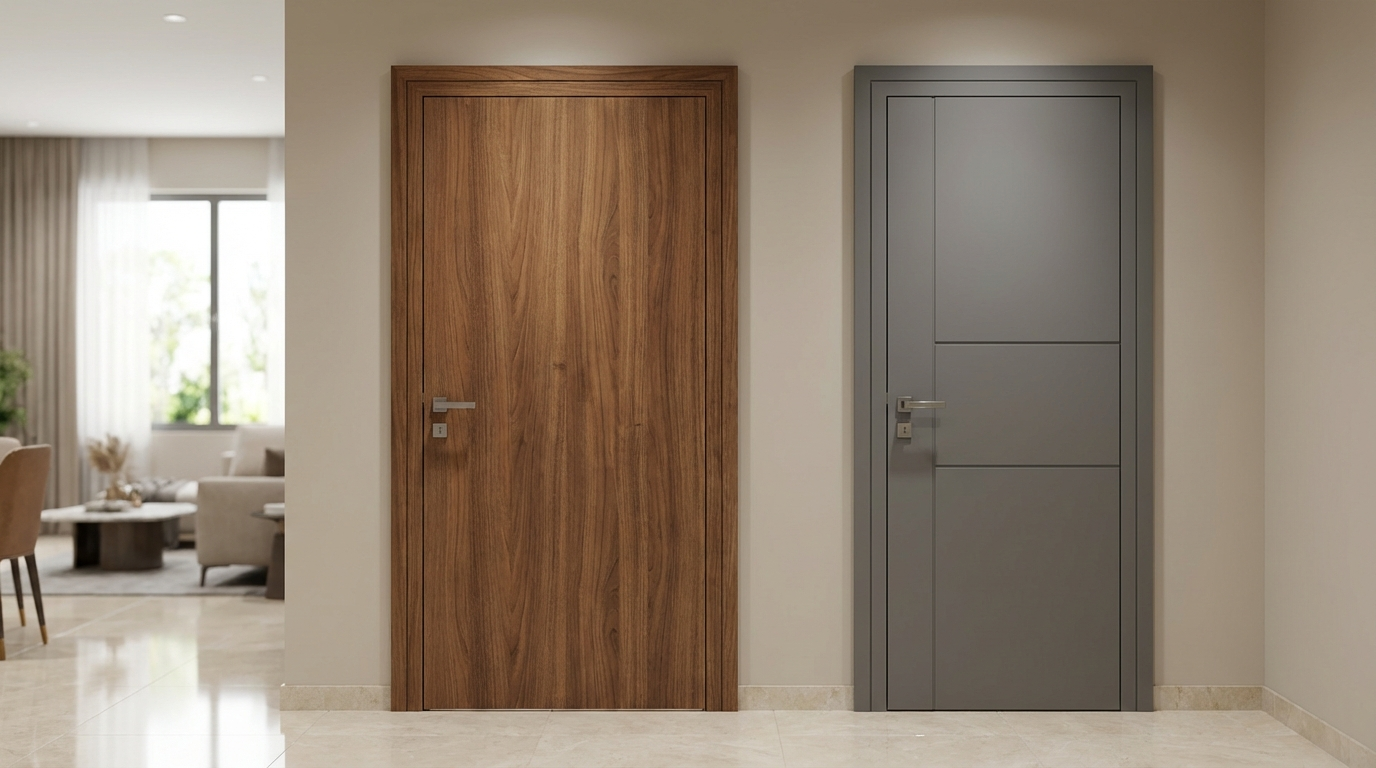
A flush door is a flat door with smooth, level surfaces on both sides, constructed by sandwiching a core material between face veneers or laminates. Unlike panel doors or carved wooden doors, flush doors have no raised or recessed panels, making them ideal for contemporary interiors where minimalist aesthetics matter.
The construction involves three primary components: the outer face material (plywood veneer, laminate, or MDF skin), the core structure (which determines strength and application suitability), and the frame (typically softwood or hardwood rails forming the perimeter). Understanding core types is critical for making the right purchase decision.
Hollow Core Flush Doors
These doors contain a honeycomb cardboard or lattice structure inside, making them lightweight (8-12 kg typically) and economical. Best suited for interior cupboard shutters, temporary partitions, and areas with minimal traffic. They offer poor sound insulation and cannot support heavy hardware. Price range: ₹1,200-2,500 for standard sizes.
Solid Core Flush Doors
Filled with blockboard, particle board, or stave core, these doors weigh 25-40 kg and provide better sound insulation, security, and durability. Suitable for bedrooms, bathrooms (with proper waterproofing), and internal room divisions. They hold hinges and locks more securely. Price range: ₹2,800-6,500 depending on core material quality.
Cellular Core Flush Doors
A middle-ground option with denser cellular structure than hollow core but lighter than solid. Common in commercial applications where fire rating requirements exist. Some variants meet fire resistance standards when properly specified.
Common misconception cleared: Many buyers assume all flush doors are flimsy or temporary. Quality solid-core flush doors with proper finishing last 15-25 years in Indian conditions when installed correctly. The "cheap door" reputation comes from hollow-core variants being mis-sold for inappropriate applications.
India-Specific Reality Check: Moisture, Termites, and Site Conditions
Indian climate conditions create unique challenges for flush door performance. Monsoon humidity (70-90% in coastal and eastern regions), termite prevalence across most of the country, and inconsistent site storage practices cause more door failures than manufacturing defects.
Monsoon and Humidity Concerns
Standard commercial flush doors with MR (Moisture Resistant) grade plywood face can handle normal indoor humidity but fail when exposed to persistent moisture. Coastal cities like Mumbai, Chennai, Kochi, and Visakhapatnam need BWR or BWP grade face veneers for any door facing balconies or external walls. During monsoon, doors swell 2-4mm; proper clearance (5-8mm at bottom) prevents jamming.
Termite Risk Assessment
Flush doors with softwood frames are termite-susceptible unless chemically treated. Always ask for termite-treated frames or specify hardwood frame construction for ground-floor installations and areas with known termite activity. Post-installation, ensure anti-termite treatment around door frames during construction phase.
Storage and Handling on Indian Sites
Most door damage occurs before installation. Doors stacked flat without spacers warp within weeks. Doors stored near wet cement, fresh plastering, or in direct rain contact develop permanent moisture damage. Insist on vertical storage with bottom protection and plastic wrapping until installation day. Many contractors store doors carelessly—inspect before accepting delivery.
Regional Variations to Consider
Northern dry zones (Delhi, Rajasthan, Punjab) face less moisture risk but extreme summer heat can cause warping if doors aren't acclimatized before installation. Eastern humid zones (Kolkata, Assam, Odisha) need higher waterproofing standards even for interior doors. Western coastal areas face salt-air corrosion risk for metal fittings; choose stainless steel or brass hardware.
Design Ideas: 30+ Flush Door Styles for Indian Homes
Flush door design possibilities extend far beyond plain flat surfaces. Modern finishing techniques, laminate innovations, and creative paneling offer designs rivaling carved wooden doors at fraction of the cost. Here are practical design ideas grouped by room type and style preference.
Living Room and Main Entrance Designs
- Vertical groove pattern: Router-cut vertical lines on flush surface, painted or laminated. 32mm thickness minimum. Creates elegant modern look.
- Horizontal slat effect: Laminate with horizontal wood-grain pattern, 35mm solid core. Suits contemporary minimalist interiors.
- Two-tone laminate: Contrasting colors split horizontally or vertically. Works well in 7×3.5 feet main doors.
- Veneer with metal strip: Natural veneer face with stainless steel or brass inlay strip. Premium option at ₹8,000-15,000.
- Glass panel insert: Frosted or tinted glass panel in upper third. Requires solid core, 35mm minimum.
- Geometric laminate pattern: Diamond, hexagon, or chevron patterns. Pre-designed HPL laminates available.
- Full-height mirror door: Mirror-finished laminate or actual mirror panel for space illusion.
Bedroom Door Design Ideas
- Matte wood-grain laminate: Walnut, oak, or teak-finish in matte texture. 30mm solid core suits most bedrooms.
- Painted flush with contrasting frame: White or light grey door with dark wooden frame visible. Budget-friendly elegance.
- Leather-texture laminate: Premium feel without actual leather. Available in brown, tan, black options.
- Minimal handle-less design: Push-open mechanism or concealed handle. Creates seamless wall integration.
- Subtle horizontal groove: Single horizontal router line at handle height. Adds visual interest without complexity.
Kitchen and Utility Area Designs
- High-gloss acrylic laminate: Easy-clean surface, moisture-resistant. Specify BWR core for kitchen areas.
- PVC membrane finish: Waterproof option for utility doors. Available in multiple patterns.
- Glass-paneled upper section: Natural light flow, frosted for privacy. Requires 35mm core minimum.
- Aluminum frame with flush panel: Moisture-proof, modern look. Slightly higher cost but excellent durability.
Bathroom Door Designs
- Full PVC flush door: 100% waterproof option. Standard 6.5×2.5 feet bathroom size. ₹2,500-4,500 range.
- Marine plywood core with PVC laminate: Hybrid solution with wood-like feel and water resistance.
- Louvered lower panel: Ventilation slots in lower third. Important for bathrooms without exhaust.
- Solid color matte finish: White, grey, or pastel shades. Easy maintenance in humid conditions.
Wardrobe and Cupboard Shutters
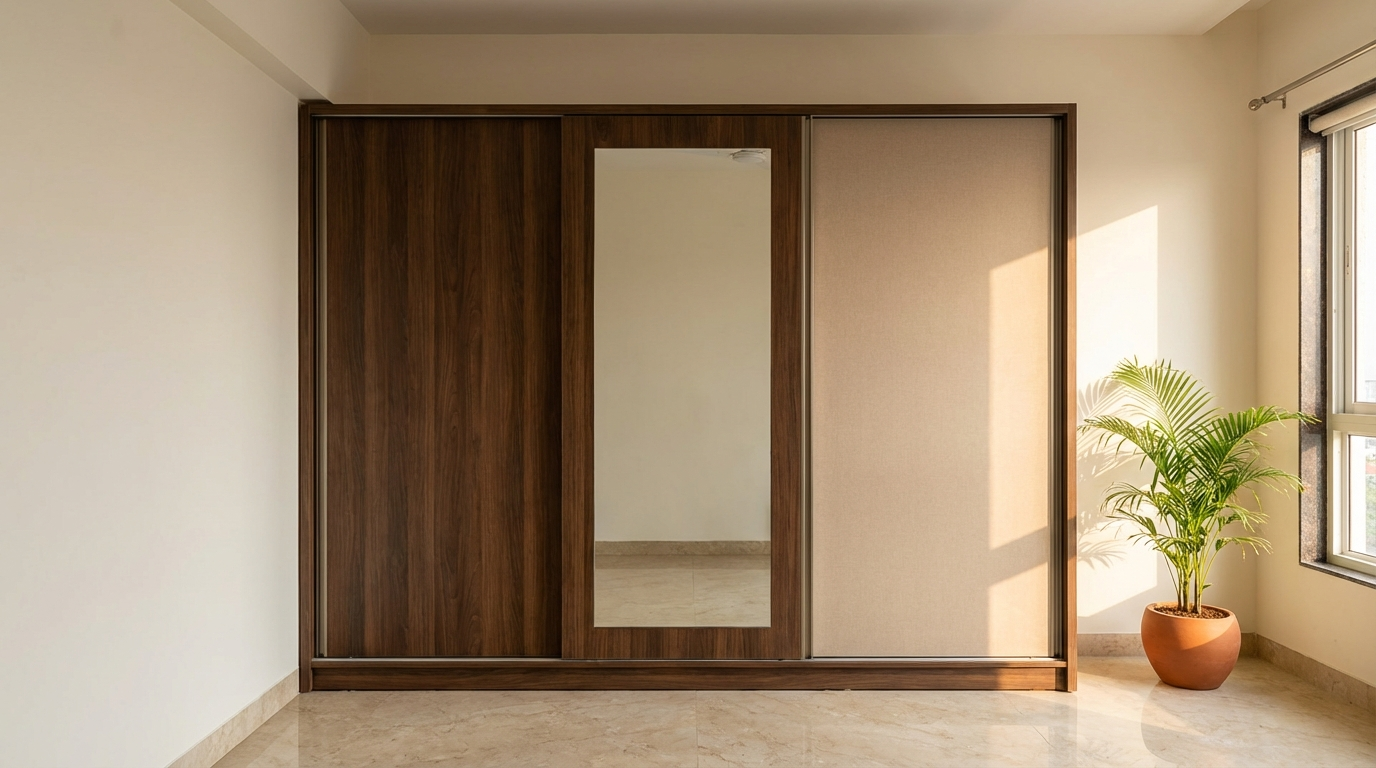
- Mirror-finish complete: Full mirror laminate for dressing area wardrobes.
- Mix-and-match panels: Alternating mirror and laminate panels. 18mm hollow or cellular core sufficient.
- Profile handle integration: Handle cut into door edge rather than surface-mounted.
- Back-painted glass: Glass panel with painted back. Premium option for master bedroom wardrobes.
For detailed guidance on wardrobe-specific plywood selection, our comprehensive wardrobe plywood guide covers thickness and grade requirements in depth.
Standard Flush Door Sizes in India
Indian flush doors follow standard dimensions that work with typical door frame construction. Understanding these helps avoid costly custom orders and ensures readily available replacement options.
| Application | Height (feet/meters) | Width (feet/meters) | Thickness (mm) |
|---|---|---|---|
| Main entrance | 7-8 ft (2.1-2.4m) | 3-4 ft (0.9-1.2m) | 32-40mm |
| Bedroom door | 7 ft (2.1m) | 2.75-3 ft (0.8-0.9m) | 30-35mm |
| Bathroom door | 6.5-7 ft (2-2.1m) | 2-2.5 ft (0.6-0.75m) | 25-32mm |
| Kitchen door | 6.5-7 ft (2-2.1m) | 2.5-3 ft (0.75-0.9m) | 30-35mm |
| Wardrobe shutter | Variable | 1.5-2 ft (0.45-0.6m) | 18-25mm |
| Store room | 6.5-7 ft (2-2.1m) | 2.5 ft (0.75m) | 25-30mm |
What Thickness Is Best for Main Doors?
Main entrance doors should be minimum 32mm, ideally 35-40mm with solid core for security and durability. Thicker doors (38-40mm) provide better sound insulation and accommodate heavier mortise locks. For apartments with security doors outside, 32mm interior flush door suffices.
Double Door Configurations
For wider openings (5-6 feet), double flush doors work better than single wide door. Standard configuration uses two 2.5-3 feet doors meeting at center. Requires proper alignment hardware (floor bolts, flush bolts) for clean closing. Consider overlapping edge (astragal) for better sealing.
Important note: Custom sizes beyond standard cost 20-40% more and take 7-15 days extra. Wherever possible, design openings around standard door sizes during construction phase.
Material Comparison: Core Types and Face Finishes
Flush door performance depends on matching core material and face finish to specific application requirements. This comparison helps you make informed choices based on location, budget, and expected usage.
Core Material Comparison
| Core Type | Weight (7×3 door) | Sound Insulation | Moisture Resistance | Best For | Price Range |
|---|---|---|---|---|---|
| Hollow (honeycomb) | 8-12 kg | Poor | Poor | Cupboards, temporary use | ₹1,200-2,500 |
| Cellular (grid) | 15-20 kg | Moderate | Moderate | Office partitions, internal doors | ₹2,000-3,500 |
| Particle board core | 25-30 kg | Good | Moderate | Bedrooms, living rooms | ₹2,500-4,000 |
| Blockboard core | 30-38 kg | Very good | Good | Main doors, high-traffic areas | ₹4,000-7,000 |
| Marine plywood core | 32-40 kg | Excellent | Excellent | Bathrooms, coastal areas | ₹5,500-10,000 |
Face Finish Options
| Finish Type | Durability | Moisture Handling | Maintenance | Appearance | Cost Premium |
|---|---|---|---|---|---|
| Plain veneer (paint-grade) | Moderate | Needs sealing | Regular repainting | Depends on paint | Base price |
| Natural wood veneer | Good | Needs lacquer | Periodic polishing | Natural elegant | +₹800-2,000 |
| Laminate (0.8-1mm) | Very good | Good | Wipe clean | Wide variety | +₹500-1,500 |
| HPL laminate | Excellent | Excellent | Minimal | Premium options | +₹1,200-2,500 |
| PVC membrane | Excellent | Waterproof | Wipe clean | Limited patterns | +₹600-1,200 |
| Acrylic gloss | Good | Good | Shows fingerprints | Modern glossy | +₹1,500-3,000 |
Bottom line: For most Indian homes, blockboard core with laminate finish offers the best value-for-money across bedroom and living room applications. Reserve marine-grade cores for genuinely moisture-exposed locations to avoid overspending.
Price Range and Cost Drivers for Flush Doors in 2026
Flush door prices in India vary significantly based on core material, face finish, size, brand, and location. Understanding cost drivers helps you budget accurately and identify where to spend versus save.
Price Ranges by Configuration
| Door Type | Standard Size (7×3 ft) | Budget Range | Mid-Range | Premium |
|---|---|---|---|---|
| Hollow core plain | Basic interior | ₹1,200-1,800 | ₹1,800-2,500 | ₹2,500-3,500 |
| Solid core laminated | Bedrooms | ₹2,800-3,800 | ₹3,800-5,500 | ₹5,500-8,000 |
| Solid core veneered | Living/main | ₹4,000-5,500 | ₹5,500-8,000 | ₹8,000-12,000 |
| Marine grade laminated | Bathroom/coastal | ₹5,000-6,500 | ₹6,500-9,000 | ₹9,000-14,000 |
| Fire-rated flush door | Safety requirement | ₹8,000-12,000 | ₹12,000-18,000 | ₹18,000-30,000 |
Major Cost Factors Explained
Core material quality: Single biggest cost driver. Moving from hollow to solid core doubles price; marine-grade adds another 30-50%.
Face finish selection: Paint-ready veneer is cheapest. Decorative laminate adds ₹400-1,200. Natural wood veneer adds ₹800-2,500. Premium HPL or acrylic finish adds ₹1,500-3,500.
Door thickness: Every 5mm increase in thickness adds ₹300-600 to base price due to additional material.
Custom sizing: Non-standard sizes cost 20-40% premium plus 7-15 days additional lead time.
Brand premium: Branded flush doors (Century, Greenply, Kitply) cost 15-30% more than unbranded local options but offer better quality consistency.
City variation: Metro cities (Mumbai, Delhi, Bangalore) typically 10-20% higher than tier-2 cities due to logistics and market factors. Coastal cities may have marine-grade options at competitive prices due to local demand.
Budget Estimation for Typical Home
For a 2BHK apartment with 1 main door, 2 bedroom doors, 2 bathroom doors, and kitchen door:
- Budget option: ₹12,000-18,000 total
- Mid-range quality: ₹20,000-35,000 total
- Premium finish: ₹40,000-65,000 total
Add ₹1,500-3,000 per door for hardware (hinges, handles, locks) and ₹800-1,500 per door for installation by professional carpenter.
Common Buyer Mistakes and How to Avoid Them
Over years of observing flush door installations across Indian homes, certain mistakes repeat frequently. Avoiding these saves money, prevents early replacement, and ensures doors perform as expected.
Mistake 1: Choosing Hollow Core for High-Traffic Areas
What goes wrong: Doors dent easily, hinges loosen within months, locks become wobbly, sound transmission remains high.
Why it happens: Budget prioritization or dealer recommendation based on margin rather than suitability.
How to avoid: Reserve hollow core strictly for wardrobe shutters and low-use storage doors. Always specify solid core for any room entry door.
Mistake 2: Using Standard Core for Bathroom Doors
What goes wrong: Bottom edge swells within 6-12 months, laminate delaminates, door jams during monsoon.
Why it happens: Bathroom size doors cost same as bedroom doors—moisture resistance seems like unnecessary upgrade.
How to avoid: Always specify BWR or marine-grade core for bathrooms. Alternatively, use full PVC doors. Edge sealing is non-negotiable even with waterproof core.
Mistake 3: Ignoring Edge Banding After Cutting
What goes wrong: Cut edges absorb moisture, cause swelling, delamination starts from edges within 1-2 years.
Why it happens: Carpenters skip edge sealing to save time; buyers unaware of its importance.
How to avoid: Insist on edge banding or multiple coats of PU sealer on all cut edges. Supervise this step personally.
Mistake 4: Ordering Without Verifying Frame Dimensions
What goes wrong: Doors don't fit frames, require excessive trimming, or leave large gaps.
Why it happens: Standard sizes assumed; actual frame sizes vary by 10-20mm based on mason work.
How to avoid: Measure each door opening individually. Order doors 15-20mm smaller than frame opening for fitting clearance.
Mistake 5: Improper Site Storage
What goes wrong: Doors warp before installation, develop moisture stains, edge damage.
Why it happens: Doors delivered early, stored flat on floor near wet construction activity.
How to avoid: Accept delivery only when ready for installation. Store vertically with spacers, away from wet areas, wrapped in plastic.
Mistake 6: Skimping on Hardware Quality
What goes wrong: Hinges sag within months, cheap locks malfunction, handles break.
Why it happens: Hardware costs seem incidental compared to door cost; bundled "free" hardware accepted.
How to avoid: Budget ₹1,500-3,000 per door for quality hinges (ball-bearing type), branded locks, and sturdy handles. Reject bundled cheap hardware.
Mistake 7: Not Checking Core Quality Before Purchase
What goes wrong: Core voids discovered during installation, uneven density causes fitting problems.
Why it happens: Face finish looks good; core hidden from view; dealer assurances trusted.
How to avoid: Ask to see sample cut-section. Tap door surface—hollow sound indicates voids. Check weight against specifications. Buy from reputable dealers only.
Quality Checks Without Laboratory Testing
You don't need expensive equipment to assess flush door quality. These field-tested methods help verify quality at dealer shop, upon delivery, and during installation.
At the Dealer/Showroom
- Weight test: Solid core 7×3 door should weigh 28-38 kg. Hollow core feels noticeably lighter (8-15 kg). Ask to lift—significant weight indicates solid core.
- Tap test: Knock across door surface with knuckles. Solid core produces dull thud. Hollow core echoes. Inconsistent sounds indicate core voids.
- Edge inspection: Check factory edges for uniform laminate adhesion. Any lifting, bubbling, or gaps indicate poor pressing.
- Surface flatness: Sight along door surface from corner. Any bowing or twist visible immediately. Place straight edge across surface to verify.
- Sample section: Reputable dealers should have cut-section sample showing core construction. Inspect for uniform core material, proper frame integration.
Questions to Ask Dealer
- What grade is the face veneer (MR/BWR/BWP)?
- What core material is used (specify: blockboard/particle/hollow)?
- Is the frame termite-treated?
- What warranty coverage applies (structure vs laminate vs hardware)?
- Can you provide ISI certification or test reports?
- What edge sealing do you recommend after cutting?
Upon Delivery Inspection
- Verify dimensions against order—measure height, width, thickness
- Check all corners for damage or crushing
- Inspect surfaces for scratches, dents, or laminate defects
- Confirm quantity and specifications match order
- Photograph any damage immediately for dispute resolution
During and After Installation
- Hinge zone integrity: Screws should grip firmly without spinning. Spinning indicates weak core in hinge area.
- Lock mortise inspection: Check core consistency where lock hole is cut. Any voids or weak material visible?
- Swing test: Door should swing smoothly, stay at any angle without drifting. Drifting indicates warping or poor hanging.
- Gap uniformity: 3-4mm gap around edges should be uniform. Uneven gaps suggest warped door or frame.
Installation and Workmanship Guidelines
Even quality flush doors fail prematurely with poor installation. These guidelines help you brief carpenters and supervise work effectively.
Pre-Installation Preparation
Acclimatization: Store doors in the room where they'll be installed for 48-72 hours before fitting. This allows wood to adjust to local humidity, preventing post-installation warping.
Frame verification: Ensure door frames are plumb, level, and square before ordering doors. Frames out of square by more than 5mm cause fitting problems.
Cutting and Sizing
- Cut from both ends equally when trimming height (not all from bottom)
- Never remove more than 15mm from any edge—weakens structure
- Use sharp, fine-toothed blade to prevent chipping
- Support door properly during cutting—unsupported cutting causes splintering
Edge Sealing (Critical Step)
All cut edges must be sealed within 24 hours of cutting:
- Apply edge banding tape (1mm PVC or ABS) with iron-on or professional bander
- Alternatively, apply 2-3 coats of PU sealer allowing drying between coats
- Bottom edge needs extra attention—apply waterproof sealer generously
- Never skip this step, even for interior doors
Hinge Installation
- Use three hinges for doors over 6.5 feet height
- Position: 150mm from top, 200mm from bottom, third centered
- Pre-drill pilot holes to prevent splitting
- Use ball-bearing hinges (3-inch minimum) for smooth, long-lasting operation
- Ensure hinges sit flush with door edge—proud hinges cause gap problems
Lock and Handle Fitting
- Mortise locks require solid core—never fit mortise in hollow core doors
- Mark positions before cutting—measure twice, cut once
- Reinforce lock area in hollow core doors with solid wood block if absolutely necessary
- Ensure strike plate aligns perfectly—misalignment causes lock failure
Carpenter Briefing Checklist
Share these points with your carpenter (mistri) before work begins:
- No cutting more than 10-15mm from any edge
- Edge sealing mandatory on all cut surfaces
- Three hinges for main and bedroom doors
- Ball-bearing hinges only (not loose pin type)
- Pilot holes before all screw insertions
- 5-8mm gap at bottom for floor clearance
- 3-4mm uniform gap on sides and top
Decision Framework: Choosing the Right Flush Door
Use this framework to match your specific requirements to the appropriate flush door configuration.
| Scenario/Requirement | Recommended Choice | Reasoning |
|---|---|---|
| Tight budget, interior only | Cellular core with laminate | Best value without hollow-core weakness |
| Bedroom in humid zone | BWR core with HPL laminate | Moisture protection plus durability |
| Main entrance, ground floor | Solid blockboard, veneer, termite-treated frame | Security, aesthetics, termite protection |
| Bathroom in any location | Marine core or full PVC | Water exposure inevitable |
| Coastal city apartment | BWP core, SS hardware, HPL finish | Salt air and humidity resistance |
| Wardrobe shutters | Hollow core with laminate | Light weight, no heavy hardware, budget-friendly |
| Kitchen entry door | BWR core, high-gloss laminate | Humidity + easy cleaning needs |
| Study room, noise concern | Solid blockboard core | Maximum sound insulation |
| Rental property, basic need | Particle board core, laminate | Moderate quality at best value |
| Premium villa main door | Solid core, natural veneer, designer hardware | Statement piece, durability, aesthetics |
Is Flush Door Good for Indian Kitchens?
Yes, flush doors work well for Indian kitchens when properly specified. Choose BWR grade core minimum, HPL or acrylic laminate finish for easy grease cleaning, and ensure proper edge sealing. Avoid wood veneer finish in kitchens—it absorbs cooking odors and stains. For modular kitchen cabinets, flush door shutters with soft-close hinges are industry standard. Our kitchen cabinet plywood comparison covers material selection for cabinet carcass in detail.
Can Flush Doors Be Used in Bathrooms?
Standard flush doors fail quickly in bathrooms due to constant moisture exposure. For bathroom use, either specify marine plywood (BWP grade) core with waterproof laminate and complete edge sealing, or choose full PVC flush doors that eliminate moisture absorption entirely. PVC doors cost ₹2,500-4,500 for standard bathroom size and offer maintenance-free waterproof performance.
How Long Do Flush Doors Last in Indian Conditions?
Quality solid-core flush doors with proper finishing and installation last 15-25 years in normal Indian conditions. Lifespan reduces to 5-8 years if wrong core grade used for moisture-prone areas, edge sealing skipped, or poor hardware fails causing door stress. Hollow core doors in appropriate applications (cupboards) last 10-15 years without issues.
Flush Door vs Alternatives: When to Choose What
Understanding when flush doors make sense—and when alternatives work better—helps optimize your door budget across the home.
Flush Door vs Panel Door
Panel doors feature raised or recessed decorative panels, offering traditional aesthetic appeal. Choose panel doors for: classical interior themes, where ornamental detail enhances design, main entrances wanting grand traditional look. Choose flush doors for: modern minimalist interiors, where clean lines matter, budget-conscious projects, easy maintenance needs.
Flush Door vs Solid Wood Door
Solid wood doors (teakwood, sal, deodar) offer unmatched durability and traditional appeal but cost 3-5x more than quality flush doors. Choose solid wood for: heritage homes, ancestral properties, where maximum durability justifies cost, statement main doors. Choose flush doors for: most residential applications, where value-for-money matters, when design flexibility (laminate options) is priority.
Flush Door vs WPC Door
WPC (Wood Plastic Composite) doors are fully waterproof and termite-proof. Choose WPC for: extreme moisture areas, outdoor-facing doors, termite-heavy zones, low-maintenance priority. Choose flush doors for: better acoustic insulation, traditional wood feel, wider design options, budget optimization where moisture isn't critical.
Flush Door vs PVC Door
PVC doors are lightweight, 100% waterproof, and economical but feel less substantial. Choose PVC for: bathrooms, toilets, utility areas, laundry rooms, secondary entrances. Choose flush doors for: bedrooms, living rooms, main entrances—anywhere substantial feel and better aesthetics matter.
Frequently Asked Questions
What is the standard size of flush door in India?
The most common flush door size in India is 7 feet (2.1 meters) height and 3 feet (0.9 meters) width, with thickness ranging from 30-35mm for interior doors. Main entrance doors are typically 7-8 feet tall and 3-4 feet wide with 35-40mm thickness. Bathroom doors are smaller at 6.5-7 feet height and 2-2.5 feet width. These dimensions align with standard door frame construction across the country, ensuring readily available options without custom orders. Always verify actual frame dimensions before ordering, as mason work variations of 10-20mm are common.
Which is better: flush door or wooden door?
This comparison depends on specific needs and budget. Flush doors offer better value-for-money, wider design options through laminates and veneers, consistent quality, and easier availability. Solid wooden doors (teak, sal) provide superior durability, traditional aesthetics, better resale value, and can be refinished multiple times. For most residential interiors, quality flush doors with laminate or veneer finish serve perfectly at 3-5x lower cost than solid wood equivalents. Reserve solid wood for main entrances or heritage-style homes where traditional appearance and maximum longevity justify the premium.
How much does a flush door cost in India?
Flush door prices range from ₹1,200 for basic hollow core to ₹12,000+ for premium marine-grade veneered options in standard 7×3 feet size. Budget hollow core doors cost ₹1,200-2,500, cellular core ₹2,000-3,500, solid particle board core ₹2,500-4,500, blockboard core ₹4,000-7,000, and marine grade ₹5,500-14,000. Face finish adds ₹500-3,000 to base price. Metro cities typically cost 10-20% more than tier-2 cities. Add hardware (₹1,500-3,000) and installation (₹800-1,500) per door for complete budgeting.
Are flush doors waterproof?
Standard flush doors are NOT waterproof—they are moisture-resistant at best. Commercial grade (MR) flush doors handle normal indoor humidity but fail when exposed to direct water or sustained high humidity. For genuinely waterproof performance, you need either marine plywood (BWP) core flush doors with proper edge sealing, or full PVC flush doors. Even waterproof-core doors require edge sealing after cutting, as the core protection doesn't extend to freshly cut surfaces. For bathrooms and high-moisture areas, specify waterproof grade explicitly.
Can flush doors provide good sound insulation?
Solid core flush doors provide moderate to good sound insulation, significantly better than hollow core variants. Blockboard core doors reduce sound transmission by 25-30 decibels when properly installed with minimal gaps. For enhanced soundproofing, choose thicker doors (38-40mm), add acoustic sealing strips around frames, and ensure no gaps under the door. Hollow core doors offer minimal sound insulation—conversation easily travels through. For studios, home offices, or bedrooms requiring privacy, solid core is essential; for true acoustic isolation, specialized acoustic doors are necessary.
How to identify quality flush door at shop?
Quality assessment starts with weight—solid core 7×3 door weighs 28-38 kg; hollow core only 8-15 kg. Perform tap test across surface; uniform dull thud indicates solid core while echoes suggest hollow areas or voids. Check edges for uniform laminate adhesion—any bubbling, lifting, or gaps indicate poor pressing. Sight along surface for warping or bowing. Ask for cut-section sample to verify core construction. Reputable dealers display BIS certification. Check frame material—hardwood frames indicate quality construction over softwood. Finally, verify warranty terms in writing before purchase.
What thickness is best for bedroom flush doors?
For bedroom doors, 30-35mm thickness provides optimal balance of durability, sound insulation, and cost. 30mm suits light residential use with budget priority. 32-35mm accommodates mortise locks securely and provides better sound insulation. Main bedroom or master bedroom doors benefit from 35mm thickness. Avoid going below 28mm even for budget projects—thinner doors feel flimsy, don't hold hardware well, and offer poor sound privacy. For bedrooms in noisy locations (road-facing, near common areas), 35-38mm with solid blockboard core noticeably improves acoustic comfort.
Do flush doors need painting after installation?
Depends on face finish. Laminated flush doors require no painting—they come ready to use with decorative surface. Wood veneer finished doors need lacquer or polish application for protection and aesthetics but not paint. Plain veneer or primer-finished doors require painting—typically 2 coats primer and 2-3 coats enamel or PU paint. Pre-laminated doors are popular specifically because they eliminate painting requirement, saving labor cost and time while providing scratch-resistant surfaces. If you prefer paint flexibility, choose paint-grade flush doors intentionally.
How to maintain flush doors in Indian climate?
Regular maintenance extends flush door life significantly. Clean laminate surfaces with damp cloth and mild soap monthly—avoid harsh chemicals. Check hinges annually; tighten loose screws and apply lubricant. Inspect edges for any laminate lifting or moisture damage—address immediately with adhesive before damage spreads. During monsoon, wipe any water splashes on door surfaces promptly. Ensure bathroom door bottom edge remains sealed—reapply waterproof coating annually. Avoid banging doors—repeated impact loosens hinges and damages edges. In coastal areas, check metal hardware for corrosion and replace if needed.
Is it necessary to use flush doors for wardrobes?
Flush door shutters are industry standard for modern wardrobes and modular furniture due to clean aesthetics, design versatility, and cost-effectiveness. For wardrobe shutters specifically, hollow or cellular core works well since doors are lightweight, don't require heavy hardware, and face no moisture exposure. This significantly reduces cost compared to solid core doors. Laminate options allow matching wardrobe finish with room aesthetics. Alternative options include HDHMR boards with laminate for premium wardrobes, glass doors for display sections, or mirror-finish laminates for dressing areas. Our detailed wardrobe material guide covers all options comprehensively.
Can termites damage flush doors?
Yes, termites can damage flush doors, particularly those with softwood frames and non-treated core materials. The frame (typically softwood rails) faces highest termite risk. Quality flush doors use chemically treated frames resistant to termite attack. Even with treated frames, flush doors installed at ground level in termite-prone areas need surrounding anti-termite treatment during construction. Laminate surfaces themselves aren't termite food, but once termites access the wooden core through any gap, damage spreads inside invisibly. Specify termite-treated frames for ground floor installations and ensure post-construction termite treatment around door frames.
What finish works best for flush doors in high humidity areas?
For high humidity areas (coastal cities, bathrooms, kitchens), HPL (High Pressure Laminate) provides best performance with excellent moisture resistance, durability, and easy maintenance. PVC membrane finish offers waterproof surface but limited design options. Acrylic gloss finish resists moisture well but shows fingerprints. Avoid natural wood veneer in high humidity—it absorbs moisture, warps, and develops mold. Always specify BWR or BWP grade core underneath any finish in humid environments. Edge sealing becomes critical—even waterproof laminates fail if moisture enters through unsealed edges.
Are cheap flush doors worth buying?
Cheap flush doors (under ₹1,500 for standard size) typically use inferior cores with voids, poor face veneer adhesion, and untreated frames. They fail within 2-3 years through warping, delamination, and hardware loosening. For rental properties or temporary use, budget hollow core doors may suffice for cupboards and storage. For any room entry door, investing ₹3,000-5,000 in solid core with proper laminate pays off through 10-15+ years of trouble-free use versus repeated replacements. The labor cost of door replacement (₹1,500-2,500 per door) makes frequent replacement expensive. Buy quality once rather than cheap repeatedly.
How do I order custom size flush doors?
Custom size flush doors require 7-15 days additional lead time and cost 20-40% premium over standard sizes. Provide exact dimensions (height × width × thickness) with 15-20mm clearance for fitting. Specify core grade, face finish, and any special requirements (glass panels, grooves) upfront. Reputable manufacturers accept custom orders; local dealers may have limited custom capability. For multiple custom doors, direct manufacturer contact often provides better pricing. Design building openings around standard sizes wherever possible to avoid custom premiums. Keep one standard-size backup door on site in case custom orders have defects.
Note: sainik710.com is an independent informational site and is not affiliated with any manufacturer. Prices and specifications mentioned are indicative and vary by region, dealer, and time. Always verify current rates and product details with local suppliers before purchase.
Disclaimer: This content is provided for general informational purposes based on industry practices and publicly available information. Product specifications, standards, prices, and availability may vary by manufacturer, region, and time. Readers should independently verify details with manufacturers, dealers, or qualified professionals before making purchase or construction decisions.Want Plywood Suggestions?
Share a few details and a Sainik 710 specialist will suggest suitable brands and connect you to responsive dealers.