False Ceiling Design: 40+ POP, Gypsum & Wooden Ceiling Ideas for Hall & Bedroom
Get 40+ false ceiling designs—POP, gypsum & wooden options for hall & bedroom. Lighting integration, cost guide & material comparison for Indian homes.
The Short Answer on False Ceiling Designs
A false ceiling is a secondary ceiling hung below your main structural ceiling, made from materials like POP, gypsum boards, wood, or PVC—and the best choice depends on your room size, budget, and local humidity conditions. Short version: If you're building a hall or bedroom ceiling in 2026, gypsum boards give you the cleanest finish with least mess, POP works best for custom curves and decorative designs on a budget, and wooden ceilings add warmth but cost more. For coastal cities like Mumbai or Chennai, always pick moisture-resistant variants—trust me on this.
- This is right for you if: You want to hide ugly wiring, AC ducts, or uneven plaster above
- This is right for you if: Your room height is at least 9.5-10 feet (otherwise things get claustrophobic—I've seen people install false ceilings in 8.5 ft rooms and immediately regret it)
- This is right for you if: You're planning integrated lighting—cove lights, recessed LEDs, or chandeliers that need proper mounting
- This is right for you if: Sound insulation matters—home theaters, bedrooms above noisy streets
- Skip this if: Your ceiling height is below 9 feet—you'll feel boxed in
- Skip this if: You're renting and can't make permanent modifications
Bottom line: A well-designed false ceiling transforms a room from "builder finish" to "interior-designed home"—but pick the wrong material for your climate, and you'll be redoing it within 3-4 years.
What False Ceiling Actually Means (Plain English)
A false ceiling, also known as a dropped or suspended ceiling, is a secondary ceiling installed below the main structural ceiling. It's like adding an extra layer to your home's 'head'—a bit of architectural millinery. Most people think false ceilings are purely decorative. Actually, they serve five practical purposes: hiding wiring and AC ducts, providing thermal insulation, improving room acoustics, enabling integrated lighting, and covering up ugly structural ceilings.
Here's what happens technically. False ceilings are secondary ceilings that are suspended from the main ceiling. False ceilings are used to conceal excessive wiring and are an efficient way of making your home more aesthetically pleasing and clutter-free. The gap between your original ceiling and the false ceiling—usually 6 to 12 inches—becomes a service void where all the electrical conduits, AC ducting, and even fire sprinkler pipes can run. Smart, actually.
Now here's something most guides won't tell you. That drop height matters a lot. Go too shallow (less than 6 inches), and you can't fit recessed lights properly. Go too deep, and you're wasting room height. I typically recommend 8-9 inches for residential projects—gives you enough space for 4-inch recessed fixtures plus a bit of buffer.
Why False Ceilings Matter Especially in Indian Homes
This is where things get interesting for us. India isn't one climate—it's at least five. And that changes everything about material selection.
In coastal cities like Mumbai, Chennai, and Kolkata, you're dealing with humidity levels of 70-85% for nearly half the year. Like choosing the best hilsa, selecting appropriate materials for your false ceiling requires a discerning eye and local knowledge. Gypsum board and PVC ceiling designs are popular choices across India and hold up well in Kolkata's sticky weather. Their moisture-resistant properties make them ideal candidates, like how a well-crafted umbrella becomes your best friend during the monsoon season.
But if you're in Ahmedabad, Jaipur, or interior Rajasthan? Different story. Humidity isn't your enemy—heat is. And here, even standard POP works fine because there's no moisture seeping into joints.
There was this flat in Bandra I consulted on—2021 I think—where the client insisted on a gorgeous layered POP ceiling with cove lighting. Beautiful work, honestly. By October (second monsoon after installation), the joints near the bathroom wall had started cracking. The whole thing needed to be redone with moisture-resistant gypsum. About ₹60,000 down the drain. The lesson? Mumbai isn't Nagpur. What works inland doesn't always work on the coast.
The cost of a false ceiling varies from place to place; that is, the price of a false ceiling in Delhi might differ from that in Bengaluru. False ceiling prices vary greatly due to the change in labour costs and per square foot price of raw materials, like gypsum board, Plaster of Paris, PVC, etc., in different places. Due to this, the cost of a false ceiling may differ by 10-15% from one city to another.
Types of False Ceiling Materials: The Complete Breakdown
Let me walk you through each material—what it's actually good for, not the marketing version.
POP False Ceiling (Plaster of Paris)
POP is available in powdered form and is mixed with water on site. This mixture is applied on a chicken mesh, which offers mechanical strength, and is then attached to a metal frame system. POP can be moulded into any shape in its hydrated form; as it dries, it hardens and retains the set shape.
POP is a highly durable material. It is cheaper than gypsum board. That's the appeal. But honestly, the mess it creates on site is something else entirely. The process of mixing the contents of a POP false ceiling on site is a messy and lengthy process that requires a lot of cleaning up afterwards. One major concern in using a POP mixture is that a lot of material is wasted during the application process and it requires adequate drying time. Unless the mixture is prepared correctly in the right proportions of POP and water, it will be of inferior quality, and might shrink or crack.
My take: POP is best when you want intricate curves, custom cornices, or decorative patterns that gypsum boards simply can't replicate. Also works great for very small areas where custom fitting is needed. But for large, straight-line modern ceilings? Not worth the headache.
Gypsum Board False Ceiling
A natural ore, Gypsum is a hydrated calcium sulphate and stays put for long periods of time. A comparatively new material for designer false ceiling, gypsum has all the qualities of POP and so much more. Manufactured in a factory, a gypsum false ceiling is designed professionally and is assembled onto the original ceiling. Gypsum false ceilings are easy to install and leave close to zero mess, since the gypsum boards are designed to your liking, professionally and in a factory, leaving your house mess free.
The boards typically come in 6 feet by 4 feet, one of the most common sizes for gypsum board artificial ceilings. Gypsum boards are pre-made and require less time for installation compared to POP. They provide a uniform and smooth finish without the need for additional layers. Gypsum has excellent fire-resistant properties, adding an extra layer of safety. Gypsum ceilings offer better acoustic insulation than POP.
Gypsum plasterboard has more strength as compared to POP. One of the main reasons why gypsum boards are used for false ceiling is because of its hydrophobic properties. Gypsum plasterboard's false ceiling offers great flexibility in design.
Is wooden false ceiling actually worth the extra cost?
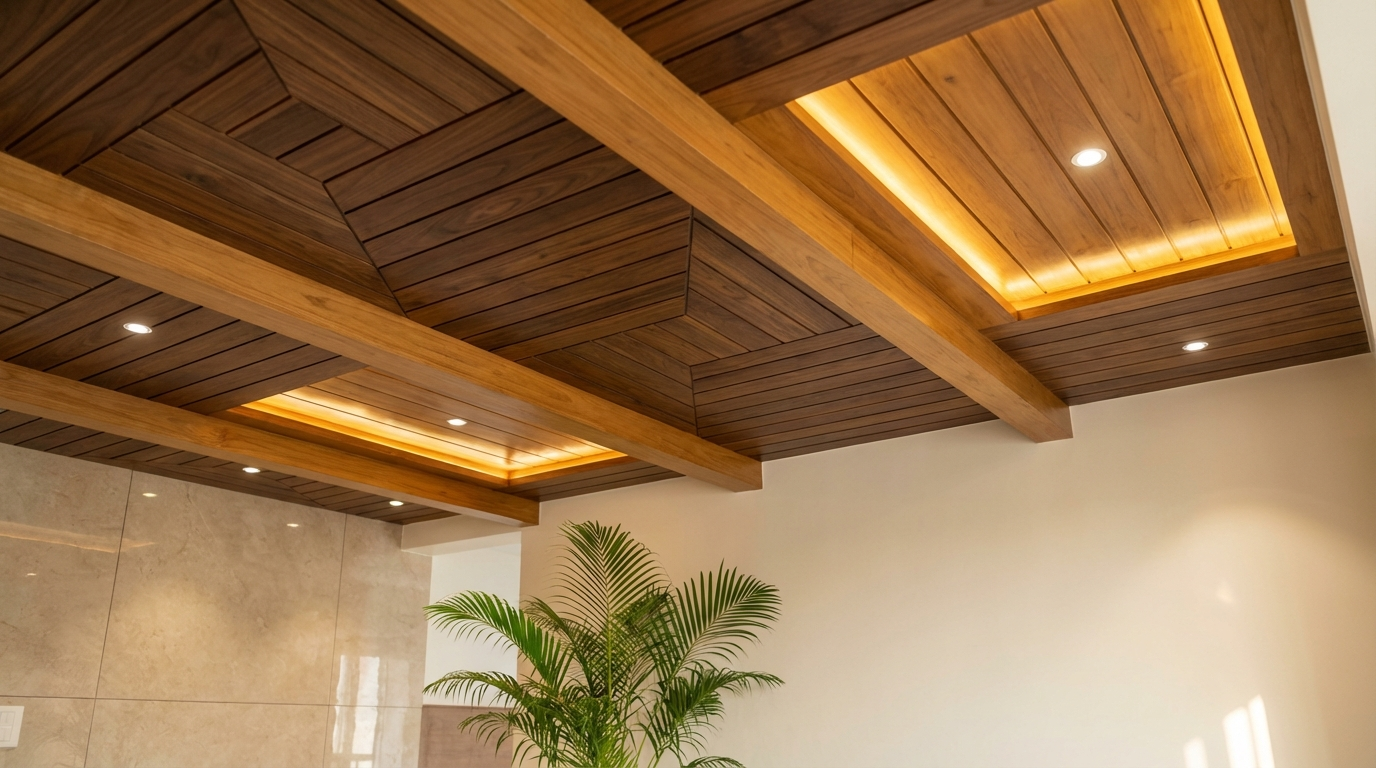
Wooden ceiling designs hold a timeless charm in any household or commercial interior, always being chosen due to their versatility and durability. The natural grains and shades of wood bring an organic feel to the space, enhancing its natural beauty and rich textures. The natural properties of wood reduce echo and reverberation, making it perfect for auditoriums, home theatres, conference rooms, and living areas.
Here's where I need to be honest with you. Solid wood false ceilings are stunning. But they're also expensive, heavy, and require solid support from above. No matter how many new materials are introduced in the ceiling design market, wood is a timeless classic and not going anywhere. Aside from being cost-effective and low maintenance, wooden false ceilings are the easiest to install and offer acoustic protection.
What most people actually use isn't solid wood—it's plywood with veneer, MDF panels with wood finish, or WPC (wood-plastic composite). These give you the wood look at a fraction of the weight and cost. The basic wood veneer design starts at about Rs. 100 per square foot. On the other hand, premium wood veneer costs between Rs. 900 and Rs. 1,200 per square foot.
For wooden ceiling applications, our plywood buying guide covers the grades suitable for ceiling work in detail.
PVC False Ceiling
In terms of moisture resistance, PVC performs better than all other false ceiling materials. Choose PVC for wet areas, kitchens, bathrooms, or low-maintenance needs.
PVC panels interlock and attach to an aluminum frame. Very DIY-friendly, actually. The catch? They look like PVC. There's a certain plastic-y sheen that's hard to hide, even with textured variants. Fine for a bathroom ceiling or a covered balcony. Not what I'd recommend for your main living room.
Comparison Table: False Ceiling Materials
| Parameter | POP | Gypsum Board | Wooden/Ply | PVC |
|---|---|---|---|---|
| Base cost per sq ft | ₹60-120 | ₹75-180 | ₹100-1200 | ₹50-150 |
| Installation time | 3-4 weeks (drying needed) | 3-5 days | 4-7 days | 1-2 days |
| Site mess | High—dusty and wet | Minimal | Moderate sawdust | Almost none |
| Design flexibility | Excellent for curves | Good for straight lines | Limited to planks/panels | Limited patterns |
| Moisture resistance | Poor | Good (MR variants better) | Moderate (needs treatment) | Excellent |
| Fire resistance | Good | Excellent | Needs treatment | Self-extinguishing |
| Acoustic insulation | Moderate | Good | Excellent | Basic |
| Lifespan (maintained) | 10-15 years | 15-20 years | 20+ years | 15-20 years |
| My preference for halls | For decorative borders only | Primary choice | Accent panels | Not recommended |
Price Reality Check: False Ceiling Costs in 2026
The false ceiling cost per sq ft in India typically ranges between Rs 65 – Rs 120 or more, depending on material and design. But that's the starting point. The actual number depends on about seven different factors.
Material Type: POP, PVC, and gypsum are priced differently based on their quality, finish, and durability. Design Complexity: Simple flat ceilings cost less, while multi-layered or decorative designs add to the price. Room Size and Height: Larger areas or high ceilings require more material and labour, increasing the total cost. Lighting Setup: Adding recessed or LED strip lights enhances the beauty but can increase the cost of the false ceiling design.
Here's what actually affects your final bill—
POP ceilings: The POP false ceiling price range is between ₹95 to ₹105 per sq. ft. + 18% GST. But that's for simple flat designs. POP ceilings can range between ₹75–120 per square foot, depending on the type of design details. POP cornices or decorative mouldings start at ₹45 per foot.
Gypsum ceilings: The starting price for a gypsum false ceiling with local A-grade channels and a Gyproc board is Rs. 60 per square foot plus 18% GST. The cost of a gypsum false ceiling with high-quality Gyproc board and channels ranges from Rs. 120 to Rs. 180 per square foot plus 18% GST.
PVC ceilings: A simple PVC design costs between Rs. 50 and Rs. 80 per square foot, while a designer option costs between Rs. 80 and Rs. 120 per square foot.
Additional costs people forget: The additional expenses involved during the installation of a false ceiling include: The electrical wiring that runs just above the false ceiling. Fixtures such as concealed lights, LED strip lights and chandeliers, which need to be purchased separately.
Budget Estimation for Common Room Sizes
| Room Type | Typical Size | Basic Gypsum | Designer Gypsum | With Lighting |
|---|---|---|---|---|
| Master Bedroom | 150-180 sq ft | ₹12,000-15,000 | ₹22,000-30,000 | Add ₹8,000-12,000 |
| Living Room | 200-300 sq ft | ₹16,000-24,000 | ₹35,000-50,000 | Add ₹12,000-20,000 |
| 2BHK Full Home | 500-700 sq ft ceiling | ₹40,000-55,000 | ₹75,000-1,20,000 | Add ₹25,000-35,000 |
These numbers are mid-2025 estimates. Add 18% GST on top. And remember—metro cities like Mumbai, Bengaluru, and Delhi tend to be 15-20% higher than tier-2 cities.
POP vs Gypsum: The Direct Comparison
You need to choose between gypsum boards or POP (plaster of paris) when deciding on the raw material for fabrication of a false ceiling. Both are essentially composed of gypsum, a naturally occurring mineral.
So here's the thing. Gypsum board is factory-manufactured from gypsum with water and a few additives, sandwiched between paper. When gypsum is semi-dehydrated by heating, it forms plaster of paris or POP, a quick-setting fine white powder, which has many uses, including making false ceilings on site.
POP can work out to be 25-50 percent cheaper than gypsum false ceilings. But—and this is a big but—The entire process of creating POP boards onsite is messy, wasteful and laborious. POP boards require adequate time for drying before installation – they can take up to a month to install.
Go for a gypsum board if you're planning a dropped ceiling with a straight-line design. They are much easier to install than POP. But if you want to give an intricate design to your ceilings with cornices and curves, opt for the easily moldable POP. They are also much cheaper than gypsum boards, though a skilled craftsman is required to finish a POP design perfectly.
What happens to POP in monsoon season?
The ceiling cannot be installed when the POP surface is moist. The problem specially occurs during the monsoon season. POP has customisable designs, elegant finish, and is budget-friendly. However, it absorbs moisture and is not suitable for damp areas.
I've had clients in Navi Mumbai start POP work in May, and by July the thing still wasn't ready because the contractor couldn't get proper drying between coats. Meanwhile their furniture was sitting in storage costing them rental. Timing your false ceiling work matters.
Decision Matrix: POP vs Gypsum
| Your Situation | Recommended | Why |
|---|---|---|
| Modern minimalist design with straight lines | Gypsum | Cleaner joints, faster install |
| Traditional design with curves, cornices | POP | Moldable to any shape |
| Tight budget, not monsoon season | POP | 25-40% cheaper |
| Mumbai/Chennai/Kolkata (high humidity) | Moisture-resistant Gypsum | Won't absorb humidity |
| Quick completion needed | Gypsum | 3-5 days vs 3-4 weeks |
| Rental flat or temporary setup | Gypsum (or skip entirely) | Easier to remove later |
| Home theater/studio with acoustic needs | Gypsum or Wood combo | Better sound absorption |
If you want a dropped ceiling with a straight-line pattern but are short on time (and don't mind spending a bit extra), a Gypsum ceiling is a better option. A POP ceiling, on the other hand, is an excellent choice if you want a unique ceiling design with flowing lines and curves and don't mind investing a little extra time to get the desired effect.
How to Choose the Right False Ceiling for Your Room
Right, let me give you a proper decision framework. Because "it depends" isn't helpful when you're standing in front of a contractor asking what you want.
Step 1: Measure your ceiling height
Stand in the center of your room with a measuring tape. If you have less than 9.5 feet, seriously reconsider whether you need a false ceiling at all. A peripheral false ceiling (just around the edges) might be the smarter play—you get the lighting benefits without losing headroom.
Step 2: Identify your primary purpose
Is this mainly for lighting? Hiding AC ducts? Pure aesthetics? Sound insulation? Different purposes mean different materials. If it's just for 6-8 recessed lights in a bedroom, you don't need a full gypsum ceiling—a simple peripheral with 12-inch cove might do.
Step 3: Check your local humidity
Coastal cities, ground floor flats, rooms above bathrooms—all these need moisture-resistant variants. Don't try to save ₹10-15 per sq ft here. Not worth it.
Step 4: Consider maintenance access
Do you have AC indoor units, water tank pipelines, or electrical junction boxes above the ceiling? You might need access panels. Grid ceilings with removable tiles work better here than continuous gypsum.
Step 5: Timeline matters
If you're in a hurry—say, moving in 3 weeks—POP is not your friend. Go gypsum or PVC.
Red flags to walk away from
- Contractor suggesting POP during June-September in coastal cities—they're not thinking about your ceiling, they're thinking about their schedule
- Quotes that don't mention frame/channel quality—local channels rust within 2-3 years
- Anyone promising "seamless" POP ceiling with no drying time—physics doesn't work that way
- Prices significantly below market rate—they're cutting corners somewhere (usually the metal framework)
- "Same rate for simple or complex design"—complex designs take more time and material, period
Common Mistakes People Make with False Ceilings
I've seen hundreds of false ceiling installations go wrong. Here's what keeps happening—
1. Ignoring the drop height
People get excited about a design from Pinterest, show it to the contractor, and realize too late that their 9-foot ceiling can't accommodate a three-layer design that needs 18 inches of drop. Result: a claustrophobic living room.
2. Skipping the electrical planning
False ceiling work happens after rough electrical but before final wiring. If you haven't finalized your lighting layout, your contractor is guessing where to put the wiring points. I've seen people discover they have light points in the completely wrong places after the ceiling is painted and done.
3. Choosing materials based only on cost
There was this builder in Andheri—must have been 2020—who did an entire apartment block with the cheapest POP possible. Within two monsoons, most flats had visible cracking along the cove sections. Ended up costing him way more in warranty repairs than he'd saved.
4. Not checking the metal framework quality
For long-term durability, always use high-quality, rust-resistant metal frames. Local channels might look the same as branded ones, but they're thinner gauge and prone to rust. The ceiling sags over time. This one really frustrates me because by the time you notice, it's too late.
5. Overdesigning small rooms
A 10x12 bedroom doesn't need coffered ceilings with triple coves and 14 recessed lights. Sometimes a simple peripheral false ceiling with 4 lights looks better and costs half as much. Restraint is a design skill.
6. Forgetting about AC servicing access
Your split AC indoor unit needs servicing every year. If the false ceiling completely boxes it in with no access panel, your technician will have to break a section every time. I've seen this happen way too often.
7. Poor joint finishing in gypsum ceilings
The joints of the gypsum boards may show signs of cracks with the passage of time. Cracks may also be caused by slightest movement in the false ceiling due to ceiling repair, cutting of holes for light or fan fixtures or where the ceiling meets the adjoining walls. Using proper jointing compound and tape matters. Cheap shortcuts show within a year.
8. Mixing materials without proper junctions
Remember that even if your ceiling is largely made of gypsum board, you may have the best of both worlds by inserting POP parts. But where gypsum meets POP, you need proper expansion joints. Different materials expand differently with temperature changes. Miss this, and cracks appear at the joints.
9. Installing during peak monsoon
I keep saying this but people keep ignoring it. June-August in Mumbai, Kolkata, Chennai—not ideal timing for POP work. Even gypsum needs a few days of dry weather for the jointing compound to cure properly.
Quality Checks You Can Do Yourself
Don't blindly trust the contractor. Here's what to look for—
Visual checks during installation:
- Metal channels should be galvanized (silver-grey) not plain steel (dark grey/black)
- Spacing between hangers should be 2-2.5 feet, not 3+ feet
- Gypsum boards should have the brand name printed on the back
- No visible rust on any metal component
- Joints should be staggered, not aligned in a straight line
- Paper tape + jointing compound at every joint, not just compound
Questions to ask your contractor:
- "What brand channels are you using?" (Good answers: Gyproc, USG, Armstrong. Bad answer: "local accha hai")
- "What's your warranty on joint cracking?"
- "Are you using MR (moisture-resistant) boards?" (for humid areas)
- "What thickness boards—9mm or 12.5mm?" (12.5mm is stronger but costs more)
- "Can you show me the boards before installation?"
Here's a trick most contractors don't like: Ask to see the packaging of the materials before they start. Branded gypsum boards come in proper packaging with manufacturer details. If they show up with loose boards claiming to be "Gyproc" without any packaging, be suspicious.
Warning signs during work:
- Workers rushing the job and finishing in 2 days what should take 4-5
- No primer application before final paint
- Uneven screw spacing (should be roughly 6 inches apart)
- Wobbly hangers or visible gaps between boards before finishing
- Strong chemical smell from boards (indicates poor quality gypsum)
- No protective covering on floors during POP work
Workmanship and Installation: What to Tell Your Contractor
Let me give you a briefing checklist—print this and hand it to your contractor before they start.
Your contractor briefing checklist:
- All electrical points must be finalized and wiring done BEFORE ceiling work starts—no guessing
- Use branded metal framework (Gyproc/USG) with proper rust-resistant coating
- Minimum 12.5mm thick gypsum boards for main areas (9mm only for non-load bearing peripheral sections)
- Paper tape + three coats of jointing compound at all joints—no shortcuts
- Two coats of primer before final paint
- Access panels at AC indoor unit locations, junction boxes, and water tank inlets
A Gypsum board false ceiling is made using gypsum plasterboards, fixed with screws to a metal frame connected to soffit. Gypsum plasterboards come in larger sheets than POP sheets and therefore there are fewer joints. The joints are finished using jointing compound. Installing gypsum plasterboard is a faster process that is clean, much more efficient and healthier due to the less residue and dust arising as part of the process.
Storage and handling:
If gypsum boards are delivered to site before installation, they need to be stored flat (not leaning against walls) in a dry area. I've seen contractors leave boards leaning against walls for a week—they warp, and then the entire ceiling has subtle waves in it. Ask where they're storing the material.
One thing I've seen carpenters skip: Proper screw depth. Screws should be set just below the board surface—not protruding (creates bumps) and not driven too deep (tears the paper and weakens the hold). If you see screws poking through the jointing compound after the first coat, that's sloppy work.
How Long Does a False Ceiling Actually Last?
Honest answer: it depends heavily on three things—material quality, installation quality, and your local climate.
Realistic lifespans with proper maintenance:
- Good quality gypsum with branded channels: 15-20 years
- Standard POP with local channels: 8-12 years
- Premium wooden panels: 20-25 years (with periodic refinishing)
- PVC: 15-20 years
But here's what actually happens in most homes. The ceiling itself might be fine, but joint cracks appear in 3-5 years. That's normal—buildings settle, temperatures change, things move slightly. A repaint with proper crack filling every 4-5 years keeps things looking fresh.
Signs of wear to watch for:
- Hairline cracks along joints (normal, can be fixed during repaint)
- Yellow/brown stains (usually indicates water seepage from above—serious issue)
- Visible sagging (framework issue—needs structural repair)
- Persistent musty smell (moisture trapped, possible fungal growth)
- Paint peeling near AC vents (condensation issue)
When to consider replacement:
If you're seeing widespread sagging, multiple water stains, or the framework is visibly rusted when you peek through an access panel—it's time. Patching at that point is just delaying the inevitable. Better to budget for a redo than keep throwing money at repairs.
Design Ideas for Different Rooms
Living Room/Hall False Ceiling Designs
The hall is where you make statements. The coffered wooden false ceiling design features a grid pattern created by the intersecting beams and panels into sunken squares and rectangles. This ceiling design is best suited for larger rooms, where it can emphasise the expansiveness of the space. Whether you are aiming for a traditional ambience or a more modern and minimalist look, coffered ceilings are one of the best wooden false ceiling designs for the halls and other larger spaces in your home.
Coffered wooden false ceilings are boxy boards or hollow squares attached to the roof. Besides offering additional elegance to your living room, this false ceiling structure also creates the illusion of a higher roof and numerous proportions within one room. Furthermore, unlike other false ceiling options, this wooden false ceiling design allows proper room lighting.
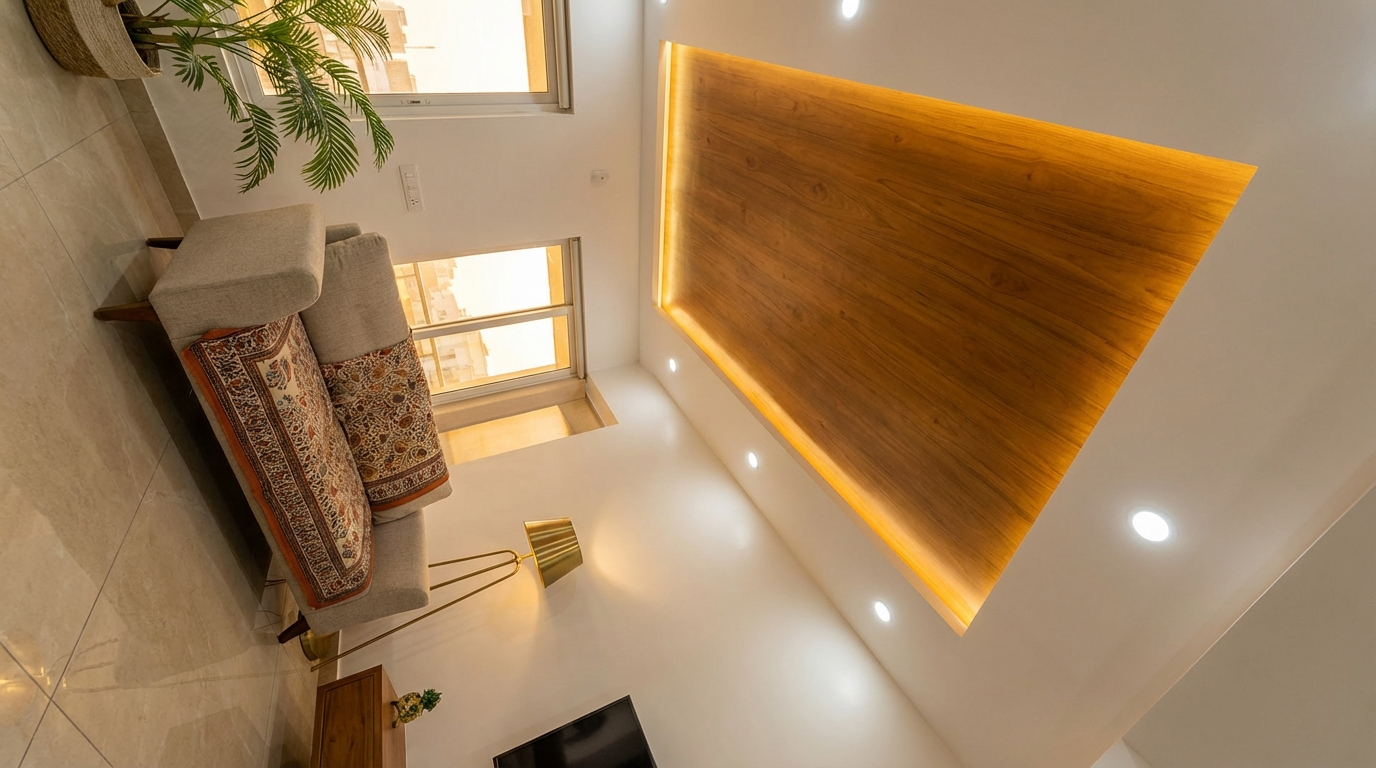
For modern minimalist halls, a simple peripheral false ceiling with hidden LED coves gives you the lighting impact without overwhelming the space. For more traditional homes, POP borders with cornices work beautifully.
Bedroom False Ceiling Ideas
If you want to make your bedroom look trendy, then you cannot miss out on this modern wooden false ceiling design. The wooden panelling detail on the side wall extends to the ceiling in this bedroom. It looks breathtaking and makes a beautiful visual boundary for the window-side office nook. The matching wood finish of the wall, false ceiling, wardrobe and bed creates a neat and uniform theme.
Bedrooms benefit from softer, indirect lighting. A simple rectangular cove above the bed with warm LED strips creates a cozy ambiance. Add a central pendant or chandelier mounting point if you like that look.
Wooden accent panels: When they work
Wood is a natural insulator, helping to regulate temperature and reduce energy consumption within a space. By providing an additional layer of insulation, wooden ceilings contribute to maintaining comfortable indoor temperatures year-round, thereby reducing reliance on heating and cooling systems.
Wood has excellent acoustic properties, absorbing and dampening sound to create a quieter and more comfortable environment.
Wooden false ceiling panels work best as accent sections—maybe above the dining table or the bed—combined with gypsum or POP for the rest of the ceiling. Full wooden ceilings are gorgeous but require proper structural support and budget.
Lighting Integration: Getting It Right
Here's what I tell my clients: plan your lighting BEFORE finalizing the ceiling design. Not after. The ceiling exists partly to enable your lighting, not the other way around.
Common lighting options for false ceilings:
- Recessed downlights: Need 4-5 inches of cavity depth minimum. Work with any material.
- LED strip coves: Hidden in peripheral coves, create soft ambient glow. Very popular now.
- Pendant fixtures: Need strong mounting points—inform contractor beforehand about weight.
- Chandeliers: Require special blocking/additional framing support for heavier pieces.
- Track lighting: Works best with higher ceiling heights (10+ feet).
To make your living room look more elegant and stand out from the rest of your home, you must opt for a wooden false ceiling design with recessed lighting. These recessed lights are uncomplicated to install in false wood ceilings and will light up your hall perfectly. You can also consider adding hanging chandeliers in this wooden false ceiling for a hall that highlights each zone elegantly.
Alternatives Worth Considering
If a full false ceiling isn't in the budget or isn't suitable for your space, here are some alternatives—
Peripheral-only false ceiling: Just around the room edges, maybe 18-24 inches wide. Gives you cove lighting, hides electrical, costs 40-50% less than a full ceiling. This is what I recommend for rooms under 10-foot height.
Beam designs: Decorative wooden or faux beams attached directly to the existing ceiling. No false ceiling needed. Works great for farmhouse or rustic aesthetics. Our wooden plywood guide covers materials suitable for this application.
Direct-attached panels: Thin gypsum or WPC panels attached directly to the existing ceiling without a dropped framework. Minimal height loss but limited to covering ugly surfaces—no space for ducting or recessed lights.
If budget is very tight: Consider just painting your existing ceiling with a clean white emulsion and adding surface-mounted LED panels. Not as glamorous, but functional and costs a fraction.
Frequently Asked Questions
Is it true that POP ceilings always crack?
Not always—but they're more prone to cracking than gypsum if the installation is poor. Unless the mixture is prepared correctly in the right proportions of POP and water, it will be of inferior quality, and might shrink or crack. If you hire skilled workers who know the correct water-to-POP ratio and allow proper drying time between coats, POP can last 10-15 years without significant cracking. The problem is finding those skilled workers consistently. Gypsum boards are more foolproof in this regard.
Can I install a false ceiling in a bathroom?
In terms of moisture resistance, PVC performs better than all other false ceiling materials. So yes, you can—but use PVC or moisture-resistant gypsum only. Standard POP or regular gypsum will fail within 2-3 years in bathroom humidity. And ensure your exhaust fan is vented outside, not into the ceiling cavity, or you're just trapping moisture up there.
What if I live in a coastal city like Mumbai or Chennai?
Always go for moisture-resistant (MR) gypsum boards or PVC. Standard materials absorb atmospheric humidity even without direct water exposure. In areas with high humidity, moisture-resistant Gypsum boards are a better option. The MR variants cost about 15-20% more but are absolutely worth it. Also, specify galvanized or rust-resistant channels—this matters more in coastal cities.
Is it true that wooden ceilings are hard to maintain?
Wooden ceilings also age gracefully, often acquiring a richer patina over time. With proper finishing and occasional wiping, they're actually quite low maintenance. The key is using properly treated wood or engineered panels. Raw, untreated wood in humid environments will warp. But laminated ply, veneered MDF, or WPC panels? They're quite stable. Refinishing every 5-7 years keeps them looking fresh.
How much does adding recessed lights to a false ceiling cost?
Each recessed light point adds roughly ₹400-800 including the wiring, fitting, and cutout work (light fixture cost is separate). For a typical living room with 6-8 lights, budget around ₹3,000-6,000 extra for the electrical work. LED strip coves cost ₹150-300 per running foot including the channel and installation.
Is it true that gypsum ceilings can develop fungal growth?
If moisture seeps into the gypsum ceiling through leaking roofs or air conditioning drain pipes, it may result in fungal growth or cause warping. This happens when there's a water leak from above—leaking AC drain, plumbing issue upstairs, or a roof leak in top-floor flats. The gypsum itself isn't the problem; the moisture source is. MR gypsum resists this better, but fix the water source first.
Can a fan be mounted on a false ceiling?
Ceiling fans need to be mounted on the structural ceiling above, not on the false ceiling. The false ceiling just has a decorative trim around the fan mounting. Never ask your contractor to hang a heavy fan from gypsum boards—it will crash down, possibly with the entire ceiling section. A proper fan hook in the RCC slab is essential.
How long does installation actually take?
The entire process of creating POP boards onsite is messy, wasteful and laborious. POP boards require adequate time for drying before installation – they can take up to a month to install. Gypsum is much faster—a 200 sq ft room can be done in 3-4 days including finishing. PVC is the quickest at 1-2 days. For a full 2BHK apartment, expect 10-15 days for gypsum, 4-6 weeks for POP.
What thickness gypsum board should I use?
The standard choices are 9mm, 12.5mm, and 15mm. For residential ceilings, 12.5mm is the sweet spot—strong enough for recessed lights and won't sag over time. 9mm works only for small peripheral sections. 15mm is usually overkill for homes but makes sense for commercial spaces with higher fire-rating requirements.
Is it true that false ceilings reduce room temperature?
They create an air gap between the structural ceiling and the false ceiling, which does provide some thermal insulation—especially useful if you're on the top floor with direct sun on the roof. Don't expect miracles, but a 2-3 degree difference in peak summer is realistic. The real cooling benefit comes from making AC more efficient by reducing the effective volume to cool.
Can false ceiling be removed later without damaging the original ceiling?
Yes, if it's a suspended system (gypsum or PVC). The hangers and channels are screwed into the structural ceiling, leaving small holes that can be filled. POP is messier to remove—involves breaking and scraping. If you're renting or unsure about permanence, stick to gypsum with standard framework that can be dismantled relatively cleanly.
What's the minimum ceiling height needed for a false ceiling?
Below 9 feet, think very carefully. With a typical 8-9 inch drop, you're left with barely 8 feet of clear headroom—feels cramped. For rooms with 9-9.5 feet height, use peripheral-only designs with minimal drop. Full false ceilings work best in rooms with 10+ feet height where you have headroom to spare.
Anyway—that's the gist of false ceilings for Indian homes. Whatever you choose, just remember: the material matters less than the workmanship. A well-installed POP ceiling outlasts a poorly-done gypsum one any day. Pick your contractor carefully, check their previous work, and don't be afraid to ask questions. Good luck with the project.
Disclaimer: This content is provided for general informational purposes based on industry practices and publicly available information. Product specifications, standards, prices, and availability may vary by manufacturer, region, and time. Readers should independently verify details with manufacturers, dealers, or qualified professionals before making purchase or construction decisions.Want Plywood Suggestions?
Share a few details and a Sainik 710 specialist will suggest suitable brands and connect you to responsive dealers.