Dressing Table Design: 35+ Modern Vanity Ideas with Mirror, Storage & Lighting
Explore 35+ dressing table designs—modern vanity, mirror & storage options. Get size guide, material tips & lighting ideas for bedroom dressing areas.
What Makes a Good Dressing Table Design (Quick Answer)
A dressing table is a dedicated furniture piece combining a tabletop surface, mirror, and storage for daily grooming and makeup routines. Also known as a vanity table, its main purpose is to provide a dedicated space for grooming, personal care, and applying makeup.
Short version: The best dressing table design balances three things—a properly sized mirror (ideally at face level when seated), enough storage for your daily-use items, and good lighting that doesn't cast shadows on your face. In 2026, demand for space-saving, multifunctional designs will grow, driven by urbanization. Don't overthink the style until you've sorted the practical bits. Get those wrong, and even the most expensive vanity becomes a glorified shelf.
This is right for you if:
- You need a proper spot for makeup and skincare that isn't the bathroom counter
- Your bedroom has at least 3-4 feet of wall space to spare—less for wall-mounted designs
- You're tired of hunting for earrings and lipsticks every morning, scattered across three different drawers
- You want a piece that adds some personality to your bedroom beyond the bed and wardrobe
Skip this if:
- Your bedroom is genuinely tiny (under 100 sq ft) and you already have storage problems
- You genuinely don't use makeup or spend time getting ready—a good mirror on the wardrobe door will do
Bottom line: A well-designed dressing table makes your mornings faster and your bedroom more organized—but only if you choose one that actually fits your space, storage needs, and lighting situation.
What a Dressing Table Actually Is (And What It Isn't)
A dressing table is a piece of furniture typically placed in a bedroom, used for applying makeup, styling hair, or getting ready. It often includes a mirror, drawers, and compartments for storage. That's the simple definition. But here's where people get confused—they mix it up with a dresser, or think any table with a mirror counts.
Most people think a dressing table is just about the mirror. Actually, the key feature setting vanities apart is a large, open table surface for laying out all your beauty essentials. Compared to a dresser, vanity tables focus less on closed-off storage and more on an easily accessible, spacious tabletop. That tabletop space matters way more than people realize—you need room to spread out your skincare bottles, makeup, brushes, hair tools, the works. If everything is crammed into drawers and you're pulling stuff out every two minutes, you've defeated the purpose.
I've seen clients order these gorgeous "vanity consoles" from fancy catalogues, only to realize the actual surface is barely 12 inches deep. You can't fit a mirror AND your products AND have elbow room for applying eyeliner. That's not a vanity—that's a decorative shelf.
Dressers primarily provide clothing and bedroom storage with a mirror for occasional use. Vanity tables specifically facilitate beauty routines like makeup, hair, and getting ready. Dressers have limited tabletop areas restricting the layout of many beauty products. Vanities feature expansive, open surface areas to comfortably accommodate tools. Keep this distinction in mind when shopping.
Why Dressing Table Design Matters in Indian Homes Specifically
Now here's where it gets interesting. What works in air-conditioned showrooms or Pinterest boards from the US doesn't always translate to Indian bedrooms. And I've learned this the hard way through client projects across Mumbai, Chennai, Kolkata, and Bengaluru.
In coastal cities like Mumbai and Chennai, humidity regularly hits 70-85% during monsoon months. That white laminate vanity that looked stunning in the shop? By September, you might notice edge swelling if the plywood core isn't moisture-resistant. The Ghatkopar side in Mumbai gets more humid than Borivali—I'm not joking, there's a noticeable difference even within the same city.
Material choice becomes critical. White plywood offers a fresh and modern twist for your wooden dressing table. This versatile material combines the strength and stability of plywood with a clean, white finish that instantly brightens your bedroom space. But you need to ask specifically about the core—is it MR grade or BWR? Most dealers stock commercial ply, which is fine for dry cities like Jaipur or Ahmedabad, but risky in Kolkata or the Konkan belt.
Lighting is another India-specific issue. Many older apartments (especially in cities like Chennai and Hyderabad) have bedrooms where natural light is limited—either because of building placement or heavy curtains to block heat. For the best position, think about placing your dressing table where it can get the most natural light. A good setup is to put the dressing table, with its mirror, opposite your bedroom windows. This way, it can capture and bounce plenty of natural light onto your face. If you can't do this, budget for proper lighting from day one. Don't treat it as an afterthought.
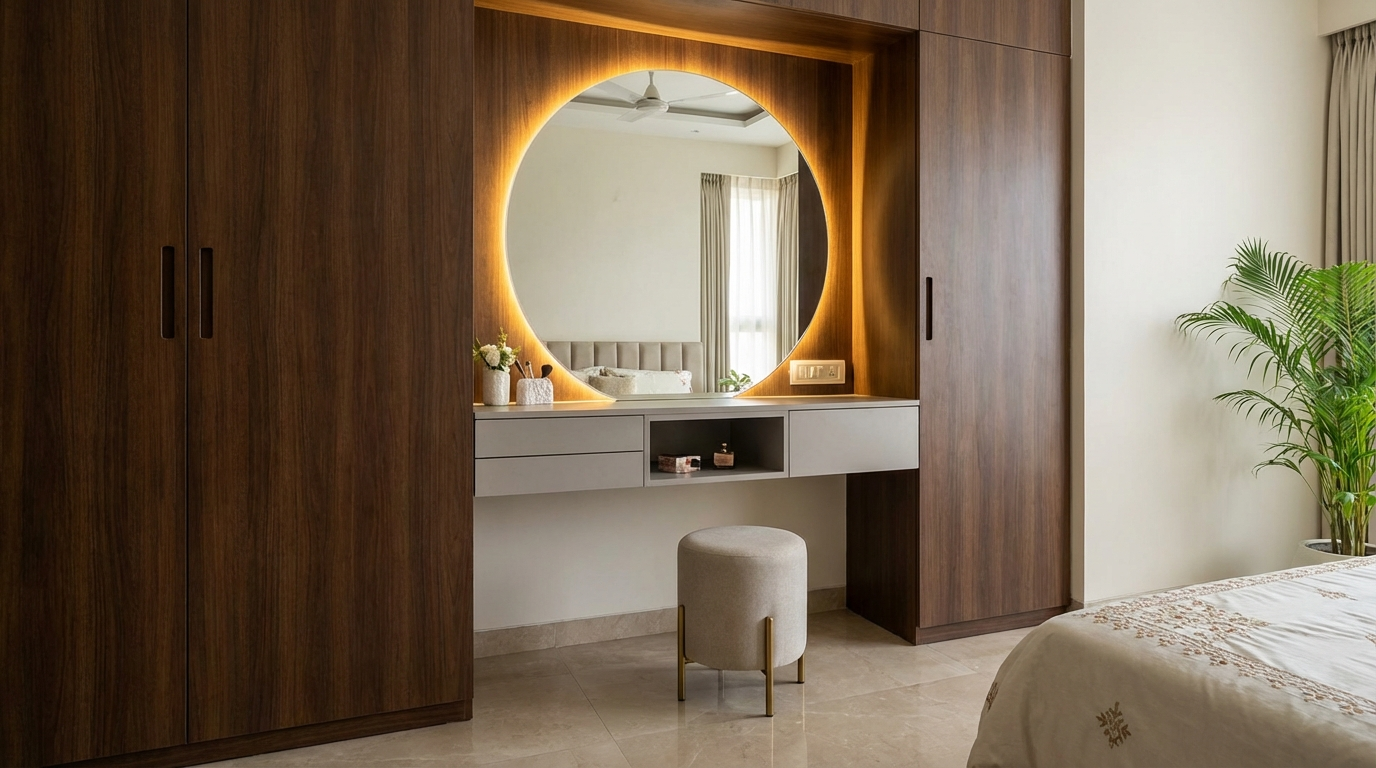
Space is the third factor. Indian bedrooms are typically smaller than Western ones. A 10x12 feet master bedroom is common in metro apartments, and you're already fitting a bed, wardrobe, maybe a side table. Wardrobe designs with dressing tables integrate seamlessly with your wardrobe, offering a cohesive solution for storage and grooming. Ideal for compact spaces, it combines practicality with style in modern bedroom setups.
Is a built-in dressing table with wardrobe worth it?
If you're getting a modular wardrobe made anyway, integrating the dressing area makes a lot of sense for Indian apartments. You save floor space, the design looks cohesive, and the carpenter can optimize storage across both pieces. I'd say 6 out of 10 projects I consult on these days go this route. The main downside? You can't reposition it later if you want to rearrange the bedroom. And if one part gets damaged (water damage, termites—yes, it happens), repairs are more complicated.
Types of Dressing Table Designs: Breaking It Down
Dressing tables, also known as vanity tables, come in various designs and styles to suit different tastes and functional requirements. But beyond just aesthetics, each type serves a different practical purpose. Here's an honest breakdown:
Modern Minimalist Dressing Tables
Modern dressing tables have sleek lines, clean designs, and a contemporary aesthetic. They may incorporate materials like glass, metal, or high-gloss finishes. These tables often prioritize functionality and simplicity.
Best when: You have a clean, uncluttered bedroom aesthetic and you're disciplined about not letting things pile up on surfaces. Honestly, most of us aren't that disciplined—so if you buy makeup faster than you finish it, this style will look messy fast.
Traditional/Vintage Wooden Designs
This type of dressing table typically features ornate details, intricate carvings, and a classic design. It may have a large mirror, drawers for storage, and often comes with a matching stool or chair.
Best when: Your bedroom already has solid wood furniture (sheesham, teak, rosewood), and you want everything to match. These can be stunning—but they're heavy, expensive, and harder to find in ready-made options. Most of what you'll find is either antique (and overpriced) or cheap reproductions that look tacky.
Wall-Mounted/Floating Vanities
A floating dressing table is an even simpler and cheaper option. These are essentially a shelf fixed to the wall, with a mirror above and maybe one or two small drawers underneath.
Best when: You're genuinely short on floor space. A 10x10 bedroom with an already-large wardrobe? Wall-mounted might be your only option. But storage will be limited—be realistic about what you actually need to keep at the vanity versus elsewhere.
Scandinavian Style
Scandinavian dressing tables are characterized by their minimalistic and functional approach. They feature clean lines, light-colored wood, and simple shapes. Storage solutions are usually incorporated into the design.
Best when: You like the IKEA aesthetic and your bedroom has natural light. The light wood tones can look washed out in dim, north-facing rooms.
Multipurpose Vanity Tables
Some dressing tables are designed to serve multiple purposes. They usually have built-in storage, a desk area, or even transform into a small dressing area. These tables maximize functionality in smaller spaces.
Best when: You work from home occasionally and don't have space for a separate desk. I've seen designs where the mirror lifts up to reveal a laptop-friendly surface—clever, but make sure the height works for both purposes.
Comparison Table: Dressing Table Types
| Type | Space Needed | Storage Capacity | Price Range | Best For | My Take |
|---|---|---|---|---|---|
| Modern Minimalist | Medium (3-4 ft width) | Limited to moderate | ₹12,000–40,000 | Contemporary bedrooms | Looks great in photos, harder to maintain in real life |
| Traditional Wooden | Large (4+ ft width) | Good—multiple drawers typical | ₹25,000–1,50,000+ | Matching with existing wood furniture | Worth it only if you're buying quality wood |
| Wall-Mounted | Minimal floor space | Very limited | ₹5,000–20,000 | Tiny bedrooms, rental apartments | Practical but not glamorous |
| Scandinavian | Medium | Moderate | ₹15,000–45,000 | Well-lit, modern interiors | Popular now but may date quickly |
| Wardrobe-Integrated | No additional floor space | Depends on design | Part of wardrobe cost | Space-constrained Indian apartments | Best value if getting modular anyway |
| Multipurpose/Convertible | Medium | Moderate | ₹18,000–50,000 | Working professionals, guest bedrooms | Clever but check the mechanism quality |
Dressing Table Dimensions: Size Guide for Indian Bedrooms
Size matters more than style when it comes to dressing tables. I've seen too many people fall in love with a design online, order it, and then realize it overwhelms the room or doesn't give enough knee clearance.
Most standard vanity tables fall around 30-34 inches high. This suits average heights seated. Lower alternative builds in the 24-28 inches range accommodate children or standing applications like quick touch-ups.
For width: Any vanity table must have a minimum width of 24 inches. However, 30 inches is thought to be the perfect width. If you have the space, go wider—vanities come in a multitude of sizes that range from 30" to 52" wide and are commonly 30" in height.
For depth (front to back): Allow 16–20 inches (40–50 cm) depth for legroom and storage. Anything shallower than 16 inches and you'll struggle to fit a proper mirror plus your products.
What height should the stool be?
This is a detail most people forget until they've already bought the table. Seated comfort keeping backs naturally upright all depends on surface planes hitting just under thigh level. If your table is 30 inches high, your stool should be around 17-18 inches. Most ready-made sets get this roughly right, but if you're buying separately or getting custom work done, tell your carpenter explicitly.
Quick Sizing Framework
| Bedroom Size | Recommended Table Width | Recommended Depth | Style Suggestion |
|---|---|---|---|
| Under 100 sq ft | 24-30 inches (wall-mounted preferred) | 12-16 inches | Floating shelf or corner unit |
| 100-150 sq ft | 30-36 inches | 16-18 inches | Compact standalone or wardrobe-integrated |
| 150-200 sq ft | 36-48 inches | 18-20 inches | Full standalone with drawers |
| 200+ sq ft | 48-52 inches or custom | 20-24 inches | Statement piece with side cabinets |
Dressing Table Mirror Options: Shapes, Sizes & Positioning
The mirror is obviously central to any dressing table. But there's more to think about than just "big mirror good."
Vanity mirrors are available in four popular shapes which are rectangular, oval, tri-fold and wall-mounted. Rectangular mirrors are attached to the table top and swivel. Oval-shaped mirrors are attached to the surface top and are able to swivel. Tri-fold mirrors are three elongated mirrors that are next to each other and are attached with hinges to enable a variety of angled positions. Wall-mounted mirrors are placed above the vanity on the wall and can be further enhanced with lighting.
Which mirror type is best for makeup?
For serious makeup application—especially eye makeup—you want the mirror close to your face. Tri-fold mirrors are excellent because you can angle the side panels to check your profile without craning your neck. Some lighted vanity mirrors offer adjustable features such as tilt, swivel, or extendable arms, providing flexibility for different viewing angles. Consider if you need magnification options for detailed work like applying eyeliner or tweezing eyebrows.
If I'm being honest, the integrated mirrors that come with most affordable dressing tables are just okay. Many clients upgrade to a separate wall-mounted magnifying mirror within a year. Budget ₹2,000-4,000 for a decent one if your main mirror is more than arm's length away.
Regarding mirror height: The ideal height for a dressing table mirror depends on your height and personal preference. The mirror should be positioned at a comfortable height for applying makeup and styling hair. As a rule of thumb, when seated, the top of the mirror should be at least 6-8 inches above your head, and the bottom edge should be close to the table surface so you can see products you're picking up.
Lighting for Dressing Tables: This One Detail Makes Everything Work
Here's what I tell my clients: you can have the most expensive vanity in Mumbai, but if the lighting is wrong, you'll still do your makeup badly. This one matters.
Proper lighting transforms your makeup routine. Integrated illumination eliminates uneven shadows that might distort your application, ensuring consistent coverage.
LED-mirror tables and vintage-inspired pieces will dominate premium segments. You're seeing more vanities with built-in LED strips now. This make up vanity comes with a lighted mirror which can be 360° rotated, with bright but not dazzle LED light, provide 3 color modes: warm yellow, warm white and cold white. The three-color mode is genuinely useful—warm light for regular use, cool white for checking how you'll look in office lighting.
LED lighting placement tips:
- The best lighting to have on your makeup vanity table is around the mirror.
- Avoid overhead lighting alone—it casts shadows under your eyes and nose
- Side lighting (at eye level) is ideal but rarely found in budget options
- Look for a mirror that offers adjustable lighting options, allowing you to control the brightness and warmth of the light. Adjustable color temperature is particularly beneficial as it helps mimic natural daylight or warm indoor lighting.
If your dressing table doesn't have built-in lighting, you can retrofit LED strips. Easy & stress-free installation—no wall or holes drilling. No assembly or electrical wiring is required, just stick firmly these LED vanity lights to a wall, mirror, or mirror frame and you're good to go! Costs maybe ₹800-1,500 for a decent strip kit. Worth every rupee.
Storage Solutions: Drawers, Shelves & Hidden Compartments
Storage is where dressing tables either prove their worth or become clutter magnets. The number of drawers doesn't matter as much as the *types* of storage.
Look for these storage enhancements: Vertical dividers perfect for organizing palettes and skincare bottles. Shallow trays ideal for daily-use products (1-2" depth recommended). Hidden compartments great for storing lesser-used items while maintaining a clean aesthetic.
My recommendation: have at least one deep drawer (4-5 inches) for larger items like hairdryers and brushes, and multiple shallow drawers or compartments for cosmetics and jewelry. Assess your storage requirements. Dressing tables often include drawers, shelves, or compartments for storing makeup, jewellery, hair accessories, and other personal items. Consider how much storage space you need and whether the table provides adequate options.
One mistake I keep seeing: people underestimate how much they own. Do a quick inventory before you buy. Count your lipsticks, palettes, skincare bottles. You'd be surprised. A small 2-drawer vanity sounds fine until you realize you have 40+ items just for daily use.
Power outlets—do you need them built-in?
2 standard plug sockets and 2 USB ports easily connect your hair dryer, curling iron, and can also charge your phone, tablet or other mobile devices. Built-in power outlets are becoming standard on higher-end vanities. Is it necessary? Depends on your setup. If there's a wall socket within easy reach, you can skip it. But if your dressing table is in the middle of a room or away from outlets, this feature is genuinely convenient.
Price Reality Check: What Dressing Tables Actually Cost in 2026
I'll be honest—pricing for dressing tables varies wildly based on material, size, and where you're buying from. Here's a realistic breakdown for the Indian market:
Budget Segment (₹5,000–15,000)
You'll get particle board or low-grade engineered wood, basic laminate finishes, simple mirror, maybe one or two drawers. Functional but not durable. Fine for PG accommodations or rental flats where you're not staying long. Expect 3-5 years lifespan with normal use.
Mid-Range (₹15,000–40,000)
This is where you start seeing decent plywood with laminate or veneer finishes, better hardware, more thoughtful storage design. 18mm commercial plywood inside with customized laminates and mirror with 2 drawers is a typical spec. Good enough for most homes, should last 7-10 years.
Premium (₹40,000–1,00,000+)
Solid wood frames (teak, sheesham), high-quality plywood cores with premium veneers, soft-close drawers, integrated lighting, designer mirror shapes. The finishes and details are visibly better. For a long-term home, this makes sense.
What actually affects your final bill:
- Material: Solid wood costs 2-3x more than plywood, plywood costs 1.5-2x more than particle board
- Size: Every additional 6 inches of width adds roughly ₹2,000-5,000
- Mirror quality: Basic glass versus beveled edges versus LED-integrated can add ₹3,000-15,000
- Hardware: Soft-close hinges and drawer slides cost more but are worth it
- Custom vs ready-made: Custom work from a carpenter costs more but fits your space perfectly
If budget is genuinely tight, consider getting a simple table custom-made in plywood (₹8,000-12,000) and buying a good wall-mounted mirror separately. Often cheaper than a package deal, and you control the quality of each component.
Material Options: Plywood vs Solid Wood vs Engineered Wood
Different options, such as solid wood, engineered wood, MDF, and HDF, are commonly used in crafting dressing tables for bedrooms. A dressing table constructed from solid wood is robust and durable.
Let me give you my honest assessment of each:
Solid Wood (Teak, Sheesham, Mango)
Beautiful, durable, becomes an heirloom piece. But expensive—a decent solid wood dressing table starts at ₹40,000 and goes up fast. Also heavy, so moving it around is a two-person job. Best for: permanent homes where you want furniture that lasts 20+ years.
Plywood with Laminate/Veneer
This is what most people end up with, and for good reason. High-quality designer plywood featuring bold colours, geometric patterns, or even artistic motifs. Imagine a dressing table crafted from plywood boasting a vibrant marigold yellow or a cool, calming blue. The possibilities are endless. Good plywood (18mm BWR grade with quality laminate) handles Indian conditions well and offers excellent value. Best for: most Indian homes.
MDF/HDF (Medium/High Density Fiberboard)
Smooth surface that takes paint beautifully—those glossy white vanities you see online are usually MDF. Downside? Doesn't handle moisture well. Edges can swell if water sits on them. Best for: dry-climate cities (Jaipur, Ahmedabad, interior Maharashtra), air-conditioned bedrooms.
Particle Board
Cheapest option, weakest durability. Fine for temporary setups but don't expect it to last more than 4-5 years. The screws tend to lose grip over time, and particle board hates humidity.
For material-specific guidance, our furniture plywood buying guide goes deeper into this.
How to Choose the Right Dressing Table: Decision Framework
Step 1: Measure your space first. I mean it—get a tape measure, note down exact dimensions including door swing clearance and walking pathways. This eliminates 50% of options right away.
Step 2: List your must-haves. How many drawers minimum? Built-in mirror or wall-mounted? Integrated lighting? Measure the area where you intend to place the dressing table. Ensure you have enough space for the dressing table, mirror, and a comfortable chair or stool. Consider the dimensions carefully to prevent overcrowding.
Step 3: Set a realistic budget range. Not just the table—include the stool, lighting upgrades if needed, and installation charges.
Step 4: Decide on material based on your city's climate. Humid coastal cities? Stick to plywood with water-resistant glue. Dry interior regions? More options open up.
Step 5: Check quality in person if possible. Online shopping is convenient, but furniture is one category where seeing the actual piece matters. Assembly quality, drawer smoothness, finish consistency—these don't photograph well.
Decision Matrix: What to Choose Based on Your Situation
| Your Situation | Recommendation | Why |
|---|---|---|
| Small apartment, getting wardrobe made anyway | Wardrobe-integrated dressing unit | Saves space, cost-efficient, cohesive look |
| Rental apartment, might move in 2-3 years | Budget ready-made piece (₹10,000-18,000) | Not worth investing heavily, can sell/donate when leaving |
| Own home, mid-budget | Custom plywood build with good laminate | Tailored to your space, lasts 10+ years, good value |
| Own home, want statement piece | Solid wood or premium designer piece | Becomes focal point, lasts decades, resale value |
| Very small bedroom, no floor space | Wall-mounted floating shelf + wall mirror | Only practical option, keep expectations modest |
| Teenager's room | Fun, colorful budget option (₹8,000-15,000) | Tastes will change, can upgrade later |
Red flags to walk away from:
- Drawer slides that feel flimsy or make grinding sounds
- Visible gaps where mirror meets frame
- Laminate edges already peeling in showroom
- No clear answer about material grade (if dealer can't tell you if it's MR or BWR plywood, be suspicious)
- Assembly instructions that require 50+ pieces
Common Mistakes People Make with Dressing Tables
1. Ignoring lighting until after purchase. Then they complain the mirror doesn't show true colors. The dressing table is only half the equation—lighting is the other half.
2. Choosing style over substance. That Instagram-worthy acrylic vanity? Gorgeous. But it scratches if you look at it wrong, and good luck getting foundation stains out of clear material.
3. Underestimating storage needs. "I don't have that much makeup." Fast forward six months, and there's a pile-up on every flat surface. This one really frustrates me because it's so predictable.
4. Not checking stool height compatibility. Bought the table online, used an existing chair that's too high, now her knees hit the underside. Sounds minor until you live with it daily.
5. Placing the dressing table in front of a window. Seems logical—natural light, right? But you'll be squinting into the glare instead of seeing your reflection clearly. A good setup is to put the dressing table, with its mirror, opposite your bedroom windows. This way, it can capture and bounce plenty of natural light onto your face. Opposite, not in front of.
6. Forgetting about electrical access. Hair straightener, curling iron, phone charger—you need outlets nearby. I've seen setups where the nearest socket is behind the bed, and there's an ugly extension cord running across the room.
7. Matching everything too precisely. The bed, wardrobe, side tables, AND dressing table all in identical finish? Looks like a furniture showroom, not a lived-in bedroom. A little contrast is good.
8. Getting a fancy flip-top mirror without testing it. Some of these need three hands to open while holding products. And if the hinge is weak, that mirror slamming down is an accident waiting to happen. There was this client in Powai—must have been 2022—whose flip-top mirror crashed down onto a glass perfume bottle. Glass everywhere, tabletop scratched, ₹35,000 vanity looking terrible after eight months.
Quality Checks You Can Do Yourself
Visual Checks at the Shop:
- Run your hand along all edges—feel for rough spots or peeling laminate
- Check if the mirror sits perfectly flat, or if there's a gap where dust will collect
- Look at drawer interiors—is it lined or raw particle board?
- Open and close every drawer multiple times—smooth glide or resistance?
- Press down on the tabletop centre with both palms—any flex or wobble?
Questions to Ask the Dealer:
- "What grade plywood is the carcass made from?" (Accept MR, BWR, or BWP; be wary if they don't know)
- "Is the laminate 0.8mm or 1mm thickness?" (Thicker is better, more resistant to scratches)
- "What brand hardware are you using for drawers?" (Hettich, Hafele, Ebco are good; no-name is risky)
- "Is assembly included in price, or separate?"
- "What's the warranty, and what does it actually cover?"
Simple Field Tests:
- Weight test: Solid wood and quality plywood have heft. If it feels suspiciously light, it's probably particle board or thin engineered wood
- Knock test: Tap the side panels. Hollow sound = thin material or air cavity. Solid sound = better construction
- Drawer pull test: Pull a drawer out completely (if the showroom allows). Does it have a stopper, or does it fall out?
- Mirror clarity test: Stand at different angles and check for distortion—cheap mirrors warp your reflection
Here's a trick most dealers don't like:
Ask to see the back panel. It's often the lowest-quality piece since "no one sees it." If the back is thin hardboard that flexes easily, the overall build quality is likely compromised throughout.
Working with Your Carpenter: Briefing Checklist
If you're getting a custom dressing table made (which I generally recommend for Indian homes—better fit, better value), here's what to communicate clearly:
1. Exact dimensions with drawing. Don't just say "medium sized." Provide measurements in millimeters. Include stool height.
2. Material specifications. "18mm BWR plywood for carcass, 0.8mm laminate, Hettich drawer slides" is a proper specification. "Good quality wood" means nothing.
3. Mirror installation method. Will it be glued, clipped, or framed? Glued is cheapest but can't be replaced easily if it cracks.
4. Edge banding requirements. This is where I've seen carpenters skip steps. Insist on proper edge banding (1mm PVC minimum) on all exposed edges. If they say "but the inside edges don't need it," push back. Moisture enters from unsealed edges.
5. Electrical provisions. If you want built-in power outlets or LED strips, discuss wiring routes before construction starts. Not after.
6. Timeline and payment terms. Get it in writing. 50% advance, 40% on delivery, 10% after a week of use is a fair structure.
I've seen carpenters rush through the edge sealing because they're paid per piece, not per hour. The problem is that unsealed edges absorb moisture over the first monsoon, and by December you'll see issues—I've seen this happen in at least thirty projects across Mumbai and Thane. Frustrating to watch.
How Long Do Dressing Tables Last?
Lifespan varies dramatically based on material and maintenance:
- Particle board: 3-5 years if lucky, less in humid climates
- MDF: 5-7 years with good care, faster degradation if moisture exposure
- Plywood with laminate: 8-12 years, longer if quality hardware and proper edge sealing
- Solid wood: 15-25+ years, can be refinished and passed down generations
What affects longevity:
- Humidity control: Consistently air-conditioned rooms extend life significantly
- Cleaning habits: Wiping up spills immediately versus letting liquids sit
- Usage intensity: Daily use by one person versus shared family usage
- Hardware quality: Cheap drawer slides fail before the structure does
Signs it's time to consider replacement: drawers that won't stay closed, visible warping of the tabletop, laminate peeling in multiple places, wobbly legs that tightening doesn't fix, or a mirror that's developed dark spots (silver layer degradation).
Alternatives Worth Considering
Console table with wall mirror: If your needs are simple—just a surface and reflection—a narrow console table positioned below a nice wall mirror works. Often cheaper, easier to find, and more flexible if you move.
Secretary desk with fold-down surface: For multipurpose rooms where you need the space back when not grooming. The desk folds up, the mirror goes behind the lid, everything hidden.
Wardrobe with built-in vanity unit: As I mentioned earlier, this is increasingly popular. Our wardrobe design guide covers this integration in more detail.
If budget is really tight, here's what I've seen work: a sturdy wall shelf (₹1,500-2,000) installed at proper height, a good wall-mounted mirror above it (₹2,000-4,000), and a small stool. Total cost under ₹6,000, and it's functional. Not glamorous, but honest.
FAQs About Dressing Table Design
Is it true that LED mirrors generate a lot of heat?
LED mirrors make shaving, applying makeup, washing your face easier. Both decorative and practical, a modern vanity mirror with lights is easy to install, with long-life LED lights that consume up to 85% less energy and can last up to 20x longer than traditional incandescent bulbs. LEDs run cool compared to old bulb-style Hollywood mirrors. Modern LED strips generate minimal heat—you can touch them during use without any issue. The heat concerns were valid fifteen years ago with early LED technology, not anymore.
What if I live in a coastal city like Mumbai or Chennai—which material is safest?
BWR (Boiling Water Resistant) or marine-grade plywood is your friend. Avoid MDF entirely for coastal climates—I've seen MDF dressing tables swell within one monsoon season in places like Salt Lake in Kolkata. Even with plywood, insist on proper edge sealing and keep the unit away from windows where rain might splash in.
Is it true that dressing tables should face east according to Vastu?
The best place to keep a dressing table is the eastern side. Positioning it beside the bed is also recommended. Ideally, your dressing table should be situated in the eastern part of the room. Another suggested layout is to place it next to the bed. Many families I work with follow this. Whether you believe in Vastu or not, the eastern placement often works well for natural morning light anyway.
How much extra should I budget for installation?
For ready-made pieces, installation is often included or costs ₹500-1,500 depending on complexity and your city. For custom builds, it's typically factored into the quoted price. What catches people off guard is the wall-mounting—if your vanity needs anchoring to the wall (common with large mirrors or floating designs), expect ₹800-2,000 extra for proper wall plugs and brackets.
Is it true that white dressing tables show stains more easily?
Yes, absolutely. White laminate shows every makeup smudge, foundation fingerprint, and water mark. High-gloss white is even worse. If you love the white aesthetic, go for matte finish and commit to wiping down daily. Or accept that it'll develop a patina of use marks over time. Personally, I steer clients toward warmer neutrals or wood tones—forgiving finishes that age gracefully.
Can I use a dining chair instead of a vanity stool?
You can, but check the height carefully. Dining chairs are typically 17-19 inches seat height, which might work if your table is 30 inches or higher. The main issue is width—dining chairs are often too wide to tuck under narrow vanity tables, so they stick out awkwardly. Armless dining chairs work better than ones with armrests.
What's the minimum depth for a dressing table to be practical?
Allow 16–20 inches (40–50 cm) depth for legroom and storage. I'd say 14 inches absolute minimum if you're desperate for space. Below that, you genuinely can't fit a proper mirror and have room for products simultaneously. You'll be constantly moving things around to use it.
Is it better to buy a set (table + stool + mirror) or separately?
Sets are convenient and usually cost less than buying separately. But the quality of individual components in sets is often uneven—typically the stool is the weakest link, using thin padding and flimsy legs. If you're particular about quality, buying the table and then adding a proper stool and mirror separately often gives better overall value. More work, but worth it.
Should the dressing table match my bed frame exactly?
This is personal preference, but my opinion? Perfect matching looks like a showroom, not a home. Complementary tones work better—if your bed is dark walnut, the vanity could be a lighter oak with similar warm undertones. Or go intentionally contrasting with a white vanity against dark wood. Just keep metal finishes consistent (all gold-toned hardware, or all silver).
Is it true that corner dressing tables waste space?
Depends on the corner. L-shaped bedroom corners often have unusable dead space anyway, and a corner vanity makes use of it efficiently. But if you're carving out a corner from otherwise usable wall space, then yes, you're losing flexibility. Corner units work best when the corner was awkward to begin with.
How important is a stool with storage?
More useful than people expect. Those lidded storage stools (where the seat lifts up to reveal a compartment) are great for items you don't need daily—backup products, seasonal accessories, travel makeup pouches. Adds maybe ₹1,500-3,000 to stool cost but worth it if your vanity drawers are limited.
What colours are trending for dressing tables in 2026?
Some of the top colours for dressing tables include white, pink, brown, beige and grey. Popular colors include white, black, brown, natural wood tones, and bold colors like blue, green, or red. I'm seeing more sage greens and dusty pinks lately, especially in younger homeowners' bedrooms. But trends change—if you're keeping this piece for 10+ years, stick with neutrals and add color through accessories that can be swapped out.
Wrapping Up
That's the gist. A dressing table sounds simple—table, mirror, drawers—but getting it right involves more decisions than people expect. Measure twice, consider your local climate, don't skimp on edge banding or lighting, and be realistic about your storage needs.
Oh, one more thing—take your time at the showroom. Sit at different heights, check your reflection in the mirror from multiple distances, open every drawer. The sales staff might hurry you, but you're the one living with this piece for the next decade. Your morning routine will thank you.
Disclaimer: This content is provided for general informational purposes based on industry practices and publicly available information. Product specifications, standards, prices, and availability may vary by manufacturer, region, and time. Readers should independently verify details with manufacturers, dealers, or qualified professionals before making purchase or construction decisions.Want Plywood Suggestions?
Share a few details and a Sainik 710 specialist will suggest suitable brands and connect you to responsive dealers.