Door Design for Home: 100+ Main Door, Bedroom & Safety Door Ideas with Materials Guide
Explore 100+ door designs for home—main door, bedroom, safety & wooden options. Get material guide, size standards & Vastu-compliant designs for India.
Door Design for Home: The Short Version
Door design is the combination of material, style, size, and functionality that determines how your home entrance or interior doorway looks, feels, and performs. The best door design for Indian homes in 2026 balances aesthetics with durability, security with ventilation, and Vastu compliance with your budget.
Short version: Doors are no longer just entry points. They are design elements now. A well-chosen door sets the tone for a space. For main doors, solid teak or Sal wood with proper sealing works best in most Indian climates. Bedrooms do fine with flush doors in laminate or veneer. Bathrooms need WPC or PVC—not wood. And whatever you pick, get the size right first: The standard door height in India is 7 ft (2134 mm), with widths ranging from 2.25 ft to 3.5 ft, depending on the room.
This guide is right for you if:
- You're building or renovating a home and confused about which door goes where
- You've heard terms like "flush door," "panel door," "WPC frame" and want clarity on what actually works
- You're trying to balance Vastu guidelines with practical budget constraints—a common headache in Indian households
- Your contractor keeps pushing options and you want to make your own informed decision
Skip this if:
- You're only looking for decorative inspiration without material guidance
- You're a professional carpenter already familiar with Indian standards
Bottom line: Get the frame and material right first—design comes second.
Note: sainik710.com is an independent informational site and is not affiliated with any manufacturer.
What "Door Design" Actually Means
Door design refers to the complete specification of a door—its material composition, construction method, visual style, hardware integration, and dimensional fit for a particular opening. It's not just about carving patterns or choosing a colour. The design encompasses whether the door is solid or hollow-core, what wood species or composite material forms its base, how it's finished, and what locking mechanisms it supports.
Most people think door design means picking pretty carvings or a nice laminate shade. Actually, good door design starts with function: Will this door face the elements? Does it need to block sound? Is termite resistance essential for your city's climate? Only after answering these questions does aesthetics enter the picture.
Doors don't just open and shut – they are the connect between two spaces, and the visual link between the one we leave and the one we enter. However, besides being right in looks they must be right in practical terms: the design, make and the materials are equally important.
Here's what confuses most homeowners: they see a door on Instagram, love it, and ask their carpenter to "make something similar." But that door might be solid oak designed for a European climate. In Mumbai's humidity or Chennai's heat, it would warp within two monsoons. Design without context is just decoration waiting to fail.
Why Door Selection Matters in Indian Homes
India isn't one climate—it's a dozen. And your doors face the full force of whatever your city throws at them.
Mumbai, Chennai, Kolkata—these coastal metros deal with 80-90% relative humidity during monsoon. India's climate isn't easy on doors. From monsoons to scorching summers, doors face everything. Wooden doors often swell in humidity and shrink in dry conditions, causing alignment issues. I've seen expensive teak doors in Bandra refuse to close by August because nobody accounted for expansion.
In Delhi and Rajasthan, the problem reverses. Extreme dry heat in summer causes cracking and warping, then sudden monsoon humidity creates stress in the opposite direction. Doors in Jaipur or Ahmedabad need materials that can handle this swing.
Coastal Karnataka and the Konkan belt are particularly brutal. Salt-laden air corrodes metal hardware, humidity attacks wood, and termites thrive year-round. If you're building near the coast, your door selection needs to be maritime-grade—Cedar is light, fragrant, and naturally decay-resistant, making it a good choice for modern main door design near coastal areas.
Unlike teak doors which shrinks and expands based on weathers in India, WPC doors and frames have no expanding capabilities. It can be used for both indoor and outdoors applications. This is why the WPC vs wood debate has gotten so heated in recent years.
Is solid wood still the best choice for main doors?
Depends on your budget and maintenance commitment. Teak is one of the most preferred materials for types of wooden doors in India due to its natural oils, resistance to termites, and classic golden-brown hue. Teak wood doors are ideal for both interior and exterior applications, offering luxury and longevity. But solid teak isn't cheap—expect to pay a significant premium over engineered alternatives.
If I'm being honest, most mid-range budgets do better with BWP-grade plywood doors faced with quality veneer. You get 85% of the look at 50% of the cost. The mistri will say solid is always better, but check who's paying the bill.
For Vastu-conscious families, Teak or Honne wood is the best option for the door as per vastu. But Vastu also emphasises proportion and placement over material—so don't bankrupt yourself on timber if the door faces the wrong direction anyway.
Types of Doors and Where Each Works Best
The main categories of doors used in Indian homes break down by construction method, material, and intended location. Here's what you actually need to know:
By Construction Method
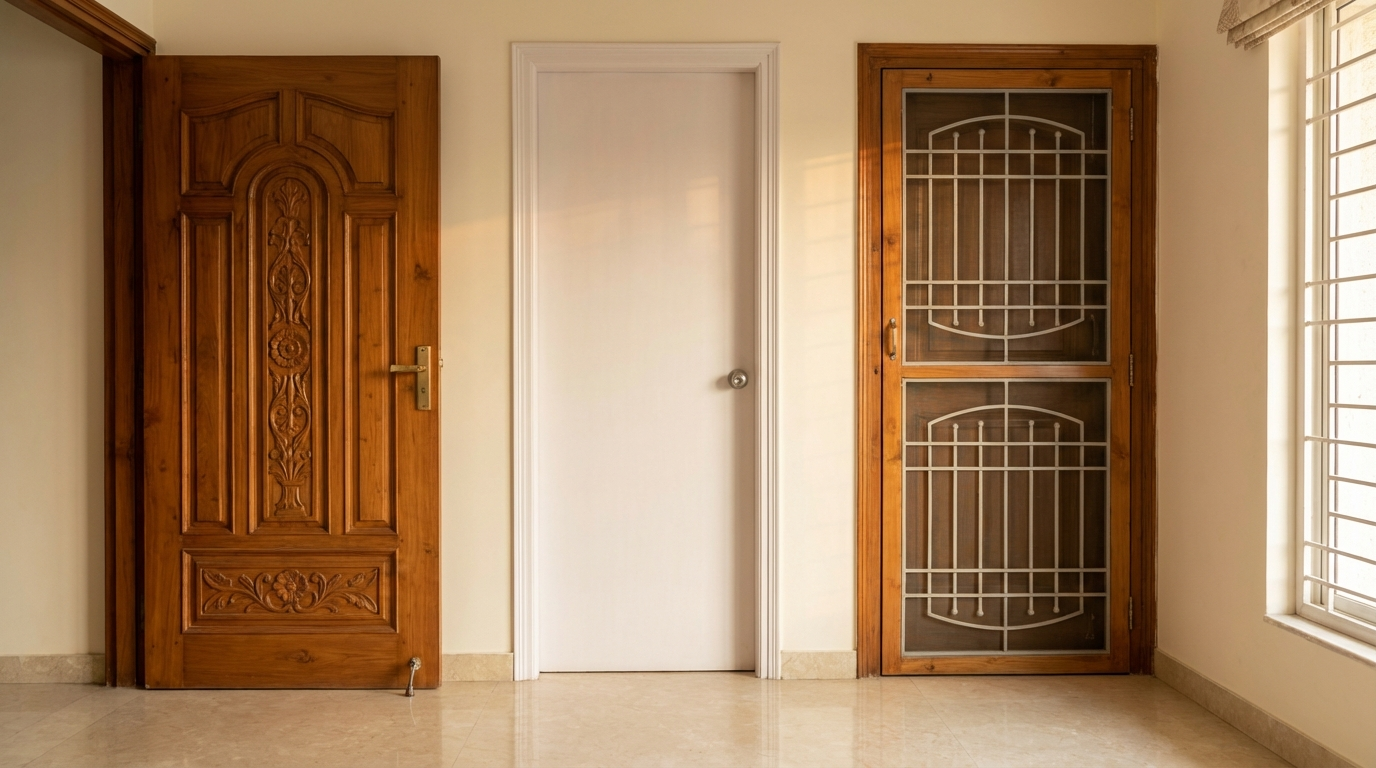
Solid Wood Doors: Solid wood doors are the gold standard in premium home entryways and interiors. They are made from strong woods like teak, sheesham, and acacia. These doors are strong, help keep rooms warm and quiet, and look rich and elegant. Best for main entrances and anywhere you want maximum impact. Heavy, expensive, requires periodic maintenance.
Flush Doors: Flush doors are simple door designs that are made from plywood or medium-density fiberboard fixed over a timber frame with a hollow core often filled with cardboard core material. The frame of the door can be made out of wood, steel, etc depending on the use case and budget of the house owner. They are mostly used inside the house for their good looks and durability. These are your workhorse bedroom and internal room doors. Clean look, budget-friendly, easy to laminate.
Panel Doors: Multiple panels within a frame create a traditional look. More expensive than flush, adds character to formal spaces like living rooms or study areas.
Hollow Core vs Solid Core: If you want a door that looks like wood, but is lighter and less expensive, then a hollow core door is ideal. This type of door has a honeycomb cardboard sheet in the centre that provides the support for the outer surface. Hollow is fine for closets and less-used rooms. For bedrooms needing sound privacy, go solid core.
By Material
| Material | Best For | Avoid For | Maintenance Level | My Take |
|---|---|---|---|---|
| Solid Teak/Sal | Main entrance, heritage homes | Tight budgets, bathroom adjacent areas | Medium—needs oiling yearly | Still the gold standard if you can afford it |
| Sheesham (Rosewood) | Internal feature doors, pooja room | Heavy humidity zones | Medium | Beautiful grain but needs protection |
| Flush Door (Plywood/MDF core) | Bedrooms, internal rooms | Exterior, bathrooms | Low | Best value for money in most scenarios |
| WPC (Wood Polymer Composite) | Bathrooms, kitchens, coastal areas | Those wanting natural wood grain feel | Very low | Game-changer for wet areas |
| PVC | Budget bathrooms, utility areas | Main doors, visible areas | None | Cheap solution but looks like it |
| Steel/Metal | Safety doors, industrial spaces | Aesthetic-first homes | Low—occasional rust treatment | Security first, looks second |
| Fibreglass | Exterior doors in harsh climates | Budgets below ₹15,000 | Very low | Underrated option for coastal homes |
Why do carpenters prefer certain materials over others?
Let me be blunt here. Your carpenter's recommendation isn't always about what's best for your home—it's often about what's easier to work with or what they've always used. Solid wood is familiar. WPC requires different tools. Fibreglass? Most local carpenters won't touch it.
I've seen this happen repeatedly: a homeowner asks about WPC for the bathroom frame, and the mistri insists on traditional wooden chaukhat because "that's how it's done." Meanwhile, that wooden frame will swell, the door will stick, and you'll be calling for repairs every monsoon.
Ask your carpenter about their experience with specific materials before letting them decide. If they haven't worked with WPC or engineered alternatives, find someone who has—especially for bathroom and kitchen doors.
Door Size Standards for Indian Homes
The ideal size of the main entrance as per Vastu should be 6 feet to 7 feet in length and 3 feet to 3.5 feet in width. The ideal proportion of the door is 2:1 concerning height and width as per Vastu.
Here's a practical size guide by room type:
| Door Type | Standard Height | Standard Width | Thickness | Notes |
|---|---|---|---|---|
| Main Entrance | 7 ft (2134 mm) | 3 ft - 3.5 ft (900-1050 mm) | 35-45 mm | Should be largest door in house |
| Bedroom | 7 ft | 2.5 ft - 3 ft (750-900 mm) | 30-35 mm | Standard flush doors work well |
| Bathroom | 6.5 ft - 7 ft | 2 ft - 2.5 ft (600-750 mm) | 25-30 mm | Can be slightly smaller |
| Kitchen | 7 ft | 2.5 ft - 3 ft | 30-35 mm | Consider swing direction |
| Pooja Room | 6.5 ft - 7 ft | 2.5 ft | 25-30 mm | Double doors common |
| Safety/Security Door | Matches main door | Matches main door | Steel frame dependent | Should align with main entrance |
The main door size as per Vastu needs to be the biggest in the house. In addition, it is even better if the main door comes in two parts rather than one big unit. This double-door approach is especially popular in South Indian homes and bungalows.
Maintain uniform door height (7 ft) across the house for visual symmetry. Door handle height should be 1050 mm (3.5 ft) from finished floor level.
Design Trends That Actually Make Sense for 2026
Minimalism continues to dominate in 2025. Simple doors with clean lines are highly prominent. You can expect some features like smooth surfaces without excessive carvings or decorations or neutral colors like matte black grey white or wood tones. This trend has carried strongly into 2026.
But here's what I tell my clients: trends are for Instagram. Your door needs to last 15-20 years minimum. Pick something you won't tire of.
What's genuinely working in Indian homes right now:
Right now, it's all about fluted panel doors, minimalist flush designs, and pooja doors with jaali or etching. Add in some matte black hardware, concealed hinges, or smart locks, and you've got both style and security in one clean look.
Combining glass and wood is a major trend. These doors allow natural light to enter while maintaining privacy and style. You can expect frosted or tinted glass panels for privacy besides wood frames and different finishes. I've installed several of these in Powai and BKC apartments recently. They work exceptionally well where entrance foyers are dark.
The latest wooden safety door designs for 2025 blend modern aesthetics with advanced functionality. Homeowners are leaning towards geometric wooden grills paired with sleek metal inlays, offering a contemporary yet secure look.
What thickness works best for main doors?
For main entrance doors, 35-45mm is standard. Ensure the door thickness is at least 35–40mm for proper fitting of digital locks and modern hardware. Go thinner and you'll struggle to accommodate quality mortise locks.
For bedrooms, 30-35mm is plenty. Anything thicker is overkill unless you're specifically looking for acoustic insulation—in which case, solid-core 40mm with proper sealing makes more sense.
Bathroom doors can be 25-30mm since they're internal and don't bear security loads. Just ensure the material is moisture-appropriate.
Safety Door Designs: Security Meets Style
Anti-theft door designs are specially built doors that offer advanced security features to protect homes from unauthorised access. These are made from strong materials like steel, iron, or reinforced wood and include added layers like multiple locking systems, grills, and digital access.
In urban apartments—Pune, Bengaluru, Hyderabad especially—safety doors have become nearly mandatory. This type of modern door design is very common in Indian homes. This metal grill design is right if you want something elegant that ensures safety. This metal grill design is very easy to operate and has been preferred by most Indians for a long time.
Main safety door types available in India:
- Steel security doors are among the strongest options available. They resist forced entry and are highly durable. Features: Thick gauge steel, powder coating, heavy-duty hinges. Use: Ideal for flats, bungalows, and independent homes. Steel security door price India: Ranges from ₹12,000 to ₹40,000 depending on thickness and design.
- Iron grill doors: Traditional, allows ventilation, pairs with main wooden door
- Main door safety design element: Multi-point locking, fire resistance. Fitted with smart locks, fingerprint scanners, and keyless entries. Features: Electronic locking system, real-time alerts, camera integration. Use: High-end apartments, tech-savvy homes. Steel security door price in India for digital variants: ₹25,000 and above.
Mesh or Grill Layering helps keep insects out while allowing airflow, especially in homes where the safety door remains shut while the main door is left open. Design trends for safety doors in 2025 are focused on combining function and form.
If I'm being honest, the combination of a solid wooden main door with a well-designed safety grille door in front remains the most practical setup for Indian apartments. You get ventilation when you want it, security when you need it, and the aesthetic impact of wood as your primary visual.
Price Reality Check: What Doors Actually Cost in 2026
Nobody gives straight answers on door pricing. So here's the reality from what I'm seeing in the market:
A designer wooden main door in India typically costs between 25,000 to ₹1.5 lakhs, depending on the material (teak, Sal, or engineered wood), carvings, size, and finish. Premium doors with hand-carved panels, digital locks, or brass inlays can go beyond ₹2 lakhs.
Rough price ranges by door type (2026 estimates):
| Door Type | Budget Range | Mid Range | Premium | What Drives Price Up |
|---|---|---|---|---|
| Solid Teak Main Door | ₹35,000-50,000 | ₹60,000-1,00,000 | ₹1,25,000+ | Carving complexity, brass work, size |
| Flush Door (Bedroom) | ₹4,000-6,000 | ₹8,000-12,000 | ₹15,000+ | Core quality, laminate grade, hardware |
| WPC Door | ₹6,000-8,000 | ₹10,000-15,000 | ₹18,000+ | Brand, finish, frame inclusion |
| Steel Safety Door | ₹12,000-20,000 | ₹25,000-40,000 | ₹50,000+ | Digital locks, design complexity |
| PVC Bathroom Door | ₹2,000-3,500 | ₹4,000-6,000 | ₹8,000+ | Brand, panel design, frame |
What actually affects your final bill:
- Frame material: Wooden chaukhat vs WPC frame vs steel—this alone can swing costs by ₹3,000-8,000
- Hardware quality: A decent mortise lock with handles costs ₹2,000-5,000. Smart locks start at ₹8,000.
- Installation: Budget ₹800-2,000 per door depending on complexity
- Finishing: Factory-finished doors cost more upfront but save on painting/polishing later
How to Choose: Decision Framework
Step 1: Identify the door's location and function. Main entrance? Bathroom? Bedroom? This determines material requirements.
Step 2: Assess your local climate. Coastal humidity? Extreme temperature swings? Termite-prone area? Match materials to conditions.
Step 3: Set your budget honestly. Include frame, hardware, and installation—not just the door shutter.
Step 4: Check Vastu requirements if applicable. Vastu principles for home entrances suggest the main door should be the largest in the house, ideally positioned facing north, east, or northeast. A double door opening inwards is considered favourable.
Step 5: Get samples. Touch the materials, check weight, examine finishes in person before ordering.
Decision Matrix:
| Situation | Recommendation | Why |
|---|---|---|
| Building in coastal city (Chennai, Mumbai) | Teak or WPC with stainless hardware | Salt air corrodes, humidity damages |
| Tight budget, need 5+ bedroom doors | Commercial-grade flush doors with laminate | Best value, good durability |
| Bathroom in humid climate | WPC or PVC—never solid wood | Moisture resistance essential |
| Ground floor flat, security concerns | Steel safety door + solid wood main door | Layered protection |
| Want heritage/traditional look | Carved Sal or Sheesham with brass | Authentic aesthetic impact |
| Rental property, durability focus | Solid-core flush with laminate | Withstands abuse, easy replacement |
Red flags to walk away from:
- Dealer can't specify wood species or core material
- Price seems too good—solid teak doesn't come cheap
- No warranty or vague "lifetime" claims without paperwork
- Factory finish looks patchy or uneven on sample
Common Mistakes People Make
Mistake #1: Using MR-grade plywood for bathroom-adjacent doors. I've seen this so many times it drives me crazy. MR grade handles light moisture, not bathroom humidity. Within two monsoons, the laminate starts lifting. Use BWP grade minimum, or better yet, WPC for anything near wet areas.
Mistake #2: Ignoring frame material while obsessing over the door. Your door is only as good as its frame. A beautiful teak door in a cheap wooden frame will stick, jam, and disappoint. WPC door frames have an advantage over conventional wood door frames as well as LVL door frames. It is 100% waterproof, termite-proof and very sturdy.
Mistake #3: Not measuring properly. "Standard size" doesn't mean your opening is standard. Get exact measurements before ordering. I had a client in Thane who ordered six doors based on builder specs—two didn't fit.
Mistake #4: Skimping on hardware. A ₹60,000 door with ₹500 handles looks terrible. Budget at least 10-15% of door cost for quality hardware.
Mistake #5: Choosing based on showroom lighting. That walnut finish looks different under your home's LED lights. Always take samples home.
Mistake #6: Not considering swing direction. Door opening should not block light switches, clash with furniture, or hit other doors. Map this out before installation.
Mistake #7: Assuming all carpenters know all materials. This one really frustrates me. Your trusted mistri may be excellent with wood but have zero experience with WPC or engineered doors. Ask specifically about their experience with your chosen material.
Mistake #8: Forgetting about maintenance requirements. Solid wood needs periodic oiling. Metal doors need rust checks. WPC needs almost nothing. Factor maintenance into your decision—not everyone follows through on care schedules.
Quality Checks You Can Do Yourself
Visual Checks:
- Run your hand across the surface—any roughness indicates poor finishing
- Look at edges closely—gaps between face and core mean problems
- Check both sides of flush doors—they should look equally good
- Examine laminate edges for bubbling or peeling
- For solid wood, look for uniform grain without artificial fills
- Check frame joints for tight fits, no visible gaps
Questions to Ask the Dealer:
- "What's the exact core material?" (Don't accept vague answers like "good quality")
- "Is this ISI marked? Can I see the certification?"
- "What warranty do you provide in writing?"
- "For solid wood—where was this timber sourced?"
- "Who do I contact if there's a problem after installation?"
Simple Field Tests:
- Tap test: Solid core sounds dull, hollow core sounds... hollow. Know which you're paying for.
- Weight check: Solid wood main doors should feel substantial—30-50 kg for a standard size. If it feels light, question the material.
- Edge inspection: Pick up the door and look along its edge. Any waviness indicates poor construction.
- Flex test: For flush doors, slight flex under pressure is fine. Excessive bending suggests weak core.
Here's a trick most dealers don't like: Ask to see the same door model they've supplied to another customer after 6+ months of use. Genuine dealers will have references. Those selling substandard product will make excuses.
Installation and Workmanship Tips
Frame Installation: The frame must be perfectly plumb and level. A 2-3mm error doesn't sound like much, but it means your door will never close properly. Use a spirit level during installation—don't let anyone eyeball it.
Edge Sealing: This is where most installations fail. Unsealed edges absorb moisture, especially in kitchens and bathrooms. Insist on proper edge banding or sealer application on all exposed edges. It adds ₹500-1000 to the job but prevents failures worth much more.
What to Tell Your Carpenter—A 6-Point Briefing:
- "Use stainless steel or brass screws only—no iron" (prevents rust staining)
- "Maintain 3-5mm gap at bottom for air flow and floor clearance"
- "Pre-drill all hinge holes—don't force screws"
- "Seal all edges before fitting—not after"
- "Check door swing before finalising hinge placement"
- "I want to inspect before you fix permanently"
Screw Guidance: For standard flush doors, 3" (75mm) screws for frame into wall, 1.5" (38mm) for hinges into door. Use at least 3 hinges for doors over 7 feet or those with security features.
Storage Note: If doors arrive before installation, store them flat—not leaning at an angle. Keep away from direct sunlight and moisture. Cover with cloth, not plastic (traps humidity).
There was this project in Mulund where the contractor stored doors leaning against a wall for three weeks during monsoon. By installation time, half of them had warped. ₹45,000 down the drain because of storage negligence.
How Long Different Doors Actually Last
Honest lifespan expectations based on what I've seen over 18 years:
- Solid Teak Main Door: 25-40+ years with proper maintenance. The teak doors in my parents' house are from 1985 and still going strong.
- Sal/Sheesham: 20-30 years if protected from moisture and treated for termites
- Quality Flush Doors: 12-20 years depending on usage and location
- WPC Doors: 15-25 years—still relatively new to market but showing good longevity
- PVC Doors: 8-12 years before fading and becoming brittle
- Steel Safety Doors: 15-25 years with rust treatment every 3-4 years
What affects longevity:
- Climate exposure (coastal = shorter lifespan)
- Usage frequency (main doors vs rarely used rooms)
- Hardware quality (cheap hinges fail first)
- Maintenance discipline (or lack thereof)
Signs to watch for:
- Door sticking or not closing properly—might indicate frame issues
- Cracks appearing in solid wood—needs immediate oiling/treatment
- Laminate bubbling or lifting—moisture has entered
- Rust on hinges spreading to door—replace hardware promptly
When to replace: If repairs cost more than 40% of a new door, replace it. Also if the door has structural damage to the core, not just surface issues.
Alternatives Worth Considering
If budget is tight: Pre-laminated particle board doors work for internal rooms where moisture isn't a concern. They cost 30-40% less than flush doors. Our HDHMR guide covers this material's capabilities in more detail.
If you need better moisture resistance: PVC doors are a budget-friendly and moisture-resistant choice for Indian bathrooms. They're lightweight, termite-proof, and don't swell with water. However, they may not offer a premium look or long-term durability. In urban homes, WPC (Wood Polymer Composite) is a better alternative—it looks better than PVC and offers enhanced strength and waterproofing.
If you want high-end without solid wood: Veneer doors give you real wood surface on an engineered core. The veneer plywood selection guide on this site goes deeper into choosing the right veneer species.
For sliding options: Sliding doors with aluminium or uPVC frames and toughened glass are excellent for Indian balconies. They save space, allow ample natural light, and offer an unobstructed outdoor view. Opt for double-glazed sliding doors for better sound insulation and temperature control in cities.
For WPC frame applications specifically, our separate WPC door frame guide explains installation nuances worth knowing.
Frequently Asked Questions
Is it true that wooden doors always warp in humid cities like Mumbai or Kolkata?
Not always, but it's a real risk. Wooden doors are classic and never run out of fashion. The natural beauty and warmth of a wood door can add elegance to any room. Of course, there are also some disadvantages to them. Wood doors are more prone to crack, warp, or even rot, especially in highly humid sections. The key is choosing properly seasoned timber and applying quality sealers. Teak resists better than most species due to its natural oils. But if you're in a seafacing flat with 90% humidity half the year, WPC frames with veneer-faced doors might be more practical.
What if I live in a coastal area like Goa or Kerala—should I avoid wood entirely?
Not necessarily avoid, but choose wisely. Teak and cedar handle coastal conditions better than most. Ensure all hardware is stainless steel or marine-grade brass. Salt air destroys ordinary iron fittings within 2-3 years. For bathroom and kitchen doors in coastal homes, WPC is almost always the smarter choice. The investment in quality materials upfront saves enormous repair costs later.
Can I install a digital lock on any door?
Digital locks can be installed on wooden doors, especially those made from teak or plywood with laminate finish. Ensure the door thickness is at least 35–40mm for proper fitting. Popular digital locks in India include Yale, Godrej, Hafele, and Dorset. They offer features like fingerprint, PIN, RFID, and mobile app access—ideal for modern Indian homes. Don't attempt installation on hollow-core doors or thin shutters—they can't support the hardware weight and mechanism.
Is it true that Vastu requires the main door to face a specific direction?
According to main door opening rules as per Vastu, the entrance should ideally face the north, northeast, east or west, as these facilitate prosperity. If you have to place the main entrance facing the south, place a vastu pyramid for your main door or helix. This will help to correct any main door vastu dosha you might have. However, Vastu should be balanced with practical considerations—forcing a door direction that creates security vulnerabilities or blocks natural light isn't wise.
Should I get double doors for the main entrance?
The double door design uses two doors instead of one. The idea of having two doors for one entryway is not revolutionary but it does add more grandeur—perhaps, even a majestic sense—to the space. Be it wood or glass, the look and feel of your space is elevated majorly with a double door. Double doors work best when your opening is 4+ feet wide. For standard 3-3.5 feet openings, a single solid door with an adjacent fixed panel often looks better than cramped double doors.
What's the practical difference between WPC and PVC doors?
PVC is pure plastic—lighter, cheaper, but looks obviously synthetic. WPC combines wood fibres with plastic, giving better appearance and feel while maintaining moisture resistance. WPC doors are an innovative and eco-friendly alternative to traditional wooden or uPVC doors. They are made from a blend of wood fibers, plastic, and some type of binding agent. This composite material is designed to offer the best qualities of wood and plastic. For bathrooms with visible doors, WPC is worth the extra cost. For utility store rooms or back entrances, PVC works fine.
How do I maintain a solid wood main door properly?
Oil it annually with teak oil or linseed oil—more frequently in dry climates. Clean with dry cloth weekly, damp cloth monthly. Never use harsh chemical cleaners. Touch up scratches with matching wood polish before they deepen. Check hinges every 6 months and oil if squeaking. This 30-minute annual routine extends door life by decades.
Is it true that carved doors are more prone to damage?
The carvings themselves don't weaken the door, but they create more surface area for dust, moisture, and polish degradation. Deep intricate carvings require more careful cleaning and periodic re-polishing to maintain their beauty. Shallow relief patterns or geometric designs are easier to maintain than complex mythological scenes with undercuts.
What should I ask for if I want a door that reduces outside noise?
Request solid-core construction with tight weatherstripping. The heavier and more solid the door, the better sound insulation. Standard hollow-core doors provide almost no acoustic benefit. Thickness matters—40mm solid core outperforms 30mm significantly. Also ensure there's no gap at the bottom—acoustic doors need proper floor seals.
Can flush doors look premium or are they only for budget projects?
For bedrooms, flush doors with laminate or veneer finish are ideal—sleek, sound-insulated, and easy to clean. Minimalist designs in neutral colours like white, walnut, or teak finish are trending. Premium flush doors with real wood veneer, concealed hinges, and quality hardware can look as good as—sometimes better than—ornate carved doors in modern interiors. It's about execution, not just door type.
How many doors should a house have as per Vastu?
According to Vastu Shastra, the number of doors in a house should be even, but not ten or multiples of eight. The ideal number of doors is considered to be 2, 4, 6, or 8. Practically speaking, design your home for function first, then adjust within Vastu parameters where possible without compromising usability.
What if my carpenter insists on using traditional wooden frames even for bathrooms?
Push back. WPC Door frame Advantages: Best to stand with high moisture and humidity level, better machinability, best to use as exterior grade material, high impact strength, 100% environment friendly product. Whereas wooden door frames are expensive and need more maintenance. These are heavily weighted and could be attacked by bugs and insects. It has low resistance to moisture and temperature changes. If your carpenter hasn't worked with WPC, find one who has—or have them supervised during first installation. The material behaves differently and requires slightly different techniques.
Final Thought
Doors are one of those things you'll interact with literally every day for the next 15-20 years. Spending an extra week on research and an extra 10-15% on quality isn't an expense—it's common sense.
And seriously—don't skip the edge banding. That's where I see 80% of door failures start.
Disclaimer: This content is provided for general informational purposes based on industry practices and publicly available information. Product specifications, standards, prices, and availability may vary by manufacturer, region, and time. Readers should independently verify details with manufacturers, dealers, or qualified professionals before making purchase or construction decisions.Want Plywood Suggestions?
Share a few details and a Sainik 710 specialist will suggest suitable brands and connect you to responsive dealers.