Dining Table Design Ideas: 35+ Modern, Wooden & 6-Seater Designs for Indian Homes
Explore 35+ dining table designs—wooden, 6-seater & modern styles. Size guide, material options & space planning tips for Indian dining rooms.
Quick Answer: What Dining Table Works Best for Indian Homes?
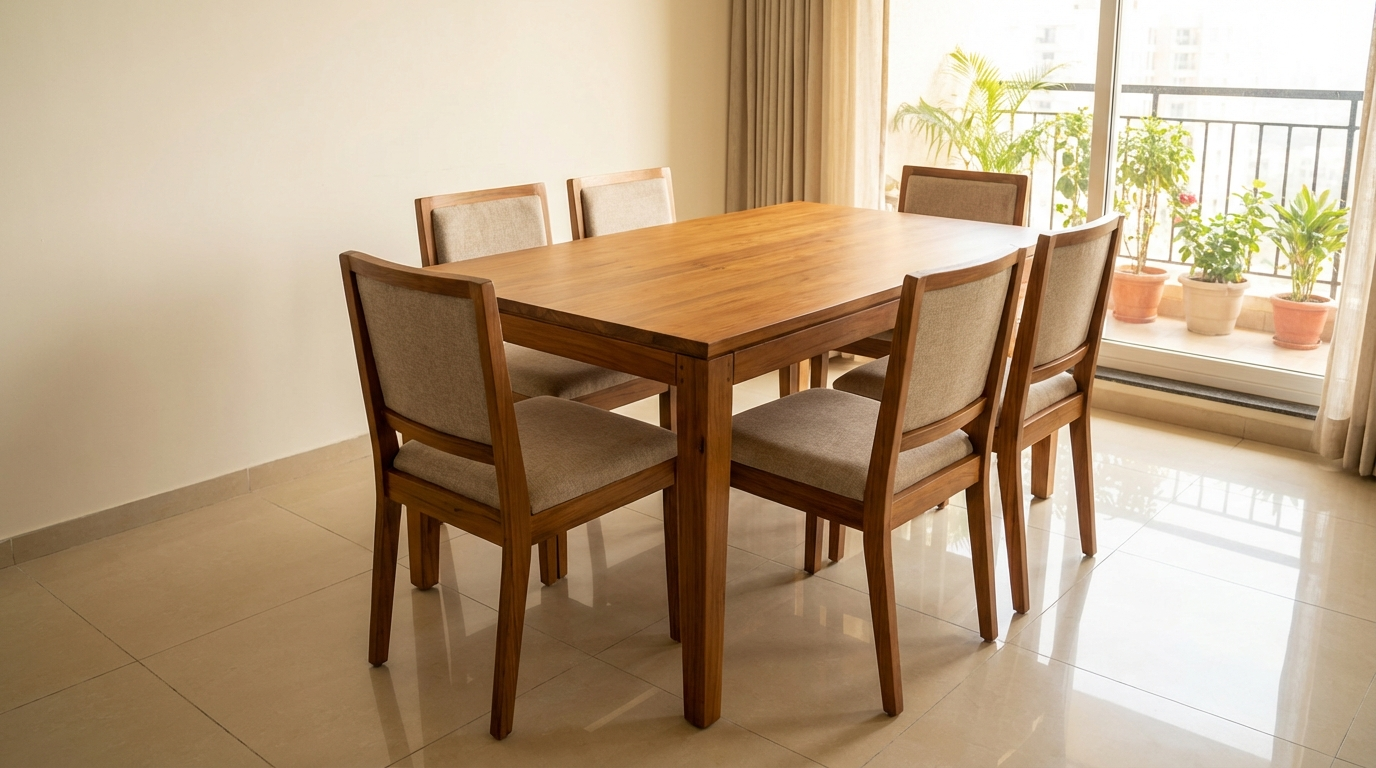
The best dining table for most Indian homes is a 6-seater wooden table measuring 72 inches long and 36–42 inches wide, preferably in solid sheesham or teak. This size comfortably fits the typical 4-6 person Indian family while leaving room for serving dishes in the center—something we actually use during meals, unlike Western dining where plates are pre-portioned.
Short version: A 72 x 36 inch rectangular dining table is a perfect match for most contemporary homes. If the space is very limited, a 60-inch round or oval table will be just right for you to have meals without feeling cramped. For material, sheesham or teak handle Indian humidity best, while marble and glass tops work if you want that premium look and don't mind extra maintenance.
This is right for you if:
- Your family has 4-6 regular members eating together
- You host occasional dinners or festivals where guest count doubles—extendable tables solve this beautifully
- Your dining space is at least 10×12 feet (ideally 12×14 for comfortable movement with chairs pulled out)
- You want furniture that lasts 15-20 years without looking dated or falling apart
Skip this if:
- You live in a studio apartment under 500 sq ft—look at wall-mounted or folding options instead
- Your dining area doubles as a workspace daily—consider a height-adjustable table
Bottom line: A well-chosen 6-seater dining table in solid wood will outlast three cheap engineered wood sets and actually improve with age if you maintain it properly.
What "Modern Dining Table Design" Actually Means in 2026
Modern dining table design is furniture that prioritizes clean lines, minimal ornamentation, and multifunctional features over heavy carvings and traditional bulk. In 2026, the trends in dining furniture reflect a broader shift towards blending sophisticated aesthetics with practical, adaptable functionality, perfectly suited for apartments and large family homes alike. The emphasis is on textured, natural materials, flexible shapes, and styles that harmonize with both traditional and contemporary interiors.
Most people think modern means glass and chrome. Actually, that's 2015 thinking. Organic silhouettes, curves, ovals, and pill shapes are big hits for 2026. They make spaces look softer and more modern. The whole industrial-cold look is out. What's in? Designers predict a strong return of mid-century and vintage vibes in 2026. This trend taps into nostalgic shapes, solid wood frames, tapered legs, rich walnut finishes, and heirloom-style craftsmanship.
Here's what I tell my clients: "modern" doesn't mean you abandon wood. The future of dining is focused on materials that provide visual interest and a tactile experience, moving beyond standard laminate and veneer. Marble has returned, not just as a luxury item, but as a practical design choice, especially for the high-end Indian market.
Why Dining Table Choice Matters More in Indian Homes
Indian dining is fundamentally different from Western dining. We serve family-style with bowls in the center. We sit longer. We have more people dropping in unannounced. A dining table that works in London might be completely wrong for Mumbai or Chennai.
Biophilic design (connecting indoors with nature) is big in 2025 and ideal for Indian homes. But beyond aesthetics, there's the climate factor. In places like Chennai or Mumbai, humidity regularly hits 80-90% during monsoons. A solid teak table handles this without warping. That cheap MDF table from the sale? By year two, the edges are swelling and laminate is peeling.
Bangalore Apartment Reality: 65% of new developments have under 600 sq ft dining areas. This is why compact, extendable, and multi-use designs dominate the Indian market. You can't just copy European dining room layouts when your entire flat is the size of their living room.
For most millennial homeowners, the dining space ends up being a multitasker. One day it's a WFH setup, another day it's game-night territory, and sometimes it's the sacred daal-chawal spot after a long day. Your table needs to handle all of this.
Does Solid Wood Really Handle Humidity Better Than Engineered Wood?
Yes, but with conditions. Sheesham is one of the better woods from which suitable furniture can be constructed for the Indian climate. Sheesham is a tough wood that does not warp or slip in humid climates. It is naturally resistant to termites and decay, making it a material that is durable and apt for long-term usage.
Engineered wood (MDF, particle board) swells at joints and edges when humidity crosses 75% for extended periods. I've seen dining tables in coastal Goa homes where the top literally delaminated after two monsoons. Solid wood expands and contracts slightly, but it doesn't fall apart. The key is proper seasoning and finishing—which is where cheap furniture fails.
Types of Dining Tables: Complete Breakdown
By Shape
Rectangular: The classic choice. Rectangular dining tables work well in long, narrow dining rooms. The best size for a rectangular table for 6 is 72″ x 36″. Best when you have a dedicated dining room or a linear open-plan layout. Downside? Needs more floor space and those corners can be brutal in tight apartments.
Round: Round dining tables are making a strong case as the centerpiece for modern gatherings, offering a more conversational and intimate atmosphere compared to the traditional rectangular table. Their circular shape fosters a sense of equality and closeness, ensuring everyone feels included in the conversation. My take: if you have a square room under 120 sq ft, round is your best bet.
Oval: Oval tables combine the best of both worlds. They offer the ample surface area of a rectangle but, because they lack sharp corners, they promote better flow in smaller or awkward spaces. They are also safer for households with young children. Honestly, this is what I recommend most often for Indian families with kids.
Square: Square table: The size is about 48 inches each side, and it is the perfect choice for the compact dining spaces. Works for 4-seater scenarios but gets awkward when you try to fit 6.
By Material
| Material | Durability | Maintenance | Humidity Resistance | Price Range | My Take |
|---|---|---|---|---|---|
| Solid Sheesham | Excellent (20+ years) | Low—polish annually | Very Good | ₹25,000–₹80,000 | Best value for Indian homes |
| Teak | Exceptional | Very low | Excellent—naturally water-resistant | ₹50,000–₹2,00,000+ | Worth it if budget allows |
| Mango Wood | Good (10-15 years) | Moderate | Good | ₹15,000–₹45,000 | Eco-friendly, great grain patterns |
| Marble Top | Surface scratches, base matters | High—stains easily | N/A (top only) | ₹40,000–₹1,50,000 | Stunning but impractical for turmeric-using kitchens |
| Glass Top | Fragile—chips happen | Shows every fingerprint | No issue | ₹20,000–₹60,000 | Skip if you have kids under 12 |
| Engineered Wood/MDF | 5-8 years max | Low initially, unrepairable when damaged | Poor | ₹8,000–₹25,000 | Only for rentals or temporary use |
India boasts a long-standing tradition of woodworking and craftsmanship, where skilled artisans expertly handle a variety of solid woods like teak, sheesham (rosewood), mango wood, and acacia. By blending age-old techniques with contemporary design ideas, these craftsmen produce unique dining tables that highlight the elegance and sturdiness of solid wood.
Price Reality Check (2026 Market)
Here's what actually affects your final bill—and what dealers don't always explain clearly.
Dining table price range starts from Rs. 3,200 and goes up to Rs. several lakhs depending on material and craftsmanship. But those ₹3,200 tables? They're plastic or very basic engineered wood. Not what you'd want for a proper dining setup.
Prices typically start from ₹18,000 for engineered wood and go up to ₹75,000 or more for premium solid wood dining tables, depending on design and craftsmanship. For a complete 6-seater set with chairs, you can find a 6-seater dining table and chair set made with quality materials for ₹23,000 and around.
At Nilkamal Furniture, the dining set starts from 6200 to 82500. The wide range reflects the material jump from plastic to premium wood.
What drives prices up:
- Solid wood vs engineered (2-3x difference)
- Hand-carved details vs machine-cut (40-60% premium)
- Imported wood vs Indian hardwood
- Brand markup—some brands charge 30-40% extra for the same material
- City—Mumbai and Bangalore showrooms are 15-20% pricier than Jaipur or Jodhpur manufacturers
Budget estimation for common scenarios:
- Starter 4-seater engineered wood: ₹12,000–₹20,000
- Mid-range 6-seater solid sheesham: ₹35,000–₹55,000
- Premium 6-seater with marble top: ₹70,000–₹1,20,000
- Luxury 8-seater solid teak with chairs: ₹1,50,000–₹3,00,000+
Wooden vs Marble vs Glass: Direct Comparison
| Parameter | Solid Wood | Marble Top | Glass Top | My Preference |
|---|---|---|---|---|
| Daily Usability | Excellent—handles hot vessels | Good with trivets | Fingerprint magnet | Wood |
| Indian Cooking Stains | Minor impact, can be refinished | Turmeric stains permanently if unsealed | Wipes clean | Wood or Glass |
| Humidity Resistance | Excellent | Stone doesn't absorb, but base matters | No issue | Depends on base |
| Repair Possibility | Full refinishing possible | Chips are permanent | Cracks = replacement | Wood wins |
| Weight | Heavy but movable | Very heavy—needs 4 people minimum | Light | Context-dependent |
| Lifespan | 15-25 years easily | 10-15 years (top fine, base may fail) | 5-10 years before chips/cracks | Wood |
| Resale Value | Good—especially teak/sheesham | Moderate | Poor | Wood |
| Child-Friendliness | High | Moderate (hard edges) | Low (breakage risk) | Wood |
Choose wood when: You want longevity, have kids, cook Indian food daily, or care about resale value.
Choose marble when: You host formal dinners, have household help for maintenance, and want a statement piece in a formal dining room.
Choose glass when: You need the room to feel larger, eat out often, and prioritize aesthetics over durability. You gain visual lightness but lose the ability to repair any damage.
How to Choose the Right Dining Table: Step-by-Step
Step 1: Measure your actual space. Not the builder's plan—the actual floor area after construction. Leave at least 3 feet of free space around the table for comfortable movement. This means a 6×3 ft table needs a room that's at least 12×9 ft minimum. Leave 3 feet (36″) around your table for chair movement.
Step 2: Count regular diners + occasional capacity. The most common family size in India consists of 4-6 people which makes the Dining table dimensions for 6 seats popular. But if you host parents or in-laws during festivals, consider extendable options.
Step 3: Assess your cooking style. Heavy Indian cooking with turmeric, oil splatters, and hot serving dishes? Marble is risky. Glass shows everything. Wood handles it all.
Step 4: Consider multi-use needs. Apartment square footage often runs at a premium, and dining spaces must accommodate more than a single daily use. Trending dining tables thus include modular, expandable, and flexible designs.
Step 5: Set a realistic budget including chairs. Tables without chairs are misleading—chairs often cost 40-50% of your total dining set budget.
| Situation | Recommendation | Why |
|---|---|---|
| Small apartment, 2-3 people | Round 4-seater, extendable if possible | Saves space, no wasted corners |
| Nuclear family, dedicated dining room | Rectangular 6-seater in solid wood | Classic choice, great resale, handles daily use |
| Joint family, regular guests | 8-seater or 6-seater extendable | Flexibility for varying numbers |
| Rental apartment | Engineered wood or good quality folding | Don't invest heavily in temporary space |
| Luxury home, formal entertaining | Marble or premium teak with statement design | Makes an impression, worth the maintenance |
Red flags to walk away from:
- Vague material descriptions ("solid wood" without specifying which wood)
- No warranty or only 1-year warranty on solid wood claims
- Joints that creak or wobble in showroom itself
- Particle board cores labeled as "engineered wood" at premium prices
- Delivery timelines exceeding 6-8 weeks without clear reason
Common Mistakes People Make
1. Buying based on showroom lighting. That beautiful dark walnut table looked stunning under their spotlights. At home under your tube lights? Completely different vibe. Always ask for swatches or check photos in natural daylight.
2. Ignoring chair dimensions. The point is to provide at least 24 inches of width for one person so as to have comfortable seating. This gives each diner enough personal space during meals—particularly at long dinners or parties. Cramped chairs ruin even the best table.
3. Choosing style over stability. There was this family in Andheri—must have been 2023—who insisted on a very trendy glass-top table with thin metal legs. Looked amazing. Two years later, wobbling so badly that every meal felt like an earthquake. Style fades, wobble doesn't.
4. Underestimating maintenance needs for marble. This one really frustrates me. Marble needs sealing every 6-12 months. Acidic foods (lemon, tomato) can etch the surface permanently. And turmeric? Forget about it. I've seen gorgeous Italian marble tops ruined within a year because nobody mentioned the maintenance requirements.
5. Not testing with actual dinnerware. Bring your own serving bowls when table shopping. Place them on the table. Do they fit comfortably with six place settings? Many tables look spacious empty but become cramped the moment you add a typical Indian meal spread.
6. Falling for "solid wood" claims without verification. Ask specifically: solid sheesham, solid teak, or solid mango? "Solid wood" is often marketing speak for a veneer layer over particle board. Check the underside of the table—that tells the real story.
7. Forgetting about leg placement. Pedestal bases look elegant but can feel unstable for larger tables. Four-leg designs at corners can obstruct head-of-table seating. Always sit at the table in the showroom and check legroom from every position.
8. Buying chairs separately without measuring. Chair seat height needs to match table height. Standard tables are 28-30 inches; chair seats should be 17-19 inches. The gap between seat and table surface should be 10-12 inches for comfortable elbow positioning.
Why Do Carpenters Prefer Sheesham Over Mango Wood?
Sheesham Wood is known especially for its durability and longevity. This is because Sheesham wood can naturally resist rot and decay. This, along with the fact that they can easily combat dry termite attacks, makes it durable in all weather conditions.
Carpenters—or mistrys as we call them—prefer sheesham because it's easier to work with for joints and carvings, holds screws better than mango, and clients rarely come back with complaints. Sheesham wood is incredibly easy to work with—but the best part is that it is also pocket friendly. Despite all the benefits of Sheesham wood, it does not burn a hole in your pocket.
Quality Checks You Can Do Yourself
Visual checks:
- Run your palm across the entire surface—feel for bumps, rough patches, or uneven finish
- Check all edges for laminate lifting or veneer bubbles
- Inspect joints closely—gaps mean poor craftsmanship
- Look at the underside—cheap tables hide particle board where you won't look
- Check leg bases for padding—exposed metal or wood scratches floors
- Examine the grain pattern—solid wood has natural variations, fake wood repeats patterns
Questions to ask the dealer:
- "What specific wood species is this?" (Not just "solid wood")
- "Is this kiln-dried or air-dried?" (Kiln-dried is better for humidity resistance)
- "What finish is applied and can it be re-polished later?"
- "What's your warranty on structural issues vs cosmetic damage?"
- "Where is this manufactured?" (Local workshops vs factory assembly affects quality)
Simple field tests:
- Tap test: Solid wood produces a deeper, resonant sound. Hollow or engineered materials sound tinny.
- Weight check: Genuine solid wood tables are heavy. If two people can easily lift a "solid teak" 6-seater, something's off.
- Flex test: Press firmly on the center of the tabletop. Quality tables don't flex or creak.
- Edge inspection: Solid wood has visible end-grain on edges. Veneer shows a thin layer line.
Warning signs to walk away:
- Dealer can't specify exact wood type
- Price seems too good for claimed material
- Table wobbles even slightly when pushed
- Strong chemical smell (indicates fresh particle board)
- Warranty excludes "normal wear" without defining it
- Refund policy is vague or non-existent
Here's a trick most dealers don't like—ask to see the same model in their warehouse or delivery truck before it's set up. Showroom pieces are often the best examples. What arrives at your home might be a different story.
Workmanship & What to Tell Your Carpenter
If you're getting a custom dining table made (which I recommend for anyone outside metro cities—local carpenters in Rajasthan, Gujarat, and South India do exceptional work), here's your briefing checklist:
- Specify wood grade and source. "Use seasoned sheesham from a reputable timber merchant, not fresh-cut wood."
- Insist on proper joinery. Mortise and tenon joints for legs, not just screws and fevicol. Dowel pins for any panel joins.
- Require moisture content testing. Wood should be 8-12% moisture content. Any higher and it will warp.
- Discuss finish options. Melamine polish is standard but PU (polyurethane) lasts longer and handles spills better.
- Get edge treatment in writing. Chamfered or rounded edges are safer and more durable than sharp 90-degree corners.
- Ask about reinforcement. For tables longer than 5 feet, a support beam underneath prevents sagging over time.
I've seen carpenters skip proper seasoning and deliver a table that looks perfect—then warps within six months because the wood wasn't ready. Ask to see the timber before work begins. Properly seasoned wood is lighter in color and feels completely dry.
Storage and acclimatization notes: If you're buying from outside your city (Jodhpur furniture in Mumbai, for example), let the table acclimatize in your home for 1-2 weeks before regular use. The humidity difference can cause minor adjustments in the wood.
How Long Will Your Dining Table Actually Last?
Honest lifespan expectations with conditions:
- Premium teak: 25-40 years with basic care. My parents' teak dining table is from 1986 and still going strong.
- Quality sheesham: 15-25 years. May need one refinishing around year 10-12.
- Mango wood: 10-15 years in dry climates, less in coastal areas.
- Marble top with good base: 10-15 years before the base shows wear.
- Glass top: 5-10 years before chips, scratches, or stress cracks appear.
- Engineered wood/MDF: 5-8 years maximum, less in humid cities.
What affects longevity:
- Climate and humidity control in your home
- Whether you use tablecloths and placemats
- How often hot items are placed directly on surface
- Quality of initial finish and any repolishing
- Weight regularly placed on surface (heavy flower vases, kids sitting on table)
Signs of wear to watch for:
- White rings from hot cups or water glasses
- Finish wearing thin at high-use spots
- Joints loosening (check by trying to rock the table)
- Surface scratches accumulating faster than before
- Any swelling or discoloration at edges (early sign of moisture damage)
When to consider replacement: When repair costs exceed 40-50% of a new table's price, or when structural integrity is compromised (wobbly legs that can't be tightened, warped tops).
Alternatives Worth Considering
If budget is tight, consider: A good quality 4-seater with bench seating on one side. Bench seating also offers flexibility during gatherings. You seat 5-6 people in the space of a 4-seater, and benches typically cost less than two additional chairs.
If space is the issue: Compact urban living demands furniture that works harder. Enter extendable dining tables—the ultimate shape-shifters for homes oscillating between intimate dinners and weekend gatherings. Innovative mechanisms include butterfly leaves (for seamless expansion), drop-sides (wall-hugging mode), and even rotating panels that add 40% surface area in seconds.
If you need better durability: Look into reclaimed teak or railway sleeper wood tables. They've already survived decades of weathering, so your dining room humidity is nothing. The patina and character are impossible to replicate in new wood. Our reclaimed wood furniture guide covers sourcing options in detail.
For those considering engineered wood alternatives for specific applications, our HDHMR guide goes deeper into where these materials make sense and where they don't.
FAQs
What size dining table fits comfortably in a 10×12 feet room?
A 4-seater (48×36 inches) or small 6-seater (60×36 inches) maximum. Measure your room and leave at least 3 feet of free space around the table for comfortable movement. With a 10×12 room, a full 72-inch 6-seater leaves barely enough space to pull out chairs without hitting walls. I'd recommend measuring with tape on the floor before committing to anything larger than 5 feet.
Is it true that glass dining tables are easier to maintain than wood?
Common belief: Glass is easy-clean. Reality: Glass shows every fingerprint, water spot, and scratch. You'll wipe it down after every meal. Wood tables with good finish need cleaning once a day and periodic polishing—arguably less daily effort. Glass wins only if you mean "doesn't stain from food." But it loses on scratches, which wood can be refinished to remove.
What if I live in a coastal city like Mumbai or Chennai?
Humidity is your enemy with any wood furniture. Sheesham wood can naturally resist rot and decay. This, along with the fact that they can easily combat dry termite attacks, makes it durable in all weather conditions. Additionally, teak has natural oils that resist moisture better than any other common furniture wood. Avoid mango wood in very humid coastal areas—it's more susceptible to warping. If you go with engineered wood, ensure it's BWP (boiling water proof) grade, not MR (moisture resistant).
Is it true that marble tops stain permanently?
Partially true. Unsealed or poorly sealed marble can absorb acidic liquids (lemon juice, tomato, vinegar) and colored spices (turmeric, haldi) within minutes. Once absorbed, these stains are permanent. Professional sealing every 6-12 months prevents this, but most Indian households don't maintain this schedule. If you cook Indian food daily, marble requires more commitment than most people anticipate.
How do I know if "solid wood" claims are genuine?
Check three things: weight (solid wood is noticeably heavy), end-grain on edges (real wood shows growth rings, veneer shows a thin line), and the underside (manufacturers rarely veneer the bottom, so you'll see the actual material). Also ask for the specific wood species—reputable sellers know exactly what they're using. "Solid wood" without species name is a red flag.
Can a 6-seater table actually seat 8 people occasionally?
Such sizes allow six people to dine together comfortably, and simultaneously there is enough space for the dishes and a little elbow room. For 8 people, you can squeeze in two extra chairs at the table ends, but it gets tight—especially for serving. For regular 8-person meals, invest in an 8-seater or a 6-seater extendable that grows to 84-96 inches.
Is it true that round tables save more space than rectangular ones?
Not exactly. Round tables encourage conversation and create a sense of intimacy among diners. They work well in smaller spaces and can accommodate more people than their size might suggest, as there are no sharp corners that limit seating. However, a round 6-seater (54-60 inch diameter) actually needs a similar room footprint as a rectangular 6-seater. The space savings come from flow—no corners jutting into walkways.
What's the difference between honey finish and walnut finish on sheesham?
There are many varieties of Sheesham wood available and they all have uniquely different colours and patterns ingrained in them. Some people prefer the natural colour and shine of Sheesham wood while others get different finishes (like honey and walnut). Honey is a lighter, golden-brown tone that shows more grain detail. Walnut is darker, richer, and hides minor scratches better. Honey suits modern minimalist interiors; walnut works better with traditional or formal settings.
How often should I polish a solid wood dining table?
Once every 12-18 months is sufficient for tables with polyurethane or melamine finish. If you have a natural oil finish (common on teak), every 6 months. The key indicator: when water stops beading on the surface and starts soaking in slightly, it's time for maintenance. Don't over-polish—it can cause buildup that clouds the wood's natural beauty.
Is it true that darker wood is always harder and more durable?
Myth. Wood hardness depends on species, not color. Mango wood can be stained very dark but remains softer than naturally lighter teak. Sheesham varies from light brown to deep rose depending on the tree's age and growing conditions. Always ask about the wood species and its Janka hardness rating (teak is around 1000-1155, sheesham is 1660-1820, mango is around 1070).
What height works best for Indian dining habits?
Most dining tables are built to a standard height of approximately 28 to 30 inches (71 to 76 cm) from the ground. This is ideal for most people to comfortably sit and dine, as it allows ample legroom beneath the table. For traditional Indian homes where floor seating is occasionally used, low dining tables (14-16 inches) exist but are rare. Stick with standard height unless you specifically want a chai-style low setting.
Should I buy dining chairs separately or as a set with the table?
Buying a dining table with chairs ensures design consistency and seating comfort. However, mixing chairs has become a design trend—tables are being paired with mismatched seating—perhaps a traditional wooden bench on one side and contemporary velvet upholstered chairs on the other. My advice: buy at least 4 matching chairs with the table, then add statement pieces if you want variety.
Final Thoughts
The dining table is probably the most-used furniture piece in any Indian home. We don't just eat there—we celebrate, argue, help with homework, pay bills, and sometimes even work from that surface. Spending a bit more upfront for quality solid wood pays off across decades of daily use.
And seriously—whatever you buy, make sure it fits through your door and elevator. I've seen families buy beautiful 8-seaters that couldn't make it past the stairwell. Measure twice, buy once.
Good luck with the project.
Disclaimer: This content is provided for general informational purposes based on industry practices and publicly available information. Product specifications, standards, prices, and availability may vary by manufacturer, region, and time. Readers should independently verify details with manufacturers, dealers, or qualified professionals before making purchase or construction decisions.Want Plywood Suggestions?
Share a few details and a Sainik 710 specialist will suggest suitable brands and connect you to responsive dealers.