Dining Area Design Ideas: 20+ Elegant Layouts for Open, Small & Modern Indian Homes
Get 20+ dining area design ideas—open plan, small spaces & modern layouts. Tips for furniture selection, lighting & storage for Indian dining rooms.
Quick Decision Summary
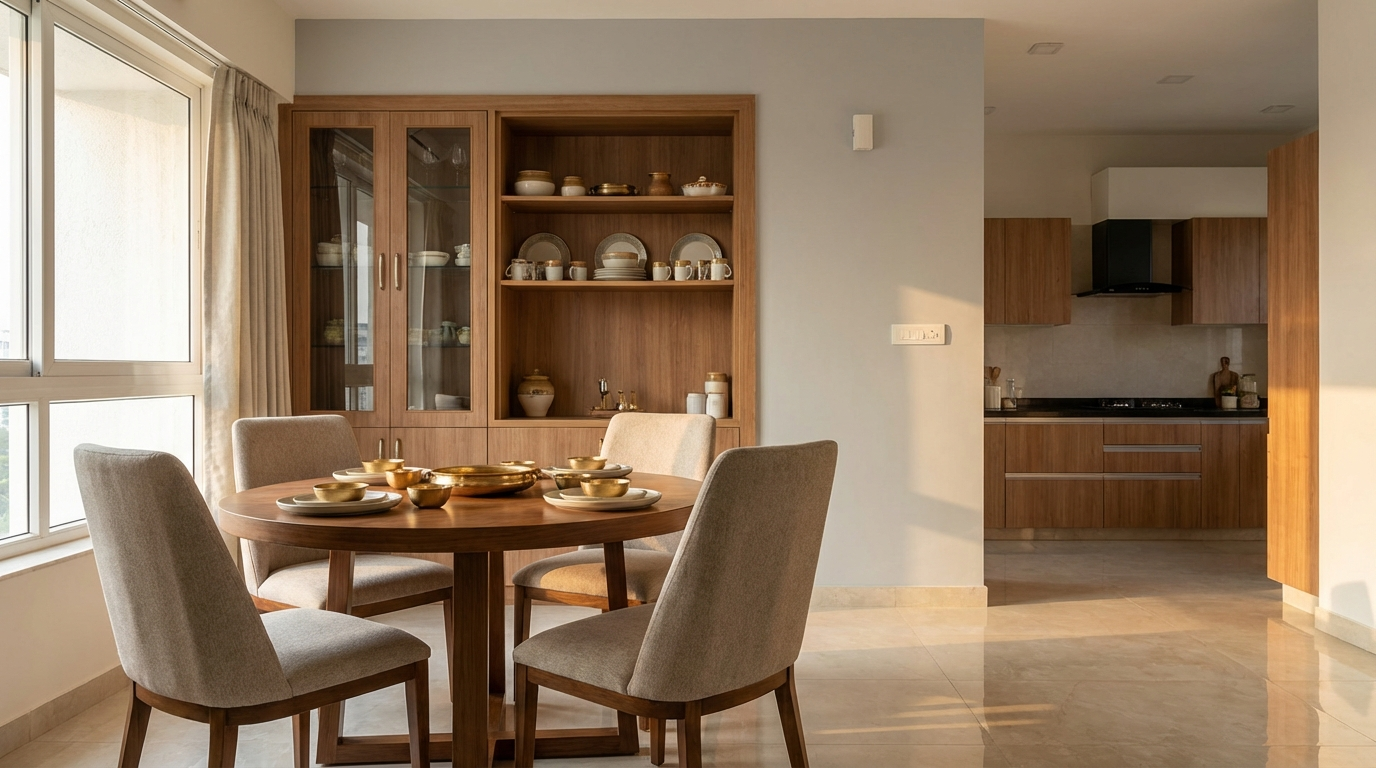
The best dining area design for Indian homes combines open sightlines, climate-appropriate materials, and flexible seating that accommodates both daily meals and festive gatherings.
If you're in a hurry: For most Indian apartments, an open-plan dining zone adjacent to the kitchen works best—use a 4-6 seater solid wood or engineered wood table with BWR-grade plywood for any built-in seating or storage. Small homes benefit from wall-mounted folding tables or extendable designs. Modern layouts should prioritise pendant lighting over the table, moisture-resistant materials near kitchen zones, and storage-integrated furniture to maximise every square foot.
- Choose open-plan dining if: You have 800+ sq ft carpet area, prefer visual connectivity, and host frequently
- Choose compact dedicated dining if: You value formal meal settings, have elderly family members preferring traditional setups, or need acoustic separation from kitchen noise
- Avoid fully enclosed dining rooms if: Your flat is under 1000 sq ft, natural light is limited, or cross-ventilation is poor
- Avoid glass-top tables if: You have young children, live in earthquake-prone zones, or dislike constant fingerprint cleaning
Key takeaway: Design your dining area around how your family actually eats—daily casual meals need different solutions than weekend entertaining.
What Dining Area Design Actually Involves
Dining area design encompasses the spatial planning, furniture selection, lighting arrangement, and material choices that transform a eating zone into a functional, aesthetically pleasing space suited to Indian lifestyle patterns. It goes far beyond simply placing a table and chairs—it requires understanding traffic flow, family dynamics, climate considerations, and how the space connects to kitchen and living areas.
In Indian homes, dining areas serve multiple functions that Western design guides often overlook. The same space hosts daily family meals, festival preparations involving floor seating, homework sessions, work-from-home setups, and extended family gatherings during functions. This multi-purpose nature demands flexible design thinking rather than rigid dining room concepts imported from temperate climates.
Technical Components of Dining Design
A complete dining area design addresses several interconnected elements:
- Spatial allocation: Minimum 10x12 feet for a 6-seater setup with circulation space; compact designs need 8x10 feet minimum
- Furniture footprint: Standard 6-seater rectangular table requires 5x3 feet table surface plus 3 feet clearance on all sides for chair movement
- Vertical elements: Pendant height (30-36 inches above table), crockery unit placement, and wall treatment zones
- Service connectivity: Proximity to kitchen (ideally within 15 feet), access to wash area, and ventilation pathways
- Material selection: Table surface, chair construction, built-in storage carcass, and flooring—each requiring climate-appropriate choices
Common Misconceptions About Dining Design
Many homeowners believe dining area design is purely aesthetic, focusing on table styles and chair fabrics while ignoring structural requirements. The reality is that poor planning leads to cramped circulation, furniture that blocks doorways, inadequate lighting for evening meals, and storage shortfalls that create clutter. Another misconception is that formal dining rooms add value—in Indian metros where space is premium, an adaptable open dining zone typically offers better utility than a closed room used only during guests' visits.
India-Specific Reality Check: Climate, Culture, and Construction
Indian dining areas face unique challenges that generic design guides rarely address: monsoon humidity that warps furniture, coastal salt air that corrodes hardware, joint family dynamics requiring expandable seating, and festival seasons demanding floor-level serving arrangements. Understanding these realities prevents expensive design mistakes.
Monsoon and Humidity Considerations
During June-September, relative humidity in Mumbai, Kolkata, Chennai, and Kerala coastal areas routinely exceeds 80-90%. This moisture penetrates wood furniture, causes veneer delamination, swells MDF components, and creates ideal conditions for fungal growth. Dining furniture in these zones requires:
- BWR or BWP grade plywood (minimum IS 303 Type 1) for any built-in components
- Solid wood tables with proper seasoning—teak, sheesham, or rubber wood with moisture content below 12%
- Avoid particle board or plain MDF for dining storage units—HDHMR with proper edge banding is the minimum acceptable alternative
- Metal or cane chairs over fully upholstered options that trap moisture
- Gap between furniture and walls (minimum 2-3 inches) for air circulation
Regional Variations Across India
Design requirements vary dramatically by region:
| Region | Primary Challenge | Material Priority | Design Adaptation |
|---|---|---|---|
| Coastal cities (Mumbai, Chennai, Kochi) | Salt air corrosion, 85%+ humidity | Marine-grade ply, stainless steel hardware | Elevated furniture legs, ventilated storage |
| Eastern India (Kolkata, Guwahati) | Prolonged monsoon, termite risk | Termite-treated wood, BWR minimum | Raised platforms, easy-clean surfaces |
| Northern plains (Delhi NCR, Lucknow) | Extreme temperature swings, dry winters | Seasoned hardwood, avoid veneer cracking | Climate-controlled rooms, humidifier consideration |
| Southern plateau (Bangalore, Hyderabad) | Moderate humidity, hard water stains | Standard BWR, laminate over veneer | Water-resistant table tops |
| Dry zones (Rajasthan, Gujarat interior) | Low humidity causing wood shrinkage | Well-seasoned wood, avoid green timber | Joint-friendly designs, avoid tight fits |
Common Contractor Practices and Pitfalls
Local carpenters (mistris) often default to commercial-grade plywood for built-in dining furniture, which lacks moisture resistance. Always specify grade explicitly and verify ISI marks. Site storage of materials is another concern—plywood and MDF stored in open areas or against wet walls before installation absorbs moisture, leading to post-installation warping. Insist on covered, elevated storage and acclimatisation for 48-72 hours before cutting.
Design Ideas with Practical Material Choices
Dining area design ideas must balance visual appeal with material practicality. Below are 25+ concepts organised by layout type, each with specific material and dimension recommendations suited to Indian conditions.
Open-Plan Dining Ideas (Living-Dining Combined)
- Island counter dining: Kitchen island extending as breakfast counter—use 18mm BWR plywood carcass with 12mm quartz or granite top. Counter height 36 inches, overhang 12 inches for knee space. Best for 2-3 person casual meals.
- Visual partition with low crockery unit: 3-feet high unit separating living and dining—19mm calibrated BWR plywood, laminate finish, soft-close hinges. Creates zone definition without blocking light.
- Floor-level Japanese-style platform: Raised platform (8-12 inches) with cushion seating—marine plywood base for moisture resistance, storage drawers underneath. Suits traditional joint families comfortable with floor sitting.
- Floating bench along wall: Wall-mounted bench seating with table—18mm BWR plywood with MS angle support brackets at 24-inch intervals. Saves floor space, adds 4-6 seats.
- Round table central placement: 4-foot diameter solid wood table—allows 360-degree access, better conversation flow. Requires minimum 12x12 feet clear space.
- L-shaped banquette corner: Built-in L-seating with storage below—19mm plywood, foam cushioning with removable washable covers. Maximises corner utility.
Small Space Dining Solutions (Under 600 sq ft homes)
- Wall-mounted folding table: Hinged mechanism on 18mm plywood panel—folds flat when not in use. Murphy bed suppliers offer integrated dining solutions.
- Extendable console-to-dining: Console table against wall extends to 6-seater—engineered wood with metal extension mechanism. Collapsed footprint 18 inches depth.
- Bar-height counter along kitchen wall: 42-inch height counter, 12-inch depth—stool seating saves floor space. Use scratch-resistant laminate top.
- Nesting table set: Multiple tables that stack—solid wood or metal frame with wood top. Pull out during gatherings, nest when not needed.
- Window-adjacent drop-leaf: Table hinged to window sill area—natural light, space-efficient. Ensure wall can bear weight; use proper wall plugs in brick/concrete.
- Bench with storage replacing chairs: Two benches with lift-top storage instead of 6 chairs—reduces visual clutter, adds storage. 18mm BWR plywood construction.
Modern Indian Dining Concepts
- Minimal Scandinavian-Indian fusion: Light oak-finish laminate furniture, white walls, single pendant light, indoor plants. Use pre-laminated MDF only in AC-controlled spaces.
- Industrial exposed brick backdrop: Exposed brick or brick-finish tiles on one wall, metal-frame table with wood top, vintage pendant lights. Ensure proper sealing of brick to prevent dust.
- Traditional South Indian brass accent: Dark wood table, brass urli centrepiece, cane chairs, traditional pendant. Teak or rosewood (if budget permits) with natural polish.
- Rajasthani carved jharokha accent wall: Decorative carved panel behind dining—can use CNC-cut MDF painted to match interiors if budget constraints exist.
- Contemporary marble-top with gold accents: Italian marble or engineered quartz top on brass-finish base. Seal marble quarterly to prevent staining from turmeric and curries.
- Boho-chic with macramé and rattan: Rattan chairs, jute rug, macramé wall hanging, live-edge wood table. Natural materials need monsoon-season care.
What Works Specifically in Indian Homes
Several design elements particularly suit Indian dining culture:
- Lazy Susan or revolving centre: Essential for Indian thali meals where multiple dishes need access—glass or wood rotating platform on table centre
- Extended table options: Guest capacity often doubles during festivals—butterfly extension or separate folding tables that match
- Easy-clean surfaces: Turmeric, oil, and curry stains are inevitable—laminate, glass, or sealed stone tops over raw wood
- Under-table storage: Drawers or shelf in table frame for placemats, table cloths, serving accessories
- Dimmer-controlled lighting: Bright for daily meals, ambient for entertaining
Is Open-Plan Dining Suitable for Indian Cooking?
Open-plan dining works well for Indian homes when proper ventilation and design barriers address cooking odour and smoke concerns. The key is strategic kitchen layout rather than avoiding open concepts entirely. A well-designed chimney (minimum 1200 m³/hr suction for Indian cooking), positioned hob away from the dining sightline, and a semi-partition like a breakfast counter create effective separation without visual blockage.
For homes where heavy tadka and deep frying happen daily, consider a closed wet kitchen for actual cooking with an open dry kitchen/pantry area adjacent to dining. This hybrid model preserves openness while containing odours. In rental apartments where structural changes aren't possible, ceiling-mounted air curtains or strategic cross-ventilation through window placement can reduce odour drift toward dining zones.
How to Choose Dining Furniture: 5-Step Decision Framework
Selecting dining furniture requires systematic evaluation rather than impulse buying based on showroom appeal. Follow this framework to avoid costly mistakes.
Step 1: Measure and Map Your Space
- Measure room dimensions including door swing paths and window projections
- Mark electrical points, switches, and AC unit locations
- Calculate available area after deducting 3-foot circulation paths
- Consider future changes—AC installation, storage addition
Step 2: Define Daily Capacity and Occasional Maximum
- Count regular daily diners (typically 3-5 in nuclear families)
- Estimate maximum gathering size during festivals/functions (often 10-15 in Indian families)
- Choose table size for daily use + extension/additional seating for occasions
- Rule of thumb: 24 inches width per person for comfortable seating
Step 3: Evaluate Material Based on Location Climate
- High humidity zones: BWR plywood minimum, teak/sheesham solid wood, avoid MDF carcass
- Moderate zones: Commercial plywood with good laminate acceptable for storage units
- AC-controlled spaces: Wider material options including quality MDF and particle board
- Check ISI certification for plywood; verify seasoning for solid wood
Step 4: Match Style to Overall Home Aesthetic
- Identify dominant design language of living area—modern, traditional, transitional
- Select complementary (not necessarily matching) dining furniture
- Consider sightlines from living room and kitchen
- Factor in wall colours and flooring when selecting furniture finish
Step 5: Verify Build Quality Before Purchase
- Check underside of tables for construction quality—corner bracing, joint tightness
- Sit on chairs and test stability—no wobbling, adequate back support
- Open and close storage unit doors—smooth operation, proper alignment
- Verify hardware quality—branded soft-close hinges, proper drawer channels
Red flags to avoid: Showroom-only pricing without installation costs, unclear warranty terms, pressure to decide immediately, reluctance to show material specifications, and unusually low prices for branded materials.
Head-to-Head Comparison: Dining Table Materials
Choosing the right table material impacts durability, maintenance, and long-term satisfaction. This comparison covers materials commonly available in Indian markets.
| Material | Durability | Maintenance | Cost Range | Best For | Avoid If |
|---|---|---|---|---|---|
| Solid Teak | Excellent (25+ years) | Annual oiling, occasional polishing | ₹40,000-1,50,000+ | Traditional homes, heirloom furniture | Tight budget, modern aesthetic preference |
| Solid Sheesham | Very Good (15-20 years) | Regular dusting, periodic polish | ₹25,000-80,000 | North Indian traditional, good value | Coastal areas (prone to moisture damage) |
| Engineered Wood (Plywood + Veneer) | Good (8-12 years) | Low—laminate wipe-clean | ₹15,000-40,000 | Budget-conscious, modern finish | Heavy daily use, desire for natural wood feel |
| Glass Top (Tempered) | Moderate (surface scratches over time) | High—frequent cleaning needed | ₹20,000-60,000 | Small spaces (visual lightness), modern look | Families with children, heavy entertaining |
| Marble/Granite Top | Excellent (surface stain risk) | Needs sealing, careful cleaning | ₹35,000-1,20,000 | Luxury appearance, formal dining | Turmeric-heavy cooking, budget constraints |
| MDF with Laminate | Moderate (5-8 years) | Very Low—wipe clean | ₹8,000-25,000 | Rental homes, temporary setups | Humid climates, long-term investment |
Choose solid wood when: You want generational furniture, prefer natural aesthetics, and can invest in maintenance. Choose engineered options when: Budget is primary concern, you prefer uniform finishes, or plan to upgrade within 10 years.
Lighting Design for Dining Areas
Proper dining area lighting combines ambient illumination with task-focused fixtures to create functional yet atmospheric spaces. The pendant light above the dining table serves as the primary design element, but supporting lighting ensures versatility for different uses.
What Height Should Dining Pendant Lights Hang?
Pendant lights should hang 30-36 inches above the table surface for standard 8-9 foot ceiling heights. This positioning provides adequate illumination for the table without obstructing sightlines across it. For higher ceilings, add 3 inches of drop per additional foot of ceiling height. The fixture's bottom edge, not the canopy, determines this measurement. For linear tables, choose linear pendants or a row of pendants spaced 24-30 inches apart. Round tables suit single drum or cluster pendants centred precisely over the table.
Layered Lighting Approach
- Primary pendant: 60-100 watt equivalent over table, warm white (2700-3000K) for flattering food appearance
- Wall sconces or picture lights: Accent artwork or crockery display, create depth
- Recessed downlights: General ambient light, especially useful in open-plan spaces
- Under-cabinet lighting: If crockery unit is adjacent, highlight display pieces
- Dimmer controls: Essential for adjusting from bright daily meals to ambient dinner parties
Common Lighting Mistakes to Avoid
Installing a single ceiling-mount fixture too far from the table creates shadows and uncomfortable glare. Choosing cool white (5000K+) bulbs makes food look unappetising. Over-relying on recessed lighting without a pendant loses the design opportunity. Installing non-dimmable fixtures limits flexibility.
Storage Solutions for Dining Areas
Indian dining spaces require substantial storage for crockery, serving ware, table linens, and occasional-use items. Integrating storage into dining design maintains aesthetics while addressing practical needs.
Crockery Unit Design Considerations
The traditional crockery unit remains relevant in Indian homes but requires modern material choices. Use 18-19mm BWR plywood for carcass in humid areas; HDHMR with proper edge banding works in controlled environments. Include a combination of closed cabinets (for everyday items), glass-fronted display sections (for decorative pieces), and drawers (for cutlery and linens).
Depth should be minimum 15 inches for dinner plates, 18 inches if storing serving platters. Height should account for ceiling clearance and top-shelf accessibility—units above 6 feet need step access for upper sections. Include internal lighting for display sections—LED strips with door-activated switches work well.
Alternative Storage Options
- Sideboard/buffet: Lower height (30-36 inches), useful as serving surface during gatherings
- Open shelving: Budget-friendly, easy access, but requires organised maintenance
- Built-in niche storage: Utilises wall recesses, doesn't occupy floor space
- Under-bench storage: If using banquette seating, storage below is efficient
- Table with integrated storage: Drawers or shelf in table frame for everyday items
Hardware Selection for Dining Storage
Quality hardware significantly impacts daily usability. Specify soft-close hinges (Hettich, Hafele, or equivalent local brands like Ebco) for cabinet doors—prevents slamming and extends hinge life. Use full-extension drawer channels for cutlery drawers—100% access is essential for deep drawers. Glass door hinges need proper rating for glass weight. Avoid unbranded hardware regardless of initial cost savings—replacement and adjustment become recurring problems.
Common Buyer Mistakes in Dining Area Design
Avoiding these frequent errors saves money, time, and frustration. Each mistake includes the underlying cause and prevention strategy.
Mistake 1: Choosing Table Size Based on Room Size, Not Family Size
What goes wrong: Homeowners select the largest table that fits, resulting in cramped circulation or unused capacity. Why it happens: Showroom tables appear smaller in large display spaces, and buyers want to maximise investment. How to avoid: Base primary selection on daily users plus 2, use extension mechanisms for occasions.
Mistake 2: Ignoring Chair Dimensions
What goes wrong: Chairs are too tall for table, arm rests don't fit under table, or seat depth is uncomfortable. Why it happens: Chairs are often bought separately from tables or selected visually without sitting test. How to avoid: Measure seat height (17-19 inches standard), arm rest clearance, and seat depth (15-18 inches). Always sit-test for comfort.
Mistake 3: Selecting Materials Unsuitable for Local Climate
What goes wrong: MDF crockery units swell in Mumbai monsoons, veneer delaminates in Chennai humidity, solid wood cracks in Rajasthan dry heat. Why it happens: Material selection based on showroom appearance rather than technical suitability. How to avoid: Consult this guide's regional material recommendations, verify ISI grades, and demand written specifications.
Mistake 4: Poor Lighting Placement
What goes wrong: Light fixture installed in room centre rather than over table centre—shadows on dining surface when table is positioned. Why it happens: Electrical points fixed before furniture layout finalised. How to avoid: Finalise table position before electrical work, or install track lighting for adjustability.
Mistake 5: Neglecting Ventilation Near Kitchen-Adjacent Dining
What goes wrong: Cooking odours permeate dining furniture and soft furnishings, oil residue settles on surfaces. Why it happens: Open-plan enthusiasm without technical solutions for Indian cooking. How to avoid: Plan chimney capacity, consider air curtains, position dining away from direct cooking sightline.
Mistake 6: Overlooking Storage Requirements
What goes wrong: Insufficient crockery storage leads to cluttered counters, makeshift arrangements, or expensive post-construction additions. Why it happens: Storage planned after furniture budget is exhausted, or underestimation of Indian household crockery volumes. How to avoid: Inventory existing items plus 30% growth, design storage accordingly, build into initial budget.
Mistake 7: Buying Complete Sets Without Customisation Consideration
What goes wrong: Ready-made dining sets don't fit space dimensions, style doesn't integrate with home aesthetics, or quality is inconsistent. Why it happens: Ready sets appear cost-effective and convenient. How to avoid: Evaluate custom versus ready options—custom costs 20-40% more but ensures fit, quality, and style consistency.
Quality Checks Without Lab Equipment
These field-verification techniques help identify quality issues before purchase or during delivery inspection.
Visual Inspection Points
- Check plywood core by examining cut edges—even layers, no gaps or voids, consistent thickness
- Veneer surfaces should show no bubbling, consistent grain pattern, secure edge bonding
- Laminate edges must be flush, no lifting at corners, consistent colour without discolouration
- Joints should be tight—no visible gaps, glue squeeze-out indicates rushed work
- Hardware alignment—doors should hang straight, drawers should slide smoothly without binding
Simple Field Tests
- Weight test: Quality plywood feels substantial—commercial grade is noticeably lighter than BWR for same dimensions
- Tap test: Knock on plywood surface—hollow sound indicates core voids, solid sound suggests dense core
- Flex test: Standard 18mm plywood shouldn't flex significantly when pressed in centre of unsupported 2-foot span
- Edge check: Run finger along cut edges—splintering indicates poor quality or dull cutting tools
- Smell test: Strong chemical odour suggests high formaldehyde content or fresh unseasoned wood
Questions to Ask Dealer or Carpenter
- What is the exact plywood grade and brand? Can I see the ISI mark?
- What is the warranty period, and what does it cover?
- For solid wood: What is the moisture content? How long was seasoning?
- What hardware brand is being used? Can I see the box or invoice?
- What is included in the quoted price—installation, transportation, edge finishing?
- Can I see a similar completed project or get reference contacts?
Workmanship and Installation Guidelines
Proper installation practices ensure your dining furniture performs as designed. Share these requirements with your carpenter or modular kitchen vendor.
Cutting and Edge Sealing
All plywood and MDF cuts must use sharp blades to prevent chipping. Exposed edges require sealing within 24 hours—PVC edge banding for laminates, veneer tape for veneered surfaces. Unsealed edges absorb moisture and lead to swelling. For built-in units, ensure back panels are also edge-sealed where exposed to wall moisture.
Fastening and Screw Selection
Plywood requires proper pilot holes—direct screwing splits the core. Use appropriate screw length: 25mm for 12mm panels, 35mm for 18mm panels. In high-stress zones (hinges, drawer channels), use screw-gripping inserts or confirm screws enter cross-grain sections for better holding power. MDF requires specific MDF screws with coarser threads.
Hinge and Hardware Zones
Heavy crockery unit doors need three hinges minimum—standard two-hinge mounting leads to sagging over time. All soft-close mechanisms require precise alignment during installation—rushed fitting causes premature failure. Drawer channels must be perfectly parallel—even 2mm deviation causes binding. Test all hardware before final installation, not after unit is positioned.
Site Storage Before Installation
Materials should never be stored directly on concrete floors—use wooden battens to allow air circulation. Protect from direct sunlight and rain. In monsoon months, extend acclimatisation period to 72 hours minimum. Verify moisture content hasn't changed between factory and site.
Carpenter Briefing Checklist
- Share exact design drawings with all dimensions
- Specify material grades in writing—brand and ISI marks
- Confirm hardware specifications before work begins
- Establish payment milestones linked to inspection points
- Agree on timeline with penalties for delays
- Document everything—photos of material delivery, work in progress
Price Considerations and Budget Planning
Dining furniture costs vary significantly based on material, construction method, brand, and city. Understanding cost drivers helps realistic budget planning.
Why Dining Furniture Prices Vary
For similar-looking 6-seater dining sets, prices can range from ₹15,000 to ₹2,00,000 or more. Key variables include:
- Wood type: Teak costs 3-5x more than rubber wood; solid wood costs more than engineered wood
- Construction quality: Mortise-tenon joints cost more than dowel joints; proper bracing adds material and labour
- Finish quality: PU coating costs more than melamine; multiple coats add to cost
- Hardware: Branded soft-close components add ₹3,000-8,000 per unit
- Customisation: Made-to-measure costs 20-40% more than standard sizes
- City variation: Mumbai and Bangalore prices are typically 15-25% higher than tier-2 cities
Budget Estimation Method
For planning purposes, use these thumb rules (2026 market, mid-range quality):
- 6-seater engineered wood dining table: ₹25,000-45,000
- 6 dining chairs (basic): ₹15,000-30,000
- 6-seater solid sheesham set: ₹50,000-90,000
- Crockery unit (6x7 feet, laminate): ₹40,000-70,000
- Pendant light (decent quality): ₹5,000-15,000
- Complete dining room setup (mid-range): ₹1,00,000-2,00,000
Add 10-15% contingency for unexpected requirements. Factor transportation separately if not included. Installation costs for built-in units typically add 5-10% to material cost.
Can Small Apartments Have Dedicated Dining Areas?
Small apartments under 700 sq ft can absolutely incorporate functional dining areas with smart design choices. The key is selecting appropriately scaled furniture and embracing multi-functional solutions rather than forcing standard dining sets into inadequate spaces.
A 4-seater round table with 3.5-foot diameter fits comfortably in spaces as small as 8x8 feet. Wall-mounted drop-leaf tables need only 18 inches depth when folded. Bar-height counters along kitchen walls provide dining function with minimal floor area impact. Corner L-seating maximises awkward spaces that would otherwise remain unused.
The psychological impact of having a defined eating space—even a small one—contributes to better meal routines and family connection compared to eating on sofas or beds. Prioritise the function even in limited square footage.
How Long Does Dining Furniture Last in Humid Conditions?
Furniture lifespan in humid Indian conditions depends entirely on material selection and maintenance practices. With appropriate choices, dining furniture can last 15-25 years even in challenging environments.
Solid teak with proper maintenance easily exceeds 25 years in coastal areas—the natural oil content resists moisture penetration. Sheesham lasts 12-18 years with annual oiling and climate-controlled homes. BWR-grade plywood furniture typically performs well for 10-15 years with proper edge sealing. MDF components in high-humidity zones rarely exceed 5-7 years before showing swelling or delamination, regardless of surface finish quality.
Key maintenance practices that extend lifespan include: maintaining furniture legs off floor contact with felt pads, ensuring minimum 2-inch gap from walls for air circulation, using dehumidifiers during peak monsoon in closed rooms, and immediately addressing any water spillage. Our detailed guide on moisture-resistant plywood selection covers material grades in depth.
Frequently Asked Questions
What is the ideal dining table size for a family of 4 in an Indian apartment?
A rectangular 4-seater table measuring 4 feet by 2.5 feet (120cm x 75cm) accommodates a family of four comfortably for daily meals. This size allows 24 inches per person along the table length with adequate elbow room. For occasional guests, keep two additional stackable chairs or choose an extendable table design that expands to 5-6 feet when needed. Round tables of 3.5-foot diameter work equally well for four people and often feel more conversational, though they're less efficient for serving Indian thali-style meals where multiple dishes spread across the surface.
Is marble or granite better for a dining table top in Indian homes?
Granite is generally more practical for Indian dining tables than marble despite marble's aesthetic appeal. Marble is porous and readily absorbs staining agents—turmeric, tomato-based curries, and lemon juice cause permanent discolouration even with sealants. Granite offers better stain resistance though neither is impervious. If you prefer the marble look, consider engineered quartz which provides similar aesthetics with superior stain resistance and doesn't require periodic sealing. Whichever stone you choose, plan for coasters and immediate spill cleanup as standard practice.
How can I make my small dining area look bigger?
Several design strategies create visual spaciousness in compact dining areas. Choose a glass-top table—the transparency maintains visual flow through the room. Select chairs with open backs rather than solid upholstery. Use a large mirror on one wall to double the perceived space. Keep the colour palette light—white or pale wood tones reflect light better than dark finishes. Avoid bulky crockery units; instead, use wall-mounted shelving that doesn't consume floor space. Adequate lighting, particularly from pendant fixtures that draw the eye upward, contributes to spaciousness perception.
What is the best wood for dining furniture in coastal Indian cities?
Teak remains the gold standard for coastal environments like Mumbai, Chennai, Kochi, and Goa. Its natural oil content and dense grain structure resist moisture penetration and fungal growth better than any other commonly available wood. Plantation teak from Kerala or Burma teak (if available) both perform well. Sheesham (rosewood) is a distant second—acceptable in AC-controlled dining rooms but prone to warping with direct humidity exposure. Avoid rubber wood, mango wood, or pine in coastal areas regardless of price advantages. For built-in furniture, marine-grade plywood (BWP/IS 710) is essential.
Should I choose a round or rectangular dining table?
The choice depends on your space shape, family size, and dining style. Rectangular tables accommodate more people (6-8 easily) and suit Indian serving styles where multiple dishes spread across the table—passing food is easier. They fit efficiently in long, narrow spaces common in apartments. Round tables create intimate settings, allow everyone to face each other, and work better in square rooms—they also eliminate sharp corners, making them safer for young children. For families of four or fewer, round tables often feel more connected. Larger families typically prefer rectangular options.
Can I use MDF furniture in my Mumbai dining room?
Plain MDF is not recommended for Mumbai's humidity levels (80-95% during monsoons). Even sealed MDF absorbs moisture through edges and hardware holes, leading to swelling and structural failure within 3-5 years. If budget constraints necessitate MDF-based products, choose HDHMR (High Density High Moisture Resistance) with all edges properly sealed using PVC edge banding—not just paint or melamine. Ensure the dining room has good ventilation or AC usage. For built-in crockery units, BWR plywood remains the safer choice for Mumbai conditions despite the cost difference.
What colour should I paint my dining room walls?
Dining room wall colours should enhance the eating experience without overwhelming the space. Warm tones—terracotta, ochre, warm beige, soft coral—are traditionally considered appetite-stimulating and create inviting atmospheres. Cool greys and blues work well in modern minimalist settings but should be balanced with warm lighting. Dark accent walls (deep green, navy) can add drama in larger dining rooms but make small spaces feel cramped. Consider the lighting—north-facing rooms need warmer paint tones to counteract cool natural light, while west-facing rooms can handle cooler tones.
How much clearance should I leave around the dining table?
Minimum clearance of 36 inches (3 feet) around all seated edges of the table is necessary for comfortable chair movement. This allows chairs to be pulled out fully and people to pass behind seated diners. Against a wall or bench seating, this can reduce to 24 inches since chairs won't be moved on that side. Between the table and any fixed furniture (crockery unit, sideboard), maintain 42-48 inches for both seated clearance and walking passage. These measurements assume standard dining chair dimensions—larger chairs with arms need additional space.
Is it worth getting a custom dining table made by a local carpenter?
Custom dining furniture from skilled carpenters often provides better value than mid-range manufactured products, particularly for solid wood pieces and non-standard dimensions. You get exact sizing for your space, material verification, and construction transparency. However, success depends heavily on carpenter skill level—request to see previous work and client references. Custom makes sense when: your space has unusual dimensions, you want specific wood species, or manufactured options don't match your aesthetic. Factory-made furniture may be preferable when you need complex mechanisms (extension systems), prefer warranty protection, or lack access to skilled craftsmen.
What type of dining chair is most comfortable for long meals?
For extended Indian meals involving multiple courses over an hour or more, chairs with these features provide best comfort: seat depth of 16-18 inches (too deep causes back strain), slight backward seat tilt (3-5 degrees), lumbar support in the backrest, and cushioning of medium firmness (too soft causes posture issues over time). Fully upholstered chairs with foam padding offer superior comfort over bare wood but require more maintenance and may absorb odours in kitchen-adjacent dining areas. Consider removable, washable seat covers for practicality.
How do I protect my dining table from turmeric stains?
Turmeric staining is a common concern with Indian cooking. Prevention is easier than removal—use placemats and table runners during meals, and immediately wipe any spills with damp cloth before the stain sets. For table surface selection, laminate tops resist staining best; glass tops are impervious but show fingerprints. Solid wood requires sealing with polyurethane—natural oil finishes don't protect against turmeric. For marble or stone, apply impregnating sealer every 6 months. If stains occur on wood, sunlight exposure often fades turmeric naturally over several days. Our furniture care guide covers detailed stain removal methods.
Can I place my dining table near an east-facing window?
East-facing windows provide excellent natural light for breakfast and morning meals without harsh afternoon sun that causes fading. This orientation works well for dining tables, though consider a few factors. Morning sun can create glare during winter months—sheer curtains help diffuse light. Wood furniture in direct sunlight may fade unevenly over years—rotate or use UV-protective window film. The warmth from morning sun is pleasant in winter but may feel uncomfortable in summer—ensure adequate cross-ventilation or AC access. Overall, east-facing is among the better orientations for dining areas compared to harsh west-facing exposure.
What is the difference between a dining room and dining area?
A dining room is a separate, enclosed space dedicated to dining with walls defining its boundaries—common in larger homes and traditional floor plans. A dining area (or dining zone) refers to an open section within a larger multipurpose space, typically sharing floor area with living rooms or kitchens without wall separation. Modern Indian apartments predominantly feature dining areas rather than rooms due to space constraints and preference for open layouts. Both serve the same functional purpose, but design considerations differ—dining rooms can feature darker colours and formal styling, while dining areas must coordinate with adjacent spaces.
How often should I polish my wooden dining table?
Polishing frequency depends on finish type and usage intensity. Lacquered or PU-coated tables need buffing every 3-4 months with appropriate furniture polish—avoid silicone-based products that build up residue. Natural oil-finished tables (teak oil, Danish oil) benefit from fresh oil application every 6-12 months or when the surface appears dry. Wax-finished surfaces need re-waxing annually. Daily care matters more than periodic polishing—use coasters, clean spills immediately, and avoid harsh chemical cleaners. Signs that polishing is overdue include: water doesn't bead on surface, finish looks dull despite cleaning, or minor scratches become visible.
Final Considerations for Your Dining Space
Creating an effective dining area design requires balancing aesthetic preferences with the practical realities of Indian living—family dynamics, climate challenges, and multi-purpose space usage. The best dining spaces aren't necessarily the most expensive or trend-following; they're the ones that work seamlessly for daily meals while gracefully accommodating occasional gatherings.
Start your design process by understanding how your family actually uses the space—observe current patterns, pain points, and wishlist items. Only then select furniture, materials, and layouts that address real needs rather than showroom aspirations. Invest in quality where it matters most: a sturdy, well-constructed table that will see daily use for years, and proper hardware for storage units that will be opened thousands of times.
The dining area represents a significant investment in your home's functionality and your family's daily experience. Taking time to plan thoughtfully, choosing climate-appropriate materials, and working with skilled craftsmen or reputable manufacturers will result in a space that serves you well for decades. For specific guidance on plywood grades suitable for built-in dining furniture, our detailed material guides cover technical specifications and brand comparisons relevant to your region.
Disclaimer: This content is provided for general informational purposes based on industry practices and publicly available information. Product specifications, standards, prices, and availability may vary by manufacturer, region, and time. Readers should independently verify details with manufacturers, dealers, or qualified professionals before making purchase or construction decisions.Want Plywood Suggestions?
Share a few details and a Sainik 710 specialist will suggest suitable brands and connect you to responsive dealers.