Cupboard Design for Bedroom: 30+ Modern Storage Ideas with Material & Size Guide
Explore 30+ cupboard designs for bedroom—wooden, modern & wall-mounted options. Get storage solutions, material guide & price range for Indian homes.
Quick Answer: Bedroom Cupboard Design That Actually Works
The best cupboard design for bedroom storage combines your room's actual dimensions, the plywood grade suited to your city's humidity, and internal configurations that match how you actually dress—not some generic showroom template.
Short version: Most bedroom cupboard designs fail because people pick style before substance. A gorgeous laminate finish on MR-grade plywood will bubble up in Mumbai's monsoon. A well-planned 18mm BWR ply cupboard with properly sized hanging space, adjustable shelves, and edge-banded surfaces will look good and work well for 15-20 years. Focus on materials first, dimensions second, aesthetics third.
This guide is right for you if:
- You're building new wardrobes or replacing damaged ones
- Your carpenter is asking questions you don't know how to answer—18mm or 16mm? BWR or commercial?
- You've seen cupboards in other homes that warped, sagged, or fell apart and want to avoid that mess
- Budget matters but you're willing to spend sensibly
Skip this if:
- You're buying ready-made furniture from a store—this is about custom work
- You just want pretty pictures without the technical stuff
Bottom line: Bedroom storage that lasts starts with the right material and proper measurements—everything else is decoration.
What Cupboard Design Actually Means (Beyond the Pictures)
Cupboard design for bedroom refers to the complete planning of freestanding or built-in storage units—including material selection, internal layout, door mechanisms, and finish choices—tailored to your specific room dimensions and storage needs. It's not just about how the thing looks from outside; it's about whether your saris stay wrinkle-free, your shoes have a home, and your winter quilts don't crush your shirts.
Most people think cupboard design means picking a door style and maybe a colour. Actually, about 70% of what makes a cupboard work well is invisible—the carcass material, shelf spacing, back panel thickness, and how the carpenter handles joints and edges. The exterior is maybe 30% of the equation.
Here's what I tell my clients: think of it like a car. Everyone notices the paint colour and the dashboard. But you're really buying an engine, transmission, and frame. Same logic applies here. That glossy PU finish everyone loves? Useless if the 12mm back panel warps because someone used cheap commercial ply in a humid climate.
A proper cupboard design accounts for your room's layout, how much light it gets, the wall material (brick vs drywall makes a difference for anchoring), ceiling height, door clearances, and—this part is almost always missed—how the doors will open without hitting your bed or blocking a window.
Why This Matters Specifically in Indian Homes
I've been doing this for 18 years across Maharashtra and Gujarat. The number one cupboard killer in India isn't termites, bad carpentry, or poor maintenance. It's humidity. Full stop.
In Mumbai, Chennai, Kolkata, and the entire coastal belt, relative humidity hits 80-95% during monsoon. Even inland cities like Bangalore and Hyderabad see 65-75% RH in certain months. That moisture gets into your plywood and particleboard. If the material isn't appropriate and the edges aren't sealed, things swell. Doors stop closing properly. Drawers stick. The laminate starts lifting at corners.
In places like Chennai or Mumbai, you'll notice problems within the first two monsoons if you've used MR-grade plywood. I've seen brand-new cupboards—barely a year old—with bases completely ruined because the builder saved ₹2,000 on material grade. That false economy cost the owner ₹60,000+ to fix.
Compare this to Jaipur or Ahmedabad where dry heat is the enemy. There, you worry more about veneer cracking and wood splitting than moisture damage. Different climate, different problems, different material priorities.
The point is: cookie-cutter designs from Pinterest don't account for whether you're in Guwahati's humidity or Rajasthan's dryness. Your cupboard design needs to be climate-aware.
Is plywood actually necessary for bedroom cupboards?
Honestly, not always. For bedrooms in dry cities like Pune or Bangalore, good-quality HDHMR or MDF can work fine—and often costs less. But for anything in coastal areas or humid zones, I strongly recommend BWR-grade or marine plywood for the carcass. The internal parts—shelves that don't bear heavy loads—can sometimes use engineered boards. But load-bearing shelves, the base, and any area near external walls? Stick with ply. The durability difference over 10 years justifies the cost difference.
Types of Bedroom Cupboard Designs: What Works When
Let me break down the main categories. These aren't mutually exclusive—you can mix and match based on your room.
By Configuration
Hinged Door Wardrobes: Classic choice. Best when you have at least 2.5 feet clearance in front for doors to swing open. More traditional look. Allows you to see full wardrobe contents at once. Cheaper to build than sliding systems.
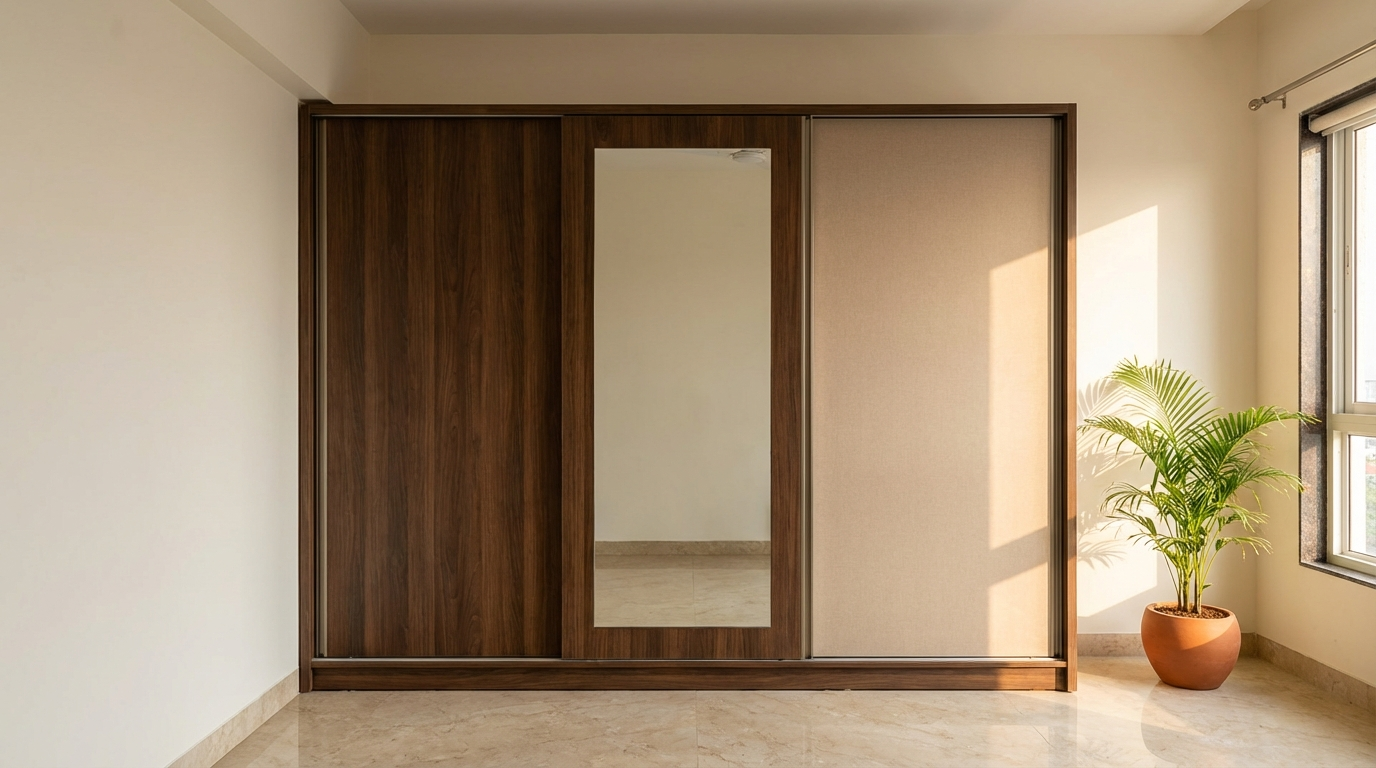
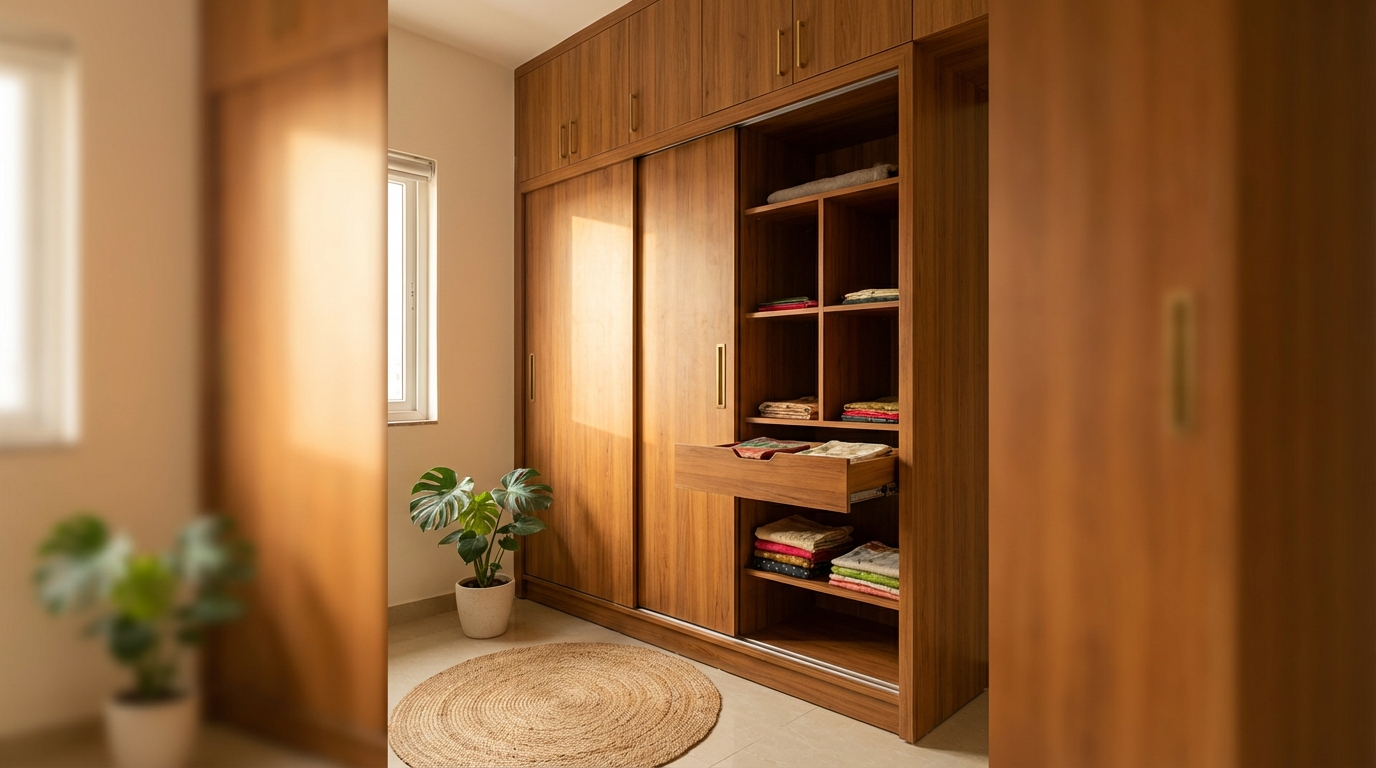
Sliding Door Wardrobes: Perfect for tight spaces—master bedrooms with bed close to the cupboard, or small rooms where swing doors would block movement. You lose some internal access (can only see half the cupboard at a time) but gain floor space. Higher cost due to track systems and hardware. The track quality really matters here—cheap aluminum tracks fail within 3-4 years. I've seen it happen in at least 40-50 homes.
Walk-In Closets: If you have a 6x6 feet or larger space to dedicate. Mostly open shelving and hanging rods without door costs. Feels luxurious but requires good ventilation to prevent mustiness. Works well in dry climates; in humid areas, you'll want dehumidifiers or good airflow.
Built-In Wall Units: Floor to ceiling, wall to wall. Maximizes storage. Makes the room feel more "finished" since there's no visible gap between cupboard top and ceiling. Costlier because of precise measurements and custom fitting. Worth it in premium homes.
By Door/Finish Style
Laminate Finish: Most common in India. Durable, affordable, huge range of colours and patterns. Good laminate (1mm thickness) lasts 10-15 years easily. Thinner laminate (0.7mm) is cheaper but scratches visibly.
Lacquered/PU Finish: High-gloss, premium look. Significantly more expensive. Shows fingerprints and dust easily—my wife hated ours until we got matte instead. Beautiful in showrooms, high-maintenance in real life.
Veneer: Real wood look without solid wood cost. Needs careful maintenance. Susceptible to humidity damage if not properly sealed. Gorgeous when done right.
Acrylic/Glass Panels: Modern, reflective surfaces. Makes rooms feel larger. More fragile than laminate. Fingerprint magnets. Popular in contemporary designs but not practical for everyone.
| Design Type | Best For | Avoid When | Cost Range (Relative) | My Take |
|---|---|---|---|---|
| Hinged Door | Rooms with 2.5ft+ clearance, traditional aesthetics | Very small rooms, beds close to cupboard | ₹₹ | Still my default recommendation—simpler, fewer failure points |
| Sliding Door | Compact bedrooms, modern look | If you want full wardrobe view at once | ₹₹₹ | Invest in quality tracks or don't bother |
| Walk-In | Large bedrooms, dressing room spaces | Humid climates without ventilation | ₹₹-₹₹₹₹ (depends on fittings) | Only if you have space AND a dehumidifier in humid areas |
| Wall-to-Wall Built-In | Maximizing storage, clean look | Rental homes, if you move frequently | ₹₹₹₹ | Worth it for long-term homes |
| Loft + Wardrobe Combo | Utilizing ceiling height for seasonal storage | Low ceilings under 9 feet | ₹₹₹ | Essential in Indian bedrooms—where else will you put suitcases? |
Standard Dimensions That Actually Work
Here's where most online guides give generic advice. Let me share what actually works in Indian homes with Indian clothes.
Overall Height: Standard ceiling in apartments is 9-10 feet. A typical wardrobe goes up to 7 feet with a loft on top reaching near ceiling. That 2-foot loft space is gold—use it for suitcases, bedding, and seasonal items. According to [homelane.com](https://www.homelane.com/design-ideas/wardrobe-design/wardrobe-dimensions-guide-indian-homes/), floor-to-ceiling configurations yield 42% more storage than standard units. Sounds about right from what I've seen.
Depth: Standard is 22-24 inches (roughly 55-60 cm). Going less than 20 inches means hangers don't fit properly—clothes brush against doors. Going more than 24 inches wastes space since you can't reach the back easily anyway.
Width per section: Keep each door section between 18-24 inches wide. Larger doors warp over time. Smaller doors mean more hinges and hardware cost. For sliding doors, each panel is typically 30-36 inches.
Hanging Rod Height: This is critical and most carpenters get it wrong. For saris and long ethnic wear: 60-65 inches from floor to rod. For shirts and kurtas: 40-45 inches (you can stack two hanging levels). For trousers on hangers: 45 inches.
Shelf Spacing: Don't fix all shelves at the same height. I recommend 12 inches for folded shirts, 15-16 inches for sweaters and bulky items, and at least one adjustable section.
Drawer Heights: Top drawers for small items: 4-5 inches internal. Middle drawers for clothes: 8-10 inches. Bottom drawers for heavy items: 10-12 inches.
What about corner wardrobes—are they worth it?
Corner cupboards have become trendy, and honestly, they make sense in certain rooms. If you have an L-shaped bedroom layout or wasted corner space, an L-shaped wardrobe [as mentioned by housing.com](https://housing.com/news/top-modern-bedroom-cupboard-designs-2022/) can add 15-20% more storage. But here's the catch: the internal corner becomes a dead zone unless you use rotating shelves or pull-out mechanisms—which add ₹8,000-15,000 to your cost. Without those, you'll stuff things in the corner and never see them again. So: worth it with proper hardware, not worth it if you're skipping the rotating internals.
Material Selection: The Most Important Decision You'll Make
Everything else is cosmetic. This part determines whether your cupboard lasts 5 years or 20.
For the Carcass (Main Body)
BWR Plywood (Boiling Water Resistant): My default recommendation for any humid city—Mumbai, Chennai, Kolkata, Goa, Mangalore, Kochi. It handles moisture far better than MR grade. Yes, it costs more. Worth every rupee in coastal areas.
Marine Plywood: Overkill for bedrooms unless you're in an extremely humid situation or the cupboard is against an external wall that sweats during monsoon. But if budget allows, no harm.
Commercial/MR Plywood: Fine for dry cities—Jaipur, Ahmedabad, interior Rajasthan, parts of Karnataka away from coast. In humid zones? Avoid. I've seen MR ply cupboards fail within 3 years in Mumbai. Not worth the risk.
HDHMR/MDF: Can work for internal shelves and partitions where moisture isn't a direct concern. Not recommended for carcass in humid areas. Good cost-effective option in dry climates. Our HDHMR guide covers this in more detail if you're considering it.
Particle Board: I actively discourage this for bedroom cupboards. Cheap yes, but absorbs moisture like a sponge. Screws don't hold well in it over time. The cupboard will literally fall apart at hinges within 4-5 years in humid conditions. The only place I'd use it is for extremely temporary furniture.
For Back Panels
Most people ignore this—big mistake. Back panels matter. Use at least 6mm plywood or 9mm for larger cupboards. Cheap 4mm hardboard backs warp and bow inward. I've opened cupboards where clothes were touching a curved back panel. Disgusting.
Thickness Guidelines
Carcass sides and top: 18mm plywood, non-negotiable. Some carpenters push 16mm to save cost—resist this for the main structure.
Shelves: 18mm for any span over 24 inches. For smaller shelves (16-18 inch span), you can get away with 16mm if you're watching budget. But wider shelves in 16mm will sag over time with clothes weight.
Doors: 18mm. Thinner doors warp—I've seen it dozens of times. The weight also helps doors close properly.
Drawer sides: 12mm is fine. Drawer bottoms: 6mm minimum, 9mm preferred.
Price Reality Check (2026 Market)
I'm not giving exact prices because they change and vary by city. But here's how to think about costs.
Basic wardrobe (per square foot of front face):
- MR ply + basic laminate: ₹800-1,100/sq ft
- BWR ply + good laminate: ₹1,000-1,400/sq ft
- BWR ply + veneer: ₹1,300-1,800/sq ft
- Marine ply + PU finish: ₹1,800-2,500/sq ft
A typical 8ft wide x 7ft tall wardrobe = 56 sq ft. At ₹1,200/sq ft, that's roughly ₹67,000 just for the cupboard. Add hardware (handles, hinges, soft-close mechanisms): ₹5,000-15,000 depending on quality. Add loft: another 15-20%. Internal fittings like pull-out trays, shoe racks, trouser hangers: ₹10,000-30,000 extra.
Here's what actually affects your final bill:
- Plywood grade—biggest factor
- Finish type—PU costs 2-3x laminate
- Hardware quality—Hettich/Hafele vs local makes a 3x difference
- Internal accessories—can double total cost if you go all-out
- Carpenter rates vary wildly by city and experience
Budget tip: Invest in good carcass material and basic internal fittings. You can always add accessories later. You cannot swap out a damaged carcass without rebuilding everything.
Internal Configuration: 30+ Layout Ideas That Actually Work
Now for the fun part. These configurations assume a typical 6-8 feet wide wardrobe. Mix and match based on your needs.
For Couples (Shared Wardrobe)
- Divide vertically: her section on left, his on right (or vice versa)
- Her side: one full-length hanging for saris/gowns, one double-hanging stack for kurtas, 3-4 shelves for folded items, 2-3 drawers for accessories
- His side: double-hanging stack for shirts and pants, one full-length for suits, more shelf space since men's clothes often fold better
- Center section: shared space—can be a mirror, or pull-out tie/belt rack
For Women Who Own Many Saris
This comes up constantly. Saris are tricky. You need either:
- Extra-deep drawers (8-10 inches) where saris lie flat—prevents permanent crease marks
- Sari rod system: rods spaced 2 inches apart where saris drape over multiple rods
- Or dedicated sari shelves: wider than normal (15-18 inch spacing) so folded saris don't crush each other
Whatever you do, don't cram saris into standard 10-inch shelves. The top ones crush the bottom ones. Silk gets damaged. I've had clients discover crushed Banarasis they forgot about. Heartbreaking.
For Small Bedrooms (Under 120 sq ft)
[Bysuryavanshi.com](https://bysuryavanshi.com/blogs/news/cupboard-design-for-small-bedroom) suggests sliding door cupboards save floor space, and that's accurate advice. But also consider:
- Using mirrors on wardrobe fronts to create illusion of larger space
- Extending wardrobe to ceiling—don't leave that dusty gap on top
- Light-colored finishes to avoid visual heaviness
- Building wardrobes into wall niches if your room has them
- Overhead storage above the bed as additional option
For Kids' Rooms
- Lower hanging rods so children can reach (adjustable is best—raise as they grow)
- More shelf space for toys and books—kids don't hang much
- Rounded corners on handles—safety first
- Fun colors or character laminates—let them choose within budget
- Lockable section for valuables or medicines
For Guest Bedrooms
- More empty hanging space (guests bring suitcases)
- Less drawer configuration
- Space for extra blankets and pillows
- Consider a luggage shelf at bottom—often overlooked
Smart Internal Fittings Worth Adding
- Pull-out trouser rack: Holds 8-10 trousers without folding. ₹2,000-4,000. Genuinely useful.
- Pull-out tie/belt rack: ₹1,000-2,000. Nice to have, not essential.
- Soft-close hinges: ₹150-300 per hinge. Absolutely worth it. Prevents door slamming and extends hinge life.
- Internal LED lighting: ₹1,500-5,000 depending on quality. More useful than you'd think, especially for deep cupboards.
- Pull-out mirror: ₹3,000-6,000. Great space-saver if you don't have a dressing table.
- Shoe rack insert: Essential. Keeps footwear organized. ₹1,500-4,000.
- Laundry basket pull-out: ₹2,500-5,000. Clever if you have space.
My honest recommendation: get soft-close hinges everywhere, internal lights in the hanging section, and a good shoe rack. Skip the fancy pull-outs initially—you can always add later.
Modern Design Trends Worth Knowing (2025-2026)
Quick detour into what's currently popular. Take what suits you, ignore the rest.
Handle-less Designs: Clean look using push-to-open mechanisms or J-profile handles built into the door edge. Looks fantastic. But: push-to-open mechanisms fail after 5-7 years typically. The J-profile option is more durable.
Combination Materials: Mixing wood textures with solid colors. Example: walnut laminate on the carcass, matte white on doors. Breaks visual monotony.
Integrated Dressing Tables: Carving out a section of the wardrobe for a mirror, small counter, and lighting. [Homelane.com](https://www.homelane.com/design-ideas/bedroom-design/modern-bedroom-cupboard-designs/) shows some good examples. Practical in rooms that can't fit a separate dressing unit.
Floor-to-Ceiling Without Loft Separation: Some newer designs eliminate the separate loft, making one continuous tall unit. Looks sleek but makes accessing top storage harder. You'll need a stool. Traditional loft with separate doors is more practical in my opinion.
Glass-Front Display Sections: A small section with glass door to display bags, accessories, or shoes. Nice touch if you have space. Fingerprints are the downside.
Fluted Panel Accents: Vertical grooves on select panels for texture. Currently trendy. Adds character without going overboard.
Common Mistakes People Make With Bedroom Cupboards
1. Ignoring the Back Panel
I've said this but it bears repeating. People spend lakhs on the front and use ₹50/sq ft hardboard at the back. That hardboard bows, absorbs moisture, and becomes the weak link. Use proper 6mm plywood minimum.
2. Wrong Plywood Grade for Their Climate
There was this couple in Vashi—nice flat, good budget. Went with MR ply because their contractor said "humidity is less on this side of Navi Mumbai." Rubbish. The entire Thane-Mumbai belt is humid. Two monsoons later, the wardrobe base was damaged beyond repair. ₹40,000+ to fix. Use BWR in coastal cities. Don't gamble.
3. Not Planning Electrical Points
If you want internal lights or a pull-out ironing board (yes, those exist), you need electrical points inside the wardrobe. Decide this BEFORE construction. Retrofitting is expensive and ugly.
4. All Fixed Shelves
Big mistake. Your storage needs change. Kids grow. You accumulate things. Have at least 2-3 adjustable shelves per section. The shelf-peg system is cheap and flexible.
5. Skipping Edge Banding
This one really frustrates me. Exposed plywood edges absorb moisture and look unfinished. Every single edge—including the ones "inside" that "nobody sees"—should have edge banding or lipping. Carpenters skip this because it's time-consuming. Insist on it.
6. Too-Deep Shelves
Anything deeper than 22-24 inches becomes a black hole. Things get pushed to the back and forgotten. If your cupboard must be deeper (some room layouts demand it), use pull-out drawers or baskets instead of fixed shelves for the extra depth.
7. Cheap Hardware
Local-made hinges cost ₹30. Hettich costs ₹150-200. Over 15 years, you'll replace local hinges 3-4 times. The premium hardware pays for itself. Same applies to drawer channels—soft-close Hettich or Hafele channels transform the user experience.
8. No Ventilation for Closed Cupboards
In humid areas, completely sealed cupboards can develop a musty smell. Some designs incorporate small ventilation gaps or grilles. At minimum, open your wardrobe doors periodically and consider silica gel packets or a small dehumidifier.
9. Forgetting About What's BEHIND the Cupboard
If your wardrobe sits against an external wall, that wall may be cold or damp during monsoon. You can get moisture migration. Solution: leave a 1-inch gap between cupboard and wall, or apply waterproofing to the back of the cupboard. I've seen carpenters push wardrobes flush against damp walls—disaster within 2 years.
Quality Checks You Can Do Yourself
Don't trust the dealer or carpenter blindly. Here's how to verify quality.
Visual Inspection
- Check the edge of the plywood sheet—you should see distinct, uniform layers
- Look for voids, gaps, or overlaps in the core
- Surface should be smooth, no patches or rough spots
- Laminate should be perfectly bonded—no bubbles or lifting at edges
- Color should be consistent across all pieces (sometimes batches vary)
- Check door alignment—close the doors and see if there's consistent gap around all edges
Questions to Ask Your Dealer/Carpenter
- "What grade plywood is this, and do you have the ISI certificate?"
- "What's the actual thickness—not nominal?"—measure it yourself
- "What brand laminate, and what thickness?"
- "How are you sealing the edges—PVC tape or solid wood lipping?"
- "What hinges and channels are you using? Show me the boxes."
Simple Field Tests
- Tap test: Knock on the board. Solid sound = dense core. Hollow echo = voids inside. Not perfect but indicative.
- Weight check: BWR ply is heavier than MR ply of same thickness. If it feels suspiciously light, question it.
- Flex test: Try to bend the sheet slightly. Quality ply resists flexing. Bendy boards mean poor core.
- Edge inspection: With a magnifying glass if possible, look at the core layers. Uniform, gapless layers indicate quality.
- Water drop test: Put a few drops on the surface. Quality boards won't immediately absorb or swell. Leave for 30 minutes and check.
Here's a Trick Most Dealers Don't Like
Ask to see the edge of a sheet they're cutting for someone else—not the pre-selected sample sheets. Samples are often cherry-picked. The stuff going into actual projects tells the real story. If they resist, that's a red flag.
What to Tell Your Carpenter: A Briefing Checklist
Print this out and hand it to your mistri. Seriously.
- Use 18mm BWR plywood for carcass, doors, and main shelves. Don't substitute MR grade without asking me first.
- Back panel must be minimum 6mm plywood, not hardboard.
- Every exposed edge—including internal surfaces—gets PVC edge banding or solid wood lipping. No exceptions.
- All hinges should be soft-close (I'll supply Hettich/Hafele if needed). Minimum 3 hinges per door for doors over 3 feet tall.
- Leave 1-inch gap behind cupboard if it's against an external wall.
- Show me all materials before you start cutting.
I've seen carpenters skip edge banding and then explain it away: "Sir, andar ka hai, kaun dekhega?" The moisture doesn't care who's looking. It'll find those raw edges and create problems you'll discover too late.
One more thing—acclimatize the plywood. If sheets have been stored in a godown, bring them to your flat 3-4 days before cutting. Let them adjust to your home's humidity. This reduces post-installation warping. Most carpenters rush through this step.
How Long Does a Bedroom Cupboard Really Last?
This depends on so many factors, but here's honest guidance.
A well-made cupboard with proper materials lasts 15-25 years for the main structure. Hardware (hinges, channels) might need replacement at year 8-12 depending on quality and use frequency. Laminate surfaces hold up for 10-15 years before showing visible wear—scratches, fading in sunlit areas.
What shortens lifespan:
- Wrong ply grade for climate—cuts life by 50% or more
- No edge banding—moisture entry, delamination
- Cheap hinges—doors sag, don't close properly
- Overloading shelves—sagging and eventual failure
- Poor ventilation in humid areas—mold, musty damage
Signs it's time to think about replacement:
- Doors no longer close properly despite hinge adjustment
- Visible swelling or warping of panels
- Persistent musty smell that cleaning doesn't fix
- Laminate peeling in multiple areas
- Drawer channels failing repeatedly
In my experience, well-maintained cupboards using BWR ply and decent hardware last about 18-20 years without major issues. After that, you might need door replacement or partial repairs, but the core structure remains sound.
Alternatives Worth Considering
If traditional plywood wardrobes don't fit your situation, here are options.
Ready-Made Wardrobes (Godrej, Nilkamal, IKEA): Quick solution. Lower cost upfront. But fixed dimensions—might not fit your space perfectly. Quality varies. Good for rental homes or temporary situations. Not ideal if you want customization or maximum space utilization.
WPC (Wood-Plastic Composite) Boards: Newer material. Good moisture resistance. But limited thickness options and some people don't like the "feel" compared to real wood. Worth exploring if your primary concern is humidity and termite resistance. Our WPC guide covers applications in more detail.
Metal Wardrobes: Used to be common in office settings. Making a comeback in industrial-style homes. Zero moisture issues. Zero termite risk. But cold, noisy, and limited aesthetic options. Works for some people.
Open Shelving + Cloth Covers: Budget option for dry climates. No doors, just shelves with fabric panels. Only viable where dust and humidity aren't issues. Most Indian homes don't work well with this approach.
FAQs About Bedroom Cupboard Design
What is the ideal thickness for bedroom wardrobe plywood?
For the carcass (sides, top, bottom) and doors, 18mm is the standard and I wouldn't recommend going thinner. Shelves can be 16mm for shorter spans (under 20 inches), but 18mm is safer for anything wider. The back panel should be 6mm minimum—not the 4mm hardboard some contractors try to use. Drawer sides can be 12mm, drawer bottoms 6mm. These aren't random numbers; they're based on structural requirements and years of observing what fails.
Is it true that MR plywood is fine for bedroom cupboards?
Common belief: "Bedrooms aren't wet areas, so MR is fine." Reality: In humid Indian cities, even bedroom air carries enough moisture to affect MR-grade plywood over years. I've personally seen MR-ply wardrobes in Mumbai homes develop edge swelling within 3 years. In genuinely dry areas—Rajasthan, parts of Karnataka—MR is acceptable. But if you're anywhere near the coast or in cities like Chennai, Kolkata, Mumbai, Goa, or Kochi, spend the extra on BWR grade. It's maybe 15-20% more cost for dramatically better longevity.
What's the difference between modular and carpenter-made wardrobes?
Modular wardrobes come pre-made in factory conditions with standardized fittings. They're assembled on-site. Benefits: consistent quality, faster installation, easier to disassemble if you move. Drawbacks: fixed sizes may not maximize your space, limited customization, often more expensive per square foot. Carpenter-made wardrobes are custom-built to your dimensions. Benefits: perfect fit, unlimited customization, often more affordable. Drawbacks: quality depends entirely on the carpenter, takes longer, can't be easily disassembled. For most Indian homes, I still prefer carpenter-made with quality materials—you get exactly what your space needs.
What if I live in a coastal city like Mumbai or Chennai?
Non-negotiable: use BWR or marine-grade plywood. Do not compromise on this. Seal all edges—no raw plywood exposed anywhere. Consider adding ventilation provisions or plan to keep silica gel packets inside. Leave gap behind wardrobe if against external wall. Choose laminate over veneer (veneer is more moisture-sensitive). Check for any dampness on the wall before installation. And honestly, if possible, don't place your main wardrobe against the external west-facing wall—that's typically the wettest during monsoon. These precautions sound paranoid until you've seen what I've seen in terms of moisture damage.
How much does a decent bedroom cupboard cost in 2026?
Very rough numbers for a standard 8x7 feet wardrobe: ₹55,000-80,000 for MR ply with basic laminate and local hardware. ₹80,000-1,20,000 for BWR ply with good laminate and branded hardware. ₹1,20,000-2,00,000+ for premium finishes (PU, high-end veneer) with top-tier fittings. These are material and labor combined. Cities like Mumbai and Bangalore run higher than smaller towns. Factor in ₹5,000-15,000 extra for internal accessories like pull-out racks, lights, and shoe storage. Always get itemized quotes—it helps you see where the money goes.
Can I use HDHMR or MDF for bedroom wardrobes?
For internal components like shelves and partitions in dry areas—yes, HDHMR works fine and can save money. For the main carcass in humid cities—I'd avoid it. HDHMR is denser than standard MDF and handles moisture better, but it's still not as resilient as proper BWR plywood when things get seriously humid. It also doesn't hold screws as well over repeated use. If budget is tight and you're in Bangalore, Pune, or similarly moderate climates, HDHMR for internal parts is a reasonable compromise. But the frame and structure? Stick to plywood.
Is it true that sliding wardrobes are better for small rooms?
Yes and no. Sliding doors don't need swing clearance, so they're perfect when your bed is close to the wardrobe. But you sacrifice something: you can only see half your wardrobe at a time. Also, sliding tracks take up 2-3 inches of internal depth. And—this matters—the bottom track collects dust and debris that can jam the mechanism. If you go sliding, invest in top-hung systems (wheels on top track rather than bottom) and quality hardware. Cheap sliding systems are among the most frequent failure points I see.
Should I include a loft with my bedroom wardrobe?
In almost every Indian home, yes. Where else will you store suitcases, seasonal blankets, and the wedding finery you wear once a year? Lofts utilize the dead space between wardrobe top and ceiling—typically 2-3 feet. Make sure the loft has separate doors (not connected to main wardrobe doors) and is deep enough to be useful. One note: if ceiling height is under 9 feet, a loft might feel oppressive and make the room feel smaller. Above 9 feet, it's almost always worth adding.
What's the best door type—hinged, sliding, or shutter?
Hinged doors are simplest, cheapest, and let you see full wardrobe contents at once. Best when you have 2.5+ feet clearance. Sliding doors save space but limit visibility and have more failure points. Bi-fold/shutter doors are a middle ground—fold outward in panels, needing less swing room than hinged but more than sliding. For most bedrooms, I recommend hinged with soft-close hinges. Only go sliding if space truly demands it. Bi-fold is trendy but those hinges connecting panels tend to loosen over time.
How do I prevent my cupboard from smelling musty?
This is a big one in humid areas. First: use proper materials and seal all edges—musty smell often comes from moisture absorption into raw wood. Second: don't pack clothes too tightly; air needs to circulate. Third: use neem leaves, silica gel packets, or activated charcoal pouches inside—replace every few months. Fourth: open wardrobe doors periodically, especially after monsoon. Fifth: if humidity is severe, consider a small rechargeable dehumidifier inside the wardrobe. I know it sounds extreme, but I've seen people do this in ground-floor Mumbai flats and it works.
Is veneer better than laminate for bedroom cupboards?
Veneer gives an authentic wood look that laminate can't fully replicate. It's more expensive and more delicate. Veneer is real wood—thin slices glued to the base. It can be scratched, is sensitive to moisture, and needs careful maintenance. Laminate is synthetic, tougher, easier to clean, and comes in wood-look options that get close to veneer appearance. For high-traffic areas or homes with kids, laminate is more practical. For a master bedroom where aesthetics are priority and you'll maintain it properly, veneer is beautiful. Your choice depends on priorities.
What internal fittings are actually worth the money?
Soft-close hinges: absolutely worth it, extends hardware life and prevents door slamming. Internal LED lights: surprisingly useful, especially for deep cupboards—worth the ₹2,000-5,000. Pull-out trouser rack: if you wear formal trousers regularly, yes. Shoe rack inserts: essential unless you have a separate shoe cabinet. Pull-out mirrors: great space-saver in rooms without dressing tables. Everything else—pull-out tie racks, rotating corner units, motorized mechanisms—is nice-to-have. Start with basics, add fancy stuff later if you feel the need.
Right, that's the lot. This ran longer than I planned, but cupboard design deserves the detail—you'll live with these things for years. Take your time deciding, especially on materials. Don't let anyone rush you into cheaper grades. And please, please insist on edge banding everywhere. Your future self will thank you come monsoon season.
Disclaimer: This content is provided for general informational purposes based on industry practices and publicly available information. Product specifications, standards, prices, and availability may vary by manufacturer, region, and time. Readers should independently verify details with manufacturers, dealers, or qualified professionals before making purchase or construction decisions.Want Plywood Suggestions?
Share a few details and a Sainik 710 specialist will suggest suitable brands and connect you to responsive dealers.